LAWRENCE, Kan. (AP) — Lawrence is considering allowing people to pay parking tickets with canned goods or monetary donations to food pantries.
The Lawrence Journal-World reports that city commissioners are considering the issue Tuesday.
Currently, the fines cost $3. The city had projected bringing in $545,202 to the parking fund from overtime parking violations in 2016. Staff projects that the city would receive $30,000 less annually in parking fines, assuming about 6 percent of parking violators participated in the alternative payment option.
The money pays for three police officers and several other staff members.
Options the council will consider include a pilot program. Alternatively, the program could be offered year-round with fines staying the same or increasing to $5 to offset the revenue loss.
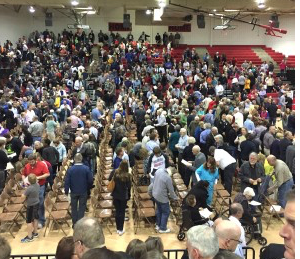
HESSTON, Kan. (AP) — Hundreds have packed a gymnasium in Hesston, Kansas, to mourn the victims of last week’s shooting rampage that left four dead and more than a dozen injured.
The Sunday night vigil featured music from a college choir, Scripture readings and words of comfort from a ministerial alliance. But Hesston Mennonite Church pastor John Murray acknowledged that none of the faith leaders and experts could answer some questions, including why? He blamed the potential for darkness that dwells in all people and sometimes erupts.
Fourteen candles were lit for the wounded and four for the dead, including the gunman.
Authorities say Cedric Ford, a convicted felon, barged into the plant Thursday while about 300 people were working the second shift and opened fire. He was angered about being served hours earlier at the plant with a protection from abuse order to stay away from a former girlfriend.
Hesston is a community of 3,700 founded by Mennonite farmers. The lawn equipment factory where the fatal shootings occurred — Excel Industries — has long been more than an economic hub. It is also a source of community pride and unity.
CRAWFORD COUNTY- Two people died in an accident just before 6p.m. on Sunday in Crawford County.
The Kansas Highway Patrol reported a 2001 Pontiac Grand Prix driven by Derek Curtis Brumbaugh, 17, Pittsburg, was southbound on U.S. 69 six miles north of Arma.
The vehicle crossed the center line and struck a northbound 2002 Chevy Silverado driven by David Glen Kessler, 56, Kearney, Missouri.
Brumbaugh and Kessler were pronounced dead at the scene and transported to Frontier Forensics.
A passenger in the Pontiac Aspen Rose Lloyd, 16, was transported to Via Christi.
Kessler was not wearing a seat belt, according to the KHP.
SEDGWICK COUNTY- A Kansas man was injured in an accident just before 9p.m. on Sunday in Sedgwick County.
The Kansas Highway Patrol reported a 2007 Harley Davidson motorcycle driven by Christopher A. Egbert, 55, Wichita was coming off the ramp from Westbound Kellogg to Northbound Interstate 235
The driver lost control of and was thrown from the motorcycle
The fourth axle of a northbound semi driven by Kip A. Hildebrand, 43, Hutchinson struck the motorcycle.
Egbert was transported to St. Francis. He was not wearing a helmet, according to the KHP.
HUTCHINSON- Fire officials in Reno County were able to contain a fire that threatened structure before 9 p.m. Saturday night.
Fire Crews responded to the 1400 block of West 3rd Ave for a reported brush fire, according to a media release.
When they arrived, they found a large tree row on fire with several school buses, trailers and a structure all in the immediate area. The fire was controlled within 15 minutes with and extensive overhaul in the tree row of the approximate 25 foot pines.
An investigation was conducted with the likely cause being careless disposal of a cigarette in the immediate area. With the high winds and extreme fire danger index, the fire spread very rapidly. Seven school buses, a storage trailer and some interior insulation damage to a building. The estimate of damage being around $47,000.
WICHITA, Kan. (AP) — Police have asked Wichita officials to consider regulating massage businesses in hopes of reducing human trafficking.
It is unclear how many massage businesses actually operate in Wichita or the state, because they are unregulated and don’t require licensing. But Wichita police say they’ve had complaints since 2013 of some massage businesses that sell sexual acts and that some of these businesses are engaged in human trafficking.
The Wichita Eagle reports that Deputy Chief Hassan Ramzah says the move is aimed at keeping the community safe.
But Charles O’Hara, a lawyer who has represented clients charged with human trafficking, said police are using the regulation as an excuse to try to outlaw those businesses.
JEFFERSON CITY, Mo. (AP) — Workers who lose their jobs in some states are getting less help through unemployment benefits than they once did.
Since the end of the Great Recession, eight states have reduced the duration of benefits below the traditional length of 26 weeks.
Some also have reduced the maximum weekly payments, narrowed who can qualify and increased work-search requirements that can result in denied benefits if not met.
The cutbacks generally are intended to help shore up unemployment insurance trust funds, which went insolvent in 35 states following the last recession.
But President Barack Obama is pushing in the opposite direction. His budget plan would require all states to provide at least 26 weeks of benefits while expanding coverage to more part-time and intermittent workers.
SEDGWICK COUNTY- Two people were injured in an accident just before 8 a.m. on Sunday in Sedgwick County.
The Kansas Highway Patrol reported a 2011 Toyota Camry driven by Norman L. Halstead, 86, Wichita was westbound on K96 near Mt. Hope.
The vehicle entered the median and crossed into the eastbound lanes of traffic.
The driver overcorrected and the vehicle went back through the median, entered westbound traffic, left the roadway, struck a KDOT fence, vaulted over an embankment and came to rest in a field on the north side of the highway.
Halstead and a passenger Helen L Halstead, 84, Wichita, were transported to St. Francis.
The were properly restrained at the time of the accident, according to the KHP.
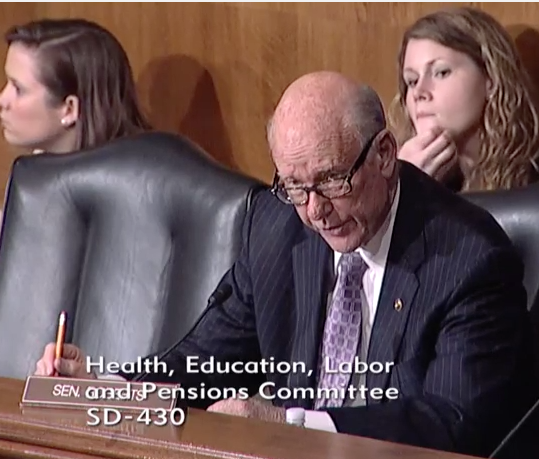
Washington, D.C. – U.S. Senator Pat Roberts on Friday called for better coordination among agencies handling the spread of the Zika virus to ensure “the best science-based solutions are available” to prevent the spread of the mosquitoes carrying the disease. Roberts questioned witness Dr. Anne Schuchat of the Centers for Disease Control and Prevention (CDC) at a Senate health committee hearing on the growing public health threat of the Zika virus.
“I believe it’s important that we are ensuring a variety of tools are available to states, towns, and countries,” Roberts said. “The president’s request proposes giving CDC the money to handle vector control and mosquito surveillance programs, but I have concerns about the agency’s expertise and access to the chemicals.”
Roberts continued, “I understand that we have engaged with the World Health Organization to ensure availability of insect repellants to address mosquitos carrying the Zika virus. How is the CDC working with EPA and others to ensure that pesticide products are registered and available for use as tools in addressing this public health situation?”
Roberts also mentioned the use of a genetically-engineered mosquito, which has been tested in Brazil and asked if the United States is considering this technology.
Roberts spoke earlier this week with researchers at Kansas State University Biosecurity Research Institute who are researching Japanese encephalitis, a similar mosquito-borne virus, saying “they impressed upon me how much we simply don’t know about the virus at this time.”
EMPORIA, Kan. (AP) — Fire officials say they are investigating several fires in Lyon County as possible arsons.
The Lyon County Sheriff’s Office said in a news release it found 14 starting points to a fire Saturday night. The blaze started just north of Interstate 35 and stretched along the Interstate 35 corridor to the Coffey County line.
Authorities are looking for an early 1990s Chevrolet or GMC single or extended cab truck that was dark blue or black. It reportedly was driven by two white males in their mid-30s with full beards.
The Lyon County Sheriff’s Office, Emporia Fire Department and Reading Fire Department responded to the fires.
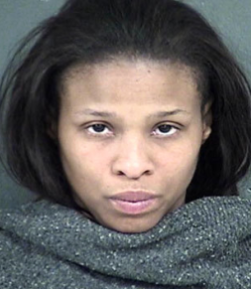
KANSAS CITY, Kan. (AP) — A competency hearing is being sought for a Kansas City, Kansas, woman who was running for public office when she was accused of hitting four high-schoolers with her car and killing one of them.
The Kansas City Star reports that Tamika Pledger is charged in Wyandotte County with involuntary manslaughter in the death of 17-year-old Tierra Smith. The teen died about a week after the January 2015 crash.
At the time, Pledger was running for the board that governs the Unified Government of Wyandotte County and Kansas City, Kansas.
Court documents say Pledger sped to the area after receiving a call from her daughter about a fight that was about to occur. The charges don’t allege that she intentionally hit the group, but that she was driving recklessly.
TOPEKA – Gov. Sam Brownback has signed into law a bill that would allow underage drinkers to seek or receive emergency medical treatment without legal repercussions.
SB 133, commonly known as the Lifeline 911 bill, became law after two and half years of work by supporters both inside and outside the Capitol. College students and lawmakers collaborated to make the new law a reality.
“I am thrilled for the students,” Sen. Tom Hawk, D-Manhattan, said. Hawk, along with numerous senators, worked with student proponents to help kick-start the bill and see it through the legislature.
“I am very proud to see the bill be signed in to law,” said Reagan Kays, former Kansas State (K-State) student body president, who was a key player in drafting the legislation.
The bill began as a student initiative at K-State and was designed to mirror similar laws in other states.
“I guess you could say (the initiative) started out as an idea I borrowed from a fellow intern the summer before my senior year of college,” Kays said.
After being elected student body president in 2014, Kays spoke with his newly elected vice president, Cody Kennedy, and they decided to run with the idea.
“We spent a lot of time explaining it to people who had never heard of anything like this legislation,” Kays said.
Before their explanations, few people were familiar with the concept of immunity from criminal prosecution for minors seeking medical assistance from alcohol, but they were very open to hearing how such a measure could affect college campuses around Kansas.
“My goal was to use the position of student body president, a role recognized by many, as a way to leverage stakeholders to get behind the bill,” Kays said.
Kays and Kennedy began speaking to legislators from the Manhattan area to see if they had any interest in the idea – and they did.
“After speaking with Kays about his initial idea, I told him, ‘Let’s get together in Topeka!’” Hawk said.
Hawk helped direct Kays and other advocates to different lawmakers around the Capitol. After drafting of the bill, Kays encouraged others to promote it.
“We organized students from K-State to go to the Capitol every two weeks to advocate for the bill,” Kays said.
Momentum to support Lifeline 911 eventually grew to include campus leaders around the state. Even as recently as early February, Jessie Pringle, University of Kansas (KU) student body president, came to the Capitol’s annual “Higher Education Day,” to urge legislators to help pass the bill.
Hawk said credit for the success of the bill goes to the students.
“It’s all about the constituents pushing for the piece of legislation,” Hawk said.
Nearly three years after the journey to implement Lifeline 911 in Kansas began, students and supporters believe the new law will benefit students across the state.
“Every once in a while you hear of tragic drinking accidents at your college or one near you,” said Anna Frame, a junior at the University of Kansas. “I think legislation like this will encourage people to help each other and not fear for their legal safety.”
Hawk strongly agrees with Frame. He believes that students have previously been nervous about the consequences they would have to face if they called for medical attention for an underage drinker, especially if they were underage themselves. This bill would protect students who drink too much and those who seek help for them.
“With the way society is, people are paranoid with getting in trouble,” said Hawk.
Kays said the ultimate objective of Lifeline 911 is to serve as an incentive to help young people pick up the phone and ask for help.
“If one of your friends or acquaintances has a little too much to drink, this bill can help them get the medical attention they need,” Kays said.
Hawk agrees.
“This bill isn’t students wanting to get out of legal responsibility. . . . This is a mature move made to help people,” Hawk said.
More than 20 states have 911 lifeline legislation in place, reports Aware, Awake, Alive, an education and advocacy group in Texas. The group reports that from 1999 to 2005, 83 deaths among college students nationwide were due to underage drinking.
LENEXA—The U.S. Environmental Protection Agency is seeking grant proposals from eligible applicants for the 2016 round of funding from the agency’s Environmental Education Grants program. These grants will support local environmental education projects that promote environmental awareness and stewardship and help provide people with the skills to take responsible actions to protect the environment.
EPA’s Environmental Education Grants program provides financial support for projects that design, demonstrate, and/or disseminate environmental education practices, methods, or techniques. EPA expects to award up to three grants from each of the EPA’s 10 regional offices, for a total of approximately 30 grants nationwide. The award amount for each of these grants will be approximately, but no more than, $91,000. Since 1992, EPA has distributed between $2 and $3.5 million in grant funding per year through the EE Grants Program, supporting more than 3,600 grants.
Applicants must represent one of the following types of organizations to be eligible: a state education or environmental agency, a college or university, a non-profit organization as described in section 501(c)(3) of the Internal Revenue Code, or a tribal education agency (which includes schools and community colleges controlled by an Indian tribe, band, or nation).
Applicant organizations must be located in the United States or territories and the majority of the educational activities must take place in the United States; or in the United States and Canada or Mexico; or in the U.S. Territories.