The Cygnus spacecraft is released from the International Space Station’s Canadarm2. Credit: NASA TV
MARCIA DUNN, AP Aerospace Writer
CAPE CANAVERAL, Fla. (AP) — The International Space Station just got a lot tidier.
A pair of NASA astronauts released a capsule loaded with 1.5 tons of trash Friday. The spacecraft should re-enter the atmosphere and burn up harmlessly over the Pacific on Saturday.
NASA supplier Orbital ATK launched the capsule to the space station in December, full of food, clothes and other goods. The astronauts removed the precious contents, then filled it with garbage for incineration.
Commander Scott Kelly and Timothy Kopra, the two Americans on board, sent computer commands to set the Cygnus free.
Orbital ATK plans to launch another Cygnus from Cape Canaveral, Florida, late next month. The flight was delayed a few weeks after black mold contaminated some of the cargo bags. Technicians had to disinfect everything.
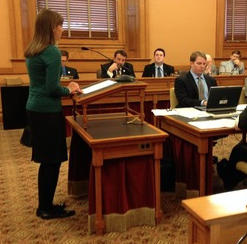
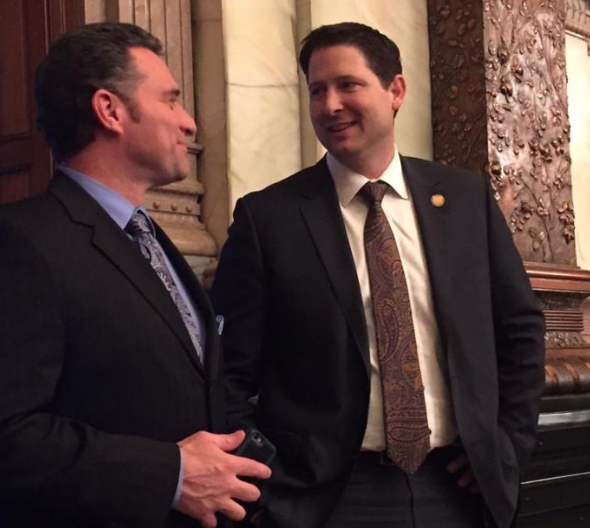
Amanda Gress, director of government relations for Kansas Action for Children, testifies in opposition to HB 2600, a bill to revise criteria for receiving public assistance in Kansas. Gress says the bill could create additional barriers for children needing a safety net.- photo by Miranda Davis, KU Statehouse Wire Service
By Miranda Davis
KU Statehouse Wire Service
TOPEKA – A bill designed to improve the state’s welfare system could create barriers for public assistance recipients, some lawmakers and children’s advocates say.
House Bill 2600 aims to revise criteria for receiving government assistance. The bill would require an individual who receives receive Kansas Food Assistance to work 20 hours per week. It would reduce the time period an individual can receive benefits from the Temporary Cash Assistance for Needy Families (TANF) from 42 months to 30 months.
Also, the bill would require recipients of public assistance to self-report any fraud or be denied assistance.
Rep. John Whitmer, R-Wichita, called the bill “common-sense legislation,” when he spoke Tuesday at a meeting of the House Committee on Health and Human Services. Whitmer is a member of the committee.
However, Rep. Jim Ward, D-Wichita, and Rep. John Wilson, D-Lawrence, also committee members, expressed concerns about the negative effect that requirements could have on applicants who did not commit fraud with malicious intent. Ward said the legislation assumes bad motivations of those applying for benefits and is meant to shame welfare recipients instead of help them.
“Does it give you any sense of problem that you’re forcing people at the risk of losing their benefits to give evidence that might be against them and that right against self-incrimination?” Ward asked.
Committee member Rep. Dick Jones, R-Topeka, said it is reasonable for people to be silent when they don’t understand the welfare system or the repercussions of their answers to questions from the Department for Families and Children (DCF).
“So the question is, what do you do to protect those people who are confused and worried about saying the wrong thing that might get their husband or their wife thrown in jail?” Jones asked.
Wilson told the committee he is worried that children may be accidentally punished if their parents have committed fraud.
“I think what’s getting lost in all of this are the children, whose lives depend on these benefits. I don’t think they can control whether their parents play by the rules,” Wilson said.
Sandra Kimmons, the director of economic and employment services for DCF, said there are still ways to get aid to children even if the parents are denied benefits. She said the legislation is a way to make sure the people who need assistance the most are getting it.
“It is our ultimate goal to help individuals move from poverty to prosperity through self-reliance,” Kimmons said.
Kimmons also said fraud investigations are not randomized and only happen once DCF receives a tip about possible wrongdoing.
Ken Thompson, director of fraud investigations for DCF, said that investigations ensure fairness and keep people from abusing the system.
“If you want the assistance, play by the rules,” Thompson said.
In addition to the fraud-reporting requirement, the bill would also require that the Kansas Lottery send a monthly list of anyone who wins more than $10,000 so the DCF can check that list to make sure no TANF recipients have won.
Rabbi Moti Rieber, executive director of Kansas Interfaith Action, opposed the legislation and agreed with Ward’s belief that the legislation is “mean-spirited.”
“This particular bill seems like a solution in search of a problem, in that it imagines that someone has won $10,000 in the lottery, where I’d like to know if there’s actually been a case of that,” Rieber said.
Amanda Gress, director of government relations for Kansas Action for Children, also opposed the legislation because she said it creates additional barriers for children to access the state’s safety net.
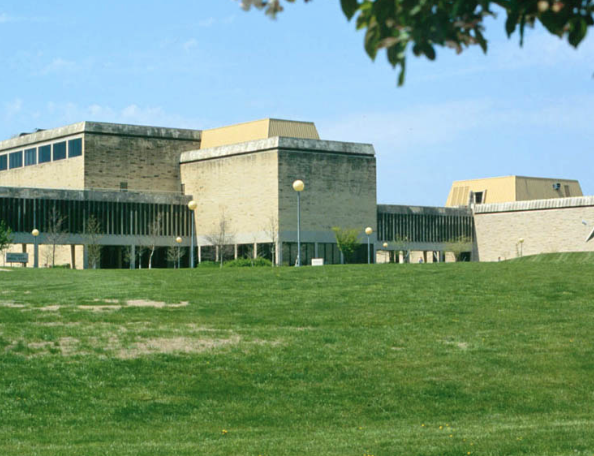
Mosier Hall is current home to the Veterinary Medicine Teaching Hospital and the Department of Veterinary Clinical Sciences. -photo KSU
TOPEKA, Kan. (AP) — A proposal to build a new veterinary laboratory at Kansas State University is one step closer to reality.
The Kansas Board of Regents on Wednesday approved the university’s proposal for a Kansas State Veterinary Diagnostic Laboratory, with an estimated cost of $43.2 million. The project still must be approved the Kansas Legislature.
The Manhattan Mercury reports the university plans an 80,000-square-foot facility. The new building will allow the university to consolidate its diagnostic and research labs with offices and support facilities.
Regent Bill Feuerborn said Kansas State will seek $10 million in private donations for the project.
A timeline for the construction, if the project is approved, has not been set.
WESTON, Mo. (AP) — Firefighters in northwest Missouri are continuing to watch the site of a grass fire fueled by high winds that damaged up to 1,500 acres of land in Platte County and caused a brief firenado on Thursday.
Video courtesy Southern Platte Fire Protection District
Dean Cull, deputy chief of the Southern Platte Fire Protection District, says Thursday’s fire burned mostly on Federal Bureau of Prisons land.
Two old outbuildings were destroyed but no injuries were reported. Cull says the blaze was largely contained by late Thursday evening but firefighters returned to the site Friday morning to douse some hot spots. The fire was started when a large mower attached to a hauler malfunctioned and threw sparks. Cull says the hotspots likely will continue until the area gets some precipitation or colder temperatures. The region is experiencing unusually high temperatures, lack of precipitation and low humidity.
TOPEKA, Kan. (AP) — Kansas lawmakers are discussing two separate proposals for lowering the state’s sales tax on groceries.
Twelve Kansas senators are sponsoring a proposal to offer voters a constitutional amendment that would reduce the sales tax to zero over three years. One of the sponsors, Democratic Sen. Tom Holland, says voters need to have a voice in how the state is handling its tax policies.
Unlike many other states, Kansas charges its full state sales tax rate on groceries. The rate was increased last year to 6.5 percent.
The Kansas City Star reports another proposal would reduce the grocery sales tax to 2.6 percent while also ending an income tax exemption for 330,000 businesses.
The House Taxation Committee plans to hold hearings on that proposal.
WICHITA, Kan. (AP) — A Wichita mathematician who sued get voting machine tapes in order to audit statistical anomalies in the 2014 election plans to appeal a judge’s ruling that prohibits her from getting access to them.
Judge Tim Lahey denied on Thursday a motion by Election Commissioner Tabitha Lehman to dismiss statistician Beth Clarkson’s open records case.
The Wichita Eagle reports that ruling is a hollow victory since the point of the lawsuit she filed last year was to check the accuracy of voting machines.
The judge told her attorney, Randy Rathbun, that he couldn’t order the county to turn over the tapes because Clarkson had presented the same issues in an earlier 2013 lawsuit she lost when she had no legal representation. The law prohibits fighting the same legal issue twice.
Photo by Jim McLean/KHI News Service Sen. Ty Masterson, left, who chairs the Senate Ways and Means Committee, and Rep. Ron Ryckman Jr., who chairs the House Appropriations Committee, say implementing some of the cost-cutting initiatives included in a recent efficiency study could stabilize the budget
Kansas lawmakers picked up their pace this week, approving what for the moment is a balanced budget and advancing several other proposals ahead of a scheduled mid-session break next week.
The budget bill uses a series of transfers, spending reductions and some borrowing to balance the current budget and end the fiscal year with a paltry $6 million in the treasury.
It also closes a projected $200 million shortfall in the budget year that begins July 1. The spending measure doesn’t include any additional money for Kansas schools despite a recent Kansas Supreme Court decision that said the current K-12 funding formula is inequitable and unconstitutional.
The Kansas Department of Education has estimated it will cost about $70 million this year and $38 million next year to comply with the court’s ruling. Ty Masterson, the Andover Republican who chairs the Senate Ways and Means Committee, said legislative leaders need time to study the court’s order.
“It is not necessary at this time to address anything as it pertains to the court,” Masterson said during the Senate’s debate on the budget bill. “We have an opportunity to work through that. A
nd the jury is out on what that really needs to be.” Democrats and several moderate Republicans voted against the budget, saying it doesn’t fix structural problems that have caused revenue shortfalls in recent years.
They point to the income tax cuts Gov. Sam Brownback muscled through the Legislature in 2012 as the main cause of those shortfalls. “This budget reinforces the fiscal mismanagement caused by a reckless and irresponsible tax policy,” said Senate Minority Leader Anthony Hensley of Topeka.
Masterson and other Republican leaders say that the state’s ongoing budget problems are manageable. “We’re solving problems as we move forward,” he said. Both Masterson and Rep. Ron Ryckman Jr., the Olathe Republican who chairs the House Appropriations Committee, said implementing some of the cost-cutting initiatives included in a recent efficiency study could stabilize the budget.
The study, done by the New York-based consulting firm of Alvarez and Marsal under a $2.6 million contract with the state, said Kansas could save more than $2 billion over the next five years by making a variety of management and policy changes.
In the coming weeks, lawmakers are expected to focus on 21 recommendations that the consultants say could save up to $1.7 billion. Limiting state employees to one health insurance option is among the recommendations being considered for immediate implementation.
Limiting state workers to a high-deductible plan that would require them to cover a significant portion of their medical costs with money from a health savings account could save the state nearly $124 million, according to the consultant’s report.
Parents as Teachers
Initial versions of the budget bill included a proposal to means test participants in the Parents as Teachers program so that federal welfare dollars could be used to cover its $12.3 million annual cost.
The proposal would have required those who didn’t meet the income guidelines to pay to participate. Advocates protested, saying the changes would transform what was intended to be a program to help all families address issues that could affect school performance into one used predominantly by low-income families. Budget negotiators pulled the controversial proposal out of the bill and substituted language that leaves the decision to the Kansas Children’s Cabinet.
That didn’t satisfy Sen. Laura Kelly, of Topeka, the ranking Democrat on the Ways and Means Committee. “Essentially, we’ve thrown Parents as Teachers under the bus,” Kelly said.
“We said, ‘OK, we’ll give that decision back to the Children’s Cabinet and let them decide whether they’ll use TANF (federal welfare funds) for Parents as Teachers. Possibly they won’t.
But it’s very likely that they will, in which case we destroy that program.” Masterson disagreed. If anything, he said, “We put the Children’s Cabinet in the bus, driving the bus. It’s their decision.”
Suicide prevention
Immediately before they considered the budget bill, senators tentatively approved a measure aimed at preventing teenage suicides.
The bill, which hasn’t yet been considered by the House, would require certified teachers and principals to complete suicide prevention training each year. Steve Abrams, the Arkansas City Republican who chairs the Senate Education Committee, said testimony provided by parents of children who committed suicide convinced him of the need for the bill.
“This is something that if indeed it saves even one life, it’s worth the effort,” Abrams said.
Another Medicaid expansion debate
The Senate on Thursday is expected to consider a welfare “reform” bill that could provide opponents of Medicaid expansion another opportunity to engineer the defeat of a bill backed by the Kansas Hospital Association.
Last week, Senator Mary Pilcher-Cook, a Republican from Shawnee, failed to force a vote on expansion because the amendment she offered was ruled not germane to the bill under consideration at the time.
But the welfare bill on the calendar for consideration Thursday probably is germane, said Senate President Susan Wagle, a Wichita Republican, because it includes medical assistance programs. Supporters of expansion are expecting either Pilcher-Cook or Sen. Jeff Melcher, a Leawood Republican, to force a vote on Medicaid expansion in hopes of defeating the bill and sending a message to the House where there is more support for expansion.
But in an interview Wednesday evening, Melcher said he hadn’t decided whether to raise the issue during Thursday’s debate on the welfare bill, which seeks to further tighten eligibility requirements.
“I haven’t really decided what I’m going to do,” Melcher said. “But I do think it’s important to let the public know where we stand on it (Medicaid expansion).”
After last week’s rules fight, Wagle removed Pilcher-Cook as chair of the Senate Public Health and Welfare Committee. That prompted 17 of the Senate’s 32 Republicans to send a letter to Wagle asking her to reinstate Pilcher-Cook. But Wagle said Wednesday that she wouldn’t reconsider her decision.
Jim McLean is executive editor of KHI News Service in Topeka, a partner in the Heartland Health Monitor team.
Charles C. Haynes is director of the Religious Freedom Center of the Newseum Institute.
In the days following the death of Justice Antonin Scalia on Feb. 13, conservative religious and political leaders have lavished praise on the long-serving justice as a champion of religious freedom.
Alan Spears, head of the Christian advocacy group Alliance Defending Freedom, hails Scalia as “the most vocal and passionate voice on the Supreme Court for religious freedom.” Sen. Ted Cruz warns, “We are one justice away from a Supreme Court that would undermine the religious liberty of millions of Americans.”
But surely this is either a case of selective amnesia or wishful thinking.
Justice Scalia was, of course, a devout Catholic who vigorously opposed abortion and LGBT rights at every turn. And he was, without question, an advocate of a lower wall of separation between church and state — a porous wall that would allow affirmations of God by government. All of this endeared him to religious and social conservatives.
But Justice Scalia was no defender of religious freedom.
On the contrary, Scalia authored Employment Division v. Smith, the landmark 1990 Supreme Court decision that all but erased the Free Exercise clause from the First Amendment.
Before Smith, religious Americans could invoke the First Amendment to seek relief from laws or regulations that substantially burdened the practice of their faith. Government could not deny religious exemptions without demonstrating a compelling state interest — and showing that it has pursued that interest in the manner least restrictive, or least burdensome, to religion.
Under this “compelling state interest” test — fully articulated in the 1963 Supreme Court decision Sherbert v. Verner — religious individuals enjoyed a high level of protection for the freedom to practice their faith openly and freely without governmental interference.
In the Smith decision, Justice Scalia, joined by four other justices, radically re-interpreted the Free Exercise clause by ruling that burdens on religious freedom no longer had to be justified by a compelling state interest. Although the government cannot pass laws targeting religious practice, it can pass laws that burden religious exercise if the law is “neutral” and “generally applicable.”
Consider, for example, the question at issue in the Smith case itself: Can the state of Oregon ban the use of peyote — a cactus with hallucinogenic properties — without providing a religious exemption for members of the Native American Church who ingest small amounts of peyote in worship ceremonies (a practice that may date back thousands of years).
Two Native Americans challenged the law after being denied unemployment benefits because they were fired for using peyote in their religious practice. Most legal experts expected the outcome to turn on whether or not Oregon could demonstrate a compelling reason for prohibiting peyote without exceptions. Instead, Justice Scalia used the case to sharply curtail the use of the long-standing free-exercise test.
In his majority opinion, Scalia ruled that government no longer has to show a compelling state interest for denying religious exemptions — as long as the law in question applies generally to everyone.
Thus, Oregon cannot pass a law stating that Native Americans are prohibited from using peyote, but it could accomplish the same result by prohibiting the use of peyote by everyone. Either way, a central religious ritual for some Native Americans would be illegal.
If religious groups want an exemption from a generally applicable law, said Scalia, they should seek a legislative remedy. This, of course, turns the First Amendment on its head: Free exercise of religion is protected by the First Amendment precisely because it is a fundamental right that is not subject to a majority vote. Seeking religious accommodation through legislation is especially difficult for religious minorities and unpopular faiths — and keep in mind that most of us are a religious minority somewhere in the country.
Leaders of many faiths were stunned by Scalia’s evisceration of the Free Exercise clause. After Smith, it would become difficult — if not impossible — to get relief from laws and regulations that seriously burdened the practice of religion. In the three years following Smith, more than 50 reported cases were decided against religious groups and individuals.
That’s why more than 60 religious and civil liberties groups — from the ACLU to the National Association of Evangelicals — joined together to “restore” the compelling interest test by getting Congress to pass the Religious Freedom Restoration Act of 1993.
Although the Supreme Court struck down RFRA as applied to the states, it continues to apply to the federal government (as we saw in the 2014 Hobby Lobby decision). Many states have passed their own RFRAs — mostly without controversy until recent years when opponents of same-sex marriage decided (mistakenly, in my view) that RFRA could provide religious exemptions to non-discrimination laws.
The current confusion and contention surrounding the meaning of “free exercise of religion” is the fallout from Justice Scalia’s decision in Smith. Without First Amendment protection, religious individuals and groups are left to seek accommodation through the political process — a messy, divisive arrangement that puts matters of conscience up for a vote.
If you agree that the First Amendment as applied by the Court for decades went too far in protecting free exercise of religion, then by all means celebrate Justice Scalia’s legacy on religious freedom.
But if you are appalled, as I am, that in far too many cases courts no longer treat religious freedom as a constitutional right, then hope for a replacement on the Supreme Court who will vote to overturn Justice Scalia’s disastrous decision in Employment Division v. Smith.
Charles C. Haynes is vice president of the Newseum Institute and founding director of the Religious Freedom Center. [email protected]
HUTCHINSON, Kan. (AP) — Kansas State Fair officials are considering a major redesign of the fairgrounds in Hutchinson.
The Hutchinson News reports all of the current proposals are long-range ideas but the goal is to make the fairgrounds a more modern attraction.
The suggestions include removing the century-old racetrack, while leaving the grandstand. The main entrance could move to a different location and the fair would be divided into quadrants with thoroughfares to make walking through the grounds easier.
Another proposal is to allow private businesses to permanently move to the fairgrounds, on a type of main street promoting Kansas.
Chip Overton, with Keffer/Overton Associates, presented six concepts to the fair board this week. The company is developing a master plan for the fair. The plan is expected to be finished by May.
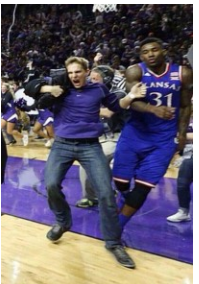
Court storming after last season’s game in Manhattan
MANHATTAN- Prior to Saturday’s 5p.m. Sunflower Showdown with the #2 Kansas Jayhawks, Kansas State University has issued a video on how to treat guests with class.
Last season, KSU Athletic Director John Currie apologized to KU officials for students storming the court after the game in Bramlage Coliseum and Big 12 Conference Commissioner Bob Bowlsby publicly reprimanded Kansas State.
No injuries resulted from the court-storming.
In May, the Big 12 Conference passed a measure under which schools could face fines or even the loss of future home games for failing to control fans who storm courts or rush fields after games.
Kansas State has 4 wins at Bramlage Coliseum against Kansas in the last 8 meetings, including back-to-back victories in 2014 and 2015. The Wildcats have not won 3 straight at home in the series since 1981-83 (4 wins).
The rivalry ranks as the 8th-longest continuously played in the country (met every season since 1921) with the 6th-most games played (282). The Jayhawks lead the series, 189-93, including 75-47 in Manhattan.
TOPEKA, Kan. (AP) — A man accused in the death of a 2-year-old boy in Topeka has been booked into the Shawnee County jail.
The Topeka-Capital Journal reports that the 31-year-old man was arrested Feb. 8 in Missouri on an outstanding first-degree murder warrant, and was booked in to the Shawnee County jail on Wednesday.
Authorities say 2-year-old Eli Clemens died on March 11, 2006, at an apartment complex. His death was ruled a homicide four months later. Topeka police have not said how the boy died.
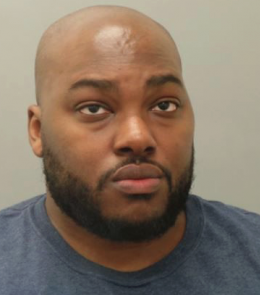
Isaiah Copridge- photo Kansas Dept. of Corrections
WICHITA, Kan. (AP) — One of two people charged in the shooting death of a Wichita State University student has been sentenced to 21 years and one month in prison.
Twenty-three-year-old Isaiah Copridge was sentenced Thursday on charges of second-degree murder and aggravated robbery in the death of 23-year-old Rayan Ibrahim Baba. Baba, an undergraduate student from Saudi Arabia, was found shot in a parking lot of one of the university’s dormitories on Aug. 8.
According to an affidavit, Baba had contacted Copridge’s co-defendant, Eboni Fingal, about sexual services she advertised online shortly before he was killed.
Fingal faces first-degree murder and aggravated robbery charges in the case. She has pleaded not guilty.
TOPEKA – One person died in an accident just after 12-noon on Thursday during a law enforcement pursuit.
The Kansas Highway Patrol reported a 2004 Chevy Impala driven by Marcos Adan Cruz Jr., 20, Topeka, was actively fleeing from State Troopers southbound on Gage Boulevard.
The driver failed to stop at the red light at Southwest 6th Street and struck a 2009 Toyota Camry driven by Jerry L. Griggs, 73, Topeka, in the passenger side doors.
A passenger in the Camry Edward Greene, 69, Tecumseh, was pronounced dead at the scene and transported to the Shawnee County Coroner’s office.
Cruz Jr., Griggs, and a passenger in the Impala Martay Cruz, 8-months, were transported to Stormont Vail.
Cruz Jr., and another passenger in the Impala Johnson Jr., Eric Keith Johnson, Jr., 21, Topeka, were also not wearing seat belts, according to the KHP.
Cruz Jr., will be booked in the Shawnee County Jail upon release from the hospital, according to a media release from the KHP.
——————-
TOPEKA – One person died in an accident just after 12-noon on Thursday during a law enforcement pursuit.
The Kansas Highway Patrol reported a trooper attempted a traffic stop on a Chevy Impala at Interstate 70 and Gage Boulevard. The driver failed to stop and after a brief pursuit collided with a Toyota passenger vehicle at 6th Avenue, according to a media release.
The driver of the Toyota died. The driver of the Impala and a baby in the suspect’s vehicle were transported to the hospital. A second passenger in the Impala was not injured.
The driver of the Impala will be booked in the Shawnee County Jail upon release from the hospital, according to the KHP.
Check the Post for additional details as they are released.