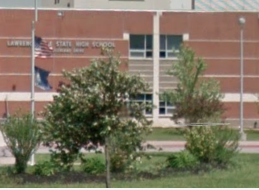
LAWRENCE, Kan. (AP) — A high school student who was displaying a Confederate flag on the vehicle he drove to school has been told he can no longer show the flag on school property.
District spokeswoman Julie Boyle said in an email that Free State High School decided not to allow the student to bring the flag to school because it was disrupting the learning environment.
Boyle said that the student was not disciplined further.
The Lawrence Journal-World reports that the district doesn’t have a policy regarding the Confederate flag, but that the high school’s student handbook has a policy that states its commitment to providing a discrimination-free learning experience.
Lawrence Superintendent Rick Doll says the school’s administration considered the student’s free speech rights before making the decision.
GARDEN CITY- Law enforcement authorities in Finney County are investigating an alleged kidnapping.
Just before 9pm on Thursday, officers of the Garden City Police Department were dispatched to a Novelty Shop at 519 West Mary Street #116 in reference to a disturbance, according to a media release.
Officers made contact with Dana Leens, 30, Garden City, and a fifteen-year-old girl.
Investigation revealed that Leens and an employee of the business engaged in an argument involving Leens’ previous partnership in the business.
The incident escalated, at which time Leens and the teen reportedly battered and dragged the employee from the business during the altercation.
Police arrested Leens, on the requested charges of
Aggravated Kidnapping Contributing to a Child’s Misconduct
The teen was arrested and is being held in the Juvenile Detention Center on the requested charge of battery.
Finney County Attorney’s Office’s is expected to release additional details next week.
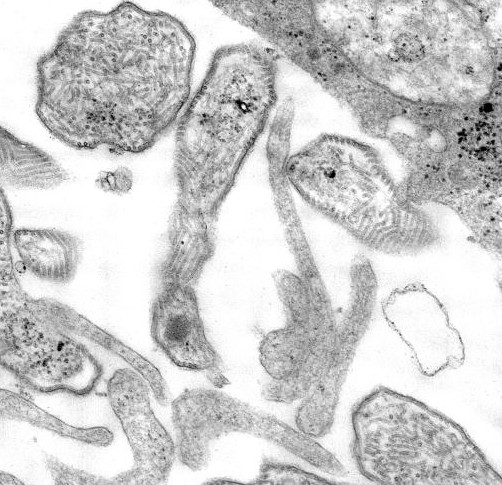
MANHATTAN — Kansas State University has confirmed one student case of mumps.The university is directly notifying anyone who may have been in close contact with the student. The university’s Lafene Health Center is working with the Riley County Health Department and the Kansas Department of Health and Environment to provide information to the Manhattan campus and surrounding community about the symptoms of mumps, how it is transmitted and how to prevent the spread of this infection.
According to the Centers for Disease Control and Prevention, symptoms for the mumps include fever, headache, muscle aches, tiredness, loss of appetite and swollen and tender salivary glands under the ears on one or both sides. It is spread from respiratory droplets, which are transmitted by sneezing and coughing.
“Kansas State University is taking all precautions to protect our students, faculty and staff,” said Jim Parker, director of Lafene Health Center. “We encourage all K-Staters to check their vaccination records with their primary care provider. If they have any concerns about possible symptoms, they should contact Lafene or their primary care provider.”
Lafene Health Center will have a walk-in measles-mumps-rubella, or MMR, vaccination clinic for Kansas State University students, faculty and staff from8:30-11:30 a.m. and 1-4 p.m.Monday, Feb. 1.
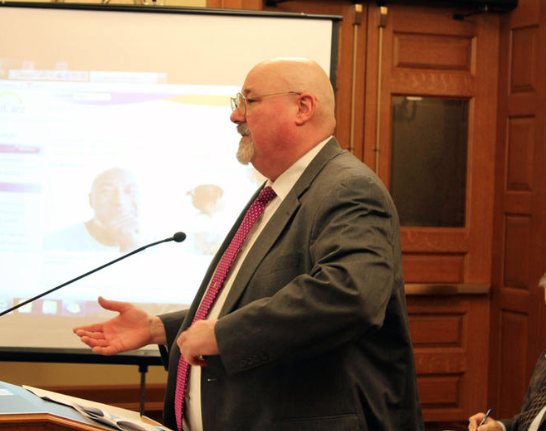
Glen Yancey, chief information officer for the Kansas Department of Health and Environment, told a legislative committee that federal mandates were the biggest cause of changes to, and delays in launching, the Kansas Eligibility Enforcement System. KHI NEWS SERVICE
A new computer system for enrolling Kansans in Medicaid and other public assistance programs will generate far less than the expected $300 million in savings, a Legislative Post Audit report finds.
The Kansas Eligibility Enforcement System (KEES) was intended to be a central portal where people could apply for benefits like Medicaid, food stamps and cash assistance, and the state could automatically verify their eligibility.
The Kansas Department of Health and Environment and Kansas Department for Children and Families estimated that the new system would generate $300 million in savings over 10 years. But costs have exceeded what was planned and the assumptions behind the savings calculations were flawed, according to the report.
The state originally estimated it would cost about $188 million to build KEES and maintain it through August 2016. However, if current trends continue, the cost through August will be closer to $234 million — about 25 percent above the estimate — mostly due to increased expenses to build the site.
Estimates of savings were “overly aggressive,” Matt Etzel, who led the Post Audit team, told the House Social Services Budget Committee last week.
KDHE and DCF had estimated the system would save them $134 million in federal penalties, despite the fact that the state had only paid one penalty — of $300,000 — in recent years.
The agencies also likely overestimated their savings on postage, the report said. They predicted their combined annual postage and printing budget would fall from $3.1 million to $500,000, for a savings of $26 million over 10 years, according to the audit.
It also isn’t clear how much of the other projected savings will materialize, as the audit summary notes. The two agencies predicted about $21 million in savings from reduced staff time related to applications and $51 million from catching fraudulent applications. The audit anticipated some benefits from those factors but couldn’t quantify how much they might be.
The only clearly defined savings the audit found was $10 million spread over 10 years that the state avoided by not maintaining older systems that KEES will replace.
More hands-on work required
So far, the system can only automatically verify information for about 10 percent of applicants, Etzel said, requiring more hands-on work than anticipated. The state hasn’t set a firm deadline to fix those issues, he said. The system also isn’t working as expected when it comes to sending some automated notices to applicants, according to the audit.
Some less-important features also were delayed or removed. KEES won’t have a consolidated customer service center, as planned. A feature that would allow people to check the status of their applications remains in the plan but doesn’t have a deadline for completion.
The system was supposed to be largely online by December 2013, Etzel said, with final touches added by May 2014. That deadline wasn’t realistic, he said, and the portal for medical programs like Medicaid wasn’t up and running until July 2015.
The costly delays prompted a legislative committee last year to approve the audit of KEES.
A second portal for other social services programs isn’t expected to be ready until August, which would put it more than two years behind schedule, Etzel said.
“This delay causes the state to rely on less efficient legacy systems,” he said.
‘Plenty of blame to go around’
The audit said poor communication between the state and contractor Accenture contributed to the delays. Frequent federal and state policy changes also were significant factors, Etzel said.
Glen Yancey, chief information officer with KDHE, said federal mandates, many of them due to health care reform, were the largest cause of changes to KEES, and state policies caused 15 percent to 20 percent of changes.
For example, the federal Centers for Medicare and Medicaid Services advised them to separate medical programs from other social services due to the complex changes happening in health insurance, he said.
“Almost 50 percent of the changes that had to be made were federal mandates,” he said. “In the IT world, we equate it to trying to change the wheels on a bus as it’s moving down the highway.”
It isn’t clear when the work will be finished, Yancey said, though he said he expects to have a better estimate in the next three months. Contracts have been changed so that Accenture will have to deliver certain products by deadlines to get paid, he said.
Rep. Will Carpenter, an El Dorado Republican who was among the legislators who called for the audit, urged the committee to focus on moving forward.
“There’s plenty of blame to go around, but that isn’t going to solve one thing,” he said.
When Yancey said mistakes were made and those involved with KEES are learning from them, Carpenter responded: “I think that’s what I wanted you to say. There were mistakes made, and it wasn’t just the federal government.”
Yancey also asked legislators to keep the complexity of building such a system in mind. Similar projects “imploded” in three other states, he said.
“They want to know what we did to get ours right and to get it live,” he said. These projects “are more prone to failure than they are to success.”
Megan Hart is a reporter for KHI News Service in Topeka, a partner in the Heartland Health Monitor team. You can reach her on Twitter @meganhartMC
WASHINGTON (AP) — The Obama administration is confirming for the first time that Hillary Clinton’s unsecured home server contained some closely guarded secrets, including material requiring one of the highest levels of classification.
The revelation comes just three days before the Iowa presidential nominating caucuses in which Clinton is a candidate.
The State Department will release more emails from Clinton’s time as secretary of state later Friday.
But The Associated Press has learned that 7 email chains are being withheld in full for containing “top secret” material.
Department officials wouldn’t describe the substance of the emails, or say if Clinton had sent any herself.
Spokesman John Kirby tells the AP that no judgment on past classification was made. But the department is looking into that, too.
WASHINGTON (AP) — Millions of young adults healthy enough to think they don’t need insurance face painful choices this year, as the sign-up deadline of January 31, approaches for President Barack Obama’s health care law.
Fines for being uninsured could average nearly $1,000 per household in 2016, according to one independent estimate.
That’s forcing uninsured people in their 20s and 30s to take a hard look to see whether they can squeeze in coverage to avoid penalties. Many are still trying to establish careers.
Christopher Rael of Los Angeles says you can cut down a ramen-noodle diet only so far. In his late 20s, Rael is pursuing a degree in sociology and working at a children’s center to pay the bills.
Jan. 31 is the deadline to enroll and avoid fines.
RILEY COUNTY- A Kansas woman was injured in an accident just after 11a.m. on Friday in Riley County.
The Kansas Highway Patrol reported a 2002 Ford Explorer driven by Kelly Miller, 38, St. George, was northbound on McDowell Creek Road two miles south of Manhattan.
The SUV went off the roadway. The driver overcorrected and the vehicle rolled into the west ditch.
Miller was transported to Via Christi in Manhattan. She was properly restrained at the time of the accident, according to the KHP.
SALINA- Law enforcement authorities in Saline County are investigating a suspect in connection with theft and forgery.
Bradley A. Dietsch, 38, Salina, is accused of providing home healthcare services to customers of Accessible Home Healthcare at 1300 E. Iron that he did not provide, according to police.
Between November 27, and January 22, police say Dietsch submitted false statements totaling $1,543.44.
He was booked into the Saline County Jail on requested charges of theft, forgery, and making false information.
TOPEKA, Kan. (AP) — Kansas lawmakers are scheduled to begin discussion of the controversial subject of school district consolidation next week.
A bill proposed by Rep. John Bradford would require districts to consolidate into countywide school districts. Bradford, a Republican from Lansing, says the bill would affect only central administrations and would not require school closings.
The Lawrence Journal-World reports any county with 10,000 or fewer students would have one countywide district. The Kansas State Department of Education says that would apply to 98 counties, 22 of which already are single-district counties.
The Kansas Association of School Boards estimates the bill would reduce school districts in the state to 132 from the current 286.
The House Education Committee is scheduled to open hearings on the bill Wednesday.
DETROIT (AP) — Nissan is recalling thousands of Altima midsize cars for a third time to fix a latch problem that could let the hood fly open while the cars are moving.
The latest recall covers 846,000 cars from 2013 to 2015.
Nissan says in documents filed with the U.S. government that paint can flake off the latch, exposing bare metal. Over time, the latches can rust and cause the secondary hood latch to remain open. If the main latch isn’t closed and the car is driven, the secondary latch may not hold the hood.
The automaker says that in two previous recalls, dealers adjusted latches and applied lubricant. But if the lubricant wasn’t put on evenly, the problem could persist.
Nissan will notify owners and replace the latch for free starting in mid-February.
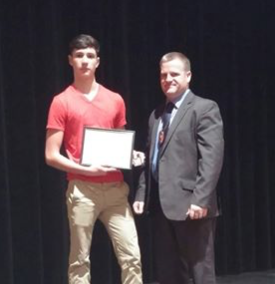
HUTCHINSON – A Kansas teen was acknowledged on Thursday for his honesty and integrity for turning in a large sum of money he found.
Sedgwick County Sheriff’s Detective Jason Burley went to Hutchinson High School and awarded Jaydon Maldonado a Certificate of Commendation and a Challenge Coin from the Sedgwick County Sheriff’s Office, according to a report on social media.
In early August Jaydon’s stepfather contacted the sheriff’s office after Jaydon found a large sum of money in the disability section at Intrust Bank Arena following the Lady Antebellum concert on July 25.
Jaydon found $900.00 lying on the ground and he turned it in to Intrust so the owner could reclaim the money.