CHASE COUNTY – A woman died in an accident just after 11:30 a.m. on Tuesday in Chase County.
The Kansas Turnpike Authority reported a 2010 Buick Lucerne driven by Kristina Marie Masters, 36, Ankeny, IA., was southbound on Interstate 35 near Matfield Green Service area.
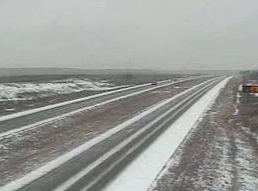
The driver lost control on the icy road. The vehicle went into a rear wheel skid, rotated clockwise, traveled onto the right shoulder and struck the rear of a truck that was legally parked and assisting another driver.
Masters was transported to a hospital where she died. She was properly restrained at the time of the accident, according to the KHP.
WICHITA, Kan. (AP) — An Oklahoma Indian tribe has filed a federal lawsuit against Kansas in the dispute over casino gambling.
The Quapaw tribe alleges the state has failed to negotiate in good faith over proposed gambling on tribal land in Cherokee County. The lawsuit contends early discussions were cooperative, but those talks stalled when the state wanted to develop a state-owned casino in the area.
The tribe’s chairman, John Berrey, said in an emailed statement it has to stand up for the rights of Indian tribes.
Neither the governor’s office, nor the attorney general’s office immediately responded to a request for comment.
A federal judge last month dismissed a separate lawsuit filed by Kansas seeking to prevent the tribe’s Oklahoma casino from expanding into Kansas. The state has appealed that decision.
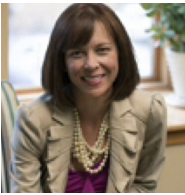
Shannon Cotsoradis, president and CEO of Kansas Action for Children- KAC photo
TOPEKA, Kan. (AP) — Gov. Sam Brownback’s office is defending a budget proposal that a child advocate says would make it easier for Kansas to siphon money from early childhood education.
The Topeka Capital-Journal reports that Brownback unveiled last week a state budget that would shift the entire Children’s Initiatives Fund to the State General Fund in fiscal year 2017.
The governor’s office says the move is meant to increase accountability and consolidate early childhood programs within the Kansas State Department of Education, which education commissioner Randy Watson says sought the change to better coordinate initiatives.
Shannon Cotsoradis, CEO of Kansas Action for Children, said she does not see how the move leads to better coordination.
The governor’s spokeswoman, Eileen Hawley, said existing childhood programs funded by the Children’s Initiatives Fund will be continued to be fully funded.
TOPEKA, Kan. (AP) — A new report from Republican legislators in Kansas says the state needs to provide greater oversight over local school construction projects.
The report approved Tuesday recommends creating a legislative committee. It would review proposals from school districts to issue bonds for construction projects when a district will receive state aid to help with the cost. It also suggests that lawmakers limit the projects eligible for state aid.
The state helps poor districts with bond payments. The cost of that aid has jumped.
The report is from a House-Senate committee that studied school funding issues last fall. The committee is recommending that Kansas overhaul how it distributes more than $4 billion in aid to its public schools.
Democrats opposed the report and said the bonding proposals insult local school boards.
WICHITA, Kan. (AP) — Authorities say a 24-year-old inmate of the Sedgwick County Adult Detention Facility has died of an unknown cause.
The sheriff’s office says in a news release that the inmate was found around 10:15 a.m. unresponsive in his cell. Both onsite medical staff and emergency responders were unable to resuscitate him. He was pronounced dead at 10:55 a.m.
Officials say the death will be investigated by the Kansas Bureau of Investigation and the sheriff’s office.
Authorities are not releasing the identity until the family has been notified.
He was booked into the jail on Sept. 30, 2013 on felony charges.
TOPEKA, Kan. (AP) — Legislators in Kansas are considering a merit pay system to reward higher quality teachers, although they are hearing plenty of opposition.
A House Education Committee hearing on Tuesday allowed teachers and lobbyists to discuss the issue.
Republican Gov. Sam Brownback’s policy director, Brandon Smith, spoke in favor of merit pay and compared it to efforts that proved successful in the District of Columbia and states such as New York.
But Kansas Families for Education lobbyist Brian Koon said merit pay risks leaving vulnerable children behind. He has two high-needs children.
The State Board of Education provides $1,100 scholarships to give teachers an incentive to attain a national certificate in their teaching specialties. But Kansas law does not mandate merit pay.
WABAUNSEE COUNTY – Two adults and an infant were injured in an accident just after 1p.m. on Tuesday in Wabaunsee County.
The Kansas Highway Patrol reported a 2001 Toyota 4Runner driver by Latricia Lynn Rudman, 51, Washburn, Mo., was eastbound on Interstate 70 just east of the Riley County line
The driver lost control of the vehicle. It went into the south ditch, up an embankment and rolled.
Rudman and passengers Kinae Wayd Gibson, 22, and Amilia Gibson, 2-months, were transported to the hospital in Wamego.
All were properly restrained at the time of the accident, according to the KHP.
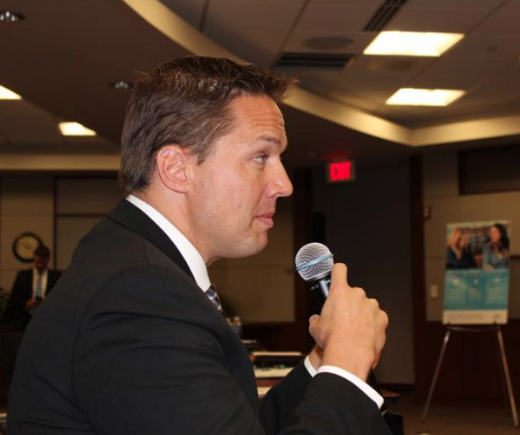
Photo by Megan Hart/KHI News Service Tarren Bragdon, president and CEO of the Foundation for Government Accountability, recently told the governor’s Social Service Policy Council that government programs aimed at low-income people undermine marriage and keep people trapped in poverty. Bragdon suggested states should further limit the length of time that people can obtain social services.
The founder of a Florida-based think tank recently told the governor’s Social Service Policy Council that government programs aimed at low-income people undermine marriage and keep people trapped in poverty.
Tarren Bragdon, president and CEO of the Foundation for Government Accountability, shared findings of a study comparing incomes and employment for people who lost food stamp eligibility when Kansas incorporated a work requirement in 2013.
The change required adults age 18 to 49 to find a job working at least 20 hours per week within 90 days or to enroll in a job training program in order to continue in the food stamp program.
Bragdon’s study found that average incomes increased by 127 percent for 14,000 Kansans who lost food stamp eligibility, and the percentage of those Kansans who weren’t in poverty increased from 7 percent to about 50 percent. The average annual income rose from $2,453 to $5,562, which still is less than half the federal poverty level of $11,770 for a single individual.
Brownback established the council last year through an executive order and tasked it with recommending ways to reduce the state’s poverty rate and improve its social services programs. Bragdon spoke to the council at its meeting in early January.
Shannon Cotsoradis, president and CEO of Kansas Action for Children, said in an interview after Bragdon’s presentation that many Kansas families still need assistance due to low wages.
“In many cases, these are working families and they are hard-working families, they just aren’t able to make ends meet,” she said.
To encourage marriage, Bragdon suggested states should further limit the length of time that people can obtain social services.
“While they’re on welfare, they’re tainted to the concept of marriage,” he said. “When you end welfare dependency, people become independent, they become productive and, if you will, they become marriage material.”
Cotsoradis questioned the emphasis on encouraging marriage in Bragdon’s presentation.
“I think we can all agree that children deserve to grow up in a family that is emotionally and economically stable,” she said. “I don’t think it’s about marriage. I think it’s about emotional and economic stability.”
Gov. Sam Brownback seemed receptive to Bragdon’s presentation during the meeting, noting he thought anti-poverty programs had “wounded” places like Linn County, where he was raised. In his first term, Brownback listed childhood poverty among his administration’s five goals.
Here is a look at some of Bragdon’s statements during his presentation to the council compared with publicly available data:
Bragdon: A 71 percent “long-term reduction in childless adult enrollment” in food stamps after the changes.
According to the Kansas Department for Children and Families, that number fell from 25,913 Kansas adults in 2013 to 7,403
Kansas adults in 2015.
Bragdon: A “2 percent increase in (the Kansas) marriage rate.”
The number of Kansas marriages increased by 1.9 percent from 2013 to 2014. That was almost entirely due to population growth, however, because the marriage rate only increased from 6 percent in 2013 to 6.1 percent in 2014. In addition, both the number of marriages and the marriage rate in Kansas were lower than in the mid-1990s.
Bragdon: “Thirty-five percent of Americans live in households receiving benefits from one or more welfare programs.”
This was correct in the fourth quarter of 2012 if the definition of welfare is broad.
Bragdon’s foundation didn’t have more recent data. As of 2012, about 35.4 percent of Americans lived in a household where someone received benefits from programs such as Medicaid, food stamps, free or reduced-price school lunches, the Women, Infants and Children (WIC) nutrition program, Supplemental Security Income (SSI), subsidized housing, cash assistance, energy assistance and some veterans’ pensions.
The actual number of people benefiting from those programs isn’t clear, because one household can receive multiple types of assistance, and not everyone in the household may receive assistance. For example, free school lunches are only available to children, and WIC wouldn’t apply to an infant’s father or older children in the family.
Medicaid was the most-used program, with 26.7 percent of the U.S. population living in a household where at least one member was enrolled. About 16.6 percent of people were in a household with someone who received food stamps, 7.3 percent with a WIC recipient and 6.6 percent with an SSI recipient. Other similar programs reached less than 5 percent of Americans.
Bragdon: “Medicaid enrollment has more than doubled since 2000.”
This is true if you include the Children’s Health Insurance Program. In 2000, 32.7 million people were enrolled in Medicaid and 35.3 million were enrolled in Medicaid or CHIP. In October 2015, 57.8 million people were enrolled in Medicaid and 71.8 million were enrolled in Medicaid or CHIP.
Some of the increase is due to population growth, as the number of Americans climbed more than 7 percent from 2000 to 2015 — from about 282 million to 321 million. About 12.5 percent of the U.S. population was enrolled in one of the two low-income health insurance programs in 2000, rising to 22.3 percent of Americans in October 2015.
Also during that time, 31 states elected to expand Medicaid eligibility under the Affordable Care Act, increasing the number of adults eligible for the program and the participation rate. Kansas is among the states that haven’t expanded Medicaid eligibility since it became an option in 2014. The national economy also weathered two economic downturns.
Bragdon: “The number of Americans dependent on food stamps nearly tripled since 2000.”
The numbers come close. About 17.2 million people received food stamps in 2000, and 45.8 million received them in 2015. It is worth noting, however, that the number of recipients had fallen from a peak of 47.6 million in 2013.
Like Medicaid, some of the increase was due to population growth. The participation rate in food stamps climbed from about 6.1 percent of the population in 2000 to 14.3 percent in 2015.
Bragdon: “Eighty-six percent of (U.S.) households on food stamps are also receiving other types of welfare.”
As of December 2012, 16,577 U.S. households received food stamps and 2,367 U.S. households, or about 14 percent, didn’t receive any other benefits.
About 21 percent of households receiving food stamps received Medicaid but no other benefits. About 3 percent received food stamps and free or reduced-price school lunches. About 18 percent received food stamps, Medicaid and free or reduced-price lunches. Another 8 percent received food stamps, Medicaid and housing assistance. The statistics didn’t specify what the remaining households received.
Bragdon: “Individuals stay on food stamps for an average of eight-plus years.”
For 2008-2012, the median length of time households continuously used food stamps was eight years, according to the U.S. Department of Agriculture. That means half of households used food stamps longer and half used them for less time.
The USDA noted some households have received benefits since the 1960s. New users had shorter lengths of time on the program, with 67 percent of households that started using food stamps between 2008 and 2012 exiting the program within two years.
Megan Hart is a reporter for KHI News Service in Topeka, a partner in the Heartland Health Monitor team. You can reach her on Twitter @meganhartMC
SEWARD COUNTY -The Kansas State Fire Marshal continues their investigation into the cause of the January 13, explosion and fire at Groendyke Transportation southwest of Liberal, according to Seward County Fire Chief Andrew Barkley.
A tanker truck and three employees were inside a large wash bay at the time of the explosion. The tank trailer was not loaded and was being externally washed. Its last contents were condensate, a natural gas processing byproduct, according to a corporate media release.
The three employees were flown to St. Francis Hospital in Wichita hospital and remain in critical but stable condition with burns, according to Barkley. A fourth employee was treated for minor injuries.
Groendyke’s terminal’s parking lot remains open but office operations have been moved temporarily to the Trinity Church on Kansas Avenue while cleanup of the at the location is completed, according to Barkley.
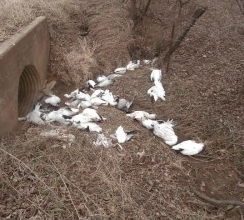
SALINE COUNTY- Law enforcement authorities in Saline County are investigating the shooting of three dozen geese, who were found in a ditch in northeast Saline County.
The geese were found in a culvert in the 4500 block of East Humbargar Road, according to Salina County Sheriff’s Captain Roger Soldan.
Anyone with information on who killed and dumped the geese is asked to call the Saline County Sheriff’s Office or the Kansas Department of Wildlife and Parks and Tourism.
WICHITA, Kan. (AP) — Emergency responders say a small plane carrying two people onboard had a “hard touchdown” at Wichita’s Jabara airport, but no one was seriously hurt.
Wichita Fire Department’s battalion chief, Stuart Bevis, said the plane came down at 12:30 p.m. Tuesday on the north end of the airport runway. He says one person was treated for minor injuries at the scene, but refused transport to the hospital.
He says the main issue emergency responders have been dealing with now is fuel leaking from one of the wing tanks.
A photo tweeted out by the Wichita fire department shows the plane on its nose.
Firefighters on the scene of an airplane emergency at Jabara Airport in the 3500 blk of N Webb Rd. pic.twitter.com/Rkon6LAXH7
The FAA says it is investigating the incident involving a Socata TBM700, a single-engine turboprop light business aircraft that slid off the runway after landing.
————
WICHITA, Kan. (AP) — Emergency responders say a small plane carrying two people onboard had a “hard touchdown” at Wichita’s Jabara airport, but no one was seriously hurt.
Wichita Fire Department’s battalion chief, Stuart Bevis, said the plane came down at 12:30 p.m. Tuesday on the north end of the airport runway. He says one person was treated for minor injuries at the scene, but refused transport to the hospital.
He says the main issue emergency responders have been dealing with now is fuel leaking from one of the wing tanks.
A photo tweeted out by the Wichita fire department shows the plane on its nose.
TOPEKA, Kan. (AP) — The Kansas House has approved a bill aimed at making it harder for judges or prosecutors to influence the work of grand juries convened by citizens.
The vote Tuesday was 101-20 on a bill that would allow people who are responsible for calling a grand jury to observe a judge’s instructions to the jurors. The measure goes next to the Senate.
Supporters said the bill would make grand juries less secretive and more responsive to the people who call them.
Kansas is one of six states allowing citizens to petition for grand juries. The 1887 law was rarely used until about a decade ago, when anti-abortion activists began using it to convene grand jury investigations of abortion clinics. The law also has since also been used to investigate adult bookstores.

 CHASE COUNTY – A woman died in an accident just after 11:30 a.m. on Tuesday in Chase County.