PRATT- The Pratt County Sheriff’s Office with the assistance of the Kansas State Fire Marshall’s Office concluded the investigation into the fatal fire that occurred south of Cullison the night of December 17.
The fire was caused by a charcoal grill, inside the trailer and a tremendous amount of stored newspapers and books inside the trailer, according to a media release.
The victim, Zane S. Baker, 68, died of smoke inhalation and thermal burns while in bed.
At approximately 8:30 p.m. on December 17, the Cullison Fire Department, Pratt County Emergency Services, and Pratt County Sheriff’s Office were dispatched 100223 SW 20th St., in Southwest Pratt County to the report of a residence on fire.
On arrival fire crews found the residence, a camper trailer, fully engulfed in flames. After the fire was extinguished, Baker’s body found in the ruble.
OSAWATOMIE, Kan. (AP) — One of Kansas’ two mental hospitals is losing federal Medicare funds because it falls short of meeting federal regulations.
The Wichita Eagle reports state officials were told Friday that Osawatomie State Hospital would receive no Medicare funds for patients admitted after Monday.
That means the state will have to pay for the care of new patients at the eastern Kansas facility. Kansas Department of Aging and Disability Services secretary Kari Bruffett says the hospital intends to seek Medicare recertification immediately.
Inspectors raised safety concerns earlier this year at the hospital, including fixtures in the ceilings that patients could use to hang themselves. The hospital put a cap on the number of patients it admits while it made renovations, creating a waiting list that has persisted since June.
MANHATTAN, Kan. (AP) — Riley County District Court officials say they have fixed errors that made confidential juvenile records available on public computers at least 20 times since 2013.
The Manhattan Mercury reports the records included arrest affidavits, details about probation violations and juvenile detention reports that were left unsealed on courthouse computers accessible to the public.
Many of the records included Social Security numbers and dates of birth for children as young as 13.
A spokeswoman for the agency that oversees the state’s courts says the data breech may have violated a Kansas law that bans public disclosure of most law enforcement and court records pertaining to juveniles.
Riley County Clerk of Court Kathy Oliver says the records were left unsealed because of human error.
TOPEKA, Kan. (AP) — An organization that represents highway construction companies is warning that further raids on Kansas highway funds to pay for other government programs endanger the state’s highways.
Bob Totten, the executive vice president of the Kansas Contractors Association, says the group will lobby hard next year against any additional transfers out of the highway fund. And the association plans to work for candidates in next year’s elections who vow to protect highway funding.
The Lawrence Journal-World reports the state transferred about $300 million from the highway fund to the general fund this year, after making similar transfers in the recent years.
Kansas Department of Transportation Secretary Mike King says the state can afford to take money from the highway fund because many transportation projects have cost substantially less than expected.
KANSAS CITY – A Kansas man was indicted Thursday on federal charges of devising a fraud scheme that cost a Turkish investor millions of dollars, according to U.S. Attorney Barry Grissom.
Nagy Shehata, 55, Olathe,and Laura Lee Sorsby, 62, Texarkana, Texas, are charged in a superseding indictment with one count of conspiracy to commit wire fraud and four counts of wire fraud. In addition, Shehata is charged with two counts of money laundering.
The indictment alleges the crimes occurred while Shehata was the president and registered agent for Premier Investment Group, Inc., and Sorsby was president of Can Am International, LLC, headquartered in Dallas. They offered an investor in Turkey investments in building a shopping mall in Turkey and a hospital in Syria. The investor transferred 6 million Euros (more than $8 million) for the hospital project. The defendants diverted the money to their own use. Shehata bought an $855,000 house and an $111,000 auto. Sorsby bought a $77,000 car and a $163,000 house. They promised the investor to return his money but they never gave the money back.
If convicted, they face a maximum penalty of 20 years and a fine up to $250,000 on the conspiracy count and each of the wire fraud counts, and a maximum penalty of 10 years and a fine up to $250,000 on each of the money laundering counts. The FBI investigated. Assistant U.S. Attorney Chris Oakley is prosecuting.
TOPEKA, Kan. (AP) — Republican Gov. Sam Brownback says he and many Kansas legislators aren’t ready to consider big increases in aid to public schools.
Brownback says he first wants to be certain that enough of the money already spent on education is finding its way into the classroom.
Lawmakers who expect to work on a new school funding law next year don’t have a clear definition of what makes up classroom spending.
Their uncertainty is likely to cloud discussions about how to distribute nearly $4.1 billion in annual aid to 286 school districts and how much to increase it.
Brownback’s critics see those arguments as an attempt to justify inadequate education funding. The State Department of Education says in the last school year, districts spent 61 percent of their operating budgets on instruction.
GALENA, Kan. (AP) — A southeast Kansas sheriff says the FBI will pay for damage to a home where authorities unsuccessfully sought a fugitive.
Cherokee County Sheriff David Groves told The Joplin Globe that the Galena home was damaged when the FBI and local agencies served a search warrant Monday night looking for man being sought on a warrant from Missouri. Groves says authorities believed the suspect was in the home Monday morning.
The wait apparently ended Tuesday evening after authorities went inside the home and determined the suspect was not there.
Groves says the FBI told him they’d pay for the damage, which included broken windows and clothes, mattresses and toys scattered around the yard. The homeowner could not be reached for comment.
HUTCHINSON-A Kansas man arrested by police in a domestic case was in court Friday where he was told of the potential charge against him.
Jose Luis Faudoa, 31, Hutchinson, was taken to jail for suspicion of kidnapping after allegedly holding his ex-girlfriend against her will.
Police were called to the report of a woman screaming in the 300 block of East 7th Street in Hutchinson.
Officers found Faudoa after not being able to locate the woman screaming.
He told police that his ex-girlfriend had broken a window in his home.
After further investigation, they learned that he had brought the victim home from work and allegedly assaulted and beat her.
He also allegedly put a gun to her head, although he denied that in court.
The victim also claims that he wouldn’t let her out of the bedroom of the home and repeatedly put the gun to her head.
She told police she was in the bed with two children. She eventually broke a window and started screaming for help.
He was eventually arrested and taken to jail for suspicion of kidnapping.
He appeared before Magistrate Judge Cheryl Allen where he attempted through an interpreter to tell his side of things, but the judge advised him against it.
His bond is set at $100,000. He will be back in court on Dec. 29 after the state files formal charges.
The Regents Governance Committee on Wednesday approved a draft policy for implementing Kansas law allowing the concealed carry of handguns on university campuses. CREDIT KHI NEWS SERVICE
By JIM MCLEAN
The chairman of the Kansas Board of Regents says he doesn’t anticipate substantial changes in state gun laws ahead of a deadline for allowing the concealed carry of handguns on university campuses.
Shane Bangerter, a Dodge City attorney appointed to the board in 2013 by Gov. Sam Brownback, said the Kansas law allowing concealed carry in public places passed by large majorities in 2013. He doesn’t expect lawmakers to revisit the issue in the upcoming session despite growing calls for them to do so in the wake of a recent spate of mass shootings in Colorado, Oregon and California.
“I don’t anticipate there being any substantial changes,” Bangerter said. “If there are, of course, we can adjust our policy accordingly.”
The Kansas House passed the bill – the Personal and Family Protection Act – 104-16. It was approved by the Senate 32-7. Legislators who voted for the bill said they believed that allowing law-abiding citizens to carry handguns on university campuses would make them safer.
Bangerter spoke to reporters Wednesday after the Regents Governance Committee approved a draft policy for implementing the law at the six state universities it governs.
The policy, which the full board is expected to consider at its January meeting, leaves it up to the universities to draft their own policies, which the regents then must approve. The board will begin reviewing those policies in June so they can be finalized and disseminated to students and faculty approximately a year ahead of the July 2017 implementation deadline.
Shane Bangerter, chairman of the Kansas Board of Regents, says he doesn’t anticipate substantial changes in state gun laws ahead of a deadline for allowing the concealed carry of handguns on university campuses. CREDIT JIM MCLEAN / HEARTLAND HEALTH MONITOR
Recently, students and faculty members at the University of Kansas and Kansas State University have voiced concerns about lifting current policies that ban weapons on their campuses.
“There is no evidence that increased gun presence has decreased death or injury by guns on campuses,” 40 K-State professors wrote in a letter submitted to newspapers across the state. “Beyond the boundaries of universities, the evidence is that the presence of guns in homes increases the likelihood of death or injury by gunshot. We believe our community is safest without guns in our midst, except in the hands of on-duty law enforcement officials.”
A group of distinguished professors at KU issued a similar statement, and Chancellor Bernadette Gray-Little announced her opposition in a message to faculty and staff.
“I want to be clear that I am not in favor of allowing concealed carry on university campuses,” Gray-Little wrote, noting that she too thought it “unlikely” that lawmakers will change the law.
The regents’ draft policy continues a current ban on the open carry of firearms and requires that concealed handguns be carried with their safeties engaged. And it requires residents of scholarship halls and dormitories who possess handguns to conceal them in secure storage devices when in their rooms. The draft says allowing students, faculty and visitors to carry concealed handguns doesn’t create an obligation that they intervene in dangerous situations to defend others.
Kansas is one of eight states that have passed laws allowing concealed carry on university campuses, e it up to the universities.
Jim McLean is executive editor of KHI News Service in Topeka, a partner in the Heartland Health Monitor team.
MANCHESTER, N.H. (AP) — Democratic presidential candidates Bernie Sanders and Hillary Clinton moved past the rancor over a breach of her campaign’s valuable voter data. Instead, Saturday night’s debate in New Hampshire turned into a pointed but polite discussion of national security, Americans’ heightened terrorism fears and the economy.
NEW YORK (AP) — The U.S., seemingly awash in crude oil after an energy boom sent thousands of workers scurrying to the plains of Texas and North Dakota, will begin exporting oil for the first time since the 1973 oil embargo. The lifting of the embargo is part of a spending deal pushed through the House and Senate last week. Here’s a brief look at why the ban was in place, and the reasons why that ban is now being lifted after four decades.
DEEP HURTING
Lines. Of all the bad memories seared into the American consciousness from the early 1970s, never-ending lines at the gas pump has to be near the top the list. The Organization of Arab Petroleum Exporting Countries put into place an oil embargo after the U.S. sided with Israel in the Yom Kippur War and the price of oil spiked. The economic effects were so dire some of the resulting policies, including a ban on oil exports, remain in place to this day.
PRODUCTION REDUCTION
The country’s energy crisis grew more precarious because domestic production began a long decline in the 1970s as oil fields matured. That decline lasted for almost 40 years and the U.S. increasingly relied on oil imports. U.S. production, which had reached almost 10 million barrels per day in the early 1970s, was halved by 2008.
SO WHAT’S CHANGED?
Technology. U.S. energy companies have developed new techniques that not only free oil and gas from fields once thought unreachable, they are returning to oil fields that, using older technology, were thought to be long drained of all fossil fuels. That created a tectonic shift in the global energy landscape. This week, crude prices fell to below $35 per barrel, down from more than $100 per barrel just last year. It’s the first time oil has been that cheap since a global recession erased energy demand.
WHO WILL BENEFIT IF THE BAN IS LIFTED?
Major oil companies. Companies including Exxon Mobil and ConocoPhillips, along with the American Petroleum Institute, an oil and gas lobbying group, have been the biggest proponents of ending the ban. But the economic benefits could be very broad. Economists say exports could help the economy by reducing gasoline prices, encouraging investment in oil and gas production and transport, creating jobs, making oil and gas supplies more stable and reducing the U.S. trade deficit.
EVERY ROSE HAS ITS THORNS
Among the biggest beneficiaries of the U.S. energy revolution: you. Those against lifting the ban say that as domestic crude leaves U.S. shores in tankers, oil will be less plentiful at home. There are a lot of U.S. industries for which energy is a huge cost, from agriculture, to airlines, to manufacturing. Many economists, however, say that U.S. oil exports would have little or no effect on prices, largely because the U.S. already exports record amounts of gasoline and diesel. Still, environmental groups worry that the rush by big U.S. energy companies to supply the world with crude will have devastating effects on the climate.
BATTLE LINES
The end to the four-decade ban on U.S. crude exports was the big prize in the budget battle for Republicans, who saw it as an arcane policy given the nation’s exploding production of oil and natural gas. In return, they agreed to the demand from Democrats for a five-year extension of credits for wind and solar energy producers and a renewal of a land and water conservation fund. Democrats also blocked a push by Republicans to GOP proposals to impede Obama administration clean air and water regulations.
NEW YORK (AP) — Mitsubishi Motors is recalling roughly 25,000 Mirages with model years 2014 and 2015 on concerns that certain wires could corrode and cause issues to the vehicle’s air bag systems.
The National Highway Traffic Safety Administration said Saturday that the vehicles affected were manufactured from August 2013 to September 2015 and were sold in states on the East Coast and in the Midwest.
The NHTSA says the Mirages have a design flaw in which melting snow could soak through the driver’s-side floor carpeting and corrode wire connectors running to a junction box nearby. The corrosion could cause delays in the deployment of the vehicles’ frontal air bags.
The NHTSA says Mitsubishi will notify owners, and any repairs necessary will be done free of charge.
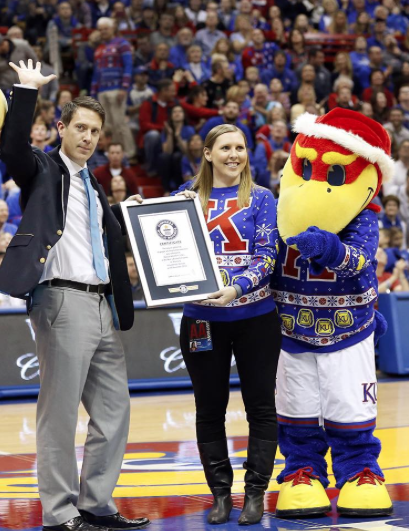
University officials said the old record belonged to Loughborough University in Loughborough, England. They say 1,175 people gathered in holiday sweaters on Dec. 10, 2014.
Associate Athletics Director Jim Marchiony says he and his colleagues on the marketing staff came up with the plan during a brainstorming session last summer.
To join the record attempt, participants had to wear a holiday sweater, which has been defined as having long sleeves and at least one holiday-themed motif.

 PRATT- The Pratt County Sheriff’s Office with the assistance of the Kansas State Fire Marshall’s Office concluded the investigation into the fatal fire that occurred south of Cullison the night of December 17.