NEW YORK (AP) — Health officials say there’s not much flu going around so far this year.
That’s a stark contrast to the last three flu seasons, when doctors’ offices were filled with patients before Christmas and illnesses peaked by late December.
U.S. officials released the weekly flu figures Friday. Only one state, South Carolina, is reporting significant flu-related traffic at doctors’ offices and clinics.
Traditionally, most flu seasons don’t really get going until around Christmas — possibly triggered by holiday gatherings that bring together people and viruses. Infected kids then go back to school, mingle with classmates, and flu season takes off.
Scientists at Los Alamos National Laboratory this week predicted there’s a 57 percent chance this flu season will peak in February.
TOPEKA, Kan. (AP) — A federal lawsuit seeking to prevent an Oklahoma Indian casino from expanding its operations into Kansas has been dismissed after the judge said the court didn’t have jurisdiction in the case.
The Joplin Globe reports U.S. District Judge Daniel Crabtree on Friday threw out the lawsuit filed by Kansas Attorney General Derek Schmidt and the Cherokee County Commission seeking to prevent Downstream Casino Resort from expanding across the state line.
Crabtree’s 38-page decision says the court didn’t have authority to review an advisory opinion by attorneys for the National Indian Gaming Commission that could allow casino gambling on tribal land in Cherokee County.
Downstream Casino Resort is located in far northeast Oklahoma, about 10 miles from Joplin, Missouri.
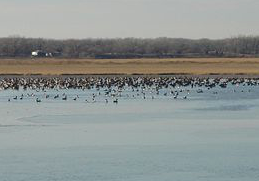
KANSAS CITY, Mo. (AP) — Wildlife officials say a bacterial disease that spreads so quickly that birds can die while in flight is to blame for the deaths of hundreds of waterfowl in central Kansas.
Roughly 1,100 dead birds have been found over the past two weeks at the Cheyenne Bottoms Wildlife Area and the nearby Quivira National Wildlife Refuge. Cheyenne Bottoms’ manager says the vast majority of those succumbed to avian cholera.
The decades-old disease doesn’t pose much of a threat to humans. But among birds, it’s a convulsion-inducing illness that comes on quickly and can even kill them midflight.
Since 1983, Kansas had had 10 outbreaks. The latest one is second only to the roughly 5,000 birds that died of it in 1998 in north-central Kansas near the Nebraska line.
TOPEKA, Kan. (AP) — The U.S. Department of Health and Human Services says about 50,000 people in Kansas had signed up through the federal health insurance exchange as of Dec. 12.
Open enrollment runs through Jan. 31, but people who haven’t signed up won’t have coverage until February. The Topeka Capital-Journal reports people who have a “qualifying event” after the deadline, such as having a baby, losing a job or aging off their parents’ insurance plans, can sign up later.
People who don’t buy insurance in 2016 will pay a penalty of 2.5 percent of household income or $696 per adult and $348 per child, whichever is higher. The maximum penalty for a family is $20,600.
Hardship exemptions are available for households whose insurance costs would exceed 8.13 percent of their incomes.
GREENWOOD COUNTY – A Kansas man was injured in an accident just after 2p.m. on Saturday in Greenwood County.
The Kansas Highway Patrol reported a 1998 Olds Delta 88 Royale driven by Jacob Smith, 22, Emporia, was westbound on Kansas 58 five miles east of Madison.
The vehicle left the roadway to the right and struck a culvert.
Smith was transported to Newman Regional Health Center.
He was properly restrained at the time of the accident, according to the KHP.
TOPEKA, Kan. (AP) — The Kansas Supreme Court has upheld the capital murder conviction of a man sentenced to life in prison for shooting two people in Wichita.
Marquis J. Marshall was convicted for the 2012 deaths of 22-year-old Zachary Hunt and 79-year-old Henry Harvey.
Marshall was sentenced to life in prison without the possibility of parole after the state chose not to seek the death penalty for the conviction.
The Topeka Capital-Journal reportsthat in a unanimous decision released Friday, the state Supreme Court rejected Marshall’s claims that the Sedgwick County District Court erred in refusing to order a competency hearing for him and that it failed to consider his request for new counsel sufficiently.
KANSAS CITY, Kan. (AP) — A second man has been convicted in the killing of a Missouri man in Kansas City, Kansas.
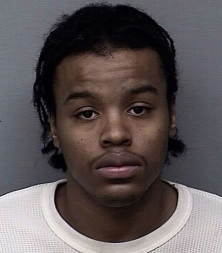
Wyandotte County jurors found Demarkus M. Campbell-Donnell guilty on Thursday of second-degree murder in the shooting death of 32-year-old Anthony M. Bush Jr.
Police said Bush was found shot to death in March in the passenger seat of a stopped vehicle. Police said the driver was also in the car but wasn’t injured.
The Wyandotte County district attorney’s office says that co-defendant Lakorri Martaneel Terry entered a plea and was convicted of second-degree murder last week. His sentencing is set for Jan. 15. The sentencing date for Campbell-Donnell will be set later.
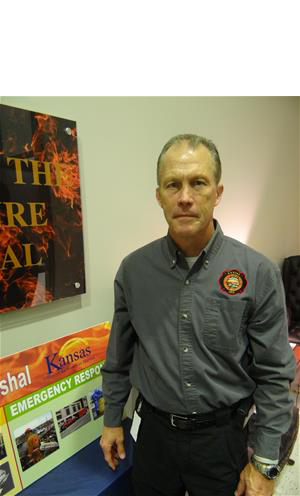
TOPEKA–Randy Hill has joined the staff of OSFM’s Emergency Response Division as Search & Rescue Coordinator.
In May of this year, the Office of the State Fire Marshal officially became the coordinating agency in charge of the Kansas Search and Rescue response program. Hill will be the point person for this program, working closely with Division Chief Hank DuPont to ensure the state is adequately prepared to respond to any kind of disaster in which search and rescue efforts are required.
Hill retired from the Leawood Fire Department in 2012 after 32 years of service. He retired with the rank of Deputy Chief. In 2012, he launched a non-profit organization called Midwest Search & Rescue, which provides disaster response training and exercises for local fire departments and first responders.
A resident of Lenexa, Randy and his wife Marlynda have three adult children and four grandchildren. Together, the Hills have owned a childcare center in Shawnee for the past 20 years.
Hill enjoys being active and staying fit through weight lifting and running. His hobbies include water sports, rappelling and caving.
He is looking forward to the challenges ahead, saying there is “much work to be done to lay the groundwork for an efficient Search and Rescue program in Kansas.”
“I have been working with search and rescue resources in the state for several years, and the one thing we’ve lacked is the leadership from the top,” Hill says. “Now that the Office of the State Fire Marshal is coordinating the Search and Rescue program in the state, we have that leadership and I’m looking forward to working with agencies and Fire Departments across the state to provide the training and credentialing necessary to be prepared for when disaster strikes.”
MANHATTAN, Kan. (AP) — Kansas State University is set to spend $6 million more than originally budgeted for the renovation of its student union.
The Manhattan Mercury reports that the Kansas Board of Regents approved a request Wednesday to increase the project’s budget from $25 million to $31 million.
University students voted for the renovations in 2013 to update the food services and provide additional space for student lounges and study space. The increase in budget allows for changes to the building’s dining services.
The budget increase also allows $2.1 million for the renovation and replacement of the union’s roof and exterior windows.
Student privilege fees and university resources will fund the renovations.
HONOLULU (AP) — President Barack Obama has vetoed two bills that would have blocked steps that his administration is taking to address climate change.
One bill would have nullified carbon pollution standards set by the Environmental Protection Agency. The second bill would have voided a set of national standards designed to reduce the amount of greenhouse gas pollution from existing power plants.
In a letter notifying Congress of his decision, Obama says climate change is a “profound threat” that must be addressed.
Some Republican lawmakers and presidential candidates scoff at the climate science.
Obama has made addressing climate change a priority. He recently praised a new international climate agreement reached at a Paris conference and credited his administration as being a driving force behind the deal.
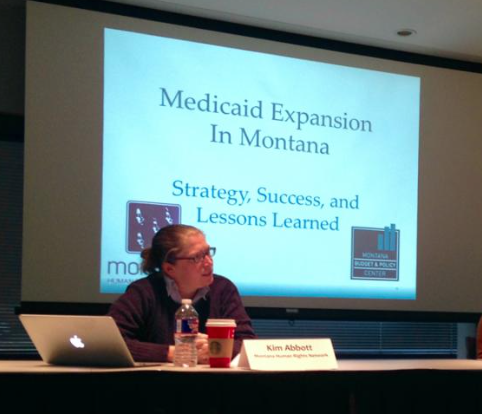
Photo by Andy Marso Kim Abbott of the Montana Human Rights Network, left, and Tara Jensen of the Montana Budget and Policy Center spoke Monday in Topeka about efforts behind their state’s recently approved Medicaid expansion plan
Two leaders of Montana’s successful Medicaid expansion movement told Kansas expansion advocates Monday that persistence, organization and discretion were keys to getting it done in their state.
Dozens of people who represent Kansas groups that favor Medicaid expansion gathered in Topeka to hear from Kim Abbott of the Montana Human Rights Network and Tara Jensen of the Montana Budget and Policy Center.
The pair said that when the broad-based coalition started its push for expansion in 2013, few people thought it would happen. But before the end of the Montana legislative session that year, the coalition moved a compromise plan to the floor that failed by only one vote.
“It really got people’s attention in the state,” Abbott said.
It took two more years, but last month Montana became the 30th state to expand Medicaid, opting for a revised plan that provides access to private insurance, offers job training assistance and requires some cost-sharing, like premiums and co-pays.
Monday’s event was hosted by the Sunflower Foundation, a nonprofit focused on improving the health of Kansans. The foundation is one of six members of the Kansas Grantmakers in Health, which last week released a report indicating Medicaid expansion would pay for itself in the state.
Billie Hall, the foundation’s president and CEO, said the Kansas advocates are where the Montana advocates were in 2013 — getting organized and hashing out what core principles must be included in any Medicaid expansion plan.
“We have just started modeling a community campaign along the lines of Montana, but we have not had the amount of time they’ve had,” Hall said. “But I feel very positive about it. Because from what we can tell, most Kansans, when you have a little information, understand the importance of Medicaid expansion.”
Similarities, differences
Like Kansas, the Montana Legislature is controlled by conservative Republicans resistant to expanding Medicaid under the Affordable Care Act, which is commonly called Obamacare.
But Montana has a Democrat governor, Steve Bullock, who pushed publicly for expansion.
Abbott said that was a big help. In Kansas, Republican Gov. Sam Brownback opposes expansion as part of Obamacare.
Montana also had a budget surplus, while Kansas is facing a financial hole of more than $100 million for the second straight year.
After next year states will have to start picking up a percentage of the tab for expansion, which is currently funded entirely by the federal government.
“It’s important to flag what’s similar and what’s different (between the two states),” Abbott said. But she and Jensen both said there were lessons Kansas advocates could take from Montana. One was to bring expansion advocates together in an organized way. The failed 2013 vote turned out to be a blessing in disguise, Jensen said, because it forced the Montana advocates to coalesce around a set of concepts rather than take opposing stances on elements such as premiums and co-pays.
“We knew that our dream legislation, for all of us, was not going to happen,” Jensen said. “We did not have the votes at all, so you have to get to a place where you all agree. … We needed to show a collective unified force, so the votes we needed could be a collective, unified force.”
The Montana groups shared funding and coordinated messaging. Persistence also was a key, Abbott said. The coalition met within a week of every legislative defeat or setback and kept the pressure on legislators both at the Capitol and in their districts.
They also were careful about how they deployed their resources, focusing on a core group of “targets” in the Legislature that they thought could be moved to vote for their side. And they did not lobby the conservative leaders. “We weren’t moving them,” Jensen said.
“They were never moving.” Abbott said the coalition focused on 19 legislators in the Montana House and nine in the Senate. Coalition conversations about those legislators came in closed meetings, and those discussions were confidential.
Rural hospitals
Some of the Montana coalition’s experiences were directly applicable to Kansas. Rural hospitals in both states face financial woes that could be eased by Medicaid expansion.
Abbott and Jensen said their coalition urged Montana hospital administrators to speak with their legislators privately about financial struggles if they weren’t willing to air them publicly.
The Montana coalition also faced resistance from a group of legislators who argued that Medicaid’s medical coverage should not be expanded until support services are funded for disabled Kansans on waiting lists.
The Brownback administration has made the same argument. Abbott said a group called Disability Rights Montana countered that argument, which frequently came from legislators not previously concerned about the waiting lists.
“Those guys and a couple other groups really took the lead on saying, publicly, ‘Yes this (waiting list) needs to be addressed, absolutely this needs to be addressed, here’s how we address this, but don’t you dare say we can’t do this (Medicaid expansion) — that is a distraction,’” Abbott said.
Abbott and Jensen also said getting uninsured Montanans to share their stories publicly was important. The Montana coalition estimated that about 70,000 people could gain coverage through expansion there. In Kansas, an estimated 150,000 people would gain coverage if eligibility is expanded to non-disabled adults earning up to 138 percent of the federal poverty line, which is annually $16,105 for an individual and $32,913 for a family of four.
The Kansas coalition hosted a forum last month in Wichita on an Indiana Medicaid expansion plan that gained approval from a Republican governor and GOP majorities in the Indiana Legislature.
Andy Marso is a reporter for KHI News Service in Topeka, a partner in the Heartland Health Monitor team. You can reach him on Twitter @andymarso
WICHITA – A Kansas woman was injured in an accident just before 9p.m. on Friday in Sedgwick County.
The Kansas Highway Patrol reported a 2000 Chevy passenger car driven by Kathleen M. Bailey, 24, Wichita, was on the Interstate 235 southbound ramp to Interstate 135 northbound in Wichita
The vehicle had a tire blow out and the vehicle hit the bridge rail.
WASHINGTON (AP) — LifeLock is paying $100 million to consumers to settle charges by federal regulators that it failed to protect customers’ personal data under a court order.
The Federal Trade Commission announced the settlement Thursday with the provider of identity-theft protection. The agency says it’s the largest settlement it has won in this type of enforcement case.
The 2010 order by a federal court required LifeLock Inc. to secure customers’ data, such as credit card and Social Security numbers, and to avoid false advertising claims. The order resulted from an action brought by the FTC and attorneys general in 35 states, alleging that LifeLock used false claims to promote its services. The company paid $12 million in that settlement.
 MIKE STOBBE, AP Medical Writer