PRATT–As 2015 winds to a close, there are several important things Kansas hunters and anglers need to know: 2015 licenses expire December 31. All 2016 licenses will go on sale December 15, and if you purchase a 2016 license before January 1, it is valid through the rest of 2015 and all of 2016.
You should also know that fees will increase for 2016. However, new license options provide significant savings. Remember, too, that lifetime licenses can be purchased through December 31, 2015 at the current price – $440. The new fee will be $500 for a lifetime fishing, hunting or furharvesting license, beginning January 1, 2016. A combination fishing/hunting combination license will cost $960.
The new fee for an annual fishing or hunting license will be $25. However, if you purchase an annual combination hunting/fishing license before February 1, the price is $40. After February 1, an annual combination hunting/fishing license will cost $45.
Another way to save is to purchase the 5-year hunting and fishing licenses. A five-year hunting or fishing license is $100, a $25 savings over purchasing the license every year. And a 5-year hunt/fish combination license is $180, a $70 savings over purchasing each license individually every year.
Hunting and fishing licenses make great stocking stuffers and a lifetime license is truly a gift that keeps on giving. You will find the application for a lifetime hunting, fishing or furharvesting license and see all new fees for 2016 at www.ksoutdoors.com.
KANSAS CITY, Mo. (AP) — With the approval by Illinois regulators for its part of a 780-mile transmission line to carry wind power from the Kansas high plains to Eastern power grids, Missouri farmers are the only ones standing in the way of the $2.2 billion project.
The battle pits Houston-based Clean Line Energy against a row of Missouri farmers stretching from Buchanan County in the west to Ralls County in the east who vow to remain steadfast in their opposition to the plan.
The Kansas City Star reports the power line is being touted by supporters as a first-of-its kind project and a major step in the fight for renewable energy against coal-fired power plants.
Opponents have cited concerns about crops, pastures and difficulties in maneuvering large equipment around towers.
HUTCHINSON, Kan. (AP) — A Kansas prosecutor says a handgun that killed the 3-year-old son of a sheriff’s deputy did not belong to the child’s father.
Reno County District Attorney Keith Schroeder says the gun that killed Kaden Nagel on Friday belonged to “a friend” of someone at the apartment where deputy Andrew Nagel was living temporarily.
The Wichita Eagle reports Kaden died early Friday morning after finding a loaded .40-caliber Glock in a South Hutchinson apartment and accidentally shooting himself with it.
Schroeder says it was the first time the child had visited the apartment, and the gun’s owner believed it had been removed from the residence.
The prosecutor says he doesn’t anticipate any charges will be filed in the case.
BOURBON COUNTY -A Kansas man was injured in an accident just before 2p.m. on Saturday in Bourbon County.
The Kansas Highway Patrol reported a 1997 Chevy 1500 pickup driven by Nathan Andrew Regan, 33, La Harpe, was westbound on U.S. 54 two miles east of Bronson.
The vehicle crossed the centerline, entered the south ditch, traveled through a barbed wire fence and hit a tree.
Regan was transported to the Mercy Hospital. He was properly restrained at the time of the accident, according to the KHP.
OSKALOOSA, Kan. (AP) — Floyd Bledsoe is out of prison in Kansas after serving 15 years for a killing his brother admitted to in a suicide note last month. But Bledsoe isn’t getting any monetary apology from the state’s taxpayers.
Unlike more than half of U.S. states, Kansas has no law setting forth the monetary value of lost time for the wrongly convicted.
That leaves 39-year-old Bledsoe with the options of suing the state or filing a claim with the state Legislature.
Payouts to the exonerated vary considerably from state to state. Some offer automatic, set amounts regardless of how much time was served.
A representative of the Midwest Innocence Project said Bledsoe will consider the options available to him for compensation.
JEFFERSON CITY, Mo. (AP) — Several new state laws intended to boost the ranks of doctors in underserved areas have yet to produce any actual results.
The laws in Missouri, Arkansas and Kansas allow new medical school graduates to start treating patients immediately, without going through years of traditional residency programs.
But Missouri regulators are still trying to implement the law more than 18 months after it first passed. And not a single new doctor has gone into practice in any of the states as a result of their new laws.
There are more than 6,200 places nationwide with a shortage of primary care physicians.
But the new laws have been opposed by some of the nation’s most influential medical organizations, including the American Medical Association. The groups say residency training remains important.
PRATT–Property boundaries aren’t always clear-cut, but the rules for hunting private land are. Because Kansas is 97 percent privately owned, landowners still provide access for most of our hunting opportunities. Know and follow some of these key private land hunting rules to prevent an early end to your season, and more importantly, to ensure good relationships are maintained between hunters and landowners.
-Kansas law requires all hunters to have landowner permission before hunting on private land whether the land is posted with “No Hunting” signs or not. If the land is posted with “Hunting With Written Permission Only” signs or marked with purple paint, hunters must have written permission from the landowner.
-Make a point to notify the landowner of when you plan to hunt and how many will be in your party. This is a common courtesy that will help keep the lines of communication open, and also can aid landowners in determining whether illegal hunters are trespassing on their property.
-Leave the land how you found it, or better. This can include things as simple as closing gates after you leave, sticking to maintained roads, and removing any trash you find.
-All deer hunters and persons assisting them must wear orange during an open firearm or muzzleloader season. An orange hat and at least 200 square inches of orange is required. Of this, 100 square inches must be visible from the front and 100 square inches must be visible from the back on the upper half of the body. Camouflage orange providing the required orange is legal.
-Know the property boundaries and know them well. Hunting from roads or railways without permission is a form of trespassing called criminal hunting; since the Kansas Department of Wildlife, Parks and Tourism (KDWPT) is one of 44 states in the Wildlife Violator Compact, conviction of trespass or criminal hunting may prevent the convicted person from enjoying hunting privileges in other states, as well.
Hunting private land in Kansas is a privilege and should be treated as such. Take advantage of private land access and chances are, you may be looking for a new spot next season. Treat landowners and their property with the same respect you would expect from someone on your land, and great things can come of it.
If you witness trespassing or illegal hunting, please call the Operation Game Thief toll-free hotline at 1-877-426-3843.
KANSAS CITY, KAN. – A Johnson County man was sentenced Thursday to 210 months in federal prison for distributing child pornography, according to U.S. Attorney Barry Grissom.
Jacob N. Hilton, 29, Gardner, Kan., pleaded guilty to one count of distributing child pornography. In his plea, he admitted he traded child pornography over the Internet with a man in Australia who was arrested by the Queensland Police during a child pornography investigation. The man’s records showed he had been in contact with Hilton and the Australian police passed the information on to investigators in Kansas. Investigators obtained a warrant and found evidence in Hilton’s Gmail account that he sent child pornography to the Australian man.
Grissom commended the Queensland Police, the FBI and Assistant U.S. Attorney for their work on the case.
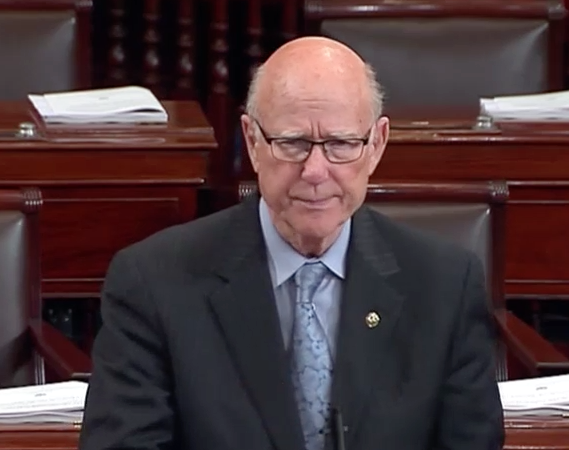
WASHINGTON, DC – U.S. Senator Pat Roberts (R-Kan.) on Friday announced that he has introduced a bill to block a proposed Internal Revenue Service (IRS) regulation that could have a chilling effect on charitable giving and would add a costly burden to charitable organizations.
The IRS is proposing a new voluntary rule that calls on charities to ask for additional personal donor information including Social Security numbers for any donation more than $250.00.
“The rule would provide the IRS detailed information on who is making donations to particular charities,” Roberts said. “The IRS has already threatened donors in groups that it doesn’t like. I don’t think we can trust them with a new source of data on donors. There also is no assurance that the agency will stop at this voluntary rule and move to make such reporting mandatory for all contributions and all charities.”
Under current law, the responsibility to substantiate the contribution is on the donor. Most non-profits provide that information to the donors for their record-keeping.
Instead, the proposed IRS regulation would allow a charity to substantiate charitable contributions by filing a return with the IRS that includes detailed donor information. If the charity elects to file the return, it must provide: the donor’s name and address, the donor’s Social Security number, the amount of cash and a description of any property other than cash contributed, whether the charity provided any goods or services in consideration for the contribution, and a description and good faith estimate of the value of any goods or services provided by the charity.
“Given that the agency has not yet adequately addressed the issues surrounding breaches of existing taxpayer information, a point the IRS readily acknowledges, and states that the existing system of substantiating charitable contributions works well, there is no compelling tax administration or enforcement reason to move forward with this proposal.”
Senator Roberts’ bill simply blocks the proposed rule from taking effect and maintains current law.
Charitable organizations are speaking out against the IRS proposal. Tim Delaney, president and CEO of the National Council of Nonprofits, recently wrote: “…the IRS proposal would open the door for scam artists…Nonprofits have neither the financial resources nor sufficient staffing to combat hackers who will see an easy source for Social Security information. This also creates a liability nightmare for innocent nonprofits…To be asked to share their address, their credit card number and their Social Security number all in the same place would be enough to scare even the most committed donor to decline to give.”
“This rule is ridiculous. If the intent is to crack down on fraud, the IRS should not create rules that will add to the problem,” Roberts said. “They have already proven that the IRS itself can’t safeguard personal and private information from abuse. Why would they burden non-profits with this collecting information that will be expensive to keep, could discourage donations and would encourage hacking?”
Senator Roberts went on to say, “This rule could dramatically reduce people’s willingness to make donations, and burden charities, many of which are small, volunteer operated organizations with new costly administrative costs. The collection and safekeeping issues surrounding this proposal could very significantly stress the good works done by our charitable sector.”
Delaney made a similar point, stressing “Every donation not given means another senior who won’t receive a meal, a child who won’t receive life-saving medical care, another animal without a home, and much more.”
Those wishing to share their concerns with this proposed rule can issue comments here.
Senator Roberts has been an outspoken critic of the IRS. Earlier this year, Roberts took aim at the scandal-ridden IRS by introducing a bicameral bill with Senator Jeff Flake (R-Ariz.), Speaker Paul Ryan (R-Wis.), and Congressman Peter Roskam (R-Ill.). The Stop Targeting of Political Beliefs by the IRS Act would stop cold further attempts by IRS to exploit bureaucratic loopholes to restrict the free speech rights of the same types of tax-exempt social welfare organizations victimized in the IRS political targeting scandal.
Senator Roberts also introduced the “Federal Employee Tax Accountability Act” to require federal employees to be current on their federal income taxes, and would prevent federal personnel who are delinquent in paying a federal tax liability from receiving a bonus or cash award. Exceptions are made for tax debt being paid pursuant to an agreement with the IRS and for certain hardships. According to the Inspector General, close to $3 million was awarded to IRS staff with violations on their records, with about half of that amount going to people with tax violations on their record.
Kansas City’s Research Medical Center is owned by HCA Midwest Health. CREDIT COURTESY HCA MIDWEST HEALTH
A Jackson County judge has awarded nearly $434 million to the Health Care Foundation of Greater Kansas City in its long-running lawsuit against HCA Midwest Health over whether HCA fulfilled the pledges it made when it bought several local hospitals in 2003 for more than $1 billion.
The award represents a sweeping victory for the foundation, which was created with proceeds from the sale of the hospitals and argued that HCA reneged on its commitments.
Circuit Judge John Torrence had previously found that HCA was liable to the foundation for failing to make capital and charitable contributions it undertook after its acquisition of the assets of nonprofit Health Midwest. Those assets included Menorah Medical Center, Overland Park Regional Medical Center and Research Medical Center.
Torrence had asked both parties to submit a proposed judgment payout but they differed on the amounts and submitted separate ones instead. Torrence adopted the foundation’s proposed order and rejected HCA’s argument that interest on the award should be calculated as simple rather than compound interest.
Torrence’s four-page order, which was handed down Wednesday afternoon, found that HCA is liable for $239.4 million over its failure to fund promised hospital improvements; $167.1 million in prejudgment interest; and more than $27 million in legal fees and expenses.
Christine Hamele, a spokeswoman for HCA, said the company was disappointed in the ruling and plans to appeal.
“We expect the Missouri Court of Appeals to rule on the appeal by the end of 2016,” she said in a statement. “HCA remains committed to providing the people of Missouri and Kansas with high-quality health care, including in the new state-of-the-art facilities we built in Lee’s Summit and Independence, Missouri.”
The health care foundation’s chairman, Kenneth E. Southwick, said in a statement that the foundation’s goal in the lawsuit “was to determine whether or not HCA had fully complied with its obligations to the people of Greater Kansas City in connection with the Health Midwest purchase.”
“After today’s final judgment, we are confident we have met that goal,” he said. “And while we won’t receive any of these dollars until the appeals process is complete, the foundation remains dedicated to serving the vulnerable people in our service area.”
In regulatory filings, HCA had previously said it intends to appeal any judgment against it. The company disputes that it reneged on its commitments and also questions whether the foundation had standing to bring the lawsuit.
The foundation sued over what it said was HCA’s failure to expend $450 million over five years as part of an agreement with then-Missouri Attorney General Jay Nixon, now the state’s governor. Nixon got involved because the deal involved the purchase of non-profit Health Midwest by HCA, a for-profit company, and the attorney general oversees all charitable institutions in the state. The agreement Nixon negotiated was intended to ensure that the proceeds were used for a public benefit.
Editor’s note: The Health Care Foundation of Greater Kansas City provides funding for Heartland Health Monitor.
Dan Margolies, editor of the Heartland Health Monitor team. You can reach him on Twitter @DanMargolies.
FOWLER- Two people were injured in an accident just before 8p.m. on Friday in Meade County.
The Kansas Highway Patrol reported a 2004 Chevy Trailblazer driven by Juan Enriquez-Ugalde, 59, Dodge City, was westbound on U.S. 56 just west of Fowler.
The Trailblazer rear-ended a 2003 Chevy Tahoe driven by Jennifer Carter, 33, Englewood, that stopped to make a left turn onto County Road 26.
Carter and a passenger in the Tahoe Hunter Cook, 16, Englewood, were transported to the Minneola Hospital.
Enriquez-Ugalde and four occupants of the Trailblazer were not injured.
All were properly restrained at the time of the accident, according to the KHP.
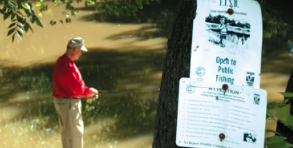
PRATT–The Kansas Department of Wildlife, Parks and Tourism’s (KDWPT) Fishing Impoundments and Stream Habitats Program (F.I.S.H.) pays landowners to allow fishing access to their private ponds and streams. F.I.S.H. is patterned after the hugely popular Walk-In Hunting Access program (WIHA), and both programs were designed to increase access to quality hunting and fishing opportunities across Kansas. Because more than 97 percent of Kansas land is privately owned, providing hunting and fishing access to private land is a KDWPT priority.
The F.I.S.H program leases private waters from landowners and opens them to public fishing. Landowners participating in F.I.S.H. receive payments for the use of their land, and anglers are in turn provided with a place to fish that might not have been available otherwise. The enrollment deadline for 2016 is December 15, 2015.
Special regulations are in place for F.I.S.H. properties, and KDWPT officials periodically patrol the areas. Violators will be ticketed or arrested for vandalism, littering or failing to comply with fishing regulations. Access is limited to foot traffic, except on roads designated by the landowner in the case of very large tracts of land. Additionally, under this program some landowners are eligible for fish stocking, habitat management, fence crossers, cattle guards, rock boat ramps, or rocked parking areas.
Each year, KDWPT publishes a fishing atlas, featuring maps that show each body of water enrolled in the program, boating allowance, and fish species available. Most F.I.S.H. sites are open for public access from March 1 to October 31, but some contracts pay landowners more to allow year-round access.
Pond Leasing
Privately-owned ponds are leased by the acre with base lease rates ranging from $75 to $125 /acre/year, depending on where the pond is located. Boating allowance bonuses are available, as well. Ponds allowing carry-in boats are eligible for an additional $10/acre/year, and properties allowing all boats access (adequate launching site must be present) are eligible for an additional $25/acre/year.
Stream Leasing
Annual lease rates for stream fishing access range from $500 to $1,500/mile/year, depending on the quality of the fisheries.
River Access Leasing
The Kansas, Arkansas, and Missouri rivers are considered navigable waters and are open to public use between the ordinary high-water marks. However, adjacent land is often privately owned, and public access points are limited. To increase public access to these rivers, the F.I.S.H. program leases access sites from willing landowners. Landowners with adequate launch facilities receive $1,500/site/year. If the site is within 10 river miles of any other public access site, a landowner can receive $2,000/site/year.
For more information on enrolling your water in the F.I.S.H. program, contact your nearest KDWPT office, or the Pratt Operations office at (620) 672-5911. You can also learn more about F.I.S.H. at www.ksoutdoors.com.
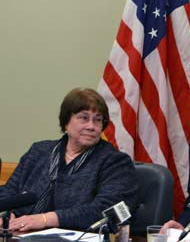
TOPEKA, Kan. (AP) — Kansas’ top child welfare official says allegations that she attempts to block potential adoptions by same-sex couples are “fiction.”
Secretary Phyllis Gilmore says decisions by the Kansas Department for Children and Families and its contractors about troubled children are driven by a desire to find the best homes for them.
The agency faces criticism that it discriminates against gay and lesbian foster parents who want to adopt the troubled children in their care. A gay-rights advocate and Democratic legislator say Gilmore should resign.
But Gilmore told The Associated Press that the department and its contractors are required by state and federal law to keep children with relatives and their siblings as much as possible. She said their decisions are focused on what’s in the best interest of each child.

 KDWPT
KDWPT