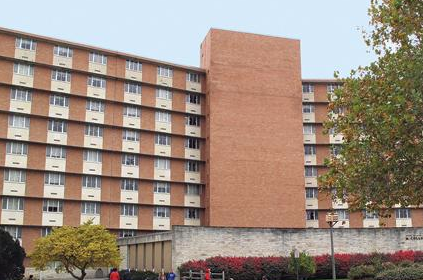
LAWRENCE, Kan. (AP) — A University of Kansas residence hall is coming down this week.
The Lawrence Journal-World reports that about 750 pounds of explosives will detonate Wednesday morning at McCollum Hall. In 18 seconds, the 10-story, three-wing, 220,000-square-foot residence hall will become a pile of rubble.
Opened in 1965, McCollum initially housed 910 students. It has been the king — at least in size — of KU’s Daisy Hill dorms ever since.
Demolition preparations began last month. The work has included removing and hauling off all soft material such as wood and sheet rock, and removing tons of metals for recycling.
WICHITA – A Kansas man died in an accident just before 1p.m. on Sunday in Sedgwick County.
The Kansas Highway Patrol reported a 1998 Toyota Rav4 driven by James G. Depriest, 63, Wichita, was entering south bound Interstate 135 from west bound Kellogg
The driver lost control on the entrance ramp. The vehicle left the roadway and struck the bridge pillar at south bound Interstate135 to eastbound U.S. 54.
Depriest was pronounced dead at the scene and transported to the Forensic Science Center
He was properly restrained at the time of the accident, according to the KHP.
TOPEKA, Kan. (AP) — A group of African-American leaders are calling for expanding Medicaid, repealing restrictive voting laws, reforming criminal sentencing and putting more restrictions on payday lenders.
The Lawrence Journal-World reports that the agenda was adopted Saturday in Topeka. It was announced after a group called the Kansas Black Leadership Council came together for the first time to adopt a unified, statewide political agenda for an upcoming legislative session and the elections to follow.
The group includes members from Kansas City, Wichita, Salina, Junction City and several other communities in Kansas.
They met at the historic St. John AME Church near downtown Topeka, which was built in 1864 and has long been a center of political and cultural activity within Topeka’s black community.
TARKIO, Mo. (AP) — Federal wildlife officials are concerned about a proposed wind farm project in northwest Missouri they say is in the migratory corridor for birds flying into the Squaw Creek National Wildlife Refuge.
Lenexa, Kansas-based Tradewind Energy plans to build roughly 150 of the 500-foot-tall wind turbines in central and eastern Atchison County, between Tarkio and Tarkio Prairie Conservation Area.
There already are about 100 turbines on the county’s west side.
The St. Joseph News-Press reports the U.S. Fish and Wildlife Service wants Tradewind to do an environmental assessment and apply for permits to allow protected species such as eagles to be killed at the facility.
Tradewind officials say the company plans to work closely with federal wildlife officials on an eagle conservation plan and will apply for voluntary permits eventually.
TOPEKA–The Kansas Reading Roadmap (KRR), an initiative commissioned by Governor Sam Brownback and funded by the Kansas Department for Children and Families (DCF), is showing strong growth in third grade reading skills, according to an independent evaluation of the 2014-2015 school year.
The University of Kansas study shows in KRR model programs across the state, a greater number of children are achieving reading proficiency. KRR’s whole-school approach includes classroom instruction, in-school interventions, afterschool and summer programs, and family engagement. KRR schools have demonstrated a nearly 10-point improvement in children reading at benchmark levels. Schools use benchmark reading goals to identify whether children are on track to read at grade level.
“Third grade reading proficiency is critical to ensuring student academic success and is a strong predictor of timely graduation from high school,” said Governor Sam Brownback. “Early literacy efforts like the Kansas Reading Roadmap can both help these children succeed in school and in life.”
KRR schools have shown impressive growth in just one year. Labette County’s, Altamont Grade School showed a 69 percent increase in children reading at benchmark and a reduction of children at risk for special education by 73 percent. At Fairfield Elementary in Langdon, the number of children needing intensive reading interventions fell 60 percent, and the number of children at benchmark increased by 54 percent.
“KRR has been an excellent support for our district’s vision, combining resources and training to better meet the needs of our K-3 students and families,” said Fairfield Superintendent Nathan Reid. “The approach of instruction during school, the support of an aligned afterschool program and the partnerships created with the families have created an environment of commitment. Our students have shown tremendous growth in our short time as part of the program, and I would recommend it to any district without hesitation.”
The KRR program, currently in 40 low-income schools across the state focuses on helping schools improve third grade reading proficiency. The program is grounded in a partnership with the Kansas Department of Education (KSDE), through the use of its Multi-Tiered System of Supports (MTSS) approach for in-school reform. Kansas MTSS is a coherent continuum of evidence-based, system-wide practices to support a rapid response to academic and behavioral needs, with frequent data-based monitoring for instructional decision-making to empower each student to achieve high standards. KSDE has spent more than 10 years developing Kansas MTSS in partnership with local schools. In addition to in-school improvement through MTSS, KRR schools also run aligned afterschool, summer and family engagement programs. Young readers who are identified as needing extra help receive coordinated interventions both during and outside of school.
“There is no one silver bullet for school reform or third grade reading,” KRR Executive Director Andrew Hysell said. “Instead it takes a lot of hard work and the better use of existing resources. Working with Kansas parents, teachers and administrators, I’m amazed by how much they’ve been able to accomplish.”
KRR utilizes Temporary Assistance for Needy Families (TANF) funds, provided by DCF. DCF Secretary Phyllis Gilmore is pleased to see such positive outcomes.
“Our mission includes promoting healthy families and encouraging personal responsibility,” Secretary Gilmore said. “Improving reading proficiency early in life ensures a brighter future for young Kansans and generations to come.”
The KRR programs provide up to 1,860 hours of out-of-school programming per student and offer direct services to more than 500 families per year.
WICHITA, Kan. (AP) — A study by a nonprofit health advocacy group says youth drug overdose rates are up in Kansas, but remain lower than the national rate.
The study released Thursday by Trust for America’s Health shows that Kansas’ overall drug overdose death rate for 12- to 25-year-olds was 5.9 deaths for every 100,000 youths. That compares to 7.3 deaths nationally for every 100,000 youths.
The Wichita Eagle reports that the state’s rate quadrupled over the last 12 years. Only Wyoming had a greater increase.
The Kansas Department for Aging and Disability Services says the state waiting list of people who need funding from the state in order to receive treatment for addiction has increased over time but started spiking about three years ago.
LAWRENCE, Kan. (AP) — A retrial for a 31-year-old man charged in a Lawrence apartment killing has ended in another hung jury.
The Lawrence Journal-World reports that Douglas County District Judge Paula Martin declared a mistrial Friday in Dustin D. Walker’s felony murder trial. Prosecutors alleged that Walker killed 39-year-old Patrick Roberts in March 2014 during a botched robbery attempt. But defense attorney Blake Glover said Walker and his cousin, Archie Robinson, didn’t break into Roberts’ apartment but went there to buy marijuana.
Walker was already convicted of an aggravated burglary charge at his first trial in February, but those jurors could not agree on the felony murder charge. Prosecutors plan to announce Dec. 2 whether they will seek another retrial.
Robinson, of Topeka, was convicted earlier in the killing.
The Kansas Ag Research and Technology Association (KARTA) and K-State Research and Extension have announced its winter conference will be moving to a bigger facility in January of 2016. The 19th Annual Kansas Agricultural Technologies Conference will be held January 21-22, 2016, at the Courtyard by Marriott and adjacent convention center in Junction City.
This annual event brings hundreds of agricultural producers and industry leaders for a two-day interactive workshop on the use of technology in the ever-changing agriculture industry. “Our winter conference has been growing tremendously over the last few years, but last year we were bursting at the seams in Salina,” says Jeff Buehler, 2015 KARTA Board President. “Our volunteer board made the decision to research other venues, and are confident that the Marriott in Junction City will better serve our conference needs now and as we continue to grow in the future.”
Those in attendance at the conference will hear presentations from dynamic speakers on a wide variety of topics dealing with precision agriculture. The two-day event also includes vendor displays, the KARTA Annual Meeting, research presentations from grant recipients, and an interactive evening discussion that is always an attendee favorite.
Anyone who signs up on or before January 15th can receive a $50 discount on their conference registration, bringing the conference price to $175 per person (which includes meals and refreshments). There is also a subsidized student rate of $50 per person, catered to agricultural students at all of the state’s post-secondary educational institutions.
The funds generated through the association dues and conference registrations are used to provide grants to facilitate on-farm research projects and instructional workshops on the hardware and software necessary to conduct agricultural research trials. Registration for the two-day conference is $175 per person prior to January 15th, or $225 per person after that deadline. There is also a $50 discount for KARTA members, and new members can always sign up on their conference registration form. For more information or to register, visit www.kartaonline.org. Be sure to follow KARTA on Twitter and Facebook.
Concerns among Kansas health care providers of a billing system “apocalypse” appear to have been unfounded. Providers are saying “so far, so good” about a twice-delayed new system that went into effect Oct. 1.
The new billing system is called ICD-10. It’s the 10th version of the World Health Organization’s International Classification of Diseases (ICD), and it replaced a system that had been in use since 1979.
The new system has far more codes than the old one — 100,000 more. It’s meant to be more specific about diagnosis and treatment, not only for billing purposes, but for medical research, evaluation of treatments and procedures, and disease outbreak tracking.
Health care providers were concerned that they might choose the wrong codes and might not get paid by insurance companies — at least not promptly — as a result. But after more than a month, the new system is working “surprisingly well,” according to Barbie Hays, coding and compliance strategist for the Leawood-based American Academy of Family Physicians.
“There was a lot of talk that this was going to be a disaster, but I think that they have found that it’s not as horrible as they were thinking it was going to be,” Hays says. “It’s not as expensive as what they thought it was going to be. The world didn’t stop, like they thought it was going to for Y2K.”
Much like unrealized fears that computers worldwide would crash on the first day of the year 2000, the conversion to ICD-10 has gone better than expected.
That’s important, Hays says, because payment delays could have been a big problem.
“So if you’re not receiving money within 21 days, they may not be able to make that paycheck for that nurse or that receptionist that’s working for them at 30 days,” Hays says.
There have been a few problems, according to Hays, but they’ve been resolved quickly.
If there were any major difficulties in Kansas, the state’s largest insurance company, Blue Cross and Blue Shield of Kansas, probably would be among the first to know about them. Spokeswoman Mary Beth Chambers said the company processes between 50,000 and 70,000 claims every day.
“Nearly 80 percent of our claims are processed entirely electronically, and if there are errors it will kick a claim out of the system to have one of our claims processors look at it more closely,” she says. “But we have not had an uptick in claims that have been kicked out because of ICD-10.”
Chambers said Blue Cross worked with health care providers across Kansas for the last three years to help them prepare for the new coding system. Initially it was scheduled to go live two years ago but was delayed — first by the Obama administration and then by Congress. That may be one reason implementation has gone as smoothly as it has.
The industry may not be out of the woods just yet, though, according to Brock Slabach of the National Rural Health Association, also based in Leawood.
“By the time the claims are submitted to the third-party payers, and then they go through the process of claims processing, the issues of cash flow won’t be seen typically until about 45 days or more,” he says.
That means it may be mid- to late November before health care providers truly can breathe a sigh of relief. Slabach said the reports from Blue Cross and Blue Shield of Kansas and the American Academy of Family Physicians would seem to indicate, however, that the worst fears about the new medical coding system will not be realized.
Bryan Thompson is a reporter for KHI News Service in Topeka, a partner in the Heartland Health Monitor team.
WILSON COUNTY- A Kansas woman died in an accident just after 10p.m. on Saturday in Wilson County.
The Kansas Highway Patrol reported a 2007 Buick Lucerne driven by Kevin E. Elwood, 45, Chanute, was westbound on Kansas 39 at Tulakes Road.
The vehicle left the roadway, entered the north ditch, impacted the embankment of a creek bed head on and descended into the creek bed.
A passenger in the Buick Darla R. Elwood, 51, Chanute, was pronounced dead at the scene and transported to Frontier Forensics. The driver was transported to Wesley Medical Center in Wichita.
They were not wearing seat belts, according to the KHP.
WICHITA, Kan. (AP) — Weather extremes are reigniting farmers’ interest in planting cover crops, a traditional farming practice that’s gaining renewed popularity in Kansas and other states. Supporters say it’s a way to help combat climate change and reduce greenhouse gas emissions.
A New York-based environmental group, the Natural Resources Defense Council, released a report Thursday on the benefits of cover crops — typically non-commodities that protect the soil between harvests of cash crops. The practice not only cuts crop losses but could also save trillions of gallons of water.
Cover crop use remains low in Kansas. Thursday’s report cited government statistics showing that in 2012 roughly 322,000 acres of cover crops were planted in Kansas, just 1.5 percent of the state’s total cropland.
GEARY COUNTY- Law enforcement authorities in Geary County are investigating a Saturday accident involving a Union Pacific train.
The train struck an abandoned 2003 Saab passenger car just before 4 a.m. on Saturday near Old Highway 40 and South Crider Road, according to a media release from Geary County Sheriff Tony Wolf.
Deputies responded to the location and found the car with extensive damage.
The unoccupied vehicle had been parked on the train tracks at a private crossing.
The Union Pacific train was headed west toward Salina from Kansas City.
Johnathon Hansen, 20, Fort Riley, was identified as the owner of the vehicle. No injuries were reported.
GARDEN CITY- Law enforcement officials in Finney County are investigating a robbery at a restaurant in Garden City.
Just before 9p.m. on Thursday, officers of the Garden City Police Department were dispatched to Mooyah’s Burgers at 2204 East Kansas Avenue for a reported robbery in progress, according to a media release.
The caller advised two subjects entered the store wearing masks, armed with a handgun.
The suspects took an undisclosed amount of money and fled the store on foot.
As officers were responding to the scene one officer observed a suspect running in the area of 2000 E Spruce Street that matched the description of one of the suspects.
The suspect was arrested without incident. He was identified as Gregory Ojeda, 17, Garden City.
Further investigation revealed two additional suspects, Daniel Ramirez, 16, and Carlos Castruita, 17; both of Garden City were involved.
Police believe all three suspects parked a vehicle at the Tangeman Sports Complex, walked to the business, allegedly committed the robbery and fled on foot.
Evidence was located in the area of the Garden City Community College football stadium.
The two additional suspects were located at a residence in the 4100 Block of East Highway 50 and arrested without incident a short time later.
When the suspects’ were arrested evidence was located on their persons. The possible vehicle used in the commission of the crime was located and will be processed for evidence.
A Garden City Community College Campus safety notification was sent out via social media at the direction of the GCCC Campus Police and GCCC school staff due to the location of the incident.
All three suspects are being held in the Juvenile Detention Center and could face the possible charges of Aggravated Robbery, according to the Finney County Attorney’s Office.