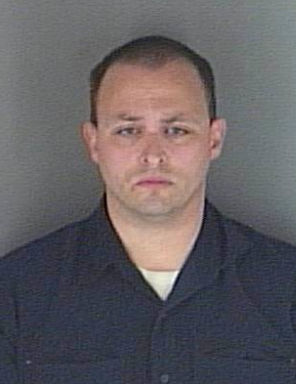
Jonathan and Allison Schumm- photo Shawnee Co. Jail
TOPEKA, Kan. (AP) — A Topeka City Council member and his wife each has been charged with one felony count and four misdemeanor counts accusing them of abusing some of the 16 children in their care.
The Shawnee County prosecutor’s office says 34-year-old Jonathan Robert Schumm and 32-year-old Allison Schumm were charged on Thursday with aggravated battery or, in the alternative, abuse of a child.
Prosecutor’s spokesman Lee McGowan says the battery charge is a lower-level felony than the abuse count.
The two also are charged with four misdemeanor counts of child endangerment.
They made their first court appearance on Friday in Shawnee County District Court, where Jonathan Schumm was appointed counsel from the public defender’s office.
McGowan says the two were still in custody as of early Friday afternoon.
TOPEKA, Kan. (AP) — The United Methodist Church in Kansas and Nebraska says 35 congregations are willing to sponsor at least one Syrian refugee family.
Bishop Scott J. Jones, leader of the church in the two states, announced Friday that the number of participating congregations could increase in the future.
Jones says the vast majority of Muslims in the world are our allies, and the church wants to stand with them against the jihadists.
The church’s Great Plains Conference includes 1,032 congregations in the two states.
Kansas Gov. Sam Brownback issued an executive order Monday prohibiting state agencies and organizations receiving state money from relocating Syrian refugees in the state. Nebraska Gov. Pete Ricketts has urged resettlement agencies not to participate in any efforts to bring Syrian refugees to that state.
NEW YORK (AP) — An outbreak of E. coli linked to Chipotle has expanded to six states.
The Centers for Disease Control and Prevention says new cases have been reported in California, New York and Ohio. Cases were reported in Minnesota earlier, while the majority of illnesses have been in Oregon and Washington.
The agency says the investigation is ongoing to determine the specific food that is linked to the illness.
So far, the CDC says 45 people have been infected in relation and that 16 of them have been hospitalized. There have been no deaths.
Late in October, Chipotle Mexican Grill closed 43 restaurants in Oregon and Washington after health officials discovered most of the people sickened in an E. coli outbreak had eaten at the chain’s restaurants. The restaurants have since reopened.
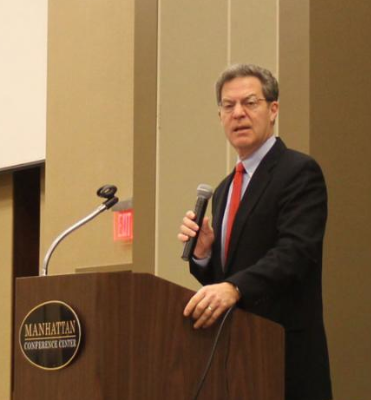
Photo by Andy Marso Gov. Sam Brownback opened a conference on the the future of water in the state by saying that the research and planning stages of the water vision are complete. “It’s time we make the tough decisions and move on forward,” he said.
A task force that will make recommendations for how to fund the state’s water projects was unveiled Wednesday. The Blue Ribbon Task Force is part of the 50-year plan to secure the state’s water supply that Gov. Sam Brownback’s administration rolled out last year.
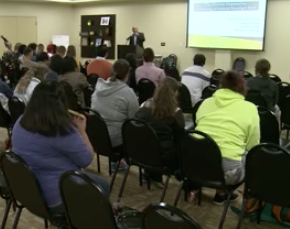
Officials from the Kansas Department of Agriculture announced the members at the Governor’s Conference on the Future of Water in Kansas at the Manhattan Hilton Garden Inn. Tracy Streeter, director of the Kansas Water Office, told a crowd of hundreds at the conference that the panel intends to work quickly.
“We will get our work done in 2016,” Streeter said. There are two main water challenges in Kansas: conserving the underground Ogallala Aquifer that sustains the western Kansas agriculture economy and preserving the above-ground reservoirs that supply the eastern Kansas population centers. The reservoirs are losing storage capacity as they fill with sediment.
Some need expensive dredging to increase the amount of water they can hold.
The banks of some streams that feed the reservoirs also need to be shored up to prevent further sedimentation. Those projects traditionally have been funded by a combination of fees on municipal water users, agricultural and industrial users and tax dollars from the state general fund.
But the Legislature has failed to provide its share of about $6 million for several years, contributing to a backlog of reservoir projects.
Getting creative
Last session Rep. Tom Sloan, a Republican from Lawrence who is one of the Legislature’s leading sustainability advocates, developed a plan to increase the municipal fees to fund the projects. Sloan said he would prefer the state kick in its share, but the overall budget crisis makes that unlikely.
Sloan said then he feared that if the task force did not make its recommendations before 2016, the Legislature would wait until after the elections in November of that year to act on them, further delaying the projects. Agriculture Secretary Jackie McClaskey acknowledged that it had taken “a really long time” to form the task force.
But Streeter noted that the Legislature “got creative” even in the midst of budget problems last session and appropriated $400,000 in each of the next two years to fortify the Tuttle Creek Reservoir.
The task force announced Wednesday includes 10 members of organizations that represent local governments, agriculture groups and utility companies. It also includes six legislators, plus Streeter, McClaskey, Health and Environment Secretary Susan Mosier and Parks and Wildlife Secretary Robin Jennison. Rep. Steven Johnson, a Republican from Assaria, said he probably was named to the panel because he is a farmer with a background in finance.
While he said he wasn’t sure what direction the panel would go, he would not rule out recommending more state general fund contributions rather than raising user fees that would increase the cost of drinking water and irrigation. “Certainly fees on users are ones we’ll want to look at any impact on, but I don’t know that we’re looking at raising fees on the users there,” Johnson said.
Governor: Time to move forward
Brownback opened the conference by saying that the research and planning stages of the water vision are complete and the next step is implementation. “It’s time we make the tough decisions and move on forward,” he said.
The governor acknowledged that choosing to conserve water might cause short-term financial pain for irrigators, but he urged them to think about what resources they will leave for their children and grandchildren. McClaskey said her department has heard from some Kansans who want mandatory conservation targets. But it plans to stick with the current plan, which relies heavily on voluntary local conservation agreements and market-based incentives.
“That’s what’s going to lead to long-term success in how we conserve our water resources,” she said.
“It’s your water; it’s your decision.” But in some instances, the state may have to step in. The depletion of the Ogallala has increased disputes between landowners in areas where the state approved more water rights than the aquifer can support. The disputes are expected to increase, and lawmakers are interested in finding ways to resolve them that don’t strain the water office or the court system.
“We’re going to be looking as an agency about what some of those solutions might be,” McClaskey said. “We haven’t seen a solution as an agency yet that we’re comfortable with.”
New overpumping penalties
She said the department is closer to stiffening penalties for those who exceed their water rights, though. Consensus has been building for years that the current penalties are not enough to deter overpumping because irrigators stand to gain more money in crop yield than they lose in fines.
The department wants to be deliberate in creating a new penalty system to ensure everyone knows the new consequences, she said. The second day of the conference, she said, would be devoted to vetting some specific proposals to crack down on overpumping. “Our goal is, by the time we finalize a regulation, every single person in this room will have an opportunity for input,” McClaskey said.
The Legislature has passed most of the legislation her department needs to carry out the governor’s vision, she said, and the department met Brownback’s goal of getting 75 percent of the plan’s Phase One projects started in the first year.
But talks with leaders of surrounding states continue, and the coming year will be key to addressing overpumping, the impairment dispute process and the reservoir project funding. “Obviously we’ve got a lot of work to do next year,” Streeter said.
Water task force members
State officials on Wednesday announced members of a task force that will recommend how to fund the state’s water projects.
Organizations
Randall Allen, executive director, Kansas Association of Counties
John Bridson, vice president of generation, Westar Energy
Colin Hansen, executive director, Kansas Municipal Utilities
Gary Harshberger, chairman, Kansas Water Authority
Terry Holdren, chief executive officer, Kansas Farm Bureau
Karma Mason, member, Kansas Chamber and Kansas Water Authority
Erik Sartorius, executive director, League of Kansas Municipalities
Dennis Schwartz, director, Kansas Rural Water Association and Kansas Water Authority
Matt Teagarden, chief executive officer, Kansas Livestock Association
Tom Tunnell, president and CEO, Kansas Grain and Feed Association
Legislature
Sen. Jim Denning, Overland Park Republican
Sen. Tom Hawk, Manhattan Democrat
Sen. Larry Powell, Garden City Republican
Rep. Jerry Henry, Atchison Democrat
Rep. Steven Johnson, Assaria Republican
Rep. Sharon Schwartz, Washington Republican
Ex-Officio
Kansas Department of Wildlife and Parks Secretary Robin Jennison
Kansas Department of Agriculture Secretary Jackie McClaskey
Kansas Department of Health and Environment Secretary Susan Mosier
Kansas Water Office Director Tracy Streeter
– See more at: https://www.khi.org/news/article/water-project-funding-task-force-named#sthash.QA5lwSZo.dpuf
TULSA, Okla. (AP) — Two teenagers have been arrested in Kansas in connection with the fatal drive-by shooting of a 16-year-old girl in Tulsa.
Tulsa Police say a 15-year-old boy and Lazerick Reid, 18, were arrested on charges of first-degree murder in the July 17 death of Deouijanae Terry. Police say the suspects were 14 and 17 at the time of the shooting.
Police have said they believe Terry was a victim of gang violence and wasn’t the intended target.
Tulsa Police Sgt. Dave Walker says the teens have been on the run since they were charged with murder on Aug. 21. He says investigators tracked them as they traveled to Dallas and then to Wichita, where agents kept surveillance on the teens. They were arrested Thursday at a home in Wichita.
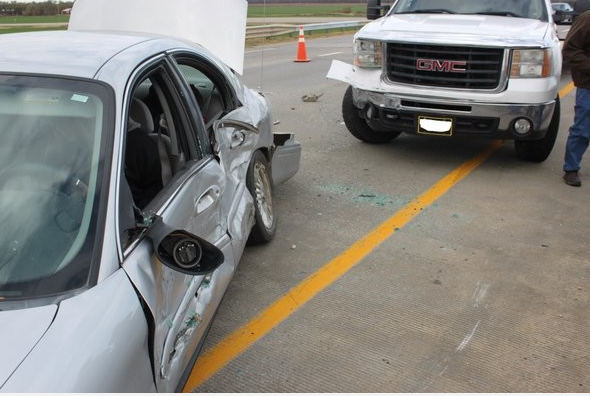
Three vehicle collision near the State Street exit on Interstate 135 Friday morning (Photo: Kansas Highway Patrol)
SALINA- A Kansas woman was injured in an accident just before 10a.m. on Friday in Saline County.
The Kansas Highway Patrol reported a 2004 Mercury passenger vehicle driven by Maria Teresa Haynes, 65, Salina, was entering Interstate 135 southbound in the construction zone.
The driver failed to obey the instructions of the flagman and pulled into the southbound lanes.
The vehicle was struck in the side by a 2009 GMC pickup driven by James D. Oblinger, 52, Wymore, Nebraska.
The GMC then struck the trailer of a 2011 Ford pickup driven by Jerry L. Vargas, 55, Salina.
Haynes was transported to Salina Regional Medical Center.
Oblinger, Vargas, and a passenger in the GMC were not injured.
All were properly restrained at the time of the collision, according to the KHP.
Emporia State officials allowed reporters back into the event after discussing the issue with the university’s general counsel.
Emporia State’s Interim President Jackie Vietti said the reporters were asked to leave the event because students thought the forum would not be open to the media. She said the university would work to avoid that confusion in the future.
The Kansas Press Association says denying media access to a public meeting would be a violation of the state’s open meetings law.
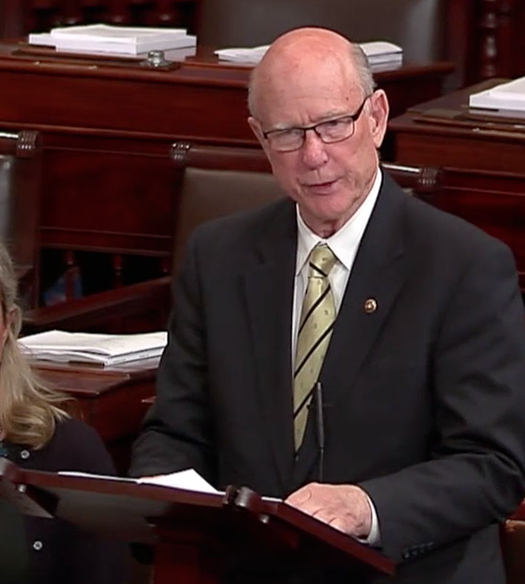
WASHINGTON, DC – U.S. Senator Pat Roberts (R-Kan.) this week spoke on the Senate floor emphasizing that in the wake of the recent terror attacks, now is the “absolute” wrong time for the administration to be putting forth a plan to relocate Guantanamo Bay detainees to the United States mainland, particularly when there has been no intelligence assessment on the danger of such a move. Watch Senator Roberts’ address here.
“The question is, how can the Administration ask Kansans, or any Americans, to paint a bullseye on their community without providing assurances that moving detainees to the U.S. will not pose a threat to them or our national security?” Roberts said. “It seems unfathomable, and yet, this president is proposing to do just that.”
“As our nation memorializes those who perished in France, it is the absolute wrong time for President Obama and this Administration to be putting forth a plan to relocate Guantanamo Bay detainees to the United States mainland.”
He continued, “We must put national security back as our top priority. It must be our first duty in the Congress, and by the Commander-in-Chief. America’s national security is my top priority and bringing Guantanamo Bay detainees to the United States is not putting our nation’s security above politics, campaign promises, or anything else.”
He noted that the administration was set this week to release a plan with options for the relocation of terrorists currently detained at Guantanamo Bay. The White House has announced that the release of the plan has now been delayed.
Roberts yesterday wrote a letter to Secretary of Defense Ash Carter demanding answers about the intelligence on the consequences to national security of this move, saying “How can the Administration decide that moving these terrorists is in our best interests if we do not have an analysis of the threats? With both the American people and the Congress opposed to this executive action, how is the President reaching this decision?”
Roberts also noted that U.S. Attorney General Loretta Lynch agrees that “if the president acts by Executive Order, he is acting unconstitutionally.”
WICHITA – Law enforcement authorities in Sedgwick County continue to search for a suspect involved with a robbery this week at Emprise Bank 2323 S. Hydraulic in Wichita.
The suspect is described as a Hispanic or mixed race black/white man in his mid 30s, 6-feet tall and weighs approximately 180 pounds, according to a police report on social media.
The suspect was wearing a black Chicago Bulls hat, a dark brown jacket, a black hoodie and black sunglasses.
He had a scruffy beard, New Balance shoes and had a grey iPhone.
Police asked anyone with information about this person, to call Investigations at 316-268-4407 or Crimestoppers at 316-267-2111.
DETROIT (AP) — Hyundai is recalling nearly 305,000 Sonata midsize cars because the brake lights can stay on when the driver isn’t stopping.
The recall covers cars from the 2011 and 2012 model years.
The company says the stopper pad between the brake pedal and the plunger that turns the lights on can deteriorate. That can make the plunger stick and cause the brake lights to stay illuminated. Also, the transmission could be shifted out of park without the brake on, and the system that lets the brakes override the gas pedal may not work.
Hyundai says no crashes or injuries have been reported.
The company plans to tell owners to take their cars to dealers to have the stopper pad replaced. No date has been set for the recall to start.
A Kansas City Council committee approved three anti-smoking measures on Wednesday. CREDIT MARIUS MELLEBYE / CREATIVE COMMONS-FLICKR
KANSAS CITY, Kan. (AP) — Officials on both sides of the Kansas City state line have approved ordinances raising the minimum age for purchasing tobacco products and alternative nicotine items to 21.
Kansas City, Missouri Council members on Thursday approved the measure on an 11-1 vote. The Unified Government of Wyandotte County.
Kansas City, Kansas approved a similar measure on a 6-1 vote Thursday night.
Supporters say raising the legal age to 21 will make it harder for younger smokers — including 18-year-olds who are still in high school — to obtain tobacco products and provide them to younger friends and relatives.
The Greater Kansas City Chamber of Commerce is leading the effort to have the ordinance passed in all cities in the metropolitan area.
John Richard Schrock is a professor at Emporia State University.
To a sociobiologist, our controversy over immigrants is a debate about inborn tribal instincts versus the higher cerebral capabilities only humans possess.
Tribalism is our inborn preference for “us” over “them.” Our tribe can be our religion, our country, our race, our language, our political group, and most definitely our family and relatives.
Recently in biology we have attributed our self-centeredness to shared genes. We point to the fact that, similar to many animals, we give preference to our young. Biology calls it “kin selection.”
But selfish genes fail to explain why we go to war to protect those unrelated to us. Favoring our own young does not explain why we adopt babies from foreign lands. Nor does it explain why so many fans in a college stadium go wild for a team of unrelated classmates but feel grievous loss when we lose to “others” who are no more distantly related.
In prehistoric times, the instinct to bond with our parents and extended family members was a matter of survival of a small tribe. It is the mentality of the herd, the flock, the pack, or the school of fish.
But in a world of seven billion, we have to overcome those tribal instincts and use our far higher mental capacity to find fair and humane ways to treat each other.
As an educator, I am uncomfortable with the way we practice youngsters in tribalism. Live on one side of town and you attend a school that chants: “Go Mustangs, Kill Bulldogs.” Then the student moves to the other side of town and the school chants: “Go Bulldogs, Kill Mustangs.”
Unfortunately, our primal instinct to protect ourselves by barricading the doors and keeping “others” out disregards the fact that most of us trace back to immigrant ancestors. Once we were “others.” Our tribal lineage was not kind to others who were Mormons or African slaves. And when we felt threatened, we felt justified in sending thousands of law-abiding Japanese Americans to internment camps during World War II. Despite some living here for generations, we still considered them “others.”
Meanwhile we ignore the terrorist acts of those who came from inside our tribe—like Timothy McVay and Terry Nichols who bombed the federal building in Oklahoma City.
And when we march to war, it becomes difficult to suppress tribalism and act humanely and objectively. Tribalism guarantees that the reporters from two sides will report the same event differently. Once we succumb to war fever, an objective observer who points out this distortion is likely to be penalized by the tribe.
Tribalism drives the drumbeat toward war. You can hear it in American reporting toward China, Russia and the Middle East—they are not OUR tribe.
But our ability to rise above tribalism and understand the sweep of humanity has resulted in some of our finest hours in history. The Marshall Plan, where America contributed to rebuilding Germany after World War II to prevent the punitive tribal mistakes we made after World War I, is an example of recognizing the dignity of others who were our defeated enemies.
But George Kennan, the author of the Marshall Plan, saw such acts as exceptions. His plan would have never been approved by the voting populace. It was the wisdom of a few leaders. Kennan contended this was a major weakness of a democracy: the vulgarity of elections. In order to keep office, a highly intelligent statesman who understands the correct and just actions that need to be taken, will nevertheless have to support a bad policy in order to be re-elected.
“Close our borders” is a perfectly normal knee jerk tribal response. But it is the grunting of cave men ancestors who lived in fear and retreated to defend their cave.
Humans are a mix of animal and angel. We have evolved the intelligence to rise above knee jerk tribalism. Other animals lack the talent to see outside their self interest. Only we have the ability to see the global picture and that we too could be the refugees in a war-ravaged land.
Leaders in Great Britain and Canada and even France—despite its losses—have risen above tribalism to accept tens of thousands of others. They know that it is the better part of being human to stare into the eyes of a refugee child—and understand: “there, but for the sake of God, go I.”
ANDERSON COUNTY- A Kansas man died in an accident just before 4:30p.m. on Thursday in Anderson County.
The Kansas Highway Patrol reported a 2001 Peterbilt Grain Grinder driven by Chad R. Collins, 39, Waverly, was westbound on 1600 Road five miles west of Garnett.
The vehicle went into the north ditch, came back out of the ditch onto the road, overturned and came to rest in the south ditch.
Collins was pronounced dead at the scene and transported to Frontier Forensics.
He was properly restrained at the time of the accident, according to the KHP.