MANHATTAN — Kansas State University in Manhattan has been designated the first bicycle friendly university in Kansas by the League of American Bicyclists, according to a media release from KSU.
The university has received the bicycle organization’s Bronze-Level Bicycle Friendly University award. In all, the league awarded or renewed bicycle friendly status to 49 universities in 31 states this year, bringing the total of designated bicycle friendly universities and colleges to 127 in the nation.
The Bicycle Friendly University program recognizes institutions of higher education for promoting and providing a more bikable campus for students, staff and visitors. The program provides the road map and technical assistance to create great campuses for cycling.
“Being designated as a bike friendly campus is something to be proud of,” said Derek Jackson, director of Kansas State University’s Housing and Dining Services. “Students and staff are biking more and more for both transportation needs as well as for recreational wellness. Having infrastructure that supports biking is important to our campus and community.”
Kansas State University encourages bicycling as an easy option for transportation and continues to improve the bicycle friendly nature of campus as called for in the university’s 2025 strategic plan.
According to Mark Taussig, associate director for campus planning who will serve as the university’s contact for the Bicycle Friendly University program, some of the steps the university has taken to be more bike friendly include developing master plan guidelines and standards for pedestrians and bicyclists; improving lighting, especially at intersections and crosswalks; adding appropriate pavement markings at crosswalks, on streets and on sidewalks; creating 3.3 miles of shared pedestrian/bicycling paths around the campus on Kimball, Denison, North Manhattan and College avenues; adding bike lanes and bike routes on city streets, including on North Manhattan and Denison avenues; and adding hundreds of new bike parking spaces on campus.
Increased awareness and enforcement of pedestrian and bicycle regulations have been priorities, as well as realigning some key intersections for improved safety, Taussig said. In addition, the university is taking out streets and replacing them with wide walkways, or malls, for pedestrians and bicyclists. One of the malls was built this year on a quarter-mile section of 17th Street on campus, with another mall planned in 2016 that will cover mile on Mid-Campus Drive.
Doug May, transportation planning intern for the Flint Hills Metropolitan Planning Organization and master’s student in regional and community planning, spent several months collecting data and preparing the application for the Bicycle Friendly University designation.
“Using the knowledge and skills I learned in the planning program at K-State, and through my internship with the Flint Hills Metropolitan Planning Organization, I was able to prepare the comprehensive Bicycle Friendly University application,” May said. “I’m looking forward to the future of K-State as it continues to grow and move even more toward a bicycle- and pedestrian-friendly environment.”
With the designation, the university will have access to a variety of free tools and technical assistance from the League of American Bicyclists to become even more bicycle friendly.
To learn more about the multimodal efforts underway at Kansas State University, the surrounding community or in the region, contact the Flint Hills Metropolitan Planning Organization at [email protected] or 855- 785-3472. To learn more about the Bicycle Friendly University program, visit bikeleague.org/BFA.
NEW YORK (AP) — Honda is recalling more than 25,000 cars in the U.S. to replace the rear grab rail brackets, which it says could interfere with the deployment of a side curtain air bag.
The carmaker says no such instances have been reported and that it discovered the faulty design during internal testing.
The company says owners of affected vehicles should go to authorized dealers once they receive notification of the recall. It says notifications will be mailed to customers starting in early December.
The recall affects 25,367 of the Fit LX vehicles, model year 2015-2016.
Owners can also determine if their cars will need repair by going to www.recalls.honda.com or by calling (888) 234-2138.
(Front left to right: Governor Brownback; Jose Wooge; Jenesis Wooge. Back left to right: Cory Rathbun, VP Foster Care Reintegration; Ashley Lang, DCF Foster Care Program Manager; Patricia Long, DCF Permanency Program Administrator; Gail Cozadd, KSCL East Region Director; Natalie Gorman, KVC Adoption Specialist; Michael Myers, DCF Prevention and Protection Services Director; Erin Wooge; Stephanie Wooge; Grace Wooge; Dave Wooge; Destiney Wooge)
Kansas Department for Children and Families
TOPEKA–When you’ve taken more than 130 children into your home as foster parents, most would think they’ve done more than enough to help others. But for Dave and Stephanie Wooge of Franklin County, adopting a few of those who needed a permanent home was just the next logical step.
For the past 17 years, the Wooges have taken placements of many children with various levels of behavioral issues, developmental needs, mental health issues, educational needs, medical diagnoses, physical challenges, various cultures, and histories of abuse.
But when the opportunity presented itself to make some of those children a part of their family, the Wooges, who live in a rural home outside of Ottawa, decided it was the right thing to do. They have adopted or taken guardianship of seven children, with the last three being a sibling set.
Stephanie Wooge said she and her husband first became interested in foster care when a relative served as a foster parent to a child. Once aware of the need, they began incorporating foster children into their own home, where they also have parented two biological children.
“We realized if we don’t do it, who will?” Stephanie said. “All children deserve to have a home, to experience family life.”
The Wooge family met with Governor Sam Brownback on Oct. 30, to participate in the official proclamation signing of November 2015 as Adoption Month in Kansas. During the month, the Kansas Department for Children and Families (DCF), its contractors and community partners are taking part in a series of events to call attention to the need for more adoptive and foster families.
“It hasn’t been difficult integrating the adopted children into our family,” Stephanie said. “It’s been that way for our biological children ever since the oldest was two years old. The biggest reward is watching the kids grow and learn how to be a part of a family. But that can also be a challenge for our adopted children learning how our family works.”
DCF contracts with KVC and Saint Francis Community Services to provide foster care and adoption services for Kansas. DCF and its partners hope more families like the Wooges will recognize the need for adoptive families during November. Currently, there are approximately 350 children available for adoption in Kansas.
“Every child deserves to know the love and stability that a healthy family can offer,” DCF Secretary Phyllis Gilmore said. “When returning home is not a safe option, we want children to have choices when it comes to both temporary and permanent care.”
Most children available for adoption have experienced abuse and or neglect. Every attempt is made to maintain a child’s connection to his/her relatives, culture and community. Relatives are given first consideration as a placement option. Although many children have an adoption resource identified, hundreds wait for a loving family to pick them.
The Wooges are one of eight families nominated for the Kathy Reilly Adoptive Family Award, an annual honor given by KVC to one of their adoptive families “who has risen above and beyond with regards to adoption.” The award will be announced during KVCs National Adoption Day celebration in Olathe on Nov. 20.
I’m so glad the State is celebrating Adoption Month, because there are so many more kids in the system who need a family,” Destiny Wooge said, the oldest of the three siblings recently adopted into the Wooge family. “Hopefully by raising awareness, a lot more children will get to experience the love and affection of a family.”
Nov. 21 is National Adoption Day this year. In several locations across Kansas, judges will finalize adoptions that have been coordinated by KVC and St. Francis. As the final step of the adoption process, these events are often emotional culminations of months of effort. Celebrations at Shawnee County Courthouse (9 a.m.) and Johnson County Courthouse (10 a.m.) will be open to the public and to media. On Nov. 20, a similar celebration of adoptions will be held at Wyandotte County Courthouse (1 p.m.).
Numerous other events will occur statewide to celebrate and promote adoption. Churches across the state will recognize Adoption Sunday on Nov. 8.
MEDFORD, Okla. (AP) — The U.S. Geological Survey reports a series of earthquakes along the Oklahoma-Kansas border — including magnitude 4.2 and 4.1 temblors near Medford.
Emergency management and law enforcement officials say no injuries or damage are reported.
The 4.2 quake was recorded at 12:29 p.m. Saturday nine miles northwest of Medford, the same area where a 4.1 magnitude quake was recorded at 5:11 a.m. Reports on the USGS website say it was felt in Oberlin, Kansas, some 400 miles away.
The two are among 11 earthquakes in north-central Oklahoma and south-central Kansas. The others ranged from magnitude from 2.5 to 3.5.
The Oklahoma Geological Survey has said many recent earthquakes in the state likely were triggered by the injection of wastewater from oil and natural gas drilling operations.
LOLITA C. BALDOR, Associated Press
KATHLEEN HENNESSEY, Associated Press
WASHINGTON (AP) — U.S. officials say the Pentagon’s plan outlining the long-stalled effort to close the Guantanamo Bay detention center, expected next week, includes details suggesting that the Centennial Correctional Facility in Colorado is one suitable site to send detainees whom officials believe should never be released.
The plan represents a last-gasp effort by the Obama administration to convince Congress that detainees who can’t be transferred safely to other countries should be housed in a U.S.-based prison.
Administration officials say the plan makes no recommendations on which U.S. site is preferred and provides no rankings. But it lists the seven prison sites in Colorado, South Carolina and Kansas visited by officials and includes advantages and disadvantages.
The officials spoke on condition of anonymity because they aren’t authorized to discuss the matter publicly.
HAVEN– A Kansas man was injured in an accident just before 6p.m. on Friday in Reno County.
The Sheriff’s office reported a combine driven by Leroy Schmidt was traveling on Parallel at Rayl Road when the vehicle rolled off a bridge and into a culvert.
Schmidt was ejected from the combine and trapped under the header.
Haven EMS and Fire freed him and transported him to a Wichita hospital for head and back injuries, according to the sheriff.
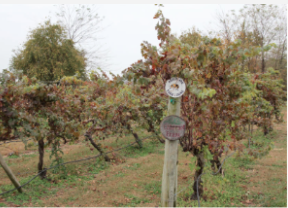
A ‘pesticide free zone’ sign hangs at the Somerset Ridge Vineyard and Winery near Paola, Kansas. Owner Dennis Reynolds says potential changes to the state’s weed eradication laws could threaten his vineyard. CREDIT ANDY MARSO / HEARTLAND HEALTH MONITOR
The rows of grapevines at Somerset Ridge Vineyard and Winery near Paola, Kansas, are withering, with dying leaves and shriveling fruit.
But that’s expected this time of year.
The prospect of it happening in the middle of the growing season concerns owner Dennis Reynolds more. Grapes are a sensitive crop, especially when it comes to herbicides that may drift over from neighboring farms or ditches.
“In certain states their use is heavily restricted or banned in certain areas,” Reynolds said of the chemicals that kill weeds. “But in a state like Kansas — where sensitive crop producers are very small in number and economic impact so far, whereas large-scale farmers that use these herbicides have much more political power — then we see kind of unfettered usage of them.”
The Kansas Legislature is mulling changes to its weed eradication laws — changes that could affect where and when such herbicides are sprayed.
Senate Bill 134 https://www.kslegislature.org/li/b2015_16/measures/sb134/ would shift the responsibility for determining which plants should be designated “noxious weeds,” and subsequently targeted for destruction, from the Legislature to the Kansas Department of Agriculture. It also would give more latitude to individual counties to designate noxious weeds and spray them with increasingly caustic substances.
Proponents say the changes will inject more science into the process of weed eradication and enable government to move more quickly to get rid of invasive species before they crowd out cash crops and good livestock forage.
But opponents worry that big business will control the process and that the chemicals used to eradicate problem weeds will have unintended consequences not only for products like Reynolds’ grapes but for human health.
Advisory panel
Kansas has 12 weeds declared “noxious” by the Legislature, including the white-flowered Sericea lespedeza and the thorny-looking musk thistle.
Chad Bontrager, deputy secretary of the Kansas Department of Agriculture, said the current definition of a noxious weed in state law is “a little bit circular.” It basically states that a noxious weed is any weed that the Legislature has declared noxious.
Once a weed is declared noxious, landowners are required by law to control and limit it on their property https://agriculture.ks.gov/docs/default-source/statutes-ppwc/noxious_weed.pdf?sfvrsn=2 . Government subsidies for herbicides — the preferred control method — are provided https://agriculture.ks.gov/divisions-programs/plant-protect-weed-control/noxious-weed-control-program . County weed directors are empowered to go onto any property and eradicate weeds at the owner’s expense if the owner does not comply with the law.
Bontrager told the Legislature’s joint 2015 Special Committee on Agriculture and Natural Resources https://www.kslegislature.org/li/b2015_16/committees/ctte_spc_2015_special_committee_on_agriculture_a_1/ last month that a host of factors should be taken into account when deciding whether a weed is “noxious”: Is it an invasive species? What’s its life span? What are its reproductive methods, annual seed production and germination? Is it a host for pests or pathogens? And what effect does it have on native species?
While the Legislature may consider all those factors, under current law it’s not a requirement.
“The Department of Agriculture would like to see a more rigorous, scientific and objective evaluation of potential noxious weeds in order to ensure we’re doing all we can to protect plant health and land owners in our state,” Bontrager said.
SB 134 would give the agriculture secretary the final word in declaring weeds “noxious,” after consulting with an 11-member advisory committee. The committee members, appointed by the secretary, would be:
Three private landowners.
Two weed specialists from Kansas State University recommended by university officials.
Two agriculture industry representatives recommended by the Kansas Agribusiness Retailers Association.
Two county weed directors recommended by the Kansas County Weed Directors Association.
One county commissioner recommended by the Kansas Association of Counties.
One natural resource management professional from the Kansas Department of Wildlife, Parks and Tourism.
The agribusiness retailers association and the Kansas Cooperative Council are on board with the changes. Lobbyists for those organizations said they usually prefer that new mandates be made by the Legislature through statute rather than through rules and regulations from executive branch officials. But in this case, the desire to take a more scientific approach to noxious weed designation trumped that philosophy, they said.
Absent from the advisory council is any seat specifically for those who produce herbicide-sensitive crops like grapes or cotton.
“We would certainly want the sensitive crop growers to be represented on any such advisory committee,” Reynolds said.
Paul Johnson is a lobbyist for the Kansas Rural Center, a nonprofit focused on sustainability.
Johnson said one of the three landowner seats on the advisory board should go to a sensitive crop producer. In addition, he said, the board should include a seat for someone from an environmental group like the Sierra Club or Audubon of Kansas.
Zack Pistora, the Kansas Sierra Club’s lobbyist, suggested the panel should include an expert from the Kansas Department of Health and Environment to advise on herbicide toxicity.
“The bugs and superweeds are starting to happen, so we’re escalating the type of chemicals we’re using,” Pistora said. “It’s a concern.”
Counties get more leeway
Johnson also is concerned about the increasing toxicity of herbicides used to kill noxious weeds.
He believes another provision in SB 134 would give city and county governments the authority to declare any weed not on the state list noxious in their jurisdiction, and allow county officials to use any chemical herbicide to kill it on public lands — even chemicals not on the state’s cost-sharing list https://agriculture.ks.gov/docs/default-source/pp-noxious-weed-control/cost-share-herbicides.pdf?sfvrsn=0 .
Johnson said many weeds used to be controlled with a chemical herbicide called glyphosate, commonly known by its commercial name, Roundup.
But as plants have developed resistance to that, a more powerful herbicide known as 2, 4-D has been employed.
“I think we’re at the point where agribusiness is getting real concerned about the weed situation because they’ve overused glyphosate and Roundup Ready, and more superweeds are coming into the process,” Johnson said. “They just want a quicker way to identify plants they can’t control with regular herbicides that we have today and just step up the toxicity.”
He fears that the noxious weed law is on its way to being streamlined so that more weeds can be added and more toxic herbicides can be used without deliberation during the legislative process — a process that ensured environmentalists were able to air their concerns during committee hearings.
Any changes to the noxious weed law, he said, should include a provision requiring landowners to use the “least toxic chemicals in regards to human and animal health” as they start trying to eradicate their weeds and then step up from there.
A 13-nation study on the cancer-causing potential of 2, 4-D was published in June in The Lancet https://www.thelancet.com/journals/lanonc/article/PIIS1470-2045%2815%2900081-9/fulltext . The researchers determined there was “inadequate evidence” of a link between cancer and high levels of 2, 4-D exposure in workers who manufacture and apply the substance.
But there is evidence that the herbicide can cause damage to crops like grapes, even at far lower application rates than those recommended by the product label https://www.extension.purdue.edu/extmedia/ho/dw-10-w.pdf .
It also tends to drift farther than other herbicides — a concern for people like Reynolds.
There are other methods for preventing and controlling problem weeds, but herbicides frequently are the most effective.
Pistora of the Sierra Club said controlling noxious weeds is important to protect native plants and animals, but a judicious, deliberate approach to eradicating problem weeds is best.
“It is a balance,” he said.
Andy Marso is a reporter for Heartland Health Monitor, a news collaboration focusing on health issues and their impact in Missouri and Kansas.
ANDOVER –Two Kansas men, including a sheriff’s deputy were injured in an accident just before 8p.m. on Friday in Butler County.
The Kansas Highway Patrol reported a 2013 Dodge Charger driven by Butler County Sheriff’s Deputy Kevin M. Kichler, 38, El Dorado, was southbound on Butler Road in Andover.
The Charger attempted to make a left turn onto 120th and turned in front of a 2004 Toyota Rav 4 driven by Albert N. Gale, 59, Rose Hill.
The Toyota struck the Charger in the rear passenger door.
Kichler and Gale were transported to Wesley Medical Center. Gale was not wearing a seat belt, according to the KHP.
TOPEKA–Kansans of all ages who love history will have the opportunity to celebrate their interest in several upcoming photography and essay contests.
The annual Kansas Factual Story Contest, sponsored by the Native Sons and Daughters of Kansas, encourages preserving factual, unpublished happenings and anecdotes from today and yesterday. The contest is open to everyone with one entry per person. Stories must be true and unpublished, take place in Kansas, and limited to 750 words. Entries are submitted electronically via email by 5 p.m. December 11, 2015, to Terry Marmet, Kansas Historical Foundation, [email protected] <mailto:[email protected]>. Submissions should use “Beech Memorial Contest” in the subject line, and include the author’s name, mailing address, and phone number, and email.
Olive Ann Beech, of Wichita, provided essay contest winners with cash awards for more than 30 years. Following her death, her daughter, Mary Lynn Oliver, Wichita, has continued this support. The Beech Memorial cash awards are: first place, $175; second place, $125; third place, $100; and $50 each for two honorable mentions. Entries will be judged on quality of writing and interesting anecdotal stories of Kansas.
The annual essay contest, /Kansas! Say It Above a Whisper, /sponsored by the Native Sons and Daughters of Kansas, is open to Kansas students in grades eight through 12. Essays are limited to 250 words and should celebrate and express pride in the state. Entries are submitted electronically via email by 5 p.m. December 11, 2015, to Terry Marmet, Kansas Historical Foundation, [email protected] <mailto:[email protected]>. Submissions should use “Boyd Essay Contest” in the subject line, and include the author’s name, school, grade, mailing address, and phone number.
Early day Kansas newspaperwoman Mamie Boyd coined the phrase used for the contest title. Her family continues to provide the cash award for the first place winner. Past essays have described interesting and strong-hearted Kansans, the state’s vast grain crops and grasslands, diversities in population, and the emotions and pride called to mind by the state’s unique beauty. Entries will be judged on quality of writing, originality, creativity, and sincerity in expressing pride in the state of Kansas.
Winners of both essay contests will be announced and recognized at the annual meeting of the Native Sons and Daughters of Kansas Friday, January 29, 2016, in Topeka.
The Happy Birthday, Kansas! student photo contest is in its second year and open to Kansas students from first through 12th grade. The contest encourages students to capture images that depict everyday life in their communities. Students can submit up to five entries online, the contest deadline has been extended to December 11, 2015. Submit entries at happybirthdayks.org, where further information and contest rules are available. Winners will be announced as part of the state’s 155th birthday commemoration at the Kansas State Capitol on January 29, 2016. The 12 first place winner will receive iPads; the 12 second place winners will receive Kindles. The inaugural contest in 2014 drew more than 570 entries from 55 Kansas counties. Contest is sponsored by the Kansas legislative spouses in conjunction with the Kansas Historical Society.
The Kansas Historical Society will preserve the essays and photographs in their collections.
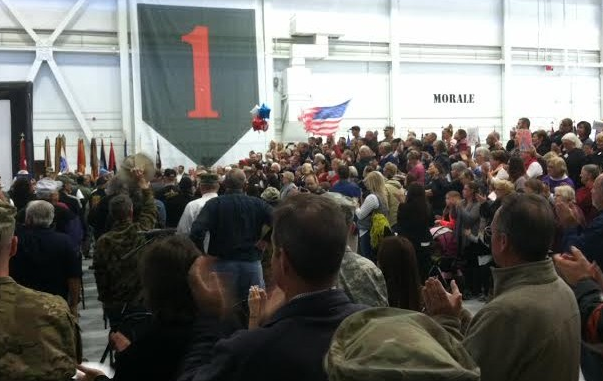
FORT RILEY-The crowd cheered, the band played, and there were standing ovations for approximately 150 Vietnam veterans at Fort Riley on Friday.
The occasion….a Welcome Home Ceremony hosted by Fort Riley.
This is the 50th anniversary year of the Vietnam War. During the Welcome Home event Major General Wayne Grigsby Jr. told the veterans they were part of the long legacy of warriors that graced the history of this country.
“We honor here the burdens borne by our brothers and sisters that served in Vietnam fully knowing that they were not embraced as they should have been when they came home. The failure of our nation to care for the Vietnam veterans did not keep them from caring for one another, and all our veterans. Vietnam veterans have gone above beyond to make sure that the current generation….my generation, of soldiers, sailors, airmen, and marines, do not have the same experience they did.”
The audience at Building 853 at Marshall Army Airfield joined inthe singing of the Big Red One song and the Armed Forces Medley during the program.
Afterwards, Vietnam Veteran Buzz Bruzina of Junction City called the ceremony “Unforgettable absolutely. It brings tears, chokes me up.”
Vietnam veteran Jim Fawcett felt the ceremony helped. “Oh yeah, I still got some ghosts I got to get rid of, but it helps.” On his message to fellow Vietnam veterans Fawcett stated simply, “Welcome home!”
WICHITA, Kan. (AP) — A Kansas man has been sentenced to nearly five years in prison for robbing three businesses while his young children were in his getaway car.
The Sedgwick County prosecutor’s office says Charles Emerson, 26, Wichita, pleaded guilty in September to one count of aggravated robbery and three counts of robbery. He was sentenced Friday in Sedgwick County District Court to 59 months in prison and ordered to pay more than $1,100 in restitution.
Prosecutors say Emerson was armed with a pistol on April 21 when he robbed an X-Citement Video, Quik Trip and Petro America in Wichita within 90 minutes. His 10-month-old daughter and 5-year-old son were asleep in the back seat of the car during the robberies.
Emerson’s girlfriend is scheduled to be sentenced on similar charges in December.
WASHINGTON, DC – U.S. Senators Pat Roberts and Jerry Moran on Friday expressed disappointment in response to President Obama and his administration’s rejection of the Keystone XL Pipeline:
Disappointed the president is putting special interest politics ahead of increases in energy security and American jobs #KeystoneXL
Roberts also issued a statement, “the president has lost an opportunity to create 42,000 jobs. Once again, despite the overwhelming support for this project among the American people, Congress and prominent labor unions, President Obama has again decided to ignore them and act alone. I had hoped the President would rise to the occasion, put commonsense above ideology, American jobs over a liberal agenda and make the long overdue Keystone Pipeline a reality.”
“Instead, it appears the President is posturing in advance of the Paris climate talks in a desperate attempt to strike a climate deal that will also not meet the approval of the American people.”
The Keystone XL Pipeline project took seven years to review. Senator Roberts voted for a bill, which was approved by the House and the Senate, to construct the Keystone Pipeline. President Obama vetoed the bill in February.
TOPEKA, Kan. (AP) — Gov. Sam Brownback’s administration is recommending against granting emergency state aid to most Kansas school districts that plan on seeking funds at an upcoming meeting with lawmakers.
The Topeka Capital-Journal reports superintendents were sent a message from the Kansas State Department of Education on behalf of the Division of Budget. The message says giving certain districts extra aid would not benefit them until next year because school budgets for this fiscal year have already been set.
The message directed at 17 of 23 districts that applied for aid suggested they apply for money next year and that attending the State Finance Council meeting on Monday is not necessary.
The governor’s office said Thursday that the message was meant as a courtesy advance notice to the superintendents since many district representatives would be driving to Topeka from western Kansas.
 MANHATTAN — Kansas State University in Manhattan has been designated the first bicycle friendly university in Kansas by the League of American Bicyclists, according to a media release from KSU.