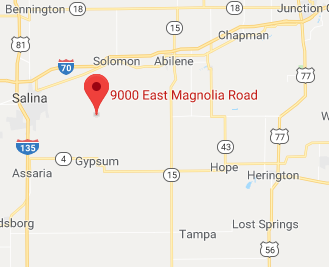
SALINE COUNTY — A 27-year-old woman and a two-year-old boy had to be rescued by Saline County Sheriff’s deputies Sunday night after attempting to drive onto a flooded roadway in the eastern part of Saline County.
Deputies were sent to the 9000 block of East Magnolia Road for the report of a vehicle stalled in floodwaters, according to Saline County Sheriff Roger Soldan.
He said deputies waded into the water covering the roadway to rescue the woman from Abilene and child.
HUTCHINSON — Law enforcement authorities are investigating a reported Monday morning stabbing in Hutchinson
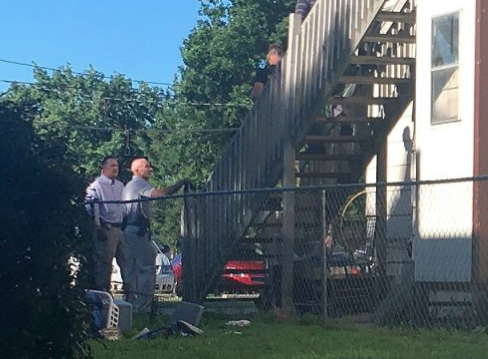
Police on the scene of the reported stabbing investigation at an apartment in Hutchinson
Just before 8a.m., police were called to an apartment in the 500 block of East 3rd Street, according to scanner traffic. The victim believed to be in his 50s was stabbed in the neck.
A woman also in the apartment was wounded. However, she may be the suspect in the stabbing, according to Hutchinson Police Chief Jeffrey Hooper. Hooper said he did not know at this point if it was a domestic incident. Hooper said there is a lot of blood.
The victim was taken to Hutchinson Regional Medical Center in critical condition and a medical helicopter was requested.
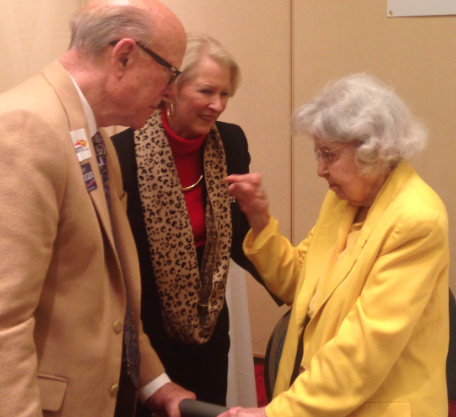
TOPEKA, Kan. (AP) — Longtime Rep. Jan Meyers, the first Republican woman elected to the U.S. House from Kansas, has died.
Meyers died Friday at the age of 90 at a nursing home where she was living. The cause of death was not announced.
A native of Nebraska, Meyers lived in Overland Park, Kansas, while representing the state’s 3rd Congressional District from 1985 to 1997. Before that, she served in the Kansas Senate from 1972 to 1984.
Kansas Gov. Laura Kelly on Monday ordered flags flown at half-staff at the Capitol complex to honor Meyers.
Congresswoman Jan Meyers was a trusted colleague, but most importantly a friend. I always looked up to Jan and depended on her advice and counsel during my time serving alongside her in Congress. pic.twitter.com/GDgFhenAjG
— Senator Pat Roberts (@SenPatRoberts) June 21, 2019
Kelly said in a statement she respected and admired Meyers, whom she called “a groundbreaking public servant.”
Sen. Pat Roberts called Meyers a trusted colleague who set a great example for future generations.
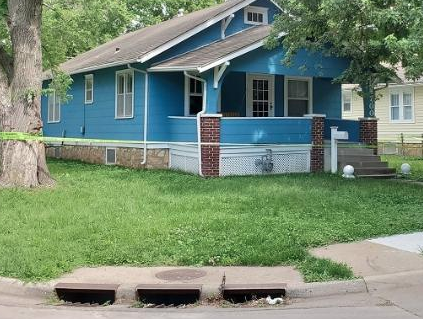
Crime scene tape in the yard of the home photo by Grant Stephens courtesy WIBW TVSHAWNEE COUNTY — Law enforcement authorities are investigating the death of a Kansas man and asking the public for help with information.
Just before 10a.m. June 17, police were dispatched to a residence in the 700 block of SW Wayne in Topeka in reference to the discovery of the body of a man in the home, according to Lt. Andrew Beightel. The victim was later identified as 36-year-old John K. Waller of Topeka.
Police are asking the public to come forward with any information related to this case. Specifically, police are asking anyone in the area of SW 6th Ave. and SW MacVicar Ave. between June 3 and 4 to remember if they saw or heard any suspicious activity. Police need anyone in the area with a home surveillance system or cameras to review them for even the smallest detail.
The Shawnee County Crime Stoppers is offering up to a $2,000 reward for information that leads to an arrest in this case.
———-
SHAWNEE COUNTY — Law enforcement authorities are now investigating the suspicious death of a Kansas man and have identified the victim.
Just before 10a.m. Monday, police were dispatched to a residence in the 700 block of SW Wayne in Topeka in reference to the discovery of the body of a man in the house, according to Lt. Andrew Beightel.
Officers located the body identified as 36-year-old John K. Waller and he was pronounced dead by medical personnel.
There were several suspicious circumstances witnessed by the responding officers so, the residence was secured and crime scene officers and detectives investigated the scene.
Through evidence found at the crime scene and information from the coroner’s office, police are investigating this crime as a homicide
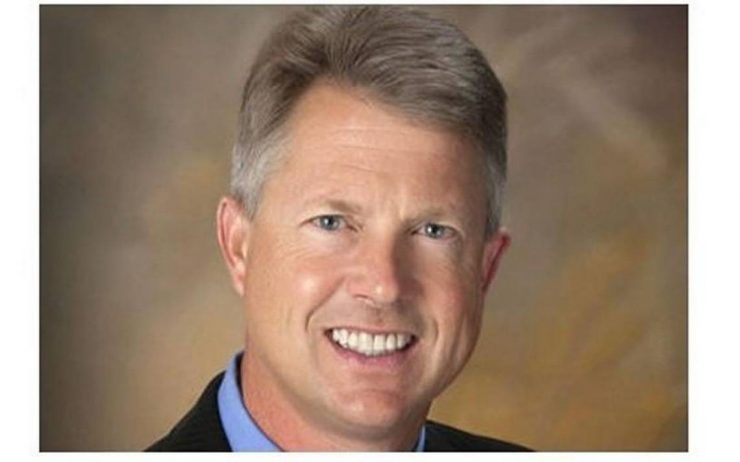
Dr. Roger Marshall, R-Great Bend, is the First District Kansas Congressman.Friends,
I recently led a letter with my Kansas House delegation colleagues to President Trump requesting that he quickly approve Governor Kelly’s request for a Major Disaster Declaration in Kansas. Over 60 counties across the state have been impacted by severe storms, straight-line winds, tornadoes and flooding, with many communities struggling to recover.
President Trump granted a Major Disaster Declaration for the state of Kansas, which triggers federal funds to help communities recover from these severe weather incidents. This declaration opens the entire state of Kansas to the Hazard Mitigation Grant Program through the Federal Emergency Management Agency (FEMA). Eligible affected counties can now receive public assistance for rebuilding public facilities and infrastructure. These counties are also eligible for Disaster Loan Assistance through the Small Business Administration (SBA), which can help communities, businesses and homeowners. More information on the SBA’s Disaster Loan Assistance program can be found HERE!
My colleagues and I here in Washington will continue to work with the Administration, FEMA, and Small Business Administration to ensure that Kansans have the tools and resources they need to get through these difficult times.
More News From the USDA
USDA’s Risk Management Agency this week announced changes to its haying and grazing program to accommodate those who planted a cover crop on Prevented Planting Acres.
For 2019 only, farmers who planted a cover crop on prevented planted acres will be permitted to hay, graze or chop those fields starting September 1 and still retain their eligibility for a full 2019 prevented planting indemnity. This is a change from the normal November 1 starting date. The move is intended to help farmers who were unable to plant because of excessive rainfall and flooding this spring but will be able to utilize the land for forage or livestock grazing this fall.
I applaud the USDA for the small but substantial change to its policy to help farmers recoup from lost planting opportunities and realize as much productivity out of their land as possible.
Talking with Sec. Chao
As a member of the Congressional Western Caucus I had the opportunity to meet with Department of Transportation Secretary Elaine Chao to discuss transportation and infrastructure priorities back in Kansas. Thanks to efforts from Kansas Livestock Association, the Livestock Marketing Association, and the National Cattleman’s Beef Association, Sec. Chao has heard from many of our beef and pork producers on the burden that Electronic Logging Devices (ELD) cause for livestock haulers. This was a great opportunity for me to remind her of the need for a delay in implementing this rule, so that we can ensure the health and safety of these animals.
We also discussed the need to continue to rollback duplicate regulations, many of which are often more burdensome on small, rural communities. Sec. Chao highlighted how the Department is working to streamline the approval process for new roads and bridges, as well as improvements to existing infrastructure. I appreciate her willingness to work with us on issues of importance to our districts. It was great to hear her thoughts on transportation infrastructure, and ways that she and the Administration are working to help rural America.
USDA Takes Control of NBAF
I had the honor of joining the Department of Homeland Security (DHS) and the United States Department of Agriculture (USDA) at the signing ceremony to transfer ownership and operational responsibility of the National Bio- and Agro-Defense Facility (NBAF) from DHS to the USDA. Under the terms of the agreement, DHS retains responsibility for completing construction and commissioning of the $1.25 billion facility, while USDA will assume responsibility for all operational planning and eventual operation of the facility.
What started out as a research project at Kansas State University, then turned into a Congressional inquiry investigating biological terror threats. Along with the tireless work of so many folks in the state, that inquiry has morphed into NBAF. The work being done in Manhattan today and in the years to come will continue to keep our country safe and will protect two of our most valuable assets – our citizens and our food supply. The location of the NBAF site in Manhattan strategically places it near the largest concentration of animal health companies in the world, providing access to important veterinary, agricultural and biosecurity research and expertise. Construction is on schedule and on budget, and I am looking forward to its completion in December 2020.
G.I. Bill 75th Anniversary
This is the 75th anniversary of the Serviceman’s Readjustment Act of 1944, more commonly known as the GI Bill. The monumental law makes sure that our troops receive immediate rewards for their service in the form of tuition assistance, small business loans, mortgages, and unemployment compensation. It has changed the lives of so many of our American heroes and hearing their stories is truly a heartwarming experience.
This anniversary I joined the rest of the Kansas delegation in sending a letter to President Trump asking him to select Mr. Harry W. Colmery to be a recipient of the Presidential Medal of Freedom. Mr. Colmery served our country in World War I as a first lieutenant in the Army Air Corps. When he returned home, he continued advocating for veterans by serving as an active member of the American Legion and would eventually become the organization’s national commander. In December of 1943, Mr. Colmery went on to handwrite the first draft of the GI Bill in the now historic Mayflower Hotel in Washington D.C. Because of his dedication to helping veterans and work on the legislation President Franklin D. Roosevelt invited him to the White House when he signed the bill into law in 1944.
Mr. Colmery may be gone, but we continue to honor his legacy. Last Congress, I helped my colleagues in passing the Harry W. Colmery Veterans Educational Assistance Act of 2017. Signed into law in August of 2017, the Colmery Act makes several improvements to the Post-9/11 GI Bill including expansion of the Survivors and Dependent’s Educational Assistance Program, improved calculations for monthly stipends, increased benefit eligibility for Reservists and Guardsmen, restoration of GI Bill benefits for students affected by school closures, funding IT improvements to ensure that GI Bill claims are processed quickly and accurately, and much more.
If you would like to hear some of the stories of what the G.I. Bill has done for our service men Click Here.
Seeking Fairness and Transparency
Who knew liver allocation policy would be such a divisive issue? A few months ago, I co-led a policy letter to the Department of Health and Human Services (HHS) asking that they halt a harmful policy instituted by the Organ Procurement and Transplantation Network (OPTN). OPTN is contracted by HHS to implement organ procurement and transplant allocation throughout the US.
The policy we are fighting would redistribute organs donated by Kansans to big cities and states with larger populations and avoids the real problem which is under performing Organ Procurement Organizations (OPO). In our state, nearly 75% of Kansans are organ donors. We support one another and our OPO is stellar at recruiting. Despite low performing OPOs like the one in New York, Kansans in need of a transplant will face longer wait times and increased costs. My amendment to the HHS appropriations bill attempted to halt this policy. Even with the support from the Ranking Member of the Energy and Commerce Committee, Ranking Members of the Appropriations Committee, and the Republican Whip, Steve Scalise, we failed at persuading Democratic Leadership from allowing my amendment to be made in order so the full House could vote for fairness, transparency and accountability.
Kansas Nurses
I was fortunate to speak with colleagues that hold a special place in my heart – America’s nurses! As a physician (and husband to a nurse), I worked hand in hand with my nursing staff to deliver the best health care to our patients, but like my profession, their workforce is also in crisis. In its current state, we will have a massive nursing workforce shortage across the US, and none will feel it more than our rural communities. With our medical professionals aging, the Bureau of Labor Statistics projects that 1.1 million additional nurses are needed to avoid further shortage. Last Congress I was proud to help pass H.R. 959, the Title VIII Nursing Workforce Reauthorization Act of 2017, which would have reauthorized nursing workforce development programs that support recruitment, retention, and advanced education of skilled nurses. The bill would also reauthorize loan repayments, scholarships, and grants fro graduates going into this profession. Unfortunately the legislation was never adopted in the Senate so there is more work to be done. Our Kansan nurses brought this program up in yesterday’s meeting, and I hope to work with my colleagues in both chambers to make sure bipartisan legislation is signed into law that will help our nurses get the resources they need to succeed.
Rural Electric Youth Tour
We had a great group of Kansans in town last week for the National Rural Electric Co-operative Youth Tour! We spent Thursday morning on the Capitol steps, where I shared a bit about my time in Congress and they asked some great questions about how to better engage with their Congressional Representatives while in Washington DC. These bright youths impressed me with their knowledge about issues affecting folks back home. It’s always encouraging to see the next generation thinking about ways to improve rural America.
Blue Cross Blue Shield
Taxes and patients. That was the big discussion with BlueCross BlueShield of Kansas and BlueCross BlueShield of Kansas City when they met with my office last week. Both groups shared with me their concerns over the health insurance tax established under Obamacare. This annual fee on health insurers would result in higher premiums for consumers, ultimately making health care less affordable to all. Last Congress, we delayed the $16 billion tax for two years, and it’s time to delay it once again. I offered them my support in working with my colleagues across the aisle to prevent this tax from going into effect.
Woman’s Congressional Softball Game
On Wednesday a group of my female colleagues from Congress took on opponents from the press corp in the Congressional Woman’s Softball Game. Started in 2009, the Congressional Woman’s Softball Game donates all proceeds to the Young Survival Coalition (YSC), and to date they have raised more than $1.3 million dollars. YSC is a group committed to improving the quality of life of young adults that have been diagnosed with breast cancer.
This was an incredible event for an even better cause and it has gotten me even more excited to play in the Congressional Baseball Game for charity this week!
4-H Meeting
I got the chance to sit down with several 4-Hers from Kansas’ First District in the middle of a busy day on the hill. We discussed the importance of passing USMCA, the recent flooding which has devastated farmers and ranchers across the Midwest, and immigration reform. Additionally, we addressed the need to create a bipartisan solution to climate change focused on innovation that would not destroy the agriculture industry as we know it. I always enjoy interacting with these young leaders and am confident that the skills they are learning now will provide them with a bright future.
MEADE COUNTY – A woman arrested on a highway in southwest Kansas two months ago remains jailed in Meade County. She was indicted Thursday on drug trafficking charges, according to U.S. Attorney Stephen McAllister.
Dora Arteaga photo Meade Co. Sheriff
Dora Elizabeth Arteaga, 42, Houston, Texas, was charged with one count of possession with intent to distribute cocaine. A Kansas Highway Patrol trooper stopped Arteaga April 14, near Plains, Kansas.
The indictment alleges officers found approximately 4.4 pounds of cocaine in a bag behind the driver’s seat.
If convicted, Arteaga will face a penalty of no less than five years and no more than 40 years in federal prison and a fine up to $5 million.
KANSAS CITY (AP) — Some U.S. Department of Agriculture researchers are reluctant to move across the country to the Kansas City area when two research agencies move there.
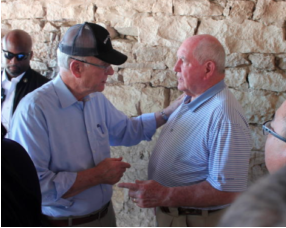
U.S. Agriculture Secretary Sonny Perdue and Senator Pat Roberts visited during a farm tour outside Manhattan in 2018-photo by Stephen Koranda/ Kansas News Service
The USDA announced plans earlier this month to move the Economic Research Service and National Institute of Food and Agriculture closer to farmers and agribusinesses they serve, and many employees have objected to the move from the Washington D.C. area.
USDA researcher Andrew Crane-Droesch tells the Kansas City Star the move is out of the question.
“It’s a mixture of outrage and resignation,” Crane-Droesch said of morale at his office. “Nobody wants to move — nothing against Kansas City.”
He said he doesn’t want to live far from his aging parents on the East Coast, and his wife has better career options in the Washington area. And the couple is in the middle of adopting.
When officials announced the move to employees of both agencies, employees turned their backs on the Agriculture Secretary.
Critics say the research agencies have lost veteran employees and been unable to fill vacancies since the USDA announced last year it was considering moving their headquarters. Opponents also argued that moving them will make it harder for federal policymakers to get objective research that might raise questions about President Donald Trump’s policies.
USDA officials say the move will save about $20 million a year on rent and other costs, which will provide more money for research.
Losing some employees is expected in this kind of move, said Dan Levine, who advises companies on relocations at Oxford Economics. He said that is why it is more common for companies to open a new office instead of closing one location and moving everyone to a new location.
“Clearly when you move people from D.C. to Kansas City, the first thing you have to worry about is retention,” Levine said. “I would expect a high amount of turnover on a move like that. And that might be something that they can for whatever reason tolerate.”
Kansas City area economic development officials are excited about the prospect of nearly 550 new jobs in the area that will pay between $80,000 and $100,000 a year.
Kansas City Area Development Council CEO Tim Cowden said his group is committed to helping federal employees and their families make the move to Kansas City.
“We understand and empathize with the families and the employees,” Cowden said. “It’s a huge move, it’s a huge transition.”
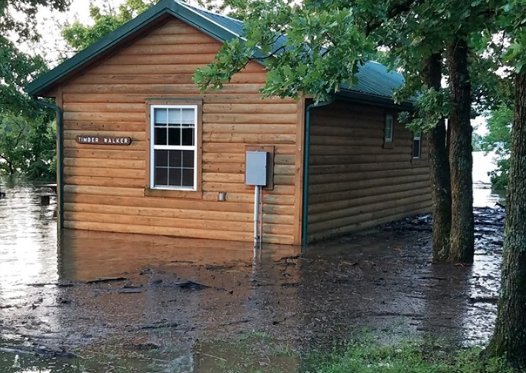
HUTCHINSON, Kan. (AP) — This spring’s heavy rain and flooding will cause significant economic losses at many of the state’s 28 parks, both from damage and from closures and refunds to disappointed campers, state parks officials said.
Cross TImbers State Park in Woodson County -photo KDWP&T
Brad Loveless, secretary of the Kansas Department of Wildlife, Parks and Tourism, said the losses will be clearer in a month or two when the cost of repairs and renovations are better known. The agency relies chiefly on entrance permits, campsite and cabin rental fees, and marina concessions to fund state parks.
Already, the agency’s park fee fund is down about $100,000 for April and May compared with a year ago because of a loss in entrance fees and campsite fees. Income from cabin rentals is down by $30,000 for those two months compared with a year ago.
Those figures don’t include all the refunds the department has been processing, “which is significant in June,” according to agency spokesman Ron Kaufman. Other losses occurred in marina concessions and from moving the Country Stampede’s move from Tuttle Creek State Park to Topeka’s Heartland Motorsports Park.
So far, the agency hasn’t asked the state for special help, with regular staff and seasonal workers managing the cleanup.
“We will need state assistance for repairing damages and for cash flow if revenues drop significantly,” Kaufman said.
Loveless said the damage is being documented and he is hopeful the state will receive help from the Federal Emergency Management Agency.
Kaufman noted that lakes in western Kansas, which were down because of drought, rose because of the rains but didn’t flood and are in “great shape.”
Parks also benefit from Kansas Lottery dollars and can obtain federal grants for projects. But the parks don’t receive money from the state general fund and revenue from the sale of hunting, fishing and fur harvesting licenses and permits cannot be spent for state park operations or maintenance and repairs.
Last year, the Park Fee Fund and Cabin Fund generated more than $10.5 million during the fiscal year, with nearly 6.9 million people visiting Kansas parks.
The high water caused several state parks to cancel campsite reservations for Memorial Day weekend, which is one of the top three periods for most parks. The Fourth of July is another peak time and some parks will have certain campsites unavailable then, too.
Cleanup and restoration will take months.
The many projects at the parks include hauling away debris, re-installing water heaters and electrical components, repairing or rebuilding boat ramps and docks, repairing some cabin flooring and cutting and removing fallen trees. Some roads in the parks also will need repair.
“Hundreds of acres of grass” will have to be replanted, and “mountains of debris removed,” Kaufman said.
Kaufman said the agency has a small, in-house engineering staff and engineering consultants to help design and oversee major repairs, and contractors will be used as necessary.
LAWRENCE, Kan. (AP) — A man on trial over an October 2017 shooting in downtown Lawrence that killed three people and wounded two others has testified he wasn’t “thinking at all” when he fired his gun.
Law enforcement on the scene of the fatal 2017 shooting in Lawrence-photo courtesy WIBW TV
Testimony ended Friday in the Douglas County District Court trial of 22-year-old Anthony Roberts Jr. of Topeka. The charges against him include two counts of first-degree felony murder.
Roberts contends he acted in self-defense after being confronted by a hostile group as bars prepared to close in a popular downtown area. Prosecutors contend Roberts and friends came to Lawrence to “settle a score.”
The shooting killed 22-year-old Leah Brown of Shawnee; 20-year-old Colwin Lynn Henderson of Topeka; and 24-year-old Tre’Mel Dupree Dean-Rayton of Topeka.
TOPEKA, Kan. (AP) — The Kansas Supreme Court has refused to shorten the time a man will spend in prison over a November 2014 murder in McPherson County that authorities say he planned.
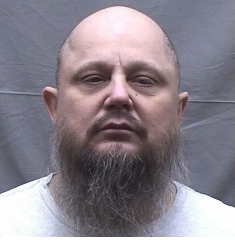
Darrah photo KDOC
The court ruled unanimously Friday against Samuel Darrah of McPherson. He pleaded no contest to charges including first-degree murder and attempted aggravated kidnapping in the stabbing of James Croft.
Authorities said Darrah plotted Croft’s murder because he had given Croft $3,200 to buy drugs and Croft did not supply them. A friend of Darrah’s stabbed Croft.
The trial-court judge sentenced Darrah to 25 years to life for murder and to eight-plus years for kidnapping and ordered the sentences served one after the other. Darrah said he should serve them at the same time.
The Supreme Court called the judge’s action reasonable.
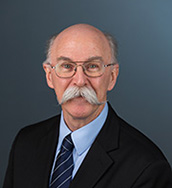
Kirk McClure, KU Professor, Urban Planning, School of Public Affairs and Administration
KU NEWS SERVICE
LAWRENCE — For decades, the federal government has used housing vouchers as part of a strategy to help low-income Americans obtain affordable housing as a way out of poverty. Part of that strategy was to help individuals and families settle closer to employment opportunities, but new research shows that proximity to jobs may not be as crucial as previously thought.
Kirk McClure, professor of urban planning in the University of Kansas School of Public Affairs & Administration, has co-written a study examining a national dataset of households receiving support from the Housing Choice Voucher Program from the U.S. Department of Housing and Urban Development. The analysis showed that recipients tended not to locate in neighborhoods that are closer to areas with high job availability compared to their previous neighborhoods and that when they do move to such areas, it does not result in higher earned income.
“We have assumed for a long time that if a household locates in a neighborhood with a lot of jobs, or at least not as much competition for jobs, that’s good,” McClure said. “Congress has not wanted this program to be a form of welfare but a way to move out of poverty and into gainful employment.”
McClure co-wrote the study with Michael Lens of the University of California Los Angeles and Brent Mast of the U.S. Department of Housing and Urban Development, Office of Policy Development and Research. It was published in the journal Cityscape. The authors set out to determine if very low-income renter households using the program, known as HCV households, move closer jobs, and if they do, whether the moves are associated with higher income. McClure and co-authors analyzed data from HUD, which included about 2 million households. Of those, approximately half were included in the study, as they were adults in the workforce, and the other half were not in the workforce due to age or disability. The data showed no association between proximity to jobs and HCV households or an increase in earnings for those who relocated closer to jobs.
“The data says people who move don’t necessarily have higher employment or earnings,” McClure said. “That suggests we may have been using this program in not the absolute best way for 25 years, and it says to me of the linkage between place of residence and place of employment is not as important as we thought.”
Other factors are almost certainly at play, the authors point out. Available transportation for HCV households was not accounted for in the study, and HCV households with vehicle ownership are more likely able to commute farther distances to jobs and services without the necessity to move. Access to public transportation also plays a role, and if a recipient moves closer to jobs, but public transit is lacking, that can be reflected in an inability to reliably get to work, get kids to school and access other basic services.
Proximity to good schools and other neighborhood characteristics play a role as well. The authors point out that many recipients likely look at those characteristics before job proximity when deciding where to move. Families show a tendency to move to neighborhoods in good school districts that are more suburban by nature and not as close to high job-density areas. Landlord resistance is another common obstacle in HCV household relocation. Landlords are under no obligation to rent to voucher recipients and can legally choose not to rent their property to voucher recipients.
McClure said the results make several points clear. First, researchers and policymakers must rethink the “geography of opportunity.” That is the driving idea behind such programs that seek to help low-income families move to new neighborhoods. Moving away from high crime areas is one factor, but what makes a desirable neighborhood is less clear. If proximity to jobs is not as important as once thought, factors such as access to transportation must be more closely studied.
“We need to rethink what it means to be a high opportunity neighborhood,” McClure said.
Second, annual report cards that are provided to the more than 2,700 housing authorities across the country that take part in HCV programs need rethinking as well. HUD has long graded housing authorities on the quality of the neighborhoods where HCV households locate. Proximity to jobs is likely overvalued in those rankings, again in respect to other factors such as access to transportation. In addition, landlord outreach needs to be strengthened. As landlords are not under an obligation to rent to voucher recipients, housing authorities should be able to offer incentives to landlords such as guaranteeing rent and guaranteeing occupation of set numbers of available units, among others, McClure said.
While policy has long focused on the proximity to jobs for housing choice vouchers, McClure and co-authors argue that the absence of data to support a benefit does not mean the programs are not working. Instead, policy should take into account other factors.
“Ultimately, we think that the rational policy response to these findings should be to keep the importance of job proximity in perspective. Evidence of the importance of job proximity for HCV households is simply not sufficient to warrant that it be as high a priority as are safe neighborhoods and access to high-quality schools,” the authors wrote. “HCV households are a diverse group, however, and for households in the workforce and without access to reliable transportation, proximity to jobs is worth paying attention to without allowing it to override concerns that evidence suggests may be more important.”
MCDONALD COUNTY, Mo. — A Kansas man died in an accident just after 6:30p.m. Friday at the Elk River below the low head dam at Noel, Missouri.
An unidentified woman swimming was swept underwater by the dam, according to the Missouri State Highway Patrol.
Jacob T. Farley, 26, Wichita, entered the water downstream in an attempt to rescue her.
A fire crew from Noel arrived on the scene and used a throw rope to rescue the woman. Farley drowned. The McDonald County Coroner pronounced him dead at the scene.
A GoFundMe account has been started to raise money for his family. Farley leaves behind a 3-year-old son.