TOPEKA, Kan. (AP) — A Kansas laboratory responsible for testing for contamination in the event of an accident at the state’s only nuclear power plant hasn’t been staffed for several weeks after its final two employees left in September.
The Kansas Department of Health and Environment says an Iowa lab is testing routine samples from the Wolf Creek nuclear plant, and that Kansas has several other agencies that would respond if there were an emergency.
The Topeka Capital-Journal (https://bit.ly/1i0nulk ) reports five people worked at KDHE’s Radiochemistry Section in 2014 but two left before the end of the year. By July staffing was down to the two who left last month.
KDHE says public health isn’t endangered and the agency’s ability to carry out its responsibilities doesn’t rely on any individual department or worker.
HUTCHINSON — The written and oral arguments have gone before an arbitrator, the Hutchinson City Council and now the Reno County District Court.
Oral arguments were heard on Thursday in the civil case filed by two former Hutchinson Police officers who were terminated for lying during an internal investigation.
The local Fraternal Order of Police filed civil action against the city on behalf of Lorenzo Bohringer and Charles Malvo, claiming the city erred in going against an arbitrator’s ruling that the two should be reinstated.
The arguments were much the same as they had been ever since the termination of the two officers took place.
City Attorney Paul Brown went before Judge Trish Rose and said the matter should be handled by the city and not before a court.
He argued that the two officers lied during an internal investigation into a complaint against another officer. He said that lying is strictly forbidden in the police department, and could not be tolerated.
The attorney for the Fraternal Order of Police Matthew Huntsman argued that if that is the case, why did another officer get just a written warning for lying to his superior over the completion of a police report that was to be use in a court hearing?
He also argued that the city wanted to send such matters to arbitration during the latest bargaining agreement, and then went against an arbitrator’s ruling when it didn’t suit them.
Judge Rose announced she will have a ruling in the matter within 30 days.
Gene Policinski is senior vice president of the First Amendment Center
It’s Free Speech Week 2015 — and a major debate over free speech has just broken out.
Thanks to the First Amendment, we are free to compliment, cajole, deny or decry. And if you’re looking for something immediate that calls out for more free and unfettered discussion, join this newest national debate over anonymous speech on the Web.
On Wednesday, a coalition of women’s and civil rights groups announced a campaign to pressure colleges, through the U.S. Department of Education, to go on the offensive — pardon that reference — against anonymous social media applications like Yik Yak, which allows students to send social media messages within a specific university’s virtual community.
These groups asked the U.S. Education of Department to treat colleges’ failure to monitor anonymous social media comments, ranging from threats of rape and murder to insults using racial slurs or simply uncomplimentary references, as a violation of federal civil rights laws.
The groups’ letter to the department’s Office of Civil Right cites a number of examples, including “incidents at the University of Mary Washington, where female students were threatened with rape, murder and other abuse via Yik Yak, and at Clemson University where racially abusive Yaks appeared after a student march protesting the failure to indict the police officer responsible for the death of unarmed African-American teenager Michael Brown in Ferguson, Missouri.”
Absent the kind of directed, viable and proximate conditions required for a criminal charge, the examples raise concerns over atmospherics and ideas expressed on campuses — areas which traditionally gain the highest levels of First Amendment protections.
In fact, the coalition is critical of college administrators who it says cite “vague First Amendment concerns” in refusing to squelch Yik Yak and its kin. It calls on federal officials to mandate that universities use campus disciplinary powers, employ technological tools to block certain social media sites, ban the use of campus wi-fi to make objectionable posts, and conduct 24-7 monitoring of social media to spot the errant postings. It also asks for counseling for students traumatized by such online posts.
The groups have a worthy goal: to combat threats of violence and assault that terrorize a perceived victim. The pressing questions — particularly poignant during Free Speech Week, which this year is Oct. 19-25 — are what kind of speech rises to that level? And how do responsible tactics against such threats avoid becoming political correctness run amok and a latter-day, academic version of witch hunts?
Such questions are far from “vague concerns” over a core freedom. And, the “Yik Yak letter” is not the only arena in which we are debating old standards about free expression.
Various economic interests have pressed state legislators to consider or enact laws that aim to prevent activists from gathering information on animal cruelty or evidence that environmental laws are being ignored — attempting to use such so-called “ag-gag” statutes and claims of economic harm to silence those who would hold violators accountable in courts of law or the court of public opinion.
New laws citing privacy and property rights would limit the use and very presence of drones. And concerns over misuse of videos taken from body cameras worn by officers are stoking yet another area of concern in what once was seen as a positive means to empower citizens to speak out on police abuses.
But increasingly it’s college campuses — just a generation ago, the bastion of efforts aimed at tearing down the power of administrators to control student expression — at the forefront of the free speech fight.
Critics worry about overzealous requirements for so-called “trigger warning” of classroom topics that might possibly upset or insult someone or bans on speech that sometime offend even a single person that could gut academic freedom. Professors and administrators are labeled as racist or sexist over perceived “microagressions” — words or phrases linked to negative or disturbing meanings, far from the long-held legal standards of a “true threat,” but simply considered to be “unwelcome.”
According to figures compiled by the Foundation for Individual Rights in Education (FIRE), at least 240 campaigns have been conducted in little more than a decade at U.S. universities to prevent speakers from appearing on campuses simply because some students or faculty members find the speakers’ views objectionable. College news outlets have been attacked because of satirical cartoons and clearly labeled op-ed pieces, all too often simply for expressing opinions some students found unsettling.
And then there’s an even a more subtle threat to the Web’s promise of a utopia for free speech. Just a few “clicks” can ensure one only sees sites that reinforce already-held views or limits social media contact only to those already in agreement.
Eliminating the serendipity of discovering other viewpoints or the intellectual challenge of confronting persuasive views that differ from our own drains both the meaning and value of free speech.
We’ve spent decades determining the legal stands for threatening speech, which includes requirements for immediacy and potential.
There’s no question that some ideas are repellent and frightening. Changing public opinion about those ideas is harder and takes more time than changing laws in an attempt to eliminate them. But the counter to speech we don’t like — or even speech we feel is detrimental to many — should be more speech, not less.
The value of free speech rests with reasoned response to the discord of differing views. America’s founders reasoned that ultimately, decisions and attitudes for the public good come from vigorous public debate.
History is replete with the failure to stop ideas by silencing a speaker. A nation rooted in dissent should not use the power of government to tell its citizens, colleges or even childish and juvenile websites to be silent in the name of comfort or a “vague notion” of making us safer by simply by not hearing or posting that which offends.
So speak up, speak out: It’s Free Speech Week.
Gene Policinski is chief operating officer of the Newseum Institute and senior vice president of the Institute’s First Amendment Center. [email protected]
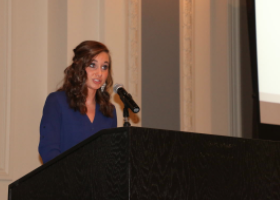
Park Hill High School senior Jordan Elder, speaking at the Greater Kansas City Chamber of Commerce Thursday, said that raising the smoking age to 21 would help her peers form healthy habits that last a lifetime. CREDIT MIKE SHERRY / HEARTLAND HEALTH MONITOR
Business and health leaders on Thursday announced an ambitious initiative to convince elected officials in the dozens of municipalities throughout the Kansas City area to raise the legal age for buying cigarettes from 18 to 21.
Spearheaded by the Greater Kansas City Chamber of Commerce and Blue Cross and Blue Shield of Kansas City, “Tobacco 21 | KC” aims to build on a movement that now counts nearly 100 communities around the country and the state of Hawaii that have made 21 the legal age for purchasing tobacco products.
“This is our time to make a choice that is different for our children,” said Dr. Bridget McCandless, CEO of the Health Care Foundation of Greater Kansas City and a leader of Healthy KC, the collaboration between the Chamber and Blue Cross.
Chamber leaders said they had no timetable for achieving their goal but were encouraged by initial conversations with local elected officials.
A legislative committee of the Unified Government of Wyandotte County/Kansas City, Kansas, on Monday is scheduled to consider an ordinance raising the tobacco age to 21. If approved, it will likely go before the full commission next month.
Preventing kids from starting to smoke is one of the best ways to keep them from picking up the habit as adults. The Institute of Medicine, in a March 2015 report, said that among adults who become daily smokers, approximately 90 percent say they first smoked before they reached the age of 19 and nearly 100 percent before the age of 26.
“It is one of the most effective ways to prevent kids from starting a noxious habit that can end in their early death,” Chamber CEO Jim Heeter said.
The Health Care Foundation cited Needham, Massachusetts, as an example of what can happen when a community increases the legal age for buying cigarettes.
Needham was the first community in the country, in 2005, to implement Tobacco 21. Between 2006 and 2010, teen smoking in Needham decreased by 46 percent.
Heeter said he hoped Tobacco 21 would mirror the successful campaign to enact local ordinances banning indoor smoking.
“We want the entire metro blanketed with Tobacco 21,” said Scott Hall, the chamber’s vice president of strategic initiatives.
Hall said the aim is not to criminalize purchases if people are caught buying cigarettes under age. Rather, he said, the idea is for municipalities to use a productive approach like sending offenders to a smoking cessation program.
In Missouri, at least, convenience store operators have been a powerful force in stymieing an increase in the cigarette tax, another way health advocates have tried to dissuade people from smoking. They say teens are especially price-sensitive.
Heeter, however, said Tobacco 21 | KC leaders don’t expect concerted opposition from convenience store operators. They are more focused on statewide issues, he said.
The convenience store lobby sought to dissuade the Columbia City Council from raising the tobacco age to 21 last year, said Ginny Chadwick, the former city councilwoman who sponsored the ordinance. The ordinance, however, passed on a 6-1 vote, she said.
Chadwick is an instructor in the School of Health Professions at the University of Missouri – Columbia, where she said students had accepted the change.
“It is part of our normal life now,” she said.
Also at the chamber Thursday was Jordan Elder, 17, a senior at Park Hill High School and co-chair of Youth With Vision, a prevention-focused organization comprised of high school leaders from Platte, Clay and Ray counties in Missouri.
“I recognize the importance of making the right choices, and I know other young people stand with me in this effort,” Elder said. “Tobacco 21 has the ability to help my peers make these good choices, choices that form healthy habits that last a lifetime.”
Editor’s note: The Health Care Foundation of Greater Kansas City provides funding for Heartland Health Monitor.
Mike Sherry is a reporter for Heartland Health Monitor, a news collaboration focusing on health issues and their impact in Missouri and Kansas.
WICHITA, Kan. (AP) — Wichita police say a man found in wrecked car has died after a shooting was reported in the area.
The Wichita Eagle reports that officers responded to an accident scene in which a car had veered off a road. Wichita police Lt. Dale Mattern says three men in the car were seriously injured and one of them later died.
Mattern would not confirm whether the person died as a result of a shooting or other injuries. The two other occupants of the car were taken to Via Christi Hospital St. Francis in critical condition.
Mattern says police took a man in his 20s into custody at the scene for questioning.
TOPEKA, Kan. (AP) — A 35-year-old man has been arrested in the death of an 8-year-old boy who was killed in a crash while riding on the back of a moped in Topeka.
The suspect was arrested Thursday on suspicion of several charges, including second-degree murder and reckless driving. Prosecutors say Trenton Feliciano was riding on a moped driven by the suspect on Oct. 4, 2014. Police say witnesses reported seeing the vehicle speeding before it collided with a car driven by a 19-year-old woman who had a 1-year-old baby with her.
The woman and the baby were taken to the hospital for treatment. The suspect was transported to a hospital with life-threatening injuries.
The suspect is being held on $300,000 bond and is scheduled to make his first court appearance Friday.
WICHITA, Kan. (AP) — Wichita police are investigating after a man was found dead of an apparent gunshot wound in the basement of a duplex.
According to Sgt. Brian Goward, officers responded to a report of a shooting around 8:45 p.m. Thursday and found the victim. A neighbor reported hearing a gunshot to authorities.
Goward said officers are looking for a male suspect.
TOPEKA, Kan. (AP) — Kansas Insurance Commissioner Ken Selzer says about 65,000 businesses in the state will pay less for their workers’ compensation coverage next year.
Selzer announced Thursday that he approved lower rates proposed by the National Council on Compensation Insurance. The council is a national group that analyzes workers’ compensation data and files proposed rates in a majority of states.
Selzer said rates will decrease by 11.6 percent for Kansas businesses obtaining their insurance in the marketplace and 10.4 percent for companies that participate in a state plan for high-risk businesses.
Insurance Department spokesman Bob Hanson said the decline in rates can be attributed to a drop in high-cost claims from businesses and greater awareness of their safety issues. Workers’ compensation insurance covers businesses against costs associated with employee injuries.
WICHITA, Kan. (AP) — The top election official in Kansas was dismissed as a defendant from the lawsuit filed by a Wichita mathematician seeking voting machine tapes after finding statistical anomalies in election counts.
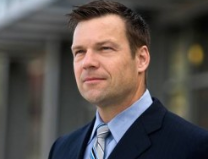
Kansas Secretary of State Kris Kobach said in a statement Thursday he was pleased but not surprised. The move leaves Sedgwick County Elections Commissioner Tabitha Lehman, whose office actually has the tapes, as the only defendant in the case.
Wichita State University statistician Beth Clarkson wants the tapes to do a statistical model by checking the error rate on electronic voting machines used at a Sedgwick County voting station during the November 2014 general election.
Kobach says the law is clear regarding auditing procedures and contends he should have never been a party to the lawsuit in the first place.
LAWRENCE–A Kansas angler got quite the surprise when he reeled to the surface not a just an ordinary fish, but a 30-inch-long eel from the Kansas River, below the Bowersock Dam near Lawrence. After closer inspection, it was determined the catch was an American eel, a species that hasn’t been seen in Kansas for nearly 10 years.
“This species spawns in the Sargaso Sea of the Atlantic Ocean,” said Kansas Department of Wildlife, Parks and Tourism Fisheries section chief, Doug Nygren. “So, this eel made a long journey from the Atlantic Ocean, through the Gulf of Mexico, up the Mississippi, took a turn at St. Louis to enter the Missouri River, and another turn to go up the Kansas River to the Bowersock Dam.”
The American eel once inhabited waters as far as the Atlantic and Gulf of Mexico coastlines, from Greenland to Brazil, and inland from Minnesota to central New Mexico. In the early 1800s and 1900s, there were several accounts of the American eel in Kansas, but dams blocking upstream migrations have made this species’ appearance a rarity today.
Less active during the day, eels will often remain under logs or other cover until night approaches. They feed primarily on invertebrates and soft-bodied fish.
Although the age of the eel caught from the Kansas River is unknown, records indicate the American eel can live to about 20 years. The current state record American eel was caught in 1987, also from the Kansas River, and weighed 4.4 pounds.
WASHINGTON (AP) — U.S. safety regulators say eight people have died and 98 people have been injured by exploding air bag inflators made by Takata Corp.
Those injured have suffered cuts to the neck, loss of eyesight and hearing and broken teeth, according to representatives of the National Highway Traffic Safety Administration, who gave the updated totals Thursday at a public meeting on the problem.
The agency says it knows of 89 driver’s side and 32 passenger inflator ruptures. Nearly one in 10 ruptures of driver side air bags causes a death.
About 23.4 million Takata driver and passenger air bag inflators have been recalled on 19.2 million U.S. vehicles sold by 12 auto and truck makers.
The agency is moving toward taking over management of the massive recalls to speed up repairs.
SHAWNEE- Two people were injured in an accident just after 4p.m. on Thursday in Shawnee County.
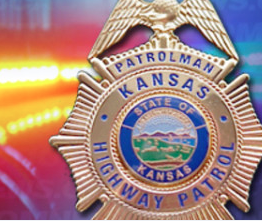
The Kansas Highway Patrol reported a 2001 Buick LeSabre driven by Larry Carl Mattias, 76, Horton, was northbound on U.S. 75 in the right lane.
The driver made an improper lane change and struck a 1999 Buick Century driven by Skyler Gene Fitzgerald, 35, Topeka, that was northbound in the left lane.
Matthias and a passenger Etta Mae Matthias, 76, Horton were transported to Stormont Vail.
Fitzgerald was not injured.
All were properly restrained at the time of the of the accident, according to the KHP.
 TOPEKA, Kan. (AP) — A Kansas laboratory responsible for testing for contamination in the event of an accident at the state’s only nuclear power plant hasn’t been staffed for several weeks after its final two employees left in September.