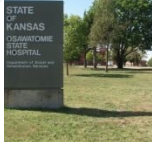
OSAWATOMIE, Kan. (AP) — A moratorium on involuntary hospital admissions will continue at Osawatomie State Hospital as mandated renovations are wrapping up.
The Wichita Eagle reports that the facility in Miami County has been limited to 146 beds since June, when the federal Centers for Medicare and Medicaid Services ordered the renovations. The hospital still has been accepting patients with mental illnesses, but not before they’re placed on a waiting list.
Although renovations are expected to end Thursday, the beds won’t open up until inspectors from the Centers for Medicare and Medicaid Services can visit the facility.
Osawatomie State Hospital is one of two state mental hospitals in Kansas. It serves patients from 46 counties in the eastern third of the state.
JOHN HANNA, AP Political Writer
TOPEKA, Kan. (AP) — Election officials across Kansas are expected to begin removing the names of more than 31,000 prospective voters from their records in line with Kansas’ tough voter identification law, which requires applicants to prove their citizenship before casting a ballot.
Secretary of State Kris Kobach has directed county election officials to discard applications from prospective voters who after 90 days did not provide all the required information and documents. Most were people who hadn’t documented their U.S. citizenship.
The proof-of-citizenship requirement took effect in 2013. Only four states have a similar requirement, which advocates support as an effective tool against voter fraud but opponents consider a ruse for discouraging voting by the poor and minorities. The culling of applications is the first since the law went into effect.
LAWRENCE, Kan. (AP) — A recently released affidavit says a man charged in a Lawrence killing laughed about the victim bleeding to death.
The affidavit supporting the arrest of 34-year-old Joshua Lee Back says officers followed a blood trail from where officers found 45-year-old Tracy Dean Lautenschlager bleeding in May.
The Lawrence Journal-World reports that the trail ended at a home, where a witness told police that Lautenschlager, Back and a third man had smoked methamphetamine the night before. The affidavit says the meth-smoking companion told officers that Back said he had “cut a person’s throat and laughed about the amount of blood squirting from the wound.”
Back, of Oskaloosa, is charged with second-degree murder and jailed on $750,000 bond. His defense attorney didn’t immediately return a phone call from The Associated Press.
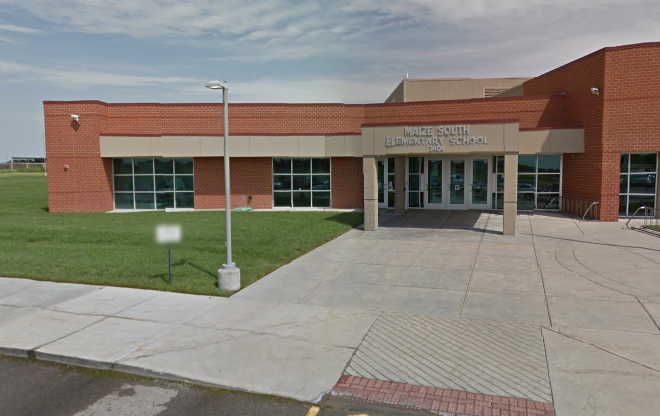
MAIZE -A judge on Wednesday granted Maize USD 266’s temporary restraining order, placing a stop to a planned road closure along the access road from Maize Road to Maize South Elementary School, according to a school district media release.
The court order mandates that the city of Wichita and developer not proceed as planned for now.
The road closure was scheduled to begin immediately and last approximately six weeks.
Citing significant concerns involving safety and logistics, the district on Monday took legal action and filed action seeking the temporary restraining order against the city of Wichita and the developer involved with the plan.
Judge William Woolley of the 18th Judicial District Court granted the temporary restraining order, which delays the planned project that will build a road from 37th Street North to Maize South Elementary School.
It will provide additional access to the school to maintain the current level of access now available.
A temporary road will be built from 37th Street to the schools before the proposed construction project can start, so that the school is still accessible from two streets. The finalization of that new temporary road will allow for the planned access road construction to begin, according to the school district.
TOPEKA, Kan. (AP) — Kansas collected $31 million less in taxes than anticipated last month, a shortfall that could tighten the state’s budget picture.
The state Department of Revenue reported Thursday that the state took in $534 million in taxes, when its official fiscal forecast projected $565 million. The shortfall was about 5.5 percent.
Tax collections were almost equally as short of expectations in August, but the department attributed that month’s shortfall to larger-than-expected income tax refunds.
Since the fiscal year began in July, tax collections have been $67 million short of expectations, or about 4.7 percent off at about $1.37 billion.
Revenue Secretary Nick Jordan noted that taxes from oil and gas production failed to meet expectations in September because of fallen energy prices. He also said farm income has declined.
WICHITA, Kan. (AP) — A Kansas judge ruled on Thursday there is enough evidence to try a 27-year-old for capital murder and rape in the death of a woman who was set on fire at a Wichita park.
The Wichita Eagle reports Cornell McNeal faces a Nov. 12 arraignment in the November death of Letitia “Tish” Davis. The 36-year-old mother of four suffered burns on more than half of her body and cuts on her head in the attack. She died about a week later.
The critically injured victim couldn’t say much to investigators after she was found near a charred area in Fairmont Park, but witnesses say she kept repeating she had been raped, beaten and set on fire.
Affidavits show a damaged cellphone and DNA evidence connected McNeal to the attack.
—————-
WICHITA, Kan. (AP) — A preliminary hearing is beginning for a man charged in the death of a woman who was raped and set on fire at a Wichita park.
The Wichita Eagle reports that the hearing that starts Thursday in Sedgwick County District Court will determine whether there is sufficient evidence for 27-year-old Cornell McNeal to stand trial. He’s charged with capital murder and rape in the November 2014 death of Letitia “Tish” Davis.
The mother of four suffered from burns on more than half her body and cuts on her head in the attack and died about a week later. Affidavits show McNeal was connected to the attack through a damaged cellphone and DNA evidence.
McNeal also is charged in a garage fire. He is jailed on a $1.25 million bond.
TOPEKA, Kan. (AP) — Kansas lawmakers are grappling with the state’s possible response to new federal rules aimed at reducing carbon emissions from power plants.
The Topeka Capital Journal reports lawmakers expressed frustration Thursday with the regulations at the first meeting of a committee created earlier this year to review any plan for complying with the rules from the U.S. Environmental Protection Agency.
EPA told states earlier this year that by 2022, they must start reducing carbon emissions linked to climate change. The EPA’s target for Kansas is a 43 percent reduction by 2030.
Kansas is expected to submit its initial plan, along with an extension request, in September 2016.
The Kansas attorney general’s office plans to challenge the federal rules in court after the final rule is published.
JUNCTION CITY – Law enforcement authorities in Geary County are set to become one of the first in the state to use drone technology.
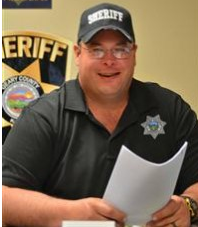
Geary County Sheriff Tony Wolf said his department has acquired a civilian model drone, and another more advanced model drone is being acquired from a company in Colorado.
“What we’re planning on doing with these drones are using these mostly right now for search and rescue.”
As an example Wolf referred to an incident about two years ago involving a lengthy search for an elderly resident in the county that suffered from dementia, had wondered away from his home and become lost.
“We were calling in KHP to bring out a helicopter to fly the area for us, but due to the weather they couldn’t fly that day.”
Wolf said authorities could put the drones, which are about the size of large model airplanes, up in the air quickly to scan an area. It would involve the use of less people.
“This would be a very valuable tool to use in the future for situations like that,” he said.
Wolf noted the drones could also be used in search and rescue operations in the Milford Lake area.
“Seems like every year we have somebody that gets stranded in a boat, or disabled, or walked way and got lost along the shoreline somewhere. When they call 911 they don’t know where they are.” Use of the drones could enable locate and rescue much quicker and be less labor intensive.
The drones have four propellers and are operated by remote control on the ground. Two deputies have received training on how to use and control them.
Wolf confirmed the cost of the two drones combined totals approximately $28,000. They were purchased with drug forfeiture funds. No taxpayer money was used.
“Right now as I understand it, we are the first law enforcement agency in the state of Kansas that does have drones,” said Wolf.
LAWRENCE, Kan. (AP) — A same-sex couple is seeking to force the Kansas Department of Health and Environment to issue a birth certificate listing both women as the parents of their baby boy.
The Lawrence Journal-World reports that Jessica and Casey Smith of Lawrence married in 2013 in California. Casey Smith gave birth Sept. 16 at Shawnee Mission Medical Center, which declined to list both women as parents on the birth certificate.
The couple filed an “emergency petition for the determination of parentage,” and a judge directed the state health department to issue a birth certificate listing both women as the child’s parents. But the department refused, saying it wasn’t notified of the women’s petition.
The women’s attorney filed a motion to join the department in seeking a legal decision on the issue.
Charles C. Haynes is director of the Religious Freedom Center of the Newseum Institute.
At a cultural moment when celebrity trumps character in America, it took a humble priest from Argentina to remind us of the better angels of our nature — and of the kind of nation we must aspire to build in the 21st century.
Pope Francis arrived in our public square as a self-described migrant, and for a refreshing week his message of compassion and justice drowned out the divisive, ugly, sometimes hateful rhetoric of this political season.
Temporarily pushed out of the headlines was trash talk about immigrants, demonizing language about American Muslims, and the puffed-up buffoonery that passes for political discourse in 2016 America.
The pope didn’t downplay or disguise his convictions about everything from climate change to the sanctity of life “at all of its stages.” But he delivered his views — and here is the lesson many of our political and religious leaders would do well to re-learn — with civility and respect.
Consider the pope’s message on religious freedom, delivered at the cradle of American freedom in front of Independence Hall in Philadelphia. Few topics are more divisive in the United States, with one side proclaiming religious liberty “under assault” and the other side condemning religious liberty as cover for “bigotry.”
Without the rancor or hyperbole that characterizes our culture wars, Pope Francis offered a powerful affirmation of religious freedom as a right “given by God himself.” And he warned against confining religious expression to “a subculture without right to a voice in the public square.”
After the pope’s departure from the United States, it was revealed that he met privately with Kim Davis — the Kentucky county clerk who refused to issue marriage licenses to same-sex couples on religious grounds.
Although both sides in the Davis affair are already citing the meeting to attack the other, the pope’s balanced approach to the controversy — signaling support for the right to conscientious objection while avoiding divisive public statements about same-sex marriage — illustrates the tone and balance he brings to conflicts over religious issues in the public square.
As John Gehring, Catholic program director at the liberal advocacy group Faith and Public Life, explained in a New York Times interview, the pope’s approach makes both sides “a little bit uncomfortable.”
“I think Pope Francis affirms religious liberty,” said Gehring, “and he rejects the culture wars. That’s something we need to grapple with.”
Of course, we can, and should, contend with one another over our religious and ideological differences, but if the common good is to be served, we should do so through civil and constructive dialogue.
Standing near the spot where American freedom was born in Philadelphia, Pope Francis called on people of all faiths and beliefs to work for “tolerance and respect for the dignity and rights of others.”
Religious freedom, he argued, thrives best in a society with “a healthy pluralism, which respects differences.”
The pope reminded us that what unites Americans is not religion — we each have our religious and non-religious convictions that rank among our deepest differences — but rather a commitment to pluralism framed by religious liberty, “a fundamental right which shapes the way we interact with neighbors whose religious views differ from our own.”
Just prior to his departure from the United States, the pope modeled the “healthy pluralism” he envisions at a worship service held at Ground Zero in New York. He met with families of those who lost their lives on 9/11 and participated in a “witness for peace” ceremony with Jewish, Christian, Muslim, Hindu, Sikh, Buddhist and other religious leaders.
The gathering was deliberately and carefully described as “multi-faith” — rather than “interfaith” — to underscore that respect for the rights of others does not mean or require uniformity of belief.
At the Ground Zero ceremony, we saw on display the rich possibilities of an America of many faiths and cultures — a nation where citizens affirm distinct religious identities while living and working together for the common good.
Realizing this ideal in an America deeply divided by religion and ideology is one of our greatest challenges in the 21st century.
It will not be easy. But for one, brief shining week, Pope Francis made many of us believe it can — and must — be done.
Charles C. Haynes is vice president of the Washington-based Newseum Institute and executive director of the Religious Freedom Center. [email protected]
TOPEKA, Kan. (AP) — A homeless woman previously sentenced to life in prison in the killing of a Topeka homeless advocate is expected to be released soon.
The Topeka Capital-Journal reports that 36-year-old Kimberly Danielle Sharp was resentenced Wednesday after her earlier convictions were overturned. She’s already been behind bars longer than the sentence of eight years and fourth months that was imposed.
Sharp initially was convicted of first-degree murder and kidnapping for her role in the death of 38-year-old David Owen. He disappeared in June 2006, and his body was found the next month.
But an appeal court ruled in July that her confession was involuntary and couldn’t be used against her during retrial. Sharp pleaded no contest on Sept. 15 to reduced charges of voluntary manslaughter and aggravated battery.
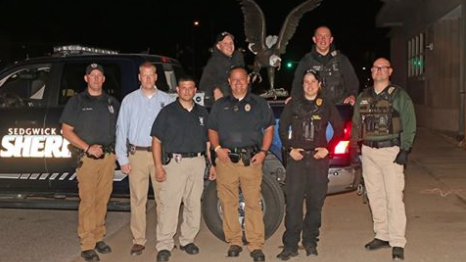
WICHITA – Law enforcement authorities in Sedgwick County have recovered the statue stolen from the Boy Scouts Headquarters on North Oliver in Wichita.
The Sedgwick County Sheriff’s Office received a tip that the eagle was buried in the backyard of a residence in West Wichita and covered with a tarp and other items, according to a media release.
Sgt. Kooser and Deputy Manning of the Sedgwick County Sheriff’s Office began conducting surveillance of the address and asked for assistance from WPD Sergeants Beard and Miller.
Officers were granted permission to search the property and located the eagle buried in the backyard.
Using a Sheriff patrol truck and towropes, officers were able to pull it out of the ground and it is in very good shape. The recovery of this stolen eagle was possible due to help from alert citizens and collective investigation by the Sedgwick County Sheriff’s Office and the Wichita Police.
WASHINGTON (AP) — The Education Department says there’s been another drop in the percentage of people who are defaulting on their student loans in the first years they are due.
More than 5.1 million borrowers began paying back their loans in the 2012 budget year, and about 611,000 defaulted — about 11.8 percent.
The rate was 13.7 percent in 2011 and 14.7 percent for 2010.
The drop was seen across all sectors of higher education — public, private and for-profit institutions.
Schools with high default rates can lose eligibility to take part in federal financial aid programs.