We have a brand new updated website! Click here to check it out!

Plant disease identified in rhododendrons sold by Kansas Walmarts, Home Depot

Sudden Death Oak dieback

KDA

MANHATTAN — The Kansas Department of Agriculture’s plant protection and weed control program this week confirmed the presence of a plant disease in hundreds of rhododendrons sold at large retail stores in Kansas. Sudden Oak Death (SOD) is a plant disease that has killed large tracts of oaks and other native species in California and Oregon, and infected rhododendrons have been identified in 10 states in the Midwest, including Kansas. The infected plants that have been found in the Midwest have all been traced back to a common source.

The causal agent of SOD, Phytophthora ramorum, has been detected in rhododendrons originating from Park Hill Plants nursery in Oklahoma, and plants from that nursery were shipped to 60 Walmart stores across Kansas and one Home Depot store in Pittsburg, Kansas.

Those stores have cooperated with KDA, USDA, and other states’ plant regulatory staff as they work to destroy all infected and potentially-infected rhododendrons still for sale, along with any other host plants in the vicinity. There is no treatment for the pathogen or disease and infected plants should be destroyed to prevent spread.

Consumers who purchased rhododendrons and other known P. ramorum hosts in April, May or June of 2019 in varieties that have been determined to be infected should take action to dispose of the plants immediately to prevent further spread of the disease.

Plants can be destroyed by burning on site, deep burial, or by double bagging in heavy duty trash bags (including the root ball) and disposing into a sanitary landfill where permitted. Varieties that should be destroyed include: Cat Cunningham Blush, Firestorm, Holden, Nova Zembla, Percy Wiseman, Roseum Elegans, and Wojnars Purple.

Other varieties of rhododendrons and other plant species may be infected as well. There are over 100 known species susceptible to P. ramorum, including, trees, shrubs and herbaceous plants. Symptoms of SOD include foliar leaf spots, browning and wilting of leaves, and brown to black discoloration on stems and/or trunks. If you observe symptoms, or are uncertain of the variety of your rhododendron. please contact your local K-State Research and Extension office for assistance.

Sudden Oak Death has not shown to be a health risk to humans or animals, even if nuts, fruit, leaves or berries from an infected plant are eaten.

For photos of symptomatic plants, a list of extension offices, or other information about what you can do to help stop the spread of this plant disease, go to agriculture.ks.gov/SOD. For additional information about SOD, see www.suddenoakdeath.org.

Students to restore photos damaged in Kansas tornado

LAWRENCE, Kan. (AP) — Students from two Lawrence high schools are offering to digitally restore print photographs that were damaged when a tornado tore through Douglas County.

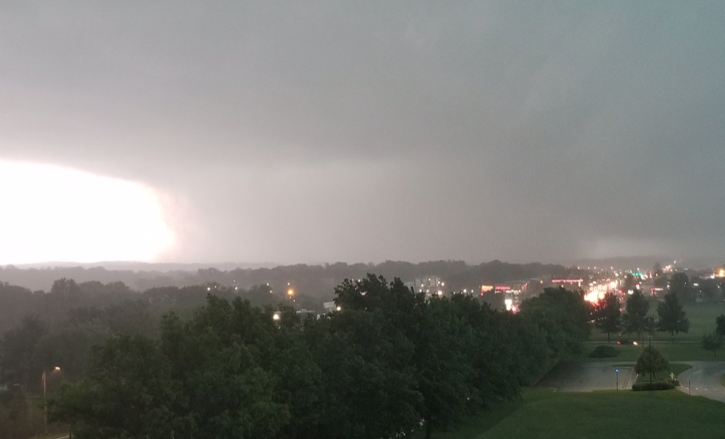
Pictures taken by Kansas Geological Survey staff member Elson Core of the May 28, tornado that went south of Lawrence and the KU campus

The large storm last month damaged trees, struck power lines and left a trail of debris on the southeastern edge of Lawrence, making some road impassable. County officials said six people were taken to the Lawrence hospital for injuries sustained in the storm.

Graphic design students at Free State and Lawrence high schools will begin restoring photographs this fall. It’s unclear how long it will take to return a restored digital file to each participant.

“Those tangible things that remind you of phases of your life are important,” said Barbara Tholen, a Lawrence High School teacher who pitched the idea to the two schools. “So hopefully we can restore some of that for people who lost them.”

Tholen said she wanted to notify tornado victims of the free service before they start disposing of items that were damaged in the tornado.

The newspaper didn’t provide details about the restoration process.

Jennifer Dixon-Perkins, who teaches graphic design at the school, said personal items such as photos are irreplaceable and can provide a sense of normalcy after a catastrophe.

Free State teacher Michelle Salmans said she tries to find ways for students to apply their learning to real world scenarios. Salmans said her students will take the assignments more seriously knowing they’re helping return something someone lost.

Free State senior Greta Hayden said she was eager to help after learning about Salmans’ class project.

“Photos are so sentimental,” Hayden said. “I just want to help people have that back again.”

___

Kan. nursing home worker used lotion to steal rings from elderly patients

OVERLAND PARK, Kan. (AP) — Charging documents say a suburban Kansas City nursing home worker stole rings valued at nearly $10,000 from a 99-year-old dementia patient by using lotion to slip them from the woman’s hands in the middle of the night.

Goodall photo Johnson Co.

23-year-old Leah Anne Goodall was arrested Saturday ahead of her preliminary hearing. The certified nursing assistant is charged with mistreatment of an elder.

A daughter of the elderly woman noticed her mother was missing four rings in April 2018. Court documents say staff at the Overland Park, Kansas, nursing home, told her that Goodall had cared for her mother the previous day and didn’t return to work.

When officers told her there was surveillance video of the room, Goodall allegedly admitted to taking the rings. They have been returned.

🎥 June is Great Outdoors Month in Kansas

KDWPT

TOPEKA – Governor Laura Kelly has proclaimed June as Great Outdoors Month in Kansas. The Kansas Department of Wildlife, Parks and Tourism joins the governor in reminding residents and visitors that Kansas has an abundance of opportunities to enjoy the great outdoors and appreciate the many natural splendors of our state.

“I urge everyone to join me and visit our wonderful state and local parks, trails and national sites,” Kelly said. “All of Kansas is waiting for you. So, get outside and make outdoor activities a regular part of your life in the Sunflower State.”

Enjoying the Kansas outdoors contributes to our quality of life; promotes physical and mental health, fitness, and environmental awareness; and is an ideal way to exercise and enjoy memorable experiences with family and friends. Also, many of our important cultural and historic events and traditions are linked to places in Kansas which are parts of national, state and local park systems.

Outdoor recreation has a significant economic impact in Kansas. It is growing nationally, generating $887 billion in consumer spending. And in Kansas, it generates an estimated $7.3 billion in consumer spending and supports 71,000 direct jobs.

Great Outdoors Month connects all of Kansans to the outdoors, and especially children, through diverse events such as National Trails Day (June 1), National Fishing and Boating Week (June 1-9), National Get Outdoors Day (June 8), the Great American Campout (June 22) and National Marina Days (June 8), Kids to Parks Day (held May 18), Great Outdoors Day of Service (June 14) and more.

To plan your outdoor activities, visit KSOutdoors.com and TravelKS.com where you’ll find a wealth of ideas, tools and information to get in the great outdoors.

Exploring the historical effects of ‘fat’ stereotyping

Christopher Forth

KU NEWS SERVICE

LAWRENCE — Disgust or contempt.

Those are the responses the word “fat” elicits.

“Disgust is an emotion that’s not about vision. It’s about touch, the fear of contact,” said Christopher Forth, a University of Kansas professor of history and Dean’s Professor of Humanities.

“If it’s not about aesthetics, why does fat provoke this sense of, ‘I can be contaminated by this?’”

That’s one of the questions addressed in Forth’s upcoming work, “Fat: A Cultural History of the Stuff of Life” (Reaktion Books, 2019). The publication has already garnered national interest after The Atlantic published a 2,000-word excerpt in May taken from the chapter “Grease and Grace: The Disenchantment of Fat?”

It included Forth’s anecdote involving an 18th-century Italian countess named Cornelia di Bandi who suddenly burst into flames.

He wrote, “Only her arms and legs remained intact. After examining what was left of her body, a local physician concluded, in a report cited years later, that the conflagration ‘was caused in her entrails’ by the variety of combustible materials to be found there, including alcohol and fat, ‘an oily liquid … of an easily combustible nature.’”

Forth said, “I have two favorite chapters, and they’re both gross.”

In addition to the aforementioned “Grease and Grace,” he favors one titled “The Fat of the Land” because of his fascination with its agricultural context.

“I had heard the phrase ‘living off the fat of the land,’ which I thought was a metaphor. It’s not. That phrase means the soil is literally sticky, unctuous, swelling. When people used to call soil fat, they meant it,” he said.

Overall, the professor describes the book as “a dramatic reinterpretation of fat and the reasons for the stereotypes about it.”

Forth spent 11 years researching and writing “Fat.” He traveled to Australia, the U.K. and many regions of the U.S. while investigating the subject.

The 352-page book delves into the history of fat, tracing the cultural, philosophical, religious and even racial connections. What once was considered healthy and desirable slowly morphed into the modern perception. He said this attitude can first be attributed to the Greeks, who originally celebrated then began to distrust less-than-Adonis-like physiques.

But the tipping point came in the late 18th century.

“Fat became a kind of pollutant that had to be excreted in order to purify the body,” Forth said.

“You start to see fat observed in non-Western peoples — particularly Africa, India and China — and this becomes a problem of not just connecting it with dirt but of nonwhiteness. It was unseemly, filthy and uncivilized.”

Forth asserts contemporary reactions by the medical community reinforced this negative outlook.

“Physicians will try to address the symptoms being manifested with immediate reference to a person’s weight — the idea that losing weight will fix this or that problem, which it won’t. The weight in many cases is incidental to the actual problem. So the health care industry is caught up in their own sense of disgust and misunderstanding about those who are overweight,” he said.

As someone who tries to avoid using the word “obesity” because of its pejorative connotation, Forth said individuals can simply look at the political news of the day to see how conflicted Americans are when it comes to the concept of fat.

Take President Donald Trump, for instance.

“You have a lot of people who very rightly condemned him for his overt, nasty fat-shaming. But after the election, it was common to call out Trump on his own fat, but also to attribute fatness to his supporters — then go the extra mile and suggest fat is connected to foolishness or stupidity. Then they connect that to the image of domesticated animals who follow and do what they’re told,” Forth said.

“So the fat-shaming of women that many Hillary Clinton supporters rightly condemned, they seem very happy to fat-shame on different grounds when it seems OK.”

This is the fourth book written solely by Forth, who’s been at KU since 2007. Past work includes “Zarathustra in Paris: The Nietzsche Vogue in France, 1891-1918,” “The Dreyfus Affair and the Crisis of French Manhood” and “Masculinity in the Modern West: Gender, Civilization and the Body.”

Forth considers his expertise to be the history of the body, including sexuality, senses and emotions.

As for the ultimate influence of “Fat: A Cultural History of the Stuff of Life,” Forth said, “I’d like it to expand the ways we think about how and why fat stereotyping works.”

Forget April Showers, Kansas Never Had This Much Rain In May

By BRIAN GRIMMET

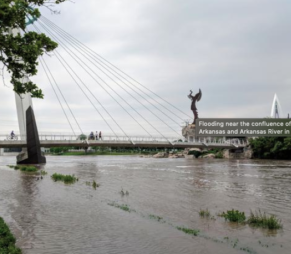
Flooding near the confluence of the Little Arkansas and Arkansas River in Wichita
BRIAN GRIMMETT / KANSAS NEWS SERVICE

The month of May was an all-timer in Kansas, as sites across the state recorded rain on all but two days. The deluge broke state and local rainfall records as well as setting several high water marks in Kansas’ rivers, streams, and reservoirs.

It rained, it poured, the old man snored

May, June and July are historically Kansas’ wettest months. But this May was by far the wettest on record, which goes back 125 years.

In fact it was the wettest month ever recorded — period. The previous record was set in June 1951.

The prolonged period of rain also helped set several local records.

On May 8, 8.22 inches of rain were measured in the south central Kansas town of Wellington besting the previous record for rainfall in a 24-hour period of 6.52 inches set on June 21, 1942.

In the northeast corner of the state, Horton also set a 24-hour rainfall record: 9.42 inches on May 24.

200 daily records, meaning the most amount of rain to ever fall on a particular day, were also set.

In addition, 19 weather stations in the state recorded monthly totals of more than 20 inches of rain.

Volunteer weather watchers with the Community Collaborative Rain Hail and Snow Network station in Rose Hill, just south of Wichita, took top honors, recording more than 30 inches of rain in the month of May.

The rainfall was uneven across the state, but followed typical patterns — drier in the west, wetter in the east. At the extremes, southeast Kansas stations averaged 17 inches of rain for the month, while west central Kansas stations averaged only 5.31 inches, which is still 175% of normal rainfall for the region in May.

Rivers, streams, and reservoirs full up

All of the rain has to go somewhere. With much of the ground already saturated from April showers, most of it ended up in a Kansas river or stream, making pit stops in flood control reservoirs along its way downstream toward the Mississippi River and Gulf of Mexico.

The amount of water moving through the system was as high as anything the U.S. Geological Survey’s Kansas Water Science Center has ever seen.

Reservoirs including Tuttle Creek Lake, Perry Lake, Milford Lake, and Cheney Lake came near to or exceeded their capacity.

Between April 29 and June 3, 104 of 136 streamgages in the state exceeded flood stage. 15 sites were above flood stage for at least 20 days.

While it’s still too early to assess overall impacts, experts say there will likely be extensive erosion and sedimentation issues from the increased flows.

Rain, rain could come again another day

The first week of June has been much drier than May and has allowed stream and reservoir levels to slowly drop back down. While the drier weather has provided much needed respite for people with flooded fields and basements, the chance for even more flooding persists.

With already saturated ground and reservoirs that are still mostly full, even a normal amount of rain in June could bring back flooding. And the forecast doesn’t offer much comfort.

The National Weather Service June forecast predicts a 50% chance for above normal rain in June.

Brian Grimmett reports on the environment and energy for KMUW in Wichita and the Kansas News Service, a collaboration of KMUW, Kansas Public Radio, KCUR and High Plains Public Radio covering health, education and politics. Follow him on Twitter @briangrimmett or email grimmett (at) kmuw (dot) org.

Coverage of energy and the environment is made possible in part by ITC Great Plains and the Corporation for Public Broadcasting.

REPORT: Kansas among 10 best states for protecting children from cyber threats

By REBECCA EDWARDS
Safewise

SALT LAKE CITY, UT – While June marks the end of school, it’s also Internet Safety Month, which is a good time to remind parents, caregivers, educators and youth service providers about the top safety threats facing children, how to protect them, and what to do if they become a victim.

Kansas has some of the most supportive laws in the country when it comes to protecting kids online, but it’s important that both adults and children are aware of the latest cyber threats so they can avoid them.

Top Online Threats for Kids

There are a number of potential dangers in cyberspace, but these are the top three online security risks that most kids face.

KISG Threat Icons - cyber bullying

1. Cyberbullying: Almost 34% of kids age 12–17 have been cyberbullied at some point in their life, and 11.5% have bullied someone else online. Cyberbullying is any aggressive, threatening, or mean-spirited activity conducted via electronic communication (email, social media posts, text messages, etc.). Girls are more likely to be the victims of cyberbullying, and more boys admit to bullying others online.¹

KISG Threat Icons - online predators

2. Online predators: Adults who use the internet to entice children for sexual or other types of abusive exploitation are considered online predators. Child victims can be as young as 1 or as old as 17. When it comes to online enticement, girls make up the majority (78%) of child victims—while the majority (82%) of online predators are male. And 98% of online predators have never met their child targets in real life.²

KISG Threat Icons - inappropriate content

3. Exposure to inappropriate content: Inappropriate content is one of the most common online threats that kids encounter. Everything from vulgar language and hate speech to graphically violent or sexual images can have a harmful effect on an impressionable child. Over 55% of tweens (kids age 10–12) have been exposed to violent content on the internet, and nearly 60% have come across sexually explicit words or images.³

NOTE: For the purposes of this guide, we’re focusing on the earliest prevention possible. While these internet safety tips for kids and parents can be applicable to anyone, we’ve selected steps to help protect children from ages 5 through 12.

KISG quote - Dennis Chow

How to Protect Your Kids from Cyberbullying

KISG cyber bullying icon #1

1. Know the risks: Understand what cyberbullying is, where and how it happens, and how to spot it. Explain that online bullies can act friendly at first, but also encourage your child to be on the lookout for any interactions that make them feel bad, scared, or sad.

KISG cyber bullying icon #2

2. Talk about it: Have ongoing discussions with your child. Talk about what cyberbullying is and what types of communication are acceptable and unacceptable. Make sure your child knows that it’s safe for them to talk to you if something makes them uncomfortable.

KISG cyber bullying icon #3

3. Keep a watchful eye: Place the computer in a common room and monitor all screen time. Use a shared email account, and if you let kids interact on social media, make sure you have full access to manage their accounts. Parental control software is another great way to stay in the know.

KISG cyber bullying icon #4

4. Set boundaries: Put time limits on screen time. Include all online activities—from homework to playing games and surfing the web. Restrict social media access and email accounts, and set rules for any IM, texting, etc. Let your kids know you’ll be checking in regularly.

KISG cyber bullying icon #5

5. Build a network (IRL): They don’t say it takes a village for nothing. The more people you have looking out for your kid online, the more likely you are to keep them safe. Know your kids’ friends and their parents. Enlist support from school, sports, and church leaders.

KISG cyber bullying icon #6

6. Be prepared to respond: Don’t wait until the heat of the moment to come up with your gameplan. In case your kid does get bullied online, learn what the proper responses are so you can keep your emotions in check and help your child deal with what they’re going through.

Steps to Take If Your Child Has Been Bullied

  • Pay attention: Look for signs of cyberbullying, like spending more time online or texting, hiding the screen from others, emotional responses to online interactions, and sadness or seclusion.
  • Ask questions: Gently ask your child what’s going on and how they feel about it. Find out if they’ve responded to the bully and what that response was.
  • Acknowledge their feelings: Your child may feel frightened, angry, sad, or even betrayed if the bully is someone they trusted. Let them know it’s okay to feel whatever they’re feeling.
  • Block the bully: Immediately block (or “unfriend”) the abuser. Use tools like site blockers and privacy settings as extra layers of protection.
  • Report it: Alert website and email administrators to the bully. Most social media platforms offer options to report a user or flag dangerous posts. If appropriate, report the abusive activity to school or law enforcement officials.
  • Assess the damage: If your child’s emotional response is extreme and protective measures don’t seem to help, seek the help of a professional.
  • Enlist reinforcements: Talk to other adults who can help protect your child (other parents, teachers, school administrators, coaches, etc.) and bolster your child’s positive friendships.

What to Do If Your Child Is the Bully

  • Look: If your child sets up new email or social media accounts without your knowledge, makes snarky remarks while online, or starts to hide their online activity, they could be picking on someone.
  • Listen: If you’re concerned, gently broach the topic with your child and then allow them the room to answer. Be open-minded and don’t blame. Bullies are usually in some kind of pain as well.
  • Monitor: Double your efforts to track your child’s online activity. If you’re not already using parental control software, now is the time to start using it.
  • Support: Encourage your child to deal with their feelings and the reasons they’re engaging in this behavior. Suggest that they apologize to the kids they’ve hurt, and help them do it.
  • Get help: It can be hard to identify why your child starting acting out in this manner. Seek professional help, and if the bullying crosses lines at school (or legally), inform the appropriate authorities and ask for resources to address the situation.
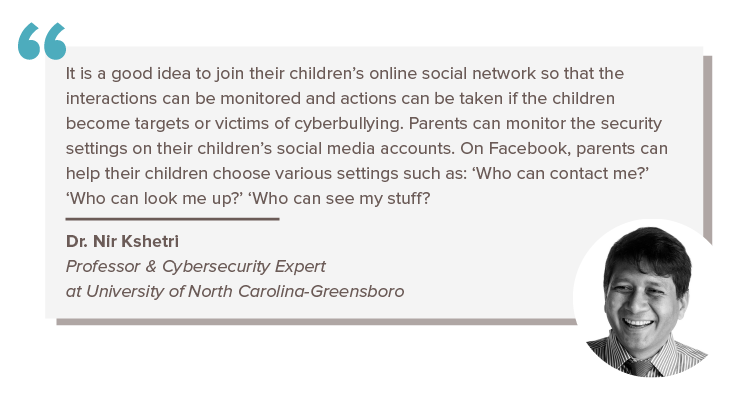
Dr. Nir Kshetri quote

How to Protect Your Kids from Online Predators

bulb icon

1. Understand the danger: Learn what online predators are, where and how predators attack, and how to spot it. Explain that contact from strangers is never okay.

signpost icon

2. Guide online behaviors: Talk about what types of online interactions are okay and what aren’t. Discuss how to recognize signs of trouble and how to ask for help.

umbrella icon

3. Rein in digital cameras: Control access to digital cameras and photo apps on every device. Make sure your kids can’t upload or download photos without your permission.

binoculars icon

4. Monitor online activity: Keep the computer in a common room, set limits on screen time, use a shared email account, and put parental controls (like filters and apps) in place.

stop sign icon

5. Keep kids out of dangerous places: Talk about the risks of chat rooms and social networks, and set up rules and time limits if you allow your kids to use them. Always follow age restrictions for websites and apps.

shield icon

6. Don’t let your guard down: Know that “safe” places still require vigilance. There are kid-focused chat rooms and games where predators may pose as children.

Steps to Take If Your Child Has Been Targeted Online

  • Let your child know it’s not their fault.
  • Cut off communication with the predator.
  • Change online credentials, including screen names, usernames, and passwords.
  • Save screenshots or copies of messages and images from the predator.
  • Report the activity to website administrators and law enforcement.
  • Seek professional help for your child as appropriate.

Safety Tips for Kids

  • Never share personal information online.
  • Don’t respond to emails, texts, or messages from strangers.
  • Don’t post or share photos online.
  • Don’t click links, open attachments, or accept gifts from someone you don’t know.
  • Never agree to meet someone you met online.
  • Let your parents or another trusted adult know if you need help.
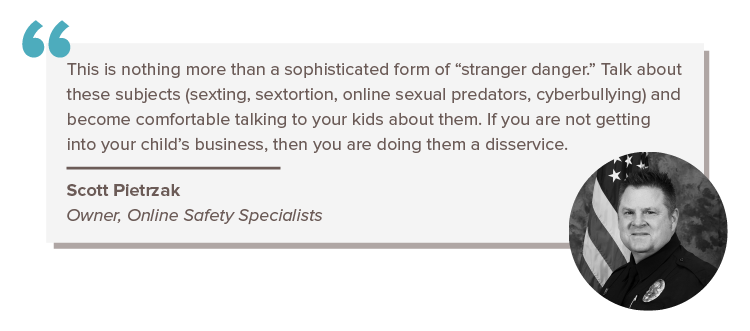
Scott Pietrzak quote

How to Protect Your Kids from Inappropriate Online Content

Map icon

1. Teach kids how to navigate the internet: Talk about proper online etiquette, how to enter safe search terms, how to identify a secure website (https), and when to ask an adult for help.

Telescope icon

2. Let kids know what to watch for: Teach them that bad stuff can come from many sources, including email and direct messages. Talk about inappropriate websites, pop-up ads, and when and where it’s okay to click on something.

Warning sign icon

3. Explain email safety: Make sure kids know not to click on things or open attachments in emails and not to respond to messages from people they don’t know. Have them ask an adult before they download anything.

Fire icon

4. Set up firewalls and content blockers: Use the built-in safety applications that come on your devices and add more to be extra safe. Block all websites that aren’t rated safe for children. Use a content filter or firewall that is designed to protect children from harmful content.

Eye icon

5. Be prepared: Have a plan in place in case your child is exposed to graphic content online. Know what the proper responses are so you can focus on helping your child manage their feelings.

Steps to Take If Your Child Has Been Exposed to Inappropriate Content

Don’t

  • Freak out.
  • React emotionally.
  • Shame your child.
  • Scare your child.
  • Blame your child

Do

  • Stay calm.
  • Be patient.
  • Find the source of the content.
  • Block access to dangerous or confusing sites.
  • Help your child sort out their feelings.
  • Restore a sense of safety.
  • Keep the conversation going.
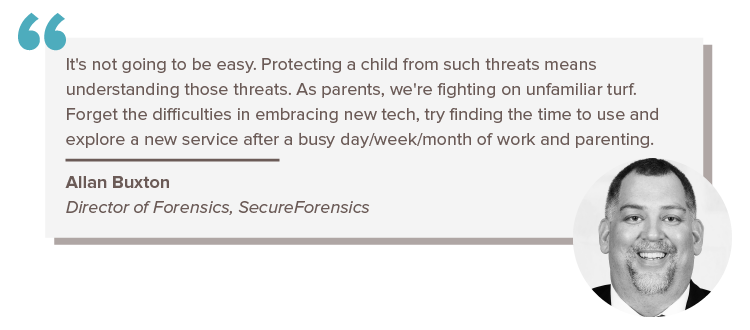
Allan Buxton quote

How Much Is Your State Doing to Keep Kids Safe Online?

State by State Internet Safet for Kids Map

To grade each state, SafeWise looked at laws for both sexting and cyberbullying. Points were assigned to states based on the types of laws currently on the books and the consequences for violating those laws. If a state has a law proposed, partial points were granted. School policies and consequences were also factors. Letter grades were determined based on the total points, with higher points earning higher grades.

State-by-State Online Safety Laws

State Letter Grade Laws Address Cyberbullying or Online Harassment Legal Consequences for Online Harassment Schools Discipline Cyberbullying Includes Discipline for Off-Campus Offenses Laws Address Sexting Misdemeanor Penalties for Sexting Felony Penalties for Sexting
Alabama C YES YES NO NO NO NO YES
Alaska C NO YES YES NO NO YES NO
Arizona B YES YES YES NO YES YES NO
Arkansas A YES YES YES YES YES YES NO
California B YES YES YES YES proposed NO NO
Colorado B YES YES YES NO YES YES NO
Connecticut A YES YES YES YES YES YES NO
Delaware C YES YES YES NO NO NO NO
Florida A YES YES YES YES YES YES YES
Georgia A YES YES YES proposed YES YES YES
Hawaii B YES YES YES NO YES YES NO
Idaho C YES YES YES NO NO NO NO
Illinois B YES YES YES YES YES NO NO
Indiana B YES YES YES NO YES YES NO
Iowa C YES YES YES NO NO NO NO
Kansas A YES YES YES NO YES YES YES
Kentucky C YES YES YES NO NO NO NO
Louisiana B YES YES YES YES YES NO NO
Maine D YES NO YES NO NO NO NO
Maryland C YES YES YES NO NO NO NO
Massachusetts B YES YES YES YES proposed NO NO
Michigan C YES YES NO YES NO NO NO
Minnesota C YES NO YES YES NO NO NO
Mississippi C YES YES YES NO NO NO NO
Missouri C YES YES YES NO NO NO NO
Montana D YES YES NO NO NO NO NO
Nebraska B YES NO YES proposed YES NO YES
Nevada C YES YES NO NO YES YES NO
New Hampshire D YES NO NO YES NO NO NO
New Jersey B YES YES YES YES YES NO NO
New Mexico C YES NO YES NO YES NO NO
New York B YES YES YES YES YES NO NO
North Carolina C YES YES YES NO NO NO NO
North Dakota B YES YES YES NO YES YES NO
Ohio C YES YES YES NO NO NO NO
Oklahoma B YES YES YES NO YES YES NO
Oregon C YES YES YES NO NO NO NO
Pennsylvania A YES YES YES YES YES YES NO
Rhode Island C YES YES YES NO YES NO NO
South Carolina C YES YES YES NO proposed NO NO
South Dakota A YES YES YES YES YES YES NO
Tennessee C YES YES YES YES NO NO NO
Texas A YES YES YES YES YES YES NO
Utah A YES YES YES NO YES YES YES
Vermont B YES YES YES YES YES NO NO
Virginia C YES YES YES NO NO NO NO
Washington C YES YES YES NO NO NO NO
West Virginia C YES YES YES NO YES NO NO
Wisconsin D NO YES YES NO NO NO NO
Wyoming D YES NO YES NO NO NO NO

More Resources to Help with Online Safety for Kids

This guide is the perfect starting point to make sure you know the basics for keeping kids safe on the internet. But online threats are constantly changing, and cybercriminals are getting more sophisticated. To help you stay ahead of the curve, here are some of the resources we recommend.

Internet Safety Classes and Workshops

State and Local Internet Safety Resources

Tools to Keep Kids Safe Online

More Educational and Support Resources

Sources

1. Cyberbullying Research Center, “2016 Cyberbullying Data
2. National Center for Missing and Exploited Children, “The Online Enticement of Children: An In-Depth Analysis of CyberTipline Reports
3. Bark, “2018 Children and Teen Cyber Fact Sheet
4. Cyberbullying Research Center, “State Sexting Laws”; Cyberbullying Research Center, “State Cyberbullying Laws


The Latest: Trump says tariffs on Mexico suspended indefinitely

WASHINGTON (AP) — President Donald Trump announced late Friday that he had suspended plans to impose tariffs on Mexico, tweeting that the country “has agreed to take strong measures” to stem the flow of Central American migrants into the United States. But the deal the two neighbors agreed to falls short of some of the dramatic overhauls the U.S. had pushed for.

A “U.S.-Mexico Joint Declaration” released by the State Department said the U.S. “will immediately expand the implementation” of a program that returns asylum-seekers who cross the southern border to Mexico while their claims are adjudicated. Mexico will “offer jobs, healthcare and education” to those people, the agreement stated.

Mexico has also agreed, it said, to take “unprecedented steps to increase enforcement to curb irregular migration,” including the deployment of the Mexican National Guard throughout the country, especially on its southern border with Guatemala. And Mexico is taking “decisive action to dismantle human smuggling and trafficking organizations as well as their illicit financial and transportation networks,” the State Department said.

The move puts to an end — for now — a threat that had sparked dire warnings from members of Trump’s own party, who warned the tariffs would damage the economy, drive up prices for consumers and imperil an updated North American trade pact. Trump’s Friday night tweet marked a sharp reversal from earlier in the day, when his spokeswoman Sarah Sanders told reporters: “Our position has not changed. The tariffs are going forward as of Monday.”

Mexican President Andrés Manuel López Obrador tweeted, “Thanks to the support of all Mexicans, the imposition of tariffs on Mexican products exported to the USA has been avoided.” He called for a gathering to celebrate in Tijuana Saturday.

The changes, in part, continue steps the Trump administration was already taking. The U.S. announced in December that it would make some asylum seekers wait in Mexico while their cases were being proceeded — a begrudging agreement with Mexico that has taken months to scale and that has been plagued with glitches, including wrong court dates, travel problems and issues with lawyers reaching their clients.

Homeland Security officials have been ramping up slowly, and were already working to spread the program along the border before the latest blowup. About 10,000 people have been returned to Mexico to wait out the processing of their immigration cases since the program began Jan. 29. More than 100,000 migrants are currently crossing the U.S. border each month, but not everyone claims asylum and migrants can wait an entire year before making a claim.

Any sizable increase may also be difficult to achieve. At the San Ysidro crossing alone, Mexico had been prepared to accept up to 120 asylum seekers per week, but for the first six weeks only 40 people per week were returned.

Trump had announced the tariff plan last week, declaring in a tweet that, on June 10, the U.S. would “impose a 5% Tariff on all goods coming into our Country from Mexico, until such time as illegal migrants coming through Mexico, and into our Country, STOP.” U.S. officials had laid out steps Mexico could take to prevent the tariffs, but many had doubts that even those steps would be enough to satisfy Trump on illegal immigration, a signature issue of his presidency and one that he sees as crucial to his 2020 re-election campaign.

After returning from Europe Friday, though, Trump tweeted, “I am pleased to inform you that The United States of America has reached a signed agreement with Mexico.” He wrote that the “Tariffs scheduled to be implemented by the U.S. on Monday, against Mexico, are hereby indefinitely suspended.”

He said Mexico has agreed to work to “stem the tide of Migration through Mexico, and to our Southern Border” and said those steps would “greatly reduce, or eliminate, Illegal Immigration coming from Mexico and into the United States.”

The 5% tax on all Mexican goods , which would increase every month up to 25% under Trump’s plan, would have had enormous economic implications for both countries. Americans bought $378 billion worth of Mexican imports last year, led by cars and auto parts. Many members of Trump’s Republican Party and business allies had urged him to reconsider — or at least postpone actually implementing the tariffs as talks continue — citing the potential harm to American consumers and manufactures.

From the moment Trump announced the tariff threat, observers wondered whether he would pull the trigger, noting his habit of creating problems and then claiming credit when he rushes in to solve them.

In late March, Trump threatened to shut the entire U.S.-Mexico border if Mexico didn’t immediately halt illegal immigration. Just a few days later, he backed off that threat, saying he was pleased with steps Mexico had taken. It was unclear, however, what — if anything — Mexico had changed.

U.S. and Mexican officials met for more than 10 hours Friday during a third day of talks at the U.S. State Department trying to hash out a deal that would satisfy Trump’s demand that Mexico dramatically increase its efforts to crack down on migrants.

The talks had been focused, in part, on attempting to reach a compromise on changes that would make it harder for migrants who pass through Mexico from other countries to claim asylum in the U.S., those monitoring the situation said. Mexico has long opposed such a change but appeared open to considering a potential compromise that could include exceptions or waivers for different types of cases. The joint declaration, however makes no mention of the issue.

Leaving the State Department Friday night, Mexican Foreign Secretary Marcelo Ebrard said he thought the deal struck “a fair balance” because the U.S. “had more drastic proposals and measures at the start.”

But Leticia Calderón Cheluis, a migration expert at the Mora Institute in Mexico City, said the agreement is essentially a series of compromises solely by Mexico, which she said committed to “a double clamp at both borders.”

Trump in recent months has embraced tariffs as a political tool he can use to force countries to comply with his demands — in this case on his signature issue of immigration. Beyond Trump and several White House advisers, though, few in his administration had believed the tariffs were a good idea, according to officials familiar with internal deliberations. Those people had worried about the negative economic consequences for Americans and argued that tariffs — which would likely spark retaliatory taxes on U.S. exports — would also hurt the administration politically.

Republicans in Congress had also warned the White House that they were ready to stand up to the president to try to block his tariffs, which they worried would spike costs to U.S. consumers, harm the economy and imperil a major pending U.S.-Mexico-Canada trade deal .

Senate Minority Leader Chuck Schumer, D-N.Y., greeted Friday night’s news with sarcasm. “This is an historic night!” he tweeted. “Now that that problem is solved, I’m sure we won’t be hearing any more about it in the future.”

___

WASHINGTON (AP) — President Donald Trump says he has suspended plans to impose tariffs on Mexico, tweeting that the country “has agreed to take strong measures” to stem the flow of Central American migrants into the United States.

“I am pleased to inform you that The United States of America has reached a signed agreement with Mexico,” Trump tweeted Friday night, saying the “Tariffs scheduled to be implemented by the U.S. on Monday, against Mexico, are hereby indefinitely suspended.”

He said Mexico has agreed to work to “stem the tide of Migration through Mexico, and to our Southern Border” and said those steps would “greatly reduce, or eliminate, Illegal Immigration coming from Mexico and into the United States.”

He said details would be released soon by the State Departemnt.

The tweet marked a change in tone from earlier Friday, when his spokeswoman Sarah Sanders told reporters in Ireland before Trump took off: “Our position has not changed. The tariffs are going forward as of Monday.” Trump has often said unpredictability helps him negotiate.

A tax on all Mexican goods , which would increase every month up to 25% under Trump’s plan, would have had enormous economic implications for both countries. Americans bought $378 billion worth of Mexican imports last year, led by cars and auto parts. Many members of Trump’s Republican Party and business allies have urged him to reconsider — or at least postpone actually implementing the tariffs as talks continue — citing the potential harm to American consumers and manufactures.

U.S. and Mexican officials held a third day of talks at the U.S. State Department trying to hash out a deal that would satisfy Trump’s demand that Mexico dramatically increase its efforts to crack down on migrants.

The talks were said to be focused, in part, on attempting to reach a compromise on changes that would make it harder for migrants who pass through Mexico from other countries to claim asylum in the U.S., those monitoring the situation said. Mexico has opposed such a change but appeared open to considering a potential compromise that could include exceptions or waivers for different types of cases.

Trump has nonetheless embraced tariffs as a political tool he can use to force countries to comply with his demands — in this case on his signature issue of immigration. And he appeared poised earlier Friday to invoke an emergency declaration that would allow him to put the tariffs into effect if that is his final decision, according to people monitoring the talks.

“If negotiations continue to go well,” Trump “can turn that off at some point over the weekend,” Marc Short, Vice President Mike Pence’s chief of staff, told reporters.

Talks had gotten off to a shaky start Wednesday, as the U.S. once again pressed Mexico to step up enforcement on its southern border with Guatemala and to enter into a “safe third country agreement” overhauling its asylum system. But as talks progressed Thursday, U.S. officials began to grow more optimistic, with Short reporting Mexican “receptivity” to potential asylum changes.

Still, he said there was “a long way to go in that particular piece.”

In Mexico, President Andrés Manuel López Obrador would not say whether he would accept his country agreeing to be a “safe third country.”

“That is being looked at,” he said Friday morning during his daily news conference, where he held out hope a deal could be reached before Monday’s deadline.

In addition, Mexican Foreign Secretary Marcelo Ebrard said Thursday his country had agreed to deploy 6,000 National Guard troops to its border with Guatemala to help control the flow of migrants as part of its concessions.

He tweeted late Friday that there would be no “tariff application on Monday.”

“Thanks to all the people who have supported us by realizing the greatness of Mexico,” he wrote.

Beyond Trump and several White House advisers, few in his administration believe the tariffs are a good idea, according to officials familiar with internal deliberations. Those people worry about the negative economic consequences for Americans and believe the tariffs — which would likely spark retaliatory taxes on U.S. exports — would also hurt the administration politically.

Republicans in Congress have warned the White House that they are ready to stand up to the president to try to block his tariffs, which they worry would spike costs to U.S. consumers, harm the economy and imperil a major pending U.S.-Mexico-Canada trade deal .

New Kansas trial ordered in 2008 death of insect exterminator

TOPEKA, Kan. (AP) — The Kansas Supreme Court has unanimously overturned the conviction of a man who killed an insect exterminator in February 2008.

Howard Barrett photo KDOC

The court ruled Friday the case against 61-year-old Howard Barrett should be returned to Riley County for a new trial.  Read the ruling here.

Barrett beat and fatally stabbed 48-year-old Thomas James, who was doing extermination work in Barrett’s apartment in Leonardville.

His attorney argued that Barrett, who is schizophrenic, felt irrationally threatened by James.

Barrett was convicted in November 2014 of second-degree murder but appealed, saying jurors should have been instructed they could find him guilty of imperfect self-defense voluntary manslaughter.

The Court of Appeals ruled that error was harmless because Barrett’s second-degree murder conviction nullified a possible manslaughter conviction.

The Supreme Court disagreed, saying the jury could have reasonably convicted Barrett of manslaughter.


New Secretary of Dept. of Administration announced

Dr. DeAngela Burns-Wallace
OFFICE OF GOV.

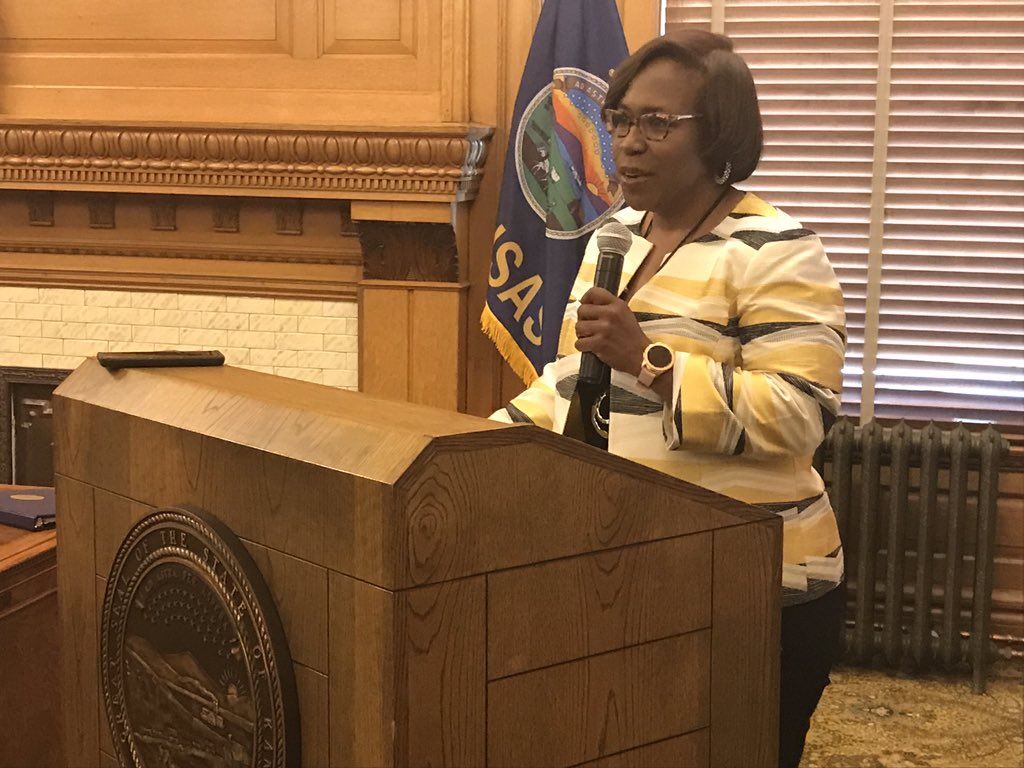
TOPEKA – Governor Laura Kelly announced today DeAngela Burns-Wallace as her choice to lead the Kansas Department of Administration.

“I’m pleased to have DeAngela Burns-Wallace on board to lead the Department of Administration,” Kelly said. “Her extensive experience and diverse qualifications will be vital to this agency. I look forward to continuing our efforts to increase transparency of contracts and improve state government.”

Burns-Wallace currently is the Vice Provost of Undergraduate Studies at the University of Kansas. Previously, Burns-Wallace was Assistant Vice Provost for Undergraduate Studies at the University of Missouri. She also served as fellow at the American Council on Education in Washington, D.C., for an emerging Leaders Fellowship in 2013. She earned her B.A. in International Relations from Stanford University, her M.P.A in Public Policy & International Affairs from Princeton University and a doctorate in Higher Education Management from the University of Pennsylvania.

“I am honored to be selected by Governor Kelly to serve the people of Kansas as Secretary of the Department of Administration,” Burns-Wallace said. “I look forward to working alongside her team to build on the progress of the last five months. Kansans are depending on us to work on their behalf.”

Current Acting Secretary Duane Goossen will step down June 7, 2019. Goossen was secretary of administration for Governors Sebelius, Parkinson and Kelly, and budget director for Governors Graves, Sebelius, and Parkinson. He also worked on the Kelly Transition Team.

“Duane was an integral part of our efforts to rebuild our state and improve morale among state employees,” Kelly said. “I can’t emphasize how important he was to this agency, as well as the state as a whole. I thank him for his friendship and service to the state of Kansas.”

John Yeary, currently with the agency, will operate as acting secretary starting June 7 until Burns-Wallace becomes acting secretary on July 1.

Burns-Wallace is to be submitted to the Senate Confirmation Oversight Committee during interim and voted on by the full Senate in 2020.

Court lifts injunction blocking Keystone XL oil pipeline

HELENA, Mont. (AP) — An appeals court has lifted a judge’s injunction that blocked construction of the Keystone XL oil pipeline from Canada to the U.S., but the developer has said it’s too late to begin work this year and environmental groups vowed to keep fighting it.

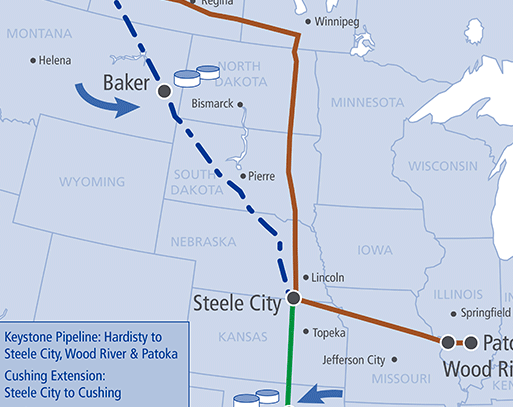
Keystone XL Pipeline — Overall route map courtesy Trans Canada

A three-judge panel of the 9th U.S. Circuit Court of Appeals on Thursday ordered dismissal of the lawsuit by environmental and Native American groups, saying President Donald Trump had revoked a 2017 permit allowing the $8 billion pipeline to be built.

Trump later issued a new permit, and the appellate judges agreed with Justice Department attorneys who say that nullifies the legal challenge involving environmental impacts.

The pipeline would ship up to 830,000 barrels (35 million gallons) of crude oil daily from the tar sands of Alberta through Montana, South Dakota and Nebraska, where it would tie in to existing pipelines to carry the crude to U.S. refineries.

The ruling Thursday was a victory for TC Energy, a Calgary, Alberta-based company that wants to build the line, though company officials have said it already missed the 2019 construction season because of court delays.

“We are pleased with the ruling,” TC Energy spokesman Matthew John said. “We look forward to advancing the project.”

John did not respond to questions on whether the ruling would change the construction schedule.

Attorneys for the plaintiffs accuse Trump of trying to get around court rulings by issuing the new permit, which they say also is flawed. They have filed another, ongoing lawsuit to block the new presidential permit.

Attorney Stephan Volker, who represents the Indigenous Environmental Network and North Coast Rivers Alliance, said he would request another judge’s order to block the project if he thought there was a chance of construction beginning immediately.

Representatives of a half-dozen other environmental groups vowed to keep fighting in court and predicted the pipeline will never be built.

“We shouldn’t forget the underlying issue here — global warning,” Volker said. “We’re trying to save the Earth. I wish the federal government would pay attention to the science and do its job.”

Last fall, U.S. District Judge Brian Morris in Montana ruled that the Trump administration did not fully consider potential oil spills and other environmental effects when it issued the 2017 permit. He blocked construction by issuing a permanent injunction against the project.

White House officials contend a presidential permit can’t be reviewed by a court. After Trump revoked that permit and issued and signed the new one, Justice Department attorneys argued that claims in that lawsuit — and Morris’ injunction — no longer applied.

The environmental groups argued that the government can’t unilaterally sweep aside years of litigation against the long-stalled pipeline.

The Justice Department has not yet responded to the second lawsuit.

Kan. Supreme Court affirms conviction in killing of Salina girl

TOPEKA —The Kansas Supreme Court has affirmed Macio Domingo Palacio, Jr.’s convictions in Saline County District Court in the death of Allie Saum in May of 2015, according to a media release from the court.

Palacio photo KDOC

He is one of five men convicted in the fatal shooting of the 17-year-old Salina girl.

In a decision written by Justice Eric Rosen and published Friday, the Supreme Court affirmed Palacio’s Saline County District Court convictions for first-degree murder, attempted first-degree murder, criminal discharge of a firearm at an occupied vehicle, and conspiracy to commit aggravated battery.

The court held that the district court did not err in denying Palacio’s motion to change venue.

It also rejected Palacio’s claim that the district court erred in denying his motion to suppress his confession. Palacio had argued that investigators obtained his confession in violation of his constitutional rights by interrogating him after he clearly asked to speak with a lawyer and by exerting coercive tactics. The court held that the officers’ questions did not constitute interrogation and that Palacio’s confession was voluntary.

Prosecutor ends criminal investigation of Chiefs’ Tyreek Hill

OLATHE, Kan. (AP) — A prosecutor says he is no longer actively investigating a criminal case against Kansas City Chiefs wide receiver Tyreek Hill involving alleged injuries to his 3-year-old son.

Tyreek Hill -photo courtesy KC Chiefs

Johnson County Attorney Steve Howe told The Kansas City Star he would reconsider his decision if new evidence emerges against Hill, who has been suspended from the team since April 25 after a television station aired a recording of a conversation between Hill and his fiancee, Crystal Espinal, about the boy’s treatment.

In news conference a day earlier, Howe said he believed the boy had been hurt but would not file charges because he couldn’t prove who did it.

The Kansas Department for Children and Families continues to investigate the couple after police were called to the Hill’s home twice in March.

Hill has maintained his innocence. Chiefs spokesman Ted Crews declined comment Friday.

Copyright Eagle Radio | FCC Public Files | EEO Public File