SALINE COUNTY —Two people were injured in an accident just before 2p.m. Wednesday in Saline County.
Photo Saline County Sheriff
A 2015 Ford F550 driven by Kenneth Reh, 75, Inman, was westbound in the 5800 Block of Kansas Highway 4 a half mile west of Niles Road, according to Sheriff Roger Soldan. The driver fell asleep and pickup left the road and struck a culvert.
EMS transported Reh to Salina Regional Health Center for head and possible chest injuries, according to Soldan. A passenger, Roman Loera-Ramos, 56, McPherson, had cuts to his face and was treated at the scene.
The pickup was carrying a chemical tank that had Roundup herbicide and there was a minor spill of the herbicide. Saline County Emergency Management personnel responded to the scene and determined that the spill did not pose a threat to humans or animals, according to Soldan.
Larry Fluery works for a Bentonville, Arkansas, film festival from a coffee shop in Pittsburg, Kansas.
By STEPHAN BISAHA Kansas News Service
In the 1990s, the near future looked like a place where distance would no longer matter.
In an increasingly online economy, location would matter less than connection. The internet appeared destined to make working from Pittsburgh, Pennsylvania, much the same as tackling a job from Pittsburg, Kansas.
Yet three decades later, location matters as much as ever.
Cities grew denser. Remote towns leaked talent. The growth of Silicon Valley and other high-tech hubs only added to the divide between city and country.
Now, some Kansas communities again see remote work as a way to rejuvenation. Here are six hurdles to bringing online jobs to rural Kansas and ways they might be overcome.
Internet Speed
When it comes to remote work, connectivity is everything.
Sending emails is possible — if painful — on a dial-up connection. But today’s remote work requires high speed. Video conferences. Screen sharing. Gigabyte-sized project files.
And then there’s the future. Augmented reality. Virtual reality. Holograms. Whatever the next technology trend, it will almost certainly consume bandwidth with increasing greed.
“Some of them, we just don’t know what they’re going to be,” said Brian Whitacre, an Oklahoma State University professor studying rural development. “But we’re just seeing this push for more data. More broadband.”
Some Kansas cities such as Pittsburg have access to fiber optic cable — the current gold standard for high-speed internet. A 200-plus-megabits-per-second connection can better prepare a city for the future of remote work.
But much of Kansas lacks access to the basic broadband needed for today’s workplace applications. Remote work just won’t come to places with slow internet.
Slow Acceptance of Remote Work
A little more than 5% of American workers worked remotely in 2017. That reflects a steady, but slow, rise.
And while the digital economy is expanding, many tech companies want their employees working physically closer together. Facebook and Google invested in campuses designed for workers to bump into each other. Yahoo and IBM have rolled back remote work privileges.
They reason game-changing serendipity happens over a cubicle wall more easily than by email.
Some companies continue to encourage remote work. Dell is doing so to save on real estate costs.
There’s also a shortage of high-skilled talent in the big metro areas where many tech companies are based. The Center on Rural Innovation is hoping companies will turn to remote work out of necessity. That’s why the center is providing financial and technical support to places like Pittsburg to create a virtual hub of trained remote workers living in small cities.
“There is a real opportunity to surface, and in some cases train up people, who can work in those fields to live where they want,” said Matt Dunne, the executive director for the Center on Rural Innovation.
Demands from younger workers may force employers who are still iffy on extra out-of-office time to give in. Millennials were more likely than older generations to say a flexible schedule and remote work opportunities were important in a job, according to a Marketplace-Edison Research poll.
Isolation
One problem for remote workers: loneliness.
About a fifth of remote workers said that was their top struggle, according to social media consultant Buffer’s 2018 State of Remote Work Report.
Health concerns linked to loneliness include increased risk of heart disease and suicide.
That’s prompted remote workers to reach out to each other. Larry Fleury does marketing and social media for the Bentonville, Arkansas, film festival. He’s joined an unofficial network of the city’s internet laborers.
“You kind of get new friendships with remote workers,” Fleury said.
Trend is Still Toward Bigger Cities
Even if remote workers can live outside big cities, will they want to?
Since 2000, urban counties have grown while many rural counties saw their populations decline. That’s partially driven by the tech field being concentrated in a few large metro areas. There’s also the gap in amenities — Emporia, Kansas, may have fiber optics, but it can’t compete with Kansas City when it comes to the number of breweries and comedy clubs.
Some researchers predict that the continued concentration in urban centers could reach a tipping point. Increasingly rising rents for small apartments could tempt workers to eye smaller towns.
Pittsburg is investing in new homes to attract those sticker-shocked city dwellers. The city is building bike paths. It may struggle to draw young singles, but the city could be a landing spot for new families looking to escape bigger cities. Pittsburg can offer high-speed internet with a slower lifestyle.
“It’s not just about the fiber,” said Shawn Naccarato, the chief strategy officer for Pittsburg State University. “The fiber is important to facilitate the economic growth, but this is about the quality of life.”
Competition That’s Willing to Pay
Kansas towns looking to attract remote workers have to compete with a growing number of places across the country doing the same. And some of those cities are willing to pay.
Remote workers that move to Tulsa, Oklahoma, get a $10,00 stipend and housing assistance. Vermont is making a similar offer.
Kansas does have its own program to draw in out-of-state workers to specific parts of the state by paying off some student loans and providing tax exemptions. That Rural Opportunity Zone program isn’t aimed at remote workers and excludes many of the counties with strong internet access.
Commutes Still Matter
Even in a remote work future, trips to the office won’t disappear.
Increasing numbers of Americans work remotely some of the time — as much as 43 percent of workers in 2017 according to a Gallup poll.
Trips to the office may shift from daily to weekly or even monthly. But researchers say employers still want face time with people on their payrolls — and video chats won’t cut it.
“People do need to come together,” said Tom Kochan, a professor at the Massachusetts Institute of Technology researching the future of work. “They need to look each other in the eye once in a while.”
The areas most likely to benefit from this workforce shift are those near major metro areas. An hour or more commute becomes more tolerable when it’s no longer five days a week.
But remote parts of Kansas with drives pushing past two hours to dense urban centers will have a harder time attracting and retaining an online workforce.
Stephan Bisaha reports on education for KMUW in Wichita and the Kansas News Service, a collaboration of KMUW, Kansas Public Radio, KCUR and High Plains Public Radio covering health, education and politics. Follow him on @SteveBisaha or email bisaha (at) kmuw (dot) org.
HUTCHINSON — A new festival the first weekend of the Kansas State Fair will feature the treasures and tourist attractions found in Kansas communities.
The Explore Kansas Festival — a showcase of Kansas culture, history, events and attractions — will take place the first weekend of the Fair, Sept. 7 and 8 in Gottschalk Park.
Fair General Manager Robin Jennison says the first-ever festival is a way to educate fairgoers about Kansas’ many attractions all in one place. Visitors will see an interactive display of Kansas byways, dig for a lost village, learn about one of the nation’s oldest town picnics and celebrate the upcoming 200th birthday of the Santa Fe Trail.
“The two-day showcase brings together Kansas communities and attractions, creating a place for the public to discover our unique treasures,” Jennison said.
A few of the communities represented:
Erie is famous for its annual Old Soldiers and Sailors Reunion, which is held during the second full week of July. The reunion features a Free Bean Feed. The beans are prepared using a historic recipe, simmering all day in cast-iron kettles over wood fires — just like soldiers used in the Civil War. This reunion has been conducted continuously since 1873 and is claimed to be the oldest consecutively running Old Soldiers and Sailors Reunion in the country.
Ark City’s Lost City of Etzanoa — In June 2015, archaeologist Dr. Don Blakeslee led a wide-ranging field study in central and southern Kansas. One of his primary goals was to rediscover the long-lost Native American city of Etzanoa. He was successful. It was in the present location of Arkansas City, Kansas. This site is now available for tours.
Santa Fe Trail — William Becknell, known as the Father of the Santa Fe Trail, left Missouri for Santa Fe, New Mexico, in 1821. More than half the trail runs through Kansas and many remnants of the trail still exist. The Santa Fe Trail was the first international trail between the United States and Mexico. The Santa Fe Trail Association will have a display celebrating the trail’s heritage.
“We see the Kansas State Fair as an important mouthpiece for Kansas Tourism,” Jennison added. “The Explore Kansas Festival can help visitors find unique cafes, fishing holes, hiking trails, next summer’s vacation spot, historic sites, natural landmarks, museums, arts and culture and events — or even a new place to call home.”
The fair has already filled up one tent for the festival and is working on filling a second overflow location. There are only a few vacant spots. The community application deadline is Monday, June 10. Spots after this date will be filled if spaces are still available.
To apply for the Explore Kansas Festival, please visit the fair’s website. For more information, call Kansas State Fair Director of Marketing Amy Bickel at (620) 669-3624 or email her at [email protected].
WICHITA — Spirit Aerosystems is making changes as they face financial challenges in the wake of the issues involving the safety of Boeing’s 737 Max jets.
On June 21, the aerostructures manufacturer in Wichita will shorten the work week to 32 hours for up to ten weeks for all salaried, management and executive employees working on commercial programs, according to a media release from the Society of Professional Engineering Employees in Aerospace or SPEEA.
The reduction will impact salaries by 20 percent per week, according to the release.
Those employees have the option to take Monday or Friday off. Employees on the Strategic Defense Program were not included in the changes.
In addition to the initial safety issues, Boeing is now telling some airlines flying its 737 model to replace a part on the planes’ wings, a move that could affect more than 100 aircraft. Boeing said on Sunday that it is working with federal regulators and contacted airlines about potential problems discovered in one batch of “slat tracks” produced by a supplier.
The 737 Max was grounded worldwide following two crashes involving the model.
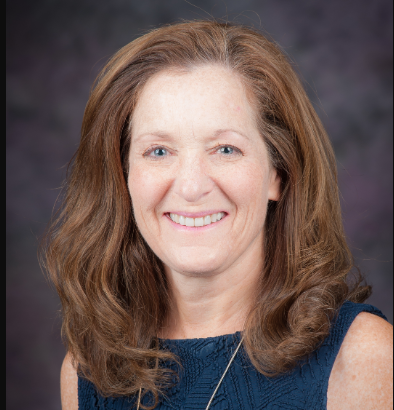
MANHATTAN — Following a national search, Bonnie Rush has been selected as the new dean of the College of Veterinary Medicine at Kansas State University.
Rush, who has been serving as interim dean of the college since 2017, was appointed by Charles Taber, provost and executive vice president. Her appointment begins June 16, according to a media release from the University.
“Dr. Rush emerged as the clear leader following a competitive national search process. With her strong history of leadership for the College of Veterinary Medicine, Dr. Rush is the right choice to lead this college and its vital teaching, research, service, and outreach programs into the future,” Taber said. “The college not only supplies the state of Kansas, the nation and the world with highly trained and skilled veterinarians, it is also a leader in infectious disease research that affects both animals and humans.”
Rush will be charged with leading the college on a variety of fronts, including program development, faculty and student development, research, teaching and extension, program accreditation, diversity and the 2025 plans for both the college and the university.
The college has three academic departments, two service units — the Veterinary Health Center and Kansas State Veterinary Diagnostic Laboratory — and is home to a number of prestigious research centers and units, including the Center of Excellence for Emerging and Zoonotic Animal Diseases, Beef Cattle Institute, Center of Excellence for Vector-Borne Diseases and the U.S.-China Center for Animal Health. The college’s professional degree program provides broad training opportunities across a comprehensive range of companion and exotic animals, and livestock species.
“It has been an honor to serve as the interim dean,” Rush said. “The students, faculty and staff of the College of Veterinary Medicine are tremendously talented and committed to advancing the missions to strengthen animal health and well-being through research, education and service. I look forward to honoring the traditions of the college, while working together to create new opportunities for the future.”
A professor of internal equine medicine, Rush’s area of clinical expertise is equine respiratory disease with an emphasis on respiratory physiology, immunology and aerosol drug therapy. She co-authored the book “Equine Respiratory Diseases” with Tim Mair from the Bell Equine Clinic, Kent, U.K.
Rush began her career as a faculty member at Kansas State University in 1993. She served as the head of the clinical sciences department from 2006 to mid-2017. She has been a core course coordinator, led curriculum reform and maintained responsibility for clinical outcome assessment. She is committed to the scholarship of teaching and has authored or co-authored more than 20 manuscripts in the Journal of Veterinary Education on effective instructional practices, communication training, and student welfare.
The recipient of the President’s Award for Outstanding Department Head in 2014, Rush also earned the 1996 and 2003 Carl J. Norden Distinguished Teacher Award, the 2002 Pfizer Award for Research Excellence, the 2004 Outstanding Woman Veterinarian of the Year and the 2009 Distinguished Alumni Award from Ohio State University.
Rush earned her Doctor of Veterinary Medicine from Ohio State University in 1989, completed internship training at North Carolina State University in 1990 and equine internal medicine residency training at Ohio State University in 1993.
WICHITA, Kan. (AP) — Authorities are investigating after a 2-year-old boy who was on the radar of child welfare officials died at a Wichita motel.
The Kansas Department of Children and Families identified the boy as Zayden Jaynesahkluah. Police say he was pronounced dead on May 31 after a woman called to report that he wasn’t breathing.
No information has been released about how he died, and no arrests have been made. Police say they are awaiting a toxicology report.
Kansas Rep. Michael Capps said that welfare officials had been involved with Zayden’s family before he died, although he had no specifics. He says the welfare agency needs to be reformed. The Wichita area has seen several child abuse homicides. The victims include 3-year-old Evan Brewer, whose body was found encased in concrete.
WICHITA, KAN. – A Russian-born woman was sentenced to 84 months in federal prison Thursday for unlawfully taking her daughter to Russia and demanding money before allowing the American father to have custody of the girl, according to U.S. Attorney Stephen McAllister.
Bogdana Alexandrovna Osipova referred to by her married name Mobley in court documents is being held in Harvey Co.
In March, a jury found Bogdana Alexandrovna Mobley, 38, guilty on one count of international parental kidnapping and two counts of attempting to extort money from the child’s father.
During trial, the prosecutor presented evidence that in April 2014 Mobley took a child of hers (identified as S.M. in court records) to Russia despite the fact the biological father, Brian Mobley, had been awarded joint custody in Sedgwick County District Court. At the time, the Mobleys had a pending divorce case before the court. The defendant did not obtain the permission of the court or Brian Mobley before going to Russia with the child. The child still has not returned to the United States.
Between April 2014 and November 2016, the defendant only permitted Brian Mobley to communicate with S.M. via cell phones and Skype applications. She told Brian Mobley that he needed to send her money in order to see the child.
WASHINGTON (AP) — U.S. and Mexican officials claim to be making progress as they labored for a second day to avert import tariffs. But President Donald Trump is still threatening to impose them as he tries to pressure Mexico into stemming the flow of Central American migrantsacross the United States’ southern border.
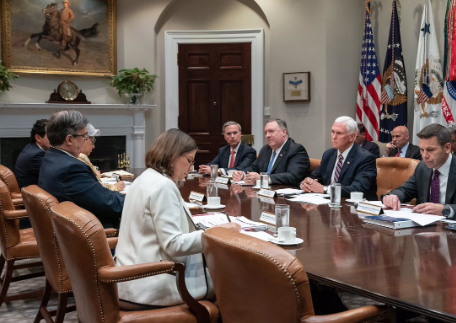
Negoitiations with officials from Mexico photo courtesy Vice Pres. Pence
Vice President Mike Pence, monitoring the talks from his travels in Pennsylvania, said Thursday the U.S. was “encouraged” by Mexico’s latest proposals but that tariffs still were set to take effect on Monday.
Pence added that it would be “for the president to decide” whether Mexico was doing enough to head off the tariffs. Pence said that, among other issues, negotiators had been discussing a potential agreement to make it difficult for those who enter Mexico from other countries to claim asylum in the U.S. Mexico has long resisted that request.
Trump has threatened to impose a 5% tax on all Mexican goods beginning Monday as part of an escalating tariff regime opposed by many in his own Republican Party.
The frantic, last-minute talks underscore Trump’s chaotic approach even when decisions have enormous economic consequences for both the U.S. and its closest allies. Trump has embraced tariffs as a tool he can use as leverage against other countries, dismissing the potential harm to American consumers and manufacturers.
Traveling in Europe, Trump told reporters that negotiators had made “a lot of progress,” but continued to play coy.
“We’ll see what happens,” Trump said in Ireland before leaving for France to attend a D-Day ceremony. “But something pretty dramatic could happen. We’ve told Mexico the tariffs go on. And I mean it, too. And I’m very happy with it.”
It remained unclear whether any deal could be struck with Trump out of the country. Many in Washington still expect the tariffs to go into effect barring a major new concession from Mexico, though lawmakers who have been in talks with both U.S. and Mexican officials said they were hopeful a deal could be reached to satisfy Trump, or at least delay the tariffs’ implementation.
Mexican Foreign Secretary Marcelo Ebrard spent several hours at the State Department Thursday morning, while Trump’s legal counsel and other Mexican aides met at the White House Thursday afternoon.
Ebrard told reporters as he left the State Department that progress was being made and that he was likely to return following consultations at the embassy. He returned in early evening.
His spokesman, Roberto Velasco, tweeted that “Options continue to be explored.”
“The stance of the United States is focused on measures of migratory control, ours on development,” he said.
White House spokeswoman Mercedes Schlapp said in an interview that conversations were continuing but “it looks like we’re moving toward this path of tariffs because what we’ve seen so far is that the Mexicans, what they’re proposing, is simply not enough.”
Pence, who led the discussions Wednesday with Secretary of State Mike Pompeo and other U.S. officials, told reporters in Pennsylvania that the administration had “made it very clear that our neighbors to the south, Mexico, must do more to end the tide of illegal immigration that is besetting our southern border.”
During Wednesday’s talks, the gulf between the countries was clear as Mexico offered small, thus far undisclosed concessions, and the U.S. demanded major action. A senior administration official said the U.S. once again pressed Mexico to step up enforcement on its southern border and to enter into a “safe third country agreement” that would make it difficult for those who enter Mexico from other countries to claim asylum in the U.S.
But Mexico surprised U.S. officials Thursday when they returned to the negotiating table and said they would commit to what Pence had requested, according to the official, who cautioned that significant questions about timing and implementation remain.
Trump officials have said Mexico can prevent the tariffs by securing its southern border with Guatemala, cracking down on criminal smuggling organizations and overhauling its asylum system. But the U.S. has not proposed concrete metrics to assess whether Mexico is complying, and it is unclear whether even those steps would be enough to satisfy Trump on illegal immigration, a signature issue of his presidency and one that he sees as crucial to his 2020 re-election campaign.
Beyond Trump and several White House advisers, few in the administration believe imposing tariffs is a good idea, according to officials familiar with internal deliberations. Those people worry about the negative economic consequences for Americans and believe the tariffs — which would likely spark retaliatory taxes on U.S. exports — would also hurt the administration politically. The officials were not authorized to discuss the matter publicly and spoke on condition of anonymity.
Republicans in Congress have warned the White House that they are ready to stand up to the president to try to block his tariffs, which they worry would spike costs to U.S. consumers, harm the economy and imperil a major pending U.S.-Mexico-Canada trade deal .
Democratic House Ways and Means Committee Chairman Richard Neal said he will introduce a resolution of disapproval to stop the tariffs if Trump goes through with his threat, panning it as presidential “overreach.”
The Department of Homeland Security announced Wednesday that U.S. Border Patrol apprehensions of migrants illegally crossing the border hit the highest level in more than a decade in May: 132,887 apprehensions, including a record 84,542 adults and children traveling together and 11,507 children traveling alone.
KANSAS CITY (AP) — An animal rescue has named a litter of puppies born during an outbreak of severe weather after Kansas City TV meteorologists.
Midwest Animal Resq of Raytown says the puppies were born May 24, when tornado warnings were issued. One day earlier, storms injured about two dozen people in Missouri’s capital city and killed three others elsewhere in the state.
The animal rescue said in a Facebook post that, “We figured they needed to be named after some of the folks who helped keep KC safe that night! Welcome to the world weather pups.”
One of the puppies is named for KMBC-TV chief meteorologist Bryan Busby, while the mother was named for the station’s meteorologist, Katie Horner. The other puppies were named for meteorologists at other TV stations.
CHANUTE, Kan. –The Kansas Bureau of Investigation (KBI), the Chanute Police Department, and the Allen County Sheriff’s Office made several arrests Thursday following a two-month long joint investigation into the distribution of illegal drugs, according to a media release.
Wade Wilson has four previous convictions in Neosho County for burglary and theft, according to the Kansas Dept. of Corrections
With the assistance of the Neosho County Attorney’s Office, arrest warrants were issued for individuals related to the distribution of methamphetamine. Then, on Thursday, June 6, in Chanute, Kan., and in the surrounding Neosho County area, the arrest warrants were executed as a part of “Operation Street Sweeper.”
The subjects were later booked into the Neosho County and Allen County Jails for drug-related crimes including the suspected distribution of methamphetamine, and the possession of controlled substances. Criminal complaints have been filed against the suspects in Neosho County District Court, and will be prosecuted by Linus A. Thuston, Neosho County Attorney. Every defendant is presumed innocent until and unless proven guilty in a court of law.
Arrested during this operation were:
Arrestee Name, Age, City, Charge(*Listed charge may be the most serious of several charges)
Wade W. Wilson, 48, Chanute, distribution of methamphetamine
Aubrey M. McKinney, 44, Humboldt, distribution of methamphetamine
Foster A. Curls, 37, Chanute, distribution of methamphetamine
Jeremy M. Wilmot, 39, Chanute, distribution of methamphetamine
Shelby T. Young, 27, Chanute, distribution of methamphetamine
Jeffery R. Sinclair, 32, Chanute, distribution of methamphetamine
Heather R. Treiber, 38, Chanute, distribution of methamphetamine
Patrick J. Blanchard, 40, Chanute, distribution of methamphetamine
Brion L. Dinkel, 45, Chanute, distribution of methamphetamine
Rickie A. Blanchard, 29, Chanute, distribution of methamphetamine
Donna R. Brewer, 36, Chanute, distribution of methamphetamine
Tim L. Ingles, 29, Chanute, distribution of methamphetamine
Heather A. Cox, 43, Chanute, distribution of methamphetamine
James A. Briggs, 50, Chanute, distribution of methamphetamine
Jessica M. Coyer, 40, Chanute, possession of a controlled substance
Ashten N. Wilson, 22, Chanute, possession of a controlled substance
The joint operation represented a coordinated law enforcement effort to combat drug violence and reduce the accessibility of illegal drugs affecting southeast Kansas. This investigation is ongoing and additional arrests are expected.
JEFFERSON CITY, Mo. (AP) — Efforts to repeal Missouri’s new eight-week abortion ban with a public vote hit a roadblock Thursday, the latest development in a fight over abortion rights that’s playing out on multiple fronts in the state.
Republican Secretary of State Jay Ashcroft told reporters that he rejected two referendum petitions aimed at repealing the sweeping abortion law — one backed by the ACLU of Missouri and the other backed by businessman David Humphreys, a wealthy GOP donor. Ashcroft cited a provision in the Missouri Constitution that prohibits referendums on legislation that has already taken effect.
Most new laws in Missouri automatically take effect on Aug. 28 of each year, as the ban on abortions at eight weeks of pregnancy will. The law includes an exception only for medical emergencies, not rape or incest.
The Republican-led Legislature, though, voted to make a section of the bill that changed parental consent laws for minors seeking abortions take effect as soon as Republican Gov. Mike Parson signed it into law.
Ashcroft, the state’s top election official, said that effectively blocked two efforts to repeal the law through a public vote. He cited a provision in the constitution that prohibits referendums on “laws necessary for the immediate preservation of the public peace, health or safety.”
The new law requires a parent or guardian giving written consent for a minor to get an abortion to first notify the other custodial parent, unless the other parent has been convicted of a violent or sexual crime, is subject to a protection order or is “habitually in an intoxicated or drugged condition.”
The law’s “emergency clause” states that enacting the parental-consent portion is vital “because of the need to protect the health and safety of women and their children, both unborn and born.”
“Because of that declaration by the Legislature, we have no other avenue but to reject Referendum 1 and Referendum 2 for failure to comply with the requirements of the Missouri Constitution,” Ashcroft said.
The ACLU of Missouri sued Ashcroft on Thursday, and the attorney who filed the other rejected petition also said he will sue to force the secretary of state to approve that referendum.
“This move is so predictable, we’ve already assembled our suit to require the Secretary of State to put aside his anti-abortion agenda and do his job by certifying the referendum,” the ACLU of Missouri’s acting executive director, Tony Rothert, said in a statement.
Ashcroft said his office is still reviewing a third and slightly different referendum petition that was filed by attorney Lowell Pearson, who said he represents the Committee to Protect the Rights of Victims of Rape and Incest. That group is also supported by Humphreys, who last week called the eight-week abortion ban “bad public policy” because it lacks exceptions for pregnancies caused by rape and incest.
Pearson said the final pending referendum petition does not seek to force a vote on provisions in the legislation that are already in effect. It’s unclear whether that would satisfy Ashcroft, who said he aims to make a decision on the petition’s constitutionality by the end of next week.
A similar repeal tactic was used in 2017, when opponents of a law limiting union powers submitted enough signatures to block it from taking effect. Missouri voters overwhelmingly rejected that anti-union law in 2018.
The legal dispute over the abortion law comes as the state’s only abortion clinic fights its own court battle to continue providing the service, despite a licensing dispute with the state health department.
The health department last week declined to renew the St. Louis Planned Parenthood clinic’s license to perform abortions, saying March inspections at the clinic uncovered deficiencies. The agency cited “at least one incident in which patient safety was gravely compromised.” It also cited what it called “failed surgical abortions in which women remained pregnant,” and alleged that the clinic had failed to obtain “informed consent.”
Clinic leaders say the allegations are part of an effort by an anti-abortion administration to eliminate the procedure in the state. Planned Parenthood pre-emptively sued to ensure continued abortion services.
Circuit Judge Michael Stelzer last week issued a ruling allowing the clinic to continue performing abortions as the court challenge plays out. During a Wednesday hearing, he did not indicate when he might rule on Planned Parenthood’s request for a preliminary injunction to allow abortions to continue.
ABILENE — Hundreds of people, including more than 60 World War II veterans, Rosie the Riveters, and labor camp survivors were in Abilene on Thursday morning to mark the 75th anniversary of D-Day.
The ceremony was on the grounds of the Dwight D. Eisenhower Presidential Library, Museum, and Boyhood Home, in front of the statue of Eisenhower. It was an appropriate location as Eisenhower, who was the Supreme Allied Commander during World War II, on June 6, 1944, led the Allied Forces in the D-Day invasion of Normandy, France. The invasion, code-named Operation OVERLORD, has been called the greatest invasion in human history and led to the downfall of Adolph Hitler and his Nazi strangle hold on Europe.
Gen. Richard Myers, USAF (Ret.).
General Richard Myers, USAF (Ret.), the former chairman of the U.S. Joint Chiefs of Staff and current president of Kansas State University, gave the keynote address.
Myers recognized veterans in the audience and noted that 43 million men and women have served in the U.S. armed forces, and of those more than 650,000 have died while serving.
Myers praised Eisenhower and called him a role model.
“The more I studied this man as a young Air Force officer, the more I thought, ‘wow!’ what a great role model,” Myers said. “His character had many great traits that stood out to me, among them a real sense of humility, of selfless service, and his acceptance of responsibility.”
Eisenhower’s Order of the Day for D-Day. The audio version along with the audio version of Eisenhower’s Address to the European People were played during the ceremony. Image courtesy National Archives
Myers said that Eisenhower’s work in the pre-war days at the Pentagon working for General George Marshall on the war plan, was indicative of his aforementioned character traits. While his peers and friends were leaving for commands in Europe, Eisehower, stayed behind, Myers said.
“If you’re a military person, you want to be a great warrior. That’s what you’re trained to be and that’s what you want to be, so he really wanted to be with them,” Myers said. “But he was told by General Marshal, ‘no. We need you here because you’re such a great planner.’ And he didn’t quibble at that.”
Eisenhower, Myers said, made up his mind that if that was where he was needed, that was where he would serve.
“That’s the selfless service I just talked about,” Myers said.
Myers noted that it wasn’t much later that President Franklin D. Roosevelt and Marshall appointed Eisenhower Supreme Allied Commander the nation saw again on D-Day what Eisenhower was made of.
Col. Tom Murtha.
“Today we come together to remember the 75th anniversary of D-Day, the day that would mark a turning point in the war, as the Allied armies began the final chapter to liberate the millions of innocent people living under the tyrrany of Nazi oppression,” said Col. Tom Murtha, 2/1 Armored Bridge Combat Team Commander.
“While the First Infantry Division, my division, played a critical role in the invasion, losing 316 soldiers on Omaha Beach, the immense joint and Allied operation on land, at sea, and in the air represented the culmination of years of planning and preparations,” Murtha said. “This tremendous burden of command of this operation rested solely on the shoulders of General Eisenhower. There was no school, there was no doctorate to prepare him for that level of command. It was General Eisenhower’s genius of command, his talent for organization, his infectious motivation that set the tone for the operation.”
Murtha also recognized the World War II veterans on hand, saying “This brave generation secured the blessings of liberty for the generations to follow. The world would be a darker place indeed, if not for their sacrifice and victory. There is no measure of thanks that we can offer for their incredible service, but we can honor them by continuing to defend the ideals that make our nation great.”
Mary Jean Eisenhower.
Mary Jean Eisenhower, the general’s graddaughter, said the heartland of American was a part of who her grandfather was.
“He loved it so much, in fact, after he had done his World War II duty and decided to run for president, he came right here to announce that he was going to run for president,” she said.
“His humble Abilene roots are what gave him the ability and the compassion for the troops and his love for this great country,” she added.
This list of known Kansans who died during the D-Day invasion and the following list of guests of honor are a part of the special program booklet produced for the honorees.
Myers and Murtha laid a wreath at the foot of the statue of General Eisenhower. They were joined by the Allied Forces Detail made up of:
Col. Tom Bolen (USA)
Col. Peter Little (United Kingdom)
Col. Olivier-Pierre Marchand (France)
LTC Stephen Gallagher (Canada)
Not only did the Abilene High School Women’s Select Chorus sing the National Anthem after the presentation of colors by the 1st Infantry Division from Fort Riley near the beginning of the ceremony, but they also sang several patriotic songs later in the event.
The World War II veterans and Rosie the Riveters were asked to stand and be recognized. Additionally, the list of those Kansans known to have died in the D-Day operation was read and a bell was rung with the reading of each name.
The invocation and the benediction were given by Fort Riley Chaplain Col. Shmuel Felzenberg.
The ceremony concluded with a 21-gun salute and the playing of Taps.
Afterward, Marvin Ledy, Abilene, an Army veteran of World War II who was in attendance at the D-Day ceremony Thursday with his wife, Lois, said he was honored to have been recognized for his service to the country.
“This is about the greatest thing in my life to be recognized for the service that we did. It was a long, long struggle, but we made it. I made it and I didn’t get hurt,” Marvin Ledy said.
KANSAS CITY(AP) — Two former college students are suing a for-profit school, alleging they were deceived into borrowing thousands of dollars in student loans with false assurances about the quality of the education and their job prospects after graduation.
Shayanne Bowman and Jackquelynn Mortenson filed the lawsuit against National American University in Jackson County Circuit Court.
The women say the school ran a “systematic, deceptive marketing scheme” that tricked them into applying for federal student loans that they cannot repay.
They say they ended up with “worthless” college credits and “crippling debt.” This is the second suit pending against the school .
National American University closed its two Kansas City-area campuses in May to focus on online education.







 “Dr. Rush emerged as the clear leader following a competitive national search process. With her strong history of leadership for the College of Veterinary Medicine, Dr. Rush is the right choice to lead this college and its vital teaching, research, service, and outreach programs into the future,” Taber said. “The college not only supplies the state of Kansas, the nation and the world with highly trained and skilled veterinarians, it is also a leader in infectious disease research that affects both animals and humans.”






 The invocation and the benediction were given by Fort Riley Chaplain Col. Shmuel Felzenberg.


