WICHITA, Kan. (AP) — The assistant football coach at a Kansas community college told officials a 300-pound defensive lineman who died of heatstroke after practice was “making a stressful moan” when he arrived to help, but rather than immediately dial 911 he called the head coach “for instruction to see how we wanted to handle the situation.”
Bradforth and his mother after his graduation from Neptune High School -courtesy Joanne Atkins-Ingram
That account and others from emails The Associated Press obtained through an open records request detail a chaotic nearly 30-minute period last August between when teammates found 19-year-old Braeden Bradforth in an alley outside his dorm and the arrival of paramedics, who struggled to reach him with a gurney.
“The fact that (the assistant coach) determined he was in visible distress was not enough for him to call 911 and get emergency help there immediately, I mean it is just mindboggling — just reckless disregard for this child’s life and it really disturbs me,” said Jill Greene, the attorney for Bradforth’s mother, Joanne Atkins-Ingram.
Greene provided the AP with copies of dispatch and emergency medical service records, hospital records, a coroner’s report and autopsy results from Bradforth’s death after the Aug. 1, 2018 , practice at Garden City Community College in western Kansas. The prominent program lost the junior college national championship game by 1 point last year after winning the title in 2016.
Bradforth was from Neptune, New Jersey, where the air is much thicker than in Garden City, which is about a half mile in elevation. The death happened on the first day of conditioning practice, when players were required to run 50-yard sprints 36 times.
“The whole way that they handled this is wrong and we need to change this,” Atkins-Ingram told the AP in an interview.
The assistant coach, Caleb Young, wrote in one email to university officials that while he was on the phone talking to head coach Jeff Sims, players were filling jugs and bottles to pour water on Bradforth.
Paramedics wrote that when they arrived Bradforth was wet, moaning and sitting slouched over with his head leaning on a building. The paramedics’ report noted coaches had made all the players go back to their rooms “so any witness(es), if any, were not present at this time.”
As emergency workers loaded him onto the stretcher, Bradforth began to choke, opened his eyes and threw up what looked like “dirty motor oil,” Young wrote. Bradforth arrived at the hospital at 10:33 p.m. in critical condition. He died at 11:06 p.m., hospital records show.
E. Randy Eichner, a former team physician and professor emeritus of medicine at the University of Oklahoma has researched deaths of football players for 30 years, said Bradforth’s was one of the most egregious he has seen. Had Bradforth been put in a tub of iced water when he got off the field, he would have walked home in good health and played the next day, Eichner said.
“They did a lot wrong,” Eichner said.
The death was ruled an exertional heat stroke. Eichner said heat stroke has killed more than 40 high school football players and at least 10 college players since 2000.
College officials did not directly respond to the AP’s questions about the emails. Instead, they re-sent a previous written statement noting they authorized an independent investigation and saying they are “aware of the misconception that the college is unwilling to give answers to the family or has interfered with information about the events that transpired on the day of Braeden’s death.”
Under pressure from Bradforth’s family and the New Jersey congressional delegation , the college hired independent investigators to review the case, including the firm that was brought in by the University of Maryland after the heatstroke death of offensive lineman Jordan McNair after a workout last year.
The emails and documents the AP reviewed showed the internal review the college released last month under mounting pressure mostly regurgitated Young’s statement from August. Notably, the college did not include in its publicly released internal review several details that call into question the coaches’ handling of the situation, such the assistant coach immediately recognizing when he got to the scene that the collapsed player was “in visible distress … and making a stressful moan.”
Young’s email says Bradforth did not show signs of distress during the conditioning or immediately after it ended at 9:05 p.m., but he stumbled as they were walking from the football field toward a team meeting in a nearby building. Young describes being interested in getting the last straggling players, including Bradforth, to the meeting on time. He wrote that he told Bradforth, “Hey, you’re good. Let’s go,” to which Bradforth responded, “Yeah, I’m good. I’m good.”
Soon, however, Bradforth started walking toward his dorm, and Young asked him if he was quitting the team. Bradforth didn’t respond verbally but shook his head. Young said he went to the team meeting and told a coach that Bradforth had quit.
Sims told Young to call the athletic trainer, T.J.Horton, who came to the scene and attempted to get Bradforth to respond. Horton called 911 at 10:01 p.m., around 25 minutes after players first found him on the ground, dispatch records show.
Sims has since been hired as head coach at Missouri Southern State, a Division II school closer to his native St. Louis.
The responding ambulance crew was unable to get a gurney into the narrow alley where he was found. Instead, paramedics and coaches carried Bradforth to the gurney on a stretcher.
Atkins-Ingram said she still has many questions about what happened after that, before her son died.
“Did anybody ride in the ambulance with him? Was he able to even ask for me?” his mother said. “I don’t know any of those details and it may not be important to anybody else, but they are very important to me … I deserve to know about my son’s last moments.”
TOPEKA, Kan – During an incident with a Sumatran tiger at the Topeka Zoo and Conservation Center in April, 40-year-old zoo keeper Kristyn Hayden-Ortega sustained critical injuries.
Sanjiv the tiger involved in the incident photo Topeka Zoo
On Thursday, the zoo released a detailed incident report on what happened April 20 when the tiger attacked the veteran zoo keeper, statements from witnesses, the emergency response, staff response, the violation of protocol and process corrections.
Preface:
What follows is a narrative summarizing the tiger incident that occurred at the Topeka Zoo and Conservation Center on April 20, 2019 in which a zoo keeper was injured. This narrative will serve as the official report to the greater Topeka community, the media and several related agencies and organizations. In some areas of the report, extra explanation is added with the intent of making it understandable by all that read it. Further questions about the content of this narrative can be directed to the following individuals:
Brendan Wiley, Topeka Zoo and Conservation Center Director, [email protected]
Molly Hadfield, City of Topeka Communications Director, [email protected]
Jacque Russell, City of Topeka Human Resources Director, [email protected]
Incident Summary:
On April 20, 2019 at approximately 9:30 AM, a zoo keeper at the Topeka Zoo and Conservation Center entered an outdoor Sumatran tiger habitat. Seconds later, a male Sumatran tiger left an adjoining indoor holding space and entered the outdoor habitat the keeper was in. Seeing the tiger, the keeper retreated towards the exit of the habitat. The tiger grabbed the keeper from behind and pulled her back into the habitat and subsequently inflicted injuries. Within three minutes and forty-five seconds after the tiger grabbed the keeper, the tiger was secured in an inside holding space and first responders were administering first aid to the injured keeper.
Internal Investigation/Review of Incident:
The purpose of the internal investigation or review is to provide a holistic summary of what went wrong, why it went wrong and what action steps will be taken to prevent a similar incident from occurring at the Topeka Zoo. Management of the Zoo has elected to expand the findings of this review to all similar situations at the Zoo. If through this review an area of improvement is identified to improve tiger management, where it makes sense that same improvement will be made throughout the Zoo’s other carnivore programs. It is not the purpose of this review to describe potential disciplinary actions surrounding this incident. Personnel matters relating to this incident will be managed in accordance with City of Topeka Personnel Code, City and Zoo policies along with union bargaining agreement guidelines. As such, those outcomes will remain confidential.
Witness Account:
Zoo Keepr Kristyn Hayden-Ortega injured in the tiger attack-photo courtesy Topeka zoo
On the morning of April 20, 2019, a Topeka Zoo Docent (trained volunteer) was stationed at the zoo’s Sumatran tiger habitat as part of the zoo’s plan to celebrate Earth Day. Shortly after, the Docent was joined by two zoo guests, a wife (Guest 1) and husband (Guest 2). The Docent and the two guests watched a Zoo Keeper (Tiger Keeper) complete the morning cleaning routine in the South side of the Sumatran tiger habitat. During this time, the zoo’s male Sumatran tiger housed on the North half of the habitat had access to both the indoor and outdoor areas of the habitat through Tiger Outside Shift Door D. The Docent and the two Guests watched the male tiger in the North enclosure go inside and back out several times during their stay in front of the tiger habitat. During this time, Tiger Outside Shift Door D was locked in the open position giving the male tiger free access to choose whether he wanted to be inside or outside.
At approximately 9:25 AM, the Tiger Keeper was observed coming around the North side of the tiger habitat where she proceeded to open a drain valve to drain the pool in the male tiger’s outdoor habitat. The Tiger Keeper then proceeded into the keeper area of the tiger holding building. The male tiger went into his portion of the tiger building through Tiger Outside Shift Door D.
At approximately 9:30, the Docent and two guests observed the Tiger Keeper again proceeding around the North side of the exhibit. The Tiger Keeper proceeded to the North Habitat Access Gate and entered the outdoor tiger habitat. Seconds later, the male tiger went through Tiger Outside Shift Door D thereby entering the same outdoor space that the Tiger Keeper was in. Seeing the tiger, the Tiger Keeper turned and proceeded back towards the access gate. The tiger caught the Tiger Keeper from behind and pulled her to the ground. The tiger proceeded to bite and claw at the Tiger Keeper several times inflicting wounds to the head, neck, back and one or both arms.
A statement by the observing Docent, recounts that as the Tiger Keeper entered the outdoor habitat the situation appeared wrong as the Docent thought the tiger had access to the outdoor habitat as the Docent had recently observed the tiger going in and out. Because the tiger was not outside, the Docent assumed the tiger was secure in a separate indoor area.
Emergency Response:
The incident was witnessed by the Docent and Guests 1 and 2 through a glass viewing window into the outdoor habitat. Both the Docent and Guest 1 took immediate actions which triggered the Zoo’s emergency response.
Realizing what time of day it was, the Docent knew there would be numerous keepers around nearby animal exhibits. Across from the Zoo’s outdoor tiger habitat is an outdoor hippo pool. She saw a staff person cleaning the hippo’s outdoor pool. In an effort to convey the emergency of the situation, she shouted, “There is a tiger out! There is a tiger out!”
At the same time as the Docent turned to seek a staff person to initiate the zoo’s emergency response, Guest 1 placed a call to 911. We estimate that the 911 call was placed between 7 and 15 seconds after the tiger grabbed and pulled the Tiger Keeper to the ground. Because the 911 operator kept Guest 1 on the call until after first responders began administering first aid to the Tiger Keeper, we are confident in stating that the entire incident occurred between three minutes forty-four seconds and four minutes two seconds.
Based on the 911 call placed by Guest 1 at 9:29 AM on April 20, 2019, we can establish time markers within the emergency. To understand the 911 call, it is important to note two things. First, during the 911 call Guest 1 walked away from the tiger habitat. Guest 1’s husband (Guest 2) stayed at the tiger habitat and watched the incident progress and relayed information to Guest 1 to convey to the 911 operator. Second, Guest 1 stated in an interview that she placed the 911 call immediately after the tiger grabbed the Tiger Keeper. Yet during the call, she stated this but also stated that the incident happened about five minutes ago. Her guess at the time frame was more than twice the actual time. It is interesting to note that all but one witness accounts more than doubled the estimate at how long things took. This is the human reaction that, “it felt like an eternity.” The one staff person that had an almost accurate sense of the time duration has a military background and served in active duty. The time markers of the 911 call are as follows:
0:01 911 operator answers call
0:37 Keeper 1 arrives at tiger habitat
1:00 Outdoor tiger habitat secured
2:33 Keeper 1 and Keeper 2 calling tiger into indoor area
3:09 Sirens from first responders approaching zoo can be heard
3:47 Tiger is secured inside building and first responders are already treating Tiger Keeper
Staff Response:
At hearing the Docent’s shout, an Animal Care Assistant cleaning the hippo pool immediately proceeded inside the Animals and Man building and notified a Zoo Keeper (Zoo Keeper 1). While the description of the emergency from the Docent was a little unclear, it gave enough information that something serious was going on near the tiger habitat. Keeper 1 immediately raced to the tiger habitat going through an unoccupied elephant habitat to get there. A few seconds later, another keeper (Keeper 2) arrived at the location of Keeper 1 via golf cart. Keeper 1 pointed to where the tiger had the Tiger Keeper in the tiger habitat. Keeper 2 assessed the situation then raced around the North side of the habitat and secured the access gate into the outdoor tiger habitat. At the same time, Keeper 2 declared over the zoo’s radio system a “Keeper Down” emergency at the tiger habitat.
Keeper 2 went into the back area of the tiger building. Keeper 2 unlocked Tiger Outside Shift Door D that was in the open position and grabbed the tiger’s meat and began calling the tiger inside.
A member of the zoo’s firearms team was headed towards one of two gun safes maintained on the zoo’s property. The firearms team member selected a 30.06 rifle from the safe and proceeded towards the tiger habitat.
Initially, the tiger did not respond to being called inside. Keeper 1 ran into the building and grabbed some of the meat in the event the plan shifted to simply luring the tiger away from the Tiger Keeper in the outdoor habitat. Keeper 1 returned to the outside vantage point.
Having heard a follow up radio call, a third keeper (Keeper 3) arrived quickly at the tiger habitat from the nearby Children’s Zoo Barn. Keeper 3 assisted Keeper 2 in trying to call the tiger inside.
Keeper 3 took some meat to take to the outdoor habitat. As Keeper 3 was heading towards the outside area, the tiger entered the building and was secured inside by Keeper 2. Keeper 2 declared an “All Clear” over the radio system giving staff and first responders clearance to enter the outdoor tiger habitat and begin administering first aid.
Just prior to the arrival of the zoo’s firearms team member at the tiger habitat, the tiger had entered and been secured in the inside tiger holding area.
Violation of Protocol:
Zoo policy never allows for a person and a tiger to share the same space. Multiple Zoo protocols and procedures dictate what must happen before a staff person enters a space previously occupied by a tiger. On the morning of April 20, a staff person omitted the crucial step of locking the tiger inside prior to the staff person entering the outdoor habitat.
Prior to the tiger incident occurring, safety protocols centered on duplication of processes such as two doors to unlock and enter to gain access to the tiger holding building and two locks on every door that a person might use to enter a space that a tiger may have access to. Specific instructions detail the sequence of steps that tiger keepers follow through the progression of daily tiger management. Until that morning, these policies and protocols had provided safe management of large cat species at the zoo. As evidenced by the events of the morning of April 20, these policies which proved safe for decades did not prevent a human from skipping a critical process (securing a tiger in an inside space prior to entering the outdoor habitat) and creating a dangerous situation.
Process Correction:
Within two hours after the incident occurred, the Zoo’s two Animal Care Supervisors put into place additional policy to prevent the chance of human error repeating a situation like the one that occurred the morning of April 20. The zoo’s organizational culture allows frontline leadership to put safety related procedural changes in place prior to formal review with senior management. The change that the Supervisors put into place is that before a person enters a space that a potentially dangerous animal was previously authorized to access and vice versa, a second person must check locks, doors and location of animals within, before a staff person opens a door or gate to that previously authorized space.
While this change in policy is a clear enhancement to reduce the risk of human error, we don’t know that it is our end policy. In the days leading up to this event, the Zoo’s Animal Care Supervisors were at an Association of Zoos and Aquariums Safety Summit in which a topic of discussion was a Two Lock Two Key System for potentially dangerous animal management. In this system, there are two differently keyed locks on all potentially dangerous doors and no staff person has both keys to both locks.
It is the current belief of management that the Two Key Two Lock system is the long-term direction the Zoo will pursue. We will spend the next 90 days evaluating our facility in line with the Two Key Two Lock system and the resources needed to safely operate it. As part of this evaluation, we will work with an outside consultant. If through the evaluation process our hypothesis holds true, we plan to implement the Two Lock Two Key System by the end of the first quarter of 2020 based on an approximate three month evaluation and facility modification process followed by a six month training and implementation process.
Emotional Wellbeing of Zoo Staff:
Within an hour and a half of the emergency the City of Topeka Human Resources Director was in touch with the Zoo Director wanting to know what resources may be helpful to staff involved in the incident. Based on the Zoo Director’s initial interview with Zoo Keepers 1, 2 and 3, the Zoo Keepers welcomed the opportunity to debrief in a professionally guided situation. As such, a counselor was available on April 21. On Monday April 22, all paid and unpaid staff of both the Zoo and Friends of the Zoo were allowed and encouraged to participate in the first of two group sessions with the Topeka Police Department’s Peer Support Team. On Tuesday April 23, through the City’s Employee Assistance Program, private counseling sessions were available to anyone involved with the incident. Three additional days of private counseling sessions were offered. Additionally, as per normal, employees have access to the Employee Assistance Program on their own initiative.
Outside Agency Review:
There have been a lot of questions as to what outside agencies will review this incident. There is one agency responsible for a holistic review with the purpose of preventing similar incidents from happening again – that agency is the City of Topeka. Other agencies will review from the angle that relates to their authority. The USDA will review as it relates to the Animal Welfare Act. OSHA does not regulate governmental organizations. The government counterpart to OSHA is the state level Department of Labor. The KDOL will review the incident from the perspective of employee safety. The final agency to review the situation is the Association of Zoos and Aquariums (AZA). The AZA will perform an in-depth evaluation as to whether or not the Topeka Zoo had sufficient policies up to industry standard in place to prevent an incident like this from happening. The AZA will utilize its Accreditation Commission to make this determination.
USDA – The USDA and specifically the APHIS (Animal and Plant Health Inspection Service) is responsible for reviewing this incident as it relates to animal welfare within the standards of the Animal Welfare Act. The Topeka Zoo has a history of self-reporting potential violations of the Animal Welfare Act with APHIS. In that vein, it is also important to note that the Topeka Zoo does not determine whether or not an item or act is compliant or noncompliant with the Animal Welfare Act. That responsibility lies with APHIS Veterinary Medical Officers (VMO) and their superiors. As such, in self reporting the Zoo only relays information. Information was relayed to a VMO on April 20, 2019 regarding the Zoo’s tiger incident. A VMO arrived at the Zoo on the morning of Wednesday, April 24 to gather information. The next morning, she arrived to gather additional information. Based on the information available to that point; because the tiger was not injured, the tiger never left the enclosure, no members of the public were injured and the fact that the staff person involved was clearly an experienced employee – there was no apparent animal welfare issue.
Kansas Department of Labor – A Safety and Health Inspector from the Kansas Department of Labor was on site to interview management staff and to see the site where the incident occurred on the afternoon of Thursday, April 25. The inspector returned for additional information on Wednesday, May 8. During the review by the KDOL, the inspector interviewed staff regarding safety protocols, reviewed training processes and reviewed the tiger programs Continuity of Operations Plan. The inspector also reviewed the qualification of the Tiger Keeper. Zoo staff shared with the inspector the protocol change to the Two Person System implemented the day of the tiger incident. On Friday, May 10, the KDOL released their findings that the Topeka Zoo is not required to make any additional changes.
AZA – The Association of Zoos and Aquariums is the accreditation authority that the Topeka Zoo and Conservation Center belongs to. AZA was notified about the incident within an hour of the time the incident occurred. As it relates to this incident, AZA will review the incident to understand what happened and focus on preventing such incidents from recurring at all AZA accredited institutions. As such, the Topeka Zoo will provide an initial report to the accreditation commission and will follow up on any recommendations or questions the Commission may have.
Other Enhancements:
Immediately following this incident, a procedure was put into place using a second person to prevent an emergency of this nature ever occurring again at the Topeka Zoo. While that procedure was already in place with elephants and apes, it now applies to all carnivores as well. Additionally, Zoo management wanted to perform a comprehensive review of all of the Zoo’s carnivore facilities and procedures with the intent of providing additional policy to guard against further incidents. To that end, the following items were or are being evaluated:
Ante Areas (Safety Entrance) to potentially dangerous animal areas – Some of the Zoo’s carnivore habitats have outdoor habitat entrances that assume all protocols and policies are followed correctly before a staff person enters the outdoor habitat. Because this incident points to the fact that human error is something we need to guard against, the decision has been made to fabricate and install safety entrances at all large carnivore outdoor habitat entrances to insure that when an outdoor habitat receives routine servicing, there is never an open access point to the habitat
CO2 Fire Extinguishers – The Topeka Zoo maintains several CO2 fire extinguishers to be used in an animal emergency or animal introduction if needed to alter aggressive acts between conspecifics. Previously, the CO2 extinguishers were stored in a centralized building within the zoo’s property ready for deployment when needed. When a CO2 fire extinguisher is activated, it releases a loud roar and creates a fog that can distract an animal. The use of a CO2 fire extinguisher was not needed in this emergency. However, because of how fast this emergency played out, if a CO2 extinguisher would have been needed, retrieving one from the stored location would have been time prohibitive. The zoo is in the process of ordering a CO2 extinguisher for each building. They will be installed in each building at the same location to make them easier to find in an emergency situation. They will be clearly labeled so that they can be differentiated from the dry powder extinguishers to be used in a fire related emergency.
Pepper Spray – Inside each potentially dangerous animal holding building there is a pepper spray canister in a wall holder painted in a bright yellow color. This canister is placed in a location for a staff person to grab in the event of a potentially dangerous situation. While it is not required, the zoo maintains a supply of smaller canisters that can be worn on a person for staff who choose to do so. The potential use of pepper spray was evaluated during this incident. In regards to the Tiger Keeper, the use of pepper spray is considered to be contraindicated. The Tiger Keeper was only two steps into the exhibit when she saw the tiger. Her instinct was to retreat to the exit. Within that time, the tiger grabbed her and pulled her back into the exhibit. It is estimated that the Tiger Keeper would not have had time to grab and discharge the pepper spray before the tiger was on her. With the emergency response, pepper spray was on scene. Because of the relatively calm nature of the tiger, the decision was made not to discharge pepper spray in fear that the spray might incite the tiger. In hind sight, this was the right decision for this emergency. As such, management continues its policy of providing pepper spray to staff that want it but not requiring that it be worn by every employee.
Panic Alarms and Personal Body Alarms – This item of consideration does not apply to this emergency. This emergency did raise the question with staff as to what if this scenario presented itself on a cold winter day when there might not be someone that witnesses an emergency. The Topeka Zoo is investigating options of a device that staff can wear on their body that would declare an alarm even when the staff person in danger cannot declare the alarm on their own behalf.
Monthly Staff Tours – This item also does not directly relate to this emergency but relates to the general emergency readiness within the team that operates the Topeka Zoo. This emergency reminds us that you cannot readily predict when or where your next emergency will take place. Based on those unknowns, we visualized a need to get all of our staff into all of our buildings on a regular basis so that all of our staff can be more comfortable with the situation if they find themselves actively managing an emergency situation. As a collective team that operates the Topeka Zoo, we meet on the first Wednesday of every month. With our May meeting we began a plan where each month we will tour an area of the Zoo.
Emergency Response Tactics to Improve On:
The staff at the Topeka Zoo regularly tabletops and practices drills for a number of situations. It is our belief that practicing emergency drills led to the rapid outcome of this event. This was the first incident of this nature in this zoo’s history. Given that this was a terrible experience from the get go, a better outcome could not have been imagined. Immediately after the incident was resolved, a request was made of all paid and unpaid staff for a statement of what they saw, heard and did during the emergency. A debriefing was held with Keepers 1, 2 and 3 and a debriefing was held with the entire staff. On June 5, the zoo will conduct drills on the emergency reenacting exactly what happened and then reviewing what could have been done better.
Even before that review begins, we can identify ways we can improve our emergency responses. Some of those observations and improvements are as follows:
Training drills are valuable however, this real emergency played out much faster. In a drill, our tendency has been to role play all the different steps that occur in a potential situation one at a time. This emergency demonstrated that many emergency processes transpire simultaneously. We think we can come up with a better system for drills that can better replicate a true emergency environment with multiple active processes.
Radio Communication – Radio communication is something we work on in every drill. Given the speed and outcome at which this emergency resolved, it is hard to be critical at how the radio communication was managed. Having said that, it was unclear for support staff to know who the ICO was. Because most of our drills center around complicated and worst case emergencies in which for public safety reasons the zoo gets closed, the Zoo was closed for a brief time the morning of the tiger incident. However, the Zoo closed after the tiger was secured in the building. These are items we will work on as we reenact this emergency and drill on others.
In an Emergency, Things Happen Fast – As referenced earlier, we will be making an effort to make sure that items needed during emergency situations are readily accessible throughout the Zoo and where possible, emergency items are stored or installed in similar places in all facilities.
Conclusion:
Until a perfect system can be put in place that can prevent the possibility of human error from occurring, organizations that manage potentially dangerous animals must have facilities and teams prepared for emergency situations. The Topeka Zoo family would like to express our sincere gratitude to the Docent and Guest 1 and 2 for their willingness to act in a critical situation and to Keepers 1, 2 and 3 for their swift and decisive actions that most likely saved the life of a coworker.
SALINE COUNTY —Law enforcement authorities are investigating a Kansas felon in connection with an alleged burglary.
Beamon-photo Saline Co.
Just after 4 a.m. Thursday, a homeowner woke to find a man inside his home in the 300 block of S. 4th Street in Salina, according to police captain Gary Hanus.
The homeowner chased the suspect out of his house and down the sidewalk. He then went back inside to call police and heard his pickup starting and and being driving away.
Officers put out an attempt to locate and the 2003 silver Ford F-150 was stopped in the area of Centennial and Crawford in Salina.
After questioning, police arrested 53-year-old Billy Beamon on requested charges of aggravated burglary, felony theft, and driving while suspended.
Beamon had picked up the key to the F-150 while inside the victims home. Beamon has previous convictions for aggravated assault and drugs, according to the Kansas Department of Corrections.
KANSAS CITY, KAN. – Four defendants were charged Wednesday in an indictment alleging they “washed” $1 bills to produce counterfeit $100 bills that they passed during a shopping spree, according to U.S. Attorney Stephen McAllister.
Campbell photo Johnson Co.Escamilla photo Johnson Co.
Steven Shane Escamilla, 30, Laguna Hills, Calif., Courtney Campbell, 37, Bouse, Ariz., John Sebestyen, 50, Mission Viejo, Calif., and Jonathan Washington, 33, no known address, are charged with conspiracy to commit counterfeiting. In addition, Escamilla is charged with one count of possessing counterfeit bills and one count of possessing methamphetamine; Campbell is charged with one count of possessing counterfeit bills and one count of possessing methamphetamine; Sebestyen is charged with one count of possessing counterfeit bills and one count of possessing methamphetamine and heroin; and Washington is charged with one count of possession with intent to distribute methamphetamine.
Sebestyen-photo Johnson Co.Washington -photo Johnson Co.
According to documents filed with the court, an employee at a hotel in Overland Park contacted police to report that the defendants were acting suspiciously. They deposited trash in containers away from their rooms that contained evidence of criminal activity.
The indictment alleges that in some cases defendants purchased goods with counterfeit cash and then returned the goods for a refund at another branch of the same store.
Upon conviction, the crimes carry the following penalties:
Conspiracy: Up to five years in federal prison and a fine up to $250,000.
Possessing counterfeit cash: Up to 20 years and a fine up to $250,000.
Possession with intent to distribute methamphetamine: Not less than five years and not more than 40 years and a fine up to $4 million.
Possessing a controlled substance: Up to a year and a fine up to $1,000.
The Overland Park Police Department and the U.S. Secret Service investigated. Assistant U.S. Attorney Leon Patton is prosecuting.
Signing the United States-Mexico-Canada Agreement/Photo courtesy of the U.S. Trade Representative Office
A Kansas Congressman says he appreciates President Donald Trump’s efforts to soften the economic blow of his trade dispute with China, but adds farmers want more trade, not handouts.
Congressman Roger Marshall says he has told the White House that farmers simply want more opportunities to sell agricultural products abroad.
“We keep emphasizing what we want is open trade markets, not a handout, and I think the White House has received that loud and clear,” Marshall tells KFEQ Farm Director Melissa Gregory. “But, on the other hand, farm agricultural bankruptcies are up, record highs unfortunately across Kansas. Mental health issues, suicides are up as well. People are way behind on their loans. So, maybe this mitigation money will help some farmers stay afloat for another three to six months.”
It is not a long-term solution, though, according to Marshall. He says other trade opportunities need to be seized.
Marshall says a good start would be for Congress to vote on the United States-Mexico-Canada Agreement which would replace NAFTA.
Marshall, a Republican, accuses Democratic House Speaker Nancy Pelosi of refusing to bring USMCA to the floor for a vote, because she doesn’t want President Trump to win a victory.
“So, it’s very frustrating to me. I sure cannot control President Xi and the Chinese, but we could take USMCA off the uncertainty pile and move it over to the certainty,” according to Marshall. “I just want to emphasize that we trade four times more of our products with Mexico and Canada than we do with China. So, we need to get USMCA done yesterday.”
Marshall says expanded trade is vital to the agricultural economy. He says that is a message he has delivered to the president.
“And I pressed upon him just as hard as I could that Mr. President, we need to get USMCA done,” Marshall says. “We need to get China done, let alone the European Union and the Japanese markets. So, I think the upside is incredibly up, but it’s also hard times.”
MANHATTAN — The suspect arrested in connection with the May 9 shots fired incident at the KSU Foundation building has been identified as Erin Trent Boykin, 23, of Junction City, according to the Riley County Police Department arrest report.
Erin Boykin photo from an earlier arrest in Geary County
He is being held on a $50,000 bond on requested charges of attempted murder in the 1st degree; In the commission of a felony, criminal damage to property; without consent value < $1000, aggravated assault; use of a deadly weapon, criminal discharge of firearm; recklessly at occupied dwelling, according to the report.
Police determined that the individuals involved in the incident are not connected to the university.
The May 9 incident began on the east side of Manhattan off campus and continued to the parking lot north of the KSU Foundation Building, where shots were fired. There were no injuries.
———-
MANHATTAN — The Kansas State University Police Department has arrested a suspect in connection with the May 9 shots fired incident at the KSU Foundation at Kimball and Denison avenues, according to a media release from K-State.
Law enforcement on the scene at the KSU Foundation offices May 9 photo by Beck Goff courtesy WIBW TV
The suspect is currently detained at the Riley County Jail on charges of attempted first-degree murder, aggravated assault, criminal damage to property and criminal discharge of a firearm. Additional charges may be pursued. This is an ongoing investigation and names will not be released at this time.
Police determined that the individuals involved in the incident are not connected to the university.
The May 9 incident began on the east side of Manhattan off campus and continued to the parking lot north of the KSU Foundation Building, where shots were fired. There were no injuries.
PHOENIX (AP) — The federal government has stopped paying for English-language courses and legal services at facilities that hold immigrant children around the country, imposing budget cuts it says are necessary at a time when record numbers of unaccompanied children are arriving at the border.
On May 30 Border Patrol agents apprehended the largest group of illegal aliens ever: 1,036 people who illegally crossed the border in El Paso Image courtesy White House
The Health and Human Services department notified shelters around the country last week that it was not going to reimburse them for teachers’ pay or other costs such as legal services or recreational equipment. The move appears to violate a legal settlement known as the Flores agreement that requires the government to provide education and recreational activities to immigrant children in its care.
But the agency says it doesn’t have the funding to provide those services as it deals with a soaring number of children coming to the U.S., largely from Central America.
It’s now up to the various nonprofit and private organizations run facilities for the children to cover the cost of teachers, supplies, legal services and even recreational activities and equipment — if they can, or choose to.
BCFS, a nonprofit provider in several Texas cities, said in a statement that it would continue providing services because not doing so would violate state licensing standards. It said it will use emergency funding from its parent organization.
“The health and well-being of those in our care are of the utmost importance and we hope there is a rapid resolution to this funding issue,” spokeswoman Evy Ramos said.
The government says it currently has 13,200 children in its care, and more are coming. The Border Patrol said Wednesday that 11,500 children crossed the border without a parent just last month. The kids are transferred to the care of Health and Human Services after the Border Patrol processes them. Health and Human Services contracts out their care and housing to nonprofits and private companies.
“As we have said, we have a humanitarian crisis at the border brought on by a broken immigration system that is putting tremendous strain (on the agency),” spokeswoman Evelyn Stauffer said. “Additional resources are urgently required to meet the humanitarian needs created by this influx – to both sustain critical child welfare and release operations and increase capacity.”
Health and Human Services is seeking nearly $3 million in emergency funding to cover more beds and provide basic care.
An official at one of the shelter providers said the government notified them on May 30 that they wouldn’t be reimbursing costs of providing education and other activities. The providers pay for things like teacher salary upfront and are then reimbursed by the government.
The official, who spoke on the condition of anonymity because he was not authorized to speak on the matter, said his employer was scrambling to figure out how it would cover the cost of teachers. The provider hasn’t laid anyone off, but worries about children who desperately need to learn English and be intellectually stimulated.
Advocates are also worried about the ramifications of cutting recreational activities. Funding cuts may result in physical education coordinators from being let go and in a lack of adults who can supervise children playing outside.
“The kids are inside 23 hours, and the hour they spend outside is a real lifeline for them,” said J.J. Mulligan, an attorney at the Immigration Law Clinic at University of California, Davis, who has visited and spoken to many of the children at the facilities. “Most of them come from Latin American countries where soccer is king, so the ability to play with their friends really brings them joy in dark circumstances.”
In a memo to staff obtained by The Associated Press, Southwest Key interim CEO Joella Brooks said she was working with the government to figure out why the funding had ended and how it can continue to offer the services. Southwest Key is a nonprofit and the largest provider of shelters for immigrant children.
“In the meantime, remember the service, encouragement and compassion you provide to these youth every day matters a great deal. Please continue to stay focused on taking good care of them,” Brooks wrote to her staff.
U.S. Rep. Raul Grijalva, D-Arizona, was critical of the cuts.
“By eliminating English classes and legal aid that are critical to ensuring children successfully navigate the asylum process, the Trump Administration is essentially condemning children to prison and throwing away the key until their imminent deportation,” Grijalva, who represents a district on the border, said in a statement.
FINNEY COUNTY — Two people died in an accident just before 2p.m. Wednesday in Finney County.
The Kansas Highway Patrol reported a 2017 GMC Sierra driven by Joe McNally, 50, Memphis, TN., was northbound on Jenny Barker Road.
A 2018 GMC Sierra driven by Christian Victor Westergard, 47, Scott City, was eastbound on Mead Road approaching the intersection to Jenny Barker Road.
Both vehicles entered the uncontrolled intersection at the same time. The 2018 Sierra struck the 2017 Sierra on the driver side between the two axles and it became fully engulfed in flames and overturned.
McNally and a passenger Jimmy Martin Sherlock, 57, Memphis, were pronounced dead at the scene.
Westergard was transported to the hospital in Garden City. All three were properly restrained at the time of the accident, according to the KHP.
HUTCHINSON — A Kansas man has been charged by the state for crimes allegedly involving inappropriate contact with an 11-year-old girl.
Donovan Hall photo Reno Co.
On Wednesday, Donavan Roy Hall was charged with aggravated indecent liberties with a child for contact that allegedly occurred March 7 and again on July 21, 2018.
He then asked for a reduction of bond, but the state objected.
Even after the investigation began, he was still attempting to contact the child, according to statements in court.. That led to the family of the 11-year-old to seek a protection from abuse order against Hall. The charge against him is a level three felony with a maximum sentence of over 20 years in prison.
TOPEKA, Kan. (AP) — Top Republican legislators on Wednesday blocked nearly $10 million that Kansas corrections officials argue they need to deal with prison overcrowding and said lawmakers might reject Democratic Gov. Laura Kelly’s choice to be the prison system’s next leader.
In February Gov. Kelly spoke to employees at the El Dorado Correctional Facility -photo courtesy KDOC
The actions by Republican legislative leaders decrease the number of male inmates that the Department of Corrections can transfer for now to private prisons out of state and halt the agency’s plans to move female inmates into empty space at a juvenile detention center in Topeka.
Top Republicans in the GOP-controlled Legislature did agree to release about $18 million, including money for pay raises for corrections officers. They said they’re still addressing the troubled prison system’s most pressing problems, with future discussions of the other spending still possible.
GOP leaders said they have reservations about the department’s plans to house 600 inmates outside Kansas and worry about conditions in private prisons generally. They questioned whether the juvenile correction project was legal and complained repeatedly that Kelly’s administration waited until late April to fully outline its plans.
But recently retired Interim Corrections Secretary Roger Werholtz said, “I think it’s going to make things more dangerous.”
Legislators provided nearly $36 million in additional funds for prisons in the next state budget. However, Republicans worried enough about how it might be spent to require Kelly to convene a meeting of eight top legislative leaders, six of them Republicans, and have them sign off on releasing the bulk of it.
Their meeting Wednesday came with Republican leaders and Kelly increasingly at odds, following her vetoes of two GOP tax relief plans and top Senate Republicans thwarting Medicaid expansion.
It also came less than two weeks after Kelly announced her appointment of Jefferey Zmuda, the deputy director of Idaho’s prisons system, as the next Kansas corrections secretary. He plans to take over in July.
But Senate President Susan Wagle, a conservative Wichita Republican, told Kelly publicly Wednesday that she is not sure Zmuda can win Senate confirmation. A state-court-judge in Idaho criticized Zmuda in a March ruling, saying he had given “disingenuous” testimony in a lawsuit over access to that state’s execution records.
Wagle said she is concerned about transparency issues with Zmuda planning to take over the Department of Corrections. Lawmakers are out of session until January, but Zmuda would be forced to step down if the Senate won’t confirm his appointment.
“He would not be confirmed if we voted today,” Senate Majority Leader Jim Denning, a conservative Kansas City-area Republican, told reporters.
Kelly firmly stood by Zmuda’s appointment. The governor said she and her staff knew about the Idaho judge’s comments and discussed them with Zmuda, and he acknowledged that issues related to the lawsuit were not handled as well as they could have been. She said once lawmakers meet him they will see that he is “eminently qualified.”
“He knows what the problems are here in the state of Kansas and he is up for the challenge,” Kelly told reporters.
The Kansas prison system has been plagued with staffing shortages even as its inmate population has continued to grow. The prison system had multiple riots in 2017 and 2018. Extra funding released by legislative leaders Wednesday will 15.9% pay raises for uniformed corrections officers across the prison system.
Werholtz told legislative leaders Wednesday that since an emergency was declared in February at the state’s maximum-security prison outside El Dorado, about 30 miles (48 kilometers) east of Wichita, employees there have worked more than 2,000 16-hour shifts.
The state has about 10,000 inmates in its custody and the official capacity of its prisons is about 9,900 — after boosting the capacity figures in 2017 by declaring that inmates could be housed two-to-a-cell in much of the system, despite some officials’ past misgivings.
The next state budget included $16.4 million to allow the department to house up to 600 male inmates in county jails or out-of-state prisons. The department is pursuing a contract with a private prison in Arizona that its officials declined to name Wednesday.
But top Republicans on Wednesday blocked $6.6 million of the funds as some of them said they dislike using private prisons. Kelly said it’s not ideal but, “I just don’t think we have much of a choice.”
The department also wanted to move 120 inmates from the state’s prison for women in Topeka to the juvenile corrections center there. Lawmakers set aside $3 million.
The budget says the money was for “renovations.” Department officials said the need for renovations at the juvenile center is minimal and wanted instead to spend the funds on staff and programs. GOP legislative leaders concluded that the budget law wouldn’t allow it and blocked the funds, stopping the project altogether.
JEFFERSON CITY, Mo. (AP) — Missouri utility regulators have approved the acquisition of a large wind energy project by a Chicago firm.
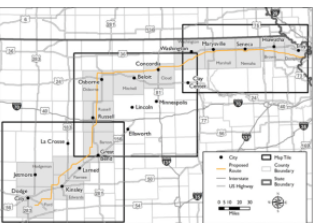
The overview map depicts the proposed route of the Grain Belt Express Clean Line in Kansas- Image Clean Line Energy Partners.- click to expand
The decision Wednesday by the state Public Service Commission was a necessary step for Invenergy to buy the rights to construct the proposed Grain Belt Express power line.
The project initiated by Houston-based Clean Line Energy Partners would carry Kansas wind energy on a 780-mile path across Missouri and Illinois before hooking into an electric grid in Indiana that serves eastern states.
Missouri regulators earlier this year reversed their previous denials and gave the green light to the project. Missouri legislators then tried but failed to prohibit eminent domain for the project.
But the project still needs regulatory approval in Illinois, where an appeals court last year overturned the state’s previous approval.
LINCOLN, Neb. (AP) — A Montana man dubbed the AK-47 bandit and accused of holding up banks in several states over a five-year period has been sentenced in a Nebraska federal court to 35 years in prison.
Gathercole in a Dawson County Nebraska courtroom July 2018 image courtesy KNOP TV
Richard Gathercole, of Roundup, Montana, received the maximum sentence Wednesday after pleading guilty in March to bank robbery. The 41-year-old Gathercole admitted during that plea hearing to using an AK-47 while robbing a Nebraska City bank in 2014. Gathercole also pleaded guilty to the 2017 carjacking of a farmer in Kansas that led to his arrest in Lexington, Nebraska.
As part of his plea deal, Gathercole won’t be prosecuted by other jurisdictions for other violent crimes, including shooting at a Kansas state trooper in 2017 and bank robberies in California, Idaho, Iowa and Washington state from 2012 to 2017.
Some of the crimes had passed the five-year federal statute of limitations.
RILEY COUNTY —One person died in an accident just after 10a.m. Wednesday in Riley County.
A 2018 Ford Escape driven by a 56-year-old man was traveling on Tuttle Creek Boulevard near mile marker 33, according to a media release from Riley County Police.
The vehicle traveled off the road and struck a pole. The was transported to Via Christi in Manhattan where he died.
The cause of the crash is under investigation. According to the Riley County Police Department, the driver may have suffered a medical episode while driving.