SHAWNEE COUNTY —Law enforcement authorities are investigating after a dog was killed following an attack.
Just before 3p.m. Saturday, police responded to a report of a vicious dog attack in the 3400 block of SW 37th Street in Topeka, according to Lt. John Trimble.
At the scene, police discovered that a vicious dog had attacked several juveniles. The children’s father came out to investigate the screaming and commotion and was also bitten by the vicious dog.
Officers were trying to contain the dog and called for an Animal Control Officer to assist in capturing the dog. Before Animal Control could arrive at the scene, the dog attacked a Topeka officer, according to Trimble.
The officer fired his department issued handgun one time, striking and killing the dog before the dog could injure anyone else. One person sustained minor injuries from the incident.
TOPEKA, Kan. (AP) — Democratic Gov. Laura Kelly’s effort to expand Medicaid in Kansas this year died Saturday when enough moderate Republicans bowed to the wishes of the GOP-controlled Legislature’s conservative leaders and ended an impasse that had tied up the state budget.
The House voted 79-45in favor of an $18.4 billion spending blueprint for state government for the budget year beginning in July. Democrats and moderate Republicans held the budget hostageFriday and much of Saturday, hoping to force the Senate to vote on an expansion planpassed by the House and favored by Kelly. Republican leaders did not budge on putting off actionuntil next year and kept meeting with GOP moderates throughout the day to bring them back to the fold.
It helped them that the budget was a good one for Kelly, fellow Democrats and the GOP moderate, providing extra money for higher education and pay raises for state employees, though her administration had problems with how it allocated extra dollars for prisons.
Expansion supporters initially were willing to risk those gains to fulfill Kelly’s goal of expanding Medicaid health coverage to an additional 150,000 Kansas residents now. Some became more nervous as the day wore on, though, particularly with the Senate’s top Republicans determined to wait until next year.
Top GOP senators strongly opposed the House’s expansion bill. Rep. Don Hineman, a moderate Republican from western Kansas in the center of ongoing talks with GOP leaders, said he was reassured by public promises from Senate leaders that a bill would be drafted later this year and considered early next year, though Kelly’s office urged them to keep blocking the budget.
“Their message was, ‘Hold tough. We think we can get this,'” Hineman said. “Enough of us disagreed with that or became uncomfortable enough that the votes were there to adopt the budget.”
Kelly’s election last year raised hopes that Kansas would join 36 other states that have expanded Medicaid or seen voters pass ballot initiatives. But like North Carolina Gov. Roy Cooper and Wisconsin Gov. Tony Evers, two other Democrats, a GOP-controlled legislature can thwart expansion plans.
“For many of our neighbors struggling with illness or disability, time is something they do not have,” Kelly said in a statement after the House’s budget vote. “Due to the failure tonight, thousands of Kansans will go without health care for another year.”
Republicans leaders argue that the expansion plan Kelly backed would be more expensive for the state than her administration projected — $34 million in net costs for the state in its first full year. They also contend that lawmakers need more time to get the details right, control health care costs, and consider work requirements for people covered by the expansion.
GOP leaders also said their focus during the impasse was in getting a budget passed, so that state government could operate past June and lawmakers could wrap up their business for the year. The spending blueprint contained more spending — a 6.5 percent over the current budget year — than many conservatives wanted, GOP leaders said.
“Our ultimate goal was to make sure that we funded core government and that our schools were funded,” said House Speaker Ron Ryckman Jr., a conservative Kansas City-area Republican.
The budget bill went next to the Senate, where the expected favorable vote would send the measure to Kelly. The House budget vote also cleared the way for it to vote on a GOP tax billdesigned to provide relief to individuals and businesses paying more in state income taxes because of changes in federal tax laws at the end of 2017.
Democrats did not hide their bitter disappointment.
“We all stayed and a bunch of you strayed,” said Rep. Tim Hodge, a Wichita-area Democrat. “I can’t believe we can’t stay solid for a few hours.”
During the budget vote, Democrats briefly played rocker Tom Petty’s song, “I Won’t Back Down” as GOP leaders held the roll open for more than 90 minutes to get the last necessary yes votes — and then nearly all Republicans jumped aboard.
“They had everything going for themselves,” said Senate Minority Leader Anthony Hensley, a Topeka Democrat. “They had all the momentum and they just can’t put up with the pressure.”
SEDGWICK COUNTY — Law enforcement authorities are investigating a robbery and have a suspect in custody.
Bonewell -photo Sedgwick Co.
Just after 11 p.m. Thursday, police responded to a robbery call at the Dollar Plus store located in the 1100 block of South Hydraulic in Wichita, according to officer Charley Davidson.
A 26-year-old female employee told police the suspect later identified as 27-year-old Christopher Bonewell entered the store, made threats and demanded money. The employee refused to give Bonewell money. Bonewell damaged items in the store and fled on foot.
Police were checking the area, located Bonewell and took him into custody without incident. There were no injuries. Bonewell is being held on requested charges of robbery, criminal damage to property and an outstanding warrant, according to Davidson.
Investigators will present the case to the Sedgwick County District Attorney’s Office.
A Buick passenger vehicle driven by a 19-year-old man was northbound on McLean at 9th Street in Wichita, according to officer Kevin Wheeler. The vehicle left the road and struck a light pole. The driver was transported to a local hospital where he died.
The cause of the accident remains under investigation. Wheeler did not release the driver’s name Saturday.
SHAWNEE COUNTY — Law enforcement authorities are investigating an armed robbery and have two suspects in custody.
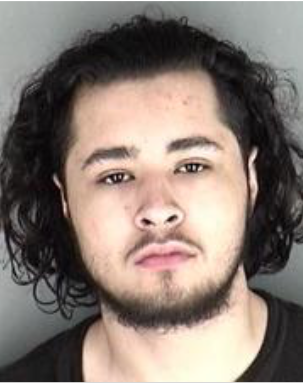
Mendez-photo Shawnee Co.
Just before 10:30p.m. Tuesday, police responded to the 1400 Block of SW Central Park in Topeka in reference a report of an armed robbery to individuals, according to Lt. Andrew Beightel.
Four adult victims told police they were just robbed at gun point by four or five suspects. One of the victims was struck by the suspects, causing a minor laceration and as the victims tried to escape, the suspects fired a gun at them.
On Wednesday police apprehend 18-year-old Francisco Alejanero Mendez, Topeka, at a residence in the 1200 Block of SW Wayne.
Police also arrested an alleged 17-year- old accomplice at a home in the 1900 Block of SW 36th Street, according to Beightel. Mendez and the juvenile teen were taken to the Shawnee Co Jail and booked in on requested charges of aggravated robbery, aggravated battery and criminal discharge of a firearm.
KANSAS CITY (AP) — Minority employees at Harley-Davidson’s plant in Kansas City have been subjected to years of harassment and discrimination — including having swastikas and nooses posted in the plant, frequent racial epithets and at least one assault, several employees said at a news conference organized by the NAACP-Kansas City on Friday.
“All the time I worked there it’s been there, it’s just ridiculous,” said Emmanuel Matthews Sr., who worked at the plant for more than two years. “This is 2019. This stuff has to stop. Something needs to be done.”
Matthews and other employees who spoke at the news conference work for Syncreon.US Inc., an affiliate of Syncreon, which supplies contract workers to the Harley-Davidson plant, but they said the harassment was directed at all minority employees. Matthews said he was assaulted by another worker at the plant but declined to discuss the details.
Harley-Davidson said in a statement that it does not tolerate any form of harassment or discrimination and actively enforces its code of conduct and anti-harassment policy along with well-established processes for employees to report concerns.
“Complaints that we were aware of were thoroughly investigated and action was taken based on the findings,” the statement reads. “As appropriate we also referred incidents and complaints to third-party employers who share our factory.”
Oswald Reid, president and CEO of Syncreon.US said in a statement Friday that the company doesn’t tolerate any of the alleged actions. He said the company provides many avenues to report harassment or discrimination, including a confidential “ethics line.” No complaints of racially discriminatory behavior have been reported to that line in the last two years, Reid said.
“Over the last three years, all alleged policy or Code of Conduct violations that we are aware of have been swiftly and effectively addressed,” Reid said. “As of this moment, there are no open investigations with regards to discriminatory behavior.”
Harley-Davidson plans to close the Kansas City plant this year and shift those operations to York, Pennsylvania. The Milwaukee-based company said the closing would eliminate 800 jobs in Kansas City.
Employees said the harassment has happened for years but has intensified as the plant’s closing approaches. They said they have seen graffiti telling black employees to die or to go back to Africa. The workers said when swastikas or racial epithets were reported, the images were sometimes left for days before being covered with spackle. They alleged management would say the incidents were being investigated but nothing ever happened and the perpetrators were rarely punished.
Rochelle Anthony, who was a union representative for the Steelworkers at the plant for nearly three years before she was fired, said she ran into constant roadblocks when she tried to file grievances and could never get a straight answer or feedback when she asked about her complaints.
“I tried,” she said. “I felt like I was fighting by myself. I couldn’t help them. It’s getting worse. We need help.”
Steve Nelson, general manager at the Kansas City plant, sent a letter to Harley-Davidson employees Thursday saying the company wanted to reassure them that the company is taking “all necessary steps” to enforce its policies. He said harassment of any kind “cannot and will not be tolerated at Harley-Davidson.” The letter included details of the company’s policies for reporting and investigating complaints.
The Rev. Rodney Williams, president of NAACP-Kansas City, said the national NAACP plans to ask Harley Davidson to launch an investigation at all of its plants to determine if discrimination is part of the company’s culture or is isolated to Kansas City.
“Whether it is closing or not, this is not acceptable,” Williams said in an interview. “We need to send a message that this not acceptable anywhere. Many employees came to us to complain so we felt it was our duty to give them a platform that they might be heard.”
TOPEKA, Kan. (AP) — A published report says a regulatory ombudsman hired by former Gov. Jeff Colyer billed Kansas taxpayers thousands of dollars for travel and food after his official workstation was quietly switched from a state office building near the Capitol to his Salina home.
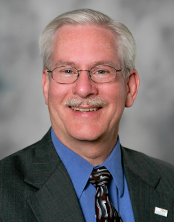
Tom Arpke
Former Republican senator Tom Arpke was chosen by Colyer last year to serve as a link between nine state agencies, the governor’s office and Kansas businesses.
Documents obtained by the newspaper through an open records request show his annual salary was about $80,000. One month after starting the job, officials in the Colyer administration changed his office location to his residence.
That designation was used to justify Arpke’s monthly claims that taxpayers should pay him extra every time he drove to Topeka for work.
MANHATTAN, Kan. (AP) — The Manhattan-Ogden School Board has approved guidelines for transgender students in the school district.
The board voted 6-1 Wednesday to approve the guidelines, after discussing the issue since December.
The guidelines give students the right to be addressed by the name and pronoun they choose. It also allows students to use the restroom that corresponds to their gender identity, and it allows students to play for sports teams of their gender identity.
The board heard comments from 21 people expressing both support and opposition.
Some opponents cited religious reasons and others criticized allowing students to play for teams of their gender identity.
Board members who supported the policy said they wanted to do what they thought was best for the students.
TOPEKA – The window for accepting Angel Investor Tax Credit Applications has reached its halfway point.
Applications for companies seeking investment through the Kansas Angel Investor Tax Credit (KAITC) program for 2019 will be accepted through Aug. 31. The program offers Kansas income tax credits to qualified individuals who provide seed-capital financing for emerging Kansas businesses engaged in development, implementation and commercialization of innovative technologies, products and services.
The KAITC Program is administered by the Kansas Department of Commerce and designed to bring together accredited angel investors with qualified Kansas companies seeking seed and early stage investment. The purpose of the Kansas Angel Investor Tax Credit act is to facilitate:
The availability of equity investment in businesses in the early stages of commercial development.
Assist in the creation and expansion of Kansas businesses, which are job and wealth creating enterprises.
Applications for certification will be accepted only for Kansas businesses in the seed and early stage rounds of financing.
Companies must meet the following criteria to be certified as a Qualified Kansas Business:
The business has a reasonable chance of success and potential to create measurable employment within Kansas.
In the most recent tax year of the business, annual gross revenue was less than $5 million
Businesses that are not Bioscience businesses must have been in operation for less than five years; bioscience businesses must have been in operation for less than 10 years.
The business has an innovative and proprietary technology, product, or service.
The existing owners of the business have made a substantial financial and time commitment to the business.
The securities to be issued and purchased are qualified securities.
The company agrees to adequate reporting of business information to the Kansas Department of Commerce.
The ability of investors in the business to receive tax credits for cash investments in qualified securities of the business is beneficial, because funding otherwise available for the business is not available on commercially reasonable terms.
Each applicant must sign a Qualified Company Agreement with the Kansas Department of Commerce.
Certification of companies must meet mandates established by Kansas statute to allow accredited Angel Investors to receive the Kansas Angel Investor Tax Credit. This year, the application fee has been reduced from $750 to $500.
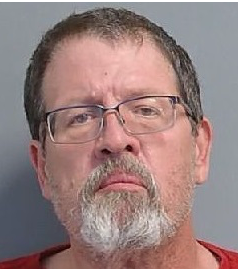
HUTCHINSON, Kan. — A Kansas man who entered a guilty plea to one count of aggravated indecent liberties with a child was sentenced Friday to life in prison with no chance of parole for 25 years.
Richmond -photo Reno Co.
Charles Richmond, 57, extradited to Kansas from Florida, was originally charged with rape, aggravated criminal sodomy and aggravated indecent liberties with a child. As part of a plea agreement, he entered a plea for the aggravated indecent liberties charge and the other two charges were dropped.
The crimes occurred over a period from Jan. 1, 2013, to Dec. 31, 2017. The child told investigators she had been molested by Richmond more than 100 times.
The life sentence was given because the single charge falls under Jessica’s Law statutes.
Long-running frustration about Amtrak’s willingness to keep a rail passenger line running through remote parts of the country has politicians threatening to block new directors to the agency.
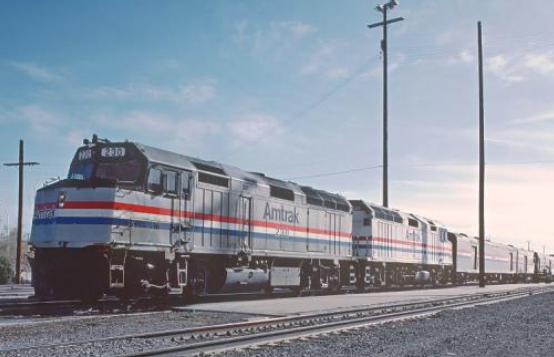
Amtrak has yet to respond to senators about the future of its long-distance routes. WIKIMEDIA COMMONS
A handful of U.S. senators demanded specifics by this week about how Amtrak plans to spend an added $50 million to keep the Southwest Chief line running from Chicago, through Kansas, to Los Angeles.
Hoping to force Amtrak to make long-term promises of keeping the Southwest Chief line, U.S. Sen. Jerry Moran of Kansas had already used the power each senator holds to put a legislative block on the appointment of three nominees waiting to join the passenger rail agency’s board of directors.
Amtrak still has not specified when it will answer the pending questions from the Senate. A spokeswoman from Moran’s office said Amtrak has made contact, but not with answers about how it plans to alter long-distance routes or how the rail service calculates what states must chip in to support service.
“(Moran) will maintain those holds (on the nominations until he gets) assurances from Amtrak that it will continue to fund the Southwest Chief and funds that rail service,” said Moran spokeswoman Morgan Said.
Moran and other senators have criticized Amtrak for proposals to replace train services with buses along some parts of the route.
Amtrak officials did not respond to requests for comment for this story.
In February, Congress gave $50 million for upkeep of the route to Amtrak to keep the line working through September. Last year, Amtrak proposed replacing service from Dodge City to Albuquerque with buses, but the federal budget prohibits the use of buses to replace long-distance train service along the route.
In early April, a group of 11 senators sent Amtrak a letter demanding more detail about its plans for the Southwest Chief and how, more broadly, it decides which long-distance routes are worth operating.
The Senate letter also addressed Amtrak’s claims that ridership is down. The most recent data provided by Amtrak says more than 52,000 passengers boarded the Southwest Chief line in Kansas in 2017, up 5.7 percent from 2016.
With 2 a.m. and 3 a.m. departures, Newton, the busiest station in the state, saw nearly 16,000 passengers in 2017. Erin McDaniel, communications director for the City of Newton, says the town supports the Southwest Chief and partners with other cities to fund it.
“We know many of our residents use it to get to Chicago as well as the Southwest,” McDaniel said.
Keeping the Southwest Chief running is important to Newton because preliminary efforts looking at establishing train service to connect Newton to the Heartland Flyer route, which runs from Oklahoma City to Fort Worth, Texas, are underway.
“There used to be a train route that went there years ago,” McDaniel said, “but if the Southwest Chief goes away, dreams of extending the Heartland Flyer would go away with it.”
Over the last year, Amtrak has removed ticket agents from many stations. But Assistant City Manager for Dodge City Melissa Mccoy said the city employs staff at its train depot.
“We have few options in terms of public transportation,” McCoy said. She said ridership jumps with tourists in the summer.
Without the Southwest Chief route, McCoy says some Dodge City residents wouldn’t be able to travel long distances.
“We have a lot of working class folks, and they have limited income,” she said. “Amtrak provides them a way to visit family and go on vacation and without that they might not have it all.”
An earlier version of this story incorrectly attributed the reason a hold was placed on Amtrak directors’ appointments. U.S. Sen. Jerry Moran took that action to secure a pledge to keep the Southwest Chief line running.
Corinne Boyer is a reporter based in Garden City for the Kansas News Service. Follow her @Corinne_Boyer.
TOPEKA, Kan. (AP) — Kansas lawmakers who support expanding Medicaid blocked passage of the next state budget Friday in a high-stakes standoff designed to force the Legislature’s conservative Republican leaders to allow an expansion plan backed by Democratic Gov. Laura Kelly.
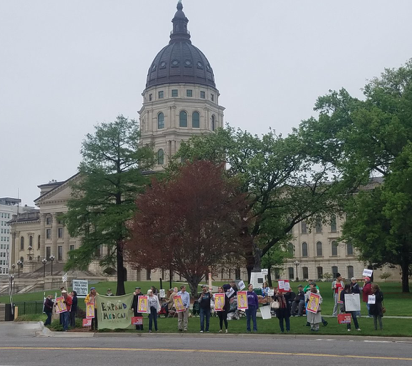
Medicaid expansion supporters at the Kansas Statehouse
Kelly’s election last year raised hopes that Kansas would join 36 other states that have expanded Medicaid or seen voters pass ballot initiatives. But, like North Carolina Gov. Roy Cooper and Wisconsin Gov. Tony Evers, two other Democrats pushing to expand Medicaid, she faces a GOP-controlled Legislature.
The Kansas House voted 63-61 against an $18.4 billion spending blueprint for the budget year that begins in July. House and Senate negotiators hashed out details Thursday night that were favorable for Kelly, fellow Democrats and moderate Republicans, with extra money for higher education, the prison system and state employee pay raises.
Democrats and moderate Republicans praised the proposed budget but saw the vote as their chance to pressure the Senate’s GOP leaders into relenting on plans to delay an expansion vote until next year.
But Republican leaders didn’t relent. The budget negotiators drafted a new, less generous spending blueprint — that removed extra funds for hospitals, whose association has advocated expansion — and put it to a vote in the House, only to see it fail by a wider margin, 81-42 against it.
“We’re going to do everything we can to get Medicaid expansion,” said House Minority Leader Tom Sawyer, a Wichita Democrat. “If we fail, we haven’t lost anything.”
The Senate has yet to debate a Medicaid expansion billapproved by the House in March, and top Republicans argue that lawmakers need more time to get the details right. Kelly has called it a “stall tactic” and is pushing lawmakers to go ahead now, so that expanded Medicaid health coverage can start in January.
The move thwarted top Republicans’ plans to wrap up lawmakers’ business for the year Friday, well ahead of the traditional 90-day mark on May 17.
GOP leaders wanted to pass a bill providing relief to individuals and businesses paying higher state income taxes because of changes in federal tax laws at the end of 2017, a smaller plan than one Kelly vetoed in March. The Senate approved it Thursday night, and supporters needed only a favorable House vote to send it to Kelly.
But lawmakers aren’t finished until they pass a budget because state government can’t operate past June or distribute $4 billion to its public schools without one. That created an opportunity for expansion supporters if they can hold up the spending blueprint long enough — but also a risk that spending they wanted would be at risk.
“I said exactly what was going to happen,” said Appropriations Committee Chairman Troy Waymaster, a conservative Republican and the House’s lead budget negotiator. “They were forewarned.”
Some expansion supporters accused GOP leaders of retaliation and even bullying. The change in funding for hospitals proved a provocative move. It removed $14 million in state funds, and it could have cost hospitals $250 million in federal funds.
Expansion advocates have been frustrated by their inability to get a bill out of committee in the Senate. The measure has bipartisan support in both chambers, but GOP conservatives who oppose it hold key leadership jobs. Top Republicans argue that an expansion plan is likely to prove more costly to the state than Kelly’s administration projects and want to consider alternatives, including work requirements.
About 15 expansion supporters dropped several thousand leaflets in the Statehouse rotunda Friday morning, each depicting a past-due hospital bill spattered with blood. The leaflets said hundreds of Kansas residents will die needlessly each year without expansion and each had the picture of a GOP senator on one side.
“When there’s extreme behavior coming out of the Senate leadership, that requires us to try to force their hand,” said Logan Stenseng, a 20-year-old University of Kansas public administration student who participated in the brief protest.
The protest didn’t move prominent Medicaid expansion opponents. Senate health committee Chairman Gene Suellentrop, a conservative Wichita Republican, noted that a leaflet with his photo contained another senator’s quote on the other side and he said the mismatch suggest the protesters “probably know very little about Medicaid expansion.”
“They need to go back to college,” Suellentrop said.
Advocates have pushed for Medicaid expansion in Kansas since 2012 and passed a bill in 2017, only to see it vetoed by then-Republican Gov. Sam Brownback. Democrats in North Carolina are hoping to include expansion in their state’s budget, but they face resistance from GOP legislative majorities and are suggesting that a veto by Cooper is ahead, with potentially protracted negotiations to follow.
___
TOPEKA, Kan. (AP) — Kansas lawmakers who support expanding Medicaid promised Friday to try to block passage of the next state budget in a high-stakes standoff designed to force the Republican-controlled Legislature’s conservative leaders to allow an expansion plan backed by Democratic Gov. Laura Kelly.
The House planned to vote Friday on an $18 billion-plus spending blueprint for the budget year that begins in July. House and Senate negotiators hashed out details Thursday night that were favorable for Kelly, fellow Democrats and moderate Republicans, with extra money for higher education, the prison system and state employee pay raises.
The Senate has yet to debate a Medicaid expansion billapproved by the House in March, and top Republicans want to postpone a vote until next year, arguing that they need more time to get the details right. Kelly has called it a “stall tactic” and is pushing lawmakers to go ahead and expand Medicaid health coverage to as many as 150,000 more people this year.
Top Republicans wanted lawmakers to wrap up business for the year Friday after passing a bill providing relief to individuals and businesses paying higher state income taxes because of changes in federal tax laws at the end of 2017, a smaller plan than one Kelly vetoed in March. The Senate approved it Thursday night, and supporters needed only a favorable House vote to send it to Kelly.
But lawmakers aren’t finished until they pass a budget because state government can’t operate past June without one. That created an opportunity for expansion supporters if they can hold up the spending blueprint.
“That’s the plan right now,” said House Minority Leader Tom Sawyer, a Wichita Democrat. “Right now, it looks like it’s holding pretty firm.”
Expansion advocates have been frustrated by their inability to get a bill out of committee in the Senate. The measure has bipartisan support in both chambers, but GOP conservatives who oppose it hold key leadership jobs. Top Republicans argue that an expansion plan is likely to prove more costly to the state than Kelly’s administration projects and want to consider alternatives, including work requirements.
About 15 expansion supporters dropped several thousand leaflets in the Statehouse rotunda Friday morning, each depicting a past-due hospital bill spattered with blood. The leaflets said hundreds of Kansas residents will die needlessly each year without expansion and each had the picture of a GOP senator on one side.
“When there’s extreme behavior coming out of the Senate leadership, that requires us to try to force their hand,” said Logan Stenseng, a 20-year-old University of Kansas public administration student who participated in the brief protest.
The protest didn’t move prominent Medicaid expansion opponents. Senate health committee Chairman Gene Suellentrop, a conservative Wichita Republican, noted that a leaflet with his photo contained another senator’s quote on the other side and he said the mismatch suggest the protesters “probably know very little about Medicaid expansion.”
“They need to go back to college,” Suellentrop said.
Blocking the budget held risks for Democrats and moderate Republicans. If the spending plan failed, budget negotiators could reopen talks and rethink an extra $35 million for the prison system, $33 million for higher education or 2.5 percent pay raise for state employees included in it.
“I would say they don’t get a better budget than this,” said Rep. Kyle Hoffman, a conservative Coldwater Republican. “If we go back, things start getting stripped out.”
TOPEKA – For more than 30 years, citizen advisors have been a vital voice for water resource issues in Kansas. The Kansas Water Office is currently accepting applications from those who would like to participate as a member of one of the 14 Regional Advisory Committees (RACs) which are established by the Kansas Water Authority (KWA).
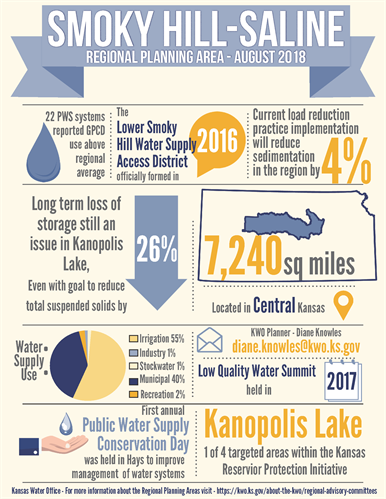
Ellis County is part of the Smoky Hill-Saline RAC .
These committees play a key role in advising the KWA on implementation of each region’s water supply priorities as part of the Kansas Water Vision and the Kansas water planning process as a whole. Regional advisory members will have the opportunity toevaluate the past five years of the Vision implementation and provide input and advice to the KWA for previously identified regional water resource-related goals and associated action plans.
In addition, members help identify and provide input on other emerging water resource related issues and concerns.
They serve as important local links to the public in their regions through interactions with various groups and individuals as well as communicate information on concerns and issues to citizens in their respective regions. The KWA, through the committee selection process, works to establish RACs which represent diverse groups of water users and interests within regions are represented.
Kansans can have a definite lasting impact on the future of water resources through RAC membership.Interested persons can apply at www.kwo.ks.gov.

 Just before 3p.m. Saturday, police responded to a report of a vicious dog attack in the 3400 block of SW 37th Street in Topeka, according to Lt. John Trimble.