We have a brand new updated website! Click here to check it out!

Kan. foster care agency has new rules for dealing with child-on-child sexual assault

A new law standardizing Kansas’ response to child-on-child sexual assault could cost $126,000 and result in more than 3,200 treatment referrals a year.

The Kansas Department for Children and Families estimates the new guidelines will result in 3,264 hotline calls being referred to treatment.
ANNA LANGOVA / PUBLIC DOMAIN

The new statute also requires the department to document whether treatment was provided to the child accused of abuse, the reasons for needing it and the outcome.

The agency estimates 3,264 children a year would need to be referred to treatment. That estimate includes both foster children in the agency’s care and children who are the subject of reports from the DCF child abuse hotline.

Agency officials say the added counseling work means DCF will have to hire two more staff members at a cost of more than $126,000 per year for salary and benefits. The Legislature did not appropriate additional funding to pay those costs this year.

Republican state Sen. Molly Baumgardner of Overland Park introduced the bill after stories broke last year of foster children assaulting other children in DCF custody. She pressed to make sure the agency had a consistent response to such incidents.

“It was very disconcerting to me, learning that there wasn’t a set process,” she said. “We need all of our kids to be safe.”

Baumgardner said she was inspired by a similar law that passed in Missouri in 2015, requiring the state’s Children’s Division to perform assessments and offer voluntary services after receiving a report that one child sexually abused another.

The Kansas law also states that the services for children who commit abuse are voluntary — unless DCF determines that the risk of future sexual behavior problems is high if the child does not receive treatment. It defines “a child with sexual behavior problems” as a minor who has allegedly committed sexual abuse against another child.

DCF says it already has procedures in place for handling reports of abuse allegedly committed by children. In an email, a department spokesman said a worker first determines whether a report of abuse is substantiated and what kind of treatment might be needed. The information is also passed to a committee, who makes a final decision on the reliability of the report and the need for treatment for the child who allegedly committed the abuse.

Currently, law enforcement is also required to conduct an investigation of reported sexual abuse of a child.

Alicia Johnson-Turner, a special assistant to DCF secretary Laura Howard, said  DCF would only provide referrals, rather than direct treatment. She said the agency may pay for treatment on a case-by-case basis.

Johnson-Turner said two organizations in the state, in the Kansas City and Wichita areas, provide evidence-based treatment for children with problematic sexual behavior. She said children who live outside those areas may be referred to community mental health centers for psychotherapy.

“That might be targeted at sexual behavior,” she said. “It just wouldn’t be one of the evidence-based models.”

The Metropolitan Organization to Counter Sexual Assault, based in Kansas City, Missouri, treats Kansas children who demonstrate age-inappropriate sexual behavior.

Such behaviors are different than a child’s curiosity about their own body, or consensual sexual behavior between teenagers of the same age, said MOCSA’s director of counseling services, Rene McCreary. It’s often caused by sexual abuse, early exposure to pornography or other types of trauma, such as witnessing domestic violence.

Children who demonstrate problematic sexual behavior — such as exposing themselves, touching other children’s genitals, using inappropriate language or gestures, or touching themselves in public — are unlikely to repeat it, she said.

“When kids act out in a sexual way, it’s pretty unusual for them to do it again,” McCreary said. “Especially after receiving treatment.”

But it’s still important for children to learn the social skills and impulse control taught at MOCSA’s 18-week program, she said. The treatment involves both group and individual therapy for children and their families. Children round out the program by writing an apology letter.

“It’s really important to us,” McCreary said, “to provide this model in the way that it’s been studied and proven to work.”

Foster children are at risk of developing inappropriate sexual behaviors due to their living conditions and their exposure to trauma and abuse, said Heidi Olson, a pediatric sexual assault nurse at Children’s Mercy Hospital in Kansas City.

Olson told lawmakers that almost half of the sexual assaults treated at Children’s Mercy in the past several years were committed by minors, with 11- to 15-year-old boys being the most likely to do so.

“Those kids aren’t even old enough to drive, and yet they are acting out with this sexually harmful behavior,” Olson said in an interview. “The way to approach this is to get kids into therapy and treatment that really works and addressing those behaviors, versus them being adjudicated and going to jail.”

It’s essential for treatment to be administered at a young age so a child can heal and learn about boundaries, she said.

For adults, “the recidivism rate is much higher,” Olson said, “so I think this is really significant.”

Nomin Ujiyediin is a reporter for the Kansas News Service.  You can reach her on Twitter @NominUJ.

HAWVER: Key report will set the tone for Kan. budget for two years

Martin Hawver

Thursday will be, well, not quite the same as a puff of white smoke emerging from the Vatican to signal selection of a new Pope, but close for us habitués of the Kansas Statehouse.

It’s the day that the Consensus Revenue Estimating (CRE) Group posits just what the state will book in revenues for the remainder of this fiscal year (to June 30) and for the upcoming fiscal year.

That estimate becomes the basis for every dime in spending that the Kansas Legislature will approve for the rest of this, and all of the next, fiscal year.

It’s the bank account. Don’t over-spend, and at the same time, don’t not spend enough to provide Kansans the services that they want their state—and its governor and Legislature—to spend on them.

The group, professors and economists and such, looks at virtually every tax number available. Then they estimate just how much of that will wind up in the State General Fund, and then the governor and legislators spend it.

This year’s CRE will provide the first good look at the “trickle down” of the December 2017 federal income tax cuts, which presumably freed up more money for the state to levy taxes against.

Businesses—those with overseas interests—that have been pushing for $130 million in income tax cuts to keep their tax bills level may or may not be able to recalculate just how much in the way of tax breaks they need to keep their profits stable or growing. Then they just have to squeeze it out of the Legislature.

And individual income taxpayers? Not sure, but the CRE will likely tell us how those federal income tax changes—lower rates—will work to make more of their income taxable by the state. Remember, Kansas income tax calculations start with what’s left over after you’ve paid your federal income taxes.

While the rate reductions are a key to that CRE computation, it may well tell legislators just how those new and higher federal standard deductions ($12,000 for single filers, $24,000 for marrieds filing jointly) will work with the state’s standard deductions. Remember, because the Legislature hasn’t “de-coupled” those standard deductions, if you can’t top the federal standard deduction then you are stuck with the Kansas standard deduction–$3,000 for singles, $7,500 for marrieds filing jointly.

What might we learn Thursday? Well, it starts with CRE predicting enough revenue to finance government, and probably pick up some of those services that have been squeezed the last few years because revenues were lower than hoped.

And if the estimate is for more money than needed for those basics? Well, after saving a dab for fiscal safety, there’s likely to be some room for tax cuts—possibly even this legislative session.

Of course, then the fight over the tax cut bill that Gov. Laura Kelly vetoed starts again, but at least there would be an identifiable amount of money that can be spent on tax cuts—after the social welfare, education, transportation and administrative pieces of the state budget are taken care of.

How much will be floating around? We’ll know Thursday.

And who gets that loose change in the state’s pocket? Corporations? Probably not. Individual income taxpayers? That’ll be fun to watch. Give it to the poor and middle-class or give it to the wealthier Kansans. As we recall, each of those folks gets one vote, and there are more Kansans in the lower brackets than at the top.

That CRE puff of white smoke? It might blow in a lot of directions…

Syndicated by Hawver News Company LLC of Topeka; Martin Hawver is publisher of Hawver’s Capitol Report—to learn more about this nonpartisan statewide political news service, visit the website at www.hawvernews.com

Alison Krauss schedules Stiefel performance

Alison Krauss to perform in the Stiefel Theatre this summer. Photo courtesy Stiefel Theatre

SALINA – A prolific and award-winning musician is coming to the Stiefel Theatre in July.

Jane Gates, Executive Director of the Stiefel Theatre, said Tuesday morning, that multiple Grammy Award winner Alison Krauss is scheduled to perform in the Stiefel Theatre at 8 p.m. July 1.

Tickets start at $89 and go on sale at 10 a.m. Friday. Buy tickets direct from the Stiefel in person or by calling 785-827-1998. Box office open Monday through Friday, noon-5 p.m. or three hours before the show on weekend show-days. Buy online through ticketmaster or at stiefeltheatre.org.

Since 1985, Krauss has released 14 albums including five solo, seven with her longtime band and musical collaborators Union Station, and the Robert Plant collaboration Raising Sand, which was certified platinum and won five Grammys, including Album of the Year and Record of the Year.

She’s sold more than 12 million records to date, and her honors include 27 Grammys, nine Country Music Association awards, 14 International Bluegrass Music Association Awards, two Academy of Country Music Awards, and two Gospel Music Association awards.

Krauss frequently collaborates with artists from numerous genres, including Dolly Parton, Taylor Swift, Kenny Rogers, Emmylou Harris, Gillian Welch, Vince Gill, The Chieftains, James Taylor, The Cox Family, Yo-Yo Ma, Johnny Mathis, Cyndi Lauper, Heart, Bad Company and Phish. She has recorded and toured with Willie Nelson, whom she honored with a performance during the 2015 Gershwin Prize Tribute Concert. She will reunite with Nelson this summer on a co-headlining tour throughout North America.

Whiskey Lullaby, a duet that she performed with Brad Paisley, won two CMA Awards in 2004. She has also produced albums for Alan Jackson, Nickel Creek and The Cox Family.

Some of these collaborators were also formative to Krauss and she lists influences including Tony Rice, Ricky Skaggs, Dolly Parton, Larry Sparks, The Cox Family, and Ralph Stanley.

Sheriff: Speed a factor, passenger ejected in Kansas crash

SALINE COUNTY — Two people were injured in an accident just after 2p.m. Monday in Saline County.

Photo Saline Co. Sheriff

A 1997 Ford Ranger driven by Jared Oehlert, 30, Salina, was traveling in the 6500 Block of South Woodward, according to Saline County Sheriff Roger Soldan.

The driver lost control of the pickup. It left the road, rolled and a passenger Dylan Stevens 26, Salina, was ejected.

Oehlert and Stevens were transported to the hospital in Salina.  Stevens was later transferred to a hospital in Wichita. Speed was believed to be a factor in the accident and the occupants were not wearing seat belts, according to Soldan.

Multiple injuries reported in Kansas house fire

Tuesday morning house fire -photo courtesy KWCH

WICHITA, Kan. (AP) — Authorities say two people have been critically injured in a Wichita house fire.

Sedgwick County dispatchers say the fire was reported around 4:40 a.m. Tuesday. The Wichita Fire Department said in a tweet that emergency crews are treating multiple patients and that two of them are critical.

The blaze is under control. No information has been released about what caused the fire or where it started.

Humming down I-70 at 700 mph? That might not be science fiction

Photo courtesy of Virgin Hyperloop One

By BRENT MARTIN
St. Joseph Post

A state senator representing northwest Missouri will be part of a panel reviewing whether a “hyperloop” between Kansas City and St. Louis is feasible.

Senator Tony Luetkemeyer of Parkville has been appointed to serve on the Blue Ribbon Panel on Hyperloop.

“This is new, cutting-edge technology,” Luetkemeyer tells St. Joseph Post. “Missouri, if we were to get the project, would be the first state in the country to have this type of technology deployed. And so, I’m excited to get to explore the issue further and to be part of that process.”

The so-called hyperloop is a different type of transportation. Passengers would ride in pods enclosed in a tube levitating along a magnetically-charged rail at amazing speeds along I-70, perhaps as fast as 700 miles an hour.

The company Virgin Hyperloop One is testing the technology in Nevada.

Missouri is being considered, because I-70 between Kansas City and St. Louis is relatively flat and the I-70 corridor has enough right of way access to build the hyperloop.

Several questions must be answered before Luetkemeyer gives his endorsement, with the state senator stating safety is his top concern, closely followed by security. He says a hyperloop would immediately become a prime target for terrorists.

Also, Luetkemeyer wants to explore the economic feasibility of the proposal by Virgin Hyperloop One.

“What is it that they are wanting in order to come to Missouri?” Luetkemeyer asks. “Will there be a sufficient economic benefit to the state to justify any types of incentive programs that they might need in order to pick Missouri?”

Luetkemeyer cautions against dismissing the concept as science fiction.

“You think back in the mid-1960s, we were sending a man to the moon,” Luetkemeyer points out. “The notion that we went from where we were technologically to having a man on the moon in a relatively short period of time, that seemed very fanciful and something that was out of fantasy, but we obviously made that a reality.”

Kansas tells court broad support is reason to OK school funding plan

By JOHN HANNA 

TOPEKA, Kan. (AP) — Lawyers for Kansas told the state Supreme Court on Monday that it should sign off on a new law boosting spending on public schools and end a protracted education funding lawsuit partly because the law has broad, bipartisan support.

photo Kansas News Service

Attorney General Derek Schmidt, a Republican, filed written legal arguments defending the new law. It contains Democratic Gov. Laura Kelly’s proposal for an education funding increase of roughly $90 million a year and is aimed at satisfying a state Supreme Court ruling last year that education funding remained inadequate.

Four school districts sued the state in 2010, and their attorneys have said that the new law does not provide enough additional funding after the 2019-20 school year. Schmidt said the districts are seeking a “heckler’s veto” after Kelly, many Republican lawmakers and the GOP-led State Board of Education agreed that the increase she sought would satisfy the court.

“This court should give great weight to the considered decisions of both the education officials and the people’s representatives,” Schmidt’s written argument said. “That is particularly true here given the widespread, bipartisan consensus.”

Attorneys for the four school districts asked in their own filing for the Supreme Court to order higher spending after the 2019-20 school year, give legislators another year to comply and keep the case open so that the state’s actions can be monitored.

“The state cannot demonstrate it has met its burden,” they wrote.

The Supreme Court plans to hear oral arguments from both sides’ attorneys May 9 and has promised to rule on whether the new law is sufficient by June 30. The justices have ruled repeatedly that the state constitution requires lawmakers to fund a suitable education for every child.

The high court has issued six rulings directing lawmakers to increase education funding in a little more than five years, so that it now tops $4 billion a year. The court declared last year that a 2018 law promising funding increases into the future wasn’t sufficient because it hadn’t accounted for inflation.

The four school districts argued that accounting for inflation is a straightforward math problem that requires increasingly larger amounts of money each year through the 2022-23 school year. Under their calculations, the increase for that year would be $363 million instead of the roughly $90 million under the new law.

“While the state has increased funding to account for some inflation, it has not completed the plan,” the school districts’ attorneys wrote.

Schmidt’s filing argues that given that the new law represents the consensus of “just about every other stakeholder” in the education funding debate, the court should not declare the law insufficient simply because some districts “will always want more money.” The four districts are part of a coalition that initially endorsed Kelly’s plan , then withdrew its backing.

“They should not be allowed to single-handedly override the governor’s and Legislature’s reasonable and considered funding determinations,” Schmidt wrote, adding that the law was passed “in light of the many competing demands on limited state funds.”

Kelly’s chief counsel also filed a request Monday with the Supreme Court, asking for permission to file “friend of the court” arguments by April 26. Her attorney argued that as a former state senator “intimately familiar” with school funding issues, she has a “unique” perspective on the law now that she is governor.

Kansas man admits role in illegal gambling operation

WICHITA, KAN. – A Kansas man pleaded guilty Monday to trying to keep Wichita police from investigating illegal poker games, according to U.S. Attorney Stephen McAllister.

Brock Wedman, 50, St. Marys, Kan., pleaded guilty to one count of concealing a felony. In his plea, he admitted he helped organize and recruit players for illegal poker games in Wichita.

On Feb. 12, 2014, Wedman was present at a poker game held at 922 1/2 E. Douglas in Wichita. Wedman did not know it, but a man he invited to play was a Wichita Police Department officer working undercover to investigate organized gambling. When Wedman became suspicious, he found the undercover officer’s car and took down the license plate and VIN numbers. Wedman gave the information to a friend who was a Wichita police officer and asked him to confirm the undercover officer’s identity.

Sentencing is set for Aug. 1.

Police: 3 Kansas teens jailed for drive-by shooting

SEDGWICK COUNTY — Law enforcement authorities are investigating a shooting and have three teen suspects in custody.

Just after 12:30 a.m. Friday, police responded to report of shots fired at a restaurant in the 300 Block of West 29th Street North in Wichita, according to officer Paul Cruz. The building and five vehicles in the parking area had been struck by bullets.

While officers investigated at the scene, other officers located the vehicle believed to have been involved with the shooting. Police detained the occupants of the vehicle and seized three handguns including one that was reported stolen, according to Cruz.

Three juveniles ages 17, 16 and 15 were arrested and booked into juvenile detention for aggravated battery, destruction to auto by firearms and juvenile in possession of a firearm. An 18-year-old boy in the vehicle was also cited for marijuana possession.

At approximately 4.am. a 21-year-old arrived at a local hospital with a gunshot wound to his hip area. He was originally at the scene of the shooting, according to Cruz. He was treated and released.

Update: Vandals destroy music room at Kansas high school

RENO COUNTY— Law enforcement authorities and school officials are investigating vandalism at Pretty Prairie High School.

Photos courtesy Reno Co. Sheriff

 Just after 9:00a.m. Saturday, deputies were dispatched to Pretty Prairie High School for a criminal damage to property case, according to a media release.

Deputies met with Principal Kevin Hedrick who said he was giving a tour of the school to the up-coming freshman class when he noticed the band room had been vandalized. It appears that the school was entered between the hours of 1:00am – 3:00a.m. Saturday.

The entire band room received severe damage. Several different colors of paint were thrown across the floor, walls and over equipment. The majority of the drums, if not all, had holes punched in them. Some of the drum heads had painted hand prints left on them. Several different musical instruments were completely destroyed.

Fire extinguishers were discharged on the building and inside of a recently purchased Van that belonged to the school. Both in the band room and in the van, items within had been thrown around. Although it is going to take a bit to see what if anything has been stolen, we believe items have been taken.

The school gave a rough estimate of damage to be between $50,000 and $75,000 and could be more.

If anyone has information regarding this case please contact the Reno County Sheriff’s Office at 620-694-2735 or Crime Stoppers of Reno County at 1-800-222-TIPS.
Detectives are continuing to investigate this case.

————

RENO COUNTY— Law enforcement authorities and school officials are investigating vandalism at Pretty Prairie High School.

Many instruments were damaged or destroyed in the school’s music room over the weekend, according to the school’s social media page.  

Vandals threw paint on pianos and destroyed music instruments along with causing extensive damage to that area of the building.

“We just got permission from the sheriff’s department and from our insurance agency to start the cleanup process and then start the inventory of what’s broken, what’s not, what can be repaired, what can’t,” USD 311 Superintendent Randy Hendrickson said. “Hopefully our goal by the end of the day is to have a list of what we need to get back into the kids hands so we can get back to normal as quickly as possible.”

While the music room was off limits, music classes were moved to the school’s auditorium. Area schools have sent emails and calls of support in an effort to help including Burrton USD 369 who was working to provide students in Pretty Prairie with replacement instruments. They have also volunteered to help restore the school’s music room.

If you would like to help the Pretty Prairie music department you can do so by calling Pretty Prairie High School at 620-459-6313 or the USD 311 offices at 620-459-6241.


Kansas man admits advertising teens for sex online

WICHITA, KAN. – A Kansas man was sentenced to 25 years in federal prison Monday for sex trafficking, according to U.S. Attorney Stephen McAllister.

Carter is being held in Harvey County

Johnell Carter, 23, Wichita, pleaded guilty to two counts of sex trafficking. In his plea, he admitted he used physical force including punching and biting to make an 18-year-old woman have sex for money at Wichita hotels. He advertised her services online.

In the second count, Carter admitted recruiting a 15-year-old to perform commercial sex acts at Wichita hotels. He advertised her services online.


Judge sentences Kan. sex offender who tried to kiss hospital employee

Russell McFarland

PAWNEE COUNTY—On Monday, Russell McFarland, age 65, previously of Wichita, appeared in the Pawnee County District for sentencing. The defendant was convicted on January 30, 2019 by jury of Aggravated Sexual Battery, according to a media release.

Testimony was presented at trial that on May 3, 2018, McFarland followed a 19-year old female staff member into a staff-only area of Larned State Hospital, forced her into a corner and tried to kiss her on the lips. The staff member was able to get free once another patient on the unit intervened. At the time, the defendant was a patient in the sexual predator treatment program. Additional testimony was presented that other patients on the unit were aware of McFarland’s intense infatuation of the staff member and were keeping an eye out for her once they saw her on the unit that day.

At Sentencing, Pawnee County Attorney Doug McNett requested the Court find McFarland a persistent sex offender based on his criminal history and double the presumptive prison sentence of 120 months. Court appointed counsel Charles Pike of Great Bend argued the degree of harm caused in the case was less than normally seen for this type of conviction and requested the Court reduce the presumptive sentence.

Following arguments of counsel, District Judge Bruce Gatterman found the defendant to be a persistent sex offender and sentenced the defendant to 200 months with the Department of Corrections. Gatterman further advised the defendant he will now be subject to the Kansas Offender Registration Act for a period of 25 years.

The defendant was returned to the custody of the Sexual Predator Treatment Program at Larned State Hospital pending transfer to the Department of Corrections.

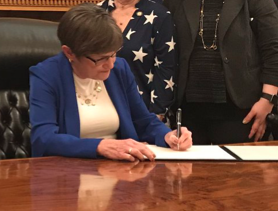
Governor signs bill to move Kansas toward hemp production

TOPEKA, Kan. (AP) — Kansas will be taking steps toward allowing farmers to grow hemp for industrial use under a measure Gov. Laura Kelly signed into law Monday.

The new law taking effect later this month replaces a state program only for researching hemp and its potential uses with a program for commercial production. Lawmakers authorized the research program last year after federal farm legislation allowed commercial hemp production.

The new law requires the Kansas Department of Agriculture to submit a plan to the federal government for regulating commercial hemp production. The department is required to confer with the governor’s and attorney general’s offices before submitting the plan.

Kelly said in a statement that the new law will help the state’s agricultural economy by giving farmers another crop to grow.

Copyright Eagle Radio | FCC Public Files | EEO Public File