SEDGWICK COUNTY — Law enforcement authorities are investigating a Kansas teen found with a gun on a school bus.
Just after 7 a.m. Wednesday, police responded to a disturbance call in reference to a 38-year-old parent concerned about a handgun missing from her home, according to officer Charley Davidson.
The woman believed her 16-year-old daughter was in possession of the gun on a school bus. Offices located the juvenile on the bus at Maple and Glenn in Wichita with the loaded handgun in her backpack, according to Davidson.
Police arrested the juvenile without incident and booked her into the Juvenile Detention Center on requested charges of criminal possession of a firearm by a juvenile and theft, according to Davidson.
There were no threats made to any students, no disruptions to any school and no one was injured.
Investigators will present the case to the Sedgwick County District Attorney’s Office.
TOPEKA – The Powerball jackpot for the Wednesday drawing is an estimated $750 million with an estimated cash option of $465.5 million.
Wednesday’s jackpot is the fourth largest in U.S. lottery jackpot history and third largest in Powerball jackpot history.
In 2016, Powerball set a world record jackpot of $1.586 billion. The three winning tickets were sold in California, Florida, and Tennessee.
If hit Wednesday, it would be the first Powerball jackpot won in 2019. The Powerball was last hit on December 26, 2018, in New York. Since the new year, the Powerball jackpot has rolled 25 times.
Additionally, the Super Kansas Cash jackpot has climbed to an all-time high of $6.2 million for the Wednesday drawing!
Super Kansas Cash is a Kansas-only game and jackpots are paid in one lump sum.
The last time the Super Kansas Cash jackpot was hit was in the January 10, 2018 drawing. On Monday, Super Kansas Cash had three tickets match the first five numbers, but not the Super Cash Ball. Each ticket is worth $2,000. Two tickets were sold in the south central region, and one ticket was sold in the north central region.
When a student comes home with a C on their report card, it often isn’t clear what that means.
Are they average in geometry? Or did their math proficiency get dragged down by poor class attendance?
Wichita Public Schools is hoping to clarify those grades by isolating academics from everything else that happens in the classroom.
DCJOHN / FLICKR, CREATIVE COMMONS
“We really want to focus on what it is that students know and what can they do,” said Christy O’Toole, the executive director of Curriculum and Instruction for Wichita Public Schools.
For years, elementary schools in Kansas have graded academic performance separately from other skills. Whether a student forgets a pencil or hands in their work late doesn’t affect their final score — often reflected as a number between zero and four.
But Kansas middle and high schools have been slow to adopt the same practices. They’ve found it difficult to lose the A’s and F’s in high school when GPAs are obsessed over by students and their parents.
Standards-based — or standards-referenced — is a method of grading where the teachers emphasize a student’s mastery of one of the state standards. Wichita Public Schools is narrowing its focus on what it sees as critical content.
“If we did ( all the state standards) in the course of a child’s life, K-12, we’d need 15,000 hours, but we only have 9,000 hours with a child,” said Andi Giesen, assistant superintendent at Wichita Public Schools. “So we’re narrowing the focus to the critical content.”
Wichita will start implementing standard-referenced grading in its elementary schools next school year. Other elementary schools in the state have used standard-based grading for years.
Augusta public schools began the practice about seven years ago. Report cards still report nonacademic performance — students receive grades in areas like group work and responsibility.
“When we were kids and parents went to parent-teacher conference, they said, ‘Johnny got an A in math and a B in science’ but they really don’t know what their child knows and what they don’t know,” said Holly Francis, assistant superintendent at Augusta Public Schools.
The practice stops after Augusta students move past fifth grade. While standard-based grading is common in Kansas elementary schools, it’s rare at the middle and high school levels.
“Everyone understands that zero to 100 scale,” said Ryan Arnold, administrative intern with Highland Park High School in Topeka. “That equates to a certain scores for the GPA. And the colleges recognize that as well.
“In my opinion that’s been the kind of sticking point for high schools.”
Wichita Public Schools will implement its new learning standards in its middle schools in 2020 and high schools in 2021. Parents won’t notice much of a difference on the final report card, however, with the grades converted to traditional A’s and B’s.
Yet Wichita high schools will be the exception, with few schools willing to change how grading is done past eighth grade when college applications depend on them.
Advocates point to Iowa for its above-average adoption of standard-based grading. Yet less than 20 high schools in Iowa have made the conversion, according to Matt Townsley, assistant professor of educational leadership at the University of Northern Iowa.
Townsley said for students at schools that haven’t switched, their performance remains foggy.
“It’s possible for a kid to get B’s on all their tests in a high school course and then they complete a bunch of extra credit crossword puzzles, bring some Kleenex boxes to school and get a bunch of homework right and that pads their grade and brings it up to an A,” Townsley said. “It’s really just not an accurate communication of what a student has actually learned.”
SALINE COUNTY— Law enforcement authorities are investigating the reported theft of two young donkeys in Saline County.
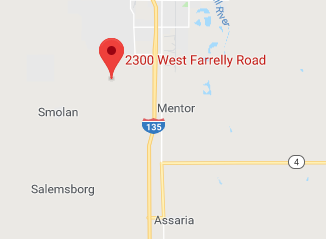
Google map
James Brown, 66, Salina, reported that a two-week-old female donkey and a four-week-old male donkey were stolen from a pasture in the 2300 Block of West Farrelly Road sometime between 5p.m. Monday and noon Tuesday, according to Saline County Sheriff Roger Soldan.
The gate on the pasture appeared to have e tampered with and a piece of sheet metal that had been in the pasture had been moved. Brown speculated that whoever took the donkeys used the sheet metal to herd the donkeys and separate them from their mother, according to Soldan.
WICHITA, KAN. – The former executive director of Inter-Faith Ministries in Wichita has been sentenced after he embezzled more than $100,000 dollars from a church in Wichita where he was a member.
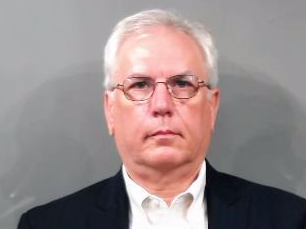
Egerton -photo Sedgwick Co.
According to a media release from the Sedgwick County Attorney, Garland Egerton, 66, Wichita, pled guilty to one count of theft on February 1, 2019.
A judge sentenced him Tuesday to 60 months of probation with an underlying sentence of 32 months in prison, according to the release.
Egerton was ordered to pay $129,556 in restitution. His lack of criminal history and the request of the church were cited in the court’s decision to grant probation. The defendant was also ordered to have no contact with the Unity of Wichita Church and attend a theft offender class.
After an audit, the church discovered $120,000 was missing. An audit showed the theft occurred from 2013 to 2018. Egerton was the bookkeeper for the church at the time. He left Inter-Faith Ministries last April.
TOPEKA, Kan. (AP) — People as young as 18 would be allowed to carry concealed weapons under a bill that has advanced in the Kansas House.
Advocates rejected arguments Tuesday that the bill could endanger lives. The bill will likely receive a final passage on Wednesday.
Kansas law has what is called constitutional carry, or the right to carry a firearm in any capacity, for residents 21 and older. A concealed carry license, available to those who complete required training, allows the holder to carry in states that have reciprocal agreements with Kansas.
Under the new law, the minimum age for concealed carry training would drop to 18. Residents who don’t receive a license at 18 would still be allowed constitutional carry in the state at age 21.
TOPEKA, Kan. (AP) — Democratic Gov. Laura Kelly could be forced to replace Kansas’ top business development official because of two small grants to a nonprofit group he previously managed from a fund tied to a late physician known nationally for doing late-term abortions.
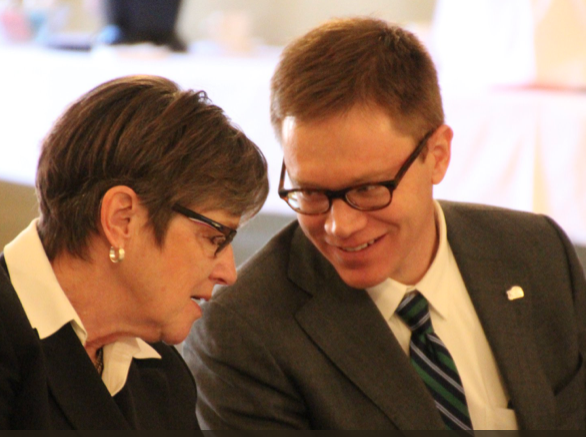
Acting Commerce Secretary David Toland visits with Gov. Kelly during a March 21 presentation in Topeka -photo courtesy Kan. Commerce Secretary
Acting state Commerce Secretary David Toland has no role in regulating abortion providers, but the state’s most influential anti-abortion group has joined an effort by some Republican legislators to oust him. They are troubled by grants totaling less than $20,000 to a southeast Kansas economic development group from a memorial fundnamed for Dr. George Tiller.
Tiller was among a handful of physicians in the U.S. known to terminate pregnancies in their final weeks. His clinic in Wichita was the site of repeated anti-abortion protests, including the weeks-long “Summer of Mercy” in 1991. He was shot to death in 2009 in his church by an anti-abortion zealot who is serving a 25 years-to-life prison sentence.
Toland’s political problems began with serving as the unpaid treasurer for Kelly’s successful campaign last year and have since mushroomed. The Republican-dominated Senate is expected to vote on his appointment next week, and it refuses to confirm him, he will have to step down from the Cabinet post he’s held since Kelly took office in January.
Several Republican senators said Tuesday that the Tiller fund grants troubled them, and the anti-abortion group Kansans for Life emailed all 40 senators a letter Monday urging them not to confirm Toland’s appointment. A few GOP lawmakers noted that the commerce secretary controls programs and incentives for luring businesses to Kansas.
“The next logical question is: Is he going to try to increase the number of abortion clinics in the state of Kansas?” said state Sen. Mary Pilcher-Cook, a conservative Kansas City-area Republican. “I think that we can’t rule that out.”
Opposition to Toland’s appointment is an example of how abortion remains an enduring political issue in Kansas, which has only three clinics providing abortions. The Legislature has had solid anti-abortion majorities for two decades and recently passed a resolution condemning a new law in New York protecting abortion rights.
“The last thing we want to see happen is a commerce secretary who is dialed in to how to get money from the Tiller foundation,” said Mary Kay Culp, Kansans for Life’s executive director.
The controversy also shows how Kelly, who promised a bipartisan governing style, has had a rocky start in the face of resistance to her agenda from conservative Republican leaders. It’s especially notable because it’s rare for even Democratic governors to have Cabinet appointments rejected.
“It’s a smear campaign,” said Senate Minority Leader Anthony Hensley, a Topeka Democrat and close Kelly ally. “It’s just politics.”
Toland previously served 11 years as executive director of Thrive Allen County, the southeast Kansas nonprofit. He’s received credit for helping to lure a new grocery store to his hometown of Iola and persuade voters to build a new community hospital.
Some Republicans have questioned Toland’s credentials and criticized him over a few social media posts and comments he made at a rally last year for expanding Medicaid. However, he also has the support of business leaders and local chamber-of-commerce officials across the state, and even some GOP senators consider him well-qualified.
“It’s time to end these baseless attacks and confirm him to be our next secretary of commerce,” Kelly said in a statement Tuesday.
According to the Wichita Community Foundation , which administers the Tiller fund, its first grant to Thrive Allen County, in 2015, was $9,380. It went to efforts to help low-income pregnant women stop smoking and get them to appointments for breast and cervical cancer screenings.
The second grant, in 2018, was $10,000 and went to the local health department to help provide long-acting contraceptives to women who have no or limited health insurance coverage.
Toland said in statement that he’s proud of Thrive Allen County’s work and, “We have healthier mothers and healthier babies in the county as a result, which is good for businesses and our economy.”
Kansans for Life and other abortion opponents are put off because Thrive Allen County’s website lists the Tiller fund as one of its “partners.”
Culp worries that small grants across the state could be used to refer women to abortion providers as part of a “racket to protect abortion.”
And Sen. Gene Suellentrop, a conservative Wichita Republican, said Toland and Thrive Allen County now have a tie with the Tiller fund.
CHEROKEE COUNTY —Law enforcement authorities are investigating the death of a homeless man in Kansas and have a suspect in custody.
Diana Marie and Ty Bohlander-photo Cherokee County
According to the Cherokee County Sheriff, on April 30, 2017, the body of 64-year-old James McFarland of Tulsa was discovered alongside a rural Cherokee County Kansas road.
Detectives identified Ty Bohlander and his mother Diana Bohlander, as suspects, leading to First Degree Murder charges being filed against both of them and arrest warrants issued, according to Cherokee County Sheriff David Groves.
During the search for the Bohlander’s, Cherokee County Sheriff’s Investigators obtained information leading them to believe they traveled to Aurora Colorado, Cheyenne Wyoming, and eventually to Southern California after killing McFarland.
Detectives have been working closely with the Federal Bureau of Investigation and the United States Marshal’s Office in an effort to locate and apprehend the suspects,” continued Sheriff Groves.
Ty Bohlander was located and was placed under arrest last week by the Santa Monica Police Department in California. He is currently being held without bond in the Twin Towers Correctional Facility in Los Angeles where he is awaiting extradition back to Kansas. He is scheduled for a Southern California court appearance on April 9.
Authorities believe Diana Bohlander is still in the Santa Monica area and law enforcement there continue to search for her, according to Sheriff Groves.
KANSAS CITY (AP) — The Latest on flooding throughout the Midwest (all times local):
The U.S. Environmental Protection Agency says it is assessing two Superfund sites located in areas that have seen overwhelming floods in recent weeks.
The EPA identified the Superfund sites as the Nebraska Ordnance Plant in Mead, Nebraska, and the Conservation Chemical Corporation in Kansas City. Superfund is a law that gives the EPA funding and authority to clean up contaminated sites.
The Mead site operated as a munitions plant from 1942 to 1956 and its disposal of radioactive waste and other chemicals led to groundwater contamination. The EPA says it has not found evidence that any hazardous contaminants were released by the flooding.
The federal agency says it will evaluate the sites further as floodwaters recede.
SOUTH HUTCHINSON, Kan. — Law enforcement authorities are investigating a Catholic priest at a South Hutchinson church for possible financial crimes, according to Reno County Sheriff’s Capt. Steve Lutz.
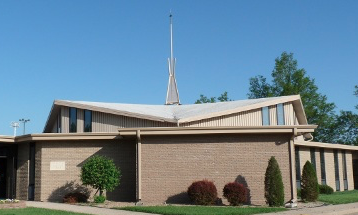
Our Lady of Guadalupe Church in South Hutchinson
“He has not been arrested. All I can confirm is that we are working a financial crime at Our Lady of Guadalupe Church in South Hutchinson,” Lutz said in a text message.
Officials are still investigating whether the priest, Juan Garza, committed any crime. The Catholic Diocese of Wichita is the victim in this case.
Lutz wouldn’t say if the priest will be arrested at some point. “The case has not been sent to the D.A.’s office,” Lutz said.
Attempts to get a comment from the Diocese of Wichita were unsuccessful.
WICHITA, KAN. – A California man was indicted Tuesday on a federal charge of smuggling more than 50 pounds of methamphetamine into Kansas, according to U.S. Attorney Stephen McAllister.
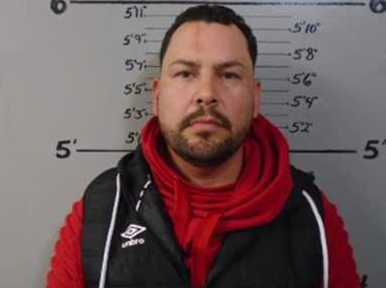
Garcia-Maldonado-photo Clark Co.
Jesus Antonio Garcia-Maldonado, 36, Panorama City, Calif., is charged with one count of possession with intent to distribute approximately 23 kilograms of methamphetamine. Garcia-Maldonado was stopped for a traffic violation in Clark County, Kan.
Officers found the drugs under the seats and hidden in rear quarter panels of the car. The car was rented in San Diego, Calif.
If convicted, he faces not less than 10 years in federal prison and a fine up to $10 million.
Just two short years ago, the State of Kansas found itself on the brink of financial disaster. Even after depleting state savings and enduring multiple rounds of devastating budget cuts, unsustainable tax policy continued to perpetuate fiscal crisis. We saw schools close and class sizes grow. We saw an overwhelmed child welfare system let children fall through the cracks. And despite promises of immediate prosperity, Kansas routinely ranked among the nation’s worst in multiple economic indicators.
As the budget hole continued to grow, the legislature passed two sales tax increases, swept more than $2 billion from the state highway fund, delayed numerous payments to the state pension system, accumulated historic levels of debt, and raided every critical investment from early childhood education to public safety. But in the end, none of these short-term band aids could stem the bleeding caused by the reckless Brownback tax experiment. In November of 2016, Kansans called for change.
The very next year, the state hit “reset” in a historic act of bipartisanship with the passage of comprehensive tax reform. Our credit score improved within a week. The number of Kansans participating in the labor force increased for the first time since 2014.
We have only just started the rebuilding process. Our recovery is uncertain; our budget is fragile. The State of Kansas cannot afford to make a U-turn now.
Senate Bill 22 – another reckless tax plan – would absolutely dismantle all the progress we’ve made. It would throw our state once again into a self-inflicted budget crisis, diminishing all the investments we’ve worked so hard to rebuild and restore. It would put our future at risk once again in order to give significant tax breaks to entities who need them the least, while continuing to leave working families behind.
I share Kansas lawmakers’ desire to keep the state tax burden as low as possible and that will continue to be a priority. In January, I presented a structurally balanced budget that funded our schools and roads, reduced state debt, left Kansas with the largest ending balance in 20 years and did so all without a tax increase.
I was a math major. This is about basic math. My budget proposal left a healthy, fiscally responsible ending balance. If I had signed Senate Bill 22, the budget that just passed the Senate would fall to more than $600 million in the hole within two years.
That is unacceptable. That is irresponsible.
We must be patient, thoughtful, and prudent as we evaluate tax policy. And, when we move forward with sustainable, commonsense tax relief, we must ensure that it benefits the Kansans who need it the most. We will focus on reducing the sales tax on food and providing real tax relief to working families.
The people of Kansas elected me to rebuild our state. They elected me to bring fiscally conservative and responsible principles back to our government. And I refuse to endorse another round of fiscally reckless policies – similar to the Brownback tax experiment – that left our state in shambles and our families struggling.
I commit to you – the people of Kansas – that I will stabilize our state’s budget, invest in our shared priorities, and continue the recovery we have all fought so hard to begin. By following through on this commitment, our state has every reason to expect a bright and successful future.


 TOPEKA – The Powerball jackpot for the Wednesday drawing is an estimated $750 million with an estimated cash option of $465.5 million.