We have a brand new updated website! Click here to check it out!

Fire Marshal: Explosive device causes damage to Kansas home

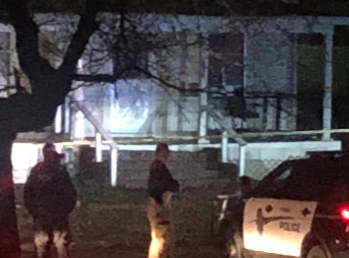
SHAWNEE COUNTY —Law enforcement authorities are investigating after an explosion on the front porch of a home early Wednesday in Shawnee County.

First responders on the scene of Wednesday morning investigation -photo courtesy WIBW TV

Just after 12:30a.m., fire crews and police responded to a home in the 300 Block of SW Harrison in Topeka, according to Fire Chief Michael Martin.

An investigation revealed some type of explosive device was used. The explosion caused approximately $2000 damage to the home at 306 SW Harrison. Flying debris caused an additional $500 damage to the home at 302 SW Harrison, according to Martin. The Topeka Police Department bomb squad assisted at the scene to search for additional explosive devices.

There were no injuries reported.

Sheriff: Barton County man dies in rollover accident

BARTON COUNTY— One person died in an accident Tuesday in Barton County.

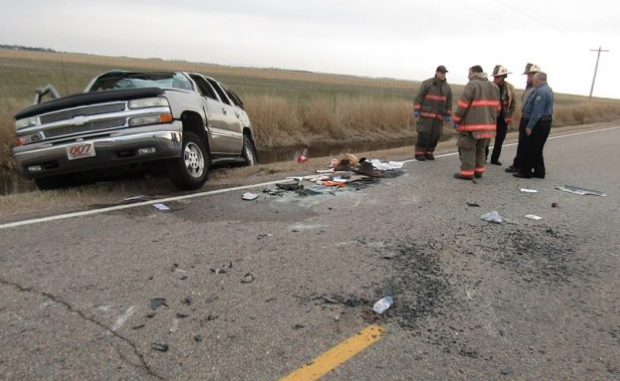
Scene of Tuesday fatal rollover accident -photo courtesy Barton Co. Sheriff

A 2002 Chevy Tahoe driven by Michael T. Kern, 58, Ellinwood, was eastbound on SE 50 Road near SE 20th Avenue, according to a social media report from the Barton County Sheriff.

The Tahoe traveled off the road toward the south ditch. The driver overcorrected. The SUV overturned as it came back onto the road and rolled.

Kern was pronounced dead at the scene. The accident remains under investigation, according to the sheriff’s office office.

Kansas House bill changes criminal penalties for abusing a child

By GRANT HEIMAN
KU Statehouse News Service

TOPEKA — A recent bill introduced to the Kansas House of Representatives changes the criminal penalties for abusing a child.

in January 2018, Aaron Peck was sentenced to 13 years in prison for the child abuse related death of an infant girl in Shawnee, Kansas. Photo courtesy KBI offender registry

House Bill 2394 decreases the level of severity for child abuse while adding the separate crime of aggravated abuse of a child.

“This legislation is extremely important to proportionately respond to extreme and serious abuse of a child,” said Kim Parker, prosecutor coordinator for the Kansas County and District Attorney’s Association.

The current Kansas statutes regarding child abuse group all acts of child abuse together as severity level 5 regardless of the amount of harm done to the child. For example, rape is a severity level 1 felony while a first-time misdemeanor is a severity level 10.

“Many of the acts of abuse perpetrated on children are overlooked by [the current] statute,” Leavenworth County Attorney Todd Thompson said in his testimony to the committee. “Furthermore, many acts of abuse against children vary in the nature of their severity, a consideration also not taken into account by our current statutory language.”

The bill would decrease the level of severity from 5 to 7, or 9, depending on the nature of the abuse. The change in severity would alter sentencing regulations to “proportionately respond to extreme and serious abuse of a child,” according to Parker.

The Office of Judicial Administration notes the bill could increase the number of cases filed in district court, which would result in more time spent by court employees and judges processing and deciding these cases. A financial effect cannot be estimated until the judicial branch has operated under the bill’s provisions.

The KCDAA and the Leavenworth County attorney supported the bill while the Kansas Association of Chiefs of Police, Kansas Sheriffs Association and Kansas Peace Officers Association testified as neutral.

The neutral groups recognized the positive intentions of the bill but noted that the vagueness within the bill “may unintentionally include law enforcement use of force or restraints.”

Grant Heiman is a University of Kansas junior from Wichita majoring in journalism.

Prairie Doc Perspectives: To straighten the bent bones of children

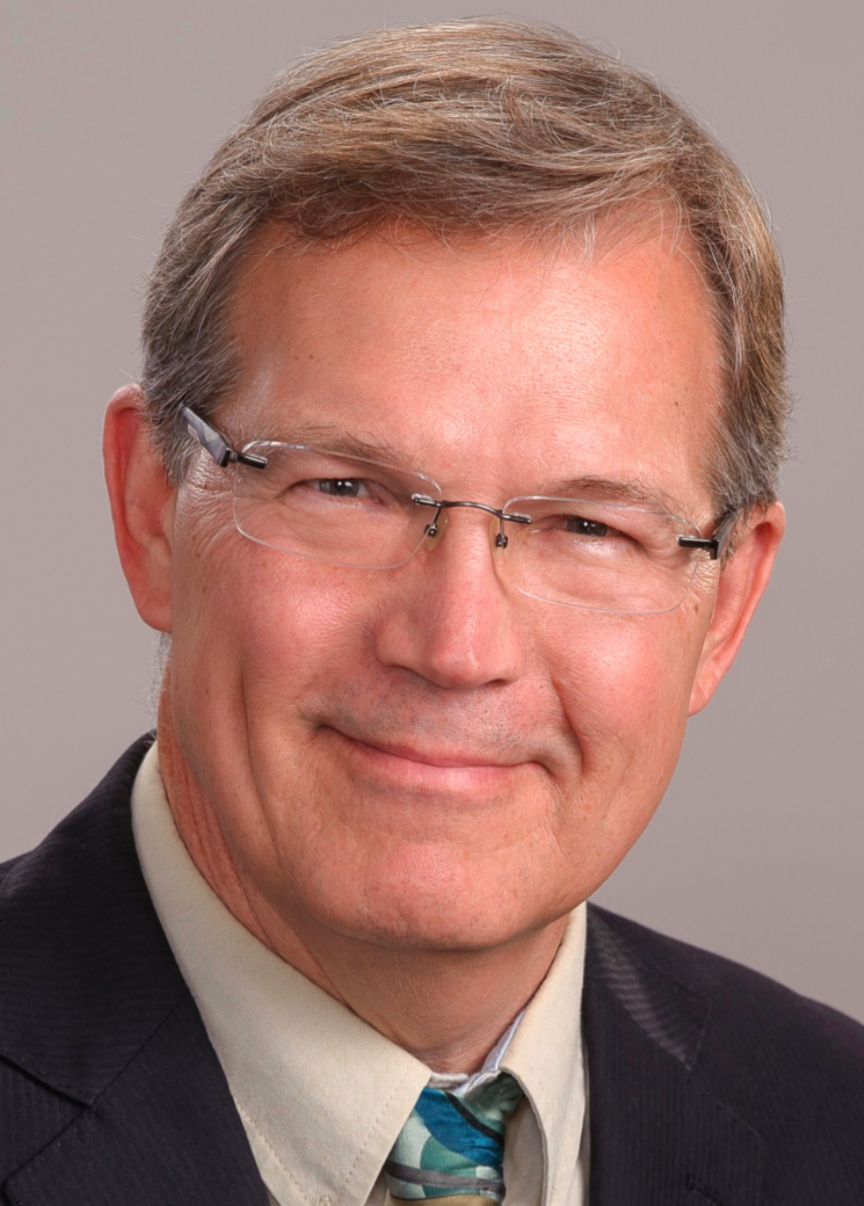
Rick Holm

Starting sometime in the middle ages, throughout many lands, there were “bonesetters” who knew about splinting, how to treat broken bones with splints made from sticks, leather and clay. They even had a guild, a medieval union of sorts, a cohesive group of workers organized to ensure quality, consistency and education. Medical schools for physicians existed at that time, but neither bonesetters nor surgeons attended those schools.

In the 1700s, Nicholas Andre’, a researcher and professor of medicine at the University of Paris, formally described splinting, a technique used by bonesetters, as a method to treat boney deformities, such as clubbed feet in newborn children. He likened it to the straightening of young tree saplings. Andre’ wrote a textbook on the subject entitled L’Orthopedie. The ancient Greek word orthos means free from deformity, to straighten; and the ancient Greek word paideia refers to the art of raising a child. Together they provide for the name of a present-day surgical specialty. Literally, orthopedics means to straighten the bent bones of children.

Surgical methods in the 1700s and 1800s were very immature. Anesthesia was first developed during the early 1800s and ether was widely used during the Civil War. After the war, surgeons brought their surgical experience home to small towns throughout the U.S. It wasn’t until after the war that we learned of bacteria and discovered we could avoid infection following surgery. In addition, X-rays were discovered by Wilhelm Roentgen in 1895, which allowed for the marvelous and revealing image of our internal boney structure.

These advancements helped set the stage for expanding the focus of orthopedics from casting and making-straight the boney deformities of children. In the 1890s, Evan Thomas, a well-known bonesetter from Liverpool, England, encouraged his son Hugh to go to medical school. While learning medicine, Hugh learned from his father bone setting and casting methods, which at the time were not being taught in schools. The younger Thomas was influential in bringing this curriculum to medical schools. He later set up practice with his nephew Robert Jones, and the two worked to develop orthopedic surgical methods in treating bone injuries in construction workers, and then war injuries in military men during World War I.

Thus, we trace the evolution from bonesetters, and straightening the bones of children; to anesthetized yet unsterile amputations during the Civil War; to bone setting taught in medical school; to surgical repair of boney injuries in World War I; to the marvelous ever-developing field of orthopedic surgery today.

For free and easy access to the entire Prairie Doc® library, visit www.prairiedoc.org and follow The Prairie Doc® on Facebook, featuring On Call with the Prairie Doc® a medical Q&A show streaming live most Thursdays at 7 p.m. central. 

Floodwaters threaten millions in crop and livestock losses

DES MOINES, Iowa (AP) — Farmer Jeff Jorgenson looks out over 750 acres of cropland submerged beneath the swollen Missouri River, and he knows he probably won’t plant this year.

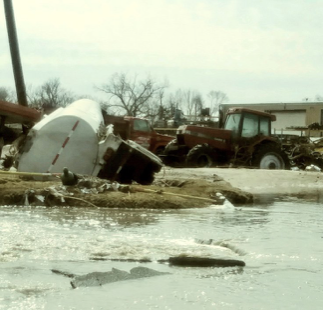
But that’s not his biggest worry. He and other farmers have worked until midnight for days to move grain, equipment and fuel barrels away from the floodwaters fed by heavy rain and snowmelt. The rising water that has damaged hundreds of homes and been blamed for three deaths has also taken a heavy toll on agriculture, inundating thousands of acres, threatening stockpiled grain and killing livestock.

In Fremont County alone, Jorgenson estimates that more than a million bushels of corn and nearly half a million bushels of soybeans have been lost after water overwhelmed grain bins before they could be emptied of last year’s crop. His calculation using local grain prices puts the financial loss at more than $7 million in grain alone. That’s for about 28 farmers in his immediate area, he said.

“The economy in agriculture is not very good right now. It will end some of these folks farming, family legacies, family farms,” he said. “There will be farmers that will be dealing with so much of a negative they won’t be able to tolerate it.”

Jorgenson, 43, who has farmed since 1998, reached out to friends Saturday, and they helped him move his grain out of bins to an elevator. Had they not acted, he would have lost $135,000.

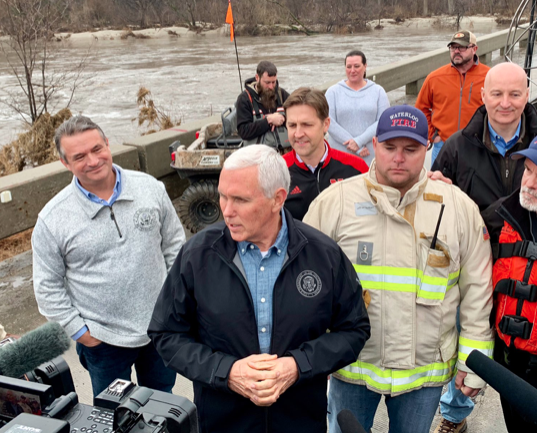
Vice President Mike Pence surveyed flooded areas in Nebraska Tuesday, where he viewed the raging Elkhorn river, talked to first responders and visited a shelter for displaced people. He promised expedited action on presidential disaster declarations for Iowa and Nebraska.

“We’re going to make sure that federal resources are there for you,” Pence told volunteers at Waterloo, a town of less than 1,000 residents about 21 miles west of Omaha that was virtually cut off by the floodwaters.

The flooding is expected to continue throughout the week in several states as high water flows down the Missouri River. Swollen rivers have already breached more than a dozen levees in Nebraska, Iowa and Missouri, according to the Army Corps of Engineers.

The water rose so quickly that farmers in many areas had no time to get animals out, said Chad Hart, an agricultural economist at Iowa State University.

“Places that haven’t seen animal loss have seen a lot of animal stress. That means they’re not gaining weight and won’t be marketed in as timely a manner, which results in additional cost,” he said.

In all, Nebraska Farm Bureau President Steve Nelson estimated $400 million of crop losses from fields left unplanted or planted late and up to $500 million in livestock losses.

In a news release issued Tuesday, Gov. Pete Ricketts said there have been deadlier disasters in Nebraska but never one as widespread. He said 65 of the state’s 93 counties are under emergency declarations.

In neighboring Missouri, water was just shy of getting into Ryonee McCann’s home along a recreational lake in Holt County, where about 40,000 acres and hundreds of homes have been flooded. She said her home sits on an 8-foot foundation.

“We have no control over it,” the 38-year-old said. “We just have to wait for the water to recede. It’s upsetting because everything you have worked for is there.”

The Missouri River was forecast to crest Thursday morning at 11.6 feet above flood stage in St. Joseph, Missouri, the third highest crest on record. More than 100 roads are closed in the state, including a growing section of Interstate 29.

Leaders of the small northwestern Missouri town of Craig ordered an evacuation. The Holt County Sheriff’s Department said residents who choose to stay must go to City Hall to provide their name and address in case they need to be rescued.

In nearby Atchison County, Missouri, floodwaters knocked out a larger section of an already busted levee overnight, making the village of Watson unreachable, said Mark Manchester, the county’s deputy director of emergency management/911.

Officials believe everyone got out before thousands of more acres were flooded. But so many roads are now closed that some residents must travel more than 100 miles out of their way to get to their jobs at the Cooper Nuclear Station in Nebraska, he said.

“It’s a lot harder for people to get around,” Manchester said.

River flooding has also surrounded a northern Illinois neighborhood with water, prompting residents to escape in boats. People living in the Illinois village of Roscoe say children have walked through floodwaters or kayaked to catch school buses.

Flooding along rivers in western Michigan has damaged dozens of homes and businesses.
Game wardens mourn the loss of K9 who saved Kansas girl

Game Wardens with the Kansas Department of Wildlife Parks and Tourism are mourning the death of a special K-9.  On their social media page, wardens reported that K-9 died Tuesday just 14 months following her retirement.

photo courtesy KDWP&T

According to the wardens, “Meg is credited with making a multitude of poaching cases, apprehension of many fugitives, and providing critical evidence recovery in murder investigations.

She has also been credited for saving lives including a three-year-old girl in Jackson County in 2016 who went missing from her home during an extremely hot day.

Meg was a true public servant, and a Kansas Game Warden to the end. We will miss you girl, rest easy.”

Jury: Roundup weed killer is major factor in man’s cancer

SAN FRANCISCO (AP) — Roundup weed killer was a substantial factor in a California man’s cancer, a jury determined Tuesday in the first phase of a trial that attorneys said could help determine the fate of hundreds of similar lawsuits.

Roundup, the Monsanto brand name pesticide built on the chemical glyphosate, is used on farm fields and on lawns and gardens. FILE: by GRANT GERLOCK / courtesy HARVEST PUBLIC MEDIA

The unanimous verdict by the six-person jury in federal court in San Francisco came in a lawsuit filed against Roundup’s manufacturer, agribusiness giant Monsanto. Edwin Hardeman, 70, was the second plaintiff to go to trial out of thousands around the country who claim the weed killer causes cancer.

Monsanto says studies have established that Roundup’s active ingredient, glyphosate, is safe.

A San Francisco jury in August awarded another man $289 million after determining Roundup caused his non-Hodgkin’s lymphoma. A judge later slashed the award to $78 million, and Monsanto has appealed.

Hardeman’s trial is before a different judge and may be more significant. U.S. Judge Vince Chhabria is overseeing hundreds of Roundup lawsuits and has deemed Hardeman’s case and two others “bellwether trials.”

The outcome of such cases can help attorneys decide whether to keep fighting similar lawsuits or settle them. Legal experts said a jury verdict in favor of Hardeman and the other test plaintiffs would give their attorneys a strong bargaining position in any settlement talks for the remaining cases before Chhabria.

The judge had split Hardeman’s trial into two phases. Hardeman’s attorneys first had to convince jurors that using Roundup was a significant factor in his cancer before they could make arguments for damages.

The trial will now proceed to the second phase to determine whether the company is liable and if so, for how much.

Hardeman declined to comment outside court.

“This has been a long time coming for Mr. Hardeman,” said one of his attorneys, Jennifer Moore. “He’s very pleased he had his day in court, and we’re looking forward to phase two.”

Many government regulators have rejected a link between cancer and glyphosate. Monsanto has vehemently denied such a connection, saying hundreds of studies have established that the chemical is safe.

Bayer, which acquired Monsanto last year, said in a statement after the verdict that it continues to “believe firmly that the science confirms glyphosate-based herbicides do not cause cancer.”

“We are confident the evidence in phase two will show that Monsanto’s conduct has been appropriate and the company should not be liable for Mr. Hardeman’s cancer,” it said.

Monsanto developed glyphosate in the 1970s, and the weed killer is now sold in more than 160 countries and widely used in the U.S.

The herbicide came under increasing scrutiny after the France-based International Agency for Research on Cancer, which is part of the World Health Organization, classified it as a “probable human carcinogen” in 2015.

Lawsuits against Monsanto followed. The company has attacked the international research agency’s opinion as an outlier.

The U.S. Environmental Protection Agency says glyphosate is safe for people when used in accordance with label directions.

Hardeman started using Roundup products to treat poison oak, overgrowth and weeds on his Sonoma County property in the 1980s and continued using them through 2012, according to his attorneys. He was diagnosed with non-Hodgkin’s lymphoma in 2015.

Pro-life group in Kansas wants ex-nominee to resign as judge

TOPEKA, Kan. (AP) — The Latest on Kansas Gov. Laura Kelly withdrawing a nominee for the Kansas Court of Appeals over political posts on his Twitter feed.

Judge Jeffry Jack courtesy photo

A pro-life group influential in Kansas politics has called on a trial-court judge to step down after political posts on his Twitter feed sunk his nomination for the Kansas Court of Appeals.

Kansans for Life said Tuesday that Democratic Gov. Laura Kelly’s decision to withdraw her nomination of Judge Jeffry Jack for the state’s second-highest court is a good first step.

But Executive Director Mary Kay Culp said the group believes Jack also should resign from his current position of Labette County district judge.

Jack’s Twitter page included posts from 2017 criticizing President Donald Trump and expressing support for gun control and abortion rights. Some used vulgar language.

Jack asked to have his name withdrawn Monday night after Republicans predicted he would not be confirmed by the GOP-controlled state Senate.

—–

A Kansas judge whose Twitter feed sunk his nomination to the state’s second-highest court says he was expressing personal opinions that do not influence his work on the bench.

In a statement Tuesday, Judge Jeffry Jack also criticized Senate President Susan Wagle for opposing his confirmation to the Kansas Court of Appeals before he had a hearing.

His Twitter page showed hundreds of tweets and retweets from 2017 that criticized President Donald Trump and expressed support for gun control and abortion rights. Some included vulgar language.

Kelly withdrew Jack’s nomination Tuesday.

Jack said his tweets were “anti-violence, anti-discrimination and anti-hypocrisy.” He said he assumed he was expressing personal opinions to a small group of followers and did not understand that his tweets were accessible to the public.

Kansas woman sentenced for killing ex, setting body on fire

LAWRENCE, Kan. (AP) — A woman has been sentenced to life in prison with no possibility of parole for 50 years for killing the father of her child whose body was found inside a burning house near Lawrence.

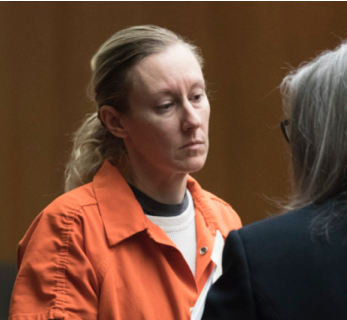
Tria Evans stands next to her attorney Carol Cline during an appearance before Judge Kay Huff on Tuesday, Feb. 6, 2018 in Douglas County District Court-photo by Nick Krug courtesy Lawrence Journal World

39-year-old Tria Evans appeared in court Tuesday for sentencing six weeks after a jury deliberated 1½ hours. She was convicted of first-degree murder, conspiracy to commit murder, arson and aggravated burglary in the November 2017 killing of 34-year-old Joel Wales.

Evans and Wales had a child together and a history of domestic disputes.

Judge Kay Huff says “it doesn’t get much more premeditated than this case.”

Wales was shot six times while house-sitting at his mother’s home just south of Lawrence. Gasoline was was poured over his body and lit on fire.

___

The Latest: Vice President Pence says federal help on the way after flood

OMAHA, Neb. (AP) — The Latest on flooding in the Midwest (all times local):

Vice President Mike Pence says the Trump administration will expedite presidential disaster declarations for Nebraska and Iowa.

Pence was in Omaha, Nebraska, on Tuesday to tour areas ravaged by the flood that has killed at least three people and forced hundreds of Midwesterners from their homes.

Pence says he spoke to the governors of both states shortly after landing in Omaha to assure them federal aid will soon be on the way.

Nebraska Gov. Pete Ricketts and Iowa Gov. Kim Reynolds were among a group of Republican leaders accompanying Pence during a brief tour of damaged areas. Others included U.S. Sens. Ben Sasse, of Nebraska, and Joni Ernst, of Iowa, as well as Rep. Don Bacon of Nebraska.

___

4:50 p.m.

A small Missouri town is under a mandatory evacuation order as the Missouri River threatens it.

The Holt County Sheriff’s Department says the evacuation was ordered Tuesday in Craig, a town of about 250 residents 110 miles (177 kilometers) north of Kansas City, Missouri.

The sheriff’s office says anyone choosing to stay must go to City Hall to provide their name and address in case they need to be rescued.

Snowmelt and heavy rain have sent the Missouri River pouring over and through levees in Nebraska, Iowa and Missouri. Craig residents join thousands of others who have been displaced by the flooding.

Former Kansas credit union president admits to embezzlement

TOPEKA, KAN. –A former president of a credit union in Topeka pleaded guilty Tuesday to a federal charge of embezzlement, according to U.S. Attorney Stephen McAllister.

Kent -photo Shawnee Co.

Connie Marie Kent, 52, Topeka, pleaded guilty to one count of theft from a credit union. In her plea, she admitted the crime occurred while she was an officer and employee of 1st Kansas Credit Union, formerly the Post Office Credit Union. Membership in the credit union is limited to government employees.

Kent agreed to a restitution amount of approximately $39,895.

Sentencing is set for June 25. She faces a penalty of up to 30 years and a fine up to $1 million.

1 person airlifted to hospital after pedestrian struck on K-State campus

MANHATTAN —The Kansas State University Police Department responded to a report of a vehicle versus pedestrian accident in the crosswalk at Denison Avenue and Todd Road at approximately 2:30 p.m. Tuesday. One person was transported to Ascension Via Christi Hospital in Manhattan and later flown to a Topeka hospital.

According to a release from KSU News and Communications Services the investigation is ongoing. The names of the people involved will not be released at this time.

Update: Kansas teen jailed after crash, fire at Sam’s Club

SHAWNEE COUNTY — Law enforcement authorities are investigating a suspect following a hit and run crash and fire and have made an arrest.

Jacob Bosh -photo Shawnee County

Just before 7p.m. Monday, police were called to Sam’s Club located 1401 SW Wanamaker in Topeka for a report of a motor vehicle accident and fire, according to Lt. Aaron Jones.

Officers discovered a vehicle fully engulfed in flames on the back side of the building. The vehicle apparently struck the electrical service to the building. A fire resulted from the impact, causing a power outage affecting the entire building. The vehicle did not penetrate the building. Authorities evacuated shoppers from the business as a precaution.

Witnesses guided officers  to a man running east from the accident scene. Officers located the driver of the vehicle identified as 19-year-old Jacob Orlando Eugene Bosch  at the Days Inn in the 1500 block of SW Wanamaker, according to Jones.

After an investigation, police arrested Bosh and he is being held without bond on requested charges that include DUI, reckless driving, speeding, operating a vehicle without registration or tags expired, driving while license suspended and possession of drugs, according to a statement from Topeka Police.

View of the Monday night fire at Sams Club in Topeka photo courtesy WIBW TV

According to Jones, “The public deserves credit for the apprehension of the suspect in this case.  Sam’s Club remained closed Tuesday, without power.

————

SHAWNEE COUNTY — Law enforcement authorities are investigating a suspect following a hit and run crash and fire.

Just before 7p.m. Monday, police were called to Sam’s Club located 1401 SW Wanamaker in Topeka for a report of a motor vehicle accident and fire, according to Lt. Aaron Jones.

Officers discovered a vehicle fully engulfed in flames on the back side of the building. The vehicle apparently struck the electrical service to the building. A fire resulted from the impact, causing a power outage affecting the entire building. The vehicle did not penetrate the building. Authorities evacuated shoppers from the business as a precaution.

Witnesses guided officers  to a man running east from the accident scene. Officers located the driver of the vehicle at the Days Inn in the 1500 block of SW Wanamaker, according to Jones.

First responders at the crash scene Monday night at Sams Club photo courtesy WIBW TV

Police have not released his name as they work to determine what caused the crash.

According to Jones, “The public deserves credit for the apprehension of the suspect in this case. The Shawnee County Emergency Communications Center was inundated with calls from the public that helped locate this driver. Sam’s Club was temporarily closed, without power.

Copyright Eagle Radio | FCC Public Files | EEO Public File