We have a brand new updated website! Click here to check it out!

Kansas to use tax incentives to help increase job opportunities for disabled

By Samantha Gilstrap
KU Statehouse News Service

TOPEKA – Kansas is going to use tax incentives to help increase employment opportunities for disabled people. But it hasn’t always been a priority.

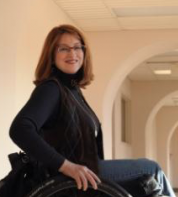
Dot Nary, Ph.D. photo courtesy University of Kansas

Before Dot Nary received her Ph.D. and began working at the University of Kansas as an assistant research professor at the Research and Training Center on Independent Living, she had been discriminated against while entering the workforce because she uses a wheelchair. Nary is currently researching ways to expand independent living for disabled people, and teaches others about disability in order to lessen the stigma.

“I went to a temp force company and I took the typing test and did fine,” Nary said. “I had a bachelor’s degree, magna cum laude, but I didn’t get one call. I think they didn’t want to send out a person in a wheelchair.”

Although the Kansas Disabilities Act prohibits employers from discriminating against candidates with disabilities, the unemployment rates for these individuals remains higher than that of the average citizen. The Bureau of Labor Statistics says that compared to an average of 4.2 percent, the unemployment rate for disabled individuals is about 9.2 percent. These numbers don’t account for disabled individuals who never enter the workforce.

According to the United States Census one in five Americans have a disability according to the broad definition of disability with only half having said that their disability is severe enough to interfere with their day-to-day life. The Bureau of Labor Statistics says that means one in five will have a much harder time finding work. Nary says discrimination is largely due to the stigma of what it is like working with a person of disability.

Kansas’s House Bill 2044 is just one step toward bringing more disabled individuals into the workforce. Most recently Nary held a forum at KU in the Dole Center to talk about proper language when speaking to or about a disabled individual. She regularly holds similar equity talks that are open to the public to come and learn. She believes by educating and normalizing disabilities, the stigma will dissolve and society will begin to see disability as part of our everyday culture.

Nary, along with the director of the Disability Rights Center of Kansas, Stephanie West-Porter, wants to let the public know how capable these individuals are and how providing them with an employment opportunity can benefit companies. West-Porter discussed her own struggle with disclosing her mental disabilities WHAT ARE THEY? to coworkers.

According to West-Porter, invisible disabilities can be just as stigmatized and dangerous to finding a job if known. West-Porter defines invisible disabilities as mostly mental illnesses including anxiety, bipolar disorder, schizophrenia, and others.
Tax incentives from this bill would bring more disabled individuals into the work force and West-Porter believes that she sees it as a way to rid society of the discrimination that she and Nary have experienced.

West-Porter talked about a time that she did disclose her disability, saying “I actually had a coworker, after I told her I had bipolar disorder, said “You’re not going to come in with a gun and kill us all one day, are you?’”

This type of misinformation is a reason why finding employment remains tough.

The Americans with Disabilities Act (ADA) requires employers to provide reasonable accommodations for. Nary says that employers could be scared of this idea because it makes the person seem more difficult to work with but oftentimes, depending on the disability, accommodations aren’t hard to make. Sometimes, like Nary, only the office desk must be lowered for wheelchair access.

The Research and Training Center on Independent Living hopes to keep the conversation going and plans to hang up posters across KU’s campus indicating what a person should or shouldn’t say to a disabled individual. They hope alongside the new bill, that by lessening the stigma and starting a bigger conversation, people with disabilities will then be given further opportunities.

The House passed Bill 2044 with only one nay and sent it along to the Senate. After hearing the bill in the Committee on Commerce, the Senate passed the bill Feb. 27, with only one nay as well.

Samantha Gilstrap is a University of Kansas senior from Charlotte, North Carolina, majoring in journalism.
Kansas man admits to federal child porn charges a second time

KANSAS CITY, KAN. – For the second time, a Kansas man has pleaded guilty to federal child pornography charges, according to U.S. Attorney Stephen McAllister.

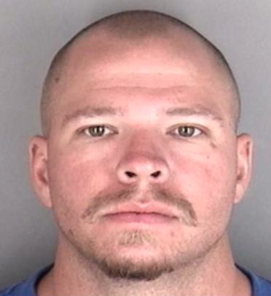
Allison -photo KBI Offender registry

Curtis Allison, 56, Leavenworth, pleaded guilty Friday to one count of possessing child pornography. In his plea, Allen admitted he was on supervised release from a prior child pornography conviction when investigators found more than 5,000 images of child pornography and 1,012 child pornography videos on his computer and storage devices.

In 2006, Allison pleaded guilty to one count of trafficking in child pornography and sentenced to 121 months in federal prison. In October 2014, he began a three-year term of supervise release. Within six months, he violated the terms of his release by using the internet to search for child pornography. The court revoked his supervised release and sentenced him to 24 months. He began a second supervised release in January 2017. Investigators found the child pornography in this case on his computer in August 2017.

Sentencing is set for May 20. Both parties have agreed to recommend a sentence of 10 years in federal prison.

Kan. man seriously injured after crash into bridge pillar

SEDGWICK COUNTY — One person was injured in an accident just before 4p.m. Sunday in Sedgwick County.

Images from Sunday’s crash courtesy KHP

The Kansas Highway Patrol reported a 1996 Honda Accord driven by Timothy Lee McKown, 51, Wichita, was southbound on Interstate 135 taking the exit to Kellogg Eastbound.

The driver lost control of the vehicle. It ran off the roadway on the right side and collided with the bridge pillar.

McKown was transported to Wesley Medical Center in serious condition. He was not wearing a seat belt, according to the KHP.

Kan. Senate bill seeks to provide housing protection for domestic violence victims

By Kate Mays
KU Statehouse News Service

TOPEKA — Another domestic violence victim protection bill was brought to committee on last week. Senate Bill 150 focuses on protecting victims from housing discrimination and making it easier for them to relocate to a safe place.

Rep. Dinah Sykes -courtesy photo

The Senate Judiciary Committee held a hearing on the bill, during which domestic violence advocates testified as proponents for the bill.

The bill addresses several obstacles that domestic violence victims face when it comes to obtaining housing. Primarily, the bill would prevent landlords from denying domestic violence victims from tenancy or evicting them based on their status as a victim and because they could be in danger again. Often times, a potential landlord will see the victim had several 911 calls made to their previous address which stops them from offering tenancy to the victims.

“We have to empower these women and men and take down this barrier. They’re taking that step out of their situation, so we have to do what we can to take down those barriers for them,” bill sponsor Sen. Dinah Sykes (D-Lenexa) said.

SB150 would also allow victims to end their leases early in order to protect themselves from further violence. Without this bill, the victims are at the will of the landlords to terminate their leases, which often leads to victims being forced to continue to pay rent for housing they’re not using or having to continue to live there because they can’t afford to pay multiple rents. Additionally, SB150 would allow victims to break their lease without their abuser’s signature.

This bill is one of several introduced during this legislative session to protect domestic violence victims. HB2270, which would require law enforcement to notify victims of domestic violence the earliest date their abuser could be released on bond, was introduced in February. Sen. Oletha Faust-Gordeau (D-Wichita) also introduced a bill that would increase penalties for domestic violence abusers. Sykes speculated that the increase in legislation could be due in part because people have been more vocal on these issues since #MeToo movement gained popularity in late 2017.

“I am disappointed that more of the bills that have been introduced in Kansas have not had hearings or weren’t blessed, so they’re kind of dead at this time and I was very fortunate to get bipartisan support on this bill and hopefully it will move out of committee next week,” Sykes said.

Two of the sponsors, Sykes and Sen. Barbara Bollier (D-Mission Hills), made headlines last year for switching their party affiliations from Republican to Democrat. The other sponsors are all Republicans.

The bill was iintroduced Feb. 12, the day before the Kansas Coalition Against Sexual and Domestic Violence’s 16th Annual Advocacy Day at the Capitol.

Kate Mays is a University of Kansas senior from Lenexa majoring in journalism.
KC man sentenced for teen’s near-overdose death on carfentanil

KANSAS CITY, Mo. (AP) — A Kansas City man has been sentenced to 15 years in federal prison for possession with intent to distribute carfentanil after a teenager who ingested half of one pill nearly died of an overdose.

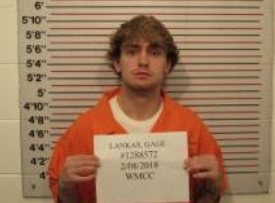
Lankas -photo MDC

Gage Lankas, 21, pleaded guilty in October and was sentenced Friday.

Carfentanil is a synthetic drug. A dose is about 5,000 times more powerful than the same amount of heroin.

The investigation began in 2017 after a 17-year-old from Grain Valley was rushed to a hospital with an overdose. The teen survived and told police he acquired pills from Lankas. He said he snorted just half of one bill that he mistook for oxycodone.

New book features untold stories of plaintiffs in Brown v. Board of Education

KU NEWS SERVICE

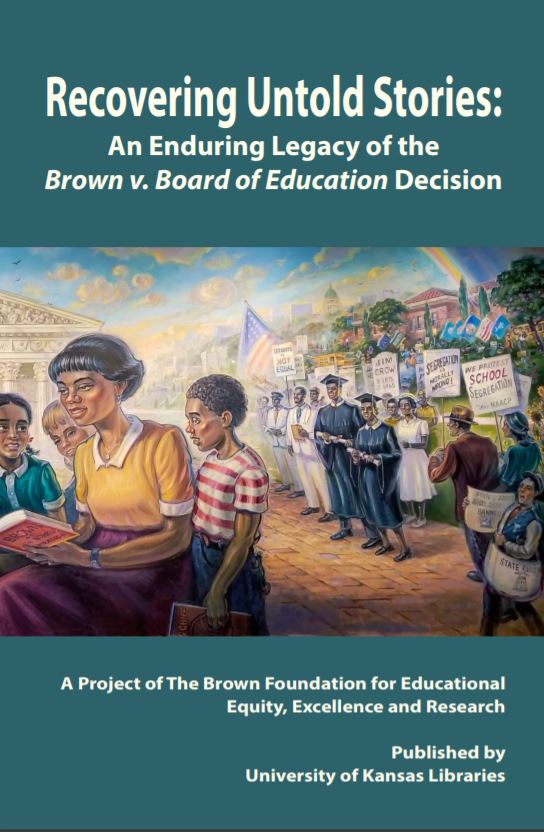
LAWRENCE — The Hall Center for the Humanities at the University of Kansas and the Brown Foundation for Educational Equity, Excellence and Research have released a new book, “Recovering Untold Stories: An Enduring Legacy of the Brown v. Board of Education Decision.”

The landmark Supreme Court decision finding segregation of public schools unconstitutional placed Topeka at the epicenter of civil rights history. Yet the full legal citation is Oliver L. Brown, et. al. vs. the Board of Education of Topeka.

The new book’s focus is on the “et. al.”: It captures the first-person narratives of individuals who were plaintiffs or descendants of plaintiffs represented in the five cases — Delaware, Kansas, South Carolina, Virginia and Washington, D.C. — that were consolidated by the U.S. Supreme Court in the decision.

In the instance of Brown v. the Board of Education, “et. al.” relegated several hundred men, women and children to what can be characterized as “legal wasteland,” rendering them largely unknown. The book uncovers and publishes some of their stories to provide a glimpse into the role of ordinary people who found themselves in the center of an extraordinary historic milestone.

Individuals involved in the cases participated in a series of in-person workshops in 2017 convened by the Brown Foundation onsite at the National Museum of African American History and Culture in Washington, D.C.

The workshops were facilitated by Cheryl Brown Henderson, founding president of the Brown Foundation, and four University of Kansas scholars: Deborah Dandridge, curator of African American Experience collections, Kenneth Spencer Research Library; John Edgar Tidwell, professor of English; Darren Canady, playwright and associate professor of English, and Vincent Omni, graduate teaching assistant in the Department of English. Workshop participants were guided through the process of writing a first-person narrative.

The results of their work are contained in this collection of essays, within which each person shares personal experiences, or those of their parents, offering a better understanding of the risk, challenge and courage of blacks who refused to be denied constitutional rights in the era of “Jim Crow” laws.

In his 1994 book, “Crusaders in the Courts: How a Dedicated Band of Lawyers Fought for the Civil Rights Revolution,” Jack Greenberg, member of the NAACP Legal Defense Fund’s legal team in Brown, poignantly refers to the numerous individuals who are embedded within the legal shorthand “et. al.”:

“Before lawyers can win cases, there have to be clients willing to stand up for their rights. The American blacks who proved willing to fight segregation and discrimination were organized for the most part by the National Association for the Advancement of Colored People (NAACP), in an environment hostile to change in the kind of justice afforded blacks.”

E-book layout and design were completed by Pam LeRow, digital media services, KU Libraries. KU Libraries also published the book. The project was funded in part by the Hall Center for the Humanities and the Walton Family Foundation.

The book is available online or can be obtained on demand as a print copy.

Kan. man accused of felony aggravated assault after SUV crash into house

COWLEY COUNTY — A Kansas man arrested after he allegedly drove his vehicle into the front portion of a house during an argument made an initial court appearance Thursday

Kenemore -photo Cowley Co.

Just before 7 a.m. February 16, police responded to a residence in the 1700 block of North Eighth Street in Arkansas City after the incident was reported, according to a media release.

They determined that Kevin Lee Kenemore, 40, Winfield, had been in an argument with a 25-year-old Arkansas City woman. During the argument, he drove his 2005 Toyota Highlander into the front of the residence.

No injuries were reported as a result of the collision. Kenemore allegedly fled the scene on foot, but was located a short time later and apprehended.

Kenemore was booked on suspicion of felony aggravated assault with a deadly weapon. He is due back in court April 4, according to the Cowley County Attorney’s office.

New Dep. Dist. Engineer for Corps of Engineers, Kansas City District

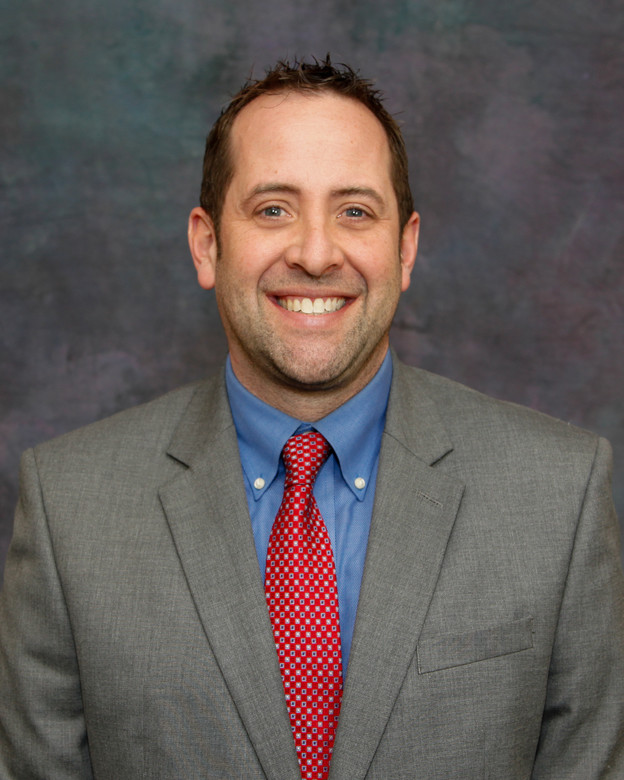
Bryan Smith

USACE

KANSAS CITY, Mo. – The U.S. Army Corps of Engineers (USACE), Kansas City District has announced Mr. Bryan Smith as the new Deputy District Engineer, Chief, Planning, Programs and Project Management.

Smith has worked for the Kansas City District for twenty years and has extensive knowledge in military programs, civil works and infrastructure operations and maintenance. As the Kansas City District’s senior civilian, Smith will oversee civil works, military construction and environmental programs for the district.

“The Kansas City District is committed to providing quality products and superior customer satisfaction around the globe and I am honored to serve the nation in a different role as the Deputy District Engineer for the Kansas City District,” said Smith. “These are exciting times in the Heartland as we have taken on new work and are executing five large-scale programs exceeding over $2 billion over the next few years. Our team of professionals are well-trained in several mission areas and am confident we will continue to deliver outstanding products while sustaining and delivering all our routine work.”

Smith believes in strong stakeholder relationships and will assist the district commander in continuing to strengthen current relationships and establish new connections in the Heartland.

“Communication is key. We have a strong history of great relationships and I plan to keep those and build upon them. A priority I have is engaging with Missouri River basin stakeholders and working together to meet the challenges of tomorrow. I will also work to sustain our relationships with our military customers in Missouri and Kansas, ensuring we are benefiting the warfighter.”

Smith is a licensed Professional Engineer and a Certified Project Management Professional.

Smith received a Bachelor of Science degree in Civil Engineering from Iowa State University and a Master of Science degree in Civil Engineering from the University of Kansas.

Kansas border communities need lower food sales tax in order to compete

By Grant Heiman
KU Statehouse News Service

Small town communities along Kansas’ borders lose business when residents cross state lines to save money on groceries.

Marmaton Market in Moran, Kansas google image

In a February hearing on House Bill 2261, which would lower the food sales tax by 1 percent, residents of these border communities testified about the struggle to compete against businesses with lower or no food sales tax.

Some residents of Moran, Kansas, make the three-and-a-half-hour round trip to Kansas City, Missouri, to shop for food products. The selection in Kansas City, Missouri, is wider and the food sales tax is 1.225 percent, as opposed to Kansas’ current 6.5 percent tax.

“Sometimes, it is worth it to make the trip when they save a significant amount of money,” Rachel Henderson, general manager of the Marmaton Market in Moran, said. “The overall impact of this habit is huge.”

A 2016 report by the Kansas Public Finance Center at Wichita State University shows that Kansas’ sales tax on food harms economic activity, especially in border counties.

“Our community misses out on any tax revenue, and it hurts business when we have to compete with a lower sales tax,” Henderson said.

According to the report by Wichita State each percent increase in the tax, (assuming surrounding counties have a lower food sales tax), results in $101 drop in food sales per capita.

“This is a tax burden that Kansans shouldn’t have to bear,” Henderson said. “If you aren’t wealthy enough to make regular trips to the city for groceries, you are forced to have a reduced budget for food.”

Of the 105 counties in the state of Kansas, 35 share a border with at least one other state, according to the Wichita State report.

The city of Oberlin, in northwest Kansas, faces the same challenges with losing business to bordering states.

“My grocery store is the only one in the entire county, not only do I enjoy this, but I understand my business also provides a critical service,” Kirk Brown, owner of Reyes Grocery in Oberlin, said in a testimony to the committee.

Halley Roberson, Oberlin’s City Planner, also reflected the same notion.

“This independent grocery store has to try and compete with national chain stores with higher prices for delivery because of lower volume and in addition a 6.5 percent tax his competitors do not have,” Roberson said.

Roberson says a reduction in the food sales tax would help the success of businesses in border towns.

“It is a push-pull situation for sure, but a serious food tax reduction or elimination would at least give border towns like Oberlin some ground to stand on,” Roberson said.

Grant Heiman is a University of Kansas junior from Wichita majoring in journalism.

Kan. community passes LGBT Equality Measure, no additional legal protection

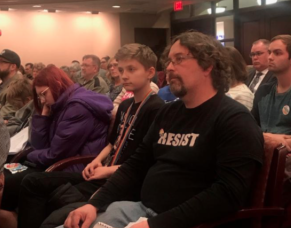
The Olathe City Council on last week passed a resolution to promote diversity and equality in the city. However, many community members attending the meeting said it did not go far enough.

Olathe resident Chad Palmer looks on as the city council discusses a resolution to protect LGBTQ people from discrimination.
photo by MICHELLE TYRENE JOHNSON

“A proclamation is nothing but lip service,” Olathe resident Chad Palmer told the city council, expressing that they needed to go further in making a stand against discrimination.

The measure passed by Olathe encourages the city to reject discrimination against any group, including on the basis of sexual orientation and gender identity and to seek mediation with the city if there is an issue. But it falls short of the protections offered by non-discrimination ordinances passed in Merriam, Prairie Village, Roeland Park, Mission and Kansas City, Kansas.

Council member John Bacon, who voted against the measure, said there was not enough opportunity to discuss it and that he didn’t think it was necessary.

“Some of the concerns I’m hearing from citizens, I’m not aware of. I hear them, but I’ve lived in this community a long time. And I’ve always known Olathe as a very loving community, and we treat everybody, or I treat everybody, the way I want you to treat me,” said council member Karin Brownlee, who also voted against the resolution.

However, Brett Hoedl, who chairs the area chapter of Equality Kansas, said mediation is encouraged but not required under the resolution, making it toothless.

“I’m frustrated because for two years you’ve had people coming in and asking about this,” Hoedl said to the city council. “This doesn’t provide protection, but it provides the illusion that there is protection.”

Mayor Michael Copeland and the other council members who voted for the resolution discussed how they would be willing to revisit the issue if the legislature failed to pass statewide protection for the LGBT community.

More than 60 people stayed until the end of the three-hour-long meeting to hear public comments on the resolution that the city council passed at the beginning of the meeting. Although most of the approximately 20 or so people who spoke supported a more pointed approach to LGBT discrimination, a few people spoke against the need to have a stronger anti-discrimination ordinance.

The United States Supreme Court legalized same-sex marriage nationwide in 2015, but no federal laws protect LGBTQ people from discrimination in housing, employment and public accommodations.

Twenty-one states and the District of Columbia have laws prohibiting discrimination against LGBTQ people, and about 225 cities – including Kansas City, Missouri – offer similar legal protections.

Overland Park and Mission Hills are also considering non-discrimination ordinances protecting LGBTQ residents.

Michelle Tyrene Johnson is a reporter at KCUR 89.3 in conjunction with the Kansas News Service. She can be contacted at [email protected].

BLM seeks bids for new off-range pastures for wild horses and burros

BLM

WASHINGTON— The Bureau of Land Management (BLM) announced Tuesday that it is seeking contractors for off-range pastures to provide a free-roaming environment and quality care for wild horses removed from Western public lands. The BLM will award multiple contracts that can accommodate 200 – 5,000 head of wild horses, with a four-year or nine-year renewal option. All contracts require supplemental feed for a minimum of four months to ensure that animals maintain a quality body condition throughout the dormant months.

Bids will be accepted from the following states through May 3, 2019: Colorado, Idaho, Kansas, Montana, Nebraska, Nevada, North Dakota, Oklahoma, Oregon, South Dakota, Texas “Panhandle” (only north of Hwy 82 and 84), Utah, Washington and Wyoming. The area west of the Cascade Mountain. Range in Oregon and Washington is excluded.

Applicants who are new to conducting business with the government must first obtain a Duns and Bradstreet number at www.dnb.com and then register at www.sam.gov/  to respond to the solicitation. No fee is involved. The solicitation describes what to submit to the BLM and where to send it. To obtain the contract solicitation: (1) Go to www.fedconnect.net;

(2) Click on “Search Public Opportunities”;

(3) Under Search Criteria, select “Reference Number”;
(4) Enter the solicitation’s reference number “140L0119R0002;

(5) Click Search” and once the solicitation’s information appears, download the information on the right.

For assistance, please contact Kemi Ismael at (202) 912-7098 or [email protected]. Ms. Ismael can assist with general questions. A list of frequently asked questions is available at:  www.blm.gov/whb.

As of March 1, 2018, the wild horse and burro population on public lands was estimated at 82,000 animals, which is more than triple the number of animals the land can support in conjunction with other legally mandated land uses. To learn more about the wild horse or burro program, visit https://blm.gov/whb

Kansas man sentenced in beating death of victim during burglary

TOPEKA, Kan. (AP) — A 32-year-old man was given the maximum sentence possible for beating a Kansas man to death during a burglary.

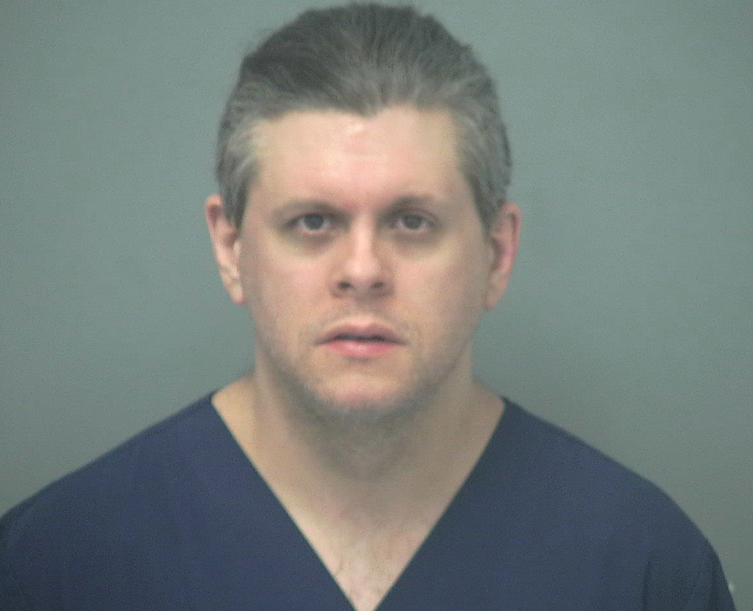
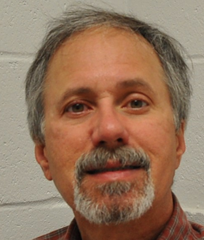
Burchfiel -photo Shawnee County

Howard Dale Burchfiel was sentenced Friday to 16 years for involuntary manslaughter and aggravated battery.

Topeka police say they found 66-year-old Allen Wichman injured after he was beaten in June 2017. He died the next month.

Shawnee County deputy district attorney Brett Watson noted that Burchfiel was convicted of attempted murder and given a lesser sentence in a 2009 case.

Watson said Wichman likely would be alive today if Burchfiel was given the standard or maximum sentence in that case.

Burchfiel said during the hearing that he accepts responsibility for Wichman’s death and apologized to his family.

Update: KHP identifies Kan. man who died after Jeep overturns in ditch

BROWN COUNTY — One person died in an accident just before 10:30p.m. Friday in Brown County.

The Kansas Highway Patrol reported a 2007 Jeep Liberty driven by Clay Kim Smith, 65, Hiawatha, was northbound in the 2200 Block of King Fisher Road one mile south of  Hiawatha.

The jeep veered off the road, struck the railroad track, a culvert and overturned in the ditch.

Smith was pronounced dead at the scene and transported to Chapel Oaks Mortuary. He was properly restrained at at the time of the accident, according to the KHP

————-

BROWN COUNTY — Authorities are investigating a fatal crash that occurred just before 10:30p.m. Friday in Brown County.

The Kansas Highway Patrol reported a vehicle was northbound in the 2200 Block of King Fisher Road one mile south of  Hiawatha. The vehicle veered off the road, struck the railroad track, a culvert and overturned in the ditch.

The KHP has not released additional details including the name of the driver.  Check the Post for more information as it becomes available.

Copyright Eagle Radio | FCC Public Files | EEO Public File