SEDGWICK COUNTY —Law enforcement authorities are investigating a reported aggravated assault with a gun and have made an arrest.
Image courtesy Wichita Police
On Wednesday, police in Wichita released security camera video from February 14, as a suspect approached a man working on a vehicle in his driveway in the 800 Block of North Chautauqua in Wichita.
Thanks to a tip from a citizen who saw the video, police arrested a 14-year-old boy on requested charges of aggravated assault, theft and possession of marijuana, according to officer Kevin Wheeler.
In the video, the teen sneaked up from behind and grabbed the victim’s 9mm handgun from the holster on his waist. Security camera images show the suspect point the gun at the victim and telling him to back away.
The suspect ran south through the alley between Chautauqua and Erie and fired a single shot at the victim who chased him. The victim was not injured.
The teen is being held in the Juvenile Detention Facility. Because he is a minor, police have not released his name.
RILEY COUNTY— Law enforcement authorities continue their investigation of three reports of apparent drug overdoses that have been related to the use of heroin containing fentanyl over the past week and released additional details Thursday.
Just after 12:35p.m. March 2, the Riley County Police Department responded to a medical emergency in Ogden, Kansas where a 27-year-old man from Emporia was transported to a medical center for treatment and has since been released.
On March 5, at 8p.m., the RCPD responded to a medical emergencies in Manhattan involving a 50-year-old man of Manhattan who was transported to a medical center and later died. Just before 11p.m. the same evening, the RCPD responded to a medical emergency in Manhattan and found a 35-year-old man of Manhattan deceased.
Authorities have not released names of those involved as they continue to investigate. The Riley County Police Department has not received any similar reports since March 5,
VALLEY CENTER, Kan. (AP) — Authorities say a man has died after becoming trapped in a container that sawdust is discharged from.
Valley Center police responded around 12:30 p.m. Thursday to Conner Industries, where the man had gone to purchase sawdust. Authorities believe he became trapped after attempting to manually free up some sawdust that was stuck in a hopper.
He wasn’t breathing when first responders arrived. Emergency responders tried to revive him but weren’t successful.
Valley Center police say the case is being investigated as an accident. The man’s name wasn’t immediately released. He had planned to use the sawdust for agricultural purposes.
Editor’s Note: The Sedgwick County Sheriff’s Department incorrectly reported an infant in the crash was in critical condition.
One of the vehicle involved in Wednesday crash-photo courtesy KWCH
SEDGWICK COUNTY — One person among 9 injured in an accident just after 7a.m. Wednesday in Sedgwick County remains hospitalized in critical condition.
A Toyota Corolla driven by a 14-year-old Morgan Tobias was southbound on 135th Street West when an eastbound Ford Expedition driven by a 21-year-old Motia Wesley on 71st Street South failed to stop at the stop sign, according to Sedgwick County Lt. Tim Myers. The Ford struck the Toyota.
In addition to the teen driver, the Toyota had 3 other occupants including a 39-year-old Kimberly Tobias a 17-year-old Didrik Ytrehus and 12-year-old Caleb Tobias.
An ambulance transported the 12-year-old to Wesley Hospital with critical injuries, according to Myers. The other occupants of the Toyota, the Wesly and passengers in the Ford including 14-year-old Alex Luben, 12-year-old Caydence Luben a 5-year-old Emma King and a 2-year-old Calvin Hughes were transported by ambulance to St. Francis.
Caleb Tobias was still in critical condition Thursday afternoon, according to Myers.
At this time the accident is still under investigation, but preliminary results show the driver of the Ford became distracted and did not stop at the stop sign, according to Myers.
WASHINGTON (AP) —Hog farmer Howard Hill is feeling the pinch from President Donald Trump’s get-tough trade policies — his pigs are selling for less than it costs to raise them. It’s a hit that Hill is willing to take for now, but his understanding also comes with a caution flag for the president.
Former Kansas congressman and current U.S. Secretary of State Mike Pompeo addressed farmers this week in Iowa- photo courtesy U.S. Office of Secretary of State
“We have patience, but we don’t have unlimited patience,” says Hill, who raises about 7,000 hogs a year near the central Iowa town of Cambridge.
The president’s willingness to pick trade fights with multiple trading partners at once has set off volleys of retaliatory tariffs, driving down the price of pork, corn and soybeans in political bellwether Iowa and elsewhere, and contributing to a 12 percent drop in net farm income nationally last year.
At issue are trade talks with China over intellectual property theft and a new U.S. deal with Canada and Mexico to replace NAFTA that is awaiting congressional approval. Those efforts could take months to complete. So scores of farm and business groups are pressing for quicker relief, a stopgap step to help them out until the more comprehensive trade agreements are resolved. They’re urging the administration to remove Canada and Mexico from the list of nations hit with a 25 percent tariff on steel shipped to the U.S. and a 10 percent tariff placed on aluminum. Their hope is that action would give the U.S. neighbors cause to remove retaliatory tariffs they placed on U.S. goods, such as a 20 percent levy Mexico placed on U.S.-produced hams.
So far, the administration hasn’t bit on that idea, but it dispatched Secretary of State Mike Pompeo to Iowa this week to assure farmers that help is on the way.
For now, Trump is walking a political tightrope: Going to bat for steel and aluminum makers has endeared him to many voters in Ohio and Pennsylvania, where steel production is a matter of economic pride and legacy, but it could end up hurting him in ag-heavy states like Iowa and Wisconsin that backed him in 2016.
In Iowa, which casts the first votes of the presidential campaign season, state Republican Party Chairman Jeff Kauffmann said he’s surprised by how patient farmers have been with Trump. The Trump Agriculture Department did approve up to $12 billion in assistance to help compensate farmers caught up in the tariff battle.
“They all say it’s hurting,” Kauffman said of the trade disputes. “They’re all saying the stopgap relief was definitely not a cure-all, but they all understand what the president is trying to accomplish. It’s quite an interesting phenomenon.”
But the defeat of two Republican House lawmakers in last year’s midterm elections hints at some of the anxiety in farm country.
State Democratic Party Chairman Troy Price said the political climate in the state has changed since Trump defeated Democrat Hillary Clinton by 9 percentage points in 2016, in part because of trade.
“These tariffs are kind of a slow burn. People are getting more and more frustrated,” Price said. “It’s one of the reasons Donald Trump is going to lose Iowa in 2020.”
Some of the Democratic candidates for president are starting to differentiate themselves from Trump on trade when talking to Iowa voters. Sen. Kamala Harris of California has criticized the president’s “go it alone” attitude. Former Rep. John Delaney of Maryland says “we’re not going to succeed in the global economy by enacting protectionist policies.”
Still, some Democrats could have trouble seizing on the issue. Sen. Bernie Sanders of Vermont spent much of the 2016 campaign railing against the very trade deals that Trump denigrated, calling them “disastrous” for blue-collar workers.
Sen. Charles Grassley, R-Iowa, chairman of the Senate Finance Committee, is among the lawmakers urging the Trump administration to lift the steel and aluminum tariffs on products brought in from Canada and Mexico. He said it’s a first step to getting the United States-Mexico-Canada Agreement through Congress. He also said it would improve the financial picture for farmers.
“Unfortunately we’re starting to see more and more warning signs that farmers are running out of leeway with their bankers and landlords,” Grassley said.
Pompeo sought to calm some of those nerves Monday even as he warned that Chinese theft of technology affects agriculture, too.
“The good news is this — help is on the way,” Pompeo said. “American producers and Chinese consumers will both be better off. The outcome of President Trump’s trade negotiations currently under way will pay dividends for people in each of our two countries.”
Hill said he was encouraged by Pompeo’s remarks.
“I think people recognize, particularly with China, they have not been playing by the rules for a long time,” Hill said. “I think producers are supportive of trying to correct these issues. On the other hand, we don’t want it to go on forever.”
The American Farm Bureau Federation reports that Chapter 12 farm bankruptcies in the U.S. went down in 2018 compared with prior-year levels. But it also noted that farm debt is at a record high, and that lending standards are tighter and the cost of credit is rising.
“Certainly many farmers have liquidated assets to discharge debt. How much longer can many others endure remains a question,” the farm group said.
WICHITA, Kan. (AP) — A federal judge has dismissed the five charges remaining against for state senator and current Sedgwick County Commissioner Michael O’Donnell at the request of prosecutors.
Michael O’Donnell-photo Sedgwick Co.
Jurors on Monday found O’Donnell not guilty of 21 countsof wire fraud but deadlocked on two counts of wire fraud and three counts of money laundering.
U.S. District Judge Eric Melgren dismissed on Thursday those remaining counts without prejudice, meaning they could be refiled. The government had filed a motion the day earlier seeking the dismissal of those charges.
O’Donnell said Wednesday he’s glad common sense prevailed but he’s sorry the legal action was such an expense for him and taxpayers.
O’Donnell was indicted last year on charges that he misspent $10,500 during campaigns for state senate and the Sedgwick County Commission.
WICHITA, KAN. – A jury returned guilty verdicts Wednesday in the federal trial of a Russian-born woman accused of unlawfully taking her child out of the United States and keeping the child away from the child’s father in Kansas, according to U.S. Attorney Stephen McAllister.
Mobley is being held in Harvey Co.
Bogdana Alexandrovna Mobley, 38, was found guilty on one count of international parental kidnapping and two counts of attempting to extort money from the child’s father.
During trial, the prosecutor presented evidence that in April 2014 Mobley took a child of hers (identified as S.M. in court records) to Russia despite the fact the biological father, Brian Mobley, had been awarded joint custody in Sedgwick County District Court. At the time, the Mobleys had a pending divorce case before the court. The defendant did not obtain the permission of the court or Brian Mobley before going to Russia with the child. The child still has not returned to the United States.
Between April 2014 and November 2016, the defendant only permitted Brian Mobley to communicate with S.M. via cell phones and Skype applications. She told Brian Mobley that he needed to send her money in order to see the child.
Sentencing is set for May 20. She faces up to three years in federal prison on the kidnapping charge and up to 20 years on the extortion counts.
DENVER (AP) — Avalanches are causing more travel problems in Colorado’s mountains.
Firefighters say an avalanche at around 5 a.m. Thursday near Copper Mountain ruptured a natural gas pipeline. Nearby highways, including a stretch of nearby Interstate 70, the state’s busy east-west highway, was shut down as a precaution as crews work to shut off the gas.
Meanwhile, a tow truck was caught in an avalanche just after midnight on I-70 at Vail Pass. The Colorado State Patrol said he was doing OK.
The highway is closed there until road crews can trigger controlled avalanches to bring down more snow during the day.
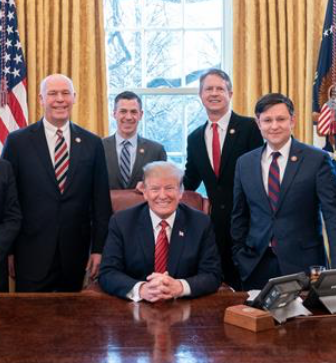
WASHINGTON D.C.-This week, Kansas First District congressman Dr. Roger Marshall and members of the Republican Study Committee (RSC), on which he serves as the Chairman of the Health Care Task Force, met with President Trump in the Oval Office to discuss advancing the committee’s agenda forward.
Photo courtesy Dr. Roger Marshall
“We discussed our plans to drive down health care costs and other market-based reforms that would give patients choice, access, and protect those with preexisting conditions.”
Congressman Marshall said. “These have been top priorities for my office, and as the Health Care Task Force Chairman, I was honored to sit down with the President and outline what fixing our broken health care system looks like.
In the nearly two-hour long meeting, President Trump expressed his support and commitment to the conservative agenda.
“Whether it’s a closed-door discussion, or an event open to the press, the President is transparent in expressing exactly what he feels. In the meeting, he was very positive and asked for our opinions. He was engaged and open to hearing our solutions.” Congressman Marshall said.
As the largest caucus of conservatives in Congress, the RSC plays a critical role in shaping Republican policies, and challenging Democrat leadership when faced with misguided policies.
In the meeting, President Trump also discussed pending trade agreements with Congressman Marshall.
“Point blank, he assured me that he would not sign a bad trade deal for Kansas farmers. The president confidently said that they are making great progress with China and will prioritize the approval of USMCA by Congress.”
WASHINGTON —As the U.S. Supreme Court weighs whether the Trump administration can ask people if they are citizens on the 2020 Census, the Census Bureau is quietly seeking comprehensive information about the legal status of millions of immigrants.
Photo courtesy US Census Bureau
Under a proposed plan, the Department of Homeland Security would provide the Census Bureau with a broad swath of personal data about noncitizens, including their immigration status, The Associated Press has learned. A pending agreement between the agencies has been in the works since at least January, the same month a federal judge in New York blocked the administration from adding the citizenship question to the 10-year survey.
On Wednesday, a federal judge in California also declared that adding the citizenship question to the Census was unconstitutional, saying the move “threatens the very foundation of our democratic system.”
The data that Homeland Security would share with Census officials would include noncitizens’ full names and addresses, birth dates and places, as well as Social Security numbers and highly sensitive alien registration numbers, according to a document signed by the Census Bureau and obtained by AP.
Such a data dump would be apparently unprecedented and give the Census Bureau a view of immigrants’ citizenship status that is even more precise than what can be gathered in door-to-door canvassing, according to bureau research.
Six former Census and DHS officials said they were not aware that individuals’ citizenship status had ever before been shared with the Census. “Generally, the information kept in a system of records is presumed to be private and can’t be released unless it fits with a certain set of defined exceptions,” said Leon Rodriguez, who led the DHS agency responsible for citizenship under the Obama administration.
The move raises questions as to what the Trump administration seeks to do with the data and concerns among privacy and civil rights activists that it could be misused.
Census spokesman Michael Cook said the agreement was awaiting signatures at DHS, but that Census expected it would be finalized “as soon as possible.”
“The U.S. Census Bureau routinely enters into agreements to receive administrative records from many agencies, including our pending agreement with U.S. Citizenship and Immigration Services, to assist us in our mission to provide quality statistics to the American public,” Cook said in a statement. “By law, the Census Bureau does not return any records to the Department of Homeland Security or any of its components, including Immigration and Customs Enforcement.”
Jessica Collins, a spokeswoman for Citizenship and Immigration Services, said no agreement has been finalized. She said the purpose of such agreements is to help improve the reliability of population estimates for the next Census.
“The information is protected and safeguarded under applicable laws and will not be used for adjudicative or law enforcement purposes,” Collins said.
Civil rights groups accuse the White House of pursuing a citizenship question because it would discourage noncitizens from participating in the Census and lead to less federal money and representation in Congress for states with large immigrant populations. Census researchers say including the question could yield significant underreporting for immigrants and communities of color.
Under the pending three-year information-sharing agreement, the Census Bureau would use the DHS data to better determine who is a citizen and eligible to vote by “linking citizenship information from administrative records to Census microdata.”
“All uses of the data are solely for statistical purposes, which by definition means that uses will not directly affect benefits or enforcement actions for any individual,” according to the 13-page document signed by a Census official.
Amy O’Hara, who until 2017 directed Census Bureau efforts to expand data-sharing with other agencies, said she was surprised a plan was in the works for sharing alien numbers, which are assigned to immigrants seeking citizenship or involved in law enforcement action.
“I wish that we were not on this path,” she said. “If the citizenship question hadn’t been added to the Census, this agreement never would have been sought.”
In previous administrations, government lawyers advised Census researchers to use a minimal amount of identifying data to get their jobs done, said O’Hara, now co-director of Georgetown University’s census research center. During her tenure, the bureau never obtained anything as sensitive as alien numbers, which O’Hara called “more radioactive than fingerprints.”
Some privacy groups worry the pending agreement is an end-run around the courts.
“What’s going on here is they are trying to circumvent the need for a citizenship question by using data collected by another agency for a different purpose,” Jeramie Scott, an attorney at the Electronic Privacy Information Center. “It’s a violation of people’s privacy.”
The agreement would bar the bureau from sharing the data with outside agencies. But confidentiality provisions have been circumvented in the past.
During World War II Congress suspended those protections, and the bureau shared data about Japanese-Americans that was used to help send 120,000 people to internment camps. Most were U.S. citizens. From 2002-2003, the Census Bureau provided DHS with population statistics on Arab-Americans that activists complained was a breach of public trust, even if the sharing was legal.
The quiet manner in which the agencies pursued sharing records could stoke concerns that the Trump administration may be seeking to create a registry of noncitizens, said Kenneth Prewitt, who was Census director from 1998-2001 and is now a Columbia University professor.
Census scholars say that could not happen without new legislation, which is not likely under the Democratic majority in the House of Representatives.
In mid-April, the Supreme Court will hear arguments as to whether the 2020 Census can include a citizenship question, with a decision expected weeks later.
Next week, Commerce Secretary Wilbur Ross, whose department oversees the census, is set to testify before Congress on his role in the controversy.
California Democratic Rep. Jimmy Gomez, who sits on the House Committee on Oversight and Reform, said he was concerned to learn of the data-sharing proposal and that Ross would face related questions.
“The news of this proposed plan will surely send shockwaves through immigrant communities across the country,” Gomez said Wednesday. “This new development raises even more questions about the motivations behind this untested citizenship question and Secretary Ross better be ready to answer them.”
About 44 million immigrants live in the United States — nearly 11 million of them illegally. The 10-year headcount is based on the total resident population, both citizens and noncitizens.
The Census figures hugely in how political power and money are distributed in the U.S., and underreporting by noncitizens would have an outsized impact in states with larger immigrant populations. Political clout and federal dollars are both at stake because 10-year survey results are used to distribute electoral college votes and congressional district seats, and allocate more than $880 billion a year for services including roads, schools and Medicare.
The push to get a clearer picture of the number of noncitizens in the U.S. comes from an administration that has implemented hard-line policies to restrict immigration in numerous agencies.
Against advice of career officials at the Census Bureau, Ross decided last year to add the citizenship question to the 10-year headcount, saying the Justice Department requested the question to improve enforcement of the federal Voting Rights Act.
Some prominent GOP lawmakers endorsed the citizenship question, saying it would lead to more accurate data, and a joint fundraising committee for Trump’s re-election campaign and the Republican National Committee used it as a fundraising tool. Immigrants’ rights groups and multiple Democratic-led states, cities and counties filed suit, arguing that the question sought to discourage the Census participation of minorities.
A citizenship question has not appeared on the once-in-a-decade headcount since 1950, though it has been on the American Community Survey, for which the Census Bureau annually polls 3.5 million households.
Documents and testimony in a New York trial showed that Ross began pressing for a citizenship question soon after he became secretary in 2017, and that he consulted Steve Bannon, President Donald Trump’s former chief strategist, and then-Kansas Secretary of State Kris Kobach, a vocal advocate of tough immigration laws who also has advised the president. Emails showed that Ross himself had invited the Justice Department request to add the citizenship question.
A March 2018 memo to Ross from the Census Bureau’s chief scientist says the DHS data on noncitizens could be used to help create a “comprehensive statistical reference list of current U.S. citizens.” The memo discusses how to create ‘baseline citizenship statistics’ by drawing on administrative records from DHS, the Social Security Administration, State Department and the Internal Revenue Service, in addition to including the citizenship question in the census.
In January, New York federal judge Jesse Furman ruled that Ross was “arbitrary and capricious” in proposing the question.
The new data comes from Citizenship and Immigration Services, a DHS agency that has taken on a larger role in enforcing immigration restrictions under Trump.
After Francis Cissna took over as director in October 2017, the agency initiated a “denaturalization task force” aimed at investigating whether immigrants obtaining their citizenship fraudulently. The agency also has slashed the refugee program to historic lows and proposed reinterpreting immigration law to screen whether legal immigrants are likely to draw on the public welfare system.
Cissna also rewrote the agency’s mission statement: “Securing America’s promise as a nation of immigrants” became “Securing the homeland and honoring our values.”
—————-SAN FRANCISCO (AP) — The Trump administration’s decision to add a citizenship question to the 2020 census “threatens the very foundation of our democratic system” because it would cause a significant undercount of immigrants and Latinos that could distort the distribution of congressional seats, a U.S. judge said Wednesday.Judge Richard Seeborg said the commerce secretary’s decision to add the question was arbitrary and capricious and would violate a constitutional requirement that the census count everyone in the country.”The record in this case has clearly established that including the citizenship question on the 2020 census is fundamentally counterproductive to the goal of obtaining accurate citizenship data about the public,” Seeborg said.Seeborg became the second judge to declare the move illegal, so the effect of his decision is limited. A federal judge in New York had previously blocked the administration from adding the question to the population count that occurs every 10 years, and the U.S. Supreme Court last month agreed to review that decision.The ruling in California, however, differed from the January decision by U.S. District Judge Jesse Furman in a significant way. Furman also found the question violated administrative requirements, but he rejected an argument that it violated the Constitution.
Seeborg found a constitutional violation, which could present another issue for the U.S. Supreme Court to consider if federal officials appeal his decision.
An email to the U.S. Department of Justice seeking comment on the ruling was not immediately returned.
Seeborg’s decision came in lawsuits by California and several cities in the state that asserted the citizenship question was politically motivated and should be kept off the census.
“Justice has prevailed for each and every Californian who should raise their hands to be counted in the 2020 census without being discouraged by a citizenship question,” state Attorney General Xavier Becerra said in a statement.
California argued that the question would cost it a substantial amount of money and at least one congressional seat by reducing the percentage of Latinos and immigrants who respond to the survey. It said that would lead to an undercount in the state with a substantial number of people from both groups.
Census numbers are used to determine states’ distribution of congressional seats and billions of dollars in federal funding.
The Justice Department had argued that census officials take steps such as making in-person follow-up visits to get an accurate count. Households that skip the citizenship question but otherwise fill out a substantial portion of the questionnaire would still be counted, Justice Department attorneys said in court documents.
The Commerce Department announced the addition of a citizenship question a year ago, saying the Justice Department asked for it and it would improve enforcement of a 1965 law meant to protect minority voting rights.
The move sparked an outcry from Democrats, who said it would disproportionately affect states favoring their party. People were last asked whether they were U.S. citizens in the 1950 census.
Seeborg rejected the claim that the citizenship question stemmed from a request by the Justice Department, calling that a “pretext” for the real reason to add it.
He cited an email from Commerce Secretary Wilbur Ross to a Commerce Department official nearly a year before the question was announced, in which Ross said he was “mystified” why nothing had been done in response to his “months old request that we include the citizenship question.”
“What ensued was a cynical search to find some reason, any reason, or an agency request to justify that preordained result,” the judge said.
TOPEKA, Kan. (AP) — The Latest on the debate in Kansas over increasing funding for public schools (all times local):
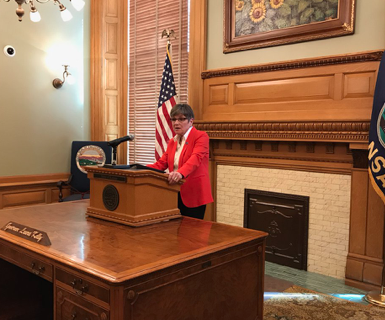
photo courtesy office of Kansas Governor
Kansas Gov. Laura Kelly’s plan for increasing public education funding has cleared its first hurdle in the Legislature despite unexpected resistance from some local school districts.
A Senate committee on school funding approved Kelly’s proposed increase of roughly $90 million a year on a voice vote Wednesday. The support for the Democratic governor’s bill came from the committee’s Republican majority and sent it to the full Senate for debate.
Kelly views her proposal as a simple way to comply with a Kansas Supreme Court mandate to boost education funding.
But fellow Democrats on the committee didn’t support her plan after a coalition of 48 school districts withdrew its support. Those districts said a second look convinced them that the plan would not provide enough money to satisfy the court.
————–
TOPEKA, Kan. (AP) — Kansas’ new Democratic governor is meeting unexpected resistance to her plan for boosting public education funding from local school districts that believe her proposal wouldn’t supply enough new money.
Gov. Laura Kelly touts her proposed increase of roughly $90 million a year as a simple way to comply with a Kansas Supreme Court mandate for an increase in education funding. She initially won over Schools for Fair Funding, a coalition of 48 school districts backing an ongoing lawsuit against the state, including the four districts that sued in 2010.
But the group withdrew its support ahead of a Senate committee hearing Wednesday. One of its attorneys said a further review of Kelly’s proposal showed it would fall tens of millions of dollars short each year of satisfying the Supreme Court.
The change of heart is complicating Kelly’s efforts to push a funding increase through the Republican-controlled Legislature and could prolong the lawsuit just when an end seemed in sight. It also threatens to divide supporters of more funding in the face of many Republicans’ misgivings about higher spending and their frustrations with what they see as an activist court.
“This kind of moves us away from, ‘Well, there’s one clear, simple answer that everyone agrees on,'” said Mark Tallman, a longtime Kansas Association of School Boards lobbyist.
The Supreme Court has issued six rulings in the past five years mandating increases in education funding, citing a duty under the state constitution for lawmakers to provide a suitable education for every child.
A 2018 law phased in a $548 million increase in the state’s $4 billion in annual funding by the 2022-23 school year. The court said it was inadequate because it did not account for inflation, and the state must tell the court by April 15 how it addressed the problem.
John Robb, an attorney for Schools for Fair Funding and the districts suing the state, said lawmakers face “an arithmetic problem.”
He contends the arithmetic requires phasing in another $364 million increase in education funding by the 2022-23 school year. The state’s spending would then be more than $900 million higher than it was from 2017-18.
That’s not how Kelly sees the math.
She argues the state can meet the court’s mandate by increasing its annual spending by roughly $90 million a year — or $364 million spread over four years. Under her plan, the state’s spending for 2022-23 would be about $640 million higher than it was in 2017-18.
That’s roughly $270 million short of Schools for Fair Funding’s mark.
But the governor has said she is relying on recommendations from the independently elected and GOP-led State Board of Education last year.
“The goal of this bill is to address inflation, end the litigation and meet the needs of our students and schools,” said Kelly spokeswoman Ashley All.
Schools for Fair Funding endorsed Kelly’s plan during a Feb. 6 hearing . Lobbyist Bill Brady sent an email the next day to the Senate committee’s members saying, “I do not know how to make our position any more clear.”
Then, Brady sent a follow-up email Feb. 26, saying that Schools for Fair Funding had “examined the numbers” and concluded Kelly’s plan was not sufficient.
The committee’s chairwoman, Sen. Molly Baumgardner, a conservative Republican from eastern Kansas, called it “a flip-flop.”
“For them to take such an about-face — there is no explanation for it,” she said.
Robb said Schools for Fair Funding initially believed Kelly’s plan was in line with its stance. He said the group later saw that the State Department of Education simply made mistakes in calculating how to adjust the state’s formula for distributing dollars to local school districts and passed those mistakes on to Kelly.
Longtime Deputy Education Commissioner Dale Dennis, in charge of the calculations, rejected Robb’s explanation: “There’s no error involved.”
The disagreement is an unwelcome development for supporters of higher education funding as they deal with a Legislature that grew more conservative after last year’s elections. GOP conservatives have long wanted to check the Supreme Court and argue that schools are not accountable enough.
And some Republicans doubt the state could sustain even Kelly’s smaller plan without raising taxes within a few years. She pledged during last year’s campaign not to pursue tax hikes, with GOP lawmakers already adamantly opposed.
“It will never happen,” said Senate Majority Leader Jim Denning, a conservative Kansas City-area Republican.
Kelly and her allies face having a plan that can win lawmakers’ approval being challenged before the Supreme Court as insufficient — repeating a pattern under her GOP predecessors that she promised to break.
Senate Minority Leader Anthony Hensley, a Topeka Democrat, is siding with Schools for Fair Funding, arguing that lawmakers should approve its proposed increases for the 2019-20 and 2020-21 school years.
“It’s important now that we try to get everybody on the same page,” he said.
SHAWNEE COUNTY – Law enforcement authorities are investigating a Kansas felon on new charges after an arrest.
Barnes -photo Shawnee Co.
Just before midnight Tuesday, police were dispatched to 2619 SW 21st in Topeka on a report of unwanted subjects intoxicated in the parking lot, according to Lt. Manuel Munoz.
Officers made contact with Sylvan Alexa Barnes, 26, who was attempting to drive away.
Further investigation by the officers revealed that Barnes was intoxicated and subsequently arrested for DUI.
Officers also located a firearm and narcotics in the vehicle. Barnes was transported to Shawnee County Department of Corrections and booked on requested charges of Felon in Possession of a Firearm, Possession of Marijuana and DUI, according to Munoz.
She has previous convictions for aggravated burglary, aggravated assault, violation of a protection order from abuse, criminal possession of a firearm, according to the Kansas Department of Corrections.
This is the 25th case in 2019 with a charge involving a felon in possession of a firearm reported by the Topeka Police Department.
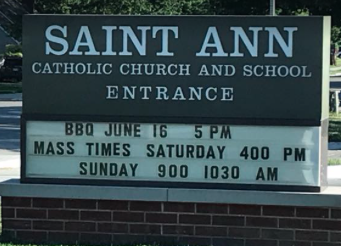
PRAIRIE VILLAGE, Kan. (AP) — About 1,000 people have signed a petition after a Catholic grade school in suburban Kansas City denied admission to a same-sex couple’s child.
The Rev. Craig Maxim told families in a letter last month that he sought guidance from the Archdiocese of Kansas City in Kansas when the same-sex couple asked to enroll their child in kindergarten at St. Ann Catholic School in Prairie Village, Kansas. He said the archdiocese advised against accepting the child because the parents could not “model behaviors and attitudes consistent with the Church’s teachings.”
About half of the people who signed the petition to Archbishop Joseph Naumann and the archdiocesan schools superintendent are St. Ann members. Catholic schools nationwide are divided over whether to admit same-sex couples’ children.