FAIRWAY, Kan. (AP) — Police have identified a man shot and injured in a gun battle with police across the street from an elementary school in suburban Kansas City.
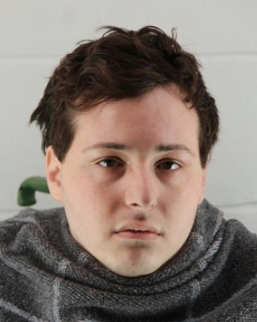
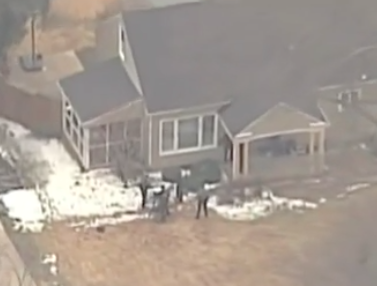
Ruffin -photo Johnson Co.Law enforcement on the scene across from Highlands Elementary School image courtesy KCTV
Fairway police say 26-year-old Dylan Ruffin was injured Friday afternoon when he exchanged gunfire with officers who had been called to the home he was in directly across the street from Highlands Elementary School in the Shawnee Mission School District. Video shows a man believed to be Ruffin exiting the home and pointing a gun at officers, who fired, hitting Ruffin. No one else was injured.
Police say Ruffin was treated at a hospital and released. He is charged with three counts of aggravated assault on an officer and weapons counts. He is being held in the Johnson County Adult Detention Center on $500,000 bond.
SHAWNEE COUNTY — Law enforcement authorities are investigating a burglary and have a suspect in custody. Just after 1a.m. Thursday, Westar Energy notified the Shawnee County Emergency Communications Center of an individual attempting to steal items from their property located in the 5500 block of SE 2nd Street, according to Sgt. Todd Stallbaumer.
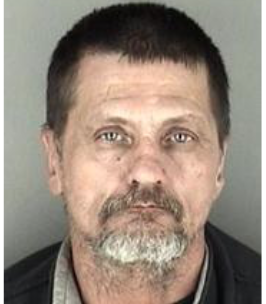
Brooks -photo Shawnee Co.
Westar personnel provided dispatch with information on a maroon Ford F150 on their property that did not belong.
Shawnee County Sheriff Deputies arrived in the area and were able to locate a vehicle matching the description provided by Westar personnel near NE K-4 HWY and Seward Avenue. A generator, tools, and other items that belonged to Westar Energy were located in the truck.
Deputies took David W. Brooks, 53 of Topeka, into custody and transported him to the Shawnee County Department of Corrections on requested charges of Burglary- non dwelling (Felony), Theft, Criminal Damage and other Traffic Charges, according to Stallbaumer.
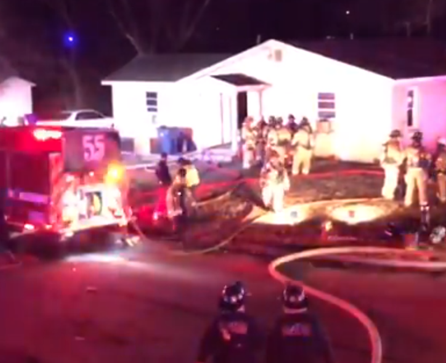
OLATHE, Kan. (AP) — Authorities say a 33-year-old woman injured in an Olathe apartment fire has died.
Crews on the scene of Thursday’s apartment fire-photo Olathe Fire Department
Alexandria Armstrong died Friday at a hospital where she had been taken in critical condition Thursday night after being pulled from the burning building.
Firefighters say the fire started in Armstrong’s apartment and appears to have been accidental. Investigators believe a damaged electrical cord ignited a couch and other nearby items.
JACKSON COUNTY — Law enforcement authorities have arrested a fugitive wanted in multiple Kansas counties.
According to Jackson County Sheriff Tim Morse, registered sex offender, Eric Paul Shoemaker, 43, Great Bend, was arrested at a Denison residence after the Jackson County Sheriff’s Office received information that he was in the area.
Shoemaker -photo Jackson Co.
Deputies approached a residence where Shoemaker was seen. He refused to come to the door. Deputies who communicated with Shoemaker at length were able to convince him to surrender peacefully.
Shoemaker had outstanding warrants in Barton, Pawnee, and Ford counties for failing to register as a sex offender, probation violations, and failing to appear on a domestic battery charge.
He is being held in the Jackson County Jail without bond.
He has a conviction for aggravated indecent liberties with a 15-year-old victim, according to the Kansas Public Offender Registry.
LIBERAL — Hefty college debt won’t saddle Bryan Medina.
He’s on a fast track to an energy career that he hopes will pave the road to family dreams: Buying his own cattle and going in on the purchase of 300 acres of land with his dad.
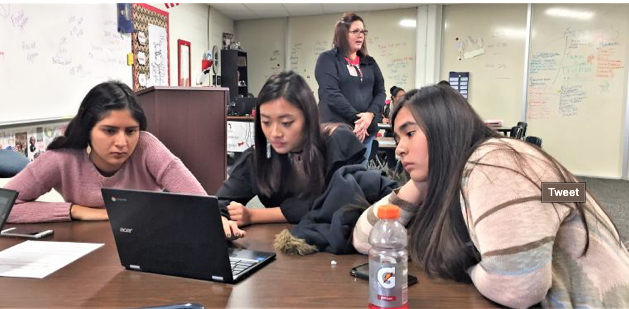
Students take a U.S. history class that also counts toward college credit at Liberal High School. CELIA LLOPIS-JEPSEN / KCUR/KANSAS NEWS SERVICE
“We could grow and eventually own our own feedyard,” said Medina, who finished high school last May in the small southwest Kansas town of Sublette. “If things go great, if we put all the work into it, we’ll definitely get there.”
Medina had just one semester left of his natural gas studies at Seward County Community College in Liberal. Kansas footed much of the bill for him, meaning Medina can start banking paychecks faster toward those livestock purchases instead of pouring them into college loans.
“I left Wyoming Tech owing $17,000,” said David Ratzlaff, one of Medina’s instructors. “It took me about 10 years to pay that off.”
Savvy teens eyeing tech careers can get a leg up in life under a Kansas program that made college free for them while still in high school. Stories like Medina’s have generated buzz, and now some education officials and lawmakers are mulling how to help students shooting for non-technical careers, too.
Cost and logistics could prove hurdles. The potential expenses of such a program remain unclear, as does legislative support amid the state’s gradual recovery from years of fiscal trouble.
New research on the dual credit boom in Texas also raises questions about how much money it really saves families. And it suggests dual credit mostly helps white students and those with more money, instead of the low-income and minority students policymakers want to put on a level playing field.
But if Kansas can smooth out the wrinkles, high school students see a way to build competitive college applications and get ahead, all while easing into more rigorous coursework. Many already enroll in dual credit at their own expense.
“It’s not as intimidating” starting college this way, said Nevaeh Bess, a Liberal High senior earning such credits at her own, familiar school. Her teachers explain class assignments and expectations clearly.
“That helps out a lot — knowing what your teacher is grading,” the aspiring anesthesiologist said. “I spoke to someone that is in college now, and she was like, ‘Well, sometimes I just don’t know what they’re looking for.’”
High stakes
For students plotting a direct course from high school to four-year colleges, taking dual credit may seem like an easy choice.
Students in Liberal pay around $300 per class. That’s less than a third of the price they’d pay as freshmen at the University of Kansas and many times cheaper than out-of-state tuition.
Liberal High senior Mica Watson-Huskey has her sights trained on a major in civil or aerospace engineering at the University of Texas at Austin because of the school’s research opportunities.
Last year, she took college algebra and trigonometry, but she lost some of the credits when she couldn’t pay in full. High school students don’t qualify for financial aid that can take some of the sting out of tuition bills.
If the state paid for even a few dual credit courses, Watson-Huskey said, that would lift ambitions at a school where many families struggle to make ends meet.
“They would have the motivation to do a college class,” she said. “They wouldn’t be limited because of the amount of money.”
One thousand of the 1,300 students at Liberal High come from low-income families.
The school lies in a corner of the state where meat drives the economy. The thousands of slaughterhouse jobs in the region pay $14 an hour on average, an annual salary of just under $30,000 a year.
Many of the students here would be the first in their family to attend college. Most learn English as a second language and four out of five are Hispanic.
Nationally, Hispanics and people whose first language isn’t English are less likely to go to college than other Americans.
The vast majority of students at Liberal High graduate. But of those only a third quickly head to college or work on an industry certificate. Across Kansas more than half of high school graduates do.
Yet missing out on higher education shuts doors. Decent jobs still exist for people with no more than a high school diploma, but not to the extent they once did.
Economist Nicole Smith says those jobs continue to dwindle. Today, just three in 10 teens who stop their educations at high school can hope to find jobs that will pay at least $35,000 from their mid-20s through their early 40s and at least $45,000 after middle age.
What of the other seven?
“They’re going to be experiencing significant amounts of hardship,” Smith said. “Even to get a job, and far less to keep that job and to earn a living wage with it.”
Smith — chief economist at Georgetown University’s Center on Education and the Workforce — co-authored studies on the changing job landscape. Those spurred Kansas and other states to ratchet up efforts to get more students to college.
Chart: The Kansas News Service Source: US Census Bureau Created with Datawrapper
Survival mode
That urgency has Kansas education officials hunting for ways to bridge the college gap — not just for go-getting teens planning careers in anesthesiology and engineering.
They hope free dual credit would plant the idea of higher education in more students’ minds, making it seem less scary, distant or unattainable.
“There are a lot of students that are college ready and college material,” said Jean Redeker, vice president for academic affairs at the Kansas Board of Regents. “But they don’t know it.”
Free tech classes have already built one bridge, college administrators say. They attract high school students whose families otherwise might not feel comfortable setting foot on a college campus — even just to ask questions.
Janeth Vazquez advises families at Seward County Community College. CREDIT BETHANY WOOD / FOR THE KANSAS NEWS SERVICE
In Liberal, many may not know about federal financial aid and generous local tuition grants. That leaves families feeling Seward County Community College “is only for people with money,” said Janeth Vazquez, who advises students there. “A goal that’s just too out of their hand.”
Vazquez gets it. Many are in survival mode. When she was a teen, her father was deported and she worked long hours after school helping to pay the mortgage, utility bills and other family needs.
“That was my story,” she said. “That was my life.”
Last year, the Kansas Senate passed a bill that would have kicked off free general education dual credit in a test program — paying for English composition for high schoolers.
It’s Kansas’ most popular non-tech dual credit class. Free access to algebra, psychology, public speaking and U.S. history would possibly have come in the following years.
The idea never got a vote in the House. It fell to the wayside amid the broader school finance battle in the Legislature — yearslong wrangling over court rulings that demand Kansas increase funding to local schools.
Recommendations for the dual credit legislation came from the Regents and Kansas State Department of Education. To qualify, they suggested students would generally need:
A 3.0 GPA and a college-ready ACT score in math or English to take algebra or composition. Nationally, most ACT-takers hit the mark in English but not math.
A 3.0 GPA and a 20 or higher composite ACT score to take any of the other three free classes. That’s a little below the national average composite score.
Logistical hurdles
Pinning down the potential cost to taxpayers has proved complicated.
Just how many of the state’s 70,000 high school upperclassmen would jump at an offer for free college English, algebra and more remains unclear. After the state rolled out free tech college classes in 2012, student enrollment in those more than doubled.
About 15,000 Kansas high school students took college dual credit at their high schools last school year. They took, on average, two classes each.
Then there’s the matter of calculating cost per student. The Board of Regents finished a study in December, but the state’s two dozen two-year colleges reported huge variations in cost per credit hour. English composition ranged from more than $900 per credit hour to $1.
Some variation is inevitable. In addition to regional cost differences, colleges deliver dual credit through a variety of models. Some high school students travel to campus for class, or connect through remote video links and online tools. In other cases, colleges send professors to high schools or rely on high school teachers to run courses themselves.
Colleges and high schools would have to figure out how to ramp up capacity if English and other classes became free. The pilot proposal aims for a soft start that would buy time to identify and deal with hurdles.
Having high school teachers teach college classes only works when those instructors hold advanced degrees with significant relevant coursework. On the other hand, placing students in on-campus classes comes with potential transportation costs and difficulty aligning schedules, among other issues.
Administrators talk eagerly about the possibilities — enthusiasm tempered by the knowledge that logistics take time to solve. They worry, too, that they might build dual credit programs only to see the money disappear in a few years amid funding battles in the Legislature.
Even funding for the state’s free tech college program — popular with lawmakers across party lines — fell millions of dollars behind in recent years. That unsettles Seward County Community College president Ken Trzaska. A quarter of the students at his school now attend through that initiative.
“That program is a great program,” he said. At the same time, it’s a vulnerability. “If, suddenly, the funding goes away or that population of students go away, then that’s a huge hit.”
Good and bad news
Uneasy faculty at the University of Texas took the following question about dual credit to university brass: Might it inadvertently hurt freshmen? Some professors reported that students arriving with college basics out of the way struggled in next-level classes.
UT’s study and a separate one conducted by the American Institutes for Research both came out last summer, among the most ambitious dual credit studies to date.
They offer good and bad news from a state ripe for analysis. Texas has vigorously promoted early college credit for years. From 2000 to 2016, the number of high school students in dual-credit classes rose more than tenfold, topping 200,000 per year.
The bad news first:
Dual credit didn’t save students much money. UT students saw a negligible impact on debt unless they showed up at college with a full two years of credit. Savings may elude many people because their credits don’t align with their degrees or they opt against graduating early.
Past research oversold dual credit. Dual credit appeared to help students likely to succeed in college anyway. After factoring for that, college enrollment only ticked up by about 2 percentage points and graduation rates by an “insignificant” 1 percentage point. Many past studies touting robust benefits from dual credit fell short of standards for rigorous research.
Dual credit doesn’t solve achievement gaps — it mostly helps white, more affluent students. Poor students who took it became less likely to go to or finish college. Black students became more likely to attend two-year colleges, but not to graduate. Hispanic students became more likely to finish a two-year, but not a four-year, degree.
Now, the good:
Even if the benefits were less than previously touted, they were still statistically meaningful. Grade analyses and course comparisons also didn’t bear out faculty concerns that high school teachers might be watering down dual credit classes for their students.
Even with evidence of less significant benefit, the cost of dual credit paid off many times over. Better college outcomes mean higher eventual incomes for dual credit students, who earn more money and consequently pay more tax revenue to the state.
Dual credit does improve college prospects for some people. Though dual credit didn’t help poorer students as a whole, it did help the academic high-flyers among them to make it to college and graduate.
Kansas state Sen. Molly Baumgardner says some of the Texas findings point to problems unrelated to dual credit. Minorities enrolling but not graduating in larger numbers suggests colleges need to recognize that students need better support.
“They have a changing role,” she said.
Baumgardner, chair of the Senate’s education committee, spearheaded work on last year’s bill. In her combined 16 years of teaching high school and community college, she saw students grow when opportunity allows.
“Kids don’t really know their limits,” she said. “But they become limited if they’re told they can’t do something.”
This is Part Four in our series on college and careers. Don’t miss Part Oneon the advent of the “college economy,” Part Two on planning life after high school and Part Three on Kansas’ tech college boom.
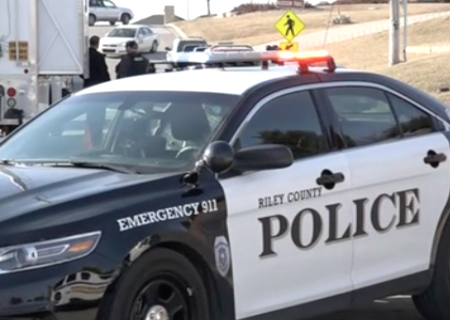
RILEY COUNTY — Law enforcement authorities are investigating a shooting that sent two people to the hospital.
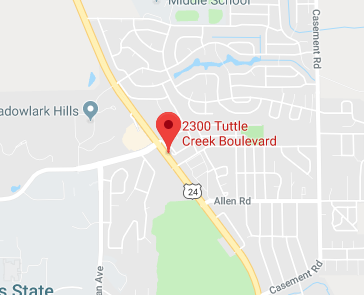
Google map
Just before 2:20 a.m. Saturday, the Riley County Police Department Dispatch Center received a report of shots fired in the 2300 block of Tuttle Creek Blvd in Manhattan.
Two individuals were life-flighted to Stormont-Vail Topeka Hospital for injuries. Investigators were still on the scene and authorities asked the public to avoid the area.
Anyone with information on this crime, is encouraged to contact the Riley County Police Department at (785) 537-2112 or Crime Stoppers at www.p3tips/353 or (785) 539-7777. Using the Crime Stoppers service allows you to remain anonymous and could qualify you for a cash reward of up to $1,000.00.
The new lab-on-a-chip’s key innovation is a 3D nanoengineering method that mixes and senses biological elements based on a herringbone pattern commonly found in nature, pushing exosomes into contact with the chip’s sensing surface much more efficiently in a process called “mass transfer.” (Credit: Yong Zeng)
KU NEWS SERVICE
LAWRENCE — A new ultrasensitive diagnostic device invented by researchers at the University of Kansas, The University of Kansas Cancer Center and KU Medical Center could allow doctors to detect cancer quickly from a droplet of blood or plasma, leading to timelier interventions and better outcomes for patients.
The “lab-on-a-chip” for “liquid biopsy” analysis, reported today in Nature Biomedical Engineering, detects exosomes — tiny parcels of biological information produced by tumor cells to stimulate tumor growth or metastasize.
“Historically, people thought exosomes were like ‘trash bags’ that cells could use to dump unwanted cellular contents,” said lead author Yong Zeng, Docking Family Scholar and associate professor of chemistry at KU. “But in the past decade, scientists realized they were quite useful for sending messages to recipient cells and communicating molecular information important in many biological functions. Basically, tumors send out exosomes packaging active molecules that mirror the biological features of the parental cells. While all cells produce exosomes, tumor cells are really active compared to normal cells.”
The new lab-on-a-chip’s key innovation is a 3D nanoengineering method that mixes and senses biological elements based on a herringbone pattern commonly found in nature, pushing exosomes into contact with the chip’s sensing surface much more efficiently in a process called “mass transfer.”
“People have developed smart ideas to improve mass transfer in microscale channels, but when particles are moving closer to the sensor surface, they’re separated by a small gap of liquid that creates increasing hydrodynamic resistance,” Zeng said. “Here, we developed a 3D nanoporous herringbone structure that can drain the liquid in that gap to bring the particles in hard contact with the surface where probes can recognize and capture them.”
Zeng compared the chip’s nanopores to a million little kitchen sinks: “If you have a sink filled with water and many balls floating on the surface, how do you get all the balls in contact with the bottom of the sink where sensors could analyze them? The easiest way is to drain the water.”
To develop and test the pioneering microfluidic device, Zeng teamed with a tumor-biomarker expert and KU Cancer Center Deputy Director Andrew Godwin at the KU Medical Center’s Department of Pathology & Laboratory Medicine, as well as graduate student Ashley Tetlow in Godwin’s Biomarker Discovery Lab. The collaborators tested the chip’s design using clinical samples from ovarian cancer patients, finding the chip could detect the presence of cancer in a minuscule amount of plasma.
“Our collaborative studies continue to bear fruit and advance an area crucial in cancer research and patient care — namely, innovative tools for early detection,” said Godwin, who serves as Chancellor’s Distinguished Chair and Endowed Professor in Biomedical Sciences and professor and director of molecular oncology, pathology and laboratory medicine at KU Medical Center. “This area of study is especially important for cancers such as ovarian, given the vast majority of women are diagnosed at an advanced stage when, sadly, the disease is for the most part incurable.”
What’s more, the new microfluidic chips developed at KU would be cheaper and easier to make than comparable designs, allowing for wider and less-costly testing for patients.
“What we created here is a 3D nanopatterning method without the need for any fancy nanofabrication equipment — an undergraduate or even a high school student can do it in my lab,” Zeng said. “This is so simple and low-cost it has great potential to translate into clinical settings. We’ve been collaborating with Dr. Godwin and other research labs at The KU Cancer Center and the molecular biosciences department to further explore the translational applications of the technology.”
According to Zeng, with the microfluidic chip’s design now proven using ovarian cancer as a model, the chip could be useful in detecting a host of other diseases.
“Now, we’re looking at cell-culture models, animal models, and also clinical patient samples, so we are truly doing some translational research to move the device from the lab setting to more clinical applications,” he said. “Almost all mammalian cells release exosomes, so the application is not just limited to ovarian cancer or any one type of cancer. We’re working with people to look at neurodegenerative diseases, breast and colorectal cancers, for example.”
On KU’s Lawrence campus, Zeng worked with a team including postdoctoral fellow Peng Zhang, graduate student Xin Zhou in the Department of Chemistry, as well as Mei He, KU assistant professor of chemistry and chemical engineering.
This research was supported by grants from National Institutes of Health, including a joint R21 (CA1806846) and a R33 (CA214333) grant between Zeng and Godwin and the KU Cancer Center’s Biospecimen Repository Core Facility, funded in part by a National Cancer Institute Cancer Center Support Grant (P30 CA168524).
WICHITA, Kan. (AP) — The fraud case of former Kansas legislator and current Sedgwick County Commissioner Michael O’Donnell is now in the hands of jurors.
Michael O’Donnell-photo Sedgwick Co.
The judge gave jurors an hour to get organized and begin deliberations before he dismisses them for weekend. O’Donnell faces 23 counts of wire fraud and three counts of money laundering related to his state and county campaigns.
Prosecutors allege he put $10,500 in campaign funds into his personal checking account and gave some to friends.
O’Donnell testified the payments were legitimate campaign expenses.
The Wichita Republican was elected to the Kansas State Senate in 2012 for a term that ended in January 2017. He did not run for re-election and instead ran for and won a term on the Sedgwick County Commission that began in 2017 and is set to expire in 2020.
FAIRWAY, Kan. (AP) — Authorities say a man has been shot and wounded after exchanging gunfire with police across the street from an elementary school in suburban Kansas City.
Law enforcement on the scene across from Highlands Elementary School image courtesy KCTV
The shooting happened around 3:10 p.m. Friday at a Fairway, Kansas, house that is located directly across the street from Highlands Elementary School in the Shawnee Mission School District. Video shows a man exiting the home and firing shots before officers shot him.
The school was on lockdown for what the Johnson County Sheriff’s Office described as a “firearms complaint” when gunfire erupted. Police weren’t returning phone messages about the man’s condition.
WICHITA, Kan. (AP) — A former Wichita YMCA employee accused of sexually assaulting two young girls at the center has pleaded no contest to rape charges.
Gaston-photo Sedgwick Co.
The Sedgwick County District Attorney’s office confirmed 22-year-old Caleb Gaston entered the pleas on Friday. Gaston is accused of raping a 4-year-old girl and sexually assaulting a 3-year-old in January 2018.
The alleged assaults happened in the Kid Zone at the downtown YMCA in Wichita.
Gaston worked at the facility as a part-time employee for five years before his arrest, which came after a woman reported her daughter had been molested.
Gaston has been jailed on a $1.1 million bond for more than a year. He will be sentenced April 26.
TOPEKA—The Kansas Supreme Court on Friday affirmed a Saline County District Court ruling from August 2016 that denied Andrew Woodring’s efforts to withdraw his plea in the death of 17-year-old Allie Saum.
Woodring -photo KDOC
According to a media release from court, Woodring was a participant in a vehicular shooting that resulted in the death of Saum in May 2015. According to information from the Kansas Supreme Court document, the state charged him with one count of premeditated first-degree murder, or, in the alternative, felony murder; one count of attempted first-degree premeditated murder; one count of criminal discharge of a firearm at an occupied vehicle; one count of conspiracy to commit aggravated battery; and one count of interference with law enforcement.
Woodring, who was 17 years old at the time of the shooting, was charged as an adult. At that time, it was alleged he provided and drove the car used in the shooting and that he also contacted the shooter and suggested that he bring a gun with him on the drive.
On April 18, 2016, Woodring entered into an agreement to plead no contest to felony murder in exchange for the state’s agreement to dismiss other charges, the Kansas Supreme Court document states.
Then on June 6, 2016, Woodring filed a motion to withdraw his plea. On August 10, 2016, Saline County District Judge Rene Young denied the motion. Woodring was sentenced to a term of life imprisonment with a minimum mandatory sentence of 25 years before he would be eligible for parole, the Kansas Supreme Court document states.
In the decision released Friday, Kansas Supreme Court Justice Eric Rosen, writing for a unanimous supreme court, affirmed the district court, noting that the facts supported guilt under an aiding and abetting theory and the mere existence of time pressure for deciding whether to go to trial is not necessarily so coercive as to compel a court to allow a defendant to withdraw a plea.
MANHATTAN, Kan. (AP) — State prosecutors are seeking a retrial after a jury could not reach a verdict on one charge against a 38-year-old Manhattan man charged with trying to kill three law enforcement officers.
Authorities on the scene of shooting and barricade situation photo courtesy WIBW TV
Prosecutors say Mark Harrison fired 33 shots during a standoff with police in January 2018.
A Riley County jury could not reach a unanimous decision Thursday on an attempted capital murder charge involving the shooting of Riley County police Sgt. Pat Tiede, who was hit in the leg.
The jury found Harrison not guilty of two attempted murder charges stemming from Harrison shooting at a SWAT vehicle with two officers inside. He was found guilty of criminal damage to property.
Prosecutors say Harrison, who was working as a research associate at K-State’s mechanical and nuclear engineering department at the time, fired at Tiede, then barricaded himself inside his home and surrendered after a three-hour standoff.