TOPEKA KAN. – The U.S. Attorney’s Office for the District of Kansas collected $6.5 million in criminal and civil actions in FY 2018, U.S. Attorney Stephen McAllister said Friday. Of this amount, $3.9 million was collected in criminal actions and $2.6 million was collected in civil actions.
“Our attorneys and investigators are very successful in recovering money owed to victims and to the government,” McAllister said. “They are one of the reasons that crime really doesn’t pay.”
As a whole, the Justice Department collected nearly $15 billion in civil and criminal actions in the fiscal year ending Sept. 30, 2018. The $14,839,821,650 in collections in FY 2018 represents nearly seven times the appropriated $2.13 billion ($2,136,750,000) budget for the 94 U.S. Attorneys’ offices.
The U.S. Attorneys’ Offices, along with the department’s litigating divisions, are responsible for enforcing and collecting civil and criminal debts owed to the U.S. and criminal debts owed to federal crime victims. The law requires defendants to pay restitution to victims of certain federal crimes who have suffered a physical injury or financial loss. While restitution is paid to the victim, criminal fines and felony assessments are paid to the department’s Crime Victims Fund, which distributes the funds collected to federal and state victim compensation and victim assistance programs.
Recent examples in the District of Kansas include recovering more than $140,000 from a CPA who made false statements on tax returns, more than $77,000 from a former Kansas bank teller who embezzled the money, more than $185,000 from the owner of a diagnostic testing facility who was convicted of health care fraud and more than $200,000 from a man who was convicted of failing to report income from illegal bookmaking.
“The men and women of the U.S. Attorneys’ offices across the country work diligently, day in and day out, to see that the citizens of our nation receive justice. The money that we are able to recover for victims and this country as a whole is a direct result of their hard work,” Director James A. Crowell, IV, Executive Office for U.S. Attorneys.
The largest civil collections were from affirmative civil enforcement cases, in which the United States recovered government money lost to fraud or other misconduct or collected fines imposed on individuals and/or corporations for violations of federal health, safety, civil rights or environmental laws. In addition, civil debts were collected on behalf of several federal agencies, including the U.S. Department of Housing and Urban Development, the Department of Health and Human Services, the Internal Revenue Service, the Small Business Administration and the Department of Education.
Gov. Laura Kelly has said she has an easy solution for funding schools. Just renew the finance plan the Kansas Legislature agreed to last year and fold in an adjustment for inflation. But over in the Senate, lawmakers are picking that proposal apart.
After months of wrangling last year, lawmakers approved a $500 million multi-year boost for schools in response to a state Supreme Court ruling in the long-running Gannon case.
The justices said that plan made strides, but still wasn’t enough to fulfill the mandate in the state constitution.
Kelly, a Democrat, branded herself as the “education governor” during the fall campaign. And she hammered on the issue during her first State of the State speech last month.
“We’re going to properly fund our schools this year. And next year. And the year after that,” she said. “Every year, every month, every day that I’m governor.”
A Senate committee held two days of hearings, where a parade of school administrators voiced support for the governor’s proposal.
They said last year’s funding boost, coupled with the inflationary adjustment, would allow them to continue investing in services for struggling students and plan ahead when hiring teachers.
“We can talk all day about teacher quality, but if we can’t plan on how many teachers we’re even going to staff, it hurts,” said Goddard Public Schools Superintendent Justin Henry. “You just don’t find them in July.”
The school districts suing the state said they would sign off on the proposal as a resolution to their lawsuit.
“Keep it simple, fix the problem, as this bill does, and end the litigation,” said Bill Brady, speaking on behalf of a coalition of 40 school districts, including the four plaintiff districts.
The Republican chairwoman of the special senate committee created to study school finance was listening, but isn’t convinced simply passing the governor’s proposal would end the legal fight.
“I don’t think we have the assurance that it will be over,” Sen. Molly Baumgardner said in an interview.
The districts have asked that the court retain the authority to monitor the issue in the coming years to make sure lawmakers follow through on any funding promises.
Republican Sen. Molly Baumgardner is skeptical adding millions more for schools would end the long-running lawsuit over funding.
CREDIT STEPHEN KORANDA / KANSAS NEWS SERVICE
Baumgardner also worries that the inflationary factor would cause costs to balloon even if student enrollment does not. After four years, school funding would increase automatically based on the Consumer Price Index.
“We are in unknown territory,” she said.
She doesn’t believe the governor’s proposal will advance in its current form.
The legislation is also missing funding for things that Baumgardner and other lawmakers consider priorities, such as classroom supplies and free ACT tests.
Republican House Speaker Ron Ryckman is also unconvinced that the governor’s numbers are sustainable. The state has a projected ending balance approaching $900 million for the current fiscal year, but the forecasts for coming years aren’t so rosy.
“Right now, if we do what the governor’s asking, we’ll never be able to pay that bill,” Ryckman told reporters earlier this month.
Ryckman’s skepticism partially stems from his objection to refinancing the state’s pension debt, as the governor has suggested, to free up money for schools.
Lawmakers have so far shown little interest in reamortizing KPERS. Without that, Ryckman doesn’t believe the state can fund schools as Kelly has proposed.
“We have to find another way to do this,” Ryckman said.
Proponents have characterized the governor’s proposal as the last small step to reach a resolution on school funding.
To Republican House Speaker Pro Tem Blaine Finch, adding $360 million more is no small step.
“That’s not ‘almost there’ when you’re talking about a $6 billion budget,” Finch told reporters. “It’s a massive spend.”
Senate President Susan Wagle has broken up the governor’s bill so that lawmakers can tackle it in pieces.
The Senate’s budget writing committee will consider the sections that essentially encompass the current school finance formula. A new committee formed by Wagle will take on Kelly’s plan to further boost spending.
Wagle isn’t offering any hints on what those committees could produce.
“I have no idea yet … how the debate will unfold,” she told reporters.
Democrats, meanwhile, are continuing to promote the governor’s proposal as the swiftest way to satisfy the court. Lawmakers are under pressure to arrive at an agreement so the attorney general can file legal briefs by an April deadline.
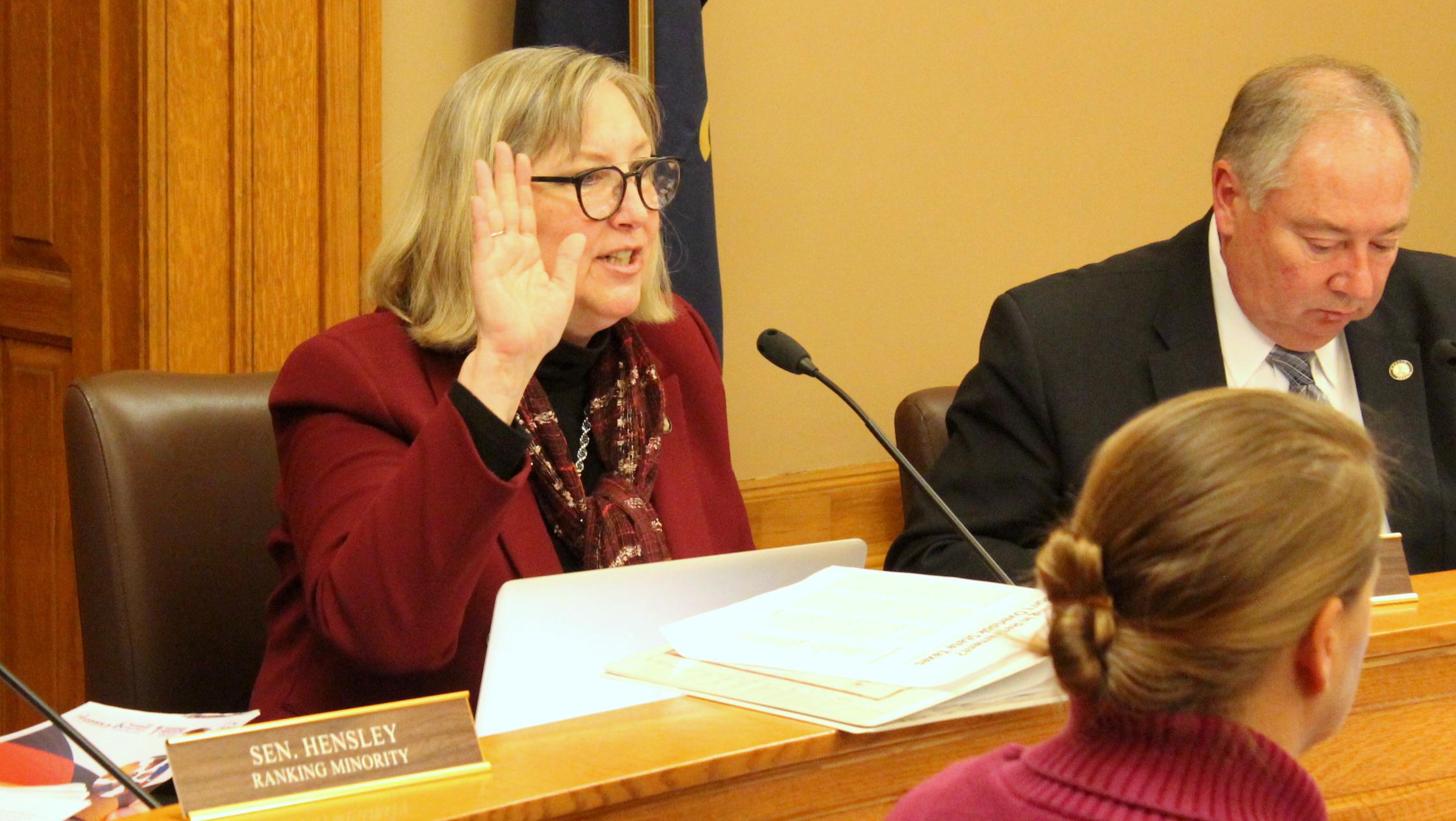
Senate Minority Leader Anthony Hensley said Kelly’s proposal is a path to ending the Gannon lawsuit, and Democrats will offer it as an amendment to any school funding bill that comes up for a vote.
“This is a critical issue and it ought to be resolved, and we ought to do it in an expeditious manner,” Hensley told reporters.
House Democratic Leader Tom Sawyer said lawmakers don’t have time to craft a new deal from scratch.
GEARY COUNTY — Three people were injured in an accident just after 5:30p.m. Friday in Junction City.
The Kansas Highway Patrol reported a 2003 Chevy Tahoe driven by Ishmail Maurice Thomas, 21, Junction City, was eastbound on Ash Street in Junction City.
The tire tracks show the Tahoe went left of center and was struck by oncoming train.
Thomas and two passengers Travis Ray Allen, 40, Junction City, and Solton, Marcus Dewayne
Solton, 31, Bossier City, LA., were transported to the Geary County Community Hospital.
There were no injuries reported on the train. The occupants of the Tahoe were properly restrained at the time of the accident, according to the KHP.
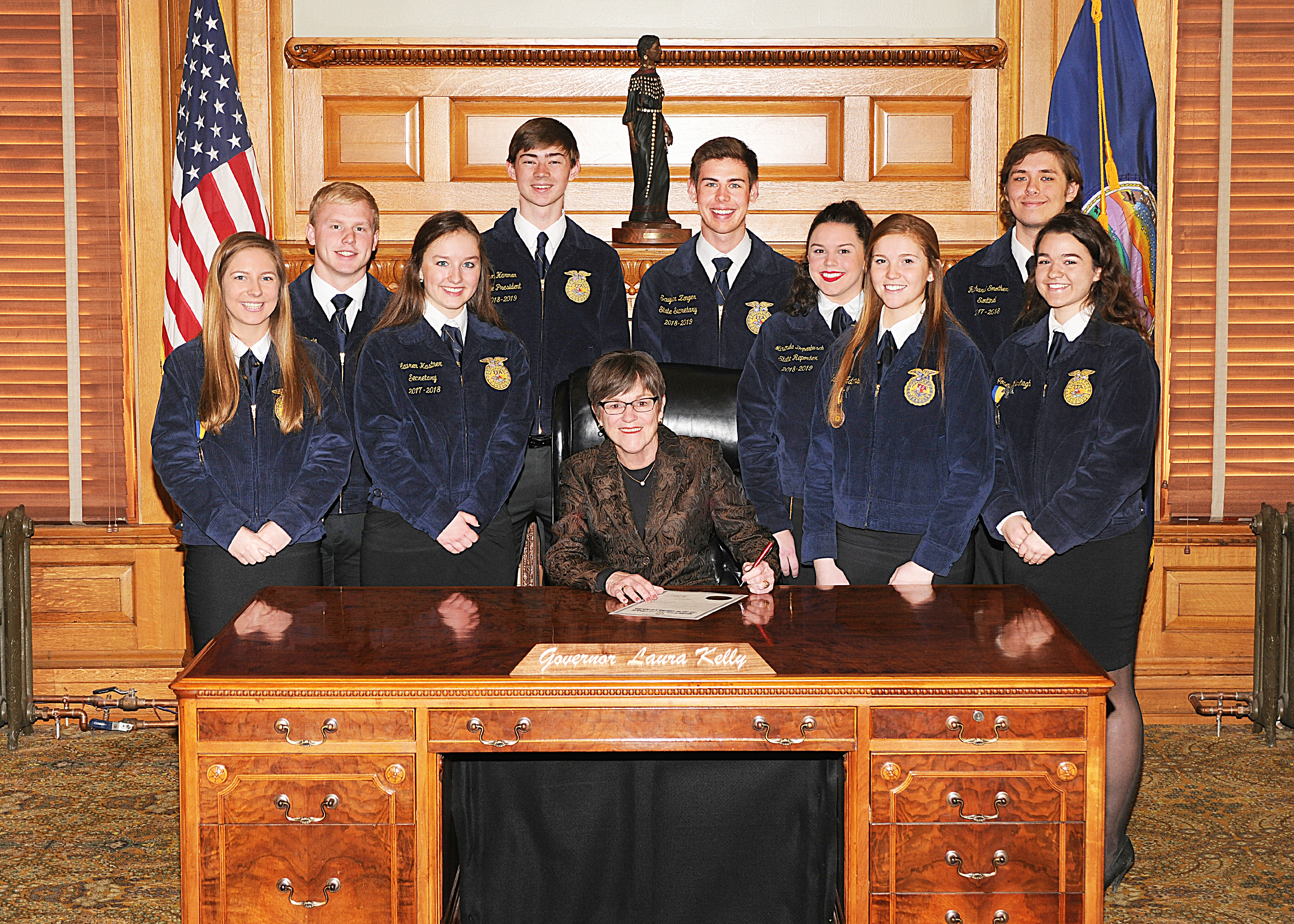
Members of the Kansas FFA Association joined with Gov. Laura Kelly for the 2019 Kansas FFA Week Proclamation signing. Pictured from left are: Riley Buss, Jefferson West President, Garrett Craig, State Sentinel, Lauren Kastner, Washburn Rural Vice President, Max Harmon, State President; Gov. Laura Kelly; Scuyler Zenger, State Secretary; Miranda Depenbusch, State Reporter, Kassie Adams Jefferson West Sentinel, Josey Metagh, Jefferson West Vice President and Richard Smothers, Washburn Rural President.
KSFFA
MANHATTAN –The 203 chapters of the Kansas FFA Association will celebrate National FFA Week, Feb. 16-23, 2019.
FFA Week embraces more than 91 years of FFA traditions while looking forward to the organization’s future. In Kansas, more than 9,700 members participate in Kansas FFA Week activities.
Kansas FFA members have a passion for agriculture. Kansas Governor Laura Kelly officially proclaimed the celebration and joined with Kansas State FFA officers and members representing the Jefferson West and Washburn Rural FFA Chapters for the official signing of the proclamation.
Designated a national week in 1947, the week of George Washington’s birthday, National FFA Week runs from Saturday to Saturday and gives FFA members an opportunity to educate the public about agriculture. During the week, chapters conduct a variety of activities to help others in their school and community learn about FFA and agricultural education.
Today’s FFA members are the innovators and leaders of tomorrow. Through agricultural and hands-on learning, they are preparing for more than 250 unique career opportunities in the food, fiber and natural resources industry.
“Kansas FFA members are a dynamic group and because of the educational opportunities and experiences that they’ve gained through agriculture education classes we know that our members will provide leadership in their local communities and in our great state and across this country for decades to come,” said Max Harman, state FFA president from the Inman FFA chapter. “Agriculture is the largest economic driver in our state and we are excited to be a part of this dynamic and diverse industry.”
The Kansas FFA Association is a statewide organization of more than 9,700 agricultural education students in 203 chapters in every corner of Kansas. It is part of the National FFA Organization, a national youth organization of 669,989 student members preparing for leadership and careers in the science, business and technology of agriculture with 8,630 local chapters in all 50 states, Puerto Rico and the Virgin Islands. Our mission is to make a positive difference in the lives of students by developing their potential for premier leadership, personal growth and career success through agricultural education. Visit www.ksffa.org for more information.
HUTCHINSON, Kan. — A Reno County District Judge kept her word and gave a downward departure to a 19-year-old Hutchinson man convicted of second-degree murder.
Taylor Lukone was placed in handcuffs after sentencing Friday.
Taylor Lukone entered a plea for the fatal 2017 hit-and-run accident that killed 51-year-old Jose Lopez who was riding a bicycle n 1200 Block of East 4th Street in Hutchinson. The vehicle fled the scene.
Lopez died 11 days after the incident at a Wichita hospital.
The state had requested a sentence of more than 13 years for the three charges, which included failing to stop at an accident and interference with law enforcement.
As part of the agreement, Lukone could not seek a departure sentence and both sides had agreed on a recommended sentence.
Judge Rose ruled that Lukone was barely 18 at the time of the crime, doesn’t have a substantial criminal history and accepted responsibility for his actions.
Assistant District Attorney Andrew Davidson argued to the court that there are no substantial and compelling reasons to depart. Davidson said Lukone earned the 13-year sentence.
Defense Attorney Shannon Crane noted that Lukone had been evaluated and it was determined that he suffered from PTSD. She said Lukone was upset because Lopez had beaten his mother and was let out of jail. But, Lopez had entered a plea in the case against him and had yet to be sentenced.
Lukone told the court he takes responsibility for his actions and that he didn’t mean for it to happen.
Davidson says he will appeal the sentence handed down by Judge Rose.
JEFFERSON COUNTY (AP) — A dog found in a ditch with electrical and duct tape around his mouth and legs has been reunited with his owner.
Authorities believe the dog was in a ditch in cold temperatures for about 12 hours before a Jefferson County sheriff’s deputy found him Saturday . He was dubbed “Jimmy” while he recovered.
Garcia -photo Jefferson Co.
The sheriff’s office said the dog — whose name is “Flick” — had “an emotional” reunion with his owner Friday and was headed home. An area funeral home paid for the dog’s care.
Jefferson County Sheriff Missouri Dave Marshak said Thursday 39-year-old Paul Garcia of Barnhart was charged with felony animal abuse and armed criminal action. Marshak says investigators believe Barnhart taped the dog and threw him out of a window. A motive hasn’t been disclosed.
SEDGWICK COUNTY — Law enforcement authorities are investigating an aggravated battery and asking the public for help to locate suspects.
Just before 4p.m. Thursday, police responded to a home in the 1800 Block of North Woodrow, according to officer Charley Davidson. A 47-year-old man told police that when he arrived home, he observed a black 4-door hatchback in a neighbor’s driveway.
An unknown male driver described as a white male with a beard and male passenger wearing shorts were attempting to take a television from the front porch of the home, according to Davidson.
As the 47-year-old approached the suspects, the vehicle ran over him as they drove from the scene southbound on Woodrow.
The victim was transported for treatment of non-life-threatening abrasions and lacerations. The suspects did not get away with the television.
Anyone with information on the case is asked to contact police.
Kansas U.S. Sen. Jerry Moran is one of several Republicans who expressed concern about President Donald Trump’s declaration Friday of a national emergency to fund construction of a U.S.-Mexico border wall.
Photo courtesy Rep. Roger Marshall
Both Moran and fellow Republican U.S. Sen. Pat Roberts voted for a bipartisan appropriations bill, which prevented another partial shutdown of the federal government and passed the Senate 86-16. Democrat Sharice Davids was the only member of Kansas’ U.S. House delegation to support the measure, which passed 300-128 in the House.
We started these negotiations asking for 230 miles of border wall – Washington left us now with 55 miles. Any Kansan can tell you that’s not a compromise worth taking.
Moran told the Kansas News Service last month during the government shutdown over the wall funding that he shared Trump’s concerns about border security, but that he hoped the president wouldn’t use emergency powers to circumvent Congress.
“Throughout my time in the Congress, particularly in the Senate, I have complained about administrations taking more and more of what is constitutionally the responsibility of the United States Congress,” he said. “But I also complain that Congress allows it to happen.”
The 1976 law that gives the president authority to declare a national emergency also gives Congress the power to terminate the order.
On Friday, Trump signed the appropriations bill. The president then declared an emergency on Friday because the measure included only $1.3 billion of the $5.7 billion he wanted for the wall. Unless blocked by Congress or the courts, the declaration will allow the president to redirect money appropriated for the U.S. military and for disaster response.
In a statement, Davids called the bill a good compromise that “funds smart and effective security at our borders and many other important investments in our communities.” The congresswoman, who is serving her first term in the 3rd District seat she captured from Republican Kevin Yoder in November, also criticized the president’s emergency declaration as “dangerous to our democracy.”
The Republican House members from Kansas all opposed the funding bill.
“It is shameful that these negotiations failed to secure our border, so I understand and respect the president’s declaration (of a national emergency),” U.S. Rep. Roger Marshall said in a statement. Marshall, who represents the vast western Kansas 1st District, voted it down because it included only enough money to build 55 of the 230 miles of border wall sought by Trump.
“I’m fed up with it, and the more than 70 percent of Kansans in my district who want the wall built are sick and tired of the political games and dysfunction in Washington,” he said.
Rep. Ron Estes, a Republican from Wichita who oversees the 4th District, also said the lack of funding for the wall justified emergency declaration.
“Rather than President Trump needing to declare a national emergency to protect our country, Congress should have done its job to provide increased border security,” Estes said in a statement.
U.S. Rep. Steve Watkins, a Topeka Republican serving his first term, ran as a “build the wall guy.” He said the funding bill doesn’t do what’s needed.
“Our border agents told us what it will require to secure our border and this is not it,” Watkins said on Twitter.
Jim McLean is the senior correspondent for the Kansas News Service. You can reach him on Twitter @jmcleanks.
TOPEKA, Kan. (AP) — Kansas Gov. Laura Kelly has three words for workers at the state’s most crowded maximum-security prison: “Please don’t quit.”
Gov. Kelly speaking this week to employees at the El Dorado Correctional Facility -photo courtesy KDOC
Kelly spoke to more than 100 employees at El Dorado Correctional Facility on Thursday, two days after the Kansas Department of Corrections declared an emergency there. She says to “Trust that we will work this out as fast as we can.”
The prison has 95 vacant staff positions while also housing 74 inmates over its limit. It’s had multiple inmate disturbances over the past two years. Several staff members raised issues of working long hours of overtime, sometimes with few breaks, and years of no pay raises.
Interim Corrections Secretary Roger Werholtz told prison employees that “What’s happening here right now is not sustainable.”
SEDGWICK COUNTY— Police presented the results of the investigation in the death of 9-year-old Roy’Ale Spencer on Thursday afternoon, according to a statement from the Sedgwick County Attorney.
Family have established a GoFundMe page after the death of Royale Spencer
Spencer and his 9-year-old friend managed to unlock a bedroom gun safe before the older boy fatally shot the younger child in a Wichita mobile home, according to officer Charley Davidson.
The family who lives in the home didn’t know that the gun was loaded when Roy’Ale Spencer was killed. Davidson said the children got into the safe after the adults in the home left for work, leaving three teens in charge. Students in Wichita public schools were out of class for Martin Luther King Jr. Day.
Inside the safe were two rifle-style BB guns and one shotgun, which had ammunition in it. After Spencer was shot, one teen attempted lifesaving efforts and called 911.
The District Attorney’s office reported Thursday that Marc Bennett is reviewing the matter before making a final decision.
SALINE COUNTY — Law enforcement authorities are investigating two suspects on drug charges after an Interstate 70 traffic stop.
McCall -photo Saline Co.Brown -photo Saline Co.
A Saline County deputy was northbound on North Ohio near Interstate 70 when he observed a gray 2016 Chevrolet Malibu pull out of the Flying J parking lot without its headlights on, according to Saline County Sheriff Roger Soldan.
The deputy stopped the car and during the course of the discussion with the two occupants determined that something was amiss. A K-9 unit was brought in and the dog indicated that drugs were in the car.
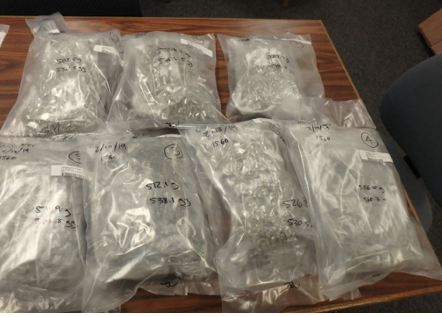
Deputies located just over eight pounds of marijuana in vacuum-sealed bags along with drug paraphernalia and $6,600 in hundred dollar bills, according to Soldan.
The marijuana located by the K-9 unit. Photo courtesy Saline County Sheriff’s Office
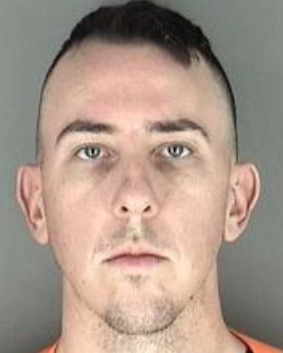
Deputies arrested Melvin McCall, 24, of Glen Burnie, MD., on suspicion of driving with no headlights on, possession of marijuana with intent to sell, no drug tax stamp, and possession of drug paraphernalia, and Gabriel Brown, 26, also of Glen Burnie, MD., on suspicion of possession of marijuana with intent to sell, no drug tax stamp, and possession of drug paraphernalia, Soldan said.
RILEY COUNTY — Law enforcement authorities are investigating a suspect for alleged child sex crimes.
Michael Sears -photo Shawnee Co.
Just before 1p.m. Thursday police arrested Micheal Sears, 32 of Ogden while at the Riley County Police Department, according to the RCPD activity report.
Sears was arrested on a Riley County District Court warrant for two counts of rape and four counts of aggravated indecent liberties with a child.
Sears was issued a total bond of $100,000.00. Sears was no longer in custody Friday morning, according to the police report.
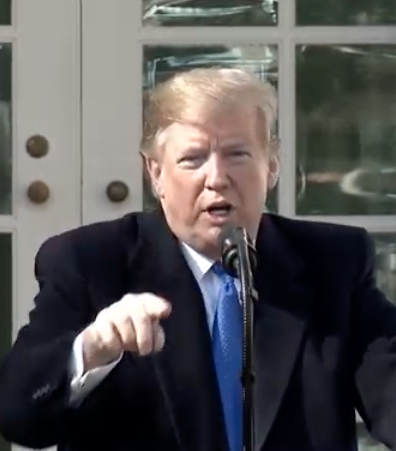
WASHINGTON (AP) — Battling with one branch of government and opening a new confrontation with another, President Donald Trump announced Friday he was declaring a national emergency to fulfill his pledge to construct a wall along the U.S.-Mexico border.
President Trump during Friday’s announcement -photo courtesy White House
Bypassing Congress, which approved far less money for his proposed wall than he had sought, Trump said he would use executive action to siphon billions of dollars from federal military construction and counterdrug efforts for the wall, aides said. The move is already drawing bipartisan criticism on Capitol Hill and expected to face rounds of legal challenges.
Trump made the announcement from the Rose Garden, as he claimed illegal immigration was “an invasion of our country.”
Trump’s move followed a rare show of bipartisanship when lawmakers voted Thursday to fund large swaths of the government and avoid a repeat of this winter’s debilitating five-week government shutdown. The money in the bill for border barriers, about $1.4 billion, is far below the $5.7 billion Trump insisted he needed and would finance just a quarter of the more than 200 miles (322 kilometers) he wanted this year.
To bridge the gap, Trump announced that he will be spending roughly $8 billion on border barriers — combining the money approved by Congress with funding he plans to repurpose through executive actions, including the national emergency. The money is expected to come from funds targeted for military construction and counterdrug efforts, but aides could not immediately specify which military projects would be affected.
Despite widespread opposition in Congress to proclaiming an emergency, including by some Republicans, Trump was responding to pressure to act unilaterally to soothe his conservative base and avoid appearing like he’s lost his wall battle.
Word that Trump would declare the emergency prompted condemnations from Democrats and threats of lawsuits from states and others who might lose federal money or said Trump was abusing his authority.
In a sing-songy tone of voice, Trump described how the decision will be challenged and work its way through the courts, including up to the U.S. Supreme Court.
He said, “Sadly, we’ll be sued and sadly it will go through a process and happily we’ll win, I think.”
In an unusual joint statement, House Speaker Nancy Pelosi, D-Calif., and Senate Minority Leader Chuck Schumer, D-N.Y., called it an “unlawful declaration over a crisis that does not exist” and said it “does great violence to our Constitution and makes America less safe, stealing from urgently needed defense funds for the security of our military and our nation. ”
“The President’s actions clearly violate the Congress’s exclusive power of the purse, which our Founders enshrined in the Constitution,” they said. “The Congress will defend our constitutional authorities in the Congress, in the Courts, and in the public, using every remedy available.”
Democratic state attorneys general said they’d consider legal action to block Trump. Puerto Rico Gov. Ricardo Rossello told the president on Twitter “we’ll see you in court” if he made the declaration.
Even if his emergency declaration withstands challenge, Trump is still billions of dollars short of his overall funding needed to build the wall as he promised in 2016. After two years of effort, Trump has not added any new border mileage; all of the construction so far has gone to replacing and repairing existing structures. Ground is expected to be broken in South Texas soon on the first new mileage.
The White House said Trump would not try to redirect federal disaster aid to the wall, a proposal they had considered but rejected over fears of a political blowback.
—————-
WASHINGTON (AP) — Congress lopsidedly approved a border security compromise that would avert a second painful government shutdown.
But a new confrontation has been ignited — this time over President Donald Trump’s plan to bypass lawmakers and declare a national emergency to siphon billions of dollarsfrom other federal coffers for his wall on the Mexican boundary.
Money in the bill for border barriers, about $1.4 billion, is far below the $5.7 billion Trump insisted he needed and would finance just a quarter of the 200-plus miles (322 kilometers) he wanted. The White House said he’d sign the legislation but act unilaterally to get more, prompting condemnations from Democrats and threats of lawsuits from states and others who might lose federal money or said Trump was abusing his authority.
The uproar over Trump’s next move cast an uncertain shadow over what had been a rare display of bipartisanship to address the grinding battle between the White House and lawmakers over border security.
The Senate passed the legislation 83-16 Thursday, with both parties solidly aboard. The House followed with a 300-128 tally, with Trump’s signature planned Friday. Trump will speak Friday morning in the Rose Garden about border security, the White House said.
Trump is expected to announce that he will be spending roughly $8 billion on border barriers — combining the money approved by Congress with funding he plans to repurpose through executive actions, including a national emergency, said a White House official who was not authorized to speak publicly. The money is expected to come from funds targeted for military construction and counterdrug efforts.
House Democrats overwhelmingly backed the legislation, with only 19 — most of whom were Hispanic — opposed. Just over half of Republicans voted “no.”
Should Trump change his mind, both chambers’ margins were above the two-thirds majorities needed to override presidential vetoes. Lawmakers, however, sometimes rally behind presidents of the same party in such battles.
Lawmakers exuded relief that the agreement had averted a fresh closure of federal agencies just three weeks after a record-setting 35-day partial shutdown that drew an unambiguous thumbs-down from the public. But in announcing that Trump would sign the accord, White House Press Secretary Sarah Sanders also said he’d take “other executive action, including a national emergency,”
In an unusual joint statement, House Speaker Nancy Pelosi, D-Calif., and Senate Minority Leader Chuck Schumer, D-N.Y., said such a declaration would be “a lawless act, a gross abuse of the power of the presidency and a desperate attempt to distract” from Trump’s failure to force Mexico to pay for the wall, as he’s promised for years.
“Congress will defend our constitutional authorities,” they said. They declined to say whether that meant lawsuits or votes on resolutions to prevent Trump from unilaterally shifting money to wall-building, with aides saying they’d wait to see what he does.
Democratic state attorneys general said they’d consider legal action to block Trump. Puerto Rico Gov. Ricardo Rossello told the president on Twitter “we’ll see you in court” if he makes the declaration.
Despite widespread opposition in Congress to proclaiming an emergency, including by some Republicans, Trump is under pressure to act unilaterally to soothe his conservative base and avoid looking like he’s lost his wall battle.
The abrupt announcement of Trump’s plans came late in an afternoon of rumblings that the volatile president — who’d strongly hinted he’d sign the agreement but wasn’t definitive — was shifting toward rejecting it. That would have infused fresh chaos into a fight both parties are desperate to leave behind, a thought that drove some lawmakers to ask heavenly help.
“Let’s all pray that the president will have wisdom to sign the bill so the government doesn’t shut down,” Sen. Charles Grassley, R-Iowa, said Thursday’s Senate session opened.
Moments before Sanders spoke at the White House, Senate Majority Leader Mitch McConnell, R-Ky., took to the Senate floor to announce Trump’s decisions to sign the bill and declare an emergency.
Sen. John Cornyn, R-Texas, told reporters there were two hours of phone calls between McConnell and the White House before there were assurances that Trump would sign.
McConnell argued that the bill delivered victories for Trump over Pelosi. These included overcoming her pledge to not fund the wall at all and rejecting a Democratic proposal for numerical limits on detaining some immigrants, said a Republican speaking on condition of anonymity to describe private conversations.
In a surprising development, McConnell said he would support Trump’s emergency declaration, a turnabout for the Kentucky Republican, who like many lawmakers had opposed such action.
Democrats say there is no border crisis and Trump would be using a declaration simply to sidestep Congress. Some Republicans warn that future Democratic presidents could use his precedent to force spending on their own priorities, like gun control. GOP critics included Maine Sen. Susan Collins, who said emergency declarations are for “major natural disasters or catastrophic events” and said its use would be of “dubious constitutionality.”
White House staff and congressional Republicans have said that besides an emergency, Trump might assert other authorities that could conceivably put him within reach of billions of dollars. The money could come from funds targeted for military construction, disaster relief and counterdrug efforts.
Congressional aides say there is $21 billion for military construction that Trump could use if he declares a national emergency. By law, the money must be used to support U.S. armed forces, they say. The Defense Department declined to provide details on available money.
With many of the Democrats’ liberal base voters adamantly against Trump’s aggressive attempts to curb immigration, four declared presidential hopefuls opposed the bill in the Senate: Cory Booker of New Jersey, New York’s Kirsten Gillibrand, Elizabeth Warren of Massachusetts and Kamala Harris of California. Amy Klobuchar of Minnesota voted for it, as did Vermont independent Bernie Sanders, who is expected to join the field soon.
Notably, the word “wall,” the heart of many a chant at Trump campaign events and his rallies as president, is absent from the compromise’s 1,768-page legislative and descriptive language. “Barriers” and “fencing” are the nouns of choice, a victory for Democrats eager to deny Trump even a rhetorical victory.
The agreement, which took bargainers three weeks to strike, would also squeeze funding for Immigration and Customs Enforcement, or ICE, in an attempt to pressure the agency to detain fewer immigrants. To the dismay of Democrats, however, it would still leave an agency many of them consider abusive holding thousands more immigrants than last year.
The measure contains money for improved surveillance equipment, more customs agents and humanitarian aid for detained immigrants. The overall bill also provides $330 billion to finance dozens of federal programs for the rest of the year, one-fourth of federal agency budgets.
Trump sparked the last shutdown before Christmas after Democrats snubbed his $5.7 billion demand for the wall. The closure denied paychecks to 800,000 federal workers, hurt contractors and people reliant on government services and was loathed by the public.
With polls showing the public blamed him and GOP lawmakers, Trump folded on Jan. 25 without getting any of the wall funds. His capitulation was a political fiasco for Republicans and handed Pelosi a victory less than a month after Democrats took over the House and confronted Trump with a formidable rival for power.
Trump’s descriptions of the wall have fluctuated, at times saying it would cover 1,000 miles of the 2,000-mile boundary. Previous administrations constructed over 650 miles of barriers.



 The Kansas Highway Patrol reported a 2003 Chevy Tahoe driven by Ishmail Maurice Thomas, 21, Junction City, was eastbound on Ash Street in Junction City.