We have a brand new updated website! Click here to check it out!

Deadly weekend on Kansas highways

The weekend snowstorm kept first responders busy. The Kansas Highway Patrol reported working nine injury accidents on Friday and ten on Saturday. Four of those accidents involved fatalities.  

The Phillips County Sheriff’s Office released several photos from accidents they worked in the snow over the weekend.

As snow was falling just after 5p.m. Friday, a semi driver from Mexico Ernesto Rafeal Nevarez Medoza, 41,  died after the semi he was driving westbound on Kansas 156 just east of the Kansas 140 Junction in Ellsworth County collided head-on with another semi.

Lee R. Crum, 81, Oskaloosa, Kansas died in a 2-vehicle crash Friday afternoon in Jefferson County.

Fatal Friday crash scene in Jefferson County photo courtesy WIBW TV

Just after 9p.m. Friday, 62-year-old Bradley S. Horton, Topeka died when his pickup hit a barrier wall on the Kansas Turnpike.

At 9:15 p.m. Saturday, Steven R. Horn, 53, Oklahoma City, died in a head on crash on U.S. 69  just south of Pittsburg. The crash sent four Kansas teens to the hospital with serious injuries.

On Sunday, the Phillips County Sheriff reported they had a busy weekend as the snow began to fall in the area. They released  photos of accidents they worked Friday to remind everyone to slow down when road conditions deteriorate and always buckle up.

Kan. officials: WIC funding available into March despite shutdown

TOPEKA, Kan. (AP) — State health officials say Kansas has enough money to provide WIC benefits into March, even if the partial federal government shutdown continues.

The Kansas Department of Health and Environment said in a news release Monday that the U.S. Department of Agriculture provided enough extra funding to keep the Women, Infants and Children program going until March 4.

The agriculture department gave Kansas more than $1.4 million for food purchases and nearly $900,000 for Nutrition Services and Administration.

The state agency says the new funds will keep its staff operational until March 13, regardless if the government shutdown continues through February.

Kansas abortion foes brace for state Supreme Court decision

By JOHN HANNA

TOPEKA, Kan. (AP) — Abortion opponents in Kansas have been bracing themselves for nearly two years for a ruling from the state’s highest court that protects the right to have an abortion and potentially upends politics in a state long at the center of the national debate.

The Kansas Supreme Court is relatively liberal in a state with a Republican-dominated Legislature that has strong anti-abortion majorities.

Court watchers also are asking: Why is it taking so long for the justices to rule?

No one outside the court knows for sure and the justices are not saying, as is their long-standing custom. One educated guess is that they still are wrestling with the implications of declaring that the state constitution protects abortion rights.

That was the core legal issue when the court heard attorneys’ arguments in March 2017 in a major abortion lawsuit . An abortion-rights decision could allow state courts in Kansas to chart their own course on abortion and invalidate restrictions that the federal courts would uphold.

“What’s the test for that?” said Jeffrey Jackson, a Washburn University of Topeka law professor. “There’s any number of weird possible decisions that you can get to.”

The case arises from abortion opponents’ numerous legislative victories during eight years under Republican governors. Democratic Gov.-elect Laura Kelly, a strong abortion rights supporter, takes office Monday, but the Legislature emerged from last year’s elections more conservative — and as anti-abortion as ever.

GOP conservatives’ power in the Legislature surged following “Summer of Mercy” protests in 1991 against the late Dr. George Tiller’s clinic in Wichita, among a few in the U.S. known to do late-term abortions. An anti-abortion zealot shot Tiller to death in 2009.

Legislators debate abortion annually. Kansas recorded its lowest number of abortions in 30 years in 2017, fewer than 6,800 — 46 percent less than the peak of more than 12,400 in 1999.

“It’s more important than ever for Kansas to recognize that women have protections under the state constitution,” said Genevieve Scott, a Center for Reproductive Rights attorney. “Any time that a court recognizes women’s rights, it has an important impact in shaping our national discourse.”

Despite abortion foes’ political rise, six of the seven Kansas Supreme Court justices were appointed by Democratic or moderate Republican governors.

In 2016, abortion opponents, GOP conservatives and others upset with capital punishment decisions tried unsuccessfully to oust four of those justices when they faced a yes-or-no statewide vote on whether they would remain on the court for another six years. Anti-abortion leaders cited the case now before the court as one reason.

During arguments in the abortion case in 2017, four justices peppered the state’s solicitor general with skeptical questions when he argued that the state constitution cannot protect abortion rights because abortion generally was illegal when it was drafted in 1859.

Mary Kay Culp, executive director of the anti-abortion group Kansans for Life, worries that the decision will make it impossible for legislators “to pass pro-life bills.”

“That’s worst-case scenario, and that’s kind of what we expect,” she said.

Her fears are not unfounded. California voters added a right to privacy to their state’s constitution in 1972, and courts there have struck down even restrictions on public funding for abortions. In 2000, Tennessee’s highest court declared that the state constitution protected abortion rights; abortion foes did not pass an amendment until 2014.

The Iowa Supreme Court ruled last year that the state constitution protected abortion rights.

The Kansas case involves the state’s first-in-the-nation ban on a common second trimester procedure. Two abortion providers sued just before the law was supposed to take effect in 2015. It has been on hold since.

A district court judge agreed with their arguments that that broad language in the state constitution’s Bill of Rights implies a right for a woman to obtain an abortion.

The Kansas Supreme Court decision has taken so long that it is compared to a small number of heavily litigated capital punishment cases. Spokeswoman Lisa Taylor said the Supreme Court’s goal is to have 95 percent of its cases decided within nine months of oral arguments.

“It’s a groundbreaking case of first impression, but my goodness, two years?” said Kansas Attorney General Derek Schmidt, a Republican whose office is defending the 2015 law.

The state’s Bill of Rights says Kansas residents have “natural rights,” including “life, liberty and the pursuit of happiness” and that “free governments” are created for their “equal protection and benefit.” Abortion opponents argue that the “life” clause protects the fetus in the womb — not the right to abort it.

“Maybe the fact that it takes so long to figure out whether there’s a previously undiscovered right in the Kansas Constitution suggests they’re having to look awfully hard,” Schmidt said.

Culp believes the Supreme Court didn’t want to issue its decision during the governor’s race last year because it would have hurt Kelly’s campaign by energizing angry anti-abortion voters.

But Jackson said if the justices have concluded that the Kansas Constitution does protect abortion rights, they still must consider how far such protections go. He said they might not have a majority yet for “any single opinion.” He worked for the court several times between 1992 and 2003 and said he saw cases sometimes “going back and forth.”

Abortion rights advocates appear to be less frustrated with the delay because the 2015 law is blocked. Several declined to speculate on what is taking the court so long.

“If the Supreme Court finds a right to abortion in the state constitution — I mean, that is huge,” said Rachel Sweet, policy director for the political affiliate of Planned Parenthood Great Plains.

Kansas seeks to expand housing program for mentally ill

TOPEKA, Kan. (AP) — Kansas officials are offering an unconventional housing program to mentally ill homeless people that they hope will ease overcrowding at state hospitals.

The state Department for Aging and Disability Services is considering offering the Housing First program beyond Wichita, Shawnee County and Wyandotte County. The program deviates from traditional housing assistance programs because it has no curfew and sobriety requirements.

“What this lets us do is get these folks who need help out of this cycle where they’re in the state hospital, they get discharged, and then pretty soon they end up back on the street,” said agency spokeswoman Angela de Rocha. “This intervenes in that cycle and stops it.”

The department secured legislative support last year to maintain the three existing programs. It’s seeking an additional $250,000 to help homeless communities in other parts of the state.

More than 320 residents have entered the program and more than 240 have found a permanent home. There were more than 2,000 homeless people across the state last year, according to state data.

Melissa Bogart, who works in housing employment and benefits for the department, said it’s been effective in Wichita, which has the state’s largest homeless population.

“What we’ve seen is persons being housed at a much quicker rate — people with a roof over the head, people being safe, people being up off the street,” Bogart said.

___

Police: One hospitalized after Kansas shooting

SHAWNEE COUNTY — Law enforcement authorities are investigating a shooting.

Police on the scene of the shooting investigation -photo courtesy WIBW TV

Just before 3 a.m. Monday, police were dispatched to a Topeka hospital after a victim arrived with a gunshot wound, according to Lt. Jerry Monasmith.

The victim advised officers of a possible location where the incident took place.  Officers located a crime scene in the 2400 Block of SE 21st in Topeka.  They have not reported an arrest.

Anyone with information regarding this crime is encouraged to contact police.

Watch: Delegation from Kansas helps commission USS Wichita

JACKSONVILLE, FL. The U.S. Navy commissioned the USS Wichita (LCS 13) Saturday at Naval Station Mayport, Florida., near Jacksonville, where the ship will be homeported.

Kansas governor Jeff Colyer and members of the Kansas congressional delegation participated in the ceremonies.


USS Wichita is the 13th vessel in the Freedom class of littoral combat ships, the Navy’s fastest and most versatile warships.

According to a media release from the Navy, the USS Wichita is designed to operate in shallow waters close to shore. A draft of only 13 feet enables the ship to conduct minesweeping operations, humanitarian support, anti-submarine and drug trafficking surveillance, among other missions. USS Wichita assets include a launching pad for two MH-60 Seahawk helicopters.

Crewmembers from the ship have visited Wichita three times to get to know their ship’s namesake city.

LCS 13 is the third Navy ship to bear Wichita’s name. The first USS Wichita (CA 45), a heavy cruiser commissioned in 1939, earned 13 battle stars during World War II. The second USS Wichita (AOR 1) was a replenishment oiler commissioned in 1968. During 24 years of service, that ship’s awards included four battle stars earned in Vietnam.

Gov.-elect has her work cut out fixing state government in Kansas

By JIM MCLEAN
Kansas News Service

Think of Laura Kelly as the fix-it governor.

As in she needs to fix what, by most accounts, is a state government in desperate need of repair.

For the first year or two of her administration, her biggest job will be restoring the capacity of state agencies crippled by budget cuts and the exodus of employees with the skills and institutional knowledge needed to keep the trains running on time.

Or, more to the point, balance the state budget, adequately fund schools and ensure that foster kids are placed in safe and stable homes.

She may want to start with high-profile initiatives to reduce the sales tax on food, restore the budget cuts suffered by universities and reboot the multi-billion-dollar highway-building program that former Republican Gov. Sam Brownback abandoned because of self-inflicted money problems.

Reality demands a more cautious approach. Kelly must closely monitor spending while triaging needs and addressing the most urgent problems. Ensuring the safety of foster children in the custody of the Department for Children and Families is likely at the top of that list.

Expectations for a new road program run high, but Kelly needs to first give new secretary of the Kansas Department of Transportation Julie Lorenz time to rebuild the agency so that it can do the basics — plow snow and mend potholes without borrowing money from the bond market.

At the Kansas Department of Commerce, incoming Secretary David Toland must rebuild the rudderless agency’s presence in the eco-devo world. It’s one that’s been systematically diminished by understaffed programs and the closing of most of the state’s trade offices around the world.

Some might argue that restoring a basic level of competency to Kansas government sets a low bar for Kelly. But given the work that needs to be done, it seems a fair measuring stick.

Let’s remember, Kelly was a reluctant candidate. Former Democratic Gov. Kathleen Sebelius, among others, had to talk her into running. Perhaps that was because as a longtime member of the Senate’s budget-writing committee, she had a notion of how difficult the job would be.

Still, after some coercion and a lot of contemplation — done during long walks along the wooded bluffs overlooking the Kansas River and Cedar Crest, the governor’s residence — Kelly concluded she could handle the job.

Then she got elected. Sitting through her first budget briefings, she said, it became apparent that the “devastation” was “even worse than I thought.”

Regardless, it’s now Kelly’s job to fix things.

Our first indication of how she plans to do that comes next week when she lays out her budget priorities in a speech to a joint session of the Legislature.

We should all be paying attention.

Jim McLean is the chief political reporter for the Kansas News Service. He’s covered politics and state government for more than 35 years. You can reach him on Twitter @jmcleanks

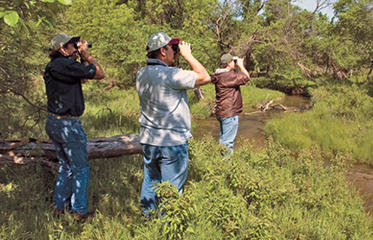
Kansas contest for top birders

KDWPT

PRATT – Think you know your Kansas birds? Prove it. Keep track of the number of different species you see between Jan. 1, 2019 and Dec. 31, 2019 and enter the 2019 Kansas Birding Big Year contest, hosted by the Kansas Department of Wildlife, Parks and Tourism (KDWPT). But you’d better bring your A-game. Last year, the winner recorded more than 300 species!

Participants of all skill levels may compete in three age groups: youth (17 and under), adult (18-64), and senior (65 and up). Winners in each category will receive great prizes that may include prints of Rob Penner ink drawings, gift cards and more.

Participation Guidelines
1. Participants must register online at https://ksoutdoors.com/Services/Wildlife-Diversity/2019-Kansas-Birding-Big-Year on or before April 1 to be part of the 2019 contest.

2. Participants must read and abide by the set of rules governing the competition (also available at ksoutdoors.com). These rules are adapted from the American Birding Association Recording Rules and Interpretations and include the Code of Birding Ethics. Breaking or disregard for these rules will disqualify the participant from the competition.

3. Participants are required to log their data into the online service, eBird, available on the Cornell University website, www.ebird.org. Each participant will need to create an individual profile, with sign-in and password to begin submitting their sightings.

4. Participants will need to submit a running total list of observed species quarterly to the program coordinator . This is to help track progress and provide quality control. The program coordinator and competition committee have final say on list totals. Dates for submissions are June 30, September 30 and December 31.

5. Winners in each category will be determined by a committee selected by the program coordinator. Winners will be notified and prizes will be awarded in mid-January of the following calendar year. Categories are defined as:

Youth – 17 and under
Adult – 18-64 (3 skill levels: Novice, Intermediate and Advanced)[KR[1]
Senior – 65 and up

6. Prizes will be awarded based on availability and appropriateness per division, as determined by program coordinator and competition committee.

For more information, visit ksoutdoors.com.

Police: Suspect held on $50K bond for Kansas armed robbery

RILEY COUNTY — Law enforcement authorities are investigating an armed robbery and have a suspect in custody.

Just before 9p.m. January 8, the Riley County Police Department Dispatch Center received a 911 call reporting an armed robbery in the 500 block of Leavenworth street at Fifths Liquor in Manhattan.

On Friday afternoon, police arrested Stephen Cortez, 21, of Manhattan in the 800 block of Osage in Manhattan for Aggravated Robbery. Cortez was issued a total bond of $50,000.00 and is being held in the Riley County Jail.

Winefest in Kansas loses partner for excluding LGBTQ bars

WICHITA, Kan. (AP) — The annual Midwest Winefest fundraiser in Wichita will have to find a new wine distributor after its partner pulled out of the event because organizers decided not to invite back certain bars and restaurants with LGBTQ clientele.

Standard Beverage’s chief financial officer, Angie Wilhelm, says the Wichita liquor distributor will not work with the festival scheduled for April 25-27 this year.

The company has provided wines for the event’s “grand tasting” for more than two decades. But Standard Beverage officials took issue with a recent decision by the event’s organizer and beneficiary, Guadalupe Clinic, to not invite businesses it deemed “morally and ethically” at odds with Catholic values.

The clinic, which provides medical services to uninsured community members, is part of the Catholic Diocese of Wichita.

Wilhelm said the company learned that the unwelcome businesses included LGBTQ bars and restaurants. Standard Beverage has been one of the fundraiser’s major donors.

“At Standard Beverage we support practices and beliefs that promote diversity and in being inclusive to individual businesses and other organizations,” Wilhelm said. “We just felt like that was unfortunately something we could not move forward with.”

David Gear, the clinic’s executive director, said LGBTQ bars and restaurants weren’t the only businesses that weren’t asked back this year. Gear declined to list the specific businesses.

“We do not feel as a Catholic Diocese and organization that we can put those establishments on posters and flyers and publications that have to do with the Winefest because they don’t morally and ethically align with Catholic morals and principles,” he said.

The Wichita Chapter of the American Institute of Wine & Food also pulled out of this year’s festival.

Mark Douglass, the chapter’s chairman, said some members of the group were concerned with the clinic’s decision, but that the small nonprofit chose to part ways to “focus on projects that are more impactful to our mission.”

The group had long provided volunteers at the event.

The group and Standard Beverage both expressed support for the clinic’s mission, despite their decision to cut ties with the event.

“It was a very difficult decision and one that we didn’t take lightly, especially because the Guadalupe Clinic, they do very good things,” Wilhelm said.

Kan. governor commutes woman’s sentence on drug charges

TOPEKA, Kan. (AP) — Outgoing Kansas Gov. Jeff Colyer has granted two pardons and commuted the sentence of an Emporia war veteran.

Carter -photo KDOC

Colyer on Friday reduced the sentence of Regina Carter to about 3½ years. She was sentenced in 2016 to eight years in prison for drug possession with intent to deliver. Colyer noted Carter’s original sentence was longer than many others given to first-time offenders. He also noted Carter suffered PTSD after serving in Iraq and received an honorable discharge from the Army.

Colyer also granted pardons to Chris Rickerson and Wandalen Thomas for felony drug possession convictions. Rickerson now runs Elite Staffing Solutions in Wichita. Thomas, who lives in Fountain, Colorado, runs a barbershop for military members and their families.

The governor denied pardon requests of 21 other applicants.

UPDATE: Police arrest suspect accused of cutting Kan. woman’s throat


BARTON COUNTY — Law enforcement authorities are investigating a stabbing and have a suspect in custody.

Timothy Chism -photo Great Bend police
Chism photo Barton Co.

Just after 10p.m. Thursday, police were dispatched to 1120 Morton Street, in reference to a stabbing, according to a media release.

Upon officers’ arrival, a 19-year old female was contacted. The victim and other witnesses stated Timothy Chism, a 34-year old white male, cut her throat and he fled from the residence on foot.

The victim was transported to the hospital in Great Bend and was reported in stable condition.

Police issued an attempt to locate for Chism for Aggravated Battery and he was still at large late Friday morning, according to police.  On Friday night, police reported they had arrested Chism. They did not release details of the arrest.

Report: US approved thousands of child bride requests

WASHINGTON (AP) — Thousands of requests by men to bring in child and adolescent brides to live in the United States were approved over the past decade, according to government data obtained by The Associated Press. In one case, a 49-year-old man applied for admission for a 15-year-old girl.

The approvals are legal: The Immigration and Nationality Act does not set minimum age requirements. And in weighing petitions for spouses or fiancees, U.S. Citizenship and Immigration Services goes by whether the marriage is legal in the home country and then whether the marriage would be legal in the state where the petitioner lives.

But the data raises questions about whether the immigration system may be enabling forced marriage and about how U.S. laws may be compounding the problem despite efforts to limit child and forced marriage. Marriage between adults and minors is not uncommon in the United States, and most states allow children to marry with some restrictions.

There were more than 5,000 cases of adults petitioning on behalf of minors and nearly 3,000 examples of minors seeking to bring in older spouses or fiances, according to the&nbsp;<a href=”https://www.hsgac.senate.gov/imo/media/doc/Child%20Marriage%20staff%20report%201%209%202019%20EMBARGOED.pdf”>data requested</a>&nbsp;by the Senate Homeland Security Committee in 2017 and compiled into a report.&nbsp;

Some victims of forced marriage say the lure of a U.S. passport combined with lax U.S. marriage laws are partly fueling the petitions.

“My passport ruined my life,” said Naila Amin, a dual citizen from Pakistan who grew up in New York City.

She was forcibly married at 13 in Pakistan and applied for papers for her 26-year-old husband to come to the country.

“People die to come to America,” she said. “I was a passport to him. They all wanted him here, and that was the way to do it.”

Amin, now 29, said she was betrothed to her first cousin Tariq when she was just 8 and he was 21. The petition was eventually terminated after she ran away. She said the ordeal cost her a childhood. She was in and out of foster care and group homes, and it took a while to get her life on track.

“I was a child. I want to know: Why weren’t any red flags raised? Whoever was processing this application, they don’t look at it? They don’t think?” Amin asked.

There is a two-step process for obtaining U.S. immigration visas and green cards. Petitions are first considered by USCIS. If granted, they must be approved by the State Department. Overall, there were 3.5 million petitions received from budget years 2007 through 2017.

Over that period, there were 5,556 approvals for those seeking to bring minor spouses or fiancees, and 2,926 approvals by minors seeking to bring in older spouses, according to the data. Additionally, there were 204 for minors by minors. Petitions can be filed by U.S. citizens or permanent residents.

“It indicates a problem. It indicates a loophole that we need to close,” Republican Sen. Ron Johnson of Wisconsin, the chairman of the Senate Homeland Security Committee, told the AP.

In nearly all the cases, the girls were the younger person in the relationship. In 149 instances, the adult was older than 40, and in 28 cases the adult was over 50, the committee found. Among the examples: In 2011, immigration officials approved a 14-year-old’s petition for a 48-year-old spouse in Jamaica. A petition from a 71-year-old man was approved in 2013 for his 17-year-old wife in Guatemala.

There are no nationwide statistics on child marriage, but data from a few states suggests it is far from rare. State laws generally set 18 as the minimum age for marriage, yet every state allows exceptions. Most states let 16- and 17-year-olds marry if they have parental consent, and several states — including New York, Virginia and Maryland — allow children under 16 to marry with court permission.

Fraidy Reiss, who campaigns against coerced marriage as head of a group called Unchained at Last, researched data from her home state of New Jersey. She determined that nearly 4,000 minors, mostly girls, were married in the state from 1995 to 2012, including 178 who were under 15.

“This is a problem both domestically and in terms of immigration,” she said.

Reiss — who says she was forced into an abusive marriage by her Orthodox Jewish family when she was 19 — said that often cases of child marriage via parental consent involve coercion, with a girl forced to marry against her will.

“They are subjected to a lifetime of domestic servitude and rape,” she said. “And the government is not only complicit; they’re stamping this and saying: Go ahead.”

The data was requested in 2017 by Johnson and then-Missouri Sen. Claire McCaskill, the committee’s top Democrat. Johnson said it took a year to get the information, showing there needs to be a better system to track and vet the petitions.

“Our immigration system may unintentionally shield the abuse of women and children,” the senators said in the letter.

USCIS didn’t know how many of the approvals were granted by the State Department, but overall only about 2.6 percent of spousal or fiancee claims are rejected.

Separately, the data show some 4,749 minor spouses or fiancees received green cards to live in the U.S. over that same 10-year period.

The head of USCIS, L. Francis Cissna, said in a letter to the committee that its request had raised questions and discussion within the agency on what it can do to prevent forced minor marriages. The agency noticed some issues in how the data was collected and has resolved them. Officials also created a flagging system that requires verification of the birthdate whenever a minor is detected.

The country where most requests came from was Mexico, followed by Pakistan, Jordan, the Dominican Republic and Yemen. Middle Eastern nationals had the highest percentage of overall approved petitions.

Copyright Eagle Radio | FCC Public Files | EEO Public File