SEDGWICK —Law enforcement authorities continue their investigation of a series of armed robberies that left a teen suspect dead and have made two additional arrests.
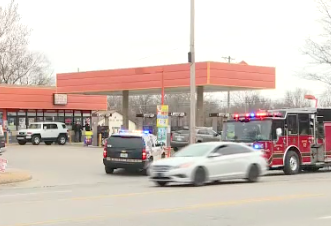
Police on the scene of the armed robbery investigation -photo courtesy KWCH
Just after 7 p.m. Saturday, police conducted a traffic stop in the 200 block of north Edgemoor in Wichita, according to officer Charley Davidson. They arrested a 17-year-old male and the 16-year-old male without incident. A firearm believed to have been used in both robberies was recovered in the vehicle.
The 17-year-old male was booked into the Juvenile Detention Facility (JDF) on warrants for the robberies, possession of narcotics and possession of a firearm by a felon. The 16-year-old male was booked on warrants for the robberies, possession of narcotics, unlawful possession of methamphetamine and a narcotic violation.
A third 17-year-old male was arrested in reference to the armed robberies on Sunday Dec. 30.
In the first armed robbery, at approximately 12:10 p.m. on Friday, Dec. 28, police responded to an armed robbery call at the Family Dollar Store, 936 S. Woodlawn. Upon arrival, Officers contacted a 59-year-old female employee. The investigation revealed two 16-year-old males and a 17-year old male entered the store, pointed handguns at a female employee and demanded property. The suspects who then fled the business took money and cigarettes. There were no injuries in this case.
In the second armed robbery, at approximately 2:45 p.m. on Friday, Dec. 28 Officers responded to a shooting at the B & H Fast Trip, 2796 S. Seneca. Upon arrival, Officers located a 16-year-old male with a gunshot wound. He succumbed to his injuries at an area hospital. The investigation revealed two 17-year-old males and two 16-year-old males entered the store, pointed handguns at an employee and customers and demanded money. The suspects took money and cigarettes. During the robbery, an armed 42-year-old male customer pulled out his firearm and fired multiple shots toward the suspects, striking one of the 16-year-olds. The suspects exchanged gunfire with the customer before fleeing the business.
MANHATTAN, Kan. (AP) — Kansas State has dismissed sophomore center Maary Lakes from its women’s basketball program for a violation of team rules and conduct detrimental to the team.
Lakes -photo courtesy KSU Athletics
Wildcats coach Jeff Mittie announced the decision in a statement Monday.
According to the Riley County Police Department, the 6-foot-4 Lakes was arrested early Monday on suspicion of domestic battery and criminal damage to property. She was released on a $750 bond.
Lakes was arrested on suspicion of domestic battery last summer, though charges against her were eventually dropped. Mittie said Lakes was “someone we thought deserved a second chance, but unfortunately, it is time for both of us to move on.”
The native of Peoria, Illinois, had played in all 13 games this season, averaging 1.6 points and 1.2 rebounds.
SALINE COUNTY — A Kansas man remains hospitalized in critical condition after a weekend accident in Saline County.
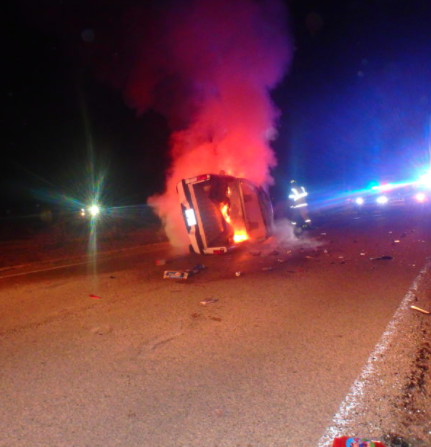
photos courtesy Saline County Sheriff’s Office
A rural Saline County man was flown to a Wichita hospital after a one-vehicle accident on West State Street Saturday night.
A 1998 Chevy S10 pickup driven by Craig McCombs, 37, rural Saline County, was westbound in the 6200 block of West State Street and North Hohneck west of Salina according to Saline County Sheriff Roger Soldan.
The driver who was ejected, sustained substantial injuries, including injuries to the head, Soldan said.
He was transported by EMS to Salina Regional Health Center and then flown to a Wichita hospital in critical condition.
A witness driving behind McCombs told deputies that he reported the accident within two minutes of it happening.
When deputies arrived approximately four minutes later, there was a small fire in the engine compartment of the pickup. The fire then spread, engulfing the pickup, Soldan said.
There was evidence of alcohol at the scene, according to Soldan.
COWLEY COUNTY — Law enforcement authorities continue their investigation of alleged identity theft.
Photos courtesy Ark City Police
Just before Christmas, authorities found credit card skimmers on two ATMs in Arkansas City, according to police.
The suspects were described as driving a red VW Jetta with a paper temporary tag that may be from Texas.
Some of the cards compromised were used in the Houston area last week. Police reported no new information Monday as they work to locate the suspects who were captured on security cameras.
WICHITA, Kan. (AP) — Kansas Sen. Jerry Moran says he wants the shutdown to come to end, saying it will soon start to affect farmers and aircraft manufacturers.
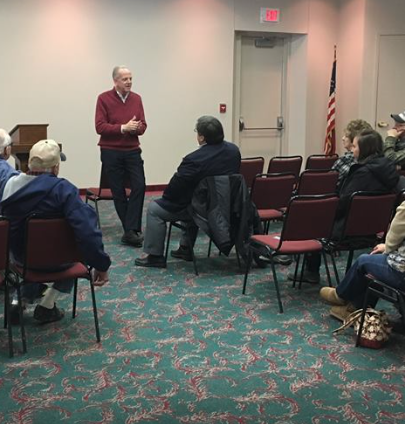
Senator Moran discussed the government shutdown on a tour in NW Kansas -photo courtesy Sen. Jerry Moran
Moran said Friday after touring three Wichita businesses that he’s “sorry” the government is in a shutdown. He added that people who are dissatisfied with the government sometimes say, “Shut her down, it doesn’t matter.” But Moran says “the things that government does are important to many people.”
He says one effect of a protracted shutdown will be that aircraft manufacturers will be unable to deliver planes because the Federal Aviation Administration office in Oklahoma City that issues aircraft titles is closed. He says farmers hurt by the trade battle with China also will have to wait for federal aid.
WICHITA, Kan. (AP) — An Ohio professor alleges in a lawsuit that Wichita State University retracted an employment offer after she told them she was pregnant.
Evangeline Heiliger says that she revealed her pregnancy for the first time and asked about childcare in March when she was offered a tenure-track job as the assistant professor of women’s studies. The suit says a dean told her the next day in an email that he “had become aware that she was no longer available for the position” and was removing her from consideration.
The suit says Heiliger never indicated she wasn’t available. Heiliger is a 41-year-old visiting assistant professor of gender, sexuality and feminist studies at Ohio’s Oberlin College.
The university says its investigation determined that no laws were broken.
WICHITA, Kan. (AP) — Shady telemarketers would face a tougher time operating in Kansas under a new bill.
Rep. Rhiley -courtesy photo
Incoming Republican Rep. Bill Rhiley, of Wellington, says he pre-filed the bill after getting complaints about calls that appear to be from Kansas, but instead are automated sales pitches from telemarketers in other states or overseas.
The bill would set limits on the use of robocalling equipment and crack down on “neighbor spoofing,” the practice of making distant calls display as local numbers on caller ID. Rhiley says he’s recently had telemarketers spoof his own phone number.
One provision of the bill would prohibit anyone, including a phone company, from providing local phone numbers to an out-of-state entity unless the number is openly listed. Rhiley wants consumers to share their stories .
SUMNER COUNTY — A Kansas mother accused in the death of her 7-month-old daughter will go to trial for the alleged crime.
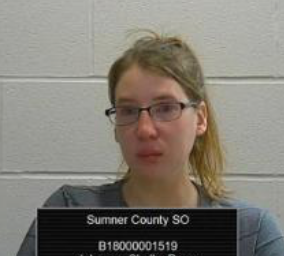
Johnson -photo Sumner County
Shelby Johnson, 26, was bound over for trial in the case last week, according to the Sumner County Attorney’s office. Her arraignment is scheduled for 1:30p.m. March 7.
On April 1, 2018 Schuyler Hulett took his 7-month-old daughter Jesslin Hulett from the home he shared with Johnson in Wellington to the emergency room at Sumner Regional Medical Center because the child was not breathing, according to the criminal complaint.
Doctors in the ER did get a pulse and the child was transported to a Wichita hospital where she died April 5.
Court documents say Johnson killed her infant daughter either by “cruelly beating” or “shaking” the baby. The documents say the girl needed immediate medical treatment, but Johnson went back to bed and the baby’s father found her not breathing about an hour later. The baby’s injuries included three bone fractures to her skull.
An autopsy found the child suffered from blunt force trauma to the head, broken bones and other injuries, according to court documents.
PHOENIX (AP) — Kwamie Lassiter, the former Arizona safety who had four interceptions in the Cardinals’ season-ending victory that clinched a playoff berth in 1998, died Sunday. He was 49.
Kwamie Lassiter played at Butler County and then for the Jayhawks from 1992-94 and then played 10 seasons in the National Football -League-image courtesy University of Kansas Athletics
The Cardinals announced Lassiter’s death without providing details. Arizona Sports, the website of the team’s flagship radio station, said Lassiter had a heart attack while working out.
“We were all devastated to learn of Kwamie’s passing today and our hearts go out to all of his family and friends,” Cardinals President Michael Bidwill said in a statement. “Kwamie came to the Cardinals, as an undrafted rookie free agent. He not only became a key contributor to our team for eight seasons but continued to make an impact on this community after his playing days ended. He will be missed greatly.”
Lassiter had had eight interceptions in 1998, the last four against San Diego to help the Cardinals reach the playoffs for the first time since moving to Arizona. The former Kansas Jayhawk had nine interceptions in 2001 and was named an alternate to the Pro Bowl.
After eight seasons with the Cardinals, Lassister played for San Diego in 2003 and St. Louis in 2004. He had 25 career interceptions, 25 with the Cardinals, returning two for touchdowns.
Lassister starred at Menchville High School in Newport News, Virginia, and played two years at Butler County Community College in Kansas before transferring to Kansas, where he played from 1992 to 1994.
BARTON COUNTY — Law enforcement authorities are investigating a suspect after a weekend incident involving gunshots in Ellinwood.
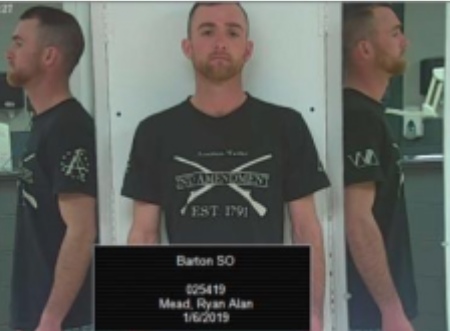
Mead -photo Barton Co.
Just after 11p.m. Saturday January 5, police responded to the 500 block of East 2nd Street in Ellinwood in reference to Violation of Protection Orders and Criminal Threats, according to a media release.
The suspect was identified as 26-year-old Ryan Alan Mead and officers responded to his residence in the 100 block of West B Street. as multiple gunshots were reported in that area.
Officers determined the suspect fired approximately fourteen 9mm rounds from a hand gun into the ground in the front yard of his residence, then fled the scene at a high rate of speed in a Ford Explorer just before the officers’ arrival.
The investigation continued into the early morning hours of Sunday, when the suspect’s unoccupied vehicle was located in the 5800 block of Broadway in Great Bend.
Officers developed information on a possible suspect location and responded to the 5900 block of Eisenhower Court where they took Mead into custody without incident just after noon.
Mead was booked into the Barton County Jail on requested charges of Criminal Threat, Violation of Protection Order, and Unlawful Discharge of a Firearm. He is being held on a $5,000 Bond.
This case is still under investigation, anyone with information is asked to contact the Ellinwood Police Department.
SHAWNEE COUNTY —Law enforcement authorities are investigating a Kansas felon on new charges.
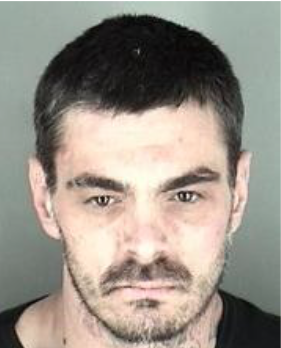
Hayes -photo Shawnee Co.
Just after 12:45 p.m. Friday, police were following up on a theft of packages from the north Topeka area.
Officers obtained a good description of the vehicle used in the thefts and ultimately located the vehicle at 21st and SW Moundview in Topeka, according to Lt. Manual Munoz.
When offices conducted a traffic stop they located the items taken in the package thefts in plain view.
Further investigation revealed a shotgun along with other items taken from other thefts.
Officers arrested Jonathan Hayes, 34, and booked him into Shawnee County Department of Corrections for Theft and Felon in Possession of a firearm, according to Munoz.
BISMARCK, N.D. — When the winds howl and the bone-numbing cold sets in, scores of North Dakotans willingly become lawbreakers by warming up their vehicles without being in them, ignoring a potential $1,500 state fine and 30 days in jail.
“It’s ineffective. The people ignore it. Let’s get rid of it,” said Republican Rep. Daniel Johnston, who is sponsoring a bill that would make it legal for people to leave their vehicles running unattended, amending a statute that has been on the books since the 1940s that no one can remember being enforced.
“Simply put, the law goes against the will of the people,” Johnston told the House Transportation Committee Friday. “The citizenry of North Dakota recognizes this is a bad law.”
Others don’t even realize it’s on the books, he said.
Donnell Preskey, executive director of the North Dakota Sheriffs and Deputies Association, told the panel that her group supports amending the law. No one spoke against it.
North Dakota’s law was put on the books nearly 75 years ago as a deterrent against automobile theft. Several states in recent years have enacted anti-idling laws in an effort to increase air quality.
National Conference of State Legislatures data shows nine states have laws to curb vehicle idling, and another 14 limit idling for certain vehicles, such as state-owned vehicles and school buses.
The group said idling wastes about 6 billion gallons of fuel annually, and 18 states have grants, loans, tax credits to encourage idle reduction.
Even environmental group Sierra Club is not standing in the way of the effort to make idling legal. Wayde Schafer, the group’s North Dakota spokesman, said banning idling vehicles is futile in North Dakota, where it’s considered a necessary evil because of brutal winter weather.
“It’s so engrained in our culture and people will never change their habits even if they know it’s against the law,” Schafer said. “It’s part of winter in North Dakota, and people want to get into a warm car, so what do you do?”
Schafer said his group will not take a position on the proposed legislation.
Bismarck Police Chief Dave Draovitch, who has spent nearly three decades with the department, said idling vehicles that are left unattended is not something that officers enforce.
“If we ever wrote a citation for it, I’d be surprised,” Draovitch said.
Still, police departments across the state often issue public service announcements reminding residents to lock their vehicles.
“We’d rather have vehicles locked,” Draovitch said, adding that leaving vehicles running while unoccupied creates a golden opportunity for thieves.
Fargo police spokeswoman Jessica Schindeldecker said most vehicles stolen in North Dakota’s biggest city occur in the winter, and most are because they are left idling with the doors unlocked.
Schindeldecker did not know if anyone had ever been cited for leaving a vehicle idling, but she said officers sometimes “chat with the owner, and tell them they just want them to stop doing it.”
Jennifer Wagner of Minot had her vehicle stolen years ago after leaving it running to drop off some items at her church. She now owns a business with her husband that installs remote starters that allow a driver to preheat a vehicle before getting into it.
North Dakota’s current law is “dumb,” Wagner said.
Most remote starters are equipped with anti-theft systems that won’t allow the vehicle to be opened or driven without a key, she said.
“Most people probably don’t even know about the law, and even if they do they don’t care and are willing to take the risk,” she said.
Her business, Too Dark Motorsports, is one of dozens in the state that sells and installs remote starters, which are often booked two to three weeks out in the winter, she said.
Wagner said she and other North Dakotans don’t buy the argument that vehicles warm up quicker while being driven. About 30 people set up appointments one day last week when a dangerous cold snap hit the region.
“No one wants to get in a frozen car in North Dakota and let it warm up,” she said. “No one.”
By Kristoffer Tique, Midwest Center for Investigative Reporting- The Associated Press
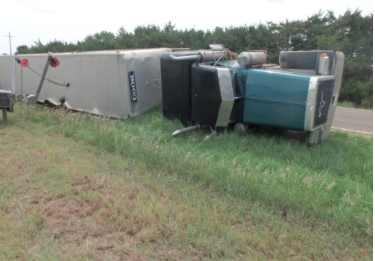
A tractor-trailer rig hauling cattle overturned on Kansas Highway 4 in southeastern Saline County in August- Photo courtesy Saline County Sheriff’s Office
It was sometime around 4 a.m. on a cool spring morning when James McGilvray lost control of his semi, careening into a ravine off Interstate 49 forty minutes south of Kansas City.
His trailer, which carried between 80 and 100 cattle, according to police records, flipped on its side as the truck plowed to a halt. The crash killed roughly half the livestock onboard, with the other half escaping onto the highway where state and city law enforcement spent the next four hours shutting down traffic in order to corral the remaining herd.
McGilvray, who was 48 at the time of the crash, blamed another car for causing the wreck, according to the crash report, despite officers marking no evidence for another vehicle’s involvement. Rather, Stacy Ball, 45, who was traveling with McGilvray and was in the sleeper cabin changing when the crash occurred, believes McGilvray fell asleep at the wheel.
On the crash report, Ball told officers that McGilvray had run off the road twice the previous night and “had been driving ‘non-stop’ for 2-3 months between Mississippi and Florida.” She also informed officers that McGilvray had been pushing himself to prove to his current employers that despite his age, he was still fit to drive the long, hard hours commonly associated with the trucking industry.
“Show me you’re not too old to haul cattle,” Ball recalled the trucking company telling McGilvray when he was first hired, according to the report.
Ball also told officers that McGilvray hadn’t updated his mandatory hours log because of how busy the company was keeping him, and that the trucking company wasn’t using electronic logging devices, or ELDs, which in December 2017 the Federal Motor Carrier Safety Administration began requiring most U.S. truckers to carry to prevent fatigue-related accidents.
Numerous attempts to reach McGilvray for comment were unsuccessful.
Under current federal hours of service law — which dictate how long commercial drivers can be on the road —commercial drivers can operate on duty for 14 hours after a mandatory 10-hour break. Electronic logging devices, which are approved GPS tracking devices plugged into the truck’s engine, are meant to replace older paper logs in order to more accurately track driver’s on-duty hours, federal officials said. The devices are projected to save dozens of lives and prevent hundreds of injuries each year, officials said, plus save stakeholders more than $1 billion annually by reducing paperwork.
But McGilvray’s crash, which happened April 27, 2018, came while livestock haulers were still temporarily waived from complying with the new ELD law because of persistent lobbying efforts from the agricultural industry. In fact, federal agencies that track and enforce these laws, like the FMCSA, have been slow to implement the devices since the law came into effect.
FMCSA has also expanded broad exemptions for drivers carrying agricultural commodities and is now considering changing several other standards that some safety advocates say would greatly reduce the effectiveness of hours of service rules.
That’s despite national data showing a rise in large truck-related fatalities. In 2017, there were 841 occupants of large trucks killed in crashes, up from 725 in 2016, and 665 in 2015, according to a National Highway Traffic Safety Administration report. When including pedestrians and other cars involved in those crashes, fatalities jump to 4,761 in 2017, up from 4,369 the year prior.
That upward trend goes for Missouri’s statewide data, too. According to the Missouri Department of Transportation, the number of deadly crashes involving commercial motor vehicles rose by more than 40 percent between 2013 and 2016.
“Forty-four states have experienced increases in truck crash deaths since 2009,” said Harry Adler, a spokesman for the Truck Safety Coalition, a national nonprofit focused on reducing truck-related fatalities and injuries. “When you look at the state of truck safety, the number of truck crashes, injuries, fatalities, they all keep going up.”
For years, industry associations like the National Pork Producers Council and the National Cattlemen’s Beef Association have touted the safety record of their drivers to circumvent expanding regulation.
“Livestock haulers comprise one of the safest sectors of the commercial motor vehicle industry due in part to the very nature of the only cargo they haul: live animals,” wrote the association in an October petition to the FMCSA, asking the agency to increase on-duty hours for livestock drivers from 14 hours to 16.
The group points to an analysis they did of FMCSA data between 2013 and 2015, where livestock haulers make up between 6-7 percent of the nation’s roughly 4 million commercial drivers yet constitute less than 1 percent of the total crashes.
Added to their driver safety record is the fact that livestock haulers must also worry about keeping their animals safe, particularly during times of extreme heat or cold, said Allison Rivera, the beef association’s executive director for government affairs.
“It’s an animal welfare issue,” Rivera said. “The problem is that, unlike the rest of trucking, we can’t just stop at a rest stop for 10 hours and rest with the animals in the back.”
So far, that argument has been working, delaying ELD implementation and relaxing the way federal agencies interpret hours of service laws and their exemptions.
Petitions from the National Pork Producers Council — joined by the National Cattlemen’s Beef Association and several other stakeholders — delayed the original ELD implementation date of December 2017 not once, but twice, giving livestock haulers 180 days to fall into compliance. Then on Dec. 13, the FMCSA announced on its website that transporters of livestock and insects aren’t required to carry ELDs at all “until further notice,” raising questions of when livestock haulers, if ever, will need to install the device.
But a larger change came from several revisions the FMCSA made to the National Highway System Designation Act of 1995, which established the first exemptions for drivers “transporting agricultural commodities or farm supplies for agricultural purposes.”
The act set a radius of 100 “air miles” around any pickup spot for agricultural goods, including livestock, feed and farm equipment. The agency defines an air mile as a nautical mile, which is equivalent to about 1.15 miles.
Truck drivers operating within the radius were exempt from hours of service regulations during a state’s harvest season. However, if their trip included leaving that radius after they picked up their livestock or other agricultural goods, then standard hours of service laws applied as soon as they left the radius, and they were subject to 10-hour breaks every 14 hours.
The idea was to give drivers with sensitive cargo the flexibility to manage their own schedules without having to worry about tight federal deadlines. And under pressure from the agriculture industry, Congress expanded that exemption to 150 air miles, or roughly 172 miles, back in 2012.
Then in the summer of 2017, the FMCSA quietly changed how it interpreted the nearly 30-year-old law altogether, said Matt Wells, the associate director of the Midwest Truckers Association, on a Facebook video.
Drivers hauling agricultural goods have always been exempted from hours of service rules while in the exempted radius but were required to track all their hours driving if their trip ever intended to leave it. Under the agency’s new guidelines, he said, now agricultural haulers only need to track their hours outside the radius and aren’t required to log any hours within it.
“Meaning that you record that time as off-duty, not driving,” Wells said. “This is the drastic change the FMCSA has done that you can now turn your logbook on and off throughout the day without affecting your daily or weekly hour limit of the logbook rules.”
That means that unlike before, law enforcement or regulatory agencies are now no longer privy to when a trucker is actually driving or when they’re taking a break while in exempted zones.
Industry leaders say giving drivers more flexibility and less stress over logging hours was necessary to help address the unique challenges livestock haulers face.
For example, Rivera said, truckers hauling livestock in some cases require extra training to handle live cargo, and therefore some end up loading and unloading by themselves because of workforce shortages and the cost of hiring extra manpower. That itself can be a safety concern, she said, and eats into the already limited time allotted to drivers under hours of service rules.
Some drivers have also come out publicly to say ELDs force truckers to act more recklessly because they essentially create a “hazardous race to beat the clock,” reported Business Insider back in May.
But Adler said these exemptions go too far at the expense of safety, especially since Congress considered expanding them further. In 2018, about 10 bills were introduced that would, in some way, expand hours of service exemptions or relax ELD requirements, he said.
“They’re all different attempts to lengthen the amount of time truck drivers are either driving or working, and there’s just not data to support that more time on task without a break, or longer work days, are safer,” Adler said.
One bill, called the Transporting Livestock Across America Safely Act, was introduced to both the U.S. Senate and House in early 2018, but failed to make it further. That bill, sponsored by Republican Nebraska Sen. Ben Sasse, would double the 150-air-mile exemption to 300 air miles — nearly 100 miles longer than the drive between Kansas City and St. Louis.
In states like Missouri or Illinois, where harvest season is year-round, 300 air miles essentially covers each state entirely, giving anyone hauling livestock or other agricultural goods free reign to drive within them without any kind of federal accountability.
While the FMCSA won’t deal with that bill — since it stalled —the agency is considering relaxing other hours of services rules, including short-haul limits and 30-minute breaks. Short hauls are when drivers operate only within 14 hours a day instead of 24 hours and are currently limited to 11 hours of on-duty time, 8 hours off duty and a mandatory 30-minute break.
The agency announced in October that it would be extending the public comment period for a second month to discuss proposed changes to those regulations, including increasing on-duty time from 11 hours to 12.
Duane Debruyne, acting director for FMCSA’s office of external affairs, said the agency has a robust process that prioritizes safety when considering any changes to regulation. For instance, he said, the agency gathered hundreds of comments before granting waivers to delay ELD implementation for livestock haulers in 2018 and weighed the decision carefully.
Under the safety considerations of that waiver approval, the agency stated it “expects that any drivers and their employing motor carrier operating under the terms and conditions of the exemption will maintain their safety record.”
Adler points to that as evidence the process wasn’t robust, especially when studies commissioned by the agency itself — such as a 2011 study titled Hours of Service and Driver Fatigue — show a clear correlation between longer hours on duty and increased risk of crashing.
“The FMCSA’s own studies show that working longer … will diminish safety,” he said. “So, the agency doesn’t need to look toward other studies, they have studies that they commissioned and did that show just that.”
On an early October morning in 2016, about a mile west of Osborn, Missouri, Gary Bowling’s cattle truck struck a ditch along U.S. Highway 36 and overturned.
The crash killed at least four cows and sent others to roam in the pre-dawn darkness, where they caused two additional accidents. One woman, 68-year-old Bonnie Bridgeman of Winston, Missouri, was airlifted to Kansas University Hospital with serious injuries after her car struck one of the escaped cattle.
According to the crash report, Bowling gave no explanation when the state trooper asked him what caused the accident. “I dropped off the shoulder. I don’t know,” he’s quoted to say in the report.
A witness, who was driving behind Bowling when he crashed, said he watched Bowling’s truck drop off the shoulder as it passed his car. “The cows must have shifted and made it so he couldn’t get back on the road,” the witness said in the report.
In the end, the Missouri State Highway Patrol filed the crash under “improper lane use/change,” which in some ways acts as a catch-all category when a cause hasn’t been identified. But Bowling’s crash highlights several challenges that both truckers and those enforcing safety face when it comes to hauling livestock.
Because animals often escape after crashes, they can cause additional accidents, particularly at night. And the cargo itself is exceptionally dangerous to transport because animals can move within the trailer, shifting weight and exacerbating the situation.
That’s a common reason many drivers give after they’ve crashed their livestock trailers, said Jennifer Woods, an expert in livestock handling and safety. But Woods, who operates her own livestock services company in Canada and helps train drivers on safety across North America, said that explanation is a myth.
Rather, Woods said, it’s more likely that sleepy drivers nod off and overcorrect after drifting out of their lane, or they turn too hard while merging because they’re fatigued and less in control.
“The load shifted because the trailer started to tip over,” Woods said. “The load doesn’t shift and tip the trailer over.”
In fact, a 2008 study conducted by Woods points to fatigue as a major cause of accidents involving livestock transportation. The study, which analyzed 415 accidents involving commercial livestock trailers in the U.S. and Canada between 1994 and 2007, most notably points to five things that suggest fatigue is the real cause behind most livestock-related crashes.
Of those crashes, it found that more than half — 59 percent — happened between midnight and 9 a.m., when drivers are likely tired — although Woods believes due to limitations from gathering that data from news reports, that the prevalence is likely closer to 90 percent.
The vast majority —80 percent —were single-vehicle accidents, which helps rule out other vehicles causing the crash. Driver error was blamed for 85 percent of the wrecks.
The vehicle rolled over 83 percent of the time, which Woods said typically suggests the driver drifted out of the lane, then overcorrected. Trailers overturned to the right-side 84 percent of the time, which falls in line with typical fatigue-related crashes in North America, where driving is done on the right-hand side.
But outside of Woods’ study, there’s not much official data on fatigue-related crashes to help push safety efforts. Looking at national and state data, fatigue doesn’t seem to play a prevalent role. A 2007 FMCSA study that looked at 963 crashes involving 1,123 large trucks between 2001 and 2003 found fatigue only playing a role in 13 percent of the accidents.
That’s the same rate in Missouri, at just above 13 percent. Out of the approximately 2,057 crashes involving large trucks between 2015 and 2017, just 271 involved fatigued drivers, according to the Missouri Department of Transportation.
Woods said that’s because fatigue is highly underreported in crashes. “Does the driver look at the cop and say, ‘Hey, I’m tired?’” she said. “Because I can tell you, when your truck hits the ditch, you’re wide awake.”
In fact, a 2014 study by the AAA Foundation for Traffic Safety estimated an average of 328,000 drowsy driving crashes occur annually, which is more than three times the police-reported number. Of those, about 109,000 result in injury and roughly 6,400 are fatal, the report said.
Cpt. John Hotz, director of the public information and education division of the Missouri State Highway Patrol, said it is likely that fatigue is underreported in highway crashes because proving fatigue played a role can sometimes be difficult to do.
Drivers are disincentivized to admit fatigue, Hotz said, since admitting fault can result in discipline from employers, suspension of a commercial driver license or prompt insurers to raise rates. It can also result in a hefty fine or hold drivers criminally liable, he said.
In Missouri, anyone who crashes their vehicle because they fell asleep can get slapped with careless and imprudent driving — which depending on circumstances, can come with up to one year in jail or a $1,000 fine. If anyone is injured or killed as a result of the crash, Hotz said, that can be upped to assault or manslaughter, a felony.
Ultimately, Woods said, industry and regulators need to find a balance between public safety and animal welfare, especially when it comes to tracking driving hours and mitigating fatigue.
“There’s a lot of moving parts,” she said. “This is not just about our truck drivers, this is about our industry. It’s about animal welfare … trying to find one hat that fits them all isn’t going to work.”
Finding a balance between industry and safety needs may be easier said than done, said Adler, who believes current trends show government regulators favoring industry over safety.
For more than a decade, he said, both the Federal Motor Carrier Safety Administration and the National Highway Traffic Safety Administration have essentially stalled talks on implementing a speed limiter rule, which would require drivers to install a device that would put a cap on the truck’s top speed.
The agencies have also been slow or reluctant to address other safety proposals, Adler said, like assigning minimum hours behind the wheel for new drivers, raising minimum insurance or researching automatic emergency braking. In 2017, the agency stalled or withdrew from nearly half a dozen safety rulemakings, reported The Hill.
“You do look at some of their priorities and say, ‘Hm, they’re not focusing on proven policies that could really move the ball on safety,’ Adler said.
Adler also said that the way agricultural exemptions are being handled is making it increasingly difficult for regulators to provide needed oversight on things like hours of service and how those hours are tracked.
In states like Missouri, where agricultural exemptions have given drivers hauling livestock enormous leeway on time spent on-duty, regulating driving hours falls almost entirely on the trucking companies themselves. That means whether a driver is scheduled in a way that provides adequate time for rest, or whether drivers are being encouraged to log hours accurately, falls on company management rather than government agencies commonly tasked with that role.
That’s one of the challenges regulators and industry leaders need to consider, Woods said. Most livestock hauling companies are small and have a good track record for compliance. But there are some chronic “bad actors,” she said.
In McGilvray’s case, when he crashed his cattle trailer in Harrisonville, he was working for Phenix Transportation West Inc., a Mississippi-based company with 125 drivers, according to the FMCSA.
In the last two years alone, Phenix drivers have been involved in three fatal crashes, according to the agency’s website, and the company has received 905 inspections for compliance that resulted in 120 of its drivers receiving out-of-service violations — a government order that pulls drivers from the road until they’re back in compliance.
That gives Phenix a ratio of 13.3 percent regarding inspections to out-of-service orders, more than double the national average of 5.5. percent, according to the website.
Information on the FMCSA website also shows that, at some point this year, the agency pulled the company’s interstate operating authority. DeBruyne said that means the Mississippi company can no longer operate outside state lines, but he wouldn’t clarify when that status was revoked or for what reasons.
Ricky Wilkerson, president of Phenix Transportation West, said the fatalities involved in the company’s record are misleading and that two of the three weren’t his drivers’ fault. He also said his livestock drivers work for his cattle hauling operation Southfork Cattle Company, which has no record of compliance inspections or fatal crashes.
However, Southfork Cattle Company isn’t authorized to operate across state lines, according to the FMCSA, and Wilkerson acknowledged McGilvray worked for Phenix. Furthermore, according to the agency’s website, Phenix reported that it does, in fact, haul livestock.
Wilkerson wouldn’t clarify that discrepancy. He also wouldn’t clarify why despite his statement that Phenix drivers installed ELDs back in 2017, McGilvray was driving without one, and disputed the notion that his company pressured any of its employees to drive beyond what’s allowed under federal law.
“It’s a mystery to us, too,” Wilkerson said of McGilvray’s crash. “But I can assure you that he had ample time to make his delivery.”
For Adler, McGilvray’s crash is the perfect example of why rolling back hours of service rules or expanding exemptions that allow more time on duty for drivers without federal oversight is a bad idea.
“All too often, you hear folks throw around the term ‘flexibility,’” he said. “Yet, there’s no discussion on how that quote, unquote flexibility can be exploited by some of the worst actors. And I think that’s what you see with so many of these unstudied, unsafe proposals.”
The nonprofit news outlet Midwest Center for Investigative Reporting provided this article to The Associated Press through a collaboration with Institute for Nonprofit News.