A Kansas man was injured Christmas Day when he tried to avoid hitting an animal on the road.
The Kansas Highway Patrol reports Joseph A. Huiett, 18, Minneapolis, was driving northbound on Interstate 135 in Saline County 1.6 miles south of Interstate 70 at 7 p.m. Dec. 25.
An unknown animal ran out in front of the 2004 Dodge Durango. The vehicle veered off onto the right shoulder, striking the guard rail. The SUV veered back across the driving lane and came to a stop on the left inside shoulder of the roadway.
Huiett was transported to Salina Regional Medical Center.
SHAWNEE COUNTY — Law enforcement authorities are investigating a suspect for an alleged car theft and robbery.
Jackson -photo Shawnee Co.
Just before 8:30p.m. Sunday, police responded to the area of 1600 Block of SW Fillmore in Topeka on the report of an Aggravated Robbery, occurring to an individual, according to Lt. Aaron Jones.
The victim reported a blue colored vehicle approached him, when a Hispanic male jumped out, wearing a gray and black striped hooded sweatshirt. The suspect approached him demanding his keys and wallet. During the robbery the suspect, indicated he had a weapon, but the weapon was never displayed and took the victims vehicle described as a Silver, 2011 Dodge Caliber, with Kansas tags.
Just before 6p.m. Christmas Eve, officers of the Topeka Police Department located the stolen Dodge Caliber near 13th and SW Harrison.
When they attempted to stop the vehicle, the driver failed to stop initiating a pursuit. The occupants abandoned the vehicle in the 600 Block of SE Lake east alley, according to Jones.
Information was developed leading to a house on the west side of the 600 block of SE Lake in search of the occupants. The house was surrounded as the vehicle was searched. 2 firearms were recovered from the vehicle; both used small caliber rifle rounds. At approximately 7pm, officers made contact with the homeowner. Police took five men and one woman from the house for questioning.
On Christmas Day, police reported Christopher Jackson, 25, was taken to the Shawnee County Department of Corrections under suspicion of aggravated robbery in relation to the theft of the silver Dodge Caliber as well as possession of stolen property in relation to the aggravated robbery of a white Pontiac G6.
KANSAS CITY (AP) — A Kansas man’s wish for two front teeth for Christmas is coming true.
A local church and friends helped raise money for Olathe man Evans Kamuru’s dental implants.
Kamuru wrote on Facebook that one front tooth broke off when he was using his teeth to cut tape and wrap presents last Christmas season. He says the other one broke in January when he was eating a waffle.
Kamuru says both teeth had crowns and were weak.
His friends created a group to help raise money for implants. Lenexa’s Gospel Outreach Center chipped in $15,000 this month, and a dentist offered a discount.
The newspaper reports that it will take months to insert the implants, but Kamuru will have two new teeth by next Christmas.
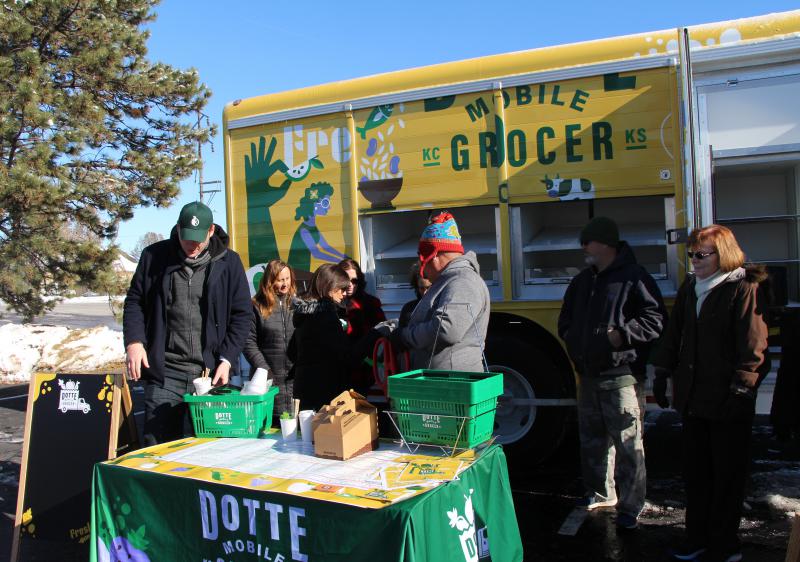
Community council members, organizers and others gather at the Dotte Mobile Grocer’s soft launch in November. Members hope the community council gives this food desert-busting initiative more staying power than other attempts to run a grocery on wheels. Kansas News Service
By MADELINE FOX Kansas News Service
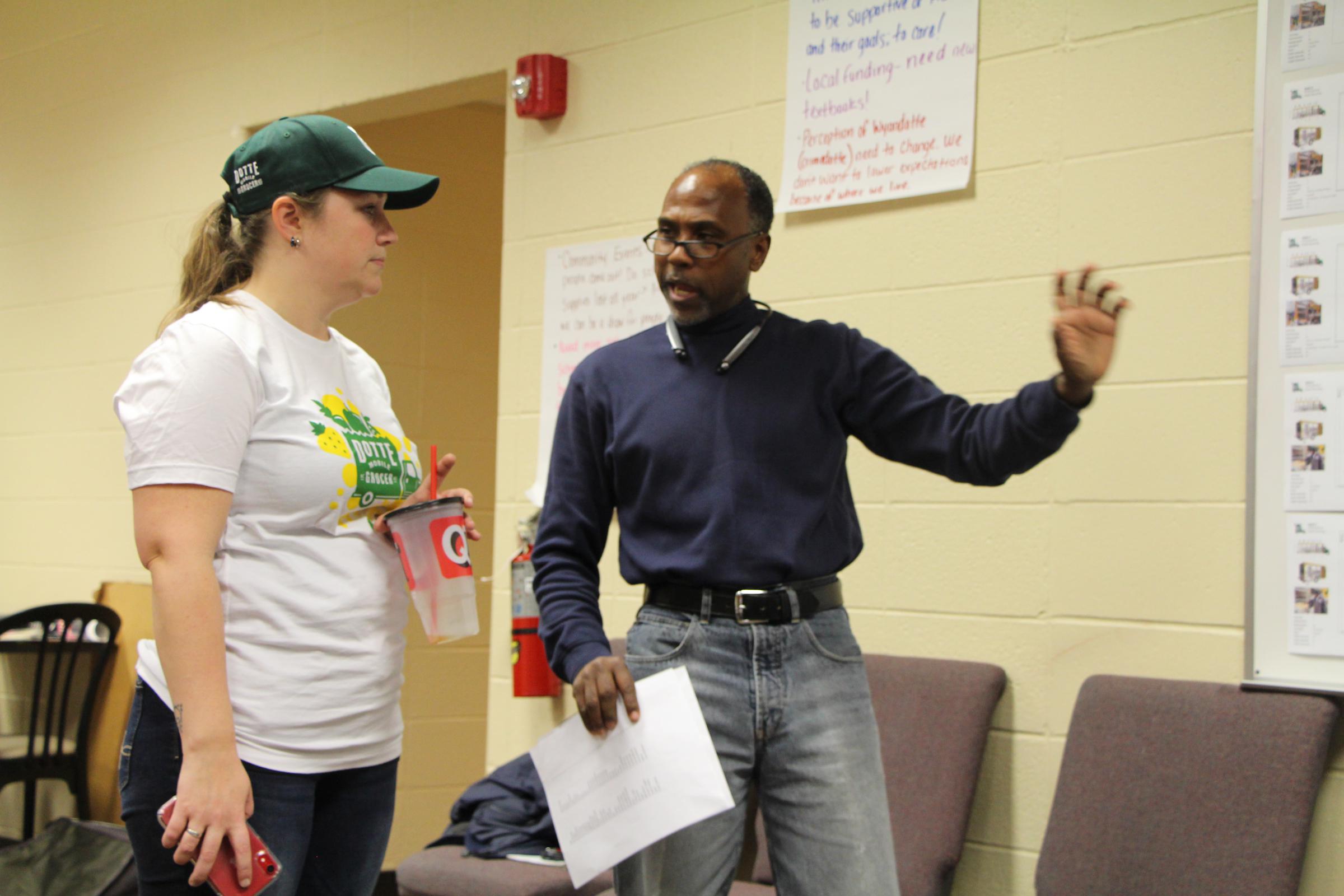
Every Wednesday night, some Wyandotte County residents gather in the back room of a community health center in Kansas City, Kansas.
On gridded sheets taped to a whiteboard, sometimes they scribble classic grocery store items — milk, cheese, meat.
The Dotte Mobile Grocer’s Mobile Market Community Council figures getting locals involved in the details means everything to the success of its grocery-store-in-a-food-truck idea.
Neighborhood residents get a say in everything from how to stock shelves to where the truck will park on which days. Listening to what neighborhood shoppers need and want, goes the thinking, makes all the difference in filling pockets of the county that no longer contain any local grocers.
In theory, that rolling grocery will deliver healthy food that people in particular neighborhoods want but can’t easily get.
Dorothy McField has seen one grocery store after another disappear in her more than 80 years living in Kansas City.
“As the larger ones took over, the smaller ones got run out of business,” she said. “Then people move, things happen — the next thing you know, we don’t have any.”
Across Kansas, the closing of grocery stores has hollowed out communities and left residents stuck. They either travel impractical distances — maybe many miles in rural areas, or across multiple bus routes in cities — or get stuck with overpriced, less healthy offerings from bodegas and convenience stores.
The disappearance of grocery stores happens with regularity, shutting off the poor, especially, from the fresh produce, meat and other staples they need to eat well.
The Dotte Mobile Grocer marks just the latest attempt at a mobile solution to an area’s food deserts. Rollin’ Grocer, a Kansas City, Missouri,-based mobile grocer, ran for a little more than a year before suspending its business in July.
Having a group of community members make even the smallest decisions about the Dotte Mobile Grocer can be time-consuming. It took the council members more than half an hour to write in just where to shelve things on a single refrigerated panel of the truck.
But, its backers suggest, having a large group of locals invested in the truck’s success is key to avoiding a fate like that of the Rollin’ Grocer.
Kolia Souza, a food systems development specialist in Kansas, called community-driven solutions the underpinning of successful fixes for poor food access.
More local people invested in a project’s success means more folks determined to prevent its failure. Operators hope that means they’ll stick around and make it work, even if nonprofit help or grants run out.
It also guards against local frustration at out-of-towners parachuting in with a fix that might not reflect what the community wants.
“Communities like ours are wary of outside — not even just outside, but well-intentioned people — saying, ‘I’ve identified a problem,’” said Mary Collins, a member of the Dotte Mobile Grocer’s community council. “Without really considering, ‘What do you think you need?’”
A member of the community council talks to Dotte Mobile Grocer driver Hannah Bailey about where to place grocery items in the truck.
Credit Madeline Fox / Kansas News Service
The mobile grocer model won’t work in all of Kansas’ food-scarce areas. In Kansas City, a truck can hit 15 food-starved spots, and 44,000 people, without traveling vast distances.
In more spread-out, rural communities, much more of the day would have to be spent driving from one location to the next. That would mean less time selling — and much tighter margins in an industry where profits turn on selling large quantities.
In Kansas towns smaller than 2,500 people, nearly one in five grocery stores closed between 2008 and 2015.
Grocery trucks can’t replace all those stores. So Souza works with food policy councils similar to the Dotte Mobile Grocer’s group of locals across the state to unlock other ideas.
For some, that means small, struggling grocery stores piggybacking on a neighboring town’s larger store, and more robust buying power, to hit purchasing minimums. In other places, it’s community gardens tended by a school and woven into class lessons.
Kansas is actually ahead of other states when it comes to big-picture thinking about food access, said Tina Khan, who works with the Kansas Alliance for Wellness to help develop local food systems.
“Kansas is really leading the way in, ‘Let’s look at that entire food system’ — aggregation, production, consumption, distribution, access,” she said.
That puts it ahead of states still trying to get farmers’ markets running. But even the solutions communities have come up with, like the Dotte Mobile Grocer, aren’t comprehensive.
“We’re not there yet,” Khan said.
Matt Kleinmann is a doctoral student at the University of Kansas. He helped come up with the mobile grocer idea and facilitates the community council. Kleinmann said the truck’s operation is fully funded by grants that will last through its first year. After that, organizers will have to make their case to health and community foundations for more money.
Grocery stores have to move a lot of merchandise to make money because products aren’t marked up as high as merchandise such as clothing or electronics.
With the size limitations of a truck, it’s hard to hit that kind of volume. Add in the non-selling hours of loading and unloading, and the cost of running the truck from stop to stop, and it’s hard for mobile markets to turn a profit, said Lucas Signorelli, executive director of St. Louis’s MetroMarket.
“I haven’t heard of anyone doing it profitably,” he said, “and we’re decently well-networked with other mobile markets around the country.”
The Dotte Mobile Grocer’s projected January open date might not do it any favors. Signorelli said their grocery bus suspends service from Thanksgiving to April because foot traffic slows down in the cold weather, and they’re worried about asking drivers to load, unload and sell in cold, icy conditions.
“Winters in a mobile market are really long and hard,” he said.
Signorelli also said he’s not heard of any mobile market that’s profitable just based on grocery sales. They all get by with grants.
A mobile grocer doesn’t replace a fully-stocked, permanent grocery store.
“I don’t think it’s gonna be the permanent solution,” said McField, the longtime resident. “But for right now, it’s beautiful.”
Plans are already underway for The Merc, a grocery co-op, to open a store in downtown Kansas City, Kansas, and there’s talk of more brick-and-mortar stores moving into the county.
Collins, the community council member, said she’s excited — not worried — about the idea of the Dotte Mobile Grocer becoming obsolete if permanent stores move in. She said the truck could perhaps be retrofitted again, and become a transport for people with limited mobility to their nearest full-line grocery store.
“If nobody needs to come to the mobile market to get their groceries anymore,” she said, “you know what? That’s a success to me.”
Madeline Fox is a reporter for the Kansas News Service, a collaboration of KCUR, Kansas Public Radio, KMUW and High Plains Public Radio covering health, education and politics. You can reach her on Twitter @maddycfox.
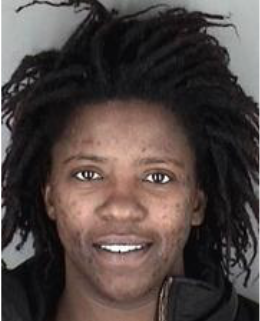
SHAWNEE COUNTY — Law enforcement authorities are investigating a suspect after an altercation with a knife.
Lately -photo Shawnee Co.
Just before 11:30p.m. Sunday, police were dispatched to SW 3rd and S. Topeka Boulevard in Topeka on a report of a stabbing, according to Lt. Manuel Munoz.
Officers located a male victim suffering from non-life injuries.
The victim was transported to a local hospital to be treated for his injuries.
Officers located the suspect identified as 31-year-old Cassandra Lately in a nearby apartment and she was transported to the Law Enforcement Center and then to the Shawnee County Department of Corrections for aggravated domestic battery, according to Munoz. Both the victim and suspect are known to each other.
SHAWNEE, Kan. (AP) — Three children and their baby sitter escaped a fire at a Shawnee home that started when Christmas lights ignited leaves in a gutter.
The Kansas City Star reports the fire was reported about 2:30 p.m. Friday when lights ignited leaves and flames spread to wood shake shingles.
After hearing a crackling sound, one of the children looked out a window and saw the roof had caught fire.
The children, ages 4, 6 and 14, and their baby sitter escaped and called 911.
Firefighters quickly extinguished the fire and were able to save the family’s Christmas tree and presents.
The fire caused about $40,000 in damage.
WICHITA, Kan. (AP) — Prosecutors will review a crash that killed a 24-year-old Kansas man for possible criminal charges.
The Wichita Eagle reports that Sedgwick County Sheriff’s Sgt. Lanon Thompson says the collision that killed Logan Owens remains under investigation. He says the agency intends to present its findings to the Sedgwick County District Attorney Marc Bennett’s Office.
Owens was a passenger in a vehicle that ran a stop sign and collided with another vehicle around 3:30 a.m. Thursday. The crash report says the man driving the vehicle carrying Owens was taken to a hospital with serious injuries. The other driver received possible minor injuries but refused treatment.
The report says authorities are investigating possible drug or alcohol use at the time of the crash.
A southwest Kansas man was killed in a three vehicle traffic accident Sat., Dec. 22, in Kingman County.
The Kansas Highway Patrol reports a 2018 Kia, a 2007 Toyota Corolla, and a 2015 Ford F150 pickup were involved in a crash three miles west of Kingman on U.S. Highway 54 shortly after 2:36 p.m.
One of four people in the Toyota, Magaly Garcia-Jimenez, 63, Dodge City, died at the scene. He was not wearing a seat belt.
The other three people, also Dodge City residents, were transported with injuries ranging from minor to serious to the Kingman County Hospital in Kingman. Those transported were Juan Hondal-Massip, 66; Elizabeth Caraballo, 60; and Maikel Hernandez-Morea, 30.
The Kia driver, Grant Holmes, 28, Lawrence, was also taken to the hospital with minor injuries.
The four occupants in the pickup, driver Michael Worsley, 36, Kansas City, Missouri; Alexis Worsley, 13, Kansas City, Kan.; Jakenzee Worsley, 11, Kansas City, Kan.; and Raymond Munoz, 52, Syracuse, were not transported to the hospital, although Munoz and Jakenzee Worsley had suspected minor injuries.
The crash remains under investigation by the Highway Patrol.
Mariah Carey on stage for NBC “Today Show” Concert / Shutterstock.com
By JONATHAN LANDRUM Jr. AP Entertainment Writer
LOS ANGELES — Mariah Carey’s “All I Want for Christmas Is You” is the highest-charting Billboard Hot 100 holiday hit in 60 years, but Americans still prefer hearing carols such as “Silent Night” and “Jingle Bells,” a new poll shows.
With Christmas next week, 12 percent of Americans named “Silent Night” as their favorite holiday song followed by “Jingle Bells” at 8 percent, according to a poll by The Associated Press-NORC Center for Public Affairs Research. The open-ended question showed that “It’s a Wonderful Life” is a fan favorite among holiday films, followed closely by a mix of recent comedies and classics.
Nine percent of respondents listed the 1946 Frank Capra classic “It’s a Wonderful Life” as their favorite film. Jimmy Stewart plays a conscientious family man who faces a seemingly insurmountable debt and attempts to end his life, but is stopped by a guardian angel on Christmas Eve.
“It’s a story of redemption,” said Michael Germana, 65, who called the film his favorite. The California native is also among the 21 percent of adults 60 and older who choose “Silent Night,” which was first performed 200 years ago.
“It’s a song of inclusion,” Germana said. “There’s no strife.”
Americans under 30 are more likely than those older to name “Jingle Bells” (12 percent) and Carey’s “All I Want for Christmas is You” (7 percent) as their favorite.
Carey’s song only trails the 1958 song “The Chipmunk Song” by David Seville as the highest-charting hit on Billboard. Other popular songs on Billboard charts include Kenny G’s “Auld Lang Syne” and “This One’s for the Children” by New Kids on the Block.
“All I Want for Christmas Is You” was named by 3 percent of adults overall, while “Baby It’s Cold Outside,” which has drawn criticism in the #MeToo era and led some stations to stop playing it, was named by 5 percent.
There were more contemporary choices among respondents when it came to film. Seven percent chose 1983’s “A Christmas Story” and “How the Grinch Stole Christmas,” but most people didn’t specify whether they preferred the 1966 animated television special or the 2000 live-action adaption starring Jim Carrey. A computer animated version, “The Grinch” has earned more than $239 million domestically since its early November release.
Six percent selected the 2003 comedy “Elf” starring Will Ferrell, the Chevy Chase-led “National Lampoon’s Christmas Vacation” and “Home Alone,” a 1990 box office hit starring Macaulay Culkin as the burglar-thwarting Kevin McCallister.
Also listed as a favorite by 2 percent of respondents: the 1988 Bruce Willis action film “Die Hard.”
Overall, Seventy movies or Christmas specials and 107 songs were cited as holiday favorites by poll respondents.
___ The AP-NORC poll of 1,067 adults was conducted Dec. 13-16 using a sample drawn from NORC’s probability-based AmeriSpeak Panel, which is designed to be representative of the U.S. population. The margin of sampling error for all respondents is plus or minus 4.1 percentage points.
Respondents were first selected randomly using address-based sampling methods, and later interviewed online or by phone.
LENEXA – The U.S. Environmental Protection Agency (EPA) announces the availability of $1.5 million grant funding in EPA Region 7 to implement projects aimed at reducing emissions from the region’s existing fleet of older diesel engines. EPA anticipates awarding approximately $40 million in Diesel Emission Reduction Program (DERA) grant funding nationally to eligible applicants, subject to the availability of funds.
“By financially supporting projects that upgrade aging diesel engines, EPA is helping improve their efficiency and reduce air pollution throughout the nation,” said EPA Acting Administrator Andrew Wheeler. “From our grant programs to our new Cleaner Trucks Initiative, EPA is taking important steps to help modernize heavy-duty trucks and provide cleaner, more efficient methods of transportation that will protect the environment and keep our economy growing.”
Diesel-powered engines move approximately 90 percent of the nation’s freight tonnage, and today nearly all highway freight trucks, locomotives, and commercial marine vessels are powered by diesel engines.
EPA is soliciting applications nationwide for projects that significantly reduce diesel emissions and exposure, especially from fleets operating at goods movements facilities in areas designated as having poor air quality. Priority for funding will also be given to projects that engage and benefit local communities and applicants that demonstrate their ability to promote and continue efforts to reduce emissions after the project has ended.
EPA anticipates releasing a separate Tribal Clean Diesel funding opportunity in late 2019.
In October, during Children’s Health Month, EPA announced the availability of approximately $9 million in rebates to public school bus fleet owners to help replace or upgrade older engines. This is the sixth rebate program to fund cleaner school buses under DERA, that have supported nearly 25,000 cleaner buses across the country for America’s school children.
Background
Since the first year of the DERA program in 2008, EPA has competitively awarded over 530 grants and 390 rebates across the country. Many of these projects funded cleaner diesel engines that operate in economically disadvantaged communities whose residents suffer from higher-than-average instances of asthma, heart and lung disease.
Eligible applicants include regional, state, local or tribal agencies, or port authorities with jurisdiction over transportation or air quality. Nonprofit organizations may apply if they provide pollution reduction or educational services to diesel fleet owners or have, as their principal purpose, the promotion of transportation or air quality. Applicants may apply until Wednesday, March 6, 2019.
Under this competition, EPA anticipates awarding between 40 and 80 assistance agreements. Applicants must request funding from the EPA regional office which covers the geographic project location. The maximum amount of federal funding that may be requested per application varies by Region.
Region 1 (Connecticut, Massachusetts, Maine, New Hampshire, Rhode Island, Vermont) will accept proposals requesting up to $1,000,000 in grant funds.
Region 2 (New Jersey, New York, Puerto Rico, U.S. Virgin Islands) will accept proposals requesting up to $2,500,000 in grant funds.
Region 3 (Delaware, District of Columbia, Maryland, Pennsylvania, Virginia, West Virginia) will accept proposals requesting up to $2,500,000 in grant funds.
Region 4 (Alabama, Georgia, Florida, Kentucky, Mississippi, North Carolina, South Carolina, Tennessee) will accept proposals requesting up to $2,000,000 in grant funds.
Region 5 (Illinois, Indiana, Michigan, Minnesota, Ohio, Wisconsin) will accept proposals requesting up to $3,000,000 in grant funds.
Region 6 (Arkansas, Louisiana, New Mexico, Oklahoma, Texas) will accept proposals requesting up to $2,500,000 in grant funds.
Region 7 (Iowa, Kansas, Missouri, Nebraska) will accept proposals requesting up to $1,500,000 in grant funds. For questions about the regional program, contact Greg Crable, [email protected] or 913-551-7391.
Region 8 (Colorado, Montana, North Dakota, South Dakota, Utah, Wyoming) will accept proposals requesting up to $2,400,000 in grant funds.
Region 9 (Arizona, California, Hawaii, Nevada, Guam, American Samoa, Northern Mariana Islands) will accept proposals requesting up to $4,000,000 in grant funds.
Region 10 (Alaska, Idaho, Oregon, Washington) will accept proposals requesting up to $1,000,000 in grant funds.
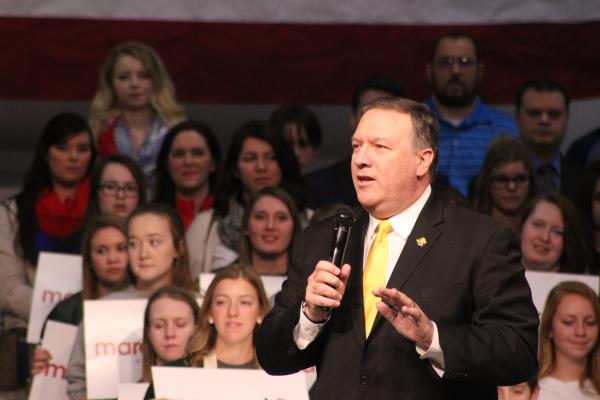
U.S. Secretary of State Mike Pompeo, Nadya Faulx / KMUW/File photo
By BRIAN GRIMMETT Kansas News Service
Mike Pompeo, the U.S. Secretary of State and a former Kansas congressman from Wichita, spoke about some of the key issues he is dealing with as the country’s leader of foreign policy during a brief interview Thursday with KMUW.
Trade War with China
Pompeo supports President Donald Trump’s decision to put pressure on China’s leadership through tariffs.
He said the current trade relationship with China is fundamentally unfair, accusing
Chinese leaders of charging excessive tariffs and forcing U.S. companies to give up their intellectual property.
“That is unacceptable,” he said. “It hurts Kansas workers.”
Since the trade war began, it has been tougher for farmers to find buyers for crops, especially soybeans. That has had a financial impact on many Kansas farmers who depend on trade with China.
But Pompeo says the short-term damage will eventually lead to a better trade situation and that the Trump administration is determined to see its plan through.
“If they would get rid of their tariffs, and they would stop stealing our intellectual property — those are the simple things (Trump’s) asking for,” he said. “It’s only fair for Kansas workers (for China) to do that.”
Syria Troop Withdrawal
Pompeo also expressed support for Trump’s decision to remove all U.S. ground troops from Syria. He said the United States has had extraordinary success in its campaign against ISIS and that it’s a good time to bring troops home.
“We will continue to keep the homeland safe from the threat from ISIS, but it no longer makes sense for there to be 2,000 soldiers stationed there,” he said. “We can accomplish this mission in a different way.”
Pompeo said even with the move, the U.S. will continue to reassure its allies that it is committed to fighting terrorism.
“Our allies know, the United States will always be the … leader in fighting against terrorism around the world,” he said. “We’ve done it for decades.”
Talks with North Korea
Pompeo said the administration remains hopeful that it can continue to make progress toward the denuclearization of the Korean peninsula.
He said that the U.S. is attempting to set up another summit between Trump and North Korean leader Kim Jong Un shortly after the beginning of the year.
In their first summit in June, the two agreed to work toward complete denuclearization, but without announcing any detailed agreement.
Later Thurday, after Pompeo’s interview, North Korean state media said the country will not give up its nuclear arms unless the U.S. gives up its nuclear weapons first.
MAYETTA (AP) — An 18-year-old Mayetta man was sentenced to five years in prison for using a rifle to shoot a 17-year-old girl, who survived.
Jackson County Attorney Shawna Miller says Lance Bailey was sentenced Thursday for aggravated battery and two counts of aggravated assault.
The Topeka Capital-Journal reports Bailey will be on three years of post-release supervision and must register as a violent offender for 15 years.
Bailey pleaded guilty last month as part of an agreement that dismissed a charge of attempted murder.
Jackson County Sheriff Tim Morse said Bailey opened fire when a car carrying three girls arrived at the home on the Potawatomi Reservation west of Mayetta.
The 17-year-old girl was shot twice as she stood in the driveway. Morse said Bailey and the girl had a previous altercation.
TOPEKA – Two Kansas state senators who earlier this week jumped from Republican to Democratic ranks have been rewarded with choice committee assignments.
The assignments given to the former moderate Republicans, Sen. Barbara Bollier of Mission Hills and Sen. Dinah Sykes of Lenxa, make them key players on two of the most contentious issues awaiting the Legislature — school spending and Medicaid expansion.
Bollier is now the top Democrat on the Senate Public Health and Welfare Committee. Before her party switch, she was the panel’s vice-chair. But Republican leaders stripped her of that rank last summer for endorsing a Democratic candidate for Congress.
“This isn’t about me, it’s about Kansans,” Bollier said. “I just want to get to work.”
Sykes is trading up on the Senate Education Committee. She’ll go from being a rank-and-file GOP member to the senior Democrat on the panel. That puts her in the thick of negotiations over how to end years of litigation over school funding.
“The opportunity to serve as the ranking minority on this committee will allow me to better represent my constituents and help shape legislation that moves through conference committees,” Sykes said in an email to the Kansas News Service.
Three-member conference committees work out differences between House and Senate versions of bills. As ranking Democrats on their respective committees, Sykes and Bollier will participate in those negotiations.
Senate Minority Leader Anthony Hensley, a Topeka teacher who had long served as the top Democrat on the education committee, stepped down to make way for Sykes.
“I’m willing to relinquish that position because I know the education issue is very, very important to Johnson County and to Sen. Sykes’ constituents,” Hensley said.
Last session, lawmakers approved a plan to put an additional $522 million into the school funding formula over five years. They believed at the time that would be enough to satisfy the Kansas Supreme Court and end a lengthy court battle with school districts.
But the court ruled that the state needed to spend another $364 million to cover inflation.
When the 2019 session begins on Jan. 14, the debate will focus on whether the state can afford that. Some Republican leaders don’t think so.
“I don’t want to make a commitment the state can’t fulfill,” Senate Majority Leader Jim Denning said at a recent meeting with Johnson County educators, according to the Wichita Eagle.
Still, Hensley said he expects Democratic Gov.-elect Laura Kelly to include the funding increase in her proposed budget.
“I believe the state can afford that,” Hensley said, noting that only about $300 million of the proposed increase would come out of the state’s general operating fund.
Money generated by a statewide property tax levy for schools would cover the rest, he said, citing an analysis done by the Kansas State Board of Education.
Attorneys for the school districts involved in the lawsuit have said the amount specified by the court would satisfy them.
Bollier will be a key player in the push to expand Medicaid to cover an additional 150,000 low-income, elderly and disabled Kansans.
“That is an absolute priority,” she said.
A coalition headed by the Kansas Hospital Association has been lobbying for expansion with little success since 2014. Lawmakers passed an expansion bill in 2017, but they fell a few votes short of overriding Republican and then-Gov. Sam Brownback’s veto.
Many Republican leaders remain opposed to expansion, but it’s a priority for Kelly. And that has expansion advocates cautiously optimistic heading into the session.
“It changes the landscape dramatically because you have a governor who will not only sign a bill, but who will actually be pushing for Medicaid expansion,” said Tom Bell, president and CEO of the hospital association.
There were few other changes in the makeup of Senate committees, other than the announcement that Gene Sullentrop, a conservative Republican from Wichita, will replace Vicki Schmidt as chair of the health committee. Schmidt, a moderate Republican from Topeka, was elected insurance commissioner in November.
Jim McLean is managing director of the Kansas News Service, a collaboration of KCUR, Kansas Public Radio, KMUW and High Plains Public Radio covering health, education and politics. You can reach him on Twitter @jmcleanks.

 HAYS POST