With Democrat Elected Governor, Kansas A Whole Lot Closer To Medicaid Expansion
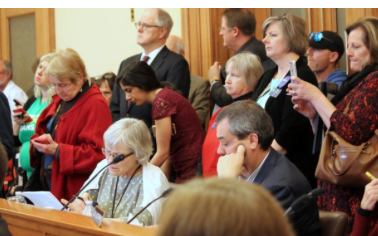
Advocates for Medicaid have packed legislative hearings in recent years and seen their cause fail. Their odds look far better this year. FILE PHOTO / KANSAS NEWS SERVICE
If elections have consequences, the top-of-the-ticket win for Democrats in Kansas likely carries no more obvious upshot than the probable expansion of Medicaid in the state.
After years of unyielding opposition from former Republican Gov. Sam Brownback and his successor — Gov. Jeff Colyer — Democratic Gov.-elect Laura Kelly looks positioned to broaden public health insurance coverage to tens of thousands more Kansans.
Kelly campaigned on expansion and listed it among her priorities in an election night victory speech.
“It’s long past time to expand Medicaid so that more Kansans have access to affordable health care,” Kelly said to cheers from supporters.
Kelly, a veteran state senator from Topeka, defeated Kansas Secretary of State Kris Kobach. A conservative Republican, he opposed expansion with at least as much vigor as Brownback and Colyer.
Kelly’s decisive five-point win has made longtime advocates of expansion optimistic that they can get it signed into law during the 2019 legislative session, which begins Jan. 14.
“We’re hopeful,” said Tom Bell, president and CEO of the Kansas Hospital Association. “But we’re also not taking anything for granted.”
Bell and other supporters fear that the defeat of some moderate Republicans by conservatives may have softened support for expansion in the Kansas House. However, with Kelly in the governor’s office, they would no longer need a veto-proof majority.
The Legislature approved expansion in 2017, but Brownback vetoed the bill.
Advocates can’t take it for granted that expansion is “automatically going to happen,” Bell said, “but bottom line, we’re much more encouraged than we have been the last few years.”
Some Republican legislative leaders who have spearheaded opposition to expansion appear ready to move on.
Rep. Dan Hawkins, the Wichita Republican who chairs the House Health and Human Services Committee, recently told the Wichita Eagle that expansion is a “foregone conclusion.”
Republican lawmakers shouldn’t waste energy opposing expansion, said Jim Joice, executive director of the Kansas Republican Party.
“I’m not sure if that (opposition) would be the best political strategy, if that’s the hill you want to die on this year,” Joice said.
The priority for Republicans should be holding Kelly to her pledge to balance the budget, fund schools, re-start the highway program and expand Medicaid without a tax increase, Joice said.
Currently, eligibility for KanCare, Kansas’ privatized Medicaid program is limited to children, pregnant women, people with disabilities and seniors in need of long-term care who have exhausted their financial resources. Parents are eligible only if they earn less than a third of the federal poverty level, less than $10,000 for a four-person family.
Single adults without children currently are not eligible no matter their income.
Expansion would extend eligibility to all Kansans who earn up to 138 percent of the poverty level, or about $17,000 annually for an individual and approximately $34,000 for a family of four.
In addition to extending coverage to an estimated 150,000 low-income Kansans who are now not eligible for KanCare, expansion would draw billions in additional federal funding. Advocates say that would help struggling hospitals across the state, many in rural areas.
“Medicaid expansion would certainly help them,” said Bell, noting that higher Medicaid reimbursements would help cover some of the losses caused by reductions in Medicare payments.
The Affordable Care Act requires the federal government cover 90 percent of the cost of expansion. The state’s costs would increase by an estimated $68 million a year, according to an estimate compiled by the Kansas Health Institute.
Expansion opponents insist the price tag will be much higher, but supporters contend it could be implemented at relatively little additional cost if federal dollars are used to cover services now funded with state dollars.
Jim McLean is managing director of the Kansas News Service. You can reach him on Twitter @jmcleanks.
Ask most people, and if they’re old enough to remember anything at all, it’s that famous photo of the doomed candidate with a smiling Donna Rice in his lap, on perhaps the most unfortunately named yacht in American political history: “Monkey Business.”
What most people don’t recall, or never even knew, is that the photo emerged two weeks after the 1987 scandal had ended in Hart’s withdrawal from the Democratic race, his hugely promising political career destroyed over suspicions — never confirmed — that he’d had an affair with Rice.
The fact that people assume the photo led to Hart’s humiliating downfall is just one of many ways in which the whole ordeal is mis-remembered, says Jason Reitman, director of “The Front Runner,” which stars Hugh Jackman in an appropriately tense, anguished turn as the Colorado senator who rose fast and fell faster.
“The story really plays with our sense of memory,” Reitman says. “First people recall ‘Monkey Business,’ so they’re remembering a joke, and then it’s, what was that blonde’s name?”
The fact that Rice was a human being (also a Phi Beta Kappa college grad) and not just a blonde on a boat is one point that “The Front Runner,” based on a 2014 book by journalist Matt Bai, seeks to drive home. But the larger point is that the Hart saga, far from a party joke, marked a watershed moment in American politics and culture, with reverberations that continue to this day.
Why? Because it was the moment when politicians became celebrities, and their private lives became our public business, even our property, Bai argues. It changed political journalism, too, he says, and created a different kind of candidate, perhaps forever.
Gary Hart
“It’s this moment in 1987 when the worlds of politics and entertainment collide,” says Bai, who co-wrote the screenplay with Reitman and former political operative Jay Carson. “And when you create a process for selecting leaders that treats them like celebrities, you inevitably attract celebrities to your process. So it’s supremely relevant.” The reference to a certain current American leader is implicit.
A quick historical primer: Hart was way ahead in the polls to take the 1988 Democratic nomination and face GOP nominee George H.W. Bush. But rumors of marital infidelity arose, and a tip led Miami Herald reporter Tom Fiedler to stake out an alley near Hart’s Washington townhouse, where the 29-year-old Rice, with whom Hart had connected on a Bahamas cruise, was believed to be staying. Fiedler and his team confronted Hart. He refused to answer questions about his private life. Soon after, amid unrelenting scrutiny on his family, he quit the race.
Hart wasn’t exactly the first American politician to be felled by a sex scandal — seen “Hamilton,” anyone? — but before him, routine sexual peccadilloes were usually considered off-limits. If they hadn’t been, many others, say John F. Kennedy and Lyndon B. Johnson, wouldn’t have survived. But Hart came along at just the wrong time, says Thomas Patterson, professor at Harvard’s Kennedy School of Government.
Patterson argues that Watergate, obviously the seminal political scandal of the ’70s, had spawned a more aggressive type of political journalism, tasking reporters with exposing the lies of politicians — big or small.
“If Hart had been luckier, journalists would have been a decade behind where they were at this point,” says Patterson. “But Hart becomes the poster child, the first casualty, of an attack journalism that was really a product of Watergate, and journalists’ sense that they couldn’t trust politicians.”
Each team member behind “The Front Runner,” which will be in wide release on Nov. 21, has their own takeaway from the Hart story. For Carson, who worked on numerous political campaigns including for Hillary Clinton, it’s how “this world where I wanted to effect positive change ended up being so soul-crushingly awful.”
Then there’s Jackman, who confesses he knew little-to-nothing about Hart beforehand: “I was a traveling backpacker on a gap year!” The Aussie actor traveled to Colorado to spend time with Hart, seeking to portray a multi-dimensional human being.
“Certainly my focus was on Gary and the man he was,” Jackman says. “But I’m left thinking about the question of principle and ethics.” For Hart, but also for other characters in the film like campaign workers and journalists, “there were lines not to be crossed,” Jackman says, “and it got simplified down to, ‘Did he have an affair or not?'”
“It wasn’t that simple,” Jackman adds. “For Gary, it was the principle of, if he starts answering those questions, he’s going to sully the process for other people, evermore. He felt like, ‘If I start talking about boxers or briefs, or the name of my dog, it’s over.'”
Of course, it was Bill Clinton who famously answered the boxers-or-briefs question. And for his own canny survival as a candidate, he may have Hart partly to thank, says Patterson at Harvard.
“Jump ahead four years, and Clinton had learned from Hart, from his failure and the damage it had done,” he says.
Now jump ahead to today. If we cared so much about Hart’s affair with Rice, some have asked, why did we elect a president who’d bragged on tape about groping women? (Trump later called it locker room talk.) Did we stop caring?
No, though maybe we’re more jaded, says Patterson. But we also live in a time of unprecedented political polarization: “People increasingly filter this stuff through their partisan lens.”
One thing everyone seems to agree on is that Hart would never survive a campaign in 2018 — mainly because he wouldn’t run under such conditions.
“Not to exalt Gary Hart, but we’re talking about a generation of potentially strong leaders who’ve had to find other ways to serve,” says Bai. “We’ve turned it into a performance process, where shamelessness and lying are rewarded.”
Adds director Reitman: “Hart very clearly said these personal questions were irrelevant, and he walked away. My question isn’t so much about him, but who ELSE isn’t running? What other candidates are we not getting a chance at?
WICHITA, Kan. (AP) — The boyfriend of a woman found dead in her home after being beaten with a shovel has pleaded guilty to killing her.
Becker-photo Sedgwick Co.
38-year-old Travis Becker Jr. entered the plea Friday afternoon in a Sedgwick County courtroom to reduced charges of first-degree felony murder and aggravated kidnapping in the November 2017 death of 42-year-old Perla Rodriguez. He had originally been charged with first-degree premeditated murder.
He’s expected to serve about 40 years after he’s sentenced on Jan. 2.
Rodriguez was outreach director for the Wichita Area Sexual Assault Center. Her severely battered body was found Nov. 14, 2017, in her home by Wichita officers. They also found a wooden handle shovel inside the bedroom, with the shovel blade covered in blood and hair.
KINGMAN COUNTY —One person died in an accident just after noon Saturday in Kingman County.
The Kansas Highway Patrol reported a 2016 Jeep Patriot driven by Reginald F H Smith, 34, Wichita, was westbound on Kansas 42 nine miles west of Norwich.
The Jeep traveled left of center, left the roadway entered the south ditch and struck a tree.
Smith was pronounced dead at the scene and transported to the Sedgwick County Forensic Center. He was properly restrained at the time of the accident, according to the KHP.
SALINE COUNTY—A small earthquake shook north-central Kansas Saturday. The quake just after 3:30 p.m. measured a magnitude 2.8 and was centered approximately 2 miles southeast of Salina, according to the U.S. Geological Survey.
It was the first quake in Kansas since a 2.5 magnitude quake shook near the Sumner County community of Belle Plaine.
There are no reports of damage or injuries from Saturday’s quake. However, the quake did generate a lot of attention among Saline County residents who reported they felt it.
KANSAS CITY, KAN. – A Kansas man was sentenced this week to 10 years in federal prison for methamphetamine trafficking, according to U.S. Attorney Stephen McAllister.
McWhorter -photo KDOC
Miles Joseph McWhorter, 34, Paola, Kan., pleaded guilty to one count of possession with intent to distribute methamphetamine. McWhorter was yelling, moving erratically and acting aggressively toward law enforcement officers when they stopped his car in Ottawa, Kan.
Investigators found almost a pound of methamphetamine in the car, as well as ammunition and $2,724 in cash.
After McWhorter was arrested, McWhorter’s girlfriend was arrested with 200 grams of methamphetamine and a shotgun, both belonging to McWhorter.
He has previous convictions for drugs and weapons charges, according to the Kansas Department of Corrections.
Seven Kansas school districts freed from some state rules now say getting that special status isn’t worth the effort.
Those districts are part of the Kansas Department of Education’s “Coalition of Innovative School Districts” program that started in 2013. Districts that join have the freedom to ignore state oversight on some of the ways they run their schools in exchange for pursuing novel approaches for improving student achievement.
The coalition uses the program to loosen teacher licensure and state assessment requirements. The relaxed rules for hiring teachers and instruction has come under criticism from some unions and education advocates who argue that the regulations are needed to maintain high standards.
“We think all of those kind of things are important and should never have been essentially done away with to begin with,” said Marcus Baltzell, the director of communications for the Kansas National Education Association.
Despite the extra freedom, the districts asked the Kansas Board of Education on Tuesday to release them from the program.
McPherson and Concordia needed to reapply this year to remain part of the coalition. But they felt that their concerns regarding regulations were already addressed by other programs and legislation that loosened guidelines for school districts across the state. Some of the new rules are based on experiments conducted by the coalition.
“The state has caught up,” said Quentin Breese, the superintendent for Concordia Public Schools. “The state board has been very progressive in that process.”
With McPherson and Concordia leaving, the other five districts decided to do the same instead of letting the coalition “die a slow death” as some superintendents described the situation.
“We, as a unified group, felt the best course of action was just to ask for release,” said Bill Mullins, superintendent at Marysville Public Schools.
The districts said they will continue to collaborate with each other, but as an informal network instead of as a group that must report its progress to the Kansas Legislature. The superintendents also expressed confidence that the state is better positioned to deal with future restriction issues that may arise.
“We fully believe that teacher barriers that may come about, they will address,” said Adrian Howie, superintendent of Hugoton Public Schools. “They don’t need us challenging that part of it.”
Stephan Bisaha is an education reporter for the Kansas News Service. Follow him on Twitter @SteveBisaha.
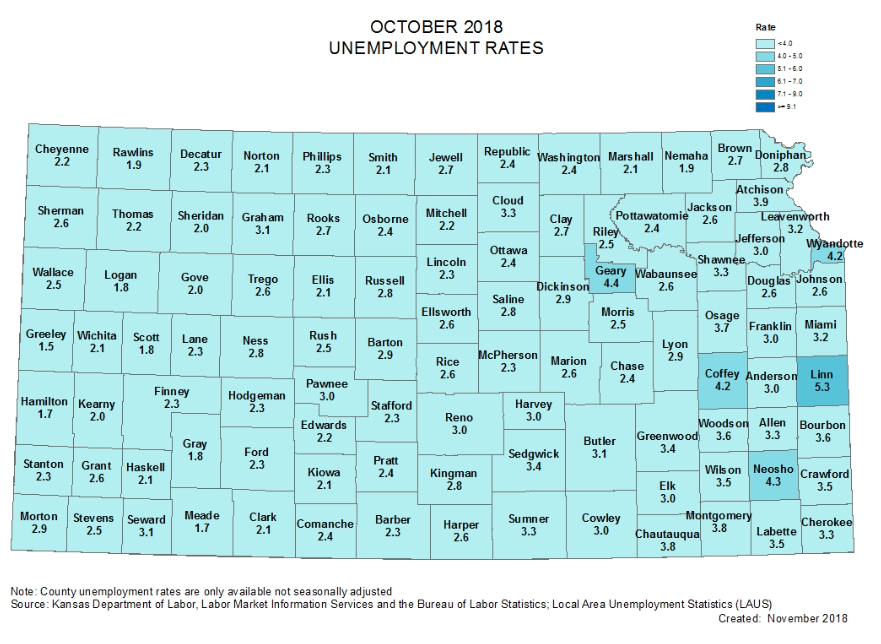
TOPEKA, Kan. (AP) — Kansas is reporting that its unemployment rate remained at 3.3 percent in October for the third month in a row.
Kansas Department of Labor image -Click to expand
The state Department of Labor has reported that Kansas also saw an increase in the number of nonfarm, private sector jobs during the previous 12 months. Such unemployment was almost 1.17 million in October, or 17,100 more than in October 2017. The growth was 1.5 percent.
Mining and logging businesses, financial services companies, and professional services firms saw the most robust job growth.
The state’s seasonally adjusted unemployment rate has been less than 4 percent since February 2017. In October 2017, it was 3.5 percent.
WABAUNSEE COUNTY— Law enforcement authorities are investigating a wrong-way driver and asking the public for assistance.
Just after 11a.m. Friday, the KHP troopers were involved with a pursuit with a stolen work truck from Colorado on Interstate 70 near the Maple Hill exit in Wabaunsee County, according to a media release. Troopers apprehended the driver identified a 22-year-old Adrianne Ray Johnson. He is being held in Wabaunsee County for fleeing, attempting to elude law enforcement, attempted aggravated assault of a law enforcement officer, felony conspiracy theft of property or services, aggravated assault and reckless driving.
During the pursuit the suspect fled eastbound toward Topeka and drove through median into oncoming traffic. Due to concern for safety of the public, troopers discontinued the pursuit. The suspect continued eastbound in the westbound lanes and head-on toward a Wabaunsee County deputy driving with his emergency lights activated. The deputy was forced to take evasive action to avoid a collision with the stolen truck.
The KHP is asking for anyone who may have been involved with this truck, any victims the truck swerved at or witnesses who may have witnessed the truck traveling eastbound in the westbound lanes to contact the KHP at 785-296-3102.
——————–
WABAUNSEE COUNTY— Law enforcement authorities are investigating a wrong-way driver and asking the public for assistance.
Just after 11a.m. Friday, the KHP troopers were involved with a pursuit with a stolen work truck from Colorado on Interstate 70 near the Maple Hill exit in Wabaunsee County, according to a media release. Troopers apprehended the driver.
During the pursuit the suspect fled eastbound toward Topeka and drove through median into oncoming traffic. Due to concern for safety of the public, troopers discontinued the pursuit. The suspect continued eastbound in the westbound lanes and head-on toward a Wabaunsee County deputy driving with his emergency lights activated. The deputy was forced to take evasive action to avoid a collision with the stolen truck.
The KHP is asking for anyone who may have been involved with this truck, any victims the truck swerved at or witnesses who may have witnessed the truck traveling eastbound in the westbound lanes to contact the KHP at 785-296-3102.
A lawsuit filed Friday contends Kansas violates foster children’s civil rights by moving them too often, adding to their trauma and restricting their access to necessary mental health treatment.
Gina Meier-Hummel started her job as secretary of the Kansas Department for Children and Families on Dec. 1, 2017 Photo by MADELINE FOX / KANSAS NEWS SERVICE
The National Center for Youth Law, Children’s Rights and Kansas Appleseed filed the suit against Gov. Jeff Colyer and the heads of the Department for Children and Families, the Department for Aging and Disability Services and the Department of Health and Environment.
The class-action suit alleges the state violated foster kids’ rights by shifting them — some of them more than 100 times throughout their time in care — often from one single-night placement to the next. The suit says that renders kids in care effectively homeless.
“There’s a chunk of the population of abused, neglected and abandoned kids in Kansas for whom the state has no housing at all,” said Ira Lustbader, litigation director for Children’s Rights. “Kids are rotated through just extreme numbers of placements.”
This process of “churning,” as described in the suit, has kids sleeping “anywhere a bed, couch, office, conference room, shelter or hospital can be found” overnight. Then they’re picked up the next morning and kept in a foster care contractor’s office for much of the next day, often into the next evening.
“Every change in placement a child experiences is a major disruption in that child’s life,” said Michelle Johnson-Motoyama, a professor of child welfare at Ohio State University who’s studied the Kansas welfare system.
She said churning creates a vicious cycle — each new placement adds compounded trauma and attachment issues, which makes it harder for them to stay in a foster home — increasing their moves almost exponentially.
The organizations seek no financial damages. Rather, the suit calls for the agencies to put together a plan to fix the churning and mental health problems, and to see that it’s implemented. A similar suit filed nearly 30 years ago led to the privatization of much of the state’s services for children in crisis.
Ten children, ten stories
The suit details the experiences of 10 children ranging from ages 7 to 17 who have been in foster care anywhere from a few months to nine years. Several have slept in foster care contractors’ offices, including one girl who was discharged from a psychiatric residential treatment facility into a series of one-night and short-term placements that included nights in an office.
One boy has been in more than 130 placements since entering the foster care system in 2012. Lustbader said that based on interviews the organizations conducted with advocates and attorneys across the state, that wasn’t unusual.
“That’s what can happen if you’re thrust into this night-to-night madness,” he said.
A 17-year-old girl described in the suit entered the foster care system in 2007. She was adopted three years later with her siblings into a family where she and her sister were sexually assaulted by their adoptive father and brother. They weren’t removed until 2013. In the five years since, the girl has been moved more than 42 times, including multiple night-to-night and short-term placements.
In one placement, the suit alleges, she was sexually exploited and trafficked. She stayed overnight in the office of a foster care contractor, including once for an entire week.
Churning kids through the system
From April to September of 2018, St. Francis Community Services, the foster care contractor for the western half of the state, had 764 children in one-night placements. Its eastern counterpart had 695 kids stay just one night in a placement.
The suit alleges DCF has enabled churning by letting contractors and child placement agencies waive capacity and sleeping space requirements — such as one home that had 10 children and that was only regulated to keep six kids. DCF approved 98 percent of approximately 1,100 requests to waive requirements for capacity and sleeping space in a 15-month period, according to a 2016 audit report.
The suit alleges that since 2017, DCF hasn’t even required agencies to ask for exceptions. As long as a child doesn’t go to that placement more than once in a week, homes can take on more kids than they are regulated to take without the state needing to sign off.
Under national standards, kids shouldn’t be moved more than 4.12 times for every 1,000 days they’re in foster care.
But according to reviews by the federal Department of Health and Human Services, Kansas hasn’t met that standard since it was set out in 2014. In its most recent fiscal year, Kansas moved kids an average of 8.6 times per 1,000 days, more than double the federal standard, and 30 percent more times than its 2016 average of 6.6 moves.
The suit alleges Colyer and the heads of the three agencies violated foster children’s 14th Amendment rights — which grants equal protection under the law — as well as the federal Medicaid Act.
It alleges Colyer, sued in his official capacity as governor, had the responsibility to make sure agencies followed state and federal law and the ability to reshape the function of agencies to ensure they were looking out for the children in the state’s care.
DCF Secretary Gina Meier-Hummel, the suit says, has “direct non-delegable custodial responsibility” for the state’s children, meaning her office is ultimately responsible for civil rights violations that happen to foster children under the supervision of the state’s foster care contractors.
Lustbader said it was important to make it clear that while DCF has delegated foster care placement to private agencies, the state welfare agency and Kansas Department of Health and Environment and Kansas Department for Aging and Disability Services still have ultimate constitutional responsibility for the state’s children.
“The buck stops with the government agencies responsible for these kids in their care,” Lustbader said. “You can certainly use private providers, but not without accountability.”
Mental health services
The secretaries of KDHE and KDADS are responsible for administering Medicaid and mental health services according to federal and state laws. They also oversee Medicaid waiver programs and operating hospitals and institutions in the state.
All foster children are eligible for Medicaid, which requires mental health screenings for children under the Early Periodic Screening Diagnosis and Treatment provisions of the federal Medicaid Act. Lustbader said under Medicaid, kids in state custody have “absolute access and entitlement” to basic screening, assessments and treatment.
The lawsuit charges that the agencies responsible didn’t meet that requirement.
Data Kansas reported to the federal government in 2016 indicated more than 3,000 foster children, nearly half the number of kids in foster care at the time, were identified as emotionally disturbed.
Changes coming
The lawsuit comes in the midst of a lot of changes coming through Kansas and its child welfare system.
Gov.-elect Laura Kelly will take office in January, and will likely bring with her a new cabinet – including new heads of DCF, KDHE and KDADS.
The foster care system is also bracing for a transition between foster care contractors. KVC and St. Francis, the two organizations that have held Kansas’ foster care and family preservation contracts since 2013, will cede family preservation to two new statewide providers, Florida-based Eckerd Connects and Missouri-based Cornerstones of Care.
TFI, a former contractor and current subcontractor for Kansas foster care, will join KVC and St. Francis as a state contractor for foster care.
Becci Akin, a professor of social work at the University of Kansas, said transitions can be chaotic. She said it’ll likely take 18-24 months after the contracts switch over in July before it’s possible to really judge whether the new providers and other new aspects of the child welfare grants are working.
A task force examining the state foster care system is submitting its final recommendations to the Legislature in January. The recommendations, which include expanding Medicaid, examining the effects of privatization and improving work conditions for social workers, could prompt legislation taking aim at some of the challenges in Kansas’ child welfare system.
Deja vu
The lawsuit echoes a case filed over foster care in 1989. That suit accused the Department of Social and Rehabilitation Services, the precursor to DCF, of failing to protect children. It evolved into a class-action case joined by the ACLU. Its Children’s Rights project has since become an independent nonprofit and is one of the parties suing now.
Rochelle Chronister, who headed SRS, said she’s not surprised Kansas is being hit with another lawsuit. She said the state’s cutting back on preventive measures to keep kids out of foster care is leading to more kids coming in, and hitting an agency that isn’t prepared to handle them.
The new suit, unlike the previous case, is in federal court. Rene Netherton, the attorney behind the earlier case, said it’s more narrow in scope than the one filed nearly 30 years ago. That earlier case focused on not only short-term placements but also worker caseloads, resources and numerous other problems with the foster care system.
Netherton also thinks the circumstances could be better this time around.
“I don’t think the climate could be any better than it will be with the new governor,” Netherton.
Netherton’s suit, and SRS’s failure of several resulting quarterly reviews, prompted the Legislature to privatize Kansas’ foster care system at the behest of then-Gov. Bill Graves.
The first contracts, for six nonprofit providers, began in 1996. Privatization has drawn the ire of some lawmakers, child advocates and birth and foster parents. They say it’s allowed the state to push blame for problems in the system to contractors and shortchange a system starved for resources.
Lori Burns-Bucklew, a Missouri attorney on the suit, says she wants the state agencies to stop treating children’s bad situations like an inevitable consequence of strains on the system.
“I have been ranting, I’ve been pounding the table, I’ve been worrying about these kids being schlepped around from night to night and I’ve been seeing it treated like it’s inevitable fallout from this messed up system,” she said. “I don’t want to let the institutional changes ignore the individual faces.”
Madeline Fox is a reporter for the Kansas News Service. You can reach her on Twitter @maddycfox.
MONTGOMERY COUNTY — One person died in an accident just after 3p.m. Friday in Montgmoery County.
The Kansas Highway Patrol reported a 2007 Harley Davidson Motorcycle driven by Nathan L. Lock, 32, Macksville, was southbound on Kansas 99 five miles south of Frankfort.
The motorcycle traveled left of center and side-swiped a 2014 Ford Fusion driven by Katheryn L. Gregerson, 21, Herman, NE., causing Lock to be ejected from the motorcycle.
A northbound 2013 Ford Fusion driven by Laura C. Edelman, 20, Sabetha also struck the motorcycle.
Lock was pronounced dead at the scene and transported to Kinsley Funeral Home. Gregerson and Edelman were not injured.
PRATT – Accessibility, a barrier to outdoor participation for many with disabilities, shouldn’t keep anyone from enjoying the outdoors. The Kansas Department of Wildlife, Parks and Tourism (KDWPT) is launching an all-new program – Adaptive Sportsmen of Kansas (ASK) – to ensure that hunters and anglers with disabilities have a new option for safely getting around outdoors.
KDWPT has secured eight electric, all-terrain track chairs that will be made available on a first-come, first-served basis at pre-approved events. Each chair, which is controlled by a joy stick on the right armrest, is camouflaged and equipped with several useful accessories, including a gun holder, fishing rod holder, LED headlight, and utility box for storage. Operators can also sit comfortably using the chair’s head rest, padded armrests and flip-out foot rest, all while having peace of mind they’re secure, thanks to the chair’s front stabilizer wheels and four-point harness.
“There are a lot of sportsmen out there who want to be hunting and fishing, but they just can’t get to where they need to. And it’s time we did something to fix that,” said Todd Workman, KDWPT Assistant Secretary for Administration.
What started as just an idea earlier this year has since blossomed into a fully-fledged program, backed by the support of Bushnell Optics and the National Wild Turkey Federation. Workman hopes other conservation-based organizations will see the value and impact of this program and consider helping it grow.
“I’m excited to begin working with conservation groups and people who need these chairs,” said ASK program coordinator, Jessica Rice. “We want these chairs in the field, helping people enjoy the outdoors.”
Anyone wanting to learn more about reserving chairs or donating to the ASK fund can contact Rice at [email protected] or (913) 278-2362.