We have a brand new updated website! Click here to check it out!

Kansas Could Cut Back On Felonies For Property Crimes

Kansas could end up handing out fewer felonies — and more misdemeanors —  for certain property crimes.


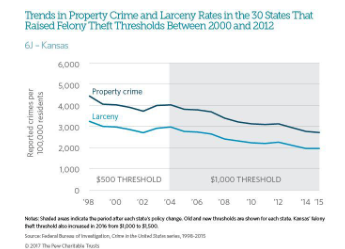
A graphic from the Pew Charitable Trusts shows the trend in property crime and larceny in Kansas. The shaded side of the graph shows rates since Kansas raised the bar for getting a theft-related felony in 2004.

That could mean sending fewer people to state prison, though some might end up in county jail instead.

Until 2016, stealing $1,000 worth of property was the threshold between misdemeanor and felony theft. Then Kansas raised the dividing line to $1,500.

A criminal justice commission looking at prison overcrowding in the state voted this week to ask the Legislature to do the same for a host of other crimes. They include criminal property damage, stealing mislaid property, counterfeiting and Medicaid fraud.

As of August, both the male and female prison populations were above capacity. The proposed changes would free up an estimated four beds a year and spare people a black mark that can make finding work difficult for the rest of their lives, says Scott Schultz, executive director of the Kansas Sentencing Commission.

It can be harder to find employment with a felony record because many employers require disclosure of felonies.

Getting a misdemeanor instead of prison means potential time in county jail, but not state prison. That doesn’t necessarily translate to less incarceration time. In some cases, people could spend more time behind bars in a county jail than they would have in a state prison.

The Kansas Sentencing Commission is making its case for the change based on research from the Pew Charitable Trusts.

Image Pew Charitable Trust

Pew found dozens of states have made similar changes since 2001. That didn’t lead to more crime. Rather, property crime and larceny rates fell in states that changed their thresholds. It dropped slightly more in states that didn’t change, but the difference was statistically insignificant.

Kansas has raised its threshold for felony theft before — in 2004 — and related crime continued to decline, Pew says.

Celia Llopis-Jepsen is a reporter for the Kansas News Service. You can reach her on Twitter @Celia_LJ.


Ad hoc committee presents recommendations on municipal court practices

LKM

TOPEKA  —  An ad hoc committee appointed by the Kansas Supreme Court a year ago to review bonding practices, fines, and fees of Kansas’ municipal courts presented its recommendations at a news conference Sept. 19.

The 18 committee members were appointed by Chief Justice Lawton Nuss in an order signed September 6, 2017. Of the 18 members, 16 are municipal judges, one a city attorney, and the General Counsel from the League of Kansas Municipalities.

The Supreme Court directed the committee to study current municipal court practices, examine the practices in other courts across the country, and recommend best practices for Kansas municipal courts.

The committee’s report offered 18 recommendations. It was delivered to the judicial administrator of the Office of Judicial Administration and to the executive director of the League of Kansas Municipalities, as spelled out in the Supreme Court order.

To prepare the recommendations the committee formed four subcommittees and each was assigned an area to study: bonds; enforcement; fines and fees; and indigency. The full committee also met five times over the last year.

Brenda Stoss, who chaired the ad hoc committee, is a municipal judge in Salina and New Cambria. She said the report is the first comprehensive look at municipal court practices statewide.

“The recommendations are important for municipal courts across the state as well as for the residents of Kansas who appear before those courts,” Stoss said.

The recommendations are similar to those proposed in national discussions of bonding practices, fines, and fees in that they focus on procedural fairness, but they also reflect the range of Kansas municipal courts in terms of size and number of cases processed each year.

The committee’s recommendations range from improving communication with defendants to studying more thoroughly the use of pretrial bail risk assessments. They also emphasize the need to adhere to due process and equal protection requirements to ensure the economically disadvantaged are not adversely affected.

Brad Ralph of Dodge City represented the city attorney viewpoint on the committee. He is also a member of the Kansas House of Representatives.

“Our municipal courts are so often the one and only contact many Kansans have with the court system. The effort by this committee—and its resulting recommendations—was and is a demonstration that our municipal courts work extremely hard to not only serve their judicial function but also to solve problems for our residents in a fair and equitable manner at every stage of those proceedings,” Ralph said.

Plans are already in place to present the committee’s report and its recommendations to interested statewide groups.

Erik Sartorius, executive director of the League of Kansas Municipalities (LKM), said city attorneys will review the report at their annual meeting in October, and the League plans to fulfill the recommendation that it conduct periodic surveys of municipal court fine schedules and make the information available to all municipal courts.

“Reviewing systems and programs in search of efficiencies is a common function within government,” said Sartorius. “What this review did—and what sets it apart from others—is it considered whether the municipal court system acts in an equitable way for individuals, rather than just efficiency. We look forward to sharing the committee’s findings with our members and seeking ways to ensure that ‘equal treatment under the law’ remains a hallmark of municipal courts.”

The report is also on the agenda for municipal judges continuing judicial education next spring, said Nancy Dixon, the judicial administrator.

“The Office of Judicial Administration works with the municipal judges education committee to plan and deliver educational programs that meet continuing judicial education requirements. The purpose of this judicial education is to reduce court delay, promote fair and efficient management of court proceedings, and support the administration of justice,” Dixon said.

The Office of Judicial Administration and the League of Kansas Municipalities plan to continue examining each of the recommendations and considering next steps.

There currently are 394 municipal courts in Kansas, and 234 municipal judges. Some judges serve more than one municipal court. In fiscal year 2017, Kansas municipal courts processed more than 350,000 cases. Fiscal year 2018 data are not yet published.

The Kansas Supreme Court has general administrative authority over all courts in Kansas, although municipalities are responsible for funding city courts and appointing and paying judges. The Office of Judicial Administration implements the rules and policies of the Supreme Court and oversees the operation and administration of the judicial branch.
Woman sentenced for blaze that killed 2 KC firefighters

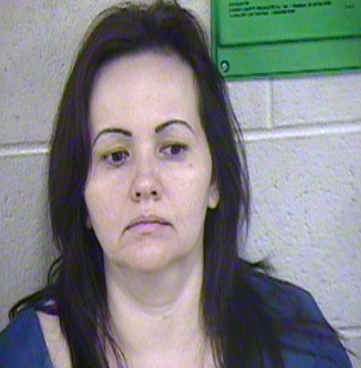
KANSAS CITY, Mo. (AP) — A 46-year-old woman who set a fire that resulted in the deaths of two Kansas City firefighters has been sentenced to 74 years in prison.

Nguyen -photo Jackson County

Thu Hong Nguyen was sentenced Friday for second-degree murder, arson and assault. She was convicted in July of setting a fire to her nail salon in October 2015.

Firefighters Larry Leggio and John Mesh died when a wall near the salon collapsed on them. Two other firefighters were seriously wounded.

Ngyuen’s sentencing was briefly delayed Friday when she began having breathing problems during victim impact statements. Emergency responders came to the courthouse to treat her and the sentencing eventually was completed.

Prosecutors say Nguyen had a history of burning businesses for insurance money. Nguyen was convicted of arson for a 2013 fire at a previous nail salon.

NASA seeks dismissal of moon dust lawsuit filed in Kansas

KANSAS CITY, Kan. (AP) — NASA is asking a federal court to dismiss a lawsuit filed by a woman over a vial of moon dust that is being kept in a secret location in Kansas.

Image courtesy U.S. District Court-Cicco v. National Aeronautics and Space Administration

Laura Cicco, of Tennessee, filed a lawsuit in June in Kansas asking a federal court to affirm that she owns the lunar dust she says she was given by astronaut Neil Armstrong, who was a friend of her father’s. She argues NASA has seized similar moon-related artifacts because it contends the government owns all lunar material.

NASA filed a motion in late August asking that the lawsuit be dismissed because it has made no effort to confiscate Cicco’s artifact.

Cicco’s attorney argue the court needs to make it clear that she owns the moon dust.

Former Kan. deputy charged with sexual battery against officer

KANSAS CITY, Kan. (AP) — A former Wyandotte County sheriff’s deputy has been accused of sexual misconduct against another law enforcement officer.

John Warczakoski -photo courtesy KCTV

Wyandotte County District Attorney Mark Dupree announced Friday that John Warczakoski is charged with two misdemeanor counts of sexual battery.

The female officer continues to work at the Wyandotte County Sheriff’s Office. Warczakoski was a deputy for 12 years before resigning earlier this week.

The incidents allegedly happened in June and early September while the deputy was on and off duty, the district attorney said.

Dupree said the alleged incidents occurred in June and early September while the deputy was on and off duty.

Warczakoski was issued a summons. He is scheduled to appear in court Oct. 2.

ABC unveils streamlined alcoholic beverage label registration

KDOR

TOPEKA — Kansas alcohol manufacturers and out of state suppliers will soon have a more efficient way to register beverage brands and renew liquor permits, the Kansas Alcoholic Beverage Control announced earlier this week.

The system improvements, which go live October 1, will allow wineries, microdistilleries, microbreweries, and manufacturers to renew their license or permit and their brand labels in the same web interface. Previously, brand registration required a separate transaction on a different system for each beverage label a manufacturer produced.

“We are so pleased to offer a more intuitive way for alcohol beverage manufacturers to do business with the State of Kansas,” Alcoholic Beverage Control Director Debbi Beavers said. “This is a substantial improvement that will require less time and money from the manufacturers.”

The enhancements feature a cart where manufacturers can register multiple labels at once under a single, streamlined checkout process.

The improvements will also feature a newly reduced convenience fee structure that will be a cost saving to businesses. While the $25 per label fee is required by law to remain in place, the system enhancement will eliminate the label processing fee. Instead, manufacturers will pay a 2.5 percent credit card processing fee, or a $1.50 bank draft fee.

Kansas has 107 in-state alcoholic beverage manufactures and 1,136 out of state suppliers that register a approximately 52,000 labels with the Division of Alcoholic Beverage Control every year.

Challenge to Kan. law on how long trains can block intersection

WICHITA, Kan. (AP) — BNSF Railway is challenging a Kansas law that limits how long trains can block intersections.

The Kansas Court of Appeals heard arguments Thursday in the case involving a lengthy blockage of two Chase County railroad crossings in December 2016.

The Texas-based railway company’s court challenge could have ramifications for railroad crossings throughout Kansas.

The law in question says railroads can only block a crossing for 10 minutes.

The Chase County Sheriff’s Office cited BNSF, alleging the company parked a train on a siding for four hours and blocked the only crossings that provide access to several farms.

BNSF denies the length of the blockage and argues that the state doesn’t have a right to regulate how long a train can block a crossing.

“That power is vested solely in the federal government,” said Jody Sanders, the company’s attorney.

Sanders said that the federal government had pre-empted state control over railroads because they’re engaged in interstate commerce and can’t be expected to comply with a patchwork of regulations across the country.

But State Solicitor General Kristafer Ailslieger said the federal government doesn’t regulate how long trains can block crossings. Without state law, companies could block crossings “without any time limit or remedy,” Ailslieger said.

“A railroad could dispose of a dilapidated locomotive in the middle of Main Street,” he said.

The state also argued that BNSF’s four-hour-long blockage in 2016 created a public safety issue.

“Emergency vehicles could not get through and the people on the other side could not get out,” he said.

The court expects to issue a ruling on the case in the next few months.

St. Francis opens secure facility for chronic runaways

WICHITA – An 18-bed secure care facility for juveniles judged to be chronic runaways has opened in Sedgwick County. It is licensed by the state and operated under the direction of Salina-based Saint Francis Community Services.

Located within the Sedgwick County Juvenile Detention Center at 700 S. Hydraulic, the secured area has separate wings for boys and girls, each wing housing nine beds. This is only the third secure care juvenile facility in the state, bringing the total number of secure care beds to 42. The other secure care beds are located Newton and Junction City.

The 5,000-square-foot area includes a communal recreation area, dining hall and classrooms where youth, ages 12 – 18, can continue their schoolwork under the instruction of ORION Education and Training, a USD 259 subcontractor. A staff of 25 Saint Francis Community Services employees, including social workers and behavioral technicians, oversee the youth 24-7. A clinical director and registered nurse are also on staff during the day.

“Kansas has an increasing need for beds and therapeutic treatment options for children in foster care, especially those children who have chronic runaway behaviors,” said Trish Bryant, Vice President of Children and Family Services for Saint Francis Community Services. “The Sedgwick County Department of Juvenile Programs reached out to us with an offer of available space in their facility. We’re excited to take this program from concept to reality, and we appreciate the County’s tremendous support.”

Annual expenses for the program will be approximately $417,000, excluding salaries. Of this amount, Saint Francis will pay Sedgwick County $352,403 annually for the space, including laundry, housekeeping and maintenance services.

Juvenile court judges across Kansas adjudicate youth to a secure care facility, often because these youth repeatedly have run away from other child welfare placements. Youth are sent to the facility for an initial 60-day stay, with two 60-day extension options available at the court’s discretion. The youth are required to stay the full length of time ordered by the court.

“The courts have been asking for more beds and more safe settings like this,” Bryant said. “Saint Francis has designed this program around a clinical model of trauma informed care and will include individual, group and family therapies. The whole idea is to give kids a safe environment where they can learn healthy living skills. They will get the behavioral therapy they need so they can recognize and control their own emotions. The goal is to prepare these kids to reintegrate into a family setting or other safe environment.”

“Many of these youth have experienced extensive trauma, and some are survivors of heinous human trafficking,” said the Very Reverend Robert N. Smith, Dean, President and CEO of Saint Francis. “That’s why we’ve structured a nurturing environment where kids don’t have to feel criminalized or further traumatized.

“Traditional youth detention facilities simply aren’t equipped or staffed to offer the kind of therapeutic services these kids need,” Smith continued. “Saint Francis’ model has the potential to vastly improve outcomes for these youth and strengthen juvenile justice programming in general. We are grateful to the Kansas Department of Children and Families and to Sedgwick County for embracing this concept and allowing us to implement it for Kansas’ kids.”

ABOUT SAINT FRANCIS COMMUNITY SERVICES
Founded in 1945 in Ellsworth, Saint Francis Community Services encompasses foster care, therapeutic foster care, adoption, family preservation, residential care, and community outreach services, as well as refugee resettlement services through the U.S. Department of State’s Resettlement Program.

The organization serves more than 30,000 individuals through child and family welfare services in Kansas, Oklahoma, Nebraska, Texas, Mississippi, and Central America. Additionally, Saint Francis provides supervised living and employment services for adults with intellectual and developmental disabilities in Mississippi. The organization is headquartered in Salina.

Federal grants expand DCF services to Kansas families

DCF

TOPEKA Kansas Department for Children and Families (DCF) Secretary Gina Meier-Hummel is excited to announce that the agency recently received two new federal grants that will allow the agency to continue to build strong, healthy families in Kansas.

The Administration for Children and Families (ACF) has awarded Kansas a $250,608 Kansas Kinship Grant through the federal Promoting Safe and Stable Families program. DCF will be utilizing the funding from this grant to develop an intensive Kinship Navigator Program in Kansas. The Kinship Navigator Program will connect kinship caregivers to resources, programs and services and will provide much-needed assistance and support to kinship caregivers.

The Kinship Navigator Program will be included in the Kansas Family Network Support grant, which is currently in the bid submission process. The Kansas Family Support Network will focus on providing direct support to parents and kinship caregivers through prevention and intervention services. By making small shifts within families, they can have an enormous impact on Kansas child welfare outcomes, such as out of home placement rates and lengths of stay in foster care.  The Kansas Family Network Support grant will take effect July 1, 2019.

“I am extremely excited about the Kinship Navigator Program because it allows us to fill a gap that existed previously and provide quality, necessary support and services to parents and kinship caregivers in Kansas,” Secretary Gina Meier-Hummel said. “This program is aimed at reducing stress on families and reducing disruptions in the caregiver process. This is great news for the children and families of Kansas.”

DCF’s Economic and Employment Services (EES) division also received a new, substantial three-year grant this week that allows the agency to develop and implement a phone application for Supplemental Nutrition Assistance Program (SNAP) clients. The SNAP recipients will be able to contact their career navigator directly through the phone app, as well as set and track appointment dates with their career navigator, see upcoming workshops, access community resources, etc.

The Process and Technology Improvement Grant, received from the United States Department of Agriculture Food and Nutrition Services (USDA), will work in conjunction with GOALS: A Program of HOPEWorks, to connect SNAP recipients to employment and training opportunities.

“We want to connect with and assist Kansas families as much as possible. By developing this phone app, EES can be more readily available to SNAP recipients,” EES Director Sandra Kimmons said. “This is a great opportunity to improve engagement in SNAP work program services, which will ultimately help more Kansas families achieve self-sufficiency.”

The Process and Technology Improvement Grant, which totaled $1,475,303, takes effect immediately and will run through September 2021. To learn more about SNAP or GOALS: A Program of HOPEWorks, visit www.dcf.ks.gov.

Data: Not all of Kansas experiencing economic growth

WICHITA, Kan. (AP) — Wichita was the only major metropolitan area in Kansas that didn’t experience economic growth last year, according to new federal data.

The U.S. Bureau of Economic Analysis released figures this week showing that the Wichita area’s gross domestic product declined 1.4 percent in 2017.

The state’s economy also declined overall, despite positive growth in cities such as Kansas City, Lawrence, Manhattan and Topeka. Kansas was among only three states to have experienced negative economic growth in 2017.

Kansas and Wichita can’t find enough workers, which limits companies’ ability to grow and boost the economy. Job vacancies increased by more than 9 percent throughout Kansas last year.

“We think workforce and talent are really the No. 1 threat to our ability to grow, not only in Wichita but also the state of Kansas,” said Gary Plummer, president and CEO of the Wichita Regional Chamber of Commerce.

Wichita officials said they’re working to address the worker shortage. The merger of Wichita State University and Wichita Area Technical College will produce better-qualified workers, officials said.

Wichita’s shrinking GDP is largely attributable to a decline in the city’s finance, insurance, real estate and rental sector, according to Jeremy Hill, director of Wichita State University’s Center for Economic Development and Business Research.

Economic analyst James Chung pointed to Wichita’s population loss. The city has lost more than 18,000 residents over the past decade.

2018 Upland Bird Hunting Forecast available online

KDWPT

PRATT – In just a matter of days, ink will be drying on freshly-printed copies of Kansas’ 2018 Upland Bird Hunting Forecast, but if you can’t wait any longer, there’s an electronic version to tide you over. Bird hunters can download a PDF version of this year’s forecast at ksoutdoors.com.

How To Download the “2018 Upland Bird Forecast”

1. Visit ksoutdoors.com

2. Click “Hunting

3. Click “Upland Birds” (found under “What To Hunt”)

4. Click “Upland Bird Forecast

The annual forecast summarizes data from spring and summer surveys and predicts what pheasant, quail and prairie chicken hunters may experience across Kansas this fall. The verdict? Kansas should have “good” upland bird hunting opportunities this fall.

Biologists create the forecast using surveys of breeding populations and reproductive success of pheasants, quail, and prairie chickens. Breeding population data are gathered with spring whistle count surveys for quail, crow count surveys for pheasants and lek count surveys for greater prairie chickens.

PHEASANT

Kansas reported the second highest pheasant harvest among states in 2017, and Kansas will still have one of the best pheasant populations in the country this fall. Pheasant hunting in Kansas should be “fair to locally good” this year.

Pheasant densities had been slowly recovering from 2013 to 2016 with a few areas reaching relatively high densities. A late 2017 spring blizzard in western Kansas reduced nesting success and resulted in a decline in the 2018 pheasant crow survey. Winter precipitation was limited this year, resulting in short wheat and concern for nesting prospects. Heavy spring and summer showers greatly improved vegetative cover for nesting, but also limited nest success. Conditions shifted peak pheasant hatch later into June and July. While wheat harvest was delayed, which typically benefits pheasant production, the short wheat limited its usefulness for nesting. Roadside counts indicate a below-average pheasant population this year. The combination of heavy cover and a later peak hatch may have reduced the number of detectable birds on the counts, but generally survey conditions were ideal.

The best areas will likely be in the northern half of the Kansas pheasant range with areas of high densities also found in central and far southwestern regions.

QUAIL

Last fall’s Kansas bobwhite quail harvest was the highest recorded in the country, finishing just above Texas, and while hunting isn’t expected to be quite as good in 2018, Kansas will still have one of the best quail populations in the country.

Precipitation patterns observed over the past five years altered vegetation, increasing both the quality and quantity of habitat, allowing for a modern quail boom. While total harvest has remained well below average due to lower hunter participation, the average daily bag has remained at the best levels observed in 20 years. The bobwhite whistle survey in 2018 showed only a slight decline compared to the 2017’s highest values ever recorded from this survey, which began in 1997. Dry weather in the east and wet weather in the west provided optimism for high production and another banner year. Early reports indicated lots of birds along roadsides and throughout wheat fields during harvest. However, observations on the statewide roadside survey were significantly down this year, with only the Osage Cuestas showing improvement. Densities in the eastern-most regions are not as high, but all regional indices remain near or above their respective long-term averages.

The best opportunities will again be found in the central regions, extending east into the northern Flint Hills.

PRAIRIE CHICKEN

Kansas is home to greater and lesser prairie chickens. Greater prairie chickens are found primarily in the tallgrass and mixed-grass prairies that occur in the eastern third and northern half of the state. The Southwest Prairie Chicken Unit, where lesser prairie chickens are found, will remain closed to hunting this year.

Greater prairie chicken hunting opportunities will be best in the Northern High Plains and Smoky Hills Regions this fall, where populations have been increasing or stable.

All prairie chicken hunters are required to purchase a $2.50 Prairie Chicken Permit in addition to their hunting license. This permit allows hunter activity and harvest to be measured and will improve management activities and inform policy decisions.

For more detailed information and regional breakdowns for all three species, consult the 2018 Upland Bird Hunting Forecast at www.ksoutdoors.com or pick one up at any Kansas Department of Wildlife, Parks and Tourism Office. The full forecast will also be featured in the 2018 November/December issue of Kansas Wildlife & Parks Magazine, available for purchase by calling (620) 672-5911.


MORAN: The DRIVE-Safe Act and Myth vs. Fact

OFFICE OF SEN. MORAN

WASHINGTON– U.S. Senator Jerry Moran (R-Kan.), along with U.S. Senators Todd Young (R-Ind.) and Jim Inhofe (R-Okla.), introduced the Developing Responsible Individuals for a Vibrant Economy (DRIVE-Safe) ActS. 3352, to address the driver shortage in the trucking and logistics industry, and enhance safety training and job opportunities for young truckers.

The apprenticeship program established by the DRIVE-Safe Act would require young drivers to complete at least 400 hours of on-duty time and 240 hours of driving time with an experienced driver in the cab with them. All trucks used for training in the program must be equipped with safety technology including active braking collision mitigation systems, a video event capture system and a speed governor set at 65 miles per hour or below. 

Due to some expressed concern regarding the safety and intent of the DRIVE-Safe Act, below is a fact sheet to highlight the rigorous training all new drivers under this bill would need to complete prior to licensing: 

MYTH #1: It obviously is going to reduce safety.” This bill will make the roads less safe because there is not adequate training for 18-year-old drivers. 

FACT:

  • It is already legal in all 48 contiguous states for 18-year-olds to drive trucks intrastate; this bill would simply allow these drivers to cross state lines with the commodities they are already transporting intrastate upon the completion of the rigorous training program.
  • It is currently legal for an 18-year-old Kansas City, Kan.-based truck driver to deliver goods 400 miles away to Goodland, Kan., and yet they are forbidden from crossing the Missouri River to make a delivery 10 miles away.
  • Further, those participating in this program would be required to complete a minimum of 400 hours of training and meet 10 performance benchmarks before being allowed to operate trucks interstate. 

MYTH #2: “Younger drivers both lack overall experience and are less safe behind the wheel than their older counterparts. 

FACT:

MYTH #3: No small-business truckers are going to be able to take advantage of that [lowered age requirements] simply because small carriers will not be able to get younger drivers insured.”

FACT:

  • Insurers have expressed a willingness to work with carriers to get younger drivers insured, so long as carriers comply with the requirements of this bill and demonstrate meaningful investments in safety. 

MYTH #4: We’ve been hearing the talk of shortage for 25 years, and when you sort through the smoke and mirrors . . . what they call a shortage is actually a retention problem… 

FACT:

  • The industry’s average workforce age, 49, is seven years older than the average American worker. The industry will need to hire 890,000 new workers over the next decade to keep up with demand, and according to the Federal Reserve’s July 2018 report of economic conditions across the country, half of all 12 Federal Reserve Districts reported trucking capacity and truck-driver shortages as an issue, despite this job being one of the most in-demand and with the biggest pay hikes of 2018. 

MYTH #5: This bill will only benefit large companies who want to “pay a starter wage and help the company make more money.” 

FACT:

  • All carriers, large and small, will benefit from a stronger labor market. Additionally, this will create good-paying job opportunities for high school graduates that were previously unavailable to them.

[1] U.S. Department of Transportation, National Highway Traffic Safety Administration, Traffic Safety Facts Annual Report TablesTable 62 Driver Involvement Rates per 100,000 Licensed Drivers by Age, Sex, and Crash Severityhttps://cdan.nhtsa.gov/tsftables/tsfar.htm.

Man charged after Kan. police chase, fatal wrong-way crash

KANSAS CITY, Kan. (AP) — A 24-year-old man has been charged after a police chase ended with a fatal wrong-way crash on Interstate 70 in Kansas City, Kansas.

Wyandotte County authorities charged Collan Leigh Cross Friday with two counts of aggravated assault on a law enforcement officer, fleeing and eluding, possession of a controlled substance and criminal damage to property. Chrissy Sale, 29, died in the crash.

The chase began Thursday when Kansas City, Kansas, police followed a car onto a dead end street before the driver struck a police car and drove off, crossing into Missouri before returning to Kansas.

Copyright Eagle Radio | FCC Public Files | EEO Public File