We have a brand new updated website! Click here to check it out!

Satellite study of Amazon rainforest land cover gives insight into 2019 fires

KU NEWS SERVICE

LAWRENCE — Throughout August and early September 2019, media around the world have reported on the extensive forest fires ravaging Brazil’s Amazon rainforest. Much of the concern stems from the Amazon’s significance to regulating the world’s climate. According to the Associated Press, the Amazon absorbs 2 billion tons of carbon dioxide every year — about 5% of global emissions. Thus, fires in the region eat away at this carbon-absorbing capacity while at the same time adding carbon to the air through burning.

Gabriel de Oliveira

recent study in the peer-reviewed journal Ecohydrology headed by University of Kansas researcher Gabriel de Oliveira gives important context to the fires burning big swaths of the Amazon today, most of which were set intentionally by farmers and ranchers to convert forest into land suitable for grazing animals or growing crops. The researchers sought to discover how these changes to land cover affect the exchange of water and heat between the surface of the Amazon and the atmosphere overhead.

“This is the first study to examine the biosphere-atmosphere interactions in the Amazon with such high spatial resolution satellite imagery,” said de Oliveira, a postdoctoral researcher in the Department of Geography & Atmospheric Science at KU. “We tried to understand the impacts of land-cover changes and deforestation in general. When you clear-cut the forests, and you convert it either to pasture or agriculture — or cut the forest, but for some reason don’t plant anything and then have a type of vegetation called ‘secondary succession’ — our idea was to try to understand how that impacts energy, like the radiative fluxes and water fluxes, or evaporation in general.”

In the paper, de Oliveira and his colleagues analyzed information from both satellites in space and weather stations on the ground in the Amazon. With data from the Advanced Spaceborne Thermal Emission and Reflection Radiometer (ASTER) and Large‐Scale Biosphere‐Atmosphere Experiment in Amazonia (LBA), they examined surface energy and water changes over different land‐cover types in one wet year and one drought year in eastern Rondônia state, Brazil. The team also found statistically significant differences in several important measures prior to and after one year of deforestation.

“Using NASA satellite images with high spatial resolution (15m) obtained by the ASTER sensor in Rondônia state, in the south-western Brazilian Amazon, we found that deforestation and consequent transition to pasture or agriculture to grow soybean tend to increase in two to four times the soil and air temperatures in the region,” de Oliveira said. “We also observed an approximately three times higher evapotranspiration over forested areas in comparison with nonforested areas.”

The researchers discovered significant variances between areas on opposite sides of the Ji-Paraná River, one side of which had suffered more deforestation than the other side, located within the Jaru Biological Reserve protected area. They measured spatial variation of albedo (or the fraction of the incident sunlight that the surface reflects), net radiation (or the total energy, derived from sunlight, that’s available at the surface), soil and sensible heat fluxes (or how much heat is transferred from the surface to the atmosphere), and evapotranspiration (the process by which water is transferred from the land to the atmosphere by evaporation from the soil and by transpiration from plants).

De Oliveira, who was raised in Brazil, said the rest of the world depends on the Amazon region to help moderate global climate.

“It’s important because it’s the largest rainforest in the world,” he said. “Precipitation in the tropics, all the water fluxes that go on in the tropics, affect the whole world. The Amazon has a very important role in that. There’s no other area in the world like the Amazon’s unique ecosystem. It’s pretty fascinating. I’m from South Brazil, a totally different environment than the Amazon. You could compare it with Kansas. But when I started studying for my master’s degree, my adviser told me, ‘You’re going to work in the Amazon rainforest.’ And I told her I’d never been there. But I spent two months in the rainforest doing research. And of course, you know, I fell in love. I’m very passionate about the Amazon and have been there so many times since then, so I have a lot of experience and stories of things that have happened there.”


The KU researcher cautioned that although forest fires in the Amazon have received attention in the media this year, the fires happen to a greater or lesser degree every year.

“Fires in the Amazon happen every year during the dry season,” de Oliveira said. “We have agricultural areas, areas that were deforested in the past — but in order to clear the area for the next year, or to make the soil a little bit better for the next year, they set a fire. They claim they’re only setting fire to burn agricultural lands. But sometimes the fire gets out of control, and it plays a part in more deforestation. Fires get out of control in agricultural land and reach the forest and burn the forest. But these fires happen in the Amazon every year, so it’s pretty straightforward. The worst years were in 2005, 2010 and 2015 because of severe drought events. Everything was really dry, and the fires would get out of control. There are no natural fires in the Amazon. They’re all set by human beings.”

De Oliveira’s co-authors on the study were Nathaniel Brunsell, professor and chair of KU’s geography & atmospheric science department; Elisabete Moraes, Yosio Shimabukuro, Celso von Randow and Luiz E.O.C. Aragao of the Brazilian National Institute for Space Research; Thiago dos Santos of the University of Michigan and Renata de Aguiar of the Federal University of Rondônia.

Court upholds conviction in murder of Salina teen

TOPEKA, Kan. — The Kansas Supreme Court Friday affirmed Stephen Gentry’s convictions in Saline County District Court first-degree murder, attempted first-degree murder, criminal discharge of a firearm at an occupied vehicle, and conspiracy to commit aggravated battery in the May 2015 death of  17-year-old Allie Saum in Salina.

Gentry photo KDOC

The court held a statutory error in failing to offer lesser included offense instructions on the two forms of reckless homicide was harmless. It also held there was no statutory error in failing to instruct the jury on lesser included offenses of voluntary manslaughter, attempted unintentional but reckless second-degree murder, attempted reckless involuntary manslaughter, and attempted voluntary manslaughter.

Additionally, the court affirmed the district court’s denial of Gentry’s motion for a continuance.

The Kansas Supreme Court, however, held the district court erred when it ordered Gentry to pay restitution to the Saline County Attorney’s Office for expenses related to witnesses and trial exhibits. The Kansas Supreme Court vacated that portion of the order, a news release from the state court noted.


Life sentence for Kansas City man who murdered daughter

KANSAS CITY (AP) — A 43-year-old Kansas City man has been sentenced to two life sentences after being convicted of murdering his teenage daughter.

Bausby -photo Buchanan Co. Sheriff

Jerry Bausby was sentenced Friday for the March 21 2016 death of 18-year-old Daizsa Laye Bausby. Prosecutors say Bausby sexually assaulted his daughter before suffocating her. She was found dead in a Kansas City motel room.

The life sentences will run consecutively.

Bausby was found guilty in July of second-degree murder, sodomy, incest and sexual abuse of his daughter, who was a Southwest High School honors student.

Jackson County Prosecutor Jean Peters Baker asked the court to set maximum sentences for Bausby, in order to “demonstrate that evil will be matched by justice.”

KDWPT: Kansas hunters, anglers spend $629M in 2018 supporting state’s economy

KDWPT

TOPEKA – For many outdoor enthusiasts, any day they can spend hunting or fishing is a day to celebrate. Now there is one more reason to observe our hunting and fishing opportunities. Governor Laura Kelly has proclaimed Saturday, September 28 as National Hunting and Fishing Day in Kansas to celebrate Kansas’ sportsmen and women and to recognize the many and varied social, cultural, economic, and ecological benefits of our time-honored traditions of hunting and angling.

Kansans have enjoyed a rich and storied tradition of hunting and angling since before Kansas became the 34th state in January 1861. The state’s sportswomen and men were among the first conservationists to support establishing the predecessors of the Kansas Department of Wildlife, Parks and Tourism (KDWPT) to conserve fish, wildlife and their habitat. Through their license fees, outdoor enthusiasts have funded state efforts to provide for healthy and sustainable natural resources.

Upon realizing that license fees alone were insufficient to restore and sustain healthy fish and wildlife populations, sportsmen and women supported self-imposed federal excise taxes on firearms, ammunition, fishing equipment and motorboat fuel to raise additional conservation funds. To this day, wildlife conservation in Kansas and other states is funded primarily by sportswomen and men, through this American System of Conservation Funding – a “user pays – public benefits” approach that is widely recognized as the most successful model of funding fish and wildlife management in the world.

In fiscal year 2018 alone, Kansas’ sportswomen and men generated more than $32 million in license and permit fees through this system to support the conservation efforts of the KDWPT. What’s more, Kansas’ 527,000 hunters and anglers support the state’s economy through spending more than $629 million while engaged in their pursuits which supports more than 9,331 jobs and generates $69 million in state and local taxes.

National Hunting and Fishing Day was established in 1972 to celebrate and recognize hunters and anglers for their immense contributions to fish and wildlife conservation, and to our society. The KDWPT is grateful for the passion of hunters and anglers in supporting the state’s conservation programs that provide sustainable habitats benefitting all the species of wildlife and fish that Kansans enjoy.

Jobless rate in Kansas lowest in 20-plus years

Click to expand

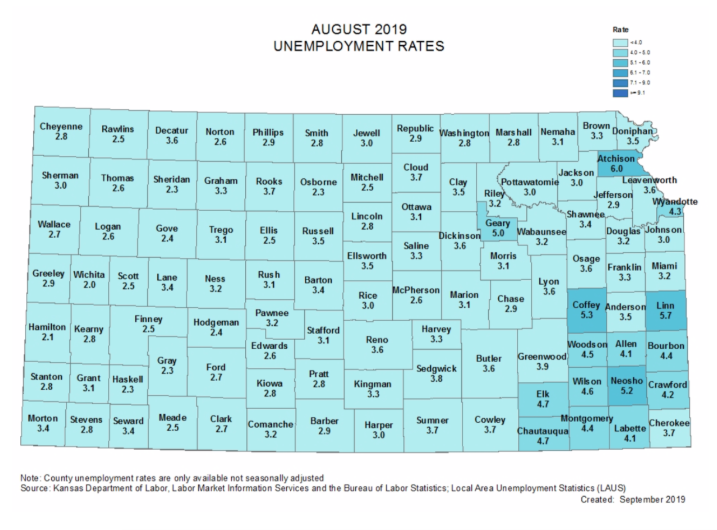
TOPEKA, Kan. (AP) — Kansas is reporting that unemployment in the state dropped to 3.2% in August and was at its lowest rate in more than 20 years.

The state Department of Labor said Friday that the state gained private-sector jobs during the month and over the past year. Labor economist Emilie Doerksen said the state has seen broad economic growth, and Gov. Laura Kelly hailed the report as good news for Kansas.

The department said the unemployment rate declined from 3.3% in July. It was also 3.3% in August 2018.

It was the lowest unemployment rate since May 1999. The rate has been below 4% since January 2017.

Kansas had nearly 1.18 million private, nonfarm jobs in August, up about 4,200 since July and 17,800 from August 2018. The over-the-year growth was 1.5%.

Husband, wife sentenced for illegally selling fish caught in Kansas

LINCOLN, Neb. (AP) — A Nebraska man and wife who sold fish they had illegally caught in public waters in Kansas and other reservoirs have been sentenced to probation.

Federal prosecutors for Nebraska say 49-year-old Phong Duong and 46-year-old Oanh Pham were each sentenced Friday to two years’ probation for illegally taking, transporting and selling fish. They were also ordered to pay $16,000 in restitution.

Prosecutors say that between May 2013 and July 2016, Duong and Pham exceeded the limits on catching fish from the Kirwin National Wildlife Refuge in northern Kansas and other reservoirs. To avoid detection, the couple would routinely change fishing spots, stash fish at off-site locations, and use “straw fishermen” — including children — to conceal fish taken in excess of limits. They’d then take the fish back home to Nebraska and clean and bag them at their Lincoln home before selling the fish.

Woman charged in deadly Kansas trailer park shooting

KANSAS CITY, Kan. (AP) — A 19-year-old woman has been charged in the deadly shooting of a man at a Kansas City Kansas, trailer park over Labor Day weekend.

Hendricks photo Johnson Co.

Alexia Lasha Hendricks is jailed on $150,000 bond on charges of second-degree murder and aggravated robbery in the death of 30-year-old Maurice Hunter Jr. No attorney is listed for her in online court records.

The district attorney’s office alleges in charging documents that Hendricks took a Chevrolet Trailblazer from Hunter “by force or by threat of bodily harm” and killed him. He was pronounced dead at the scene on Sept. 1.

KDA to host multistate African swine fever exercise

KDA

MANHATTAN — The Kansas Department of Agriculture will be one of 15 states participating in a functional exercise the week of Sept. 23-26 focused on the states’ plans for African swine fever (ASF) response and mitigation. The functional exercise, led by the U.S. Department of Agriculture, will test participants’ abilities to respond to a simulated animal disease event.

KDA conducts an annual statewide exercise to practice the state’s response plan to a foreign animal disease event, typically with a simulation of foot-and-mouth disease. This month’s multistate exercise is focused instead on ASF, which has been confirmed in China and several other countries in eastern Asia, but has not occurred in the United States. Members of the KDA Division of Animal Health have been actively working with federal partners, state agencies of neighboring states, and representatives from the pork industry to enhance the state’s response plan with specific focus on ASF.

This four-day functional exercise, which will be based out of KDA headquarters in Manhattan, will enable KDA and its partners in other state agencies, federal and local government, industry, university and 14 other states to practice this response plan.

The functional exercise will attempt to simulate a real-world response as much as possible, including actual veterinarian testing and laboratory results, along with planning and resource coordination, disease mitigation, public educational information, and permitted movement to allow continuity of business for non-infected operations.

African swine fever is a highly contagious virus that affects pigs, causing high fever, loss of appetite and vomiting, and usually resulting in death. Other livestock species are not susceptible to ASF. There are no human health risks from ASF; it does not affect humans and is not a public health threat. An ASF outbreak in the United States would, however, have the potential to cause enormous economic losses not only to pork producers but to the entire production chain as well as to consumers.

For more information about the multistate ASF exercise, contact KDA at 785-564-6700. Media wishing to monitor the exercise should contact KDA director of communications Heather Lansdowne at [email protected] or 785-564-6706 for more information.

In Kansas, Shifting The Power Balance Between Renters And Landlords

Mold. No heat in the winter. Leaking roofs.

The most common complaints Teresa Baker hears about rental housing in Kansas revolve around poor living conditions that violate state law.

As part of her job for the nonprofit Housing and Credit Counseling Inc., Baker serves as an advice guru for low-income residents in about 20 Kansas counties.

Tenants come to her if they’ve received eviction notices, forfeited security deposits or can’t get landlords to make repairs. Sometimes, she counsels landlords, too.

“Of course, it’s the landlord’s business to understand what the law says and his obligations,” Baker said. “The tenants are coming at this blindly.”

Kansas law sets some rules for inevitable disputes between renters and property owners. Yet some tenants and advocates contend landlords too often end up on top because they have more money and familiarity with the rules. The imbalance is leading some tenants to take action.

Housing experts also say Kansas lacks protections that other states offer to renters.

For example, state law prohibits cities and counties from establishing rent control and other rental regulations. Another tactic allowed by other states but banned in Kansas: withholding rent to force a landlord to make repairs. State law allows a landlord to evict tenants for being three days late on the rent.

“That’s one of the Number One things that we deal with, with tenants,” Baker said. “They call us when it’s too late, but they withheld rent and they’re going to court tomorrow.”

Ed Jaskinia, a Kansas City-area landlord and lobbyist for the Associated Landlords of Kansas, says the laws fairly balance the interests of both sides — renters who need to be guarded from predatory landlords, and landlords who want to maintain their properties and make money.

Ed Jaskinia, lobbyist for the Associated Landlords of Kansas.
CREDIT NOMIN UJIYEDIIN / KANSAS NEWS SERVICE
“We’ve got the best laws in the country because it protects everybody equally,” said Ed Jaskinia, a Kansas City-area landlord and lobbyist for the Associated Landlords of Kansas. “It tells us what the rules and regulations are, what we can and can’t do.”

He says tenants should take up their proposed reforms to the cities they live in.

In the meantime, he says tenants already have protections. For example, if a landlord won’t make repairs, tenants can call their city’s code enforcement division to make an inspection. And state law prohibits landlords from retaliating against tenants who do so.

But it’s hard to prove retaliation in court, Baker said. And she said many rural towns don’t have the budget to enforce housing codes.

“Even if they have some type of code on the books,” Baker said, “they don’t enforce it because they can’t.”

Legal Options

Another option for tenants is suing a landlord in small claims court for not completing repairs, exorbitant utility bills or not returning a security deposit.

State law requires landlords to return deposits within 30 days with an itemized list of charges taken out. Otherwise, tenants can sue for one-and-a-half times the amount of the original deposit.

“It’s very common for landlords to keep your security deposit for expenses that I don’t think would be legal,” said Casey Johnson, an attorney for Kansas Legal Services who counsels low-income people on housing. “Those are some good protections for tenants.”

But small claims lawsuits often turn out in favor of the landlord.

“It’s very difficult to get evidence and time to present into a court case,” Johnson said. “Kansas, I would say, is fairly landlord-friendly.”

Tenant Activism

Some residents of Lawrence, Manhattan and Kansas City — where renting is more common than in the rest of the state — are trying to change that. They say there’s a shortage of quality and affordable housing.

Data from the Census Bureau shows that the overall rental vacancy rate in Kansas in 2017 was 7.5%. In Kansas City, it was 8.5%, in Manhattan, it was 10.6% and in Lawrence, it was 6.7%. In the U.S. overall, 6.1% of rental units were vacant in 2017.

Generally, cities in Kansas have a higher proportion of residents who are rent-burdened — defined by the U.S. Department of Housing and Urban Development as spending 30% or more of their income on rent. More than 53% of Lawrence and Manhattan residents are rent-burdened, compared to 44% of all Kansans and 50.6% of Americans overall.

A group called Renters Together, in Manhattan, formed earlier this year, holds weekly meetings with the goal of increasing the number of rental units that the city inspects.

“We’ve noticed that landlords have been retaliating against tenants that do call code services here,” said Jonathan Cole, lead organizer for the group. “We’ve also noticed that people just don’t know that they can call.”

A similarly named group in Lawrence, Renters Together LFK, recently hosted a meeting to tell tenants how to get their security deposits back. The group has knocked on doors and spoken to hundreds of local tenants, said organizer Yoshi Stout.

“At the end of the day,” Stout said, “the tenants need to have some sort of agency for themselves.”

The group encouraged Lawrence resident Kayla Marks to sue her landlord, Manhattan-based company McCullough Development, Inc., in Douglas County small claims court.

In August 2018, Marks and her boyfriend moved into an apartment in Lawrence that she says was a mess. The place was dirty. A window was broken. There was a hole in a bedroom door and the linoleum floor needed to be replaced.

She tidied up and let her landlord know about the repairs. A few months later, the floor and the window were fixed, but by then, she had to move out. She and her boyfriend had broken up, and she couldn’t afford the apartment by herself. Her depression got so bad that she was hospitalized. She got a note from her doctor saying she could no longer live by herself.

Former Lawrence resident Kayla Marks sued her landlord in Douglas County small claims court.
CREDIT NOMIN UJIYEDIIN / KANSAS NEWS SERVICE
In February 2019, Marks applied for a legally required accommodation for her disability, asking to move out of her apartment. Her landlord granted it, but said she owed another month’s rent and sent her a bill for cleanup after she moved out. The company charged her an additional $258, which she disputed.

McCullough Development, Inc., declined multiple requests for comment.

“I’m a clean freak, so this place was spotless,” Marks said. “So I just didn’t think that that was right.”

She sued, asking for money back on her rent and deposit. She didn’t get any money back, but a judge ruled that she didn’t owe her landlord money either.

Marks said she wouldn’t have known how or why to sue without the help of Renters Together.

“I didn’t even know what the actual verdict was until I had to ask somebody,” she said. “But knowing that the verdict was that I don’t owe anything, I’m very pleased.”

Nomin Ujiyediin reports on criminal justice and social welfare for the Kansas News Service. Follow her on Twitter @NominUJ or email nomin (at) kcur (dot) org.

KU study: E-cigarette ads influence adolescents who fail to question tactics

(Photo credit: Pexels.com)

KU NEWS SERVICE

LAWRENCE — The tobacco industry has a history of targeting young people in its advertising to attract new customers. As vaping and electronic cigarettes have grown in popularity, advertisers are up to the same old tricks. New research from the University of Kansas shows that not only do those advertising tactics work, but young people also fail to question information touted in those ads.

Adolescents are the target market for e-cigarette advertisers as drawing in young customers is key to the industry’s business model. While research has examined how young people view e-cigarettes, or how high school youths view advertising, little attention has been paid to how such ads target adolescents. Researchers conducted five focus groups with 39 youths ages 12-17 who don’t use e-cigarettes to find out how they viewed the ads. The findings reflect three key themes:

  • The ads motivate nonsmokers to use e-cigarettes.
  • There was a fascination with the technical and emotional appeal of the products.
  • When searching for information about e-cigarettes, there was very little validation of information.
Yvonnes Chen, KU Associate Professor, School of Journalism

Yvonnes Chen, associate professor of journalism & mass communications; Chris Tilden, research project manager at KU’s Center for Public Partnerships & Research, and Dee Katherine Vernberg of the Lawrence-Douglas County Health Department conducted the focus groups and published their findings in the journal Psychology & Health. The study was funded by a Centers for Disease Control Community Health Grant.

“When e-cigarettes were just starting, people were curious how and why they existed and how they work. But now that they are increasingly popular, we want to know more about their advertising and marketing,” Chen said. “Research has skimmed over the advertising factors, especially as they relate to adolescents’ intent to use them.”

Participants said advertising for e-cigarettes made them want to try the products. They pointed to multiple flavors, the idea that they were a safe alternative to traditional cigarettes and the way they made vaping look cool as the main reasons. Multiple respondents said the ads mentioned they were healthier than cigarettes, leading them to believe they would not get addicted.

“These e-cig companies steal the entire playbook from the tobacco industry,” Chen said. “You see the ‘cool factor,’ the sex appeal and all the same tactics cigarette companies used in advertising. But before now we haven’t looked at how those approaches are perceived by adolescents.”

Respondents also indicated a fascination with the technical and emotional appeal of the commercials. Several pointed out the appeal of the e-cigarettes themselves, their sleek design, batteries and packaging to look like flash drives or “Lord of the Rings” branding were appealing.

“I saw a magazine ad for high-end e-cigarettes, marketing them as a more classy alternative to cigarettes. They were highlighting features and technologies they had, like how long the battery lasted. So it was making it seem fancy — special vapor technology,” one participant said.

Others recalled special effects used in the ads, such as how Blu, one of the most popular brands, had black-and-white commercials highlighting only the color of the e-cigarette.

The emotional appeal was front and center, with participants reporting they perceived social benefits like increased friendships or health benefits including a safer alternative to traditional tobacco, help in quitting smoking or the absence of secondhand smoke.

The third theme showed that when adolescents search for information on e-cigarettes, there was little verification of the information they found. The majority reported youths their age learn about e-cigarettes through search engines and social media platforms. Participants cited YouTube and Instagram demonstration videos on blowing smoke rings and other vaping tricks. When asked if they searched for specific information, the adolescents reported they searched for information on ingredients, if they contained nicotine, health effects, how to obtain them and price. While some said they found “very scientific” information, others said they mostly found information aimed at justifying use.

While the findings show that adolescents remember specific aspects of the ads, their comments lacked skepticism, suggesting the influence of the ads is even more effective on adolescents than older audiences. The results, when taken with the industry trend of increasingly using digital and mobile media for product promotion, show that e-cigarettes and marketing should be regulated by the FDA, researchers argued. While such regulation does not currently exist, media literacy campaigns designed to help adolescents better understand targeted messages and encourage critical thinking would be beneficial.

“The ads were all about being designed so they would be remembered by the viewers. And the e-cigarette industry is very aware of that and very good at it,” Chen said. “I think this adds to a growing body of research and adds support for researchers urging the FDA to take swift action to regulate e-cigarettes.”

Area Game of the Week: Thunder Ridge at Hill City


There was royalty under the lights as a homecoming king and queen were crowned in Hill City. However, no homecoming is complete without a homecoming football game, and that is just what was on tap when the Thunder Ridge Longhorns payed a visit to the Hill City Ringnecks.

The two squads facing off also meant a coaching clash of two former standout running backs.  Coach Travis Desbien is in his 3rd year leading the Hill City Ringnecks. He was a standout running back on Palco’s 2005 state runner-up team. Coach Joel Struckhoff is leading Thunder Ridge for a second year. In 2011 he led Thunder Ridge to a state title as a running back and he still holds several career yard and point records at the 8-man level.

Both coaches were decorated players, but tonight was about this year’s athletes. Reece Struckhoff, a cousin of Joel’s, got the scoring started when he returned the opening kickoff 80 yards for a touchdown. The Senior running back had to sit out last year due to transfer rules, but he has been making up for lost time this season. He did it again later in the quarter, breaking off a long touchdown run on 3rd and 10. Struckhoff helped his team to a 14-0 lead at the end of the first quarter.

The Ringnecks struck first in quarter number 2, on a long touchdown pass to junior receiver Brody McDowell, the ensuing conversion was good, making the score 14-8 Longhorns. Each team found one more score before the half, making it 28-16 at the break. Both squads also had a touchdown brought back by a penalty in the quarter.

Hill City started the second half with the ball, but they failed to score and were forced to punt. Thunder Ridge was able to cash in on their next possession as Struckhoff took in another touchdown, making the score 36-14. More solid defense and a pick-six by Struckhoff helped Thunder Ridge ride out an exciting second half, resulting in a 48-22 victory to spoil Hill City’s homecoming.

Struckhoff finished with 22 carries for 253 yards and 5 touchdowns, he also had the kick return touchdown, the interception return, and 12 tackles. Hill City’s junior standout quarterback Jayce Hamel had 124 yards and a score on 26 carries, he also threw for 132 yards and a touchdown. Brody McDowell finished with 6 receptions for 172 yards and 2 scores. Thunder Ridge is 3-0 on the year, while Hill City drops to 1-2.

Thunder Ridge plays the second of a 3-game road trip next Friday when they head to Almena to face District 5 opponent Northern Valley.

Hill City will hit the road as well next Friday when they face undefeated Clifton-Clyde.

Kansas man jailed for violent baseball bat attack on stepfather

SEDGWICK COUNTY —Law enforcement authorities are investigating a suspect after a violent attack on his stepfather

Tyler Lewis photo Sedgwick Co. Jail

Just before 10:30p.m. Thursday, police responded to report of a disturbance at a home in the 4800 Block of South Fern in Wichita, according to office Charley Davidson.

At the scene, police found a 59-year-old man with critical injuries. EMS transported him to a local hospital for treatment.

Investigators learned that the suspect identified as 26-year-old Tyler Lewis went to his stepfather’s home. During a disturbance between the two men, Lewis battered the step-father with a baseball bat, stabbed him multiple times and fled on foot.

Police found Lewis in the parking lot of an apartment complex in the 2700 Block of South Topeka. They arrested him on requested charges of aggravated battery and an aggravated weapons violation.

The stepfather remains hospitalized but has been upgraded to fair condition, according to Davidson.

US to send troops to Saudi Arabia, hold off on striking Iran

WASHINGTON (AP) — The Pentagon on Friday announced it will deploy additional U.S. troops and missile defense equipment to Saudi Arabia and the United Arab Emirates, as President Donald Trump has at least for now put off any immediate military strike on Iran in response to the attack on the Saudi oil industry.

Defense Secretary Mark Esper told Pentagon reporters this is a first step to beef up security and he would not rule out additional moves down the road. Gen. Joseph Dunford, chairman of the Joint Chiefs of Staff, said more details about the deployment will be determined in the coming days, but it would not involve thousands of U.S. troops.

Other officials said the U.S. deployment would likely be in the hundreds and the defensive equipment heading to the Middle East would probably include Patriot missile batteries and possibly enhanced radars.

The announcement reflected Trump’s comments earlier in the day when he told reporters that showing restraint “shows far more strength” than launching military strikes and he wanted to avoid an all-out war with Iran.

Instead, he laid out new sanctions on the Iranian central bank and said the easiest thing to do would be to launch military strikes.

“I think the strong person’s approach and the thing that does show strength would be showing a little bit of restraint,” Trump told reporters during a meeting with Australian Prime Minister Scott Morrison. “Much easier to do it the other way, and Iran knows that if they misbehave, they are on borrowed time.”

Dunford told reporters the extra equipment and troops would give the Saudis a better chance of defending against unconventional aerial attacks.

“No single system is going to be able to defend against a threat like that,” he said, “but a layered system of defensive capabilities would mitigate the risk of swarms of drones or other attacks that may come from Iran.”

The U.S. has not provided any hard evidence that Iran was responsible for the attacks, while insisting the investigation continues, but Esper on Friday said the drones and cruise missiles used in the attack were produced by Iran.

“The attack on Sept. 14 against Saudi Arabian oil facilities represents a dramatic escalation of Iranian aggression,” Esper said, adding that the U.S. has thus far shown “great restraint.”

In deciding against an immediate U.S. strike, Trump for the second time in recent months pulled back from a major military action against Iran that many Pentagon and other advisers fear could trigger a new Middle East war. In June, after Iran shot down an American surveillance drone, Trump initially endorsed a retaliatory military strike then abruptly called it off because he said it would have killed dozens of Iranians.

On Friday, he left the door open a bit for a later military response, saying people thought he’d attack Iran “within two seconds,” but he has “plenty of time.”

Trump spoke just before he gathered his national security team at the White House to consider a broad range of military, economic and diplomatic options in response to what administration officials say was an unprecedented Iranian attack on Saudi oil facilities.

Iran has denied involvement and warned the U.S. that any attack will spark an “all-out war” with immediate retaliation from Tehran.

Secretary of State Mike Pompeo and Vice President Mike Pence have condemned the attack on Saudi oil facilities as “an act of war.”

Esper and Dunford declined to discuss any potential ship movements to the region, although a number of U.S. Navy vessels are nearby.

The additional air and missile defense equipment for Saudi Arabia would be designed to bolster its defenses in the north, since most of its defenses have focused on threats from Houthis in Yemen to the south.

A forensic team from U.S. Central Command is pouring over evidence from cruise missile and drone debris, but the Pentagon said the assessment is not finished. Officials are trying to determine if they can get navigational information from the debris that could provide hard evidence that the strikes came from Iran.

Copyright Eagle Radio | FCC Public Files | EEO Public File