RENO COUNTY — One person was injured in an accident during a chase just after 2p.m. Saturday in Reno County.
The Kansas Highway Patrol reported a 2004 Suzuki motorcycle driven by Skyler J. Rupp, 21, Wichita, was fleeing from Mount Hope Police southbound on Obee Road six miles south of K-96.
The driver lost control of the motorcycle and crashed.
Rupp was transported to a hospital in Wichita. He was wearing a helmet, according to the KHP. Authorities have not released what prompted the chase.
WICHITA — Large industrial operations — think electrical power plants, oil refineries, ethanol facilities —cough carbon dioxide into the atmosphere by the ton. That, in turn, warms the planet.
Carbon dioxide is all around us. Plants use it for food. Humans exhale it. It’s used in dry ice and to make your soda fizzy.
But it’s produced in serious, problematic quantities when we burn fossil fuels — every time we jump in a car and to generate the majority of the electricity we use.
When we do that, we’re taking carbon that was once stored in the ground and putting it into the atmosphere as carbon dioxide, or CO2.
To prevent some of the catastrophes that would cause, researchers want to stash CO2 emissions back in the ground.
With funding from the U.S. Department of Energy’s CarbonSAFE program, researchers from the Kansas Geological Survey, environmental policy groups, lawyers and oil and gas companies spent the last three years investigating the feasibility of carbon capture and storage in Kansas.
(By Crysta Henthorne/Kansas News Service)Kansas Geological Survey petroleum engineer Eugene Holubnyak has been working on the carbon capture and storage project in Kansas for three years.
“No matter how you slice it,” said Eugene Holubnyak, a petroleum engineer leading the project at the Kansas Geological Survey, “we’re centrally located and I think we have all the necessary components that need to be in place to be a hub for distributing CO2.”
The research first looked at the potential of capturing CO2 emissions from Westar’s Jeffrey Energy Center, a coal-fired power plant located northwest of Topeka. It’s one of the largest emitters of carbon dioxide in the country.
The project would work like this.
First, capture the CO2 straight from the exhaust stacks of the power plant. Then, compress the gas into a liquid. It would then be put it in a pipeline and sent to southwestern Kansas where it would be pumped deep into the ground.
In some cases, it would be put into what’s known as a saline aquifer — essentially a natural underground storage tank.
In other cases, it would be used for something called enhanced oil recovery. That means injecting CO2 into the ground on one side of a deposit to push hard-to-reach oil and gas toward a well on the other side.
The researchers discovered that, at this point, that plan would be too expensive. Even with recently approved tax incentives aimed at jumpstarting carbon capture projects, it would cost Jeffrey Energy Center far more to capture and compress than it could make selling the CO2.
A possibility that might be more economically tempting would capture CO2 from a network of ethanol plants across the Midwest.
That’s because unlike the byproduct of burning coal, which contains multiple chemicals — pollutants that would have to be separated before you pump anything into the ground — ethanol coughs up relatively untainted carbon dioxide.
“The challenge is that, relative to the size of a power plant, ethanol plants are pretty small,” said Brendan Jordan who worked on the project for the Great Plains Institute, a non-profit that wants to transform the country’s energy systems.
Under that scenario, size would matter. To make the same kind of impact that capturing CO2 from a power plant would have, ethanol plants from all over the Midwest would need to be connected through a regional pipeline.
Jordan said that kind of network would be a start until the cost of capturing power plant CO2 and other industrial sources drops dramatically.
And it might rally a range of people often at odds with each other.
Environmentalists support it because it could help curb climate change. Ethanol plants like it because it opens up a new revenue stream selling CO2 to oil and gas companies. The oil and gas industry is on board because it’s looking for a cheap, consistent source of CO2 to use in enhanced oil recovery.
That kind of broad support makes Jordan optimistic a commercial project could launch in the next five to ten years.
“The problem we have in the Midwest is a mismatch between where a lot of the ethanol plants are and where the appropriate geology is,” Jordan said.
Kansas is right in the middle of that equation. Any major pipeline project would have to run through the state — allowing both producers and consumers of CO2 to easily connect.
“You’ve got the right geology to do saline projects and you’ve got a lot of oil and gas,” Duguid said. “Those fields are at the right depths and have the right properties to do enhanced oil recovery.”
But some environmentalists worry about the unintended consequences of the tax incentives that make any of this profitable enough for companies to try. Particularly since it might just enable more oil drilling.
Hawkins argues carbon capture and storage isn’t a grand solution for eliminating all fossil fuel emissions, but rather one of many tools to reduce their impact.
Even if carbon capture makes it easier to drill for, and burn, oil, Hawkins said it could ultimately offset the fossil fuel use it would make easier.
For now, at least, it’s all still an idea. Researchers and industry professionals are working to make it a reality. But a future with large-scale carbon capture, pipelines and storage projects still largely depends on potential regulatory changes, tax incentives, and the economy as a whole.
So when will the first project get built in Kansas?
“Bold statement: five years,” Holubnyak said. “If not in this time it’s probably never going to happen.”
Brian Grimmett reports on the environment, energy and natural resources for KMUW in Wichita and the Kansas News Service. You can follow him on Twitter @briangrimmett or email him at grimmett (at) kmuw (dot) org. The Kansas News Service is a collaboration of KCUR, Kansas Public Radio, KMUW and High Plains Public Radio focused on the health and well-being of Kansans, their communities and civic life.
KANSAS CITY. (AP) — A man has been convicted of killing his mother’s fiance after blaming him for burglarizing his home.
William Miller-Kirkland photo Jackson Co.
Jurors found 28-year-old William Miller-Kirkland, of Independence, Mo., guilty Thursday of first-degree murder and armed criminal action in the December 2017 shooting death of Teddis Burns-El. His sentencing is set for Oct. 25.
Court records say Miller-Kirkland’s mother told police that she was sleeping in her Independence apartment with her fiance when they were awoken by banging and screaming.
She says her son was drunk and believed that her fiance was either involved in the burglary or was covering for a cousin. She says her son shot her fiance once in the arm and several more times after he fell.
Police then arrested Miller-Kirkland after he briefly fled in a sport utility vehicle.
FORD COUNTY — Law enforcement and zoo officials are investigating injuries to a monkey at the zoo in Dodge City.
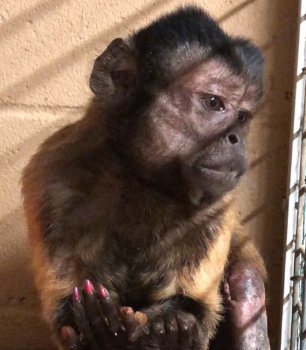
Capuchin monkey photo courtesy Wright Park Zoo
Wright Park Zoo and City staff previously released information that an older Tufted Capuchin Monkey, Vern, was found with minor injuries the same morning it was reported that another Capuchin from the Zoo’s troop, Pickett, was located just outside City Limits, according to a media release.
After further veterinary treatment, it was found that the injury was more extensive than it initially appeared and would require surgery. When originally reported, it was not yet determined how Pickett came to be outside the enclosure or how Vern was injured.
“Based on DCPD’s investigation as of Friday, we do not believe the little monkey, Pickett, found his way outside the enclosure on his own,” said Dodge City Police Chief Drew Francis. “Nor do we believe he traveled to where he was found on his own. The older monkey’s injury appears to be from blunt force trauma in excess of what would occur from a fall.”
Officer’s conducting the investigation suspect that someone gained access to the enclosure and injured the older monkey as he tried to protect his offspring from being taken.
Hannah Schroeder, Head Zookeeper, said, “Vern is very protective of the younger monkey and would not have let him go without a fight. Unfortunately, this suspected altercation resulted in a broken knee cap.”
After many discussions with the Zoo’s contracted veterinarian, Dr. Jennifer Wipf, it was decided that the, “best course of action for recovery was for Vern to be transferred to Kansas State University for surgery,” Schroeder said.
Surgery was performed on September 10, 2019, by veterinary and orthopedic specialists at Kansas State University to repair the broken bones and was deemed successful.
“Vern is recovering well but will have to spend the next 6-8 weeks away from his family while he recovers,” Schroeder said. “He is back at the zoo and will remain behind the scenes until his injuries are healed.”
While Vern recovers, the investigation into the incident continues, Francis said.
“Though I doubt the culprit has the decency to come forward,” Francis said. “I also suspect someone may know who committed this act or have an idea who would do this. If that’s you, we would greatly appreciate talking with you.”
SHAWNEE COUNTY —The Shawnee County Sheriff’s Office Criminal Investigation Division has been developing several suspects over the past couple of weeks in connection to the aggravated burglary that occurred in the 7600 block of SW Urish Road on August 26.
On September 10, officers from the Shawnee County Sheriff’s Office Criminal Investigations Division and Fugitive Warrants Unit arrested Matthew J. Kolbek Jr, 24, Topeka, in the 1200 Block of SW Belle Terrace after Kolbek jumped from a 2nd floor window and attempted to elude officers through a nearby park, according to Sgt. Todd Stallbaumer.
Authorities seized a firearm, ammunition, 8.3 lbs of Marijuana, over 60 THC vape cartridges, and approximately $3000 cash from the residence.
Additionally, Emily M. Kratochvil, 21, Sahayvian J. Griggs, 18, and Joshua M. Long, 23, all from Topeka, were located and arrested over the past couple of days in connection to the incident. The four suspects were booked into the Shawnee County Department of Corrections with the following requested charges includin gAggravated Battery – Use of a Deadly Weapon, Aggravated Assault – Use of a Deadly Weapon, Aggravated Burglary, Criminal Threat, Criminal Damage to Property and Criminal Use of a Firearm.
Kolbek has previous conviction for criminal threat, aggravated battery and stalking, according to the Kansas Department of Corrections.
DODGE CITY, Kan. (AP) — Fire officials say one person suffered smoke inhalation in a fire at a meatpacking plant in southwestern Kansas.
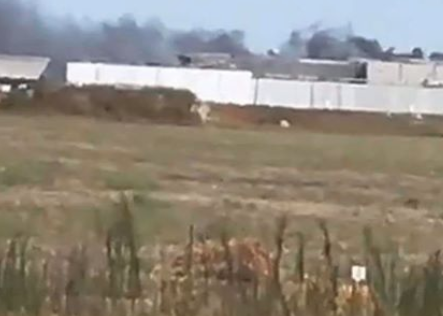
Fire at Cargill meat processing plant in Dodge City-photo courtesy Holcomb Community Fire Dept.
The fire broke out Friday afternoon at the Cargill plant in Dodge City.
The station says Dodge City Fire Chief Robert Heinz reported the fire was on the roof of the rendering side of the plant, and crews found a fire in the area’s ventilation system. The blaze was extinguished in minutes.
Heinz says a spark from welding work being done at the plant ignited grease. He says one person had to be taken to a hospital for smoke inhalation, but is expected to recover.
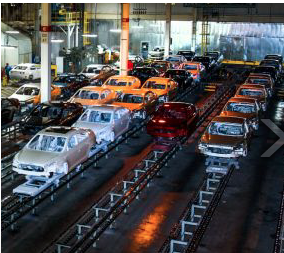
DETROIT (AP) — Leaders of the United Auto Workers union have extended contracts with Ford and Fiat Chrysler indefinitely, but the pact with General Motors is still set to expire Saturday night.
The move, plus a widening corruption investigation of union leadership, puts added pressure on bargainers for both sides as they approach the contract deadline and the union starts to make preparations for a strike.
The General Motors Fairfax KC Assembly Plant (Photo by Susan McSpadden for Chevrolet)
The union has picked GM as the target company, meaning it is the focus of bargaining and would be the first company to face a walkout. GM’s contract with the union is scheduled to expire at 11:59 p.m. Saturday.
It’s possible that the four-year GM contract also could be extended or a deal could be reached, but it’s more likely that 49,200 UAW members could walk out of GM plants as early as Sunday because union and company demands are so far apart.
Picket line schedules already have been posted near the entrance to one local UAW office in Detroit.
Art Wheaton, an auto industry expert at the Worker Institute at Cornell University, expects the GM contract to be extended for a time, but he says the gulf between both sides is wide.
“GM is looking through the windshield ahead, and it looks like nothing but land mines,” he said, citing a possible recession, trade disputes and the expense of developing electric and autonomous vehicles. “I think there’s really going to be a big problem down the road in matching the expectations of the union and the willingness of General Motors to be able to give the membership what it wants.”
Plant-level union leaders from all over the country will be in Detroit on Sunday to talk about the next steps, and after that, the union likely will make an announcement.
But leaders are likely to face questions about an expanding federal corruption probe that snared a top official on Thursday. Vance Pearson, head of a regional office based near St. Louis, was charged with corruption in an alleged scheme to embezzle union money and spend cash on premium booze, golf clubs, cigars and swanky stays in California. It’s the same region that UAW President Gary Jones led before taking the union’s top office last year.
Jones and other union executives met privately at a hotel at Detroit Metropolitan Airport on Friday. After the meeting broke up, Jones’ driver and others physically blocked an Associated Press reporter from trying to approach him to ask questions. Jones has not been charged in the case.
Union spokesman Brian Rothenberg said Friday night that Jones remains in office, as does Pearson. “They didn’t make any changes,” he said.
In a 40-page criminal complaint, the government alleged that over $600,000 in UAW money was spent by union officials at businesses in the Palm Beach, California, area, including at restaurants, a golf resort, cigar shop and rental properties, between 2014 and 2017.
The union said the government has misconstrued facts and said the allegations are not proof of wrongdoing. “Regardless, we will not let this distract us from the critical negotiations under way with GM to gain better wages and benefits,” Rothenberg said.
At UAW Local 22 in Detroit, picket line schedules for three days were posted on the lobby windows. The local represents workers at a plant that straddles the border between Detroit and the hamlet of Hamtramck.
The 24-hour schedules don’t list any date to start but a separate schedule has a group reporting to the union hall at 6 a.m. on Sunday. The factory, which makes the Chevrolet Impala and Cadillac CT6, is one of four that GM plans to close.
Here are the main areas of disagreement:
— GM is making big money, $8 billion last year alone, and workers want a bigger slice. The union wants annual pay raises to guard against an economic downturn, but the company wants to pay lump sums tied to earnings. Automakers don’t want higher fixed costs.
— The union also wants new products for four factories GM wants to close. The factory plans have irked some workers, although most those who were laid off will get jobs at other GM factories. GM currently has too much U.S. factory capacity.
— The companies want to close the labor cost gap with workers at plants run by foreign automakers. GM’s gap is the largest at $13 per hour, followed by Ford at $11 and Fiat Chrysler at $5, according to figures from the Center for Automotive Research, an industry think tank. GM pays $63 per hour in wages and benefits compared with $50 at the foreign-owned factories.
— Union members have great health insurance plans but workers pay about 4% of the cost. Employees of large firms nationwide pay about 34%, according to the Kaiser Family Foundation. The companies would like to cut costs.
If there is a strike, it would be the union’s first since a short one against GM in 2007.
The union may have to strike at least for a while to show workers that it got as much from the company as it could, Wheaton said. Some workers, he said, mistrust union leaders due to the corruption scandal.
Negotiators are usually tight-lipped about the talks, but a week ago, UAW Vice President Terry Dittes wrote in a letter to local union leaders that GM has been slow to respond to union proposals. GM answered in a letter sent to factories that said it is moving as quickly as it can.
“We are working hard to understand and respond to UAW proposals and we have offered to meet as often as needed,” the letter said.
Just before 11:30 p.m., police attempted to stop a 2013 white Chevrolet Silverado for a traffic infraction, according to office Charley Davidson.
The vehicle was occupied by 29-year-old T.J. McMahan, 52-year-old Robert Boots, 24-year-old Skyler Bazil-Lounsbury all of Wichita and a known 25-year-old suspect.
McMahan, who was the driver, refused to stop, accelerated and fled from officers. A vehicle pursuit ensued and McMahan fired two shots at the officers while driving. The first shot fired was in the area of East 1st Street and North Spruce Street and the second was in the area of East 1st Street and North Estelle. The officers were not injured.
The pursuit continued south on Hillside and ended at Range Street after the truck’s tires were flattened by a tire-deflation device during the pursuit. All four suspects ran from the vehicle and into the neighborhood.
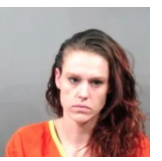
McMahan photo Sedgwick Co.
Officers set up a perimeter and utilized multiple police K-9s, drones, and a KHP helicopter to search for the suspects. McMahan, Boots, and Bazil-Lounsbury were located in the area and arrested without incident. Officers are working to locate the fourth known suspect.
McMahan is being held on a $250,000 bond on requested charges that include two counts of aggravated assault of a law enforcement officer, felony evade and elude, criminal possession of a firearm, as well as other drug and traffic-related charges. Boots of Wichita and Bazil-Lounsbury were both jailed for outstanding warrants, according to Davidson. Boots was no longer in custody Friday. Bazil-Lounsbury has a bond of $150,000 bond for probation violations, according to online jail records.
Officers also located methamphetamine, marijuana, a gun magazine and live ammunition in the vehicle. A handgun was also recovered during the investigation.
There are 14 such sites in the United States., and the KU Cancer Center-Midwest Cancer Alliance site is the only one that focuses on rural communities.
As an NCORP MU community site, KU Cancer Center and Midwest Cancer Alliance will accrue individuals to NCI-approved cancer clinical trials and research studies that encompass cancer prevention, screening, supportive care and symptom management, treatment, quality of life and cancer care delivery.
“This grant is an affirmation and recognition of our scientific leadership and expertise in cancer prevention, survivorship, and cancer-care delivery research,” said Roy Jensen, MD, Director of the KU Cancer Center. “That we are the single site focused on rural communities underscores our vital role in helping our fellow Kansans.”
NCORP is a national network of investigators, cancer care providers, academic institutions and other organizations whose goal is to improve patient outcomes and reduce cancer disparities through clinical trials and research studies. NCORP grants are awarded to top institutions that have demonstrated a strong commitment to the communities they serve.
“As the outreach network of the cancer center, Midwest Cancer Alliance has partnered with hospitals, cancer centers and health care providers across Kansas for more than a decade,” said Hope Krebill, MSW, BSN, RN, executive director of Midwest Cancer Alliance. “This grant enhances our ability to leverage the expertise of our rural cancer providers and KU Cancer Center researchers to expand clinical trials and decrease barriers to participation, with the ultimate goal of eliminating cancer disparities and preventing and treating cancer more effectively,” Krebill said.
“Support from the grant strengthens the institutions’ commitment to advancing clinical trial access and quality of care in rural communities,” said breast oncologist and co-principal investigator Priyanka Sharma, MD. Sharma also noted that patients can now access benefits from several new cancer prevention, survivorship and cancer-care delivery clinical trials.
According to Gary Doolittle, MD, Midwest Cancer Alliance medical director and co-principal investigator for the NCORP grant, bringing clinical trials to a broader patient population may reduce disparities in cancer, given that providing clinical trials to cancer patients is considered a standard of care. Per numerous studies, including a 2017 study conducted by the Centers for Disease Control, people in rural America are more likely to die from cancer than those in the country’s metropolitan counties.
“While improvements in cancer care have been significant over the last several decades, the need to provide dedicated, comprehensive care continues to grow, particularly in rural areas,” Doolittle said. “We need to ensure that people across the landscape of our area have access to the highest quality cancer care, and this grant enables KU Cancer Center and Midwest Cancer Alliance to help do just that.”
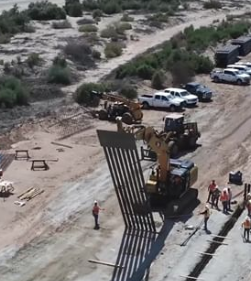
YUMA, Ariz. (AP) — On a dirt road past rows of date trees, just feet from a dry section of Colorado River, a small construction crew is putting up a towering border wall that the government hopes will reduce — for good — the flow of immigrants who cross the U.S.-Mexico border illegally.
Border wall construction photo courtesy White House
Cicadas buzz and heavy equipment rumbles and beeps before it lowers 30-foot-tall sections of fence into the dirt. “Ahí está!” — “There it is!” — a Spanish-speaking member of the crew says as the men straighten the sections into the ground. Nearby, workers pull dates from palm trees, not far from the cotton fields that cars pass on the drive to the border.
South of Yuma, Arizona, the tall brown bollards rising against a cloudless desert sky will replace much shorter barriers that are meant to keep out cars, but not people.
This 5-mile (8-kilometer) section of fencing is where President Donald Trump’s most salient campaign promise — to build a wall along the entire southern border — is taking shape.
The president and his administration said this week that they plan on building between 450 and 500 miles (724 and 806 kilometers) of fencing along the nearly 2,000-mile (3,218-kilometer) border by the end of 2020, an ambitious undertaking funded by billions of defense dollars that had been earmarked for things like military base schools, target ranges and maintenance facilities.
Two other Pentagon-funded construction projects in New Mexico and Arizona are underway, but some are skeptical that so many miles of wall can be built in such a short amount of time. The government is up against last-minute construction hiccups, funding issues and legal challenges from environmentalists and property owners whose land sits on the border.
The Trump administration says the wall — along with more surveillance technology, agents and lighting — is key to keeping out people who cross illegally.
Critics say a wall is useless when most of those apprehended turn themselves in to Border Patrol agents in the hope they can be eventually released while their cases play out in immigration court.
In Yuma, the defense-funded section of tall fencing is replacing shorter barriers that U.S. officials say are less efficient.
It comes amid a steep increase since last year in the number of migrant families who cross the border illegally in the Yuma area, often turning themselves in to Border Patrol agents. Many are fleeing extreme poverty and violence, and some are seeking asylum.
So far this year, Border Patrol agents in the Yuma sector have apprehended over 51,000 family units. That’s compared with just over 14,500 the year before — about a 250% increase.
The Yuma sector is the third busiest along the southern border, with officials building a temporary, 500-person tent facility in the parking lot of the Border Patrol’s Yuma headquarters in June.
It spent just under $15 million for the setup and services for four months, including meals, laundry and security, but officials are evaluating whether to keep it running past next month as the number of arrivals in Yuma and across the southern border have fallen sharply in recent months.
The drop is largely due to the Mexican government’s efforts to stop migrants from heading north after Trump threatened tariffs earlier this year to force Mexico to act.
The number of people apprehended along the southern border fell by 61 percent between this year’s high point in May and the end of August. In Yuma, it fell by 86 percent, according to government figures. Most people apprehended are either traveling as families or are unaccompanied children.
“Historically this has been a huge crossing point for both vehicles as well as family units and unaccompanied alien children during the crisis that we’ve seen in the past couple of months,” Border Patrol spokesman Jose Garibay said. “They’ve just been pouring over the border due to the fact that we’ve only ever had vehicle bollards and barriers that by design only stop vehicles.”
Victor Manjarrez Jr., a former Border Patrol chief who’s now a professor at the University of Texas, El Paso, was an agent when the government put up the first stretch of barriers along the southern border — in San Diego.
He’s seen barriers evolve from easily collapsible landing mats installed by agents and the National Guard to the sophisticated, multibillion-dollar projects now being done by private contractors.
Manjarrez says tall border fencing is crucial in some areas and less helpful in others, like remote stretches of desert where shorter barriers and more technology like ground sensors would suffice.
“One form doesn’t fit in all areas, and so the fence itself is not the one solution. It’s a combination of many things,” Manjarrez said.
The ease of construction varies by place and depends on things like water, Manjarrez said, adding that just because a plot of land is flat “doesn’t mean it’s not complex.”
He said building 450 to 500 miles (724 and 806 kilometers) of fence by the end of next year would be tough if that figure doesn’t include sections of the wall that have been built recently.
“As it stands now, contractors are building pretty fast,” Manjarrez said. The real question is whether the government needs to build that much fencing, he said.
The Trump administration may face those issues along with lawsuits from landowners who aren’t giving up their property so easily and environmentalists who say the barriers stop animals from migrating and can cut off water resources.
The Tohono O’odham tribe in Arizona also has expressed opposition to more border fencing on its land, which stretches for nearly 75 miles (120 kilometers) along the border with Mexico.
Near Yuma, the Cocopah Indian Tribe’s reservation is near the latest fencing project, and leaders are concerned it will block the view to its sacred sites, spokesman Jonathan Athens said.
TOPEKA – In support of September as Suicide Prevention Month and National Suicide Prevention Week September 8-14, state agencies, along with the Kansas Attorney General’s Office, are releasing a unified resource that outlines actions that all Kansans can take to protect and empower youth.
“Suicide is the second leading cause of death for Kansans age 15 to 24 and it is the third leading cause of death for youth ages 5 to 14 – this is unacceptable,” said Dr. Lee Norman, Secretary of the Kansas Department of Health and Environment (KDHE). “Every one of us has a role to play, whether you’re a friend, parent, community member or school employee. We need to come together to help our youth.”
The resources, which can be found online, identify actions that everyone can take. The agencies involved in its creation include: KDHE, the Kansas Department for Aging and Disability Services, the Kansas Department for Children and Families, Kansas State Department of Education and the Kansas Attorney General’s Office, in collaboration with the Kansas Suicide Prevention Resource Center.
“As we mark National Suicide Prevention Week, I want to commend the work of all the agencies involved in creating the tip sheets as resources for Kansans and look forward to working closely together as we lead a collaborative effort to strengthen the overall Kansas response to youth suicide,” said Gina Meier-Hummel, Youth Suicide Prevention Coordinator for the Kansas Attorney General’s Office.
If you or someone you know is in need of assistance, please call the National Suicide Prevention Lifeline at 1-800-273-8255.
BARTON COUNTY —Friday the 13th was an unlucky day for methamphetamine dealers in Barton County. The Sheriff’s office conducted three search warrants at various locations in the county, according to Sheriff Brian Bellendir. It is believed this was a methamphetamine distribution operation.
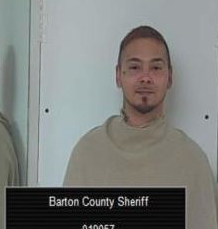
Zapata photo Barton Co.Deputies on the scene of Friday’s investigation
Shortly after 10 AM deputies and detectives executed a search warrant at 1411 20th St. in Great Bend. Deputies arrested Roosevelt (Ty) Henderson, 32 of Great Bend on requested charges of distribution of methamphetamine, criminal use of a firearm as well as destruction of evidence. As deputies were attempting to gain entry into the residence, Henderson attempted to flush suspected methamphetamine down the toilet causing it to clog. A large amount of cash as well as a handgun were located at the residence. Henderson is being held in lieu of a $300,000 bond.
Just before 11a.m. deputies then proceeded to 260 N. Washington just north of the City of Great Bend. Deputies gained entry to the residence and contacted John Paul Zapata. Zapata was arrested on charges of conspiracy to distribute methamphetamine and felon in possession of a firearm. Four children were also found in the residence Juvenile Services was contacted and a “child in need of care” case has been initiated. Currency was also seized at that residence
At approximately 12:15p.m., deputies executed a search warrant at Affordable Tire and Auto located at 4908 10th Street in Great Bend. At that location Sheriff’s deputies found evidence of distribution of methamphetamine and a stolen firearm. Brett Denning, age 51 of Great Bend was booked into the Barton County jail on requested charges of possession of methamphetamine and possession of stolen property.
SHAWNEE COUNTY —Law enforcement authorities are investigating a violent attack on a Kansas man and have made an arrest.
Hoffman photo Shawnee Co.
Just after 2a.m. August 17, police were dispatched to the Lazy Toad Bar located at 5331 SW 22nd Park in Topeka in reference to a shooting that had occurred in the parking lot, according to police spokesperson Gretchen Koenen. When officers arrived on scene they located a victim later identified as 30-year-old Jesse B. Green. suffering from serious injuries.
He had been shot and run over by a vehicle. After an extended stay in the hospital recovered from his injuries.
On Friday, officers arrested 21-year-old Ty’vaire Demone Henderson in connection with the incident. He was booked into the Shawnee County Department of Corrections on requested charges of attempted first-degree murder.