We have a brand new updated website! Click here to check it out!

Baby Red Panda at Kansas zoo has died

photo courtesy Lee Richardson Zoo

FINNEY COUNTY — Southwest Kansas residents and staff at the Lee Richardson Zoo are mourning the loss of a red panda cub.

On Friday, veterinary and animal care staff at Lee Richardson Zoo made the painful decision to euthanize the smallest of the three red panda cubs born August 12, according to a social media report.

On October 2 while monitoring the cubs, animal care staff noted that one was losing weight rather than gaining and lagging substantially behind his brothers. Staff planned supplemental feedings and prepared formula. But when staff were next able to separate the cubs from their mother to provide the first extra feeding on Tuesday, the smallest cub was in crisis. He was moved to the veterinary clinic for tube feeding and attention to a an injury.

“The littlest red panda gave all he had as did veterinary and animal care staff but it just wasn’t enough,” said Sarah Colman, General Curator.

“The littlest one may have only been with us for a little while, but it hurts to have lost him. The two other cubs are doing well. One is big for his age, and the other is gaining weight more quickly than he was, since there’s less competition.”

Mother and cubs are indoors, where they will most likely stay until later this month or early November based on when Ember has elected to go outside with her previous litters.

Until then, footage of mom and cubs will be on the zoo’s website, the zoo Facebook page and YouTube channel, as well as local cable channel 8 in southwest Kansas.

5 Reasons The Kan. Supreme Court Found The State’s School Funding Unconstitutional

Last week the state lost again at the Kansas Supreme Court, which unanimously ruled that Kansas is underfunding its public schools, with repercussions for academically struggling children across the state — and especially for students and taxpayers who live in resource-poor school districts.

Because it’s just the latest in a string of similar decisions, the ruling means Kansas, in the eyes of its courts, has been unconstitutionally funding public schools for most of the past decade and a half.

Here are five key messages the justices had for the Legislature and the state of Kansas in the decision.

You can’t give extra money to Blue Valley and De Soto but no one else. 

This spring Kansas lawmakers added nearly $300 million to spending on public schools, to be phased in over the next two years. Tucked into that was a combined $2 million for Blue Valley and De Soto school districts to serve more children from low-income families than those districts actually enroll.

So why did the two Johnson County districts get money for nonexistent students while other districts didn’t? The state argued that districts with a low percentage of children from low-income backgrounds still have their share of kids who are struggling academically. Hence, they should get a cushion of extra funding to serve those academically struggling kids.

That didn’t fly with the justices, who pointed out that districts across the state may face similar situations — there are nearly 40,000 Kansas public school students who are academically struggling yet don’t come from low-income families.

The implication: If Blue Valley and De Soto get extra money for kids in that category, other districts should too.

You can’t let some school districts hike the amount of money they raise through property taxes but make other districts face public protest petitions and elections before they can do the same thing. 

During recent repeated revisions to school finance laws, the Legislature allowed some districts to enlarge one part of their budgets that comes primarily from local taxpayers — without having to face protests from those taxpayers. Not all the districts fit the Legislature’s criteria for doing so, but among those that did, dozens jumped at the opportunity.

Then the Legislature closed this window and grandfathered in those districts.

That’s not fair, the justices concluded. It denies the rest of the state’s schools equal access to funding.

Your new rules for paying electricity and insurance bills are unfair to the state’s poorer school districts. 

The Legislature has a history of tweaking its school finance legislation in ways that school boards argue shift the costs of education away from state coffers and onto local taxpayers. And the justices have repeatedly agreed with the school boards.

Why do they care? Because when the state does this, poorer school districts — meaning those in areas of Kansas where local property isn’t worth as much, so taxing it doesn’t raise as much — have a hard time keeping up.

This spring lawmakers suggested school districts could start paying their utilities and some of their insurance bills with a specific local property tax fund that is otherwise meant for things like building construction and computer purchases. A key feature of this fund is that the amount of money poorer and richer school districts have in it varies — a lot.

Take Kansas City Kansas and Blue Valley. Each district serves around 21,000 students, and each charges local taxpayers the same tax rate to fuel that construction fund. But because Blue Valley is property-rich, this raised $22.7 million. Kansas City Kansas ended up with just $9.2 million — even after the state kicked in money to account for the fact that the district’s property values are lower.

So the state Supreme Court slapped lawmakers on the wrist for changing the rules about utility and insurance bills.

You can’t calculate how much money to give poorer school districts based on older data. 

This spring the Legislature decided to change how it calculates some of the money it gives to poorer districts. Instead of taking into account current data from local school budgets, it decided to start using data from a year earlier.

The state argued this offers budget stability and predictability. It makes it easier to see just what the state’s financial obligations will be.

That didn’t convince the court. The tweak cuts an estimated $16 million from the state’s aid to schools in 2017-18 — savings that come from reducing payments to districts with weaker tax bases.

One thing is clear in the history of school finance rulings: Kansas courts don’t like it when lawmakers rejigger the rules in a way that disproportionately cuts money from poorer schools.

The biggie: You need to put enough money into schools to help a lot of kids do a lot better. 

The school districts that are suing Kansas accuse the state of cutting deep into school funding when the recession hit, failing to fix the situation and pursuing income tax cuts instead — all while schools reeled under the effects of increasing costs and inflation, and taxpayers and students paid the price.

In this context, the plaintiffs argued, adding $300 million isn’t enough, and ongoing inflation will eat up half of it anyway.

Read the latest Kansas Supreme Court ruling in Gannon v. Kansas.

So how much money is needed? The justices didn’t say. What they really want is for the Legislature to put effort into figuring out what amount is needed and then show the court how it came up with it. And the court wants reasoning and calculations that make sense.

The court calls this “showing your work,” a phrase math teachers can no doubt appreciate.

Yet in the years-long saga of Gannon v. Kansas, the justices have repeatedly seemed unconvinced the Legislature is doing much more than coming up with a politically expedient figure and filing legal briefs that say, “There. We’re done.”

The problem, as the court sees it, is that a quarter of Kansas public school students are struggling with basic proficiency in math and reading. The state and Legislature have a duty to try to fix that by digging into the problem and passing reasonable legislation, the justices say.

So did Kansas show its work this time? Not according to the court.

The Legislature offered up a four-page statistical analysis of how much money schools need in order to be successful. The justices spent 14 pages complaining about its shoddy documentation, methodology and reasoning — effectively painting the memo as at best sloppy and at worst numerically manipulative. And, they noted, the Legislature didn’t end up actually following the results of the memo.

Read the legislative research memo on school funding in 41 Kansas districts.

They contrasted what appeared to them to be a cursory job with two school finance studies the Legislature commissioned more than a decade ago. Each of those studies took analysts at least half a year to complete. One resulted in more than 340 pages of analysis and supporting documentation. The other had more than 160 pages.

The justices found similar weaknesses in the state’s other arguments — on topics ranging from funding for kindergarten to spending on academically struggling kids.

So in their eyes, the state didn’t make a convincing case for why it concluded that an extra $300 million was needed for schools and not, say, $200 million, $400 million or $800 million.

And that’s a problem, because the legal burden of proof was on the state.

Celia Llopis-Jepsen is a reporter for the Kansas News Service, a collaboration of KCUR, Kansas Public Radio, KMUW and High Plains Public Radio covering health, education and politics. You can reach her on Twitter @Celia_LJ.

Affidavit: Suspect in tax office shooting admitted he "killed a guy"

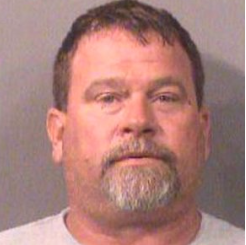
Wirths -photo Sedgwick Co.

WICHITA, Kan. (AP) — Court records say a man accused of walking into a tax office in Wichita and shooting a seizure agent told an acquaintance in a phone call that he’d “lost it” and “just killed a guy.”

The arrest affidavit for Ricky Wirths says the call was one of two that the 52-year-old made after the Sept. 19 shooting that wounded Cortney Holloway. The affidavit says Wirths also asked the acquaintance to care for his employees and children. In a second call to an employee, he’s accused of confessing that he’d “just shot somebody.” Wirths also expressed thanks for the employee’s “hard work.”

Wirths is jailed on $500,000 bond after pleading not guilty to attempted first-degree murder. Wirths owed nearly $400,000 in outstanding tax warrants.

Kansas boy whose town gave him a special Christmas dies

Christian Risner-photo courtesy Van Arsdale Funeral Home

LEBO, Kan. (AP) — A 3-year-old boy whose fight with cancer prompted his small southern Kansas hometown to celebrate Christmas in September has died.

Christian Risner of Lebo died Saturday in Emporia. Christian’s family announced his death on a Facebook page they established after the boy was diagnosed with Rhabdoid kidney cancer in April 2016.

Christian began hospice care in August.

He loved Christmas, so Lebo — a town of about 940 people — put on a special celebration Sept. 10, with Santa, a horse-drawn sleigh and homes throughout the town decorated for the holiday.

The Jones-Vans Arsdale Funeral Home says his funeral will take place Saturday at Lebo High School, with visitation before the service.

He is survived by his parents, two brothers and paternal grandparents.

UPDATE: KBI assisting investigation of Kansas house fire

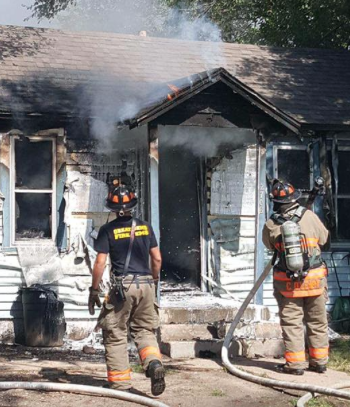
Photo Great Bend Fire and EMS

GREAT BEND —Officials are investigating the cause of a fire at a home in Great Bend.

The Kansas Bureau of Investigation, Kansas Fire Marshal’s Office and Great Bend Police are assisting with the investigation, according to Great Bend Fire Chief Luke McCormick.

On Friday afternoon the Great Bend Fire Department responded to the 2700 block of 19th Street to battle a house fire.

There were no injuries reported. Check Hays Post for additional details as they become available.

K-State investigating after Jewish structure on campus vandalized

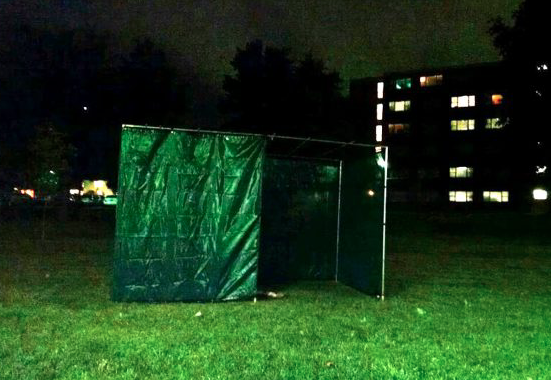
photo courtesy Glen Buickerood

MANHATTAN, Kan. (AP) — Authorities are investigating the vandalism of a temporary dwelling erected outside a Kansas State University residential complex for the Jewish harvest festival Sukkot.

The Topeka Capital-Journal reports that the sukkah was found late Friday wrapped around the car of graduate student Glen Buickerood, damaging the vehicle. Buickerood, who doesn’t identify as Jewish, had collaborated with the Jewish student group Hillel to put up the sukkah to promote diversity.

Buickerood said in an email to university officials that he distributed posters and hung one on the sukkah telling students about the structure before the vandalism.

poster found on campus in April -courtesy image

Hillel adviser Greg Newmark says what happened was “certainly anti-Semitic in effect.” Newmark says the “most generous” thing he can say is that the people involved “are remarkably insensitive.”

The sukkah was rebuilt Sunday morning.

In April the University condemned Anti-Semitic posters found on the KSU campus.

Funeral services set for victims in Lawrence shooting that killed 3

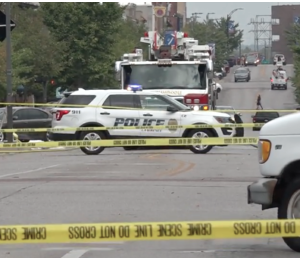
Law enforcement on the scene of the weekend fatal shooting in Lawrence-photo courtesy WIBW TV

DOUGLAS COUNTY — Law enforcement authorities continue to investigate the October 1, fatal shooting in downtown Lawrence as  Funeral services are scheduled for two of the victims.

Public visitations are scheduled Tuesday for 20-year-old Colwin Henderson and 24-year-old Tremel Dupree Dean, according to Peaceful Rest Funeral Chapel in Topeka.

Leah Elizabeth Brown, 22, Shawnee, also died and two others were wounded with non-life threatening injuries.

Police have released no new information on the case.

Just after 1:39 a.m. Sunday October 1, Lawrence Police were near the area of 11th and Massachusetts Street when they heard multiple gunshots, according to a media release.

At the scene, officers encounter a large crowd and several victims suffering from gunshot wounds. In total five victims have been identified from the shooting.

Police say there are conflicting reports on social media regarding the shooting at 11th and Massachusetts.  Lawrence Police believe the shooting stemmed from a physical altercation that occurred near the northwest corner of 11th and Massachusetts Street.

Investigators are requesting anyone who may have witnessed any fights in the area prior to the shooting or captured any video relating to the incident, which occurred around 1:39am, to contact the police department.

Police are urging anyone who may have witnessed this incident or has any information relating to it to contact the Lawrence Police at (785) 832-7509 or Crime Stoppers of Lawrence and Douglas County at (785)843-TIPS. Tips made to Crime Stoppers may remain anonymous.

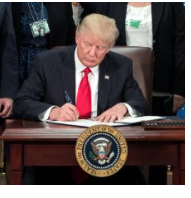
Trump plans order to expand your health care options

WASHINGTON (AP) — The White House is planning an executive order that would expand health plans offered by associations to allow individuals to pool together and buy insurance outside their states. That move follows failed efforts by Congress to overhaul the health care system.

President Donald Trump has long asserted that selling insurance across state lines would trigger competition that brings down premiums for people buying their own policies. Experts say that’s not guaranteed, partly because health insurance reflects local medical costs, which vary widely around the country.

Trump is expected to sign the executive order next week.

Kansas teen sentenced for attack on woman in her home

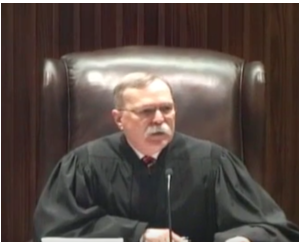
Vansyckle

RENO COUNTY— One of three people arrested in connection with the June break-in and beating of a Hutchinson woman was sentenced Friday to over six years in prison.

Reno County Judge Trish Rose then granted him three years on community corrections.

Demetrius Vansyckle, 19, Hutchinson, was charged with Pleasure Torres and Melissa McGuire in the case.

Vansyckle was convicted of aggravated burglary, aggravated battery and aggravated assault with the case involving the break-in at a home on West 14th Street in Hutchinson on June 6. The three are accused of beating a woman victim repeatedly. They also battered the other two occupants.


USGS: Sunday earthquake shakes Kansas


HARPER COUNTY — An earthquake just after  shook portions of Kansas Sunday afternoon. The quake just before 3:30p.m. measured a magnitude 2.6 and was centered four miles east of Harper, according to the U.S. Geological Survey.

It is the first earthquake reported in Kansas in October and the first since a pair of quakes shook north of Harper on September 28.

There are no reports of damage or injury from Sunday’s quake.

KCC receives pipeline safety grant

KCC

TOPEKA – The Kansas Corporation Commission (KCC) has been awarded a grant from the U.S. Department of Transportation’s Pipeline and Hazardous Materials Safety Administration (PHMSA) to assist in its underground pipeline damage prevention efforts.

The grant will be used to fund one full-time employee dedicated to damage prevention inspections and enforcement for the Wichita metropolitan area as well as augment enforcement in the Kansas City metropolitan area.

Excavation damage is the most common cause of damage to underground pipelines. The Wichita and Kansas City metropolitan areas account for 60% of the excavation activity in Kansas. Statewide, there were 1187 reports of gas lines damaged as a result of excavation activity in 2016. Of those, 50% occurred in the two metro areas.

“This grant opportunity has allowed the KCC to have a presence in the field at the site of the damage before repairs are complete,” said KCC Chief Engineer Leo Haynos. “The ability to interview the parties involved, to look at the locate marks, and to understand the type of excavating equipment involved, provides the inspector with the information needed to make a credible determination of the cause.”

In addition to compliance actions for violations, including the recommendation of civil penalties, the KCC’s enforcement strategy is coupled with a strong educational component that fosters communication among all parties. Using this approach, damages to underground natural gas pipelines with respect to excavation activity in the area have stabilized at 2 damages per every 1000 excavations.

Kansas was one among 24 states and the Commonwealth of Puerto Rico to receive a PHMSA grant.

Sheriff: Search continues for Kan. felony suspect who fled traffic stop

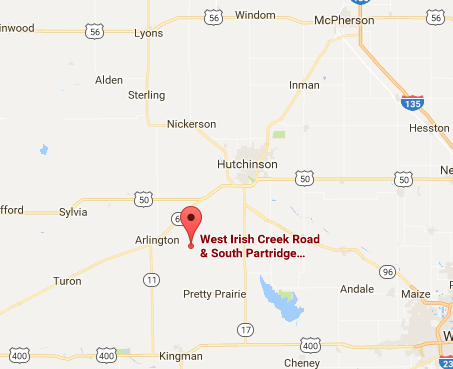
Location of the search, according to the Reno Co. Sheriff -Google map

RENO COUNTY — Law enforcement authorities continue a search for a suspect wanted on a felony warrant.

On Saturday afternoon, a Reno County Deputy noticed a driver that had a felony warrant and tried to make a traffic stop, according to a  social media report.

The driver fled and the chase ended near Partridge and Irish Creek Road when the driver and passenger fled on foot.

Reno County Deputies with the assistance of the Kansas Highway Patrol and a tracking dog did an extensive search of the area and could not locate the subjects.

There is no reason to believe the public is in danger, according to the sheriff’s department.

The Sheriff’s Department did not release the names of the suspect.

State Senator: Plan to house Nebraska inmates in Kansas illegal

Omaha Sen. Ernie Chambers- photo courtesy Nebraska State Legislature

BEATRICE, Neb. (AP) — A Nebraska state lawmaker says Gage County has violated the state constitution by housing inmates across the state line in Kansas.

The Beatrice Daily Sun reports that Omaha Sen. Ernie Chambers has asked the Nebraska Attorney General’s Office to issue a legal opinion on a contract approved by the Gage County Board of Supervisors in late September.

The one-year contract reserves 10 beds in the Washington County, Kansas, jail for Gage County inmates, at a cost of $246,000 a year.

Chambers said in a letter Wednesday to the attorney general that it’s a violation of the Nebraska Constitution to transport an inmate to another state for any offense committed in Nebraska.

Gage County Board Chairman Myron Dorn declined to comment on Chambers’ allegation.

Copyright Eagle Radio | FCC Public Files | EEO Public File