WASHINGTON – U.S. Senator Jerry Moran (R-Kan.) issued the following statement after the Administration, the Senate Finance Committee and the House Ways and Means Committee released their tax reform framework Wednesday:
“It has been more than 30 years since President Reagan signed the 1986 Tax Reform Act – the economy was entirely different and the way we do business across the world has changed drastically. Americans can no longer afford the status quo of an outdated and complicated tax system. Today’s tax reform framework is a first step toward growing our economy, boosting small businesses, creating new jobs and keeping good jobs here at home. Creating a fairer and simpler tax code means better days for working families and higher paying jobs in Kansas and across the country. I look forward to working with my colleagues and the Administration on this tax reform framework.”
The full framework can be found here. A one-pager description can be found here.
MANHATTAN — The 2017 Taiwan Agricultural Youth Exchange Program is currently accepting applications from high school seniors or college freshmen who are passionate about agriculture and are interested in representing Kansas in a week-long exchange program in late November 2017.
Each year the National Taichung Agricultural Senior High School in central Taiwan hosts students from the Midwest for this program. Selected students will tour agricultural facilities and businesses in Taiwan, and will learn about Taiwanese agriculture. This program will take place November 20-24, 2017.
“The Taiwan Agricultural Youth Exchange Program is a tremendous opportunity for students who are interested in agriculture,” said Suzanne Ryan-Numrich, international trade director for the Kansas Department of Agriculture. “Students are able to return from Taiwan with a broader understanding of international agriculture and the role that exports play in their local communities.”
Exports play an important role in Kansas agriculture. According to Euromonitor, Kansas exported nearly $101 million in agricultural goods to Taiwan in 2016, including beef, oil seeds, cereal grains and wheat flour. Globally, exports of agricultural products contributed almost $3.5 billion to the Kansas economy in 2016.
Three students will be selected to represent Kansas. To be eligible to apply, students must meet the following requirements:
Be a high school senior or college freshman;
Be at least 18 years of age by the beginning of the trip;
Have a strong Kansas agricultural background;
Have a valid U.S. passport by time of exchange program selection; and
Be able and willing to pay for airfare costs (approximately $1,400).
Applications must be submitted by October 17 for the student to be considered. Students interested in applying can find more information at agriculture.ks.gov/AgEd. The Taiwan Agricultural Youth Exchange Program is sponsored by the Kansas Department of Agriculture, the Kansas FFA Association and Kansas 4-H.
For more information, contact Robin Blume, KDA education and events coordinator, at [email protected] or 785-564-6756.
SALINE COUNTY — Law enforcement authorities are investigating a stolen vehicle and have made an arrest.
Just before 4:30 Wednesday, deputies were dispatched to report of an injury accident at the intersection of Center and First in New Cambria, according to Saline County Sheriff Roger Soldan
Kimberly Potts, 46, New Cambria, told deputies she was stopped at the stop sign on Center Street when a vehicle came from the west at a high rate of speed. The driver attempted to turn south on Center and struck the front of her 2002 Dodge Dakota. The vehicle then drove off.
While deputies were working the accident, an 81-year-old New Cambria woman reported that her 2009 Nissan Pathfinder was stolen from her driveway.
She told deputies two teenagers came to her house around 2 a.m., asking for her grandson, who no longer lives at her residence. The boys told the woman that they did not have any place to stay, so she invited them to spend the night. She contacted authorities a couple hours later after she discovered that the boys and the car were missing.
Sheriff Soldan said that the woman was familiar with the boys and provided names. Authorities caught up with them in the community of Solomon a short time later. They told deputies that they had returned the Pathfinder. Deputies the vehicle at the residence with damage to the front and driver’s side.
Deputies took Calob Haymond, 15, and Benny Garza, 14, both of Solomon into custody for deprivation of property. Haymond, who was driving, could face additional charges, according to Sheriff Soldan.
A private vehicle transported Potts to Salina Regional Health Center.
Haymond and Garza are being held at North Central Kansas Regional Juvenile Detention Facility in Junction City, according to Soldan.
KANSAS CITY (AP) — A Kansas City man who declared “I won” after killing his wife has been sentenced to life in prison with no possibility of parole.
A Clay County jury in August convicted 45-year-old Thomas Santamaria Jr. of first-degree murder in the beating and strangulation death of his 50-year-old wife, Yuvett Santamaria.
Clay County Prosecuting Attorney Daniel White said video and audio recordings taken when Santamaria was being led away from the crime scene show him telling an acquaintance “I won.”
The victim was found dead on a bedroom flood in March 2015. Her husband was asleep in the bed in the same room.
The Kansas City Star reports trial testimony indicated Santamaria suspected his wife was having an affair and wanted a divorce.
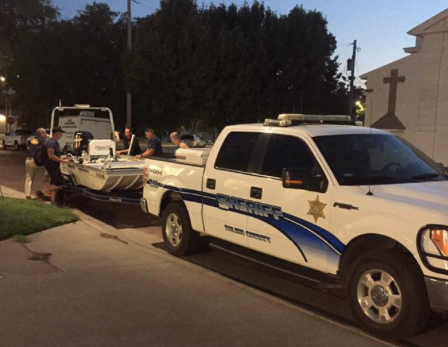
Crews in Salina preparing to deploy Aug. 31 to Hurricane Harvey (Photo courtesy Salina Fire Dept.)
OFFICE OF GOV.
TOPEKA – Governor Brownback and Lt. Governor Colyer on Wednesday recognized water rescue teams from agencies across Kansas who were deployed to Texas to assist in recovery efforts from Hurricane Harvey
The ceremony took place on the South capitol steps, and was followed by a reception at Cedar Crest that included the teams and their families.
The search and rescue teams, comprised of over 50 individuals from 16 different agencies across the state, deployed to Texas on Aug. 30 to assist with the floods after Hurricane Harvey. In addition to personnel, the deployment included hard bottomed, air, and inflatable boats. They all returned to Kansas on Sept. 5.
“We are proud of these individuals who were ready and willing to help when called upon. They were prepared with specialized swift water rescue training that allowed them to be of service in this unique kind of disaster. We thank them for their talents, abilities, and willingness to help others,” said Brownback.
The crews engaged in search and transportation operations for people and animals stranded by flood waters. Kansas search and rescue swift-water/flood teams, along with teams from the Kansas Department of Wildlife, Parks & Tourism, worked mostly in Katy, Texas, with teams from Oklahoma, Tennessee, and Missouri. Collectively, 15 strike teams consisting of five boat squads combined for a total of 75 water assets. Kansas strike teams searched close to 1,200 structures and evacuated 27 individuals. In total, the joint operation resulted in over 4,000 structures searched and over 100 evacuations. The teams also worked on other small assignments and were on standby as needed.
“What these brave men and women accomplished in serving our neighbors in Texas is a remarkable feat of collaboration and caring,” said Colyer. “They have represented our state well and we thank them for serving.”
“I am proud of the men and women from the many different Kansas organizations who did not hesitate when called upon for hurricane relief,” said Maj.Lee Tafanelli, the Kansas adjutant general. “I am especially proud that the Emergency Management Assistance Compact (EMAC), which guides the coordination of all these resources across the country is once again being managed right here in Kansas by the Kansas Division of Emergency Management.
“I would also like to remind Kansans that September is Preparedness Month. Though there are numerous skilled, courageous responders such as these, it is everyone’s responsibility to be prepared at home for an emergency. If you need information about what your family can do to be prepared, please visit www.ksready.gov.”
Agencies involved were: The Kansas Adjutant General’s Office, Kansas Fire Marshal’s Office, Kansas Department of Wildlife, Parks and Tourism, Chanute Fire Department, Derby Fire Department, Hutchinson Fire Department, South Hutchinson Police Department, Manhattan Fire Department, Mission Township Fire Department, Neodesha Fire Department, Newton Fire/EMS, Parsons Fire Department, Pittsburg Fire Department, Salina Fire Department, Saline County Sheriff’s Office, Sedgwick County Fire District #1, Shawnee Fire Department, and Winfield Fire/EMS.
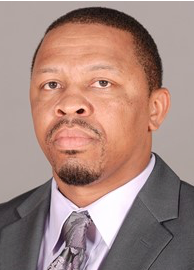
TOPEKA – Maj. Gen. Lee Tafanelli, the adjutant general, announced the selection of Chief Master Sgt. Maurice L. Williams as the state command senior enlisted leader for Joint Forces Headquarters, Kansas National Guard, Topeka. Williams replaces Command Chief Master Sgt. James Brown, who is leaving the position to become the command senior enlisted leader for Joint Force Civil Support, Joint Base Langley-Eustis, Virginia.
In this role, Williams, will be the primary advisor to the adjutant general of Kansas on all matters pertaining to the enlisted force. He currently serves as the state command chief master sergeant for Joint Forces Headquarters, North Carolina National Guard, and will begin his duties in Kansas Oct. 2.
“I am pleased to announce the selection of Chief Master Sgt. Williams, who brings with him an impeccable record and leadership experience that will benefit the Kansas National Guard,” said Tafanelli. “This position carries great responsibility and I am confident that he is the right person to join our team.”
“I am looking forward to serving the Citizens, Airmen and Soldiers of the state of Kansas,” said Williams. “Chief Master Sgt. James Brown has laid a great foundation for the enlisted Soldiers and Airmen of the Kansas National Guard and I look forward to the opportunity of building upon his legacy.”
“It has been my absolute honor to serve the citizens of Kansas and the soldiers and airmen as their command senior enlisted leader for the Kansas Guard,” said Brown. “It is comforting to know I am leaving our most valuable assets, our enlisted warriors, in the capable hands of this tremendous Airmen, Chief Master Sgt. Maurice Williams.”
Williams entered the North Carolina Air National Guard in 1987 and graduated from the Air Transportation Specialist course at Shepard Air Force Base, Texas, in 1988. During his career, he has served in a number of command positions in North Carolina, South Carolina, Texas, Germany, Iraq, Kuwait, and Qatar.
His military education includes the Noncommissioned Officer Prep Course, Noncommissioned Officer Leadership Course, Senior Noncommissioned Officer Academy Course, Air National Guard Chief Executive Course, Chief Leadership Course, Command Chief Orientation Course, Senior Enlisted Joint Professional Military Education Course, and numerous other professional courses.
Williams earned an associate’s degree in criminal justice, and bachelor’s and master’s degrees in businesses administration from Columbia Southern University, Orange Beach, Alabama.
Williams’ military awards and decorations include the Meritorious Service Medal, Air Force Commendation Medal with oak leaf cluster, Joint Service Achievement Medal, Air Force Achievement Medal, North Carolina National Guard Meritorious Unit Citation, North Carolina Adjutant General’s Meritorious Achievement Service Ribbon and North Carolina National Guard State Service Ribbon.
TOPEKA— Officials say that within the next two months vehicles will appear for sale from unscrupulous sellers that are the result of water damage from Hurricanes Harvey and Irma.
Kansas consumers should check the backgrounds of vehicles they may consider purchasing, said Ken Selzer, CPA, Kansas Commissioner of Insurance.
“The time is coming when the adage ‘let the buyer beware’ will become ever more important when it concerns buying a used vehicle,” said Commissioner Selzer. “A common-sense approach to inspecting a vehicle is needed now, because some flood-or-hurricane-damaged vehicles may be making their way to Kansas car lots from Texas or Florida.”
Commissioner Selzer and Kansas Insurance Department staff members urge prospective vehicle buyers to get a CARFAX Vehicle History Report. This will tell if the vehicle has been in a flood, a crash or a fire. Also, buyers should consider taking the vehicle to a trusted mechanic for an inspection prior to purchase.
The Commissioner also recommends checking these possible signs of vehicle water damage:
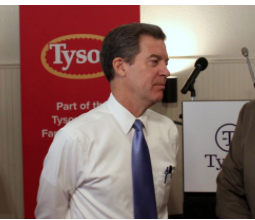
Members of Gov. Sam Brownback’s Cabinet are working to find a new home for a $300 million Tyson Foods chicken plant in Kansas. STEPHEN KORANDA / KPR
SALINA, Kan. (AP) — Saline County commissioners are supporting an effort to bring a Tyson chicken plant to Cloud County and Concordia.
The commissionon Tuesday signed a letter in support of the $300 million project. The letter says the plant would benefit the entire region because Tyson will invest $100 million to help farmers and ranchers raise poultry.
Tyson was planning to build the plant near Tonganoxie but put those plans on hold after fierce opposition from nearby residents. On Sept. 19, the Leavenworth County Commission rescinded an offer for $500 million in industrial bonds for the plant because of the opposition.
Gov. Sam Brownback’s administration had pledged an undisclosed amount of tax breaks to persuade Tyson to locate on a 300-acre site south of Tonganoxie.
MEDICINE LODGE –A Kansas man was sentenced Tuesday to more than 19 years in prison for sex crimes against a child, according to Kansas Attorney General Derek Schmidt.
Robert E. Livi Pruitt, 26, pleaded guilty in July to one count of attempted rape, one count of aggravated intimidation of a victim and one count of contributing to a child’s misconduct. Judge Francis Meisenheimer sentenced Pruitt to 231 months to be served in the Kansas Department of Corrections. The sentence is to run consecutive to the Jessica’s Law life sentence Pruitt is currently serving.
The crimes were committed in May 2012, before his Jessica’s Law conviction. The charges stemmed from an investigation by the Kansas Bureau of Investigation. Assistant Attorney General Lyndzie Carter of Schmidt’s office prosecuted the case.
Pruitt had a previous rape conviction in Barber County in 2014.
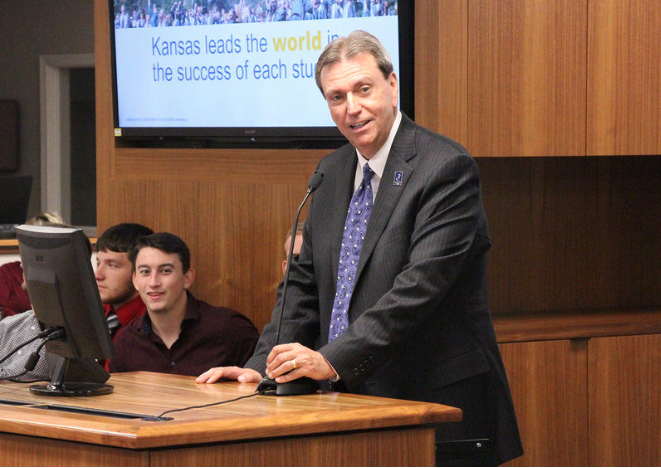
Kansas education officials did little to promote a public comment period for a school accountability plan designed to steer the state through 2030 and guide nearly $2 billion in federal spending.
Randy Watson, Kansas education commissioner, says state officials gathered input for an educational initiative in 2015 that helped inform their work on a plan that could guide $2 billion in federal funding through 2030. CELIA LLOPIS-JEPSEN / KANSAS NEWS SERVICE
While some states that publicized town halls and launched online surveys for their plans collected comments by the thousands, Kansas officials didn’t use such tools nor issue news releases or social media posts about the state’s public comment period.
Fewer than 20 people submitted feedback during the 30-day period — primarily the month of August — when the draft was available on the Kansas State Department of Education’s website.
Education Commissioner Randy Watson said that number isn’t a concern.
“What it speaks to is that most people in Kansas are attuned to where the (state) board is heading” with its vision for schools, he said. “And the people that are engaged and wanting to know about the impact of the ESSA plan, they are giving us feedback for that.”
ESSA refers to the Every Student Succeeds Act, a federal statute on better serving students — particularly those who are historically disadvantaged or underserved.
States were charged with crafting accountability plans that demonstrate how they will comply with the law, which replaced its predecessor, called the No Child Left Behind Act, in 2015. Kansas submitted its plan to the U.S. Department of Education on Sept. 12. Watson said Kansas had gathered public input for a separate initiative in 2015 that helped inform its work on complying with ESSA.
Public notices
Jawanda Mast, an advocate for children with disabilities, disagrees with Watson’s assessment. Mast, whose teenage daughter attends school in Olathe, said she knew Kansas was required to publish its draft online for public comment but had difficulty finding it. She reached out to the department to ask for the link.
“I am pretty involved and kind of know what’s going on,” said Mast, who has concerns about how details in Kansas’ ESSA plan will affect special education. “If it’s that hard to find, it’s not very public.”
Through an open records request, the Kansas News Service sought all notices used to announce the public comment period and copies of the submitted comments.
The agency provided a screenshot of its public comment page — which was part of the early childhood, special education and federally funded services section of its website — and an invitation sent to an email list for specialists in early childhood and special education.
“These are the two tools that were used to get the message out,” an attorney for the agency wrote.
It did not use social media. During the 30-day comment period, however, it did share dozens of posts on social media platforms regarding other agency news.
The Kansas State Department of Education posted a notice of the public comment period on its website. CLICK to EXPAND
Sixteen people or organizations submitted feedback. The agency initially delayed releasing the public comments to the Kansas News Service, citing an exemption to open records law pertaining to documents in which opinions are expressed.
Martha House, a longtime school librarian in Council Grove, was among those who wrote in. House said she and other librarians had kept an eye out for town hall opportunities to discuss the ESSA plan, but seeing none, watched for the 30-day online commenting window.
Several current and former school librarians were among those who wrote in with concerns about the plan’s lack of specifics on leveraging libraries to bolster student achievement.
“We had to try,” said House, president of the Kansas Association of School Librarians. “There are some things that librarians can really contribute to.”
Advisory committee
Watson and education deputy commissioner Brad Neuenswander say Kansas had an ESSA advisory committee that met two or three times a year to discuss and help shape the plan.
Meeting dates and minutes were posted online, and the gatherings attracted extra participants who shared their thoughts.
The group included nearly 40 people, according to a list provided by the agency. About half were employees from large and small school districts across the state, representing various roles and functions, such as special education and school administration.
Others represented private schools, the postsecondary sector, education advocacy groups such as the teachers union and school board association, parents of children with disabilities and others.
“We try to get a lot of voice,” Neuenswander said. “We try to have a large enough representation of what we believe Kansas student population looks like, as well as trying to keep it a manageable enough group.”
Watson and Neuenswander also said they discussed and showed the ESSA draft in a variety of other contexts, such as at superintendent meetings.
“I would say most of what we did was get comments when we were out in the field,” Neuenswander said.
‘Deep and broad’
Kansas receives about $150 million annually for the federal programs tied to its ESSA plan, the bulk of which goes toward addressing academic achievement in low-income communities.
Chad Aldeman, of Bellwether Education Partners, a consulting group that promotes school improvement for underserved students in particular and is independently reviewing state ESSA plans, said states would benefit from seeking “both deep and broad” input because “no one person can represent an entire state.”
Aldeman has not reviewed what steps Kansas took, but he said most states used a combination of advisory committees and broader public outreach tools, such as surveys.
“If you think accountability matters, then you want a system that people can understand and react to,” he said.
The Kansas News Service reviewed dozens of other state websites for ESSA information and found news releases from all but two announcing the release of the drafts and calling for public comment.
Some states added summaries or readers’ guides to the dense policy blueprints — which can be upward of 100 or 200 pages — held town halls, supplemented the statutory minimum 30-day comment period with surveys or enlisted the help of school districts to notify families about input opportunities.
Such varied approaches were recommended by the Council of Chief State School Officers, which brings together heads of education for each state.
“Most states reached out to many stakeholders in different ways,” council spokeswoman Olympia Meola wrote in an email.
Last year the council published a guide on engaging communities in the ESSA process. It advised drawing on a range of strategies, such as leaning heavily on Facebook and Twitter to reach parents, using blogs and online surveys, and distributing printed materials to reach families that don’t have computers.
The group also suggested releasing glossaries, summaries free of education jargon, or other materials that make the ESSA draft more accessible to non-educators and clarify how it relates to the state’s own strategic vision.
“The intent of ESSA is to make sure the people affected by the law are at the table from the start of the process,” the guide said.
To that end, it advocated for starting early, to avoid a situation in which people feel they have been invited to give input only after decisions have been made.
Multiple drafts
According to a partial list of ESSA plans compiled on the Collaborative for Student Success’ UnderstandingESSA.org website, at least 15 states released more than one draft to the public.
Oklahoma is among those 15. It issued three drafts during 2016 and 2017, starting with a preliminary version published online with a survey that attracted more than 3,000 comments on questions such as what tests to use for measuring student progress and whether to spend certain funds on teacher retention or other efforts.
“In making those decisions, it was so very critical we heard from stakeholders,” said Robyn Miller, deputy superintendent for the Oklahoma State Department of Education.
It solicited comments from dozens of groups and institutions — from Native American tribes to military bases — and issued nearly 800 invitations for input.
The state held town halls and online webinars, seeking student participation at each, and 1,000 people turned out at seven locations statewide.
“I think from draft to draft, those stakeholders who have been very vocal, they could see that they were heard,” Miller said.
For example, Oklahoma added plans to recognize schools with robust arts or science programs in its online school accountability tool that families can navigate for information. The state also adopted feedback from its school librarians similar to the input that librarian House and others provided in Kansas.
Kansans Can
The Kansas State Department of Education did conduct dozens of public meetings and gather thousands of comments in 2015, but that was unrelated to ESSA. Those efforts gleaned input from educators, families and businesses on what skills they thought today’s youths need to succeed and the role of schools in instilling those.
The feedback they received became the backbone for Kansans Can, the Kansas State Board of Education’s vision, which includes outcomes like success after high school and social skills and emotional growth among students.
“None of that is included in our ESSA plan,” Neuenswander said. “The board’s vision is not part of the ESSA plan.”
Instead, Neuenswander and Watson described ESSA as a subset of their agency’s work.
But because the Kansas ESSA plan is geared at meeting requirements for receiving and spending federal dollars, it contains many details above and beyond what was discussed on the Kansans Can listening tour.
It asks schools to more than triple test score proficiency rates for some student subgroups — such as African-Americans, English language learners and children with disabilities — by 2030. That would mean boosting scores on standardized math and reading tests at steep annual rates that the Kansas Association of School Boards is concerned have not previously been achieved and sustained on this scale.
The state also was required to make decisions in its plan about:
How to support struggling schools.
What steps to take if they miss progress targets.
How to ensure children in minority racial and ethnic groups or from low-income families have equal access to qualified, skillful, experienced teachers.
Whether to spend certain funds on improving equitable access to good teachers.
Some of these nitty-gritty components are what concerned Mast, the parent from Olathe.
Kansas, for example, used a key statistical threshold to determine which schools will have to meet which accountability targets. The state said it chose a threshold that is statistically sound, but Mast worries it will exempt many schools from goals related to serving children with disabilities. That’s one reason she wanted more public discussion.
“I did not feel like they were very transparent,” she said.
Watson and Neuenswander said the state education department’s ESSA plan fits with the Kansans Can vision. The proficiency targets and the goal of a 95 percent graduation rate, for example, reflect the State Board of Education’s push to meet Kansas workforce needs and ensure students are ready for life after high school.
The agency wasn’t trying to discourage public comments on its ESSA plan, Watson said, but did want to avoid causing any confusion in which the public might think educational officials were shifting away from Kansans Can.
The listening tour for that vision was one reason the agency didn’t see a need for more extensive outreach on ESSA.
“We felt like we already had the input of what Kansans wanted,” Watson said. “So we didn’t have to go repeat that process.”
LOUISVILLE, Ky. (AP) — The Latest on a federal fraud and bribery scandal in college basketball (all times local):
The FBI says Oklahoma State assistant basketball coach Lamont Evans, a Kansas State alum, has surrendered to federal authorities in allegations that he took bribes to influence star athletes.
FBI special agent Jessica Rice says Evans surrendered to federal marshals early Wednesday on federal corruption charges following an investigation into the criminal influence of money on coaches and players in the NCAA.
Rice says Evans is scheduled to make an initial appearance before U.S. Magistrate Charles Goodwin about 3 p.m. Wednesday.
According to the papers, Evans expected $2,000 a month for his services. Evans said it was necessary to use his influence over the youngsters early in their college careers because many of them are “one and done,” meaning they play one year of college ball before joining the NBA, according to court papers.
Evans graduated with a degree in social science from K-State in 2009. He worked with the Wildcat basketball program as a Student Assistant from 2008-09, a Graduate Manager from 2009-2011, and an Assistant Coach 2011-12, according to his OSU bio.
12:35 p.m.
The acting U.S. attorney in Manhattan says the picture of college basketball painted by criminal charges his office brought against four college assistant coaches and an Adidas executive is not a pretty one.
Joon Kim made the comment at a news conference Tuesday after the charges were unsealed in Manhattan federal court. Assistant coaches at Arizona, Auburn, the University of Southern California and Oklahoma State were expected to appear in courts later Tuesday to face the charges.
Kim says the case against 10 men, including sports agents and marketing professionals, exposed “the dark underbelly of college basketball.” He says the coaches exploited the “trust of the players they coached and recruited.”
It was not immediately clear who will represent the coaches in court.
___
The director of global sports marketing for Adidas is among those charged in a bribe-paying scheme that federal authorities say was designed to match agents and advisers to players before they became NBA stars.
James Gatto was arrested Tuesday along with nine others, including four assistant basketball coaches from Arizona, Auburn, the University of Southern California and Oklahoma State. It was not immediately clear who will represent him in court.
In criminal complaints, authorities said agents and financial advisers paid bribes to assistant coaches to get them to introduce them to star college players and their parents before the students turned professional.
Authorities said the coaches received thousands of dollars in bribes, enabling the agents and others to get a slice of the millions of dollars the athletes could eventually make in the NBA.
___
9:50 a.m.
Federal prosecutors have announced charges of fraud and corruption in college basketball, including against four coaches.
The coaches work at Oklahoma State, Auburn University, Arizona and the University of Southern California.
They were among 10 people charged in New York City federal court. Others included managers, financial advisers and representatives of a major international sportswear company. The details will be discussed at a news conference on Tuesday afternoon.
In court papers, prosecutors said the FBI has since 2015 been investigating the criminal influence of money on coaches and student-athletes who participate in intercollegiate basketball governed by the NCAA.
They said the probe has revealed numerous instances of bribes paid by athlete advisers, including financial advisers and associate basketball coaches, to assistant and associate basketball coaches to exert influence over student athletes.
HARPER COUNTY—Three earthquake in two days shook portions of Kansas. A quake at 8:30p.m. Tuesday measured a magnitude 2.7 and was centered approximately fourteen miles southeast of Harper, according to the U.S. Geological Survey.
That followed a 2.6 magnitude quake at 2:15 p.m. Tuesday approximately five-mile northeast of Harper. On Monday, a 2.5 quake was centered thirteen miles northwest of Harper. There are reports of damage or injury from the quakes.
The USGS reported also reported a series of five quakes measuring 2.7 – 3.2 in Sedgwick, Harper and Sumner County September 10-15.
——–
HARPER COUNTY —A small earthquake shook Kansas on Monday. The quake measured a magnitude 2.5 and was centered approximately 13-miles northwest of Harper, according to the U.S. Geological Survey.
It is the first earthquake in Kansas in more than a week. The USGS reported a series of five quakes measuring 2.7 – 3.2 in Sedgwick, Harper and Sumner County September 10-15.
There are no reports of damage or injury from Monday’s quake.
The scene of Tax office shooting-photo courtesy KWCH
WICHITA, Kan. (AP) — The state is investigating reports that workers at a Wichita tax office were unable to call 911 on their office phones after a co-worker was shot last week.
Kansas Organization of State Employees executive director Robert Choromanski says that workers shouldn’t have to use their personal cellphones in an emergency. And he “questioned how many critical minutes, or seconds, elapsed before emergency services could be contacted.”
State spokeswoman Rachel Whitten confirmed Tuesday that employees have complained about the inability to call 911. Whitten said Secretary Sam Williams visited the Wichita office Monday and made a test call to 911, which went through.
Ricky Wirths is charged with attempted first-degree murder in the shooting of tax agent Cortney Holloway. Revenue officials say Wirths owes almost $400,000 in taxes.

 OFFICE OF SEN. MORAN