WICHITA, Kan. (AP) — An autopsy report concludes that a toddler fatally injured at a carnival in Wichita, Kansas, died after grabbing an electrically charged fence.
The report says 15-month-old Pressley Bartonek of Conway Springs was diagnosed as being brain dead five days after being shocked May 12.
According to the report, the toddler was at a small carnival on a parking lot when she grabbed metal fencing and became unresponsive by the time her father freed her hands.
The report says that a test by an electrical company showed about 300 volts coming from the fence.
The carnival operator, Evans United Shows based in Plattsburg, Mo., has not publicly commented about the matter.
SALINE COUNTY – Law enforcement authorities are investigating a suspect for a weekend assault.
A 39-year-old Salina man was arrested after he allegedly threatened a neighbor before hitting another with a metal baseball bat, according to Police Capt. Paul Forrester.
Just after 7p.m. Sunday, Latishia Ford, 29, and Nicholas Albany, 38, both of Salina, were sitting on a porch at a home in the 400 block of Baker in Salina, according to Police Captain Paul Forrester.
A neighbor, George Wagner, came out of his house with what appeared to be a black handgun and allegedly threatened Ford before going back inside his home.
Albany went to confront Wagner and knocked on his door. Wagner answered the door swinging a metal baseball bat and allegedly hit Albany in the face, according to Forrester.
Police arrested Wagner and booked him into the Saline County Jail on two counts of aggravated assault and one count of aggravated battery. Authorities also found a black BB gun and two metal bats in his residence, according to Forrester.
Kansas is on track to spend less than a third of what it did six years ago on cash assistance and to serve a third as many low-income people, according to a state budget office memo.
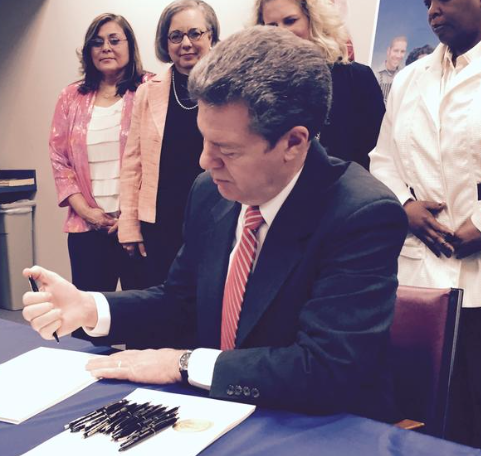
Gov. Sam Brownback signed a welfare reform measure in 2015 that included lower lifetime limits on cash assistance for low-income Kansans. Since 2011 the state has incorporated work requirements for some anti-poverty programs. FILE PHOTO / KANSAS NEWS SERVICE
Those numbers have been falling steadily since Gov. Sam Brownback took office in 2011, when Kansas began incorporating work requirements for programs like cash assistance and food stamps in an effort to break what the governor described as “cycles of dependency.”
Kansas officials say the number of people receiving cash assistance has dropped because of a new emphasis on transitioning them to work, but evidence of their employment is inconclusive and the state’s poverty rate hasn’t fallen as fast as the national average during that period.
An April budget memo shows the state will spend about $14.9 million on cash assistance for 11,000 Kansans in the current fiscal year, down from about $52 million on cash assistance for roughly 39,000 Kansans in 2011. Spending this year includes about $300,000 from the state general fund, while much of the rest comes from the federal Temporary Assistance for Needy Families block grant.
The budget memo suggests the downward trend will continue in Kansas. It predicts total spending on cash assistance will fall about 15 percent in fiscal year 2018, to $12.8 million, and another 16 percent in the following fiscal year, to $10.8 million. Both projections are lower than Brownback’s proposed budget anticipated in January.
The estimates come as lawmakers are struggling to fill a projected shortfall of nearly $900 million over the next two budget years while complying with a court order to increase funding for schools. The reductions in cash assistance aren’t likely to make much difference in the overall budget picture, however, because the state general fund only provides a small percentage of the program’s funding: projected at $118,000 in 2018 and $105,000 in 2019.
Effect On Families?
Theresa Freed, spokeswoman for the Kansas Department for Children and Families, said the department expects the number of Kansans receiving cash assistance to drop below an average of 10,000 per month in the 2018 fiscal year that starts in July and 8,000 per month in the following year.
Freed attributed the reduction to more Kansans getting jobs rather than being dropped from the cash assistance program. She said DCF received reports of 40,000 former cash assistance recipients getting jobs since 2011. However, that number may not account for former recipients who did not report when they got a job or others who may have reported several jobs as they cycled in and out of the program.
“Policy changes in recent years have incentivized employment and self-reliance,” she said in an email. “These effective and widely supported improvements to discourage dependence on government assistance have helped Kansas families.”
Those who did find work earned an average of $10.14 per hour, Freed said. At 40 hours a week, that’s an annual salary of about $21,000 before taxes, about 129 percent of the federal poverty level of $16,240 for a two-person family.
Annie McKay, president and CEO of Kansas Action for Children, said she is concerned that parents who are no longer eligible for cash assistance haven’t found family-supporting jobs.
“I don’t see the same corresponding decline in indicators that would corroborate the claims regarding employment — like homelessness data from schools, or free and reduced lunch figures, or Kansans accessing food pantries, or kids living below the poverty line,” she said.
The number of children in families receiving cash assistance has fallen from about 26,000 in 2011 to about 8,500 in the current fiscal year.
According to the most recent data, about 18 percent of Kansas children were in families with incomes below the poverty line in 2015. About 16 percent were below the poverty line in 2011.
Kansas’ overall poverty rate decreased from 13.8 percent in 2011, when welfare changes began rolling out, to 13.0 percent in 2015, the most recent year with data. That’s a drop of about 5.8 percent, although the poverty rate decreased faster nationwide and in Missouri, Oklahoma and Colorado during the same period.
Lower Lifetime Limits
Kansas officials have incorporated a combination of administrative and legislative changes to reduce access to cash assistance and encourage people to rejoin the workforce.
In late 2011, the Kansas Department of Social and Rehabilitation Services began suspending cash assistance if parents failed to participate in job training or to name a non-custodial parent so the department could collect child support. SRS was later reorganized as DCF, with some services going to other departments.
Rob Siedlecki, then secretary of SRS, said the department would help parents with child care assistance and other services they needed to resume working. He also likened losing cash assistance to breaking an addiction.
“We want (families) to be successful,” he said in November 2011. “I don’t want them on the welfare rolls. It’s like a narcotic, if they keep on taking the program without trying to help themselves.”
Brownback signed bills passed by the conservative-led Legislature adding restrictions over the next five years. The changes reduced the cash assistance time limit to four years in 2011, and then to three years in 2015 under the HOPE Act. A follow-up bill in 2016 lowered the lifetime limit to two years.
DCF estimated about 200 families lost access to cash assistance when the three-year limit took effect, and another 424 lost access due to the two-year limit. Many families cycle in and out of the cash assistance program, however, so it isn’t clear how many will ultimately hit the limit.
Community programs that assist low-income Kansans say demand has grown or stayed steady as the state changed its cash assistance program.
Tawny Stottlemire, executive director of We Fight Poverty in Topeka, said more people have sought help with rent, utilities and food in recent years. The organization doesn’t track whether clients previously received cash assistance, she said, but the number of people seeking help is higher than it would expect, given the relatively stable economy.
“Over the past three years, we’ve seen steady increases over normal” requests for help, she said.
Timi Myers, housing director for Southeast Kansas Community Action Program, said she wasn’t sure if more people have sought help paying their rent since the restrictions passed.
“We continue to have a steady flow of people seeking rental assistance,” she said.
Meg Wingerter is a reporter for the Kansas News Service, a collaboration of kcur.org, Kansas Public Radio and KMUW covering health, education and politics. You can reach her on Twitter @MegWingerter.
SEDGWICK COUNTY- Law enforcement authorities in Sedgwick County are investigating an injury accident
Just after 4:30p.m. Monday, police were dispatched to the intersection of Kellogg and Woodlawn in Wichita, according to Tuesday’s media briefing.
The investigation determined a motorcycle driven by a 59-year-old man was westbound on Kellogg. A large archery target fell out of the bed of a westbound pickup. The motorcycle rider swerved and hit the retaining wall. He was transported to local hospital in serious condition, according to police.
Officers eventually were able to speak to the pickup driver. There is no word of possible charges in the accident. Police reminded drivers to make certain they tie down items they are transporting to avoid similar accidents.
WICHITA, Kan. (AP) — The latest government update shows a quarter of the winter wheat crop in Kansas is in poor to very poor condition.
The National Agricultural Statistics Service on Tuesday reported that 30 percent of the state’s wheat is rated in fair condition. About 38 percent is in good and 7 percent in excellent condition.
Wheat coloring is at 39 percent.
The agency says that hail in northwestern Kansas has damaged some wheat and recently planted spring crops. The southern half of the state was mostly dry this past week while areas in the north got up to two inches of rain.
About 82 percent of the state’s corn crop has now been planted statewide. Soybean planting is at the 41 percent mark. Sorghum seeding is 11 percent complete.
BUTLER COUNTY – Law enforcement authorities in Butler County are offering a cash reward for information in a case of vandalism.
On Friday May 12, officers with the El Dorado Police Department were dispatched to the ball diamond restrooms at Central Park, 200 N. Griffith, for a report of criminal damage to property, according to a social media report.
Upon arrival, officers were informed that sometime over the past 24 hrs. someone entered and damaged the restrooms.
If anyone has information about this crime or information about other crimes, please contact Crime Stoppers at (316) 321-1080 or submit a tip via the Crime Stoppers email at [email protected]. Remember your information is anonymous and if your tip leads to an arrest you could be eligible for a cash reward of up to $1,000.00.
TOPEKA, Kan. (AP) — A Kansas legislative leader says negotiations between the National Rifle Association and the University of Kansas Health System are delaying debate on a bill aimed at keeping concealed guns out of public hospitals.
Senate Majority Leader Jim Denning said Tuesday that GOP leaders are waiting to see whether the talks result in a compromise before the Senate considers the bill.
A 2013 law requires public health facilities to allow concealed guns into their buildings starting in July unless the buildings have security such as metal detectors or guards. The Senate’s measure would grant a permanent exemption to state hospitals, other public hospitals, mental health centers, some nursing homes, the KU health system and the university’s teaching hospital in Kansas City, Kansas.
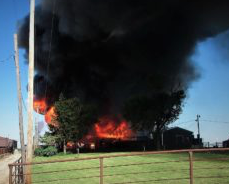
Rural Saline County fire-photo Saline County Sheriff
SALINE COUNTY – A weekend fire in rural Saline County is being blamed on a faulty electrical wire.
Just after 5p.m. Friday, crews from Rural Fire District #3 responded to 901 South Hedville Road for a reported hay barn on fire, according to Saline County Sheriff Roger Soldan.
As the fire spread, officials called Rural Fire District #7 to assist.
When first responders found live electric wires on the ground, they contacted DS&O Electric Cooperative to turn off the power and prevent the fire from spreading further.
The barn that belonged to Rolling Hills Ranch contained hay, several all-terrain vehicles, a loader, along with fencing supplies and equipment. The ranch is not affiliated with nearby Rolling Hills Zoo.
The total loss was estimated at $150,000. There were no reported injuries.
TOPEKA, Kan. (AP) — Kansas legislators have approved a new requirement that abortion providers give women information about their doctors’ histories and provide it in print in a specific type style on white paper.
The bill goes to Republican Gov. Sam Brownback after the Senate approved it on a 25-15 vote Tuesday. The House passed the measure last week. Brownback is a strong abortion opponent.
The bill would require that abortion providers give women information about the physician at least 24 hours beforehand. The information would include the doctor’s credentials, malpractice insurance, hospital privileges and disciplinary record. It would have to be printed in 12-point Times New Roman type.
Bill supporters say women need the information to make informed decisions.
Critics say the bill is meant to discourage women from having abortions.
ATCHINSON COUNTY – A Kansas man died in a farming accident Monday in Atchison County.
Just after 2p.m., Michael Bodenhausen, 64, Muscotah, was operating a Polaris Sportsman 500 ATV spraying thistles on farm ground north of Muscotah, according to Sheriff Jack Laurie in a media release.
The ATV rolled and landed on top of Bodenhausen.
Family members found him and called 911, according to the sheriff.
Just after 9p.m.Bodenhausen was pronounced dead on the scene and transported to the coroner’s office in Kansas City for further investigation.
JUPITER, Fla. (AP) — The Latest on Tiger Woods’ arrest in Florida on suspicion of driving under the influence (all times local):
11:05 a.m.
A police report lists four medications, including Vicodin, that Tiger Woods reported taking when he was stopped for DUI.
The report released Tuesday indicated that Woods told officers that he was recovering from surgery.
Woods has had four back surgeries since 2014, the latest in April. Painkillers are generally prescribed after such surgeries, and many carry warnings to avoid driving while taking them. Other medicines, including over-the-counter allergy medicine or anti-anxiety medicines, can also cause drowsiness and include warnings about driving.
The report said Woods was cooperative “as much as possible” when found asleep at the wheel early Monday morning. He was “extremely sleepy” and the officer observed it was hard for Woods to keep his eyes open and hard to walk.
10:30 a.m.
Police say Tiger Woods was asleep at the wheel but had no alcohol in his system when officers spotted his car stopped along a Florida road.
An affidavit released Tuesday said Woods was alone and wearing his seat belt when Jupiter Police officers found his Mercedes early Monday in the right lane. The car’s engine was running and its lights were on.
The report says officers woke Woods, who had “extremely slow and slurred speech” and told them he took several prescriptions.
According to the report, Woods was confused and asked how far he was from his Hobe Sound home. Officers said Woods was cooperative but failed a roadside sobriety test. Breath and urine tests showed no alcohol in his system.
Woods’ arraignment in Palm Beach County court on a DUI charge is scheduled for July 5.
———-
JUPITER, Fla. (AP) —Tiger Woods says an unexpected reaction to prescription medicine led to his arrest on a DUI charge in Florida.
Woods spent nearly four hours in the Palm Beach County Jail after being arrested early Monday on suspicion of DUI.
The 14-time major champion says in a statement that alcohol wasn’t involved. Woods says he didn’t realize the mix of medications affected him that strongly.
He also says he understands the severity of what he did and takes full responsibility.
Woods had a fourth back surgery on April 20. He wrote in an update on his website last Wednesday that the fusion surgery gave him instant relief from pain and that he hasn’t felt this good in years.
—————-
JUPITER, Fla. (AP) — Police say golf great Tiger Woods has been arrested on a DUI charge in Florida.
Jail records show Woods had been arrested by police in Jupiter. He was released just before 11 a.m. on his own recognizance. He has been charged under a Driving Under the Influence statute.
No other details were immediately available. Messages left for a Jupiter police spokeswoman were not immediately returned.
KANSAS CITY, Mo. (AP) — Kansas City police say the death of a 31-year-old man near a walking and biking trail is being investigated as a homicide.
The body of Chase Hardin was found Monday morning along the Harry Wiggins Trolley Track Trail in south Kansas City.
The discovery comes less than two weeks after police said they were investigating similarities between four other homicides along another trail that stretches from south Kansas City to Olathe, Kansas. All the victims were male, ages 54 to 67. Three were walking their dogs. The Kansas City Star reports ) that the FBI has joined the investigation into those deaths.
Police said no evidence exists to link the four deaths. And spokeswoman Stacey Graves says there is no evidence Monday’s death is related to the four earlier deaths.
Hardin had been convicted of burglary, felony possession of controlled substances and theft, according to the Missouri Department of Corrections.
WICHITA, Kan. (AP) — Grain elevators across Kansas are feverishly working to move last year’s grain out to make room for the new winter wheat crop as another harvest nears.
Kansas Grain and Feed Association executive director Tom Tunnell says there is still a storage issue, particularly in southwest Kansas.
The activity at elevators comes amid a wheat crop that has begun ripening. The Kansas harvest typically begins in the state’s southernmost counties and moves northward as the wheat ripens.
Cutting could begin late next week in south-central Kansas with harvest expected to be in full swing by the second week of June.
Farmers are grappling with damp weather, crop diseases and low prices.
Cash prices that are $1 to $1.50 a bushel below break-even cost.