LAWRENCE, Kan. (AP) — A teenager who brought a gun to Lawrence High School has been sentenced to nine months of probation.
The boy was sentenced Wednesday after pleading no contest in June in juvenile court to misdemeanor criminal use of a weapon.
Charges stem from an incident on Feb. 6, when the boy was called to an assistant principal’s office when he threw his school-issued laptop at a door.
Prosecutor Bryant Barton has said the assistant principal found a loaded handgun in the boy’s bag.
The district says no students or staff were threatened with the gun.
Another teenager who brought a loaded gun to the school a week after this incident pleaded no contest to the same misdemeanor charge and was sentenced in July to six months of probation.
TOPEKA —The Kansas Corporation Commission (KCC) is collecting data and analyzing recent injection well activity in Reno County in an effort to uncover the cause of a series of earthquakes in the Hutchinson area. Amid damage reports and a concern for public safety, the KCC is conducting an investigation and will evaluate whether additional action is needed to safeguard Kansans.
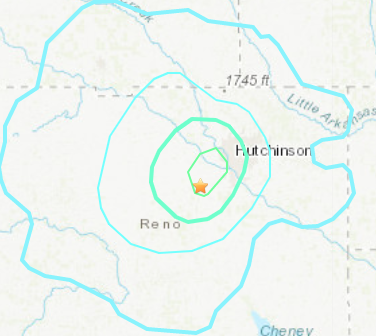
Location of Sunday’s 4.1 Reno Co. quake -USGS image
In 2015, the KCC issued an order reducing injection rates in portions of Harper and Sumner counties after the number of earthquakes in that area began to trend upward. In 2016, the Commission issued a second order limiting injection in additional areas of Harper and Sumner as well as parts of Kingman, Sedgwick and Barber counties when earthquake activity there started to rise.
The area currently under study in Reno County focuses primarily on Arbuckle Formation depth wells and involves both Class ll oil and gas industry injection wells regulated by the KCC and Class l wells regulated by the Kansas Department of Health and Environment (KDHE).
Class ll wells are used to inject fluids associated with oil and natural gas production into deep confined rock formations. There are two types of Class ll injection wells: disposal wells and secondary/enhanced recovery injection wells. Disposal wells are used to inject produced fluids into rock formations that do not produce oil or gas. Typically, the injection formations are isolated from usable quality groundwater and are sealed above and below by cementing steel casing into the unbroken and impermeable well bore and rock formations within the well. Secondary/enhanced recovery injection wells are used to inject produced fluids back into formations/reservoirs that contain oil or gas. These formations are also isolated from usable quality groundwater. The injection of produced fluid back into potentially productive formations often allows for the increased recovery of oil or gas reserves.
Class l wells are used to inject hazardous and non-hazardous industrial and municipal wastewater into deep, confined rock formations. Disposal typically occurs thousands of feet below the lower most underground source of drinking water (USDW). Industries that utilize Class I wells include: refining, metal production, chemical manufacturing, pharmaceutical industry, commercial disposal, food production and municipal wastewater treatment.[1] Nearly all Class I disposal wells in Kansas inject into the Arbuckle Formation.[2]
To fully evaluate all injection activity in Reno County, the KCC staff is working with other state agencies to collect information regarding well construction, depths, injection volumes, pressures, maintenance practices and any new injection well activity in the area. This investigation and evaluation process is ongoing and dependent upon the complexity of the evolving fact finding process. Accordingly, a precise timeline for completing the investigation has not yet been determined.
WASHINGTON – A researcher at the University of Kansas (KU) was indicted Wednesday on federal charges of hiding the fact he was working full time for a Chinese university while doing research at KU funded by the U.S. government.
Tao photo University of Kansas
Feng “Franklin” Tao, 47, Lawrence, Kansas, an associate professor at KU’s Center for Environmentally Beneficial Catalysis (CEBC), is charged with one count of wire fraud and three counts of program fraud. He was employed since August 2014 by the CEBC, whose mission is to conduct research on sustainable technology to conserve natural resources and energy.
“Tao is alleged to have defrauded the US government by unlawfully receiving federal grant money at the same time that he was employed and paid by a Chinese research university—a fact that he hid from his university and federal agencies,” said Assistant Attorney General Demers for National Security. “Any potential conflicts of commitment by a researcher must be disclosed as required by law and university policies. The Department will continue to pursue any unlawful failure to do so.”
The indictment alleges that in May 2018 Tao signed a five-year contract with Fuzhou University in China that designated him as a Changjiang Scholar Distinguished Professor. The contract required him to be a full time employee of the Chinese university. While Tao was under contract with Fuzhou University, he was conducting research at KU that was funded through two U.S. Department of Energy contracts and four National Science Foundation contracts.
Kansas Board of Regents’ policy requires staff to file an annual conflict of interest report. In Tao’s reports to KU, he falsely claimed to have no conflicts of interest. The indictment alleges that he fraudulently received more than $37,000 in salary paid for by the Department of Energy and the National Science Foundation.
If convicted, he faces up to 20 years in federal prison and a fine up to $250,000 on the wire fraud count, and up to 10 years and a fine up to $250,000 on each of the program fraud counts.
The maximum potential sentences in this case are prescribed by Congress and are provided here for informational purposes only, as any sentencing of the defendants will be determined by the assigned judge.
The University of Kansas cooperated and assisted in the FBI’s investigation. Assistant U.S. Attorney Tony Mattivi is prosecuting.
SEDGWICK COUNTY—Law enforcement and school district authorities are investigating an alleged school threat.
On Tuesday night, USD 262 officials became aware of a social media post that appeared to show a photo of a group chat message, according to a memo to parents.
The message pictured contained a reference to a possible threat but did not actually contain threat, according to the memo.
Valley Center Law enforcement worked overnight to investigate the referenced, non-specific threat.
Additional law enforcement was in place at the school Wednesday. Additional precautions were also taken as part of the school district’s crisis plan.
Authorities have not reported an arrest or additional details.
SALINA —Plans are now underway for a $3.4 million expansion of the Salina Health Education Center, 138 N. Santa Fe Ave., which serves as the home for the Salina campuses of both the KU School of Medicine and KU School of Nursing.
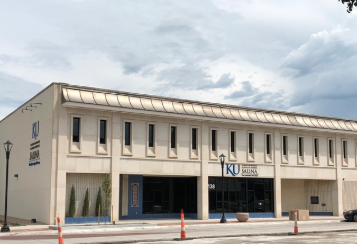
Salina Health Education Center on North Santa Fe Ave., which serves as the home for the Salina campuses of both the KU School of Medicine and KU School of Nursing.
According to a media release, when plans were originally developed to establish a new Salina medical campus for KU in 2016, the project was intended to house only the medical school. In 2017, the KU School of Nursing announced plans to also establish a program in Salina and both schools were able to share space in the Salina Health Education Center when the building opened in June 2018.
Enrolment for the nursing program was planned to increase over time. The first two classes of nurses in the 2017-2018 and 2018-2019 school years were capped at 12 students. This fall, the entering class expanded to 18 students. The entering class will again expand to 24 students for the 2020-2021 school year. Then, there will be 48 total third- and fourth-year nursing students on campus each year thereafter.
The KU-Salina nursing program offers a Bachelor of Science in Nursing to admitted students who have completed their first two undergraduate years of education at a regionally accredited college or university.
“The additional space is designed to be shared by both schools and will continue to allow us to develop interprofessional education between medical and nursing students,” said Lisa Larson, Ph.D., R.N., dean of the KU School of Nursing-Salina campus. “The expansion is greatly needed to accommodate the expansion of nursing class sizes, which begin this fall.”
The expansion of the Salina Health Education Center will utilize 15,871 square feet of vacant office space already connected on the south side of the facility with frontage on Phillips Plaza in downtown Salina. The space was formerly used by the Salina Area United Way, State of Kansas Department of Corrections,
Copeland Insurance and a number of other businesses over the years.
The new space will offer a seamless interior connection to the rest of the Salina Health Education Center and provide dedicated offices for faculty and additional space for classrooms, testing and study areas, as well as clinical skills labs and conference rooms.
Don Marrs, DMA Architects, Salina, is currently completing the design-development phase of the project. Construction is expected to be completed by December 2020.
The Salina Regional Health Foundation and KU Endowment are partnering to raise funds for the project.
“Donors may support the expansion project by giving through KU Endowment or our Foundation,” said Tom Martin, Salina Regional Health Foundation executive director.
“This project supports the common good of the KU medical and nursing schools and their common missions to train doctors and nurses who will serve the future medical needs of rural Kansans,” said Joel Phelps, Salina Regional Health Center president and chief operating officer.
The University of Kansas School of Medicine-Salina opened with its first class of eight students in 2011, establishing itself as the smallest four-year medical school in the United States. Five classes of doctors have graduated to date. For those graduates who have already completed their primary care residency training, more than half are practicing today in Kansas across several rural communities.
The University of Kansas School of Nursing-Salina graduated its first class of students this past spring. The graduates spent the summer completing boards and are now starting to attain employment.
The Salina Health Education Center is owned by the Salina Regional Health Foundation and was made possible through the $9.2 million Blueprint for Rural Health Campaign. The schools use the facility rent free.
“The growth and success of these programs certainly wouldn’t have happened without the dedication and support of Salina Regional Health Center, the Salina Regional Health Foundation, Dane G. Hansen Foundation, and so many others throughout the community and region,” said Bob Moser, M.D., dean
of the KU School of Medicine-Salina campus. “What has already been achieved with the establishment of these schools and student success has gone beyond what anyone could have hoped for.”
“This new expansion would not be possible without the vision and support from the Salina community,” said Robert D. Simari, M.D., executive vice chancellor for the University of Kansas Medical Center and executive dean of the KU School of Medicine. “Working together, we aim to provide health care professionals for rural Kansas and beyond.”
LYON COUNTY —A tractor-trailer hauling cattle overturned south of Emporia just after midnight Wednesday, killing two dozen of the animals.
The Kansas Highway Patrol says the driver TerryBailey, 56, Berryville, Arkansas, was transporting the cattle to Arkansas City to be slaughtered when he fell asleep and went off the side of Interstate 35.
Besides the 24 cattle that died when the rig overturned, 13 were pulled from the wreckage alive. Wallace says the surviving cattle are in a pen waiting to resume their journey.
EMS transported Bailey to a hospital with minor injuries.
The crash disrupted southbound traffic as crews worked to get the rig upright and repair damaged asphalt.
WICHITA, Kan. (AP) — The family of a slain Kansas inmate filed a federal lawsuit Tuesday alleging a systemic disregard for the health and safety of prisoners housed at the Meade County jail.
D-Anthony Andrews is being held in the El Dorado Correctional Facility, according to the Kansas Dept. of Corrections
The complaint filed in U.S. District Court stems from the Aug. 29, 2017, death of Joshua DeVilbiss by another inmate. The prisoners had been transferred to the Meade County facility to alleviate overcrowding in the Sedgwick County jail.
The lawsuit filed against various officials in Sedgwick and Meade counties alleges DeVilbiss “not only experienced extensive pain and suffering, but he died a horrible and preventable death.”
A spokesman for the Sedgwick County Sheriff’s Office declined to comment on the pending lawsuit. But in a 2017 news release issued about the inmate death, the sheriff’s office said the 30-year-old Wichita man who died was being held on unspecified misdemeanor charges and had been in custody for almost a month. It also noted that Sedgwick County, at the time, had 43 inmates housed at the Meade County jail.
Meade County Sheriff Mark Miller said he had not seen the lawsuit, and did not immediately respond after The Associated Press emailed him a copy of the complaint.
Sedgwick County has long had a problem with overcrowding, said attorney Gerald Lee Cross, Jr., who’s representing the DeVilbiss family. He added that DeVilbiss was put into a prison population with other people who were facing violent charges, as well as inmates with mental health issues that were not being addressed.
“I anticipate that both counties are going to speak to the failure at the state and federal level to address mental health in the general prison population, but at the end of the day there are so many institutional failures here within both departments,” Cross said. “I think both systems are choosing process over people.”
The lawsuit said DeVilbiss was suffering from some undisclosed illness, urinating blood, when he was finally granted permission to transfer back to the Sedgwick County jail to get medical treatment. He was in pain from his medical condition, starving from being underfed and had been receiving threats to his life because he had to gamble for food, according to the suit.
But before he could be moved, an inmate identified as D’Anthony Andrews in the lawsuit learned of the impending transfer, became furious at a perceived lack of respect and threatened DeVilbiss.
The lawsuit alleges Andrews struck DeVilbiss from behind near a sleeping area, knocking him unconscious. After being unable to revive him, several inmates moved him to a shower area where his body was later found.
Andrews pleaded no contest to a reduced charge of involuntary manslaughter in a plea agreement with prosecutors, according the court filing. He was treated for mental illness at the Larned Correctional Mental Health Facility and later transferred to the El Dorado Correctional Facility.
Andrews is also named as a defendant in the civil lawsuit filed by DeVilbiss’ family.
TOPEKA, Kan. (AP) — Prosecutors want a 17-year-old to face adult charges in a shooting that left an 18-year-old woman dead.
Police on the scene of the shooting investigation Saturday photo courtesy WIBW TV
The teen suspect faces a second-degree murder charge in the death of Ashley Usher. She was found Saturday afternoon inside a house in Topeka suffering from a gunshot wound and died later at a hospital.
Shawnee County District Attorney Mike Kagay says he plans to ask a court to try the teen as an adult. He also faces charges of interference with law enforcement, theft of a firearm and criminal use of a weapon.
DOUGLAS COUNTY — One person died in an accident just before 10:30p.m. Tuesday in Douglas County.
A pickup truck struck a moped driven by a 24-year-old Lawrence woman in the 2700 Block of Haskell Avenue, according to officer Patrick Compton.
Upon their arrival, officers rendered aid to the woman until paramedics arrived. Rescue attempts were unsuccessful and she was pronounced dead at the scene, according to Comptom.
The 2700 block of Haskell was closed to traffic until about 5 a.m., Wednesday.
At this time, all possible contributing factors are being actively investigated, and no further information is available.
WASHINGTON (AP) — The Trump administration is moving to end a long-standing federal court agreement that limits how long immigrant children can be kept in detention, a decision that will almost certainly lead to a new court fight over the government’s ability to hold migrant families until their cases are decided.
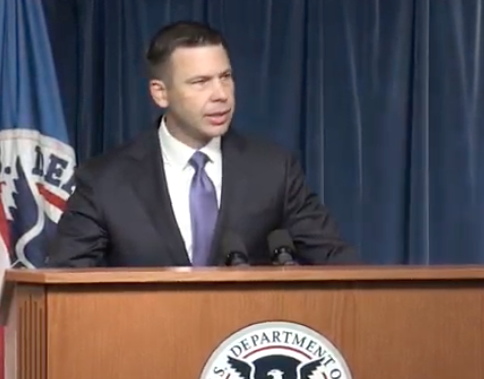
Department of Homeland Security (DHS) acting Secretary Kevin McAleenan during Wednesday’s news conference -image courtesy DHS
Ending the so-called Flores agreement is a top priority for the Trump administration. It requires the government to keep children in the least restrictive setting and to release them as quickly as possible, generally after 20 days in detention. Homeland Security officials say they are adopting regulations that reflect the agreement and there is no longer a need for court involvement, which was only meant to be temporary.
The move is the latest effort by the administration to restrict immigration, President Donald Trump’s signature issue, and is aimed at restricting the movement of asylum seekers in the country and deterring more migrants from crossing the border. It is bound to generate fresh outrage, following reports of dire conditions in detention facilities, and it is questionable whether courts will let the administration move forward with the policy.
Peter Schey, a lawyer for the immigrant children in the Flores case and president of the Center for Human Rights and Constitutional Law, said if the regulations don’t match the settlement, “they would be in immediate material breach, if not contempt of court.”
“I think all these things are now part of the 2020 campaign,” Schey said.
The officials said they are creating a set of higher standards to govern family detention facilities, which will be regularly audited, and the audits made public. But the rules would allow the government to hold families in detention until their immigration cases are completed, which could be much longer than 20 days.
The officials spoke to reporters on condition of anonymity to discuss regulations that had not been made public.
The regulations were expected to be formally published Friday and go into effect in 60 days absent legal challenges.
They follow moves last week to broaden the definition of a “public charge” to include immigrants on public assistance, potentially denying green cards to more immigrants. There was also a recent effort to effectively end asylum altogether at the southern border.
Flores is a constant talking point by the president and his administration, which claims it is an immigration loophole that encourages migrants to make a dangerous and potentially deadly journey to the U.S. The district judge overseeing the agreement has already refused government requests to increase the amount of time children can be detained, and advocates have already moved to block the regulations when the proposed rule was first announced last September.
Parents and children coming into the country are often released into the U.S. while their asylum requests wind their way through the courts — a practice Trump has derided as “catch-and-release.”
Homeland Security did not say how long it expects families to be kept. Asylum cases involving detained families move much more quickly than cases for families released, taking months instead of years to resolve, in part because there are none of the delays that result when immigrants set free in the U.S. fail to show up for a hearing.
The government operates three family detention centers that can hold a total of about 3,000 people, though one is being used for single adults, and the other two are at capacity. Officials hope they would not need extra bed space because the rules would serve as a deterrent.
The massive influx of Central American families to the U.S.-Mexico border has vastly strained the system, though agreements by Mexico to clamp down on migrants heading north and a new agreement with Guatemala forcing migrants to claim asylum there instead of heading north are expected to reduce the flow, though the action has been decried as inhumane.
Trump administration officials have also forced more than 30,000 people to wait out their asylum cases in Mexico while their cases progress. It’s not clear how this change would affect that policy.
Lawyers in the Flores case recently spoke out about what they said were deplorable, filthy conditions for children held at border facilities not meant to hold large groups of people for very long.
And a recent report by an independent monitor overseeing claims of government noncompliance with Flores rules detailed the extreme overcrowding and poor conditions that immigrant youths faced in detention.
For example, a Border Patrol station in in Clint, Texas, an El Paso suburb, had a capacity for 105 children. On June 1, there were 676. Lawyers who visited that facility in June described squalid conditions. Children cared for toddlers, the lawyers said, adding that they had inadequate food, water and sanitation.
At a detention center in McAllen, Texas, there were nearly 1,800 juveniles when the entire capacity for both juveniles and adults was 1,500.
The monitor in the Flores settlement visited some facilities, finding that they were as cold as 66 degrees Fahrenheit (19 degrees Celsius), and “even participants in the inspection and dressed in business clothes often found the temperature uncomfortably cool.”
A federal appeals panel found last week that detained children should get edible food, clean water, soap and toothpaste under the agreement, after a bid to limit what must be provided.
The Flores agreement has been into effect since 1997 but mostly applied to children who came to the country alone. In 2015, U.S. District Court Judge Dolly Ghee ruled the requirements were applicable to children who crossed the border with families, after the Obama administration tried to detain them together until their cases were completed.
Part of the issue was that children could not be kept in facilities that weren’t licensed, and no states license family detention centers. Homeland Security officials say by adopting the standards for education, healthy food and cleanliness used by U.S. Immigration and Customs Enforcement, which detains adult immigrants, they are satisfying requirements in lieu of state licensing requirements.
The agreement surfaced again in the spring of 2018, when the Trump administration adopted a policy of prosecuting anyone caught crossing illegally. More than 2,900 children were separated from their parents as a result.
Trump eventually backed down and stopped the separation of families. A federal judge ordered parents and children reunited; the government has said it has done so in as many cases as it could.
SHAWNEE COUNTY — Law enforcement authorities are investigating an alleged threat at a Kansas high school
Hodge photo Shawnee Co.
Just after 1p.m. Tuesday, police received a call from a vigilant citizen stating that they had information about a person who had made threats of violence to Topeka West High School, according to Lt. John Trimble.
Police notified USD 501 officials and worked seamlessly to ensure the safety of the students.
Investigators and officers then tracked down and spoke with all parties that were associated with this threat and took Isaiah K. Hodge, 19, Topeka, to the Law Enforcement Center. He was interviewed and subsequently booked into the department of corrections on a requested charge of Aggravated Criminal Threat, according to Trimble.
SEDGWICK COUNTY – Law enforcement authorities are investigating a fatal shooting, have identified the victim and two suspects arrested.
Marcus Lamar photo Sedgwick Co.
Just after 6p.m. Monday, police responded to report of a shooting in the 4600 Block of East Boston in Wichita, according to office Charley Davidson.
A police officer attending a meeting nearby also responded to the scene and they located the victim identified as 33-year-old Jerome Armbeck of Wichita in an open field. He had multiple gunshot wounds. Despite the efforts of police and emergency personnel, Armbeck was pronounce dead at the scene, according to Davidson.
Investigators have learned that a disturbance occurred between Armbeck and several other individuals. One suspect fired a weapon several times striking the victim, according to Davidson. This was not a random incident.
On Tuesday, police arrested 20-year-old Marcus Lamar on a charge of felony murder, aggravated robbery and an outstanding warrant and a 17-year-old boy on a charge of felony murder and aggravated robbery
Lamar has a previous theft conviction and was reported an absconder, according to the Kansas Department of Corrections
————-
SEDGWICK COUNTY – Law enforcement authorities are investigating a fatal shooting, have identified the victim and made an arrest.
Just after 6p.m. Monday, police responded to report of a shooting in the 4600 Block of East Boston in Wichita, according to office Charley Davidson.
A police officer attending a meeting nearby also responded to the scene and they located the victim identified as 33-year-old Jerome Armbeck of Wichita in an open field. He had multiple gunshot wounds. Despite the efforts of police and emergency personnel, Armbeck was pronounce dead at the scene, according to Davidson.
Investigators have learned that a disturbance occurred between Armbeck and several other individuals. One suspect fired a weapon several times striking the victim, according to Davidson. This was not a random incident.
On Tuesday morning, police took one suspect into custody in connection with the shooting. A second suspect was arrested just before noon, according to Davidson. Police have not released their names or possible charges.
KANSAS CITY — Law enforcement authorities responded to a strange call in Kansas City Tuesday.
Traffic camera images courtesy KC Police
Just before 11:30a.m, police received multiple calls about a man carrying a topless, unconscious woman on the west side of downtown, according to a social media report.
Callers said it looked like the man wanted to throw the woman over a bridge, dropped her on the sidewalk, dragged her head over a curb, had her slung over his shoulder and appeared to be trying to dress her, according to police. One caller said he was yelling ‘savior’ while holding the woman just east of the 12th Street Bridge.
Multiple officers quickly responded to the scene. They found a man and what they found was totally unexpected, according to the release. The woman was actually a life-size female doll.
The man told police he found it in a dumpster of a restaurant at 16th and Broadway. He had carried the doll to the woods. According to police, they advised him not to carry the doll around in public anymore.