In the op-ed, Congressman Marshall discusses the importance to Kansas producers of opening markets in places like Cuba.
“Cuba represents a potential top-10 wheat market, and as their tourism continues to grow, demand for higher quality protein sources will match well for our livestock producers. In a time of record low commodity prices, we cannot be arbitrarily choosing markets in which not to sell. We are only holding ourselves back.”
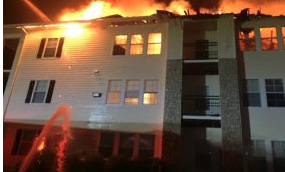
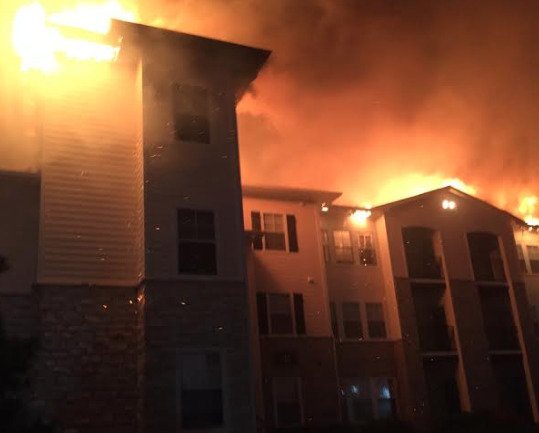
Saturday apartment building fire -photo Junction City Police
GEARY COUNTY -The preliminary damage estimate from the Junction City Fire Department on the apartment building fire at the Bluffs apartment complex on Saturday has been placed at $750,000 to the structure and $400,000 to the contents.
Building B, which contained 28 apartment units burned. No one was injured, and the Bluffs has worked to provide new apartments for those who were displaced.
The fire call came in at 1:12 a.m. with personnel from multiple agencies responding including the Red Cross to assist with the recovery process.
The donations for victims are being kept off-site for the next few days and then later opened up at the clubhouse at the Bluffs. Some churches in the area have also reached out to help.
The families who were impacted by the blaze range from toddlers to single young adults, to older residents, according to apartment leasing manager Neva Fisher. “Some of the things that you don’t realize, their medications, their glasses, prescription glasses, those are things that can’t be donated. We’re just looking for options for them.”
Fisher confirmed the majority of the residents were affiliated with the military, but there was one USD 475 teacher and a small number of other civilians who resided in the building that burned.
Another fire at the Bluffs in April of 2016 destroyed Building F in the complex. There were no injuries in that fire. Cause of Saturday’s fire is still under investigation.
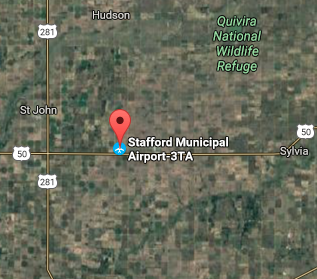
STAFFORD COUNTY – A Kansas man was involved in a small plane mishap just before 1:30p.m. on Sunday in Stafford County.
The Kansas Highway Patrol reported a 1978 Bellanca, single engine 4-seat aircraft piloted by Milton D. Pinkston, 86, St. John, aligned the takeoff path incorrectly.
The aircraft went too far to the east, traveled off the runway and entered a muddy wheat field. The landing gear dug in and the aircraft flipped.
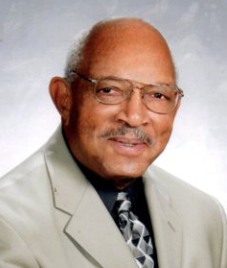
WICHITA, Kan. (AP) — A former football star for what now is Wichita State University is being remembered for his composure confronting racism directed at him and other black athletes in the 1940s.
About 100 family and friends gathered Saturday at Koch Arena for a memorial service for Linwood Sexton, who died March 29 at the age of 90.
As a halfback, Sexton led the Shockers in total offense in 1946 and 1947, helping them to a 1947 Raisin Bowl berth. He earned All-Missouri Valley Conference honors from 1945 through 1947.
That’s despite sitting out games in places such as Tulsa and West Texas State because of his race.
Sexton is a member of the conference, Shockers and Kansas sports halls of fame.
KANSAS CITY, KAN. – A Kansas man has been arrested and charged in two robberies, according to U.S. Attorney Tom Beall.
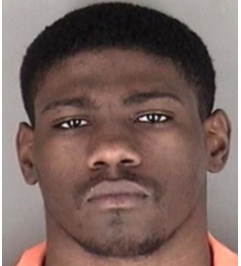
The Topeka Police Department assisted the FBI in arresting Joshua Alexander Musgraves, 24, Topeka, who is charged with two counts of commercial robbery.
An indictment filed in U.S. District court in Topeka alleges that on Jan. 6, 2017, Musgraves robbed Plato’s Closet, a clothing store at 1580 S.W. Wanamaker Road in Topeka.
The indictment also alleges that on Jan. 20, 2017, Musgraves robbed Kentucky Fried Chicken at 1812 N.W. Topeka Boulevard in Topeka.
If convicted, he faces up to 20 years in federal prison and a fine up to $250,000 on each count. The Topeka Police Department and the FBI investigated. Assistant U.S. Attorney Jared Maag is prosecuting.
Kansas legislators hit adjournment Friday with some big tasks left for their wrap-up session that starts May 1.
At the top of the list is a tax and budget plan, which largely will be influenced by the amount of school funding that legislators decide to add in light of the Kansas Supreme Court’s ruling last month. In the health policy arena, Medicaid expansion supporters are regrouping after the governor’s veto — and holding out hope for another shot this session.
Here’s a look at what legislators have accomplished and what remains to be done during the 2017 session regarding budget, education and health issues.
Coming To A Budget Compromise?
Lawmakers have made progress on balancing the current budget for the fiscal year that ends in June, but solutions for the coming years have eluded them. Revenue shortfalls are projected to total around $1 billion over the next two budget years.
Senate President Susan Wagle said Friday that agreeing on a tax package is “the most difficult thing” for legislators to do. CREDIT STEPHEN KORANDA /KPR
Republican Senate President Susan Wagle said the slow progress is to be expected.
“Coming to a compromise, an agreement on a tax package is probably the most difficult thing any state Legislature would have to do,” she said.
In February the House and Senate did advance a tax increase, but Gov. Sam Brownback vetoed the plan and lawmakers didn’t have the votes to override.
Sen. Laura Kelly, a Topeka Democrat, said legislators may consider a modified version of that plan.
“The issue, quite honestly, is the governor,” she said. “Can we get anything past him?”
This week Brownback made an unexpected announcement that he was endorsing a “flat tax” plan from a Senate committee. It would have eliminated the current 2.7 and 4.6 percent income tax brackets and imposed a 4.6 percent tax rate on all Kansans.
That bill failed by a wide margin in the Senate, 37-3, and gave legislators a bit of insight, Kelly said.
“We have found out what won’t work. I guess that’s progress,” she said.
On Friday, Brownback called the budget work done so far a “good opening discussion” but said more negotiations are likely.
“When you’re dealing with tax policy, you’ll go through 100 iterations to come up with something that can get through the entire process,” Brownback said.
That process may make for long days when legislators return to Topeka for the wrap-up session.
Rep. Melissa Rooker said they’ve been told to plan to work for two weeks straight, including through the weekend, to find tax and budget solutions.
“Which is fine, it’s appropriate to get the people’s business done, but it’s a lot of heavy lifting to pack into a very compressed time frame,” said Rooker, a Fairway Republican.
Both chambers have made some progress on budget plans for the coming two years. They largely avoid spending cuts and include some small, targeted spending increases. But both budgets would require hundreds of millions of dollars in new revenue to balance.
Sen. Dennis Pyle, a Hiawatha Republican, is among the lawmakers who want to consider spending cuts before tax increases.
“People in here generally like to spend money — especially other people’s money,” Pyle said.
The top budget writer in the Senate, Republican Carolyn McGinn of Sedgwick, said last month that she’s prepared to make spending cuts.
“At the end of the day, we have to balance our budget,” McGinn said. “If nothing passes on the revenue side, we’ll be back. We’ll be taking things out. We will balance this budget.”
Court Ruling Steers Education Funding
Budget negotiations have been complicated by the need to develop a new school funding formula, as spending on K-12 public education takes up about half of the $6 billion state general fund.
The optimism about education funding in Kansas really started in last year’s elections when moderate Republicans and Democrats unseated conservative legislators. Many of the new lawmakers had education backgrounds, from PTA members to a former superintendent, and made school funding a priority in their campaigns.
Acknowledging that writing a new school funding formula would be a priority — and a complicated process — House Speaker Ron Ryckman of Olathe created a special panel, the House K-12 Budget Committee.
A number of school funding plans emerged early in the session.
One was authored by Rooker with lots of input from other moderates and some Democrats.
Conservative plans included one by Rep. Scott Schwab of Olathe and a leftover plan from last year written by Rep. Ron Highland, former chair of the education committee, and Steve Abrams, who lost his Senate seat in the last election. Another plan came from the former president of the Kansas Chamber of Commerce.
During the first few weeks of the session, the committee discussed all of those plans. Then, talks slowed.
Superintendents did have some concerns when lawmakers talked about cutting current education aid to help balance the budget or forcing schools to dip into their reserves in future years, but nothing came of that.
House Speaker Ron Ryckman formed a special committee to come up with a new school funding formula this session. CREDIT STEPHEN KORANDA/KPR
Looming over all of this, of course, was the pending Kansas Supreme Court ruling in the Gannon school funding case.
Finally, on March 2 the court ruled that Kansas school funding was unconstitutionally inadequate. Estimates on how to fix that ranged from $500 million to $800 million.
After the ruling, David Smith, chief of staff for Kansas City Kansas Public Schools, said: “I think what people have come to understand is that any funding formula that is efficient and effective will look very much like the old one because it’s going to be tied to what it actually costs to educate students.”
The first plan from legislative leaders upped spending by just $75 million. Democrats scoffed at that number and, despite some arm-twisting by leadership, most Republicans dismissed it as too little.
Rep. Larry Campbell of Olathe, chairman of the K-12 committee, said the bill was “a starting point.”
During a marathon hearing on March 30, the K-12 committee increased that one-time infusion of $75 million to a five-year total of $750 million in new spending.
Rep. Ed Trimmer from Winfield, the ranking Democrat on the committee, said that’s the minimum the Legislature needs to add for public schools.
“Otherwise we’ll be back here doing this same thing again after the court tells us that’s not enough money,” he said.
Educators are excited about some elements of the bill: state funding for all-day kindergarten if districts choose to offer it, $10 million more over five years for at-risk early childhood development and about $2 million for teacher mentoring and professional development.
However, the committee did not pass out the bill. Campbell wanted to hire a constitutional lawyer to review the measure and ensure sure it will pass muster with the state Supreme Court before sending it to the House and Senate. Former state Senator Jeff King, who’d initially been rejected as too political, got the job as the committee’s counsel Friday a few hours after the Legislature adjourned for the break.
Once the bill hits the House and Senate floors, many questions remain. How will legislators come up with millions more in education funding when the state faces a large budget hole? Will moderate Republicans in the House be able to add more funding? Will $750 million survive in the Senate?
And then there’s the most important question: what will the Kansas Supreme Court think?
Medicaid Expansion A Veto Victim
Expanding eligibility for KanCare, the state’s privately run Medicaid program, dominated health policy debates this session.
After three years of attempts to get a Medicaid expansion bill beyond committee, the House and Senate debated and passed the bill. But they were unable to get enough votes to override Brownback’s veto. In his veto message, the governor said the bill prioritized “able-bodied” people over those who have disabilities.
Sheldon Weisgrau, director of the Health Reform Resource Project, said KanCare expansion advocates aren’t conceding defeat this session. But if the Legislature doesn’t take it up again this year, Weisgrau said advocates will keep pushing expansion as a way to help more Kansans access health care and to assist rural hospitals.
Rep. Susan Concannon, left, is unsure of the prospects for Medicaid expansion when the Legislature returns for its wrap-up session. CREDIT MEG WINGERTER / KANSAS NEWS SERVICE
“I’m a believer that nothing is dead until the Legislature adjourns,” he said in an email. “This issue is too important and has too much support to give up on.”
Rep. Susan Concannon, a Beloit Republican who was one of the strongest legislative voices in favor of expansion, was less sure about its prospects this session. Some House members have said they are open to reconsidering the issue, but she said it would be difficult to get another bill passed in the time remaining.
“It’ll be back next year, full force,” she said. “I’m discouraged, but I’m not giving up.”
Another health policy priority for Democrats and some moderates also may have fallen short. State hospitals, mental health centers, college campuses and the University of Kansas Hospital had sought an exemption from a state law that requires them to either allow visitors to carry concealed handguns or to hire security and install metal detectors. Several bills exempting one or more of those facilities failed to advance, though a bill that would exempt only state hospitals is alive in the House.
Tim Keck, secretary of the Kansas Department for Aging and Disability Services, said during a legislative hearing that bringing guns into a psychiatric hospital could endanger patients and employees.
“It’s not a safe environment to have weapons available,” he said.
Early in the session, committees discussed how they could invest more in the mental health system and restore some funding cut from Medicaid reimbursements last year.
Legislative leaders cautioned that state general fund dollars would be scarce as they tried to fill the budget hole and come up with a school funding plan that would satisfy the courts, so lawmakers have turned to other sources for health programs.
They looked to increase the privilege fees that health maintenance organizations pay to sell insurance plans as a way to restore a 4 percent cut to for Medicaid reimbursements.
A bill that passed the House on Thursday would raise the privilege fee paid on revenue from insurance premiums from 3.31 percent to 5.77 percent. The funds would go first to reversing the reimbursement cuts, with any additional money going to an “improvement fund” for community mental health centers.
Cindy Samuelson, spokeswoman for the Kansas Hospital Association, said the group was pleased to see the Legislature come up with a way to restore some of the Medicaid funds.
The bill raising the privilege fee would have to go conference committee because the Senate passed a different version, but Samuelson said medical providers are hopeful it will get through the process.
“The Medicaid provider cuts are exacerbating an already stressed health care system,” she said in an email. “By restoring the lost Medicaid funds, the state is taking an important first step in strengthening the Kansas health care system and the economic benefits associated with it.”
Kyle Kessler, executive director of the Association of Community Mental Health Centers of Kansas, said the improvement fund would help replace about $20 million in state funding that the centers have lost since 2007. The state funds help offset the cost of caring for uninsured patients, he said.
Lawmakers have shown an interest in mental health this year, and particularly in how limited admissions at Osawatomie State Hospital have forced emergency rooms and mental health centers to keep patients safe while they wait for a bed, Kessler said.
“We feel good about how they are listening to community mental health centers back in their home communities,” he said.
This story was produced by Stephen Koranda, Meg Wingerter and Sam Zeff of the Kansas News Service, a collaboration of kcur.org, Kansas Public Radio and KMUW covering health, education and politics. .
PRATT – The sound of a gobble will stop a turkey hunter in their tracks – anytime, anywhere. Like no other sound you’ve heard, a gobble is a high-pitched, rattling chortle that seems to erupt from a tom’s throat. It carries far on a calm spring morning, which can be good and bad for the turkey. Gobbles also signal the start of the spring turkey season.
Spring turkey hunting entails calling males, or toms, within range by imitating the call of a female, or hen. It’s both exhilarating and nerve frazzling. But be forewarned, many become hopelessly addicted to the adrenaline rush of spring turkey hunting after just one experience.
The Kansas spring turkey season opened for youth and hunters with disabilities on April 1 (During the youth season, youth 16 and younger may hunt with adult supervision). Archery hunters started hunting April 3, and the regular shotgun/archery season is April 12-May 31, 2017. All hunters need a turkey permit, as well as a hunting license, unless exempt by law. Go to www.ksoutdoors.com for all spring turkey regulations, a unit map, as well as license and permit fees. Only bearded birds may be harvested during the spring season, and hunters may take one bird per permit and one bird per game tag in designated units. Turkey permits are not available online and must be purchased at Kansas Department of Wildlife, Parks and Tourism (KDWPT) offices or license vendors.
Toms may gobble throughout the year, but they are most vocal in the spring during the breeding season. They sound off to let hens know they’re available, which is the good thing. However, gobbles also let hunters know where they’re located, which is the bad thing, if you’re a turkey.
Finding turkeys is the first step of a spring turkey hunt. Our largest game bird roosts in mature trees, so any timber stand, shelterbelt, creek bottom or even old homestead can host roosting turkeys. Scout likely areas by searching for tracks on dirt roads, glassing edges of stubble and winter wheat fields or listening for gobbles just after sunset. Toms have a peculiar habit of gobbling just after they fly to roost in the evening and just before they fly down in the morning, so if you hear that, you know you’ve found a great spot.
To take some of the guesswork out, consider hunting public lands. KDWPT manages more than 500,000 acres of state and federal land for public hunting, and more than 275,000 acres of private land are enrolled in the spring Walk-in Hunting Access (WIHA) program, so there’s plenty of spots to choose from this Spring. The 2017 Spring Turkey Hunting Atlas includes maps showing all public hunting lands and is available wherever licenses are sold, so grab yours today or download a copy from www.ksoutdoors.com.
Once you’ve found birds, the next step is to set your alarm for “dark-thirty” the next morning. Under the cover of darkness, try to quietly get in position 75 to 100 yards from the roost. Sit with a tree wider than your shoulders at your back, in full camouflage and watch the woods wake up. When you hear the sound of turkeys from their roost, make some soft tree yelps on your call to convince a tom you’re a new hen roosted nearby. After the birds fly down, the calling strategy begins. A tom will often gobble in response to your calls, but it’s never a sure thing. Real live hens are tough to compete with and may lead your tom away, and turkeys have excellent vision, so one false move can send a bird off. But when it works and you call a bird within range, watching and listening as a big tom gobbles, struts and spits so close is an experience you’ll never forget – and one you’ll want to repeat again and again.
Keeping safe during the spring turkey season requires some extra precaution because hunters are dressed in full camouflage and making sounds like a turkey. Sitting against a tree wider than your shoulders protects you if an unthinking hunter stalks your call from behind. Always assume any sound you hear is another hunter, and always yell or whistle if you see another hunter. Any movement like a wave could draw fire. Always be sure of your target before you pull the trigger, and that means you have to see a beard on the bird during the spring season. Some hunters will wear an orange hat walking in and out of the woods, and they hang that hat on a limb above them while sitting. It’s also a good idea to wrap a bird you kill in florescent orange for the carry out.
TOPEKA, Kan. (AP) — A Kansas jury has cleared a man of attempted-murder charges linked to a shooting nearly a year ago.
The Topeka Capital-Journal reports a Shawnee County jury acquitted 29-year-old Joshua Mathews Yasuo Valdivia on Friday, also clearing him of a weapons count. Jurors did find him guilty of interference with a law enforcement officer.
Valdivia testified Thursday, denying he had never met Dennis and didn’t shoot him eight times. Dennis survived.
Jurors had the option of acquitting Valdivia or convicting him of attempted first-degree murder or attempted second-degree murder.
A co-defendant, 23-year-old Malik Yates, is serving more than four years in prison on convictions of aggravated burglary and interference with a law enforcer. He pleaded guilty last October, when a charge of attempted first-degree murder was dropped.
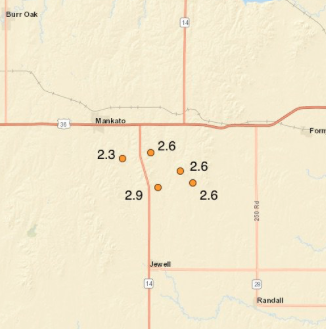
JEWELL COUNTY – Five small earthquakes hit north central Kansas since Friday. The most recent hit just before 2 p.m. on Saturday. It measured 2.6 and was centered approximately 8 miles southeast of Mankato, according to the U.S. Geological Survey.
It was the tenth quake in Kansas this week.
A 2.6 magnitude quake hit just after noon Saturday and was centered approximately 10 miles southeast of Mankato.
A 2.9 magnitude quake hit just after midnight Saturday and was centered approximately 5 miles southeast of Mankato.
In addition, a 2.6 magnitude quake also hit 11 miles northeast of Caldwell in Sumner County just after 5:30 a.m. on Saturday.
On Friday, a 3.3 magnitude quake hit at 3:08 p.m. and was centered approximately 8 miles southeast of Mankato
The agency reported two quakes in the same area Thursday, and two others on Tuesday and Wednesday.
There are no reports of damage or injury from Saturday’s quakes according, according to the Jewell County Sheriff’s Department.
The USGS recorded 7 Kansas earthquakes in March and 6 in February. They measured from 2.5. to 3.3.
JEWELL COUNTY –A seventh earthquake this week hit north-central Kansas on Saturday. It is the ninth quake in Kansas this week.
The 2.6 magnitude quake hit just after noon and was centered approximately 10 miles southeast of Mankato, according to the U.S. Geological Survey.
A 2.9 magnitude quake hit just after midnight and was centered approximately 5 miles southeast of Mankato.
In addition, a 2.6 magnitude quake also hit 11 miles northeast of Caldwell in Sumner County just after 5:30 a.m. on Saturday.
On Friday, a 3.3 magnitude quake hit at 3:08 p.m. and was centered approximately 8 miles southeast of Mankato
The agency reported two quakes in the same area Thursday, and two others on Tuesday and Wednesday.
There are no reports of damage or injury from Saturday’s quakes according, according to the Jewell County Sheriff’s Department.
The USGS recorded 7 Kansas earthquakes in March and 6 in February. They measured from 2.5. to 3.3.
———-
JEWELL COUNTY – A sixth earthquake this week hit north-central Kansas early Saturday. It is the eight quake in Kansas this week.
The 2.9 magnitude quake hit just after midnight and was centered approximately 5 miles southeast of Mankato, according to the U.S. Geological Survey.
In addition, a 2.6 magnitude quake also hit 11 miles northeast of Caldwell in Sumner County just after 5:30 a.m. on Saturday.
On Friday, a 3.3 magnitude quake hit at 3:08 p.m. and was centered approximately 8 miles southeast of Mankato
The agency reported two quakes in the same area Thursday, and two others on Tuesday and Wednesday.
There are no reports of damage or injury from Saturday’s quakes according, according to the Jewell County Sheriff’s Department.
The USGS recorded 7 Kansas earthquakes in March and 6 in February. They measured from 2.5. to 3.3.
———–
JEWELL COUNTY – A fifth earthquake this week hit north-central Kansas. It is also the sixth quake in Kansas since Sunday.
The 3.3 magnitude quake hit at 3:08 p.m. Friday and was centered approximately 8 miles southeast of Mankato, according to the U.S. Geological Survey.
The agency reported two quakes in the same area Thursday.
A 3.2 quake hit at 7:13p.m. and was centered three miles south of Mankato and just after 11 a.m. Thursday a 3.0 quake and was centered approximately six miles southeast of Mankato.
The agency reported a 2.7 quake 9 miles southeast of Mankato just after 5:30 Wednesday morning.
Just after 1p.m. Tuesday a 3.4 quake was centered nine miles southeast of Mankato.
Residents report feeling the earthquakes, according to Jewell County Sheriff Don Jacobs. There are no reports of damage or injury from Friday’s quakes according to Jacobs.
On Sunday, the USGS reported a 2.8 earthquake was centered approximately 2 miles southeast of Medicine Lodge at 6:15p.m.
The agency recorded 7 earthquakes in March including a 2.9 quake March 30, near Belle Plaine.
The USGS also recorded 6 earthquakes in February. They measured from 2.5. to 3.3.
———
JEWELL COUNTY – A fourth earthquake this week hit north-central Kansas on Thursday. It is the fifth earthquake in Kansas this week.
The magnitude 3.2 quake hit at 7:13p.m. and was centered three miles south of Mankato, according to the U.S. Geological Survey.
Just after 11 a.m. Thursday a 3.0 quake and was centered approximately six miles southeast of Mankato.
The agency reported a 2.7 quake 9 miles southeast of Mankato just after 5:30 Wednesday morning.
Just after 1p.m. Tuesday a 3.4 quake was centered nine miles southeast of Mankato.
Residents report feeling the earthquakes, according to Jewell County Sheriff Don Jacobs. There are no reports of damage or injury from Thursday’s quakes according to Jacobs.
On Sunday, the USGS reported a 2.8 earthquake was centered approximately 2 miles southeast of Medicine Lodge at 6:15p.m.
The agency recorded 7 earthquakes in March including a 2.9 quake March 30, near Belle Plaine.
The USGS also recorded 6 earthquakes in February. They measured from 2.5. to 3.3.
There are no reports of damage or injury from Thursday’s quakes according to the Jewell County Sheriff’s Department.
——–
JEWELL COUNTY – A third earthquake this week hit north-central Kansas on Thursday.
The quake just after 11 a.m. measured 3.0 and was centered approximately six miles southeast of Mankato, according to the U.S. Geological Survey.
The agency reported a 2.7 quake 9 miles southeast of Mankato just after 5:30 Wednesday morning.
Just after 1p.m. Tuesday a 3.4 quake was centered nine miles southeast of Mankato.
On Sunday, the USGS reported a 2.8 earthquake was centered approximately 2 miles southeast of Medicine Lodge at 6:15p.m.
The agency recorded 7 earthquakes in March including a 2.9 quake March 30, near Belle Plaine.
The USGS also recorded 6 earthquakes in February. They measured from 2.5. to 3.3.
There are no reports of damage or injury from Thursday’s quake, according to the Jewell County Sheriff’s Department.
WASHINGTON (AP) — The Associated Press has learned that the FBI has been reviewing the handling of thousands of terrorism-related tips and leads received over the past three years to make sure they were properly investigated and no obvious red flags were missed.
The review follows attacks by people who were once on the FBI’s radar but who, in the past 12 months, have been accused of violence in an Orlando, Florida, nightclub, on the streets of New York City and at a Florida airport.
In each case, it was determined the suspects didn’t require continued law enforcement scrutiny months and sometimes years before the attacks.
The review is an acknowledgment of the FBI’s challenge in predicting which of the thousands of tips received annually might one day materialize into a viable threat.
TOPEKA—The Kansas Insurance Department (KID) can provide personal insurance assistance and information to Kansans affected by recent fires throughout the state, according to Ken Selzer, CPA, Kansas Commissioner of Insurance. The department also has a new fire prevention video available.
“The aftermath of the recent western Kansas wildfires and the major fire event in Overland Park is emotional for property owners, so we suggest that they work through their insurance companies’ claims process as best as they can,” said Ken Selzer, CPA, Kansas Commissioner of Insurance. “But representatives on our Consumer Assistance Hotline, 800-432-2484, are ready to assist those who have questions or concerns about their insurance coverage. We believe that the insurance companies have responded well to their policyholders’ concerns, but we also stand ready to assist if needed.”
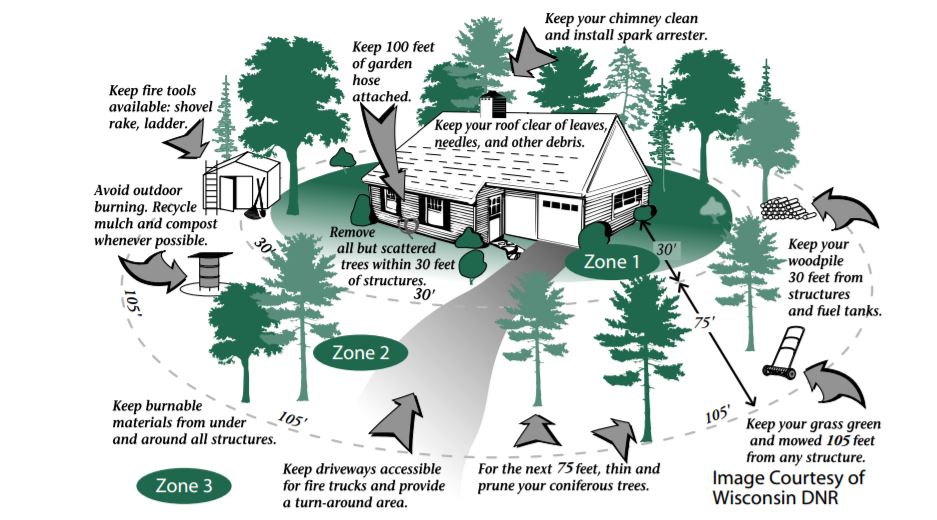
To help prevent loss from future fires, the Commissioner said, KID produced a video discussing fire zone defensible areas around housing.
Additionally, approximately 800 informational packets were mailed to insurance agencies and related entities in the western half of Kansas. The packets contained a “Wildland Fire Action Guide” distributed by the United States Department of Agriculture Forest Service, the KID “Auto and Homeowners Insurance” booklet, and a KID “Personal Inventory” booklet.
“All of those booklets are available to Kansans through our website, www.ksinsurance.org,” Commissioner Selzer said. “They contain valuable tips on acquiring and maintaining auto and homeowners insurance, how to inventory your belongings, and how to provide a barrier to encroaching fire through preventive landscaping.”
KANSAS CITY, Kan. (AP) — Prosecutors in Kansas’ Wyandotte County have dropped a murder charge against a woman who had been accused of killing a teenager nearly 30 years ago.
The Kansas City Star reports that prosecutors announced the dismissal of the case involving 48-year-old Carolyn Heckert of Smithville, Missouri, in a statement but didn’t elaborate.
Heckert had been jailed since her arrest last October in connection with the 1989 stabbing death of 18-year-old Sarah DeLeon. DeLeon’s body was found along railroad tracks near Interstate 435 in Kansas City, Kansas.
New DNA collection and testing technology prompted police to reopen the case in July 2014.
A Heckert attorney, John P. O’Connor, said Friday that Heckert was elated that the murder charge has been dropped.
Saturday fire in Junction City-photo courtesy JC Police
GEARY COUNTY- Officials are working to determine the cause of a major fire at an apartment complex early Saturday.
Just after 1a.m., firefighters and law enforcement from multiple agencies responded to the blaze at 1810 Carolina Avenue in Junction City.
Junction City Fire Chief Terry Johnson confirmed Building B, containing 26 apartment units, is a loss.
“Our first arriving units came in. We had heavy fire on the south side of the building and fire was through the roof, we started operations. We went through several evolutions of operations at this point. The building is a loss at this time, unfortunately,” according to Johnson.
By five a.m. the fire had been mostly contained, but there were still a lot of hot spots in the building, and ladder fire trucks were being utilized to provide firefighters a better view of the top of the structure.
Johnson confirmed all residents of the apartment building got out safely. He estimated approximately 40 to 50 residents were displaced. “Red Cross is on scene. They’re helping out with providing food for the firefighters and support needs for the residents.” Johnson expressed gratitude for all the communities that came in to provide assistance in dealing with the fire.
Geary County Emergency Management Director Garry Berges said they will help coordinate with the agencies. “We helped provide communication between the surrounding county agencies that came in…the Manhattan Fire, Fort Riley Fire, we made sure everybody could talk so everybody knew what was going on. We’ll be here to support. We made sure the Red Cross was available to help, not only the firefighters, but also the displaced residents.”
This is the second time there has been a major fire at the Bluffs Apartment Complex. In April of 2016 an apartment building at that complex was destroyed by fire.