NEOSHO COUNTY- A Kansas teen died in an accident just before 4a.m. on Saturday in Neosho County.
The Kansas Highway Patrol reported a 1997 Chevy pickup driven by Nickolas LeviGofourth,16, Independence, was eastbound on 10th road two miles north of Dennis.
The pickup traveled off the roadway into westbound ditch, hit a tree at the driver’s side door, and flipped. The driver and a passenger were ejected.
Gofourth was pronounced dead at the scene and transported to Frontier Forensics.
Passengers in the pickup Michael Wayne Curtis Killough, 17, and Pete Bryan Rehmert,
18, both of Thayer, were transported to Labette County Medical Center.
They were not wearing seat belts, according to the KHP.
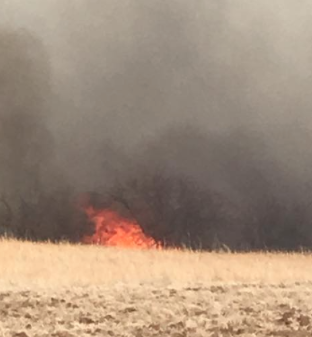
MARQUETTE, Kan. (AP) — Officials worry this year’s potential for a fire outbreak in Kansas could be worse than last year, when the state saw its biggest known wildfire.
Jim Unruh, a volunteer fire department chief in Marquette, helped fight last year’s Anderson Creek blaze that charred 390,000 acres in Oklahoma and Kansas.
Unruh says that this year “just scares me,” because of already dry conditions and a lot of fuel on some pastures.
Problems already have surfaced. Unruh’s crew last month battled a wildfire of 3,600 acres.
Kansas Forest Service fire specialist Eric Ward says the state had three large wildfires in January. “Large” is defined as a fire that burns at least 100 acres of trees or more than 300 acres of brush.
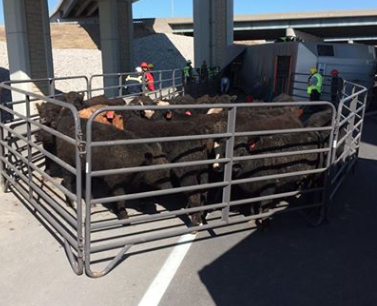
Law enforcement rounding up 55-60 head of cattle loose from overturned semi on Friday-photo KDOT
LENEXA, Kan. (AP) — The owner of cattle that escaped when a truck overturned near Kansas 10 and Interstate 435 in Kansas is trying to round up the strays.
A semi-trailer truck overturned Friday near Lenexa, releasing cows in all directions. Highway ramps were closed for hours while several law enforcement and private individuals tried to capture the nearly 35 cattle that escaped. The effort ended when the sun went down.
Lenexa police spokesman Danny Chavez says about 25 of the cows remained free in fields near the highways Saturday morning. He tells The Kansas City Star that police have decided the cattle are safe so no roads will be blocked Saturday.
Police aren’t trying to corral the cows but Chavez says the cattle’s owner is working to recover them.
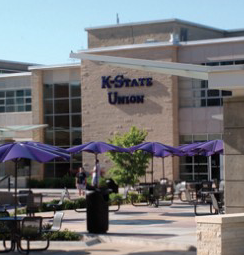
ansas State makes $6 million budget reduction
MANHATTAN, Kan. (AP) — Kansas State officials say the university will reduce its budget by $6 million.
President Richard Myers said Friday the cuts to the current fiscal year budget are in response to a drop in enrollment and uncertain state funding.
The Manhattan Mercury reports (https://bit.ly/2mntkTS ) the cuts represent a 2.21 percent across-the-board reduction. Department heads will be responsible for determining how the reductions will be implemented.
Myers says the cuts will allow the university to continue to provide scholarships and respond to a deficit in its central scholarship account.
He said the university’s future funding remains uncertain because the Kansas Legislature is still putting a budget together and hasn’t chosen to raise taxes to respond to a budget deficit.
KANSAS CITY, Mo. (AP) — The youngest of five people convicted in a 1988 arson fire that killed six Kansas City firefighters could be released from prison soon.
A federal judge ruled Friday that Bryan Sheppard, who is now 45, should have his sentence reduced to 20 years in prison. Because Sheppard has already served 22 years, he could be released. Details of his possible release were not available Friday.
Sheppard was 17 when he was sentenced to life in prison for the November 1988 explosion.
The Kansas City Star reports he was granted a new sentencing after the U.S. Supreme Court ruled mandatory life sentences for juveniles were unconstitutional unless a judge first considered their individual situation.
The five people sentenced in the case have long maintained their innocence.
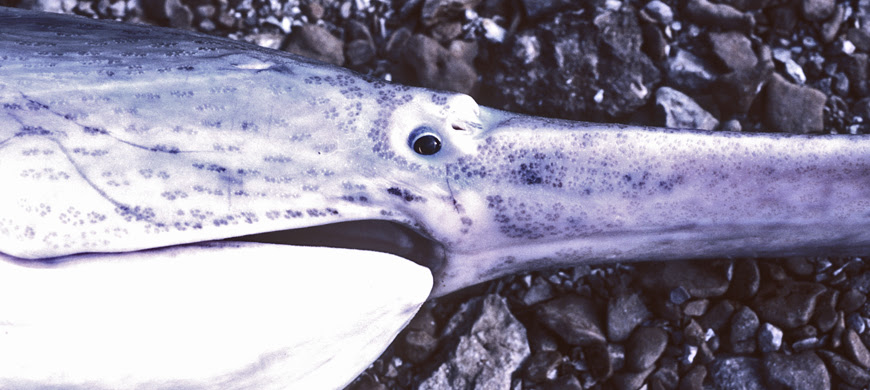
PRATT – Anglers are eager for warm weather and time on the water, and one of the hallmarks of spring fishing is the opening of the paddlefish snagging season. But hold on, it’s not as easy as showing up on opening day. While there are several rivers in southeast Kansas where paddlefish snagging is allowed, conditions must be right for paddlefish to be present.
The Kansas paddlefish season runs March 15–May 15 during the annual spring spawning run. Paddlefish may be taken in posted areas inside Chetopa and Burlington city parks on the Neosho River; on the Neosho River at Iola, downstream from the dam to the city limits; on the Marais des Cygnes River below Osawatomie Dam, downstream to a posted boundary; on the Marais des Cygnes River on the upstream boundary of the Marais des Cygnes Wildlife Area, downstream to the Kansas-Missouri border; and the Browning Oxbow of the Missouri River (Doniphan County).
Water temperatures of 50-55 degrees and an increase in river flow will start paddlefish moving upstream out of reservoirs. Most Kansas paddlefish are caught from the Neosho River at Chetopa, but for paddlefish to be present there requires a significant increase in river flow. It’s a good idea to call local Kansas Department of Wildlife, Parks and Tourism offices or area bait shops for river and angler updates before traveling to a site.
Paddlefish have been around for more than 300 million years, and these large, prehistoric looking fish are unique in several ways. First, they are similar to sharks in that their skin is scaleless and smooth, and their skeleton is made of cartilage rather than bones. And second, they are filter feeders, eating only microscopic zooplankton. As a result, they can only be caught by snagging. Kansas waters commonly produce paddlefish weighing 30-60 pounds, and the world record paddlefish that weighed 144 pounds was caught in Kansas.
Paddlefish anglers must have a paddlefish permit ($12.50 for adults, $7.50 for youth), which includes six carcass tags. Because the permit includes carcass tags, it must be purchased in-person from a license vendor or by calling 1-800-918-2877, in which case permit and carcass tags will be mailed. Permit-holders can snag up to two fish per day, and six for the season. Unless exempt, paddlefish snaggers must also have a Kansas fishing license.
Paddlefish may be snagged using pole and line with not more than two single or treble hooks. Barbless hooks must be used in Chetopa City Park. Catch and release is allowed in Burlington, Chetopa, and Iola, except that once attached to a stringer, a fish becomes part of the daily creel limit. There is a 24-inch minimum length limit for fish snagged in the Missouri River boundary waters, and there is a 34-inch minimum length limit for fish snagged on the Marias des Cygnes River.
Immediately upon harvest, anglers must sign a carcass tag, record the county, date and time of harvest, and attach the tag to the lower jaw of the paddlefish. Paddlefish caught out of season or in non-snagging areas may be kept only if they are hooked inside the mouth.
For information, consult your 2017 Kansas Fishing Regulation Summary, or visit www.ksoutdoors.com and click “Fishing,” “Fishing Regulations,” then “Paddlefish Snagging.”
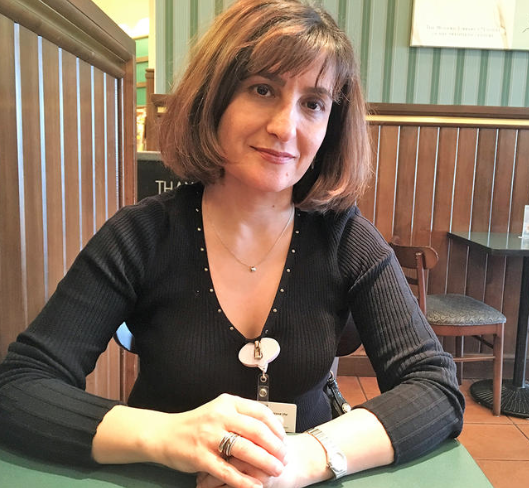
Dr. Saeedeh Salmanzadeh is a physician with Topeka-based Stormont Vail Health. She became a U.S. citizen in 2015 after immigrating to the United States from Iran, one of seven countries included in President Donald Trump’s travel ban. ANDY MARSO / KANSAS NEWS SERVICE
By ANDY MARSO
Dr. Saeedeh Salmanzadeh became a U.S. citizen at a naturalization ceremony in October 2015.
When the presiding official asked if any of the new citizens wanted to speak, she was one of the first to raise her hand.
By then Salmanzadeh had spent 15 years in America, after leaving her home in Iran where she was a doctor.
She had spent two years with no pay, studying for exams so she could practice in the United States.
She had spent three years practicing alongside her husband — also an immigrant from Iran — in Aberdeen, S.D., where they were the only pediatricians in a town of about 27,000 people.
She had spent a decade practicing in Topeka — expanding her patient list, buying a house and putting down roots.
At the naturalization ceremony, Salmanzadeh made the last step in that process, taking an oath to support and defend the laws and Constitution of the United States of America. Afterward she had a few things she wanted to say.
“I just thank(ed) all the American people, all the people who knew me and accepted me as I am,” Salmanzadeh said recently, sitting in a Topeka coffee shop and reliving the moment. “Most of the people after knowing me, they really didn’t care if I am atheist or Muslim or Christian. They look at me as a human being, and this is something that makes the United States very unique.”
But she fears that might be changing.
An executive order signed Jan. 27 by President Donald Trump barred travelers from her home nation and six other majority Muslim countries from which Barack Obama’s administration had restricted visas in 2015 because of concerns about terrorism.
The travel ban has since been blocked by a federal judge, but the Trump administration is fighting to restore it or implement a new version.
The abruptness of the ban caused havoc at the nation’s airports as some people who were en route to the United States or had landed were told they could not enter.
Many industries were affected, including an American medical system that relies increasingly on foreign labor. Health centers nationwide, including some in Kansas and Missouri, have long rolled out the welcome mat for foreign doctors. Rural areas in particular have benefited from a special “J-1 visa waiver” program for immigrant doctors who agree to work in underserved areas.
That’s what Salmanzadeh did. But others like her are now caught in the middle as a flashpoint debate over national security intersects with a more long-running discussion about how the U.S. fills its doctor shortage.
“If they want to continue (the ban) I am sure the places like Aberdeen, South Dakota, or very underserved area(s) … they are going to be affected most,” Salmanzadeh said.
The Numbers
According to the Migration Policy Institute, immigrants accounted for 27 percent of U.S. physicians and surgeons in 2010. The Medicus Firm, a company that recruits doctors on behalf of clients like hospitals, says that includes more than 15,000 doctors from the seven countries named in the ban: Iran, Iraq, Yemen, Sudan, Somalia, Syria and Libya.
The majority of them come from Iran. Some, like Salmanzadeh, left amid growing unrest that included student protests in 1999 and a government crackdown that followed.
Salmanzadeh said that at her house in Topeka the travel ban led to a series of frantic phone calls with family members back in Iran who wondered whether they would be able to see each other.
“We try to give them some reassurance that now we are citizens (and) hopefully … nothing is going to happen,” Salmanzadeh said. “But this is (the) kind of anxiety this law had on every family and these are normal families (that) had nothing to do with terrorists.”
Salmanzadeh is one of six physicians from countries named in the ban who are employed by Topeka-based Stormont Vail Health. A statement from the company said its physician support services division was in touch with an immigration lawyer to make sure those who are on work visas are able to stay.
“We want to support them in any way we can during this unsettling time,” said Dr. Robert Kenagy, senior vice president and chief medical officer.
Stormont Vail isn’t the only health system in the region affected.
Nathan Miller, a senior vice president of recruiting for Medicus, said the company’s data show that 269 doctors from the seven countries named in the ban are practicing in Kansas and Missouri.
They’re doing everything from primary care to heart surgery, and Miller said they’re generally the cream of the crop from their home countries.
“These are the top performers,” he said.
The doctors from the seven countries named in the travel ban represent only about 1 percent of the approximately 25,700 physicians in the two states.
But Miller, like Salmanzadeh, said they’re disproportionately working in rural areas.
“We rely on these international physicians to provide this type of care,” Miller said. “Some of these places, if these physicians weren’t available, they would be in even more dire straits than they are now based on the shortage they’re dealing with.”
Other Options
Dozens of physicians groups, including the American Medical Association, came out against the travel ban after it was announced.
But the Association of American Physicians and Surgeons was not among them.
Jane Orient, the executive director of the group for conservative doctors, said the precautions are justified until immigrant vetting processes improve.
“We have a national security problem, and we need a better way of assuring that people that are coming here are really coming to be Americans and not to blow people up,” she said.
Orient said she does not dispute the clinical abilities of the doctors coming from abroad, and most are “perfectly normal people” who don’t intend to cause any harm.
But she said the outcry over the ban has exposed the U.S. health system’s over-reliance on bringing in foreign doctors.
There’s an alternative, she said: Make room for the thousands of U.S. medical students every year who fail to “match” with one of the country’s coveted residency slots and have their dreams of becoming a doctor delayed or denied.
“We’re dependent on a brain drain from countries who are desperately short of physicians themselves,” Orient said. “And while these (visas) may be a good opportunity for excellent physicians to come here, I’m not sure we want to be dependent on this to serve our own people when we have lots and lots of Americans who would like to be physicians and are kept out simply by these restrictions on the number of positions that are available.”
Medical students fail to match with residency slots for a number of reasons, including receiving low scores on a licensing exam or reaching for competitive slots and not having an adequate backup.
Residency slots at hospitals across the country are funded in part by Medicare. A 1997 bill meant to restrain federal spending limits how many are available.
Orient said it’s time for an update.
“I think they made a tremendous miscalculation,” Orient said. “Now we’re hit with baby boomers retiring … and we do not have enough specialists to take care of them.”
Les Lacy is the vice president of regional operations for the Great Plains Health Alliance, a nonprofit that promotes rural health care and hospitals in Kansas and Nebraska.
He agreed that in the long-term the only cure for the rural physician shortage is more homegrown doctors.
“Train more physicians and support more residency slots, that’s what you do,” Lacy said. “We don’t have enough of them.”
But that takes time. Meanwhile, state governments are considering several stopgap measures such as increasing telemedicine or allowing mid-level providers like advanced practice registered nurses to do more.
Kansas Gov. Sam Brownback wants to increase residency slots, and Kansas and Missouri are among the first states (along with Arkansas) to pass laws allowing medical students who don’t match to practice in underserved areas under the supervision of another doctor.
None of the measures are perfect solutions.
“If it was a silver bullet, we would already have pulled it out and pulled the trigger on it,” Lacy said.
Hiring firms like Medicus to bring in foreign doctors under the J-1 visa is also an option, but Lacy said it’s falling out of favor.
Foreign doctors often experience culture shock in rural outposts and rarely stay after their three years are up, he said. Then hospitals are back in the recruiting game.
“It’s not as often used as it was 10 to 20 years ago,” Lacy said of the J-1 visa. “That doesn’t mean it’s a bad solution. It’s a solution not used as often right now, at least in communities I’m associated with.”
Other States
Salmanzadeh said the biggest reason she left Aberdeen for Topeka was to be closer to a sister who lives in Lawrence.
But she is more comfortable in Topeka, with an Iranian-American community in nearby Kansas City, she said, and the cultural challenges of rural practice were greater.
Another state, Minnesota, is making investments to try to bridge that gap.
Michael Westerhaus is a professor in the University of Minnesota’s Department of Medicine. He’s also a primary care physician at the Center for International Health, a clinic in St. Paul that was established in 1980 to care for the influx of Southeast Asian refugees after the Vietnam War.
Minnesota continues to be a haven for refugees, most recently thousands of Somalis displaced by civil war there.
Westerhaus said that in addition to providing treatment, the St. Paul clinic serves as a training ground for immigrants with overseas medical experience.
Like Miller and Orient, Westerhaus said the clinical abilities of the foreign physicians are often top-notch. But there are new things they need to get used to in the United States. Some are technical, like using electronic medical records. Others are cultural, like learning to give patients a set of treatment options and letting them choose, rather than dictating what will be done.
“A lot of the work we do is around development of those kind of skills,” Westerhaus said.
The Minnesota Legislature recently appropriated $1 million to address a physician shortage there that is expected to grow to between 2,000 and 4,000 doctors by 2025.
Some of that money will be used to pay for more residency slots, but a portion will go to Westerhaus’ clinic to establish a formal training program for the estimated 400 to 500 immigrant physicians in the state who aren’t licensed to practice in their new country yet. To qualify they will have had to live in Minnesota for two years and commit to spending five years practicing primary care in an underserved area after they complete the program.
Westerhaus said the communities they go to have nothing to fear.
“I’ve never had any personal concerns about my security or safety or that of our patients,” Westerhaus said. “We’ve found these are people that are caring, compassionate. They entered a career that was a service back in their own country, entered a career that was connected to serving others and they bring that same spirit here.”
The only security concerns Westerhaus has heard are from the immigrants themselves. Since the ban, he said, some of them “have gotten signals that they’re not as welcome here as they thought they were.”
Salmanzadeh said she would support the travel ban if it would truly make America safer. But she wonders why her native country was chosen while countries like Saudi Arabia — home to most of the 9/11 attackers — was not, and she fears extremists will use it as a recruiting tool.
“I’m sure ISIS can take advantage of this law to advertise that (the) United States is against all the Muslims in the world,” Salmanzadeh said. “Which is not true. Which is not true. … I hope that everything goes back to normal and the United States stays as a land of opportunity for all people around the world that are pursuing happiness.”
Andy Marso is a reporter for kcur.org‘s Kansas News Service, a collaboration of KCUR, Kansas Public Radio and KMUW covering health, education and politics in Kansas. You can reach him on Twitter @andymarso.
MANHATTAN — From workforce development to increased market access to research and development of new technologies and products, agriculture is primed for growth. Based on direct input and collaboration with hundreds of Kansas agricultural leaders, the Kansas Department of Agriculture has compiled and summarized industry feedback into desired growth outcomes for 19 specific sectors of the industry. The outcomes document has now been published on the Kansas Department of Agriculture website, agriculture.ks.gov/GrowAg, along with documents providing expanded background information for each of the 19 agricultural sectors.
“At every stage of this project, we have been pleased with the enthusiasm, initiative and spirit of cooperation shown by agricultural leaders throughout the state, who are eager to work together to enhance an environment for growth in Kansas,” said Secretary of Agriculture Jackie McClaskey. “It comes as no surprise to us that the farmers, ranchers, and agricultural business leaders of Kansas understand the need to look to the future in strategic ways to create short-term and long-term expansion of our state’s agriculture industry.”
The Kansas Agricultural Growth Strategy project has been coordinated by KDA, with participation by more than 500 agricultural stakeholders. This project is a direct response to the call to action issued at the August 2015 meeting of the Governor’s Council of Economic Advisors hosted by KDA. A highlight of the project was the inaugural Kansas Governor’s Summit on Agricultural Growth, which was held in Manhattan in August 2016. The Summit brought together nearly 400 leaders from across industry sectors under one roof to talk about barriers, challenges, opportunities, growth goals and next steps.
Input from the Summit, as well as from smaller meetings both before and after the event, led to the identification of desired industry outcomes, which can be found at the Ag Growth website. These documents are not intended to represent the opinions and priorities of the state government, but as a compilation of feedback from agricultural stakeholders which will now serve as a guidance document for private, public and academic partners to work together to grow the agricultural industry.
“Growing the Kansas economy is a top priority, and to grow the Kansas economy the agriculture industry must grow,” said Governor Sam Brownback. “I appreciate the commitment of everyone across the state who has worked on this agricultural growth project and I look forward to seeing their progress in the future.” Agriculture is Kansas’ largest industry and economic driver, contributing $64 billion to the Kansas economy, and employing nearly 13 percent of the Kansas workforce.
Individual action plans for each outcome have been developed by members of the KDA Growth Team in consultation with industry partners, and will be used to track progress of the strategic growth project.
The industry will gather once again this summer for the second annual Governor’s Summit on Agricultural Growth on Thursday, Aug. 24, 2017, to evaluate progress on the actions plans and to identify next steps for the Kansas agriculture industry. Information on the Summit will be posted as it becomes available at agriculture.ks.gov/summit.
KANSAS CITY, Kan. (AP) — A judge is weighing the fate of two federal lawsuits in Kansas challenging the constitutionality of a state law requiring prospective voters to prove their U.S. citizenship.
U.S. District Judge Julie Robinson didn’t indicate when she would rule after presiding over a three-hour hearing Friday in Kansas City, Kansas, on motions seeking partial summary judgment.
At the crux of the lawsuits is a disputed voter registration law requiring Kansas voters to provide documents such as a birth certificate, naturalization papers or passport. The cases challenge the requirement for people registering to vote at motor vehicle offices.
Robinson heard arguments over claims that the state’s requirement unconstitutionally burdens the right to vote and violates the right to travel because it allegedly discriminates against U.S. citizens who come to Kansas from elsewhere.
RILEY COUNTY – Law enforcement authorities in Riley County are investigating a report of aggravated arson.
On Thursday, police filed a report from a 39-year-old man who told police a 36-year-old woman known to him set his bed on fire and hit him with a cell phone at a residence in Manhattan.
The woman faces possible charges of domestic battery and aggravated arson.
There were no injuries, according to Riley County Police spokesman Alexander Robinson.
Due to the nature of the allegations made, police released no additional information.
OLATHE, Kan. (AP) — A Kansas man will be sentenced in May for causing a fatal traffic crash while he was fleeing from law enforcement.
Forty-one-year-old Boyd Chism, of Shawnee, pleaded no contest Thursday to reckless second-degree murder in the November 2015 death of 17-month-old Addilynn Poole.
The Kansas City Star reports Chism also pleaded no contest to a charge of aggravated battery for injuries suffered by another child.
A Johnson County judge accepted the pleas and found Chism guilty. His sentencing is scheduled for May 11.
Chism’s car hit a vehicle driven by Addilynn’s mother as he was fleeing from a Johnson County sheriff’s deputy who tried to stop him for speeding.
Where Douglas crashed into a home -photo courtesy KWCH-
WICHITA, Kan. (AP) — Authorities say an 18-year-old who pointed a gun at a Sedgwick County sheriff’s deputy during a traffic stop last year died of a self-inflicted gunshot wound.
Sheriff Jeff Easter released the findings Friday in the death of Caleb J. Douglas. An autopsy ruled his death a suicide after the bullet in his head matched the handgun found in his car.
A bullet fragment found in his left shoulder is believed to have come from the deputy’s gun.
Sedgwick County District Attorney Marc Bennett says no charges will be filed over the Sept. 1 encounter.
When the driver pulled a handgun, the deputy ran toward his patrol car before turning and firing multiple shots at the suspect’s car. The driver sped off.