We have a brand new updated website! Click here to check it out!

Kansas Lottery transfers more money to state this fiscal year

KS LOTTERY

TOPEKA – The Kansas Lottery is pleased to announce it transferred more revenue to the State of Kansas in Fiscal Year 2019 than in Fiscal Year 2018.

The combined transfer from the traditional lottery and state-owned and operated casino gaming revenue totaled $173.6 million.

The total revenue transferred to the State through traditional lottery game sales was $74.9 million. Revenue transferred from state-owned and operated casino gaming totaled $98.7 million. Kansas Lottery retailers saw record commissions in FY19 of $17.3 million.

Traditional lottery sales in Fiscal Year 2019 were $295.3 million. Lottery sales were 9.79 percent higher than in FY18 when sales were $268.9 million.

“It’s the Kansas Lottery’s mission to engage our players in a fun and secure way while also doing our best to try and maximize a return to the State,” said Kansas Lottery Executive Director Stephen Durrell. “We do that by looking at ways to keep our players interested and excited about our games. The Lottery is continuing to add new games and second-chance promotions that offer unique experiences, and we thank all of our players and retailers for their continued support.”

A portion of proceeds from traditional lottery sales was dedicated to paying for the 272 Lottery vending machines being rolled out to select retailers across the state. The Kansas Lottery avoided interest and financing costs by paying for the vending machines from operating funds.

“Our vending machine roll-out has been methodical as we try to look for the best retailers to maximize the effectiveness of the machines,” Durrell said. “We look forward to the opportunity for increasing our sales and transfer to the state through vending machine sales. Vending machines offer easier access for our players to find their favorite games and takes the burden off our retailers during times of high retail sales.”

The Kansas Lottery also transferred a combined $8.3 million to the Problem Gambling and Addictions Grant Fund. The transfer included $80,000 from traditional lottery games and $8.22 million from state-owned and operated casino gaming, as required by state law.

“The Kansas Lottery values its relationship with the four managers the State contracted with to manage these casinos,” Durrell continued. “The casinos generate millions of dollars for the state and helps the Lottery accomplish its mission by maximizing the State’s revenue.”

Where Does the Money Go?

Traditional Lottery Revenue
Traditional lottery revenue goes into the State Gaming Revenues Fund. On a yearly basis, the first $50 million is divided by a formula which first transfers $80,000 to the Problem Gambling and Addictions Grant Fund. Then 85 percent of the balance is transferred to the
Economic Development Initiatives Fund, 10 percent to the Correctional Institutions Building Fund, and 5 percent to the Juvenile Detention Facilities Fund.

The Economic Development Initiatives Fund supports state programs that create and retain jobs in Kansas. Those include Kansas Department of Commerce programs, Tourism and Parks programs in the Kansas Department of Wildlife & Parks, the Kansas Board of
Regents for vocational education programs, and many more.

Other portions of traditional lottery revenue are specifically appropriated for veterans’ programs and, beginning in Fiscal Year 2020, mental health programs. All other net revenues in excess of $50 million must be transferred to the State General Fund. In Fiscal Year 2020, up to $8 million of the net profits generated from vending machine sales will be directed to mental health programs throughout the state.

Veterans Games
Included in the Fiscal Year 2019 transfer of traditional lottery was $1.2 million from the sale of special $1 and $2 Veterans Benefit instant scratch tickets. Proceeds from the tickets go to state programs benefiting Kansas Military veterans. Some of the programs include Veterans Enhanced Service Delivery Program, National Guard scholarships and Kansas Veterans homes and cemeteries.

Expanded Lottery (Casino) Revenue
The 2007 Kansas Expanded Lottery Act created the Expanded Lottery Act Revenues Fund (ELARF). The State’s share of revenue from state-owned and -operated casino gaming is transferred from the ELARF for purposes of reduction of state debt, state infrastructure improvements and reduction of local ad valorem tax; and/or for other purposes as directed by the Kansas Legislature, such as Kan-Grow Engineering Funds at state universities and the reduction of unfunded actuarial liability of the Kansas Public Employees Retirement
System (KPERS).
Police: 17-year-old boy jailed for murder of 18-year-old Kan. girl

TOPEKA, Kan. – Law enforcement authorities are investigating a fatal shooting and have a suspect in custody.

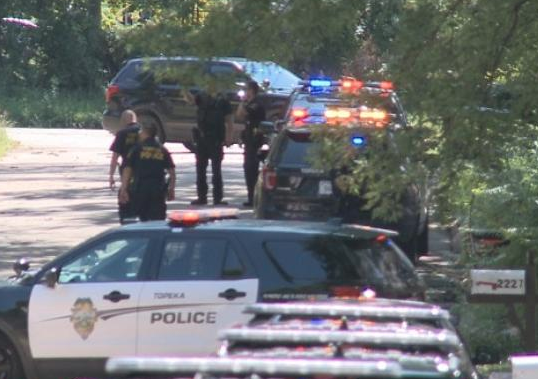
Police on the scene of the shooting investigation Saturday photo courtesy WIBW TV

Just before 1;30 p.m. Saturday, police responded to a call for service reporting an Aggravated Battery in the 2200 Block SE Ohio Street in Topeka, according to Lt. Jerry Monasmith. Upon arrival, officers found a
an 18-year-old victim identified as Ashley T. Usher of Topeka inside the residence suffering from what appeared to be a gunshot wound.

Officers were able to secure the scene, while first responders performed first aid.
EMS transported  her to a local hospital initially with what was thought to be non-life threating injuries.

She died at the hospital, according to Monasmith.

As a result of the investigation, police have arrested and booked one 17-year-old juvenile male was booked into the Shawnee County Juvenile Department of Corrections on charges of murder in the 2nd degree, criminal use of, a weapon and theft, according to Lt. Jennifer Cross.

USGS: Another strong earthquake shakes Reno County

RENO COUNTY — Another earthquake shook residents in south-central Kansas early Sunday. The quake at 3:45 a.m. measured a magnitude 4.1 and was centered approximately 3 miles west of South Hutchinson, according to the U.S. Geological Survey.

Location of Sunday’s Reno Co. quake -USGS image

This follows six quakes in Reno County over a 24-hour period including a 4.2 magnitude quake just before 8 a.m. Friday that was felt over much of the state and that caused some minor damage.

The other five quakes all were 3.1 or smaller, according to the U.S.GS.

Kidney stones, other health worries you didn’t know climate change would bring to Kansas


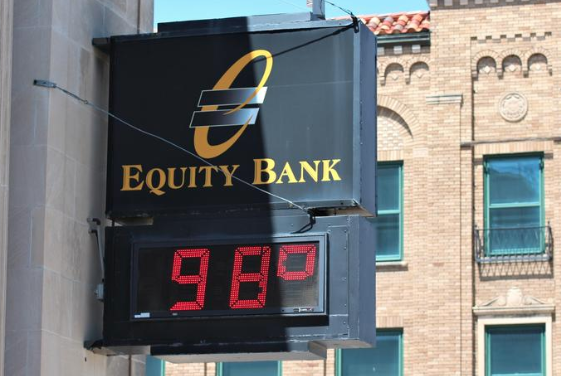
TOPEKA ― The “Kidney Stone Belt” is a thing, and it’s coming for Kansas.

A bank in downtown Topeka reflects recent high temperatures.
CELIA LLOPIS-JEPSEN / KANSAS NEWS SERVICE

Climate change is expanding that swath of America, currently in the south and southeast, that suffers much higher rates of this sometimes-excruciating renal complication.

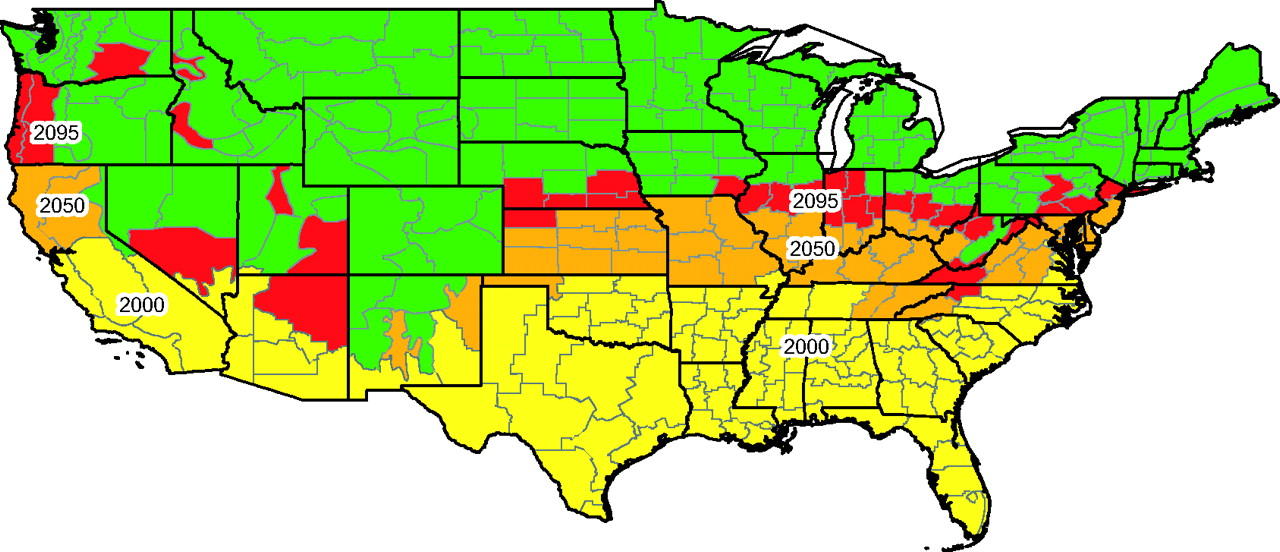
By 2050, the belt will include Kansas, according to a new review by the Kansas Health Institute.

The nonprofit, which along with the Kansas News Service receives funding from the Kansas Health Foundation, looked at the best science on how hotter temperatures and other changes will affect our bodies here in the Wheat State.

Here are some highlights.

Your kidneys

When temps rise, you sweat more and urinate less. That means more kidney stonesand chronic kidney damage.

A National Academy of Sciences paper predicted the kidney stone belt will envelop most of Kansas by 2050.
CREDIT NATIONAL ACADEMY OF SCIENCES BIT.LY/2MZLXRD

Already, the health institute says, research shows more kidney failures happen during heat waves. And Kansas risks seeing a lot more heat.

Though climate change will mean a drier western Kansas and a wetter eastern Kansas, scientists predict the whole state will get warmer. How much? Compared to the first 60 years of the 20th century, Kansas will grow anywhere from 2 to 14 degrees Fahrenheit warmer ⁠— and maybe more. (That range reflects the fact that policymakers may or may not take action to curb climate change, the report explains.)

Your heart

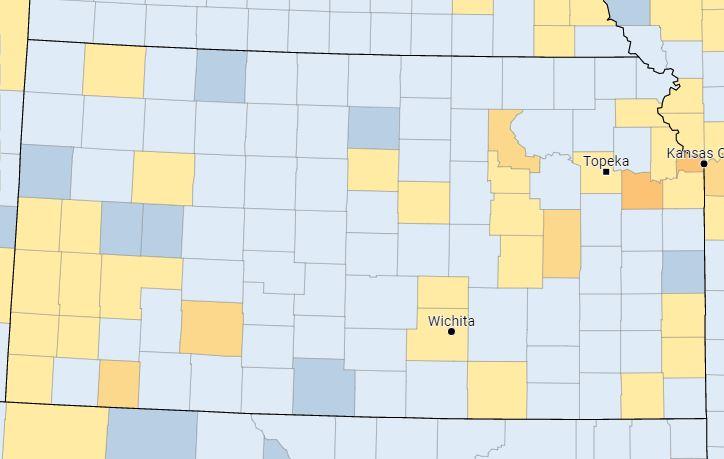
Most Kansas residents now believe in climate change, according to the Yale Program on Climate Change Communication, but only about half pin the blame on humans despite ample scientific evidence.

Regardless, people should expect more cardiovascular disease in the coming decades. As with so many other health conditions, more people land in the hospital with heart problems when summer heat is at its worst.

Rural Kansas residents are particularly skeptical (counties in shades of blue) that humans cause climate change.
CREDIT YALE 2018 CLIMATE OPINION MAPS. BIT.LY/2MZXSGE

Put irregular heartbeat and ischemic heart disease on the list of problems that may increase (the latter is when arteries narrow, reducing the flow of blood and oxygen to the heart and potentially causing heart attacks).

Your lungs

In the past few decades, the annual pollen season in the Heartland has lengthened 10 to 18 days.

But that’s not all that’s changing. Bigger daily doses of smog, carbon dioxide and other kinds of pollutants will take their toll on our respiratory systems and compound the effects. Pollution can exacerbate fungal spores and other sneeze-worthy things, especially for those already affected by things like asthma, KHI’s research brief notes.

Tiny airborne pollutants also get stuck in our lungs or make it into our bloodstream, the institute says, and science links that to wheezing, lung cancer, chronic obstructive pulmonary disease and shorter lives. A new study of several U.S. cities found today’s ozone levels already cause lung damage normally associated with heavy smokers.

The rest of your body

Milder winters bolster the ranks of mosquitoes and ticks out there, and longer summers give them more days to bite you.

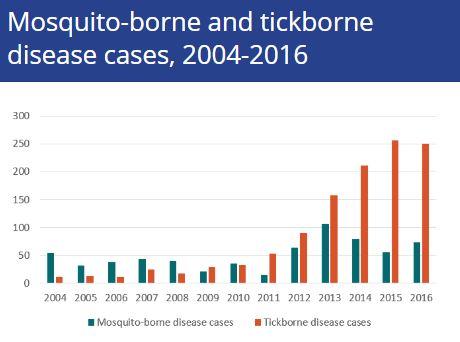
Compared to half a century ago, the season for mosquito-borne illnesses has lengthened 18 days in the state’s south and 13 in the north, the Kansas Health Institute says. From 2004 to 2016, the number of people getting sick from tick bites increased 20 times over.

Number of annual cases in Kansas of illnesses from mosquito and tick bites.
CREDIT THE CENTERS FOR DISEASE CONTROL. BIT.LY/2Z30K3Z

That’s annoying enough, but of course most important is what they spread ⁠— West Nile virus and Lyme disease, which can cause fatigue, fever, joint pain, spinal inflammation and more.

We can mitigate the risk of these diseases and other problems brought by global warming to some extent. But it’ll take work, and lots of it. This could range from greater public investments in mosquito control to better educating ourselves on the habits that help stave off kidney stones. (Hint: Cutting back on meat, eating at home more often, and downing loads of water.)

Who’ll have it worst?

People with physical disabilities or mental illness or living in cities. Infants. The elderly, especially those who have conditions like dementia. Workers who pave roads and toil on farms, and others constantly in the sun.

KHI says these groups of people are more vulnerable to heat stress and other health risks.

Because the U.S. already has glaring health disparities in poor neighborhoods and communities of color, the American Public Health Association says, they’ll be disproportionately affected by the changes, too.

Celia Llopis-Jepsen reports on consumer health and education for the Kansas News Service. You can follow her on Twitter @Celia_LJ or email her at celia (at) kcur (dot) org. The Kansas News Service is a collaboration of KCUR, Kansas Public Radio, KMUW and High Plains Public Radio focused on the health and well-being of Kansans, their communities and civic life.

2 Kansas men dead, 2 hospitalized after pickup rollover crash

JEFFERSON COUNTY — Two people died in an accident just before 10:30p.m. Saturday in Jefferson County.

The Kansas Highway Patrol reported a 2002 Chevy Silverado driven by John F. Lewis, 43, Ozawkie, was northbound on K237 four miles north of U.S. 24.

The driver failed to negotiate a curve. The pickup left the roadway to the west and rolled.

Passengers Christopher T. Webb, 46, Topeka, and Luke A. Puccinelli, 20, Oskaloosa, were pronounced dead at the scene and transported to Frontier Forensics.

Jefferson County EMS transported Lewis and passenger Gavin M. Lewis, 20, Nortonville, to Stormont Vail in Topeka. None of the occupants were wearing seat belts, according to the KHP.

Governor appoints two members to Humanities Kansas

OFFICE OF GOVERNOR

TOPEKA – Governor Laura Kelly appointed Brad Allen and Lisa Sisley to Humanities Kansas, which was formerly named the Kansas Humanities Council.

“The Humanities Kansas board is dedicated to ensuring that people across our state have access to programs to help enrich their communities,” Kelly said. “Brad and Lisa are passionate about generating new ideas and strengthening our democracy. They will be a wonderful addition to the team.”

Brad Allen, Lawrence, has worked as the executive director of the Lawrence Public Library for seven years. Previously, he worked as the branch manager and programming coordinator for the Everett Public Library in Everett, Wash. Allen received a master’s degree in Afro-American Studies from the University of Wisconsin-Madison, a Master of Science in library and information science from University of Illinois at Urbana-Champaign and a bachelor’s degree in American studies and psychology from the University of Kansas.

Lisa Sisley, Manhattan, has worked as the principal for New Boston Creative Group, LLC, for 13 years. Previously, she worked as a writer for the dean’s office at Kansas State University’s College of Human Ecology, and owned Lisa Sisley Writing Services. Sisley earned a bachelor’s degree in English literature from Kansas State University.

Humanities Kansas is an independent nonprofit group that works to strengthen civic life by pioneering programming, grants and partnerships to connect communities with history, traditions and ideas. Kansans can visit www.humanitieskansas.org to request a speaker, explore stories about our state, find a humanities-related event nearby and more.

The governor’s appointments to Humanities Kansas are not subject to Senate confirmation.

KU study: Gender roles shape public attitudes about transgender military service

(Photo by iStock)

KU NEWS SERVICE

LAWRENCE — Attitudes toward transgender people have become increasingly scrutinized during the last few years. But those attitudes intersect with actual policy most visibly in the military.

A new research study titled “Public Attitudes on Transgender Military Service: The Role of Gender,” published in the current issue of Armed Forces & Society, examines how cultural opinion affects the shifts in acceptance.

Don Haider-Markel

“It fundamentally shows the values of not only egalitarianism and traditionalism but also the role of sex and gender conformity in shaping these attitudes,” said Don Haider-Markel, professor and chair of political science at the University of Kansas.

Together with KU Associate Professor Patrick Miller, Haider-Markel seeks to establish a more concrete frame of reference for this subject, as well as surveying how it’s both similar and distinct from gay and lesbian concerns.

“Significant portions of the public — around 30 percent — still don’t have clear attitudes on transgender policy-related issues. That itself is important so we get some kind of baseline for analysis. Only in the past seven or eight years did we get the first real national polling data about transgender issues. To even develop some initial measures and predictors of those attitudes is still relatively unique,” said Haider-Markel, whose co-authors also include Daniel Lewis, Barry Tadlock, Andrew Flores and Jami Taylor.

Their initial research hypothesized that “personal experiences with the military and with transgender people, along with values, personality predispositions and religion, are likely to influence individual attitudes.” They tested this using data from a unique 2015 national survey of American adults. The results suggest interactions, opinions on gender roles and religiosity had the most substantial (albeit conditional) effects on viewpoints regarding transgender military service.

Haider-Markel became interested in exploring this topic when he came across an unusual statistic discovered by the Williams Institute at UCLA School of Law: Transgender individuals are more likely to have served or be serving in the U.S. military when compared to the general population.

“Ironically, as an institution, the military is seen as one where gender norms are pretty rigid,” he said. “So it may actually be attractive to some transgender people prior to fully coming out. At the time when people enlisted or went to officer training school, they were perhaps trying to rigidly conform to a gender they had already started to feel uncomfortable with, and they thought the military might help.”

A veteran of the Air Force, Haider-Markel served until 1993. He may not have knowingly served with anyone transgender, but he says that was a genuine possibility.

“When I was 18 and in tech school, I was surprised at the number of male soldiers who on the weekend would leave the base and wear makeup or do other forms of cross-dressing or gender-nonconforming kinds of things,” he said. “But even in the mid-to-late 1980s, that was a big surprise to me.”

This latest research builds on the work of a group that has earned the nickname “Team Kansas.” After producing nine articles on the topic, Haider-Markel’s team published its first book: “The Remarkable Rise of Transgender Rights” (University of Michigan Press, 2018).

“It’s probably the most efficient and effective research team I’ve ever worked with,” he said.

Having spent 22 years at KU, Haider-Markel’s work focuses on public policy and public opinion, with an emphasis on civil rights, criminal justice and counterterrorism.

Earlier this year, the Trump administration reinstated a near-total ban on transgender individuals serving in the military. This was supposedly based on the “tremendous medical costs and disruption” of allowing these troops to serve.

Will Trump’s ban be overturned?

“I don’t know if it will be the next president or if it will be before that,” Haider-Markel said. “But the pathway is difficult to change. We can see these temporary setbacks, but the movement itself is well-established. A march toward full civil rights for LGBT people is just a matter of time.”

Kan. man convicted of internet sex exploitation indicted on new charges

WICHITA, KAN. – A Kansas man was indicted Wednesday on charges that even though he already was a registered sex offender he produced and distributed child pornography, according to U.S. Attorney Stephen McAllister.

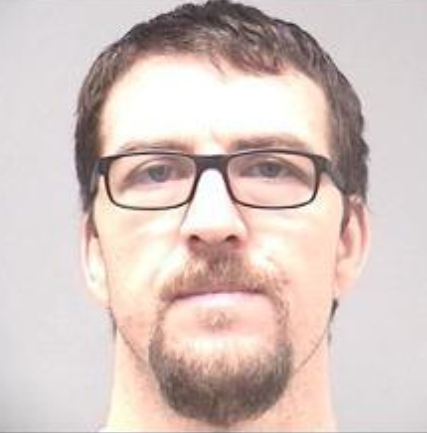
Merida is being held in Butler Co.

Daniel Eric Merida, 35, El Dorado, Kan., was charged in a superseding indictment with one count of producing child pornography, two counts of committing crimes against minors while registered as a sex offender, two counts of distributing child pornography, one count of possessing child pornography, one count of sending obscene material to a minor and one count of transporting child pornography. The crimes are alleged to have occurred at various times from 2014 to 2018 in Butler County, Kansas.

Upon conviction, the crimes carry the following penalties:

Producing child pornography: Not less than 25 years and not more than 50 years in federal prison and a fine up to $250,000.

Felonies involving minors while a registered sex offender: A term of 10 years, consecutive to sentences on other counts that include Distributing child pornography: Not less than five years and not more than 20 years and a fine up to $250,000.

Possessing child pornography: Not less than five years and not more than 20 years and a fine up to $250,000.

Sending obscene material to a minor: Up to 10 years and a fine up to $250,000.

Transporting child pornography: Not less than five years and not more than 20 years and a fine up to $250,000.

Kan. man air-lifted to hospital after near drowning at Table Rock Lake

STONE COUNTY — One person was seriously injured in an accident just after 11:30 a.m. Saturday at Table Rock Lake.

Image courtesy Missouri State Highway Patrol

The Missouri State Highway Patrol reported Gary D. Vernon, 51, Shawnee, was airlifted to Mercy Hospital in Springfield after a he was found face down in the water two miles southeast of Kimberling City.

Authorities released no additional details Saturday afternoon.

83-year-old killed Kan. man in front of victim’s 8-year-old son

SHAWNEE COUNTY— A Kansas man was convicted Friday of fatally shooting the buyer of his Topeka home because he felt too much was being asked of him before he moved out, according to Shawnee County District Attorney Mike Kagay.

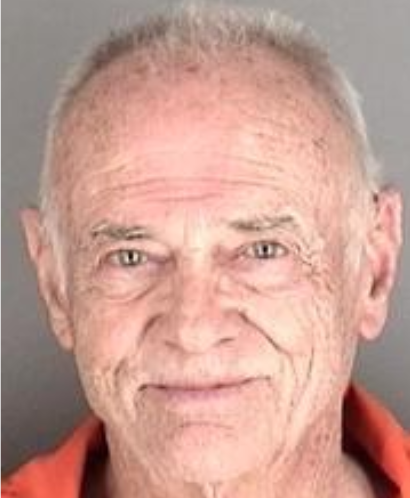
Darcy-photo Shawnee Co.

Jurors found Anthony Darcy guilty Friday of second-degree murder and assault in the death of 36-year-old Stephen Matthew Snyder. He also was convicted of child endangerment because the killing happened in front of Snyder’s 8-year-old son, according to Kagay.

Prosecutors allege Snyder was shot three times in May 2017 when he went to the house he was buying from Darcy to measure a room for carpet. Snyder had closed on the house but allowed Darcy to live in it for two weeks before moving out.

The defense argued that Darcy acted in self-defense. His sentencing is set for Nov. 8.

-The AP contributed to this report.

Arts in Medicine now accepting applications

KCAIC

TOPEKA  – Arts in Medicine, a partnership between the Kansas Creative Arts Industries Commission (KCAIC) and Emporia State University (ESU), is accepting applications from associations, agencies and organizations that provide medical services to Kansans.

If accepted, art therapy faculty and two second-year graduate art therapy students from Emporia State University will work with the applicant agency to build a medical arts program and schedule that meets the needs of specified populations.

Applicants should be interested in offering patients, clients, or staff art therapy services such as, but not limited to:

  • Group art therapy programming designed to meet the psycho-social needs of patients, care givers or medical personnel
  • Individual art therapy for patients receiving treatment (i.e. cancer treatments or transfusions)
  • Art-based workshops for medical personnel or clinicians in training (stress relief, group bonding, etc.)
  • Arts-based programs at special events (grief camps, open houses, etc.)

Applicants must be Kansas-based institutions, organizations or associations that provide medical services to Kansas residents. Applications are welcome from agencies that serve all age and developmental levels. Art experience and art skills are not necessary.

Applications are due by Sept. 6, 2019. Applications will be reviewed and evaluated by a panel including members of KCAIC, ESU and art therapy professionals.

To submit an application, visit https://kansascaic.submittable.com.

Police: Man shot, run over in Kansas bar parking lot

SHAWNEE COUNTY — Law enforcement authorities are investigating a violent attack early Saturday.

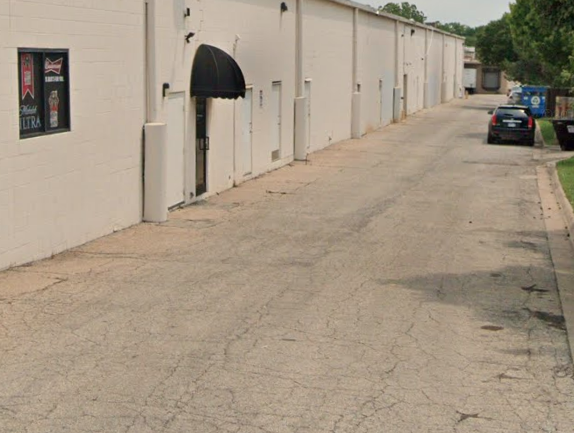
Google image

Just after 2a.m. Saturday, police were called to 5331 SW 22nd Place, Lazy Toad Bar in Topeka for a report of a shooting, according to Lt. Aaron Jones.

Officers located one victim suffering from serious but non-life threatening wounds in the parking lot.  The victim had been shot at least once as well as run over by the suspect vehicle. 

Police have not reported an arrest and have not released the victim’s name.


Kansas couple sue to keep son from being vaccinated

STILWELL, Kan. (AP) — A suburban Kansas City, Kansas, lawyer and his wife are suing to try to keep from having to vaccinate their 4-year-old son.

It is the second time Linus and Terri Baker, of Stilwell, have sued over the issue. They sued the Kansas Department of Children and Families after the agency in 2017 said it would vaccinate the boy against their wishes. That never happened, even though a judge dismissed the suit.

The Bakers say they are worried vaccines could affect the health of the boy, who was born with a heart condition that has since been corrected with surgery.

They are now suing the Blue Valley school district and various state officials, seeking an injunction to allow the boy to attend school without being vaccinated and without filing religious or medical exemptions. They’re also asking a judge to declare Kansas’ vaccination requirements unconstitutional.

The school district and health agency declined to comment to the newspaper.

Copyright Eagle Radio | FCC Public Files | EEO Public File