MARION COUNTY – A Kansas man was injured in an accident just before 9a.m. on Wednesday in Marion County.
The Kansas Highway Patrol reported a 1989 Toyota Tacoma driven by Twayne A. Cutsinger, 45, White City, was northbound on U.S. 77 one mile south of Lost Springs.
The driver lost control of the vehicle. It entered the west ditch and overturned.
Cutsinger was transported to St. Francis Medical Center in Wichita.
He was not wearing a seat belt, according to the KHP.
TOPEKA — Doctors providing abortions in Kansas might be required to provide women with more information about their medical background
. SB 98 adds new provisions to the Women’s Right to Know Act, which currently requires physicians to give women written information about their fetus and abortion method, among other information.
Currently, the name of the physician is the only information about the doctor that must be provided by clinics. The bill would require some information already available from the Kansas State Board of Healing Arts be added to abortion procedures.
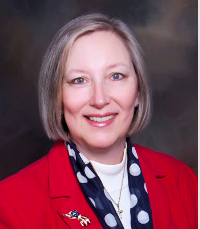
Senator Molly Baumgardner
SB98 would also require information about the provider’s clinical privileges at other hospitals, and show whether the provider resides in Kansas. The bill specified all additions to be written in black 12-point Times New Roman font in clinic paperwork.
Proponents of the bill included the Family Policy Alliance of Kansas, Kansans for Life, Sen. Molly Baumgardner (R-Louisburg), and two feminine health care providers. They testified Tuesday to the Senate Federal and State Affairs Committee.
Baumgardner said women don’t have direct access to information about their abortion provider from clinics, which is why she said she supports the bill.
Kansans for Life Legislative Director Kathy Ostrowski said opponents to the bill have no real reason to oppose it.
“[The proposed addition is] not harassment, it’s not a stigma, it’s not an undue burden and it’s eminently rational,” she said. . .“They just don’t want us invading their territory.”
Sen. Oletha Faust-Goudeau (D-Wichita), ranking minority leader of the committee, questioned the requirements of the bill, and made a similar comment about territory, citing her 13 years of experience in the state legislature.
“So this is kind of the nature of the beast. [Abortion] will come up over and over and over,” Faust-Goudeau said. “Again, it’s all about control.”
The bill could face potential legal issues. Trust Women Foundation Attorney Robert Eye opposed the bill, saying the Supreme Court had already ruled similar provisions unconstitutional in 2016 on a Texas case, Texas v. Hellerstedt.
The Court ruled that abortion legislation introducing any restrictions or requirements without a medical basis are unconstitutional. He said the addition could be legal if the proponents of the bill could point to a health benefit provided from the additions.
“The burden is on them, those who are supporting more restrictions, more red tape,” Eye said.
Faust-Goudeau said she wanted what is in the best interest of women who want and need abortions.
“And then I want us to do what’s legally fair and respectful to physicians that would be required to provide this information to a woman,” Faust-Goudeau said.
Currently, no medical providers in any specialty are required to disclose the information being discussed in SB98.
Planned Parenthood, the American Civil Liberties Union of Kansas and two feminine health care providers from Kansas also opposed the bill.
No action was taken on the bill.
Deanna Ambrose is a senior journalism major at the University of Kansas from Frankfort.
SALINE COUNTY- Law enforcement authorities in Saline County are investigating a suspect for attempted auto theft after two car dealerships joined forces to stop him.
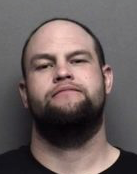
Just before 12:30 p.m. on Tuesday, Calvin Hinz, 33, began prowling around the Long McArthur Automobile lot in the 3500 block of South Ninth Street in Salina, according to Salina Police Sergeant Jim Feldman.
Hinz was looking into cars and asking for keys. Long McArthur employees warned neighboring Marshall Motor Company of the suspicious man.
Hinz then walked to the service Bay at nearby Marshall Motors service bay and allegedly attempted to steal a 2015 Jeep Cherokee.
Dealership employees boxed Hinz in with other vehicles and waited for police to arrive.
Hinz was taken to the Saline County jail where he faces multiple charges, including theft and driving while suspended
SEDGWICK COUNTY -The police officer hit by a stolen SUV driven by a fleeing suspect remains in critical condition at a Wichita Hospital, according to Deputy Police Chief Troy Livingston during the online media briefing Wednesday morning.
“He is doing a lot better than he was on Tuesday,” said Livingston. “He has a lot of injuries to overcome but his family is with him. We are not releasing his name.”
The family and Wichita Police thanked the public for their show of support during the difficult time.
Police spokeswoman Nikki Woodrow says officers were monitoring a house in south Wichita Tuesday where a stolen vehicle was seen and a known suspect with various felony warrants was located.
She says a suspect fleeing the house ran over one of the officers with a vehicle. Another officer fired one round.
Deputy Chief Jose Salcido says the shot did not hit either the suspect or vehicle.
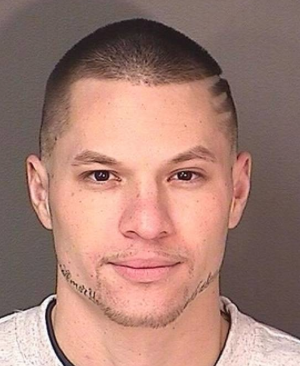
Police gave chase for several blocks, and the suspect ran into a business. Justin Terrazas, 31, was taken into custody by an officer and his canine partner.
PAWNEE COUNTY – Law enforcement authorities in Pawnee County are investigating a suspect on drug charges.
On Monday, officers from the Pawnee County Sheriff’s Office executed a search warrant in at a residence in rural Pawnee County. Officers received information of a possible indoor marijuana grow in the basement of the home, according to a social media report.
Officers found the marijuana grow was recently disassembled prior to their arrival.
They were able to collect enough evidence to arrest the 62-year-old male homeowner for felony cultivation of marijuana, felony possession of drug paraphernalia with intent to cultivate, and possession of misdemeanor drug paraphernalia.
The suspect was transported to the Pawnee County Sheriff’s Office and booked into jail on a $75,000 bond.
The suspect’s name has not been released during the investigation.
CLOUD COUNTY – Six children were injured in a school bus accident just after 9p.m. Monday in Cloud County.
The UDS 344 Southern Cloud School District bus driven by Nancy Brayton, 75, Beloit, was traveling in dense fog at 90th near Acorn Road, according to Cloud County Sheriff Brian Marks.
The bus was returning from an all-day band trip to Lincoln. It slid off the road and traveled over an embankment.
Three of the children were transported to the Cloud County Health Center.
Three others were treated at the scene for minor injuries. Brayton was not injured.
HARVEY COUNTY – Law enforcement authorities in Harvey County are investigating a suspect for DUI and driving a stolen vehicle after a crash early Wednesday.
Just before 1a.m., a speeding Pontiac Grand Prix traveling at a high rate of speed passed an officer on patrol just north of Interstate 135 and East First Street in Newton, according to police chief Eric Murphy.
The officer attempted to stop the vehicle. The driver stopped at a train crossing, made a u-turn and took off. The officer attempted a pursuit but was not able to keep up.
A few moments later, a 911 call indicated a vehicle hit a curb, trees and rolled into an apartment unit in Newton, according to Murphy.
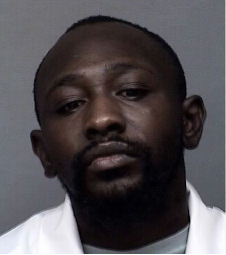
The driver, identified as Lee Andrew Cummings, 34, Wichita, was found walking nearby.
He was transported to Newton Medical Center for treatment and later booked into jail for charges including DUI, reckless driving, Felony Flee and Elude and Felony possession of stolen property.
Officers determined the vehicle had been stolen on Tuesday night in Wichita, according to Murphy.
Cummings has previous convictions for Theft, Criminal Damage, Burglary and Robbery in Sedgwick County, according to the Kansas Department of Corrections.
John Richard Schrock is a professor at Emporia State University.Current House Bill 2171 defines “sex” as “the physical condition of being male or female, which is determined by a person’s chromosomes, and is identified at birth by a person’s anatomy” as if this is always the case. In the case of transgender children, this is not the case. This bill’s wording reveals major biological ignorance and discrimination against a handicap.
Usually, but not always, XY chromosomes produce a boy and XX produces a girl. However, a relatively high rate of babies are born XO: one X chromosome and no second X or a Y. This is called Turner syndrome. I have had at least six Turner syndrome students in my classrooms during my teaching career that I know of. Additional cases when chromosomes fail to separate normally produce individuals who are XXX, XXY, XYY, and XXXY, etc.
The bill states that sex is identified at birth. Not always. If a couple do not already know the sex of their child, the first announcement they await is “it’s a boy” or “it’s a girl”! But sometimes the delivering physician has to say “I’ll get back to you on that” when the genital anatomy is ambiguous and not clearly either male or female. There are many causes for when the body does not follow normal development. Today, science understands most of them.
In the case of androgen insensitivity, a baby “girl” appears to have the external and internal anatomy of a girl, until they biopsy the gonadal tissues and discover internal testes! Testes produce testosterone that flows through the bloodstream and body tissues respond to the testosterone by developing male tissues. But in this case, the child’s cells lack the receptors and ignore the testosterone. The child has XY chromosomes and testes but the child’s body develops female.
Altogether there are five major factors that must align for normal sexual development: chromosomes, anatomy, hormones and brain development for gender and for sexual ideation. Most of us are very lucky to develop with all five of these in agreement. We inherit XY, have male anatomy, produce testosterone, feel comfortable in a more-or-less masculine role, and are sexually attracted to females after puberty. Or we inherit XX chromosomes, have female anatomy, produce estrogens (there are several), feel comfortable in a more-or-less feminine role, and are sexually attracted to females.
But some children are not as fortunate, and their chromosomes, anatomy, hormones, and brain development do not align. This is not uncommon. Taken in total, some form of sexual ambiguity is more common than all cases of Down syndrome and cystic fibrosis combined.
Forget the rest of the LGB alphabet. This is not about “gay rights.” The only group that is targeted by this legislation is transgender children. Usually by age 6, a child’s brain develops a “feeling” of being either masculine or feminine. It is not learned. And at this age, it has nothing to do with sexual attraction.
For most of us, our feeling of being male or female will align with our anatomy. But for transgender children, this feeling of being masculine or feminine does not align with their birth anatomy. This is biological. It is not a choice. They will not decide to be a boy one day and a girl the next. These children will usually be facing hormone treatments and a series of reconstructive surgeries. But due to widespread ignorance among outside adults, some Kansas transgender children stay at home, homeschooled because of the discomfort they feel at school by the very same attitudes demonstrated in HB2171.
Masculinity or femininity is not something you learn or can change; it develops during the last trimester before birth. Dr. Dick Swaab’s research team in the Netherlands was the first to clearly locate this brain difference over a decade ago.
This is a handicap, and HB2171 reflects an ignorance, indeed a cruel attitude toward those children whose brain development for gender identity does not match their birth anatomy.
NEWTON, Kan. (AP) — The preliminary hearing has been rescheduled for one of two people accused of killing three people before fleeing to Mexico.
The Harvey County attorney said in a news release that the hearing for 31-year-old Myrta Rangel has been moved to April 6.
The purpose of the hearing is to determine whether there is evidence for Rangel to be tried on one count of capital murder and three counts of first-degree murder in the deaths of 33-year-old Travis Street, 37-year-old Angela May Graevs and 52-year-old Richard Prouty. Thirty-five-year-old Jereme Nelson faces identical charges.
The victims’ bodies were found in October outside a rural home near Moundridge. An 18-month-old child was found unharmed.
Nelson and Rangel were extradited last month to Kansas.
RENO COUNTY – Two people remain jailed after their arrest on Monday on drug related charges.
Just after 10 a.m. Monday, police were called for a suspicious vehicle at a fast-food restaurant, 20 East 4th Avenue in Hutchinson, according to testimony in Reno County court.
Officers reported smelling marijuana which led to the search of the vehicle where they found drugs including four plastic bags of suspected methamphetamine and a scale.
Police arrested Heather Payne, 34, rural Hutchinson for possession of meth with intent to sell, possession of paraphernalia with intent to sell, personal use drug paraphernalia and no tax stamp.
They also arrested 46-year-old Terry E. Goodwin of Wichita. He faces charges including possession of stimulants, possession of depressants, possession of marijuana and drug paraphernalia.
In court, Payne who is on probation in another case was denied any bond reduction because it was a distribution case.
Goodwin’s bond was set at $2,500. He has previous convictions for drugs and theft in McPherson, Reno and Sedgwick Counties.
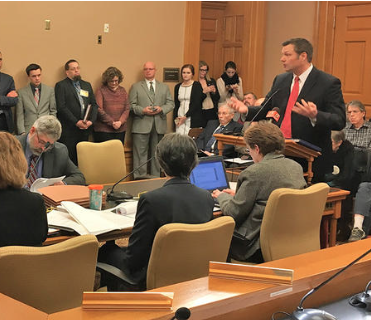
Kansas Secretary of State Kris Kobach responds to a question from Sen. Randall Hardy, left, during Tuesday’s hearing on voter registration requirements. ANDY MARSO / KANSAS NEWS SERVICE
Kansas Secretary of State Kris Kobach says his office has the names of 115 non-citizens who illegally registered or tried to register to vote in Kansas, but he won’t be able to prosecute many of them.
Kobach is the only secretary of state in the country who is authorized to prosecute voter fraud. He has cited non-citizen voting to support his push for laws that require Kansans to produce U.S. citizenship documents like passports and birth certificates to register. But so far the cases his office has taken on have been against lawful citizens who Kobach said illegally voted in multiple states.
On Tuesday Kobach told the Kansas Senate Ethics and Elections Committee about the 115 non-citizen registrants. In an interview after the committee meeting, Kobach said he wouldn’t be able to prosecute most of them because they registered more than 10 years ago.
“Now if they subsequently voted within the last five years, then that is a prosecutable crime,” Kobach said. “But the problem is the statute of limitations.”
Kobach said he’s considering prosecuting one of the more recent registrations.
He was at the committee meeting to promote Senate Bill 37. The legislation would allow his office to set up a two-tiered voting system that prohibits Kansans from voting in state and local races if they have signed an affidavit swearing to their citizenship but have not produced the required documents.
Kobach had set up such a system after a federal court blocked the proof-of-citizenship requirements from being imposed on voters who register when they get their driver’s licenses. That system has since been blocked by a judge who said state law did not give him the authority to do that.
On Tuesday Kobach told legislators that the list of 115 was compiled largely by cross-referencing a list of temporary driver’s license holders who are in the state legally but are not U.S. citizens.
That accounted for 80 of the 115 names. Almost all the rest came from Sedgwick County Election Commissioner Tabitha Lehman, a Kobach appointee. Lehman said she and her staff have been regularly attending naturalization ceremonies to help new citizens register and found 32 were already registered.
A spokeswoman for Kobach’s office said the other three on the list were non-citizen residents of Finney County, Barton County and Johnson County who attempted to register but were stopped by the proof-of-citizenship requirements.
Opponents of the requirements said they want more proof of the 115 cases he cited and said some could have been mistakenly registered by state workers at the Division of Vehicles.
“I have no reason to believe that list is legitimate,” said Davis Hammet, the president of a Topeka nonprofit named Loud Light that aims to boost voter turnout.
Other opponents like the American Civil Liberties Union and League of Women Voters said the list cited by Kobach pales in comparison to the 17,500 Kansans who had their registrations suspended by the proof-of-citizenship requirements before courts intervened last year.
An unknown number of Kansans who registered at the Division of Vehicles also continued to get receipts saying they could not vote in state or local elections through the October registration deadline for the general elections.
Doug Bonney, the lawyer who has handled the ACLU’s multiple legal challenges against Kobach, told legislators that changing state law by passing SB37 would not end those court fights.
“Our cases do include constitutional challenges to the law,” Bonney said.
Andy Marso is a reporter for kcur.org‘s Kansas News Service, a collaboration of KCUR, Kansas Public Radio and KMUW covering health, education and politics in Kansas. You can reach him on Twitter @andymarso.
OMAHA-A man has been convicted of selling the same farm tractor to three different people, even though a bank in Kansas held a lien on the tractor, according to US Attorney for Nebraska Deborah R. Gilg.
Benedict T. Palen, Jr., 63, Denver, waived indictment February 4, and entered a guilty plea to a one count information which charged him with mail fraud.
Sentencing has been set for May 5, 2017. Under the statute, Palen is subject to a maximum punishment of up to twenty years of imprisonment, a $250,000 fine, and a term of supervised release of up to three years.
According to documents filed in the case, in September of 2012, Palen, acting through his company, Great Plains Farms, sold a John Deere tractor to an individual in Holdrege, Nebraska for $45,000 representing it to be free and clear of liens. A $20,000 check was mailed to Palen as a down payment. On the same date, Palen sold the same tractor to an individual in South Dakota. Further investigation revealed that not only was there a lien against the tractor held by a bank in Kansas, but the same tractor had actually been sold in 2011 by the defendant, as vice-president of Pull Pans, Inc., to a company in Florida.
When Palen had not delivered the tractor to the Holdrege buyer by April of 2013, Palen claimed there was a discrepancy in the number of hours on the tractor and modified the agreement to provide for delivery of a different John Deere tractor thereby causing the buyer to mail a $25,000 check to Palen for the remaining amount due.
However, this alternate tractor had also been sold in 2011 by the defendant, as vice-president of Pull Pans, Inc., to the Florida company.
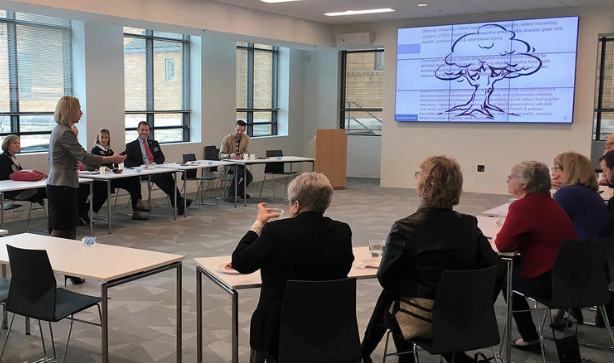
Legislators in the Healthy Kansans Caucus hear a presentation on social determinants of health from Tatiana Lin of the Kansas Health Institute in Topeka. ANDY MARSO / KANSAS NEWS SERVICE
Kansas legislators concerned about health issues are doing something unusual in politics these days: getting bipartisan.
Veteran legislators from both parties who lead the House and Senate health committees have formed the Healthy Kansans Caucus.
The first meeting attracted about a dozen lawmakers Friday to a conference room at the Kansas Health Institute in Topeka.
Many of them were elected for the first time in November. One of the freshmen, Rep. Tom Cox, said the new crop of legislators are more interested in problem-solving than partisan wrangling.
“People are up here interested in learning more about what the problems are and figuring out what the solutions are and less focused on ‘How do I push my specific ideology? How do I force the solution to match my ideology?’” said Cox, a Republican from Shawnee. “Instead they’re focused on ‘How do we find the right solution for the state of Kansas?’ And I think this was a great example of the stuff we’ll be seeing coming this legislative session.”
The group’s first meeting included a presentation by Tatiana Lin, senior policy analyst at the health institute, about social determinants of health — the many factors that affect a person’s well-being.
It spurred discussion about balancing the need for people to take personal responsibility for their health through diet and exercise choices with government’s role in making that easier through services like public transportation.
Cox told the rest of the caucus about losing 15 pounds while living in Hungary for a few months because he walked everywhere. He said when he returned to the United States he quickly regained all the weight, even though he was generally eating healthier.
“You don’t realize how sedentary you become so quickly (in the U.S.),” Cox said.
The group plans to meet every two weeks during the legislative session. Future topics include county health rankings, early childhood trauma and data-informed health policy decisions.
Cox said the policymakers who show up aren’t going to agree on everything, especially when it comes time to make laws. There will be divisions even within the two parties, he said, but they won’t be as crippling to debate as in recent years.
“At the end of the day I think people are going to talk about it,” Cox said. “I think those conversations are really going to happen this time.”
Andy Marso is a reporter for kcur.org‘s Kansas News Service, a collaboration of KCUR, Kansas Public Radio and KMUW covering health, education and politics in Kansas. You can reach him on Twitter @andymarso.
 MARION COUNTY – A Kansas man was injured in an accident just before 9a.m. on Wednesday in Marion County.