TOPEKA – Governor Laura Kelly has proclaimed June as Great Outdoors Month in Kansas. The Kansas Department of Wildlife, Parks and Tourism joins the governor in reminding residents and visitors that Kansas has an abundance of opportunities to enjoy the great outdoors and appreciate the many natural splendors of our state.
“I urge everyone to join me and visit our wonderful state and local parks, trails and national sites,” Kelly said. “All of Kansas is waiting for you. So, get outside and make outdoor activities a regular part of your life in the Sunflower State.”
Enjoying the Kansas outdoors contributes to our quality of life; promotes physical and mental health, fitness, and environmental awareness; and is an ideal way to exercise and enjoy memorable experiences with family and friends. Also, many of our important cultural and historic events and traditions are linked to places in Kansas which are parts of national, state and local park systems.
Outdoor recreation has a significant economic impact in Kansas. It is growing nationally, generating $887 billion in consumer spending. And in Kansas, it generates an estimated $7.3 billion in consumer spending and supports 71,000 direct jobs.
Great Outdoors Month connects all of Kansans to the outdoors, and especially children, through diverse events such as National Trails Day (June 1), National Fishing and Boating Week (June 1-9), National Get Outdoors Day (June 8), the Great American Campout (June 22) and National Marina Days (June 8), Kids to Parks Day (held May 18), Great Outdoors Day of Service (June 14) and more.
To plan your outdoor activities, visit KSOutdoors.com and TravelKS.com where you’ll find a wealth of ideas, tools and information to get in the great outdoors.
“Disgust is an emotion that’s not about vision. It’s about touch, the fear of contact,” said Christopher Forth, a University of Kansas professor of history and Dean’s Professor of Humanities.
“If it’s not about aesthetics, why does fat provoke this sense of, ‘I can be contaminated by this?’”
That’s one of the questions addressed in Forth’s upcoming work, “Fat: A Cultural History of the Stuff of Life” (Reaktion Books, 2019). The publication has already garnered national interest after The Atlantic published a 2,000-word excerpt in May taken from the chapter “Grease and Grace: The Disenchantment of Fat?”
It included Forth’s anecdote involving an 18th-century Italian countess named Cornelia di Bandi who suddenly burst into flames.
He wrote, “Only her arms and legs remained intact. After examining what was left of her body, a local physician concluded, in a report cited years later, that the conflagration ‘was caused in her entrails’ by the variety of combustible materials to be found there, including alcohol and fat, ‘an oily liquid … of an easily combustible nature.’”
Forth said, “I have two favorite chapters, and they’re both gross.”
In addition to the aforementioned “Grease and Grace,” he favors one titled “The Fat of the Land” because of his fascination with its agricultural context.
“I had heard the phrase ‘living off the fat of the land,’ which I thought was a metaphor. It’s not. That phrase means the soil is literally sticky, unctuous, swelling. When people used to call soil fat, they meant it,” he said.
Overall, the professor describes the book as “a dramatic reinterpretation of fat and the reasons for the stereotypes about it.”
Forth spent 11 years researching and writing “Fat.” He traveled to Australia, the U.K. and many regions of the U.S. while investigating the subject.
The 352-page book delves into the history of fat, tracing the cultural, philosophical, religious and even racial connections. What once was considered healthy and desirable slowly morphed into the modern perception. He said this attitude can first be attributed to the Greeks, who originally celebrated then began to distrust less-than-Adonis-like physiques.
But the tipping point came in the late 18th century.
“Fat became a kind of pollutant that had to be excreted in order to purify the body,” Forth said.
“You start to see fat observed in non-Western peoples — particularly Africa, India and China — and this becomes a problem of not just connecting it with dirt but of nonwhiteness. It was unseemly, filthy and uncivilized.”
Forth asserts contemporary reactions by the medical community reinforced this negative outlook.
“Physicians will try to address the symptoms being manifested with immediate reference to a person’s weight — the idea that losing weight will fix this or that problem, which it won’t. The weight in many cases is incidental to the actual problem. So the health care industry is caught up in their own sense of disgust and misunderstanding about those who are overweight,” he said.
As someone who tries to avoid using the word “obesity” because of its pejorative connotation, Forth said individuals can simply look at the political news of the day to see how conflicted Americans are when it comes to the concept of fat.
Take President Donald Trump, for instance.
“You have a lot of people who very rightly condemned him for his overt, nasty fat-shaming. But after the election, it was common to call out Trump on his own fat, but also to attribute fatness to his supporters — then go the extra mile and suggest fat is connected to foolishness or stupidity. Then they connect that to the image of domesticated animals who follow and do what they’re told,” Forth said.
“So the fat-shaming of women that many Hillary Clinton supporters rightly condemned, they seem very happy to fat-shame on different grounds when it seems OK.”
This is the fourth book written solely by Forth, who’s been at KU since 2007. Past work includes “Zarathustra in Paris: The Nietzsche Vogue in France, 1891-1918,” “The Dreyfus Affair and the Crisis of French Manhood” and “Masculinity in the Modern West: Gender, Civilization and the Body.”
Forth considers his expertise to be the history of the body, including sexuality, senses and emotions.
As for the ultimate influence of “Fat: A Cultural History of the Stuff of Life,” Forth said, “I’d like it to expand the ways we think about how and why fat stereotyping works.”
SALT LAKE CITY, UT – While June marks the end of school, it’s also Internet Safety Month, which is a good time to remind parents, caregivers, educators and youth service providers about the top safety threats facing children, how to protect them, and what to do if they become a victim.
Kansas has some of the most supportive laws in the country when it comes to protecting kids online, but it’s important that both adults and children are aware of the latest cyber threats so they can avoid them.
Top Online Threats for Kids
There are a number of potential dangers in cyberspace, but these are the top three online security risks that most kids face.
1. Cyberbullying: Almost 34% of kids age 12–17 have been cyberbullied at some point in their life, and 11.5% have bullied someone else online. Cyberbullying is any aggressive, threatening, or mean-spirited activity conducted via electronic communication (email, social media posts, text messages, etc.). Girls are more likely to be the victims of cyberbullying, and more boys admit to bullying others online.¹
2. Online predators: Adults who use the internet to entice children for sexual or other types of abusive exploitation are considered online predators. Child victims can be as young as 1 or as old as 17. When it comes to online enticement, girls make up the majority (78%) of child victims—while the majority (82%) of online predators are male. And 98% of online predators have never met their child targets in real life.²
3. Exposure to inappropriate content: Inappropriate content is one of the most common online threats that kids encounter. Everything from vulgar language and hate speech to graphically violent or sexual images can have a harmful effect on an impressionable child. Over 55% of tweens (kids age 10–12) have been exposed to violent content on the internet, and nearly 60% have come across sexually explicit words or images.³
NOTE: For the purposes of this guide, we’re focusing on the earliest prevention possible. While these internet safety tips for kids and parents can be applicable to anyone, we’ve selected steps to help protect children from ages 5 through 12.
How to Protect Your Kids from Cyberbullying
1. Know the risks: Understand what cyberbullying is, where and how it happens, and how to spot it. Explain that online bullies can act friendly at first, but also encourage your child to be on the lookout for any interactions that make them feel bad, scared, or sad.
2. Talk about it: Have ongoing discussions with your child. Talk about what cyberbullying is and what types of communication are acceptable and unacceptable. Make sure your child knows that it’s safe for them to talk to you if something makes them uncomfortable.
3. Keep a watchful eye: Place the computer in a common room and monitor all screen time. Use a shared email account, and if you let kids interact on social media, make sure you have full access to manage their accounts. Parental control software is another great way to stay in the know.
4. Set boundaries: Put time limits on screen time. Include all online activities—from homework to playing games and surfing the web. Restrict social media access and email accounts, and set rules for any IM, texting, etc. Let your kids know you’ll be checking in regularly.
5. Build a network (IRL): They don’t say it takes a village for nothing. The more people you have looking out for your kid online, the more likely you are to keep them safe. Know your kids’ friends and their parents. Enlist support from school, sports, and church leaders.
6. Be prepared to respond: Don’t wait until the heat of the moment to come up with your gameplan. In case your kid does get bullied online, learn what the proper responses are so you can keep your emotions in check and help your child deal with what they’re going through.
Steps to Take If Your Child Has Been Bullied
Pay attention: Look for signs of cyberbullying, like spending more time online or texting, hiding the screen from others, emotional responses to online interactions, and sadness or seclusion.
Ask questions: Gently ask your child what’s going on and how they feel about it. Find out if they’ve responded to the bully and what that response was.
Acknowledge their feelings: Your child may feel frightened, angry, sad, or even betrayed if the bully is someone they trusted. Let them know it’s okay to feel whatever they’re feeling.
Block the bully: Immediately block (or “unfriend”) the abuser. Use tools like site blockers and privacy settings as extra layers of protection.
Report it: Alert website and email administrators to the bully. Most social media platforms offer options to report a user or flag dangerous posts. If appropriate, report the abusive activity to school or law enforcement officials.
Assess the damage: If your child’s emotional response is extreme and protective measures don’t seem to help, seek the help of a professional.
Enlist reinforcements: Talk to other adults who can help protect your child (other parents, teachers, school administrators, coaches, etc.) and bolster your child’s positive friendships.
What to Do If Your Child Is the Bully
Look: If your child sets up new email or social media accounts without your knowledge, makes snarky remarks while online, or starts to hide their online activity, they could be picking on someone.
Listen: If you’re concerned, gently broach the topic with your child and then allow them the room to answer. Be open-minded and don’t blame. Bullies are usually in some kind of pain as well.
Monitor: Double your efforts to track your child’s online activity. If you’re not already using parental control software, now is the time to start using it.
Support: Encourage your child to deal with their feelings and the reasons they’re engaging in this behavior. Suggest that they apologize to the kids they’ve hurt, and help them do it.
Get help: It can be hard to identify why your child starting acting out in this manner. Seek professional help, and if the bullying crosses lines at school (or legally), inform the appropriate authorities and ask for resources to address the situation.
How to Protect Your Kids from Online Predators
1. Understand the danger: Learn what online predators are, where and how predators attack, and how to spot it. Explain that contact from strangers is never okay.
2. Guide online behaviors: Talk about what types of online interactions are okay and what aren’t. Discuss how to recognize signs of trouble and how to ask for help.
3. Rein in digital cameras: Control access to digital cameras and photo apps on every device. Make sure your kids can’t upload or download photos without your permission.
4. Monitor online activity: Keep the computer in a common room, set limits on screen time, use a shared email account, and put parental controls (like filters and apps) in place.
5. Keep kids out of dangerous places: Talk about the risks of chat rooms and social networks, and set up rules and time limits if you allow your kids to use them. Always follow age restrictions for websites and apps.
6. Don’t let your guard down: Know that “safe” places still require vigilance. There are kid-focused chat rooms and games where predators may pose as children.
Steps to Take If Your Child Has Been Targeted Online
Let your child know it’s not their fault.
Cut off communication with the predator.
Change online credentials, including screen names, usernames, and passwords.
Save screenshots or copies of messages and images from the predator.
Report the activity to website administrators and law enforcement.
Seek professional help for your child as appropriate.
Safety Tips for Kids
Never share personal information online.
Don’t respond to emails, texts, or messages from strangers.
Don’t post or share photos online.
Don’t click links, open attachments, or accept gifts from someone you don’t know.
Never agree to meet someone you met online.
Let your parents or another trusted adult know if you need help.
How to Protect Your Kids from Inappropriate Online Content
1. Teach kids how to navigate the internet: Talk about proper online etiquette, how to enter safe search terms, how to identify a secure website (https), and when to ask an adult for help.
2. Let kids know what to watch for: Teach them that bad stuff can come from many sources, including email and direct messages. Talk about inappropriate websites, pop-up ads, and when and where it’s okay to click on something.
3. Explain email safety: Make sure kids know not to click on things or open attachments in emails and not to respond to messages from people they don’t know. Have them ask an adult before they download anything.
4. Set up firewalls and content blockers: Use the built-in safety applications that come on your devices and add more to be extra safe. Block all websites that aren’t rated safe for children. Use a content filter or firewall that is designed to protect children from harmful content.
5. Be prepared: Have a plan in place in case your child is exposed to graphic content online. Know what the proper responses are so you can focus on helping your child manage their feelings.
Steps to Take If Your Child Has Been Exposed to Inappropriate Content
Don’t
Freak out.
React emotionally.
Shame your child.
Scare your child.
Blame your child
Do
Stay calm.
Be patient.
Find the source of the content.
Block access to dangerous or confusing sites.
Help your child sort out their feelings.
Restore a sense of safety.
Keep the conversation going.
How Much Is Your State Doing to Keep Kids Safe Online?
To grade each state, SafeWise looked at laws for both sexting and cyberbullying. Points were assigned to states based on the types of laws currently on the books and the consequences for violating those laws. If a state has a law proposed, partial points were granted. School policies and consequences were also factors. Letter grades were determined based on the total points, with higher points earning higher grades.
State-by-State Online Safety Laws
State
Letter Grade
Laws Address Cyberbullying or Online Harassment
Legal Consequences for Online Harassment
Schools Discipline Cyberbullying
Includes Discipline for Off-Campus Offenses
Laws Address Sexting
Misdemeanor Penalties for Sexting
Felony Penalties for Sexting
Alabama
C
YES
YES
NO
NO
NO
NO
YES
Alaska
C
NO
YES
YES
NO
NO
YES
NO
Arizona
B
YES
YES
YES
NO
YES
YES
NO
Arkansas
A
YES
YES
YES
YES
YES
YES
NO
California
B
YES
YES
YES
YES
proposed
NO
NO
Colorado
B
YES
YES
YES
NO
YES
YES
NO
Connecticut
A
YES
YES
YES
YES
YES
YES
NO
Delaware
C
YES
YES
YES
NO
NO
NO
NO
Florida
A
YES
YES
YES
YES
YES
YES
YES
Georgia
A
YES
YES
YES
proposed
YES
YES
YES
Hawaii
B
YES
YES
YES
NO
YES
YES
NO
Idaho
C
YES
YES
YES
NO
NO
NO
NO
Illinois
B
YES
YES
YES
YES
YES
NO
NO
Indiana
B
YES
YES
YES
NO
YES
YES
NO
Iowa
C
YES
YES
YES
NO
NO
NO
NO
Kansas
A
YES
YES
YES
NO
YES
YES
YES
Kentucky
C
YES
YES
YES
NO
NO
NO
NO
Louisiana
B
YES
YES
YES
YES
YES
NO
NO
Maine
D
YES
NO
YES
NO
NO
NO
NO
Maryland
C
YES
YES
YES
NO
NO
NO
NO
Massachusetts
B
YES
YES
YES
YES
proposed
NO
NO
Michigan
C
YES
YES
NO
YES
NO
NO
NO
Minnesota
C
YES
NO
YES
YES
NO
NO
NO
Mississippi
C
YES
YES
YES
NO
NO
NO
NO
Missouri
C
YES
YES
YES
NO
NO
NO
NO
Montana
D
YES
YES
NO
NO
NO
NO
NO
Nebraska
B
YES
NO
YES
proposed
YES
NO
YES
Nevada
C
YES
YES
NO
NO
YES
YES
NO
New Hampshire
D
YES
NO
NO
YES
NO
NO
NO
New Jersey
B
YES
YES
YES
YES
YES
NO
NO
New Mexico
C
YES
NO
YES
NO
YES
NO
NO
New York
B
YES
YES
YES
YES
YES
NO
NO
North Carolina
C
YES
YES
YES
NO
NO
NO
NO
North Dakota
B
YES
YES
YES
NO
YES
YES
NO
Ohio
C
YES
YES
YES
NO
NO
NO
NO
Oklahoma
B
YES
YES
YES
NO
YES
YES
NO
Oregon
C
YES
YES
YES
NO
NO
NO
NO
Pennsylvania
A
YES
YES
YES
YES
YES
YES
NO
Rhode Island
C
YES
YES
YES
NO
YES
NO
NO
South Carolina
C
YES
YES
YES
NO
proposed
NO
NO
South Dakota
A
YES
YES
YES
YES
YES
YES
NO
Tennessee
C
YES
YES
YES
YES
NO
NO
NO
Texas
A
YES
YES
YES
YES
YES
YES
NO
Utah
A
YES
YES
YES
NO
YES
YES
YES
Vermont
B
YES
YES
YES
YES
YES
NO
NO
Virginia
C
YES
YES
YES
NO
NO
NO
NO
Washington
C
YES
YES
YES
NO
NO
NO
NO
West Virginia
C
YES
YES
YES
NO
YES
NO
NO
Wisconsin
D
NO
YES
YES
NO
NO
NO
NO
Wyoming
D
YES
NO
YES
NO
NO
NO
NO
More Resources to Help with Online Safety for Kids
This guide is the perfect starting point to make sure you know the basics for keeping kids safe on the internet. But online threats are constantly changing, and cybercriminals are getting more sophisticated. To help you stay ahead of the curve, here are some of the resources we recommend.
TOPEKA – Governor Laura Kelly announced today DeAngela Burns-Wallace as her choice to lead the Kansas Department of Administration.
“I’m pleased to have DeAngela Burns-Wallace on board to lead the Department of Administration,” Kelly said. “Her extensive experience and diverse qualifications will be vital to this agency. I look forward to continuing our efforts to increase transparency of contracts and improve state government.”
Burns-Wallace currently is the Vice Provost of Undergraduate Studies at the University of Kansas. Previously, Burns-Wallace was Assistant Vice Provost for Undergraduate Studies at the University of Missouri. She also served as fellow at the American Council on Education in Washington, D.C., for an emerging Leaders Fellowship in 2013. She earned her B.A. in International Relations from Stanford University, her M.P.A in Public Policy & International Affairs from Princeton University and a doctorate in Higher Education Management from the University of Pennsylvania.
“I am honored to be selected by Governor Kelly to serve the people of Kansas as Secretary of the Department of Administration,” Burns-Wallace said. “I look forward to working alongside her team to build on the progress of the last five months. Kansans are depending on us to work on their behalf.”
Current Acting Secretary Duane Goossen will step down June 7, 2019. Goossen was secretary of administration for Governors Sebelius, Parkinson and Kelly, and budget director for Governors Graves, Sebelius, and Parkinson. He also worked on the Kelly Transition Team.
“Duane was an integral part of our efforts to rebuild our state and improve morale among state employees,” Kelly said. “I can’t emphasize how important he was to this agency, as well as the state as a whole. I thank him for his friendship and service to the state of Kansas.”
John Yeary, currently with the agency, will operate as acting secretary starting June 7 until Burns-Wallace becomes acting secretary on July 1.
Burns-Wallace is to be submitted to the Senate Confirmation Oversight Committee during interim and voted on by the full Senate in 2020.
Larry Fluery works for a Bentonville, Arkansas, film festival from a coffee shop in Pittsburg, Kansas.
By STEPHAN BISAHA Kansas News Service
In the 1990s, the near future looked like a place where distance would no longer matter.
In an increasingly online economy, location would matter less than connection. The internet appeared destined to make working from Pittsburgh, Pennsylvania, much the same as tackling a job from Pittsburg, Kansas.
Yet three decades later, location matters as much as ever.
Cities grew denser. Remote towns leaked talent. The growth of Silicon Valley and other high-tech hubs only added to the divide between city and country.
Now, some Kansas communities again see remote work as a way to rejuvenation. Here are six hurdles to bringing online jobs to rural Kansas and ways they might be overcome.
Internet Speed
When it comes to remote work, connectivity is everything.
Sending emails is possible — if painful — on a dial-up connection. But today’s remote work requires high speed. Video conferences. Screen sharing. Gigabyte-sized project files.
And then there’s the future. Augmented reality. Virtual reality. Holograms. Whatever the next technology trend, it will almost certainly consume bandwidth with increasing greed.
“Some of them, we just don’t know what they’re going to be,” said Brian Whitacre, an Oklahoma State University professor studying rural development. “But we’re just seeing this push for more data. More broadband.”
Some Kansas cities such as Pittsburg have access to fiber optic cable — the current gold standard for high-speed internet. A 200-plus-megabits-per-second connection can better prepare a city for the future of remote work.
But much of Kansas lacks access to the basic broadband needed for today’s workplace applications. Remote work just won’t come to places with slow internet.
Slow Acceptance of Remote Work
A little more than 5% of American workers worked remotely in 2017. That reflects a steady, but slow, rise.
And while the digital economy is expanding, many tech companies want their employees working physically closer together. Facebook and Google invested in campuses designed for workers to bump into each other. Yahoo and IBM have rolled back remote work privileges.
They reason game-changing serendipity happens over a cubicle wall more easily than by email.
Some companies continue to encourage remote work. Dell is doing so to save on real estate costs.
There’s also a shortage of high-skilled talent in the big metro areas where many tech companies are based. The Center on Rural Innovation is hoping companies will turn to remote work out of necessity. That’s why the center is providing financial and technical support to places like Pittsburg to create a virtual hub of trained remote workers living in small cities.
“There is a real opportunity to surface, and in some cases train up people, who can work in those fields to live where they want,” said Matt Dunne, the executive director for the Center on Rural Innovation.
Demands from younger workers may force employers who are still iffy on extra out-of-office time to give in. Millennials were more likely than older generations to say a flexible schedule and remote work opportunities were important in a job, according to a Marketplace-Edison Research poll.
Isolation
One problem for remote workers: loneliness.
About a fifth of remote workers said that was their top struggle, according to social media consultant Buffer’s 2018 State of Remote Work Report.
Health concerns linked to loneliness include increased risk of heart disease and suicide.
That’s prompted remote workers to reach out to each other. Larry Fleury does marketing and social media for the Bentonville, Arkansas, film festival. He’s joined an unofficial network of the city’s internet laborers.
“You kind of get new friendships with remote workers,” Fleury said.
Trend is Still Toward Bigger Cities
Even if remote workers can live outside big cities, will they want to?
Since 2000, urban counties have grown while many rural counties saw their populations decline. That’s partially driven by the tech field being concentrated in a few large metro areas. There’s also the gap in amenities — Emporia, Kansas, may have fiber optics, but it can’t compete with Kansas City when it comes to the number of breweries and comedy clubs.
Some researchers predict that the continued concentration in urban centers could reach a tipping point. Increasingly rising rents for small apartments could tempt workers to eye smaller towns.
Pittsburg is investing in new homes to attract those sticker-shocked city dwellers. The city is building bike paths. It may struggle to draw young singles, but the city could be a landing spot for new families looking to escape bigger cities. Pittsburg can offer high-speed internet with a slower lifestyle.
“It’s not just about the fiber,” said Shawn Naccarato, the chief strategy officer for Pittsburg State University. “The fiber is important to facilitate the economic growth, but this is about the quality of life.”
Competition That’s Willing to Pay
Kansas towns looking to attract remote workers have to compete with a growing number of places across the country doing the same. And some of those cities are willing to pay.
Remote workers that move to Tulsa, Oklahoma, get a $10,00 stipend and housing assistance. Vermont is making a similar offer.
Kansas does have its own program to draw in out-of-state workers to specific parts of the state by paying off some student loans and providing tax exemptions. That Rural Opportunity Zone program isn’t aimed at remote workers and excludes many of the counties with strong internet access.
Commutes Still Matter
Even in a remote work future, trips to the office won’t disappear.
Increasing numbers of Americans work remotely some of the time — as much as 43 percent of workers in 2017 according to a Gallup poll.
Trips to the office may shift from daily to weekly or even monthly. But researchers say employers still want face time with people on their payrolls — and video chats won’t cut it.
“People do need to come together,” said Tom Kochan, a professor at the Massachusetts Institute of Technology researching the future of work. “They need to look each other in the eye once in a while.”
The areas most likely to benefit from this workforce shift are those near major metro areas. An hour or more commute becomes more tolerable when it’s no longer five days a week.
But remote parts of Kansas with drives pushing past two hours to dense urban centers will have a harder time attracting and retaining an online workforce.
Stephan Bisaha reports on education for KMUW in Wichita and the Kansas News Service, a collaboration of KMUW, Kansas Public Radio, KCUR and High Plains Public Radio covering health, education and politics. Follow him on @SteveBisaha or email bisaha (at) kmuw (dot) org.
TOPEKA – The Kansas Department of Health and Environment (KDHE) announces that Dayna Brinckman, DDS, CHCEF, has been named as the State Oral Health Officer. This position had previously been vacant.
“We are excited to welcome Dayna to our agency. She brings a wealth of knowledge and outreach experience which will benefit our state greatly,” said Lee Norman, KDHE Secretary.
Brinckman received her Doctor of Dental Surgery degree the from University of Missouri, School of Dentistry, and her bachelor’s degree from the University of Kansas.
Brinckman previously served as the Chief Dental Officer for the Health Partnership Clinic in Olathe and as an Outreach Dentist for ReachOut Healthcare America in Kansas City, Kan.
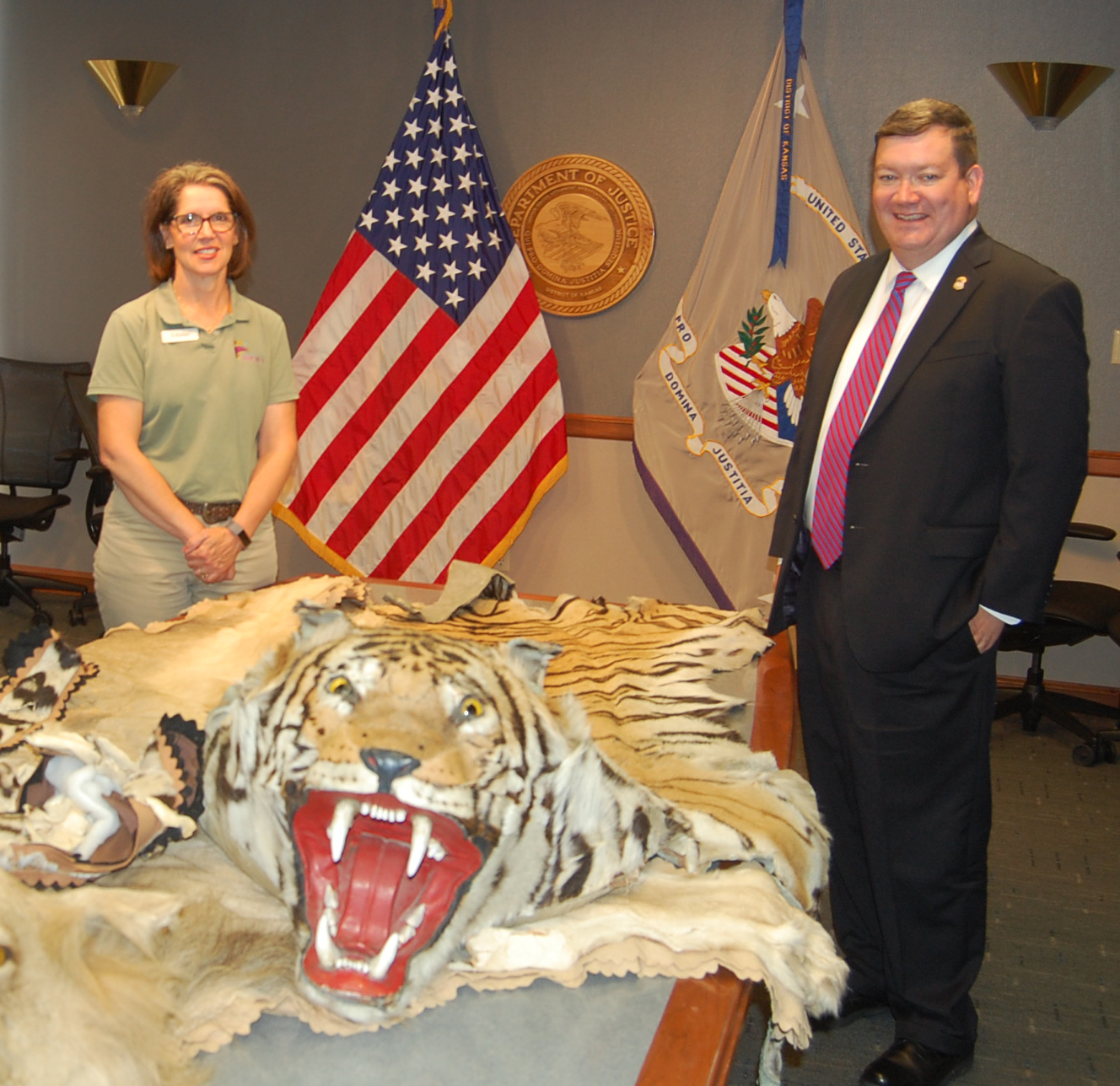
Some young animal lovers at the Topeka Zoo got to touch a tiger pelt Thursday. U.S. Attorney Stephen McAllister is in the center. At the far right is Dennis Dinwiddie, the zoo’s director of education and conservation.
OFFICE OF U.S. ATTORNEY
WICHITA – Zoos in Topeka and Wichita are receiving tiger and lion pelts that federal agents seized from wildlife traffickers, U.S. Attorney Stephen McAllister said Friday.
McAllister said his office donated the pelts to the Topeka Zoo and the Sedgwick County Zoo. The pelts were seized by agents of the U.S. Fish and Wildlife Service who were enforcing federal laws aimed at protecting endangered animals and disrupting the global black market for hides and other parts of protected wildlife.
“Poachers, wildlife smugglers and black market merchants are stealing our last chance to protect and preserve creatures of awesome strength and beauty,” McAllister said. “Once these animals go, they will be gone forever. They are a precious natural resource that the federal government protects, including by criminal prosecution of illegal traffickers.”
The Department of Justice’s Environment and Natural Resources Division (ENRD), together with United States Attorneys’ Offices across the country, is responsible for prosecuting international wildlife trafficking crimes, primarily under the Endangered Species Act (ESA) and the Lacey Act, as well as crimes related to wildlife trafficking, such as smuggling, money laundering, and criminal conspiracy.
Wildlife items forfeited or abandoned to the U.S. Fish and Wildlife Service are stored in a 22,000-square-foot office and warehouse located northeast of Denver that is called the National Wildlife Repository. Many of the items are donated to educational facilities and nonprofit organizations to aid in teaching about endangered species.
McAllister said the tiger pelts came from the wildlife depository.
Schanee Anderson, curator of education, accepted the pelts on behalf of the Sedgwick County Zoo. Note that the large tiger’s head has been distorted by a taxidermist trying to emphasize the animal’s size and ferocity.
Fish and Wildlife Service agents used some of them in a sting operation in Wichita in 2018. A Wichita man pleaded guilty to making a deal to pay $8,000 to have two tiger pelts delivered to him. Agents retrieved the tiger pelts and seized a lion pelt from his home when they arrested him.
McAllister said the Justice Department estimates the international illegal trade in wildlife generates as much as $23 billion annually.
In Kansas in recent years, federal agents have investigated wildlife trafficking cases including deer and elk that had been poached by guides and hunters, eagle feathers that were being unlawfully sold and Asian leopard cats unlawfully imported to Kansas. Federal prosecutors across the country also have pursued cases involving native turtles being exported to other countries.
LAWRENCE – The Robert J. Dole Institute of Politics at the University of Kansas will welcome Dirk Wouters, ambassador of Belgium to the United States, for a public program this summer.
Wouters will deliver remarks at the institute at 2 p.m. June 13. The program is free and open to the public, and a free livestream of the event will be available.
In his talk, Wouters will highlight some of the current challenges facing the European Union and developments in the U.S. that have affected transatlantic relationships. This will include the current U.S. presidential administration’s approach to relations with Russia and China, trade deficits, NATO and Europe’s energy dependence.
The ambassador was appointed to his position in September 2016. He represents the king of the Belgians and Belgium’s federal government in the U.S. and in the Commonwealth of the Bahamas. He is responsible for the direction and work of the embassy and its consulates, including bilateral political and economic relations.
Prior to his current assignment, the ambassador was permanent representative of Belgium to the European Union (EU). Wouters has served his nation’s international interests extensively, having joined the Belgian Ministry of Foreign Affairs in 1980. In 1986, he began his efforts representing Belgium in European affairs, and he later received an assignment in Rome dealing with political and economic issues. Beginning in the mid-1990s, he served as deputy permanent representative of Belgium to the United Nations (UN) in New York City.
The ambassador’s work would shift to the EU in 2003-2009, where he served as permanent representative of Belgium to the Political and Security Committee. He would later join the office of the Belgian prime minister as a diplomatic adviser, and later, the office of the minister of foreign affairs as chief of staff.
The Robert J. Dole Institute of Politics is dedicated to promoting political and civic participation as well as civil discourse in a bipartisan, philosophically balanced manner. It is located in KU’s West District and houses the Dole Archive and Special Collections. Through its robust public programming, congressional archive and museum, the Dole Institute strives to celebrate public service and the legacies of U.S. senators Bob Dole and Elizabeth Dole.
More information on all programs, as well as ongoing additions to the schedule, can be found on the Dole Institute’s website, www.doleinstitute.org.
LAWRENCE — When University of Kansas professor John James Kennedy began working in rural China, he would get introduced to villagers with multiple children – despite the country’s strict one-child policy.
“Some of these villagers would have three kids. They’d introduce eldest daughter and youngest son by their name, but the middle daughter was the nonexistent one,” said Kennedy, associate professor of political science.
“They’d call them that with a nod and a wink: ‘hei hu’ — ‘the black child.’ When saying that, they meant unregistered.”
While China’s controversial mandate has led to an estimated 20 million “missing girls,” Kennedy asserts at least half of them aren’t truly gone. Instead, they are more a product of policy noncompliance between families and local officials to keep the births covered up.
That’s the contention of Kennedy’s debut book, “Lost and Found: The ‘Missing’ Girls in Rural China” (Oxford, 2019). The paperback, co-written with Yaojiang Shi of Shaanxi Normal University in China, publishes June 3.
Kennedy and Shi started researching this topic in 1995 and continued into 2015, mostly in the Shaanxi province in northern China. They interviewed residents, hospital employees, family planning administrators, registration officials and those responsible for issuing birth certificates – from the national, county and village levels.
He said this one-child policy, instituted in 1979 to curb the country’s rapid population growth, was easier to implement in cities because urban employment was connected to housing and social welfare. However, the execution of this proved far trickier in agrarian areas.
“The assumption was rural farmers had a son preference,” said Kennedy, who is also the director of KU’s Center for East Asian Studies. “The reason was they didn’t have insurance or pensions like urban folks, so they relied on their sons in old age to take care of them. Daughters were married out so they don’t live with their natal family; they take care of their husband’s family.”
By the mid-1980s, the government realized it was too hard to enforce this singular policy in rural areas. So they decided if the firstborn was female, families could have a second child without a fine. Families would have a girl, then go for a second child. If that baby was a girl, they would not register the infant.
Whereas urban households attempting this tactic had a much greater chance of getting caught, those in rural communities proved more successful.
“It’s because the street-level bureaucrats are not just agents of the state, they’re also villagers. They have to live with these people,” he said. “But by mutual noncompliance, they’re turning a blind eye to the deeper issues.”
Although estimates have often been inflated by academics and the media, many demographers believe the number of missing girls is in the 20 million range.
“They are either nominally missing – in that they are hidden – or are truly missing, which is through sex-selective abortion or infanticide,” he said.
Despite researching this topic for decades, Kennedy said the subject was previously too sensitive for his Chinese colleagues to publish at the time. The one-child policy ended in 2015, prompting greater scrutiny of its consequences.
A Los Angeles native who has taught at KU since 2003, Kennedy actually lived with the Chinese family who is featured on the cover of “Lost and Found.” He said this quintet was a fitting example of his findings: The son was registered as a second child, the oldest daughter as a first child, and the middle daughter went unregistered.
Kennedy, who is fluent in Mandarin and an expert in Chinese local governance, said of his inaugural book, “I hope it opens a broader discussion about our assumptions of villagers and their behavior.”
Graduation weekends are upon us. This is a time of year to celebrate the hard work and dedication of students and teachers and congratulate those we know who have succeeded at earning a degree and advancing into their next phase of life. For some that can mean going on to college, technical school, or a higher degree. And while these are worthy pursuits, the reality is they usually come with a pretty big price tag attached.
Paying for college is a big endeavor for most, but with some planning and foresight, it doesn’t have to be impossible. The State of Kansas offers some very simple solutions for getting a jumpstart on college savings, and the sooner you get started the better. Here’s a brief summary of a couple of very easy options and how they work:
529 Accounts: These are investment savings accounts you as a parent or grandparent can contribute to, tax-deferred. Put a little bit in automatically from each paycheck or set aside something each month to contribute. Large or small, these investments earn dividends over time and you get to choose how and when to contribute. With regular contributions to this kind of investment, you can watch your money grow into an amount that could fund your child’s future educational goals, at accredited higher education institutions anywhere in the United States. These funds can be used for qualified expenses at 2- or 4-year college, vocational school, technical college, graduate school, and even K-12 education institutions. The state of Kansas also allows you to take an annual tax deduction of up to $3,000 in 529 contributions if you’re single or $6000 if you’re married.
K.I.D.S. matching grants: The State of Kansas wants college to be achievable for all students. For families that may struggle financially to come up with the money to fund a child’s higher education goals, K.I.D.S. matching grants are a wonderful option to grow your money faster than you could on your own. You must live in Kansas and earn an income less than 200% of the federal poverty level. With these qualifications you can open a 529 account with any amount you wish and the state will match whatever you contribute, up to $600/year.
Year after year there are success stories of students graduating whose parents and grandparents took the time to think ahead on their behalf, putting away a little at a time and watching that money grow into a debt-free college experience for their new graduate.
Elaina was one such student. Her grandmother, Guadalupe Martinez started an account for her when she was little, contributing $25 per paycheck whenever she could. Upon Elaina’s graduation from high school, her grandmother presented her with a check that brought Elaina to tears. It was enough to get her through college debt free, which she did.
This is not an uncommon tale.
Kids across Kansas have been blessed with the opportunity of education because of the wise planning of someone in their life who cared enough to think ahead and save. Whether it is one of the above options or another kind of savings vehicle, I challenge Kansans during this special time of year to think ahead for someone they love and find a way to save. Every little bit adds up, and investing in a child’s future education now is one of the best gifts you can give them.
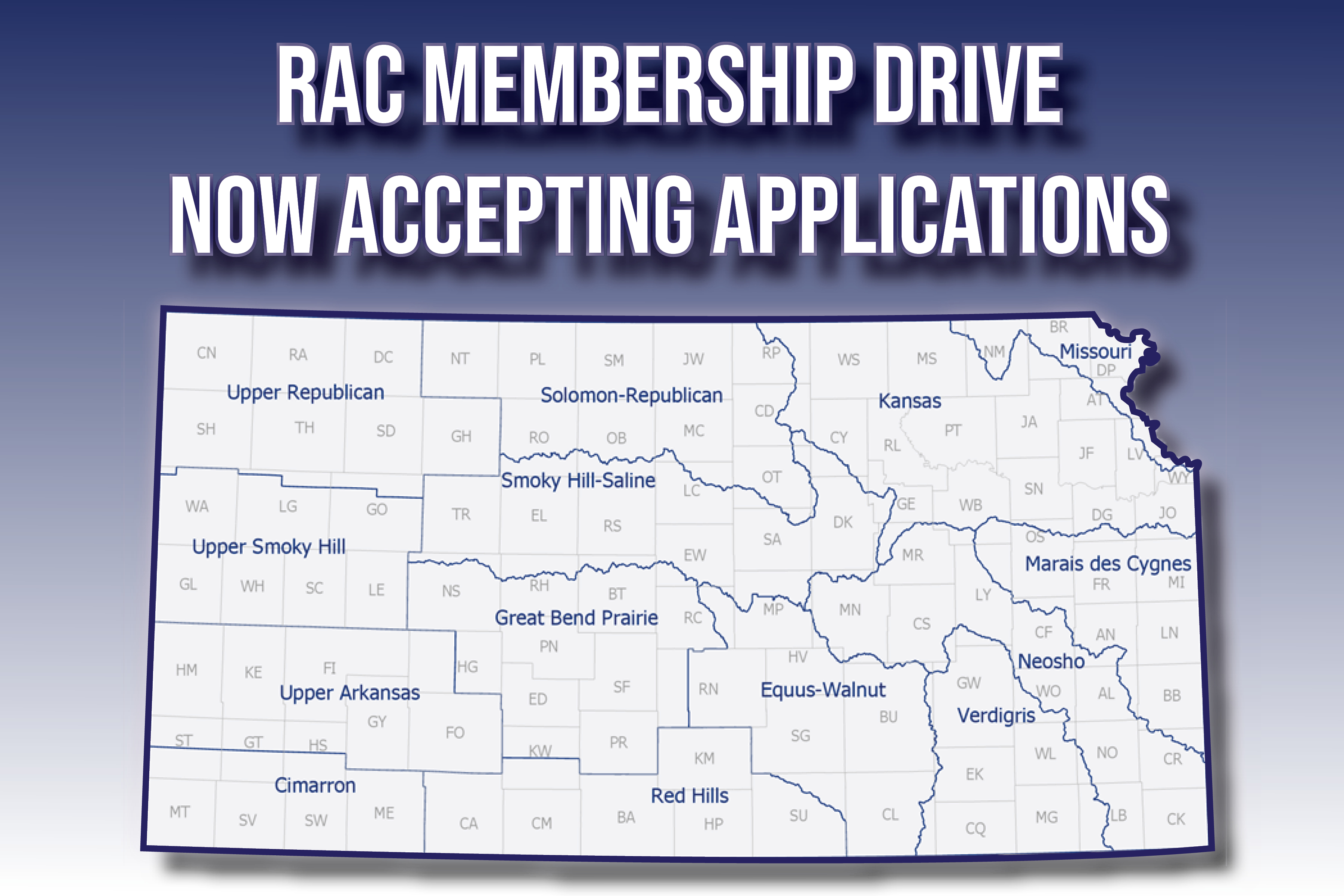
TOPEKA – The Kansas Water Office is currently accepting applications from those who would like to participate as a member of one of the 14 Regional Advisory Committees (RACs) which are established by the Kansas Water Authority (KWA). Interested individuals are encouraged to apply soon as the deadline is only two weeks away.
These committees play a key role in advising the KWA on implementation of each region’s water supply priorities as part of the Kansas Water Vision and the Kansas water planning process as a whole. They help identify and provide input on other emerging water resource related issues and concerns. The committee selection process will ensure all of the water users and interests within the region are represented.
Kansans can have a definite lasting impact on the future of water resources through RAC membership.Interested persons can apply at www.kwo.ks.gov. The application deadline is May 31, 2019.
As the state’s water office, KWO conducts water planning, policy coordination and water marketing as well as facilitates public input throughout the state. The agency prepares the Kansas Water Plan, a plan for water resources development, management and conservation.
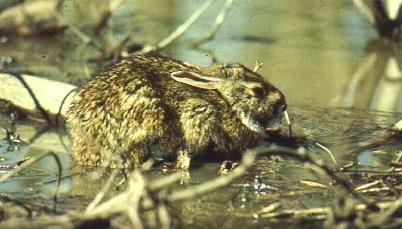
TOPEKA – The Kansas Department of Wildlife, Parks and Tourism (KDWPT) cautions people living in or near high-water areas to not be surprised if they see more wildlife than usual. Animals living near flooding bodies of water or in low-lying areas will be forced to temporarily move to other locations to survive. They could congregate on high-ground “islands,” in residential or commercial areas or around outbuildings. Residents may even find small animals in homes or outbuildings if they’re not well-sealed.
Animals such as rabbits, rodents, lizards, snakes, turtles, insects, certain birds or even larger animals such as coyotes and deer may be on the move. Here are some tips to be aware of when you spot a flood-weary animal –
Leave them alone. They need a refuge from high water and might only be passing through. They will not set out to harm you, but any animal may bite or attack in self-defense.
Small animals like lizards and snakes may congregate under shrubs, rocks and debris. Use caution and protective clothing such as long pants, gloves and sturdy shoes if you need to work in the yard or garden. Above all, do not reach blindly under rocks and debris. You don’t like surprises, and neither will a sheltering animal.
Many animals can swim and may get trapped in a flooded building, so use caution when removing possessions from a flooded structure.
Do not try to feed them. Free food may encourage them to overstay their welcome.
The water will eventually recede, giving animals the opportunity to return to their former habitats, so be patient and be a good neighbor to our wildlife.
Most animals can adapt to changing weather conditions, but not all. Be aware that some animals will perish but many more are likely to survive.
Ground-nesting birds and other animals may lose their nests or burrows and their eggs or young. Many will re-nest as soon as they find proper habitat. Though it may take time, most animal populations will eventually recover.
Do not attempt to rescue animals stranded by high water, as flood waters are dangerous and can obscure serious hazards.
Keep an eye on pets to be sure they don’t tangle with displaced wildlife or chase wildlife into floodwaters.
If displaced wildlife have become a nuisance, people can visit the KDWPT website at https://ksoutdoors.com/Services/Wildlife-Damage-Control and find a list of wildlife damage control permit holders (NADC Permit Holders) who may be able to assist.
TOPEKA – Governor Laura Kelly today announced her selection of Jefferey Zmuda as the next Kansas Secretary of Corrections. Zmuda is currently the deputy director of the Idaho Department of Correction.
“This is a critical time of change and recovery for the Kansas Department of Corrections,” Kelly said. “I’m pleased Jeff Zmuda has agreed to take on the important challenge of restoring our corrections system and improving morale across all facilities. He will continue our work to rebuild the agency while bringing new ideas and leadership to Kansas.”
Zmuda has a long record of success managing the Idaho Department of Correction and coordinating with stakeholders, including legislators, the judiciary, and other county and state partners. Previously, he served as the chief of prisons in Idaho. In this role, he oversaw all aspects of prison operations for nine state run facilities, including public safety initiatives, security protocols and practices, mental health care and treatment, education services, and reentry programs. Zmuda also has extensive experience addressing personnel and operations challenges across a correctional system.
“I’m honored to be selected by Governor Laura Kelly to lead the Kansas Department of Corrections,” Zmuda said. “I look forward to being on the ground and working with the dedicated men and women of the agency to address the needs and challenges facing Kansas facilities.”
The Governor also commended current Acting Secretary of Corrections Roger Werholtz for his commitment to the State of Kansas and his longtime public service. Werholtz has been instrumental during the transition and early months of the Kelly Administration, shining a light on the challenges the Department of Corrections faced during the last eight years and the desperate need for reforms. He has also been a critical advocate for a much-needed pay increase for corrections staff, specifically corrections officers in all facilities.
“I cannot say enough about the important role Secretary Werholtz has had in the transition and assessment of the department of corrections during the last six months” Kelly said. “He dug deep and shared the problems that had been concealed for eight years. Not only that, he presented a plan to address the many challenges we face. I thank Roger Werholtz for his impeccable service to the State of Kansas.”
Werholtz’s last day will be Friday, May 31. Chuck Simmons, the current deputy secretary for facilities management, will serve as the interim secretary beginning June 1 until Zmuda becomes the acting secretary on July 1.
“When Keven Pellant, Chuck Simmons and I returned to KDOC, we did so because of how much we cared about this agency and the people here with whom we had spent most of our careers,” said Werholtz. “We hope that we are leaving KDOC better than we found it and believe that under Jeff Zmuda’s leadership it can achieve the expectations we all have.”
The governor will chair her first Finance Council meeting on June 5, 2019. The Corrections budget will be discussed.
“This is a difficult time for many in the department of corrections, but I am committed to address the problems, provide strong leadership, and support for the officers who are working hard hours to keep all Kansans safe,” Kelly said. “I’m hopeful that the Finance Council will approve fair pay increases for the all corrections officers in all facilities who put their lives on the line every day.”



 He wrote, “Only her arms and legs remained intact. After examining what was left of her body, a local physician concluded, in a report cited years later, that the conflagration ‘was caused in her entrails’ by the variety of combustible materials to be found there, including alcohol and fat, ‘an oily liquid … of an easily combustible nature.’”