We have a brand new updated website! Click here to check it out!

KS company paying millions in Medicare fraud case

global medical directThe owners of Kansas-based Global Medical Direct, LLC and Global Medical Inc., Robert Shea and Mark Franz, have agreed to pay $7 million to resolve allegations against them in connection with a scheme to submit false claims to the federal Medicare and Tricare healthcare programs, announced United States Attorney Kenneth Allen Polite, Jr. from the Eastern District of Louisiana along with United States Attorney Barry Grissom, from the District of Kansas. 
The companies have also agreed to pay to the United States $5 million in proceeds from the sale of all of the companies’ assets to settle civil allegations under the False Claims Act.  Shea and Franz will also receive twenty-year exclusions from participation in any federal healthcare program as part of the settlement. 
 
Global Medical, Inc. and its parent company, Global Medical Direct, LLC, are mail-order diabetic supply companies.  The United States contends that, between April 1, 2008 and January 31, 2012, owners Robert Shea and Mark Franz caused Global Medical and Global Medical Direct to enter into numerous marketing contracts with insurance brokerage and other companies with customer bases likely to have a high percentage of diabetes patients and paid these companies based on the number of patients referred for diabetic supplies.  The Anti-Kickback Statute makes it unlawful to pay or receive remuneration for patient referrals because of the high-potential for billing abuse to Federal programs, such as Medicare, resulting from these types of arrangements. 
 
The settlement resolves the companies’ and its owners’ civil and criminal liability for their participation in the wrongdoing.
 
The investigation and prosecution of the companies and their owners was conducted jointly by the U. S. Attorney’s Offices for the District of Kansas and the Eastern District of Louisiana, the Office of the Inspector General for the Department of Health and Human Services, and the Federal Bureau of Investigation. 
 
“Patients have a right to expect that medical suppliers have justly earned the opportunity to win government business,” said Mike Fields, Special Agent in Charge, Office of Inspector General, U.S. Department of Health and Human Services, of the region including Louisiana.
“Besides the dollar settlement, two of Global’s owners are now banned from government health programs for at least the next two decades.”   


50 Year Vision at Governor’s Water Conference

WaterKansas Governor Sam Brownback’s Water Conference will be held Thursday, October 24 and Friday, October 25, at the Hilton Garden Inn & Conference Center in Manhattan.

Thursday, the Governor will address a 50-Year Vision for Kansas water and meeting the state’s needs. He will issue an Executive Order to begin work immediately on this priority resource.

The conference topics include:

  • Meeting Kansas’ water needs now and in the future
  • Drought resiliency and conservation
  • The value of water
  • Reservoir sedimentation
  • Water’s role in developing the Kansas agriculture economy

Other speakers at the conference include: Charles Fishman, author of The Big Thirst and The Wal-Mart Effect and Pat Mulroy, who oversees the Las Vegas Valley Water District and Southern Nevada Water Authority. A legislative panel is planned for Thursday afternoon. Day two will build on the water policy discussions with technical presentation posters and talks. Dr. James Stack, Director of the Great Plains Diagnostic will present Feeding a Growing Population in a Resource Stressed World.

To view the agenda for a complete list of speakers and panelists for both days visit: www.kwo.org

Lead Poisoning Prevention Week October 20-26

lead free kidsFrom EPA Region 7:

While lead poisoning is a health issue that can affect persons of any age,
young children are most at risk.

The Centers for Disease Control and
Prevention estimates that at least 4 million households in the U.S. have
children living in them at risk of exposure to toxic lead. Nearly half a
million U.S. children ages 5 and younger have blood lead levels above five micrograms per deciliter, the reference level at which CDC recommends public health actions be initiated.

Nationally, the most common way that children become exposed to lead is by
breathing or swallowing dust or chips of lead-based paint, which is often
found in and around housing or child-care facilities built prior to 1978,
when lead-based residential paints were banned in the U.S.

Lead poisoning can adversely affect nearly every system of the body, but
particularly the central nervous system, especially for unborn and young
children whose bodies are just beginning to develop and grow. Because lead
poisoning often occurs with no obvious symptoms, it frequently goes
unrecognized. However, lead poisoning is easily diagnosed with simple
testing.

For more facts about lead from EPA, visit: https://www2.epa.gov/lead

Electronic registration in the field for deer processing

deer processing electronicFROM THE KANSAS DEPARTMENT OF WILDLIFE, PARKS AND TOURISM:

With permit sales reaching nearly 100,000 every year, whitetail deer are easily one of Kansas’ most sought-after big game animals.

One important regulation deer hunters should be aware of is deer must be tagged before being moved from the site of the kill. Unless a hunter has an either-sex permit, the head must also remain attached to the carcass for identification purposes while in transit to a residence or place of commercial processing or preservation.

In an effort to allow hunters to bone out deer prior to transport, the Kansas Department of Wildlife, Parks and Tourism created a voluntary electronic deer check-in system. Electronic registration is not required but allows hunters to register their deer through the Internet, using photos taken at the harvest site. Once registered, hunters will receive a confirmation number that allows them to transport the carcass without the head attached. If Internet access is unavailable at the kill site, the hunter can retain the photographs while in transit and a registration number can be obtained later.

This is the close up of the deer. The tag must be clearly visible with all the information filled out.

This registration process requires a hunter to submit two digital photographs — one close-up clearly showing the completed tag attached to the deer and a second showing the entire body of the deer with the head still attached. Once logged on to the KDWPT website, a hunter must submit the photos and enter the KDWPT number from their permit, time and date of the kill and the county where the deer was taken. A confirmation number will be issued by email when the photos and data are successfully received. This confirmation number must be retained during transportation.

Once these steps are completed, the deer head may be removed and the carcass prepared for transportation. The system allows KDWPT staff to see the deer and the hunter’s completed tag without the time and expense of maintaining a check station.

To access the electronic deer check-in, click on kdwpt.state.ks.us/news/Hunting/Big-Game-Information/Deer/Deer-Check-in

his is the complete deer photo. This photo is used to verify sex of the deer. Tag must be attached and visible.

This option was developed to address two important issues regarding deer carcass transportation. The first concern is about the movement of any material from a deer that may contribute to the transmission of chronic wasting disease (CWD). It is believed that spread of CWD could be diminished if certain body parts affected by the disease are not moved from the site where the deer is taken. Because CWD affects the brain and central nervous system, the transportation of a deer head and skeleton from one location to another is considered a likely means for the disease to spread. The new registration system allows a hunter to leave these items at the kill site, minimizing the possibility of spreading CWD.

The second concern is directly related to the first. Many states have adopted strict regulations to prevent the spread of CWD. Typically, these regulations do not allow the transportation of a deer head with brain tissue from a state with confirmed CWD cases. Hunters have been cited in other states and their deer confiscated for not complying with the transportation laws of that state. The new registration system allows a hunter to properly dispose of the head and legally transport the boned meat, as well as the cleaned skull cap and antlers, to the hunter’s home.

Nicodemus historic site re-opens

nicodemus visitor centerNicodemus National Historic Site re-opens to visitors today.

Visitors can access public areas and roads immediately while facilities and other public services are brought back online.

Nicodemus National Historic Site has been closed since October 1 due to the lapse in Congressional appropriations.

“We are excited happy to be back at work and welcome visitors to Nicodemus National Historic Site,” said Superintendent Angela Wetz. “Autumn is a particularly special season to enjoy all that Nicodemus has to offer.”

The visitor center is open Monday through Saturday from 9:00 AM to 4:30 PM excluding federal holidays and will continue to offer the park film, tours, and interpretive programs.


KS Supreme Court suspends former AG’s law license

Former KS Attorney General Phill Kline

Former Kansas Attorney General Phill Kline has had his law license indefinitely suspended by the Kansas Supreme Court over allegations of ethical misconduct during his investigation of abortion providers.

Friday’s decision comes after repeated disputes between Kline and his critics over his tactics over alleged violations of state law.

Kline was Kansas attorney general from 2003 to 2007 and Johnson County district attorney in 2007 and 2008. He is now a visiting professor at Liberty University in Virginia.

A state disciplinary panel contends Kline repeatedly misled or allowed subordinates to mislead others , including a grand jury, to further his investigations.

As attorney general, Kline pursued misdemeanor criminal charges against Dr. George Tiller over late-term abortions performed by his Wichita clinic. The case was dismissed for jurisdictional reasons.

More than 7,000 new jobs for Kansas

Gov. Brownback speaks at the
Gov. Brownback at Thursday’s dedication of BNSF’s new Logistics Park Kansas City Intermodal Facility in Edgerton (Photo courtesy KRP)

Burlington Northern Santa Fe (BNSF) Railway dedicated its new Logistics Park Kansas City (LPKC) Intermodal Facility in Johnson County today during the facility’s grand opening ceremony.  Governor Sam Brownback spoke at the event.

As one of Kansas’ largest economic development projects ever, the $250 million, 440-acre facility will provide businesses with a direct connection to the global supply chain via the BNSF’s transcontinental railroad that begins in California and terminates in Chicago.

It will also provide companies with the ability to quickly ship goods by rail and truck to their final destinations, as well as create thousands of jobs for Kansans.

LPKC is projected to help create an estimated 7,400 jobs in the immediate area of the development and 13,000 jobs in the state of Kansas at full build-out.


New chief counsel for Gov. Brownback

Laue
Brant Laue, Chief Counsel to KS Governor Sam Brownback

Kansas Governor Sam Brownback today announced the appointment of Brant Laue as his Chief Counsel.  He will join the administration staff on Nov. 4, 2013.

Born in Hanover, Kan., Laue is a 1986 graduate of the Cornell Law School in Ithaca, New York. He was a note editor for the Cornell Law Review and was awarded the Order of the Coif.

After graduation Laue clerked for the Honorable Roger L. Wollman, Circuit Judge in the Eighth U.S. Circuit Court of Appeals in South Dakota and served as Special Assistant to the Assistant Attorney General, Civil Division, in the U.S. Department of Justice in Washington, D.C. He currently is partner with Armstrong Teasdale LLP in Kansas City.

Laue is a partner in his family’s ranch, Laue Charolais Ranch, which includes one of the Midwest’s oldest purebred Charolais cattle breeding establishments.  He is active in the Thoroughbred horse community as a horse owner and breeder and is the current Chairman of the Board of Governors for the American Royal Livestock, Horse Show and Rodeo.

Northwest KS communities to build moderate-income housing

OLYMPUS DIGITAL CAMERAHoxie, Quinter and Stockton are among ten Kansas communities to share $2.1 million in funding to build moderate-income housing and infrastructure in rural areas.

The Moderate-Income Housing (MIH) Program, an initiative funded by the State of Kansas and administered by Kansas Housing Resources Corporation (KHRC), works to help cities and counties develop multi-family rental units, single-family for-purchase homes, and water, sewer and street extensions in communities with populations fewer than 60,000 people.

MIH funding can also be used to finance construction costs, rehabilitate unsafe or dilapidated housing, and offer down-payment and closing-cost assistance to homebuyers.

The need for moderate-income, workforce housing throughout Kansas is growing. Currently, there are 97 counties and over 600 communities eligible to apply for MIH funding. These communities comprise approximately 68 percent of the state’s total population. Numerous municipalities statewide are experiencing opportunities for economic development and job growth, but the lack of adequate, affordable housing is posing roadblocks to new expansion.

2013 MODERATE-INCOME HOUSING AWARDS

City of Cottonwood Falls–$100,000

City of Hoxie–$382,451

City of Hugoton–$250,000

City of Humboldt–$100,000

City of Liberal–$350,000

City of Lyons–$200,000

City of Parsons–$100,000

City of Quinter–$400,000

City of Stockton–$71,000

Stafford County–$168,000

Hoxie, located in Sheridan County, will develop infrastructure needed to build 18 housing units in the Sunrise Addition.  The city committed $20,000 to pay for curbs and gutters.

Quinter, located in Gove County, will develop infrastructure for eight duplex-style renal units and eight units serving the elderly.

Stockton, located in Rooks County, will purchase and prepare in-fill lots to construct four 3-bedroom homes and offer down payment and closing cost assistance to potential homebuyers.  Rooks County Economic Development has committed $100,000 to lower the interest rate for the builder.


Kansas contributes to Civil War website

civil war 1
Date: Between 1861 and 1865
This tintype shows Captain Oran Curtis, to the left, with members of the 15th Kansas Volunteer Cavalry, Company F. Captain Curtis was the father of U.S. vice-president Charles Curtis.

The Kansas Historical Society recently contributed more than 1,600 images from its archival collections to Civil War on the Western Border, a website that explores the Kansas-Missouri border conflict 1854 – 1865.

The site was created through a collaborative effort of libraries, museums, and historical societies in Kansas and Missouri. The Historical Society images include photographs, maps, journals, and government documents from the territorial Kansas and Civil War periods. Civil War on the Western Border will be maintained by the Kansas City Public Library.

Visit the site at civilwaronthewesternborder.org.

The Historical Society’s 1,600 images, plus many more dated 1854 – 1865, are available on Kansas Memory, the Historical Society’s online digital archives. Visit kansasmemory.org.

The Kansas Historical Society is a state agency that operates the Kansas Museum of History, State Archives, Kansas Capitol Tour Center, and 16 state historic sites. For more information, visit kshs.org.

civil war 4 ks and mo map
This color map, ca. 1854-1861, is entitled “Nebraska and Kanzas.” It was printed by J.H. Colton and Co. in New York.


ACA plan costs vary up to 20% across state

acaFROM THE KANSAS HEALTH INSTITUTE:

Despite technical glitches and limited online functionality, the highly debated insurance marketplaces, a centerpiece of the Affordable Care Act (ACA), opened in Kansas and around the country October 1.

The Kansas Health Institute (KHI) has produced an issue brief and regional map which summarize the plans and the prices offered in the marketplace for individuals and families in the seven rating areas of Kansas.

There are 72 plans available in the Kansas marketplace provided by four private insurance companies. 65 of the plans are available for individuals and families, and seven for small businesses. At least two health insurance companies offer coverage in each county, and the average number of plans available per county is 37.

According to the KHI brief, a “benchmark plan” (a middle-of-the-road plan in terms of covered benefits and cost), will be available to a typical family of four at a monthly premium ranging from $651 to $771. The same plan would cost a 28 year-old individual $186 to $221 per month, and a 63 year-old couple would pay $1,013 to $1,200 per month. These figures do not account for any financial assistance that low- and middle-income individuals and families may qualify for.
For that same benchmark plan, a family of four with annual income of $25,000 living in Jackson County, (the median-priced county in the median-priced rating area), would pay $42 per month after the premium tax credit, a 28 year-old individual making $12,000 a year would pay $20 per month, and a 63 year-old couple with income of $17,000 would pay $28 per month.
KHI’s map of Monthly Premiums for Benchmark Plan by Rating Area further depicts the price variance across the state.
Both more and less expensive plans are also available in the marketplace, and prices vary by region as shown in the brief.
The brief also shows how Kansas and other states that opted not to expand Medicaid, as allowed by the ACA, have created a coverage gap for the poorest people in the state. A 28 year-old individual with annual income below the federal poverty level of $11,490 would not be eligible to receive a premium tax credit and also would not be eligible for Medicaid. If they wanted insurance, they would have to pay the full premium price on their own. The same situation would apply to a 63 year-old couple with annual income below $15,510, who would not qualify for a premium tax credit, nor for Medicaid.
“The opening of the Kansas marketplace is an important milestone for the health reform law,” said Robert F. St. Peter, M.D., an author of the brief and KHI president and CEO. “There has been a lot of discussion about whether the variety and prices of the plans offered in the marketplace will be enough to attract the large number of Kansans necessary to make it work efficiently. This first year of operation will be critical in determining that.”
The launch of the marketplaces around the country is expected to be bumpy as kinks and glitches in the system are worked out, and online functionality is improved. “People have time to see how the marketplace works, “said LeAnn Bell, an author of the KHI research brief, “as long as a plan is selected and payments are made before December 15, coverage can still begin as early as Jan. 1, 2014.”
The Kansas Health Institute is an independent, nonprofit health policy and research organization based in Topeka, Kansas. Established in 1995 with a multi-year grant from the Kansas Health Foundation, the Kansas Health Institute conducts research and policy analysis on issues that affect the health of Kansans.

Ribbon Cutting for new I-70 lanes

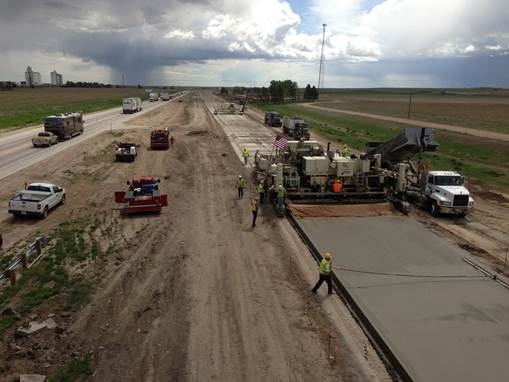
A ribbon-cutting event marking the completion of the I-70 reconstruction project in western Kansas will  be held Monday, October 14, at 3p.m. in the I-70 eastbound Travel Information Center near Ruleton, just west of Goodland.

Keynote speakers include: Kansas Secretary of Transportation Mike King and President/C.E.O. of Koss Construction Company David Howard.

The event marks the completion of the three-year project to rebuild both east and westbound lanes of I-70 from the Colorado/Kansas border, 12 miles into Kansas.

Koss Construction Co., of Topeka, was the prime contractor for the $48 million project.

Koss Construction crews paving the eastbound lanes earlier this year

The reconstruction project is funded by T-WORKS, the Transportation program passed by the Kansas Legislature in May of 2010.

Parking for the ribbon-cutting event will be limited, and carpooling is encouraged. 

A bus will be provided to transport those who are interested in attending this event.  To arrange a ride or get directions to the event, contact: Kristen Brands, KDOT Northwest Kansas Public Affairs Manager, at (785) 877-3315 or [email protected] in Norton.

Open house to discuss bridge projects

k-9 road signFrom the Kansas Department of Transportation:

The public is invited to an informational open house in order to get feedback about  two future bridge projects which will temporarily close sections of K-9 Highway in Norton County.

The open house is Tuesday, October 15, from 5-7p.m. in the Lenora Community Room, 110 N. Main Street.

KDOT engineers will discuss the scheduling of construction and associated detours, as well as share information regarding two bridge replacement projects in Norton County.

The first bridge is located approximately 11.5 miles east of the Norton/Decatur County line on K-9 Highway (between Lenora and the U.S. 283 junction), over the North Fork Solomon River Drainage.  The second bridge project is located less than a mile east of the K-9/K-173 junction (between Edmond and Logan) on K-9 Highway, over Big Timber Creek.

The bridge projects are funded by T-WORKS, the Transportation program passed by the Kansas Legislature in May of 2010.

Copyright Eagle Radio | FCC Public Files | EEO Public File