MANHATTAN – The American Legion Boys State of Kansas Leadership Academy is now taking applications for its 2019 session. The event, which will be in its 82nd year, will be held Sunday, June 2, through Friday, June 7, at Kansas State University in Manhattan.
The ALBSKLA is for young men who will enter their senior year of high school in the fall of 2019. It provides a relevant, interactive, problem-solving experience in leadership and teamwork that develops self-identity, promotes mutual respect and instills civic responsibility. Boys State is a “learning by doing” political exercise that simulates elections, political parties and government at the state, county and local levels, providing opportunities to lead under pressure, showcasing character and working effectively within a team. It’s also an opportunity to gain pride and respect for government and the price paid by members of the military to preserve democracy.
At a minimum, applicants should be in the top half of their high school class and be involved in extracurricular activities in their school and community. Potential delegates can also be nominated to attend by their high school counselor or other influential people in their lives.
The cost to attend the Boys State of Kansas program is $325; however, in many instances, sponsors pay for the majority of the fees, with the delegate or his family paying a $50 applicant fee. Those wishing to apply to the program should visit https://kansasboysstate.com/ to fill out an application, which are due by Tuesday, April 30, along with the fees to guarantee a spot in the program.
Potential sponsors, such as American Legion posts, civic organizations, businesses, clubs and interested individuals, or those with questions, should contact Troy Fowler, ALBSKLA director of operations, at [email protected].
The American Legion Boys State of Kansas Leadership Academy is an interactive simulation that teaches high school seniors-to-be the value of democracy and civic duty. Participants form mock governments and campaign for positions at the city, county and state levels. After the elections, participants find out firsthand the difficult decisions made daily by those in government through a series of challenging simulations. Delegates, nominated to attend by their high school counselors and other influential people in their lives, are sponsored by American Legion posts and various civic organizations from across the state. All delegates demonstrate outstanding leadership qualities in student government, athletics and/or other activities.
The Boys State program was founded by Legionnaires Hayes Kennedy and Harold Card in Illinois in 1935, and was first held in Kansas two years later in Wichita. The Kansas program moved to the University of Kansas in Lawrence in 1963 and remained there until 1991. The following year, it moved to its current location at Kansas State University in Manhattan. For more information about the American Legion Boys State of Kansas Leadership Academy, visit https://kansasboysstate.com/ or https://ksbstate.org/.
PRATT – New line on your reels, check. Hooks sharpened, check. Tackle box cleaned and organized, check. Now all you have to do is pick up a copy of the 2019 Kansas Fishing Regulations Summary, available now in printed form wherever licenses are sold and at Kansas Department of Wildlife, Parks and Tourism offices. A PDF of the pamphlet can be downloaded at www.ksoutdoors.com. Every angler should keep a copy of the regulations in their tackle box or boat.
In addition to the current regulations on equipment restrictions, license and permit prices, and creel and length limits, there is a special section listing new regulations for 2019. One section is devoted to special length and creel limits on all reservoirs and lakes throughout the state. The Fish I.D. pages include color illustrations of common fish found in Kansas by Joseph Tomelleri. Current state record fish weights are listed along with an application and the minimum lengths required to receive Master Angler Awards.
Get a copy today so you’ll be ready when the fishing bug bites.
PRATT – The Kansas Department of Wildlife, Parks and Tourism (KDWPT) reminds hunters not to discard their 2018-19 Kansas Hunting Atlases. Unlike past years, there will be no spring atlas printed in 2019. All fall and spring Walk-in Hunting Access (WIHA) tracts are included in the atlas printed and distributed last August.
Additional copies are available from KDWPT offices and will be distributed as needed to license outlets this spring in time for the spring turkey season. But hunters should also go to www.ksoutdoors.com, under “Where To Hunt,” to find maps that include tracts that were enrolled after the printed atlas was completed. Due to a late-summer push for new enrollments, more than 20,000 acres were added and are included on these electronic maps.
The atlas’ legend shows color codes that designate tracts open only in the fall, tracts open in both spring and fall and tracts open only during the spring turkey season. Again this year, more than 1 million acres are enrolled.
The WIHA program was initiated in 1996 when 36,000 acres were enrolled. The program was popular with hunters and landowners and quickly grew, reaching the million-acre mark by 2004. That level of access has been sustained ever since. The newest part of the program is called iWIHA and is designed to increase enrollment in urban counties and provide high quality experiences by limiting access to a certain number of hunters on an area on a given day. Hunters can check an area’s status the night before and check in, knowing that access will be limited. For details on the iWIHA program, go to https://ksoutdoors.com/Hunting/Hunting-Programs/iWIHA-Limited-Access-Hunts
Hunters looking for quality turkey hunting opportunities should also apply through the Special Hunts program, which provides limited accessed through a lottery drawing to designated tracts of land. The 2019 Spring Turkey Special Hunts should available Feb. 2 at www.ksoutdoors.comunder “Special Hunts.”
WASHINGTON – U.S. Senators Jerry Moran (R-Kan.), Mark Warner (D-Va.), Roy Blunt (R-Mo.) and Amy Klobuchar (D-Minn.) today reintroduced the Startup Act – bipartisan, cutting-edge legislation to encourage job creation, grow entrepreneurial activity, increase innovation and advance economic development.
The Startup Act would accelerate the commercialization of university research and creative inquiry that can lead to new ventures, review and improve the regulatory processes at the federal, state and local levels, and modernize a critical Economic Development Administration (EDA) program to spur economic growth and promote innovation. The widely-supported legislation also creates both entrepreneur and STEM visas for highly-educated individuals so they can remain in the United States legally to promote new ideas, fuel economic opportunity and create good-paying American jobs.
“America continues to fall behind in new business development and struggles to retain top talent that could grow our U.S. economy,” said Sen. Moran. “With a renewed sense of urgency, Congress must prioritize policies that will help recruit and retain highly-skilled students and innovators, bolster a pro-growth environment and enable entrepreneurs to transform ideas and research into companies and products – creating meaningful, good-paying jobs for Americans in the process. Thank you to Senators Mark Warner, Roy Blunt and Amy Klobuchar for continuing to prioritize this important legislation to help make certain America remains the best place in the world to bring an idea to market and grow a business.”
“I’ve spent most of my career in the private sector so I know the importance of advancing innovation,” said Sen. Warner. “By encouraging entrepreneurship and helping attract and retain talented individuals, this bipartisan bill will help Virginia promote capital investment while boosting our economy and promoting U.S. competitiveness.”
“To compete and succeed in a 21st Century global economy, we have to make our country the best place in the world for entrepreneurs to start and grow their businesses,” said Sen. Blunt. “This bill will help promote innovation and small business growth, which in turn will create more jobs and strengthen the economy. The legislation will also increase U.S. competitiveness by making sure we have the workforce we need for high-demand STEM fields.”
“Startups and small businesses are engines of job creation and economic growth,” said Sen. Klobuchar. “Our bipartisan bill would make it easier for students and innovators to get their ideas off the ground, encourage new ideas, and strengthen our workforce to keep the U.S. competitive in the 21st century economy.”
Many of the principles included in the Startup Act are based on the research and analysis by the Ewing Marion Kauffman Foundation, based in Kansas City, Mo. Kauffman research shows that immigrants to the United States are nearly twice as likely as native-born Americans to start businesses, and first-generation immigrants now make up nearly 30 percent of all new U.S. entrepreneurs.
Data shows that international students studying in the U.S. on temporary visas accounted for nearly two-fifths of all Ph.D.s in STEM fields – that number has doubled over the past three decades. Further, international doctoral students were significantly more likely than domestic students to major and earn degrees in STEM disciplines in the U.S.
The Startup Act is supported by Sprint, Garmin, the Enterprise Center of Johnson County, the Kansas City Startup Foundation, Engine, the UMKC Innovation Center, the KC Tech Council, the Internet Association, the Consumer Technology Association, CTIA, SSTI, CompTIA, the Angel Capital Association, the Computer and Communications Industry Association, National Venture Capital Association, the Center for American Enterprise and the Information Technology Industry Council.
WASHINGTON – U.S. Senators Jerry Moran (R-Kan.) recently introduced the Building Rail Access for Customers and the Economy (BRACE) Act to make permanent a critical tax credit used to repair and upgrade short line railroads. Sen. Pat Roberts (R-Kan.) is a cosponsor of the bill.
“Short line railroads connect rural and regional economies across our state and provide communities with access to national and global markets,” said Sen. Moran. “The BRACE Act would make certain that short line railroads and the communities who depend on them can stay up-to-date on critical maintenance and track improvements. This bipartisan legislation would mark significant progress as we work to make critical, much-needed investments in our nation’s transportation infrastructure.”
This tax credit was first established by legislation introduced in 2004 by then-U.S. Representative Jerry Moran to encourage railroads, railroad customers and suppliers – who depend the most on short line railroads – to invest directly in maintaining the more than 2,000 miles of short line rails in Kansas. Located in the center of America’s heartland, Kansas is one of the leading rail and distribution centers in our country and plays an integral role connecting farmers and factories with communities around the globe.
The BRACE Act would make permanent this tax provision used to repair and upgrade short line railroads, which are defined by the Surface Transportation Board as railroads that generate between $36 and $458 million annually and move largely agricultural and manufacturing freight. Making this tax credit permanent would allow communities to repair, maintain, and upgrade additional short line railroads nationwide.
Since 2006, Congress has acted periodically to extend the credit, often retroactively. This uncertainty causes private investment in short line rail to decline, reduces safety and customer service, and provides uncertainty to businesses, farmers and employers that cannot be globally competitive without freight rail. In addition to making this tax credit permanent, the BRACE Act would provide a safe harbor to allow credits to retroactively be allocated to investments made in 2018, as the credit was last extended only through December 31, 2017.
The BRACE Act was introduced by U.S. Senators James Crapo (R-Idaho) and Ron Wyden (D-Ore.) and is cosponsored by U.S. Senators Richard Blumenthal (D-Conn.), Bob Casey (D-Pa.), Jim Inhofe (R-Okla.), Johnny Isakson (R-Ga.), Chuck Schumer (D-N.Y.), Debbie Stabenow (D-Mich.), John Thune (R-S.D.) and Roger Wicker (R-Miss.).
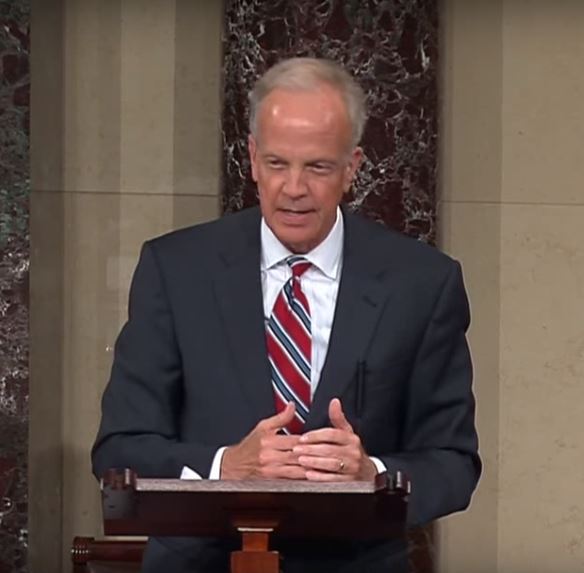
WASHINGTON – U.S. Senator Jerry Moran (R-Kan.) today announced his appointment to key committees, as well as his continued chairmanship of two influential subcommittees, in the United States Senate. Sen. Moran will serve on the following committees for the 116th Congress:
U.S. Senate Committee on Appropriations
Subcommittee on Commerce, Justice, Science, and Related Agencies, Chairman
Subcommittee on Agriculture, Rural Development, Food and Drug Administration, and Related Agencies
Subcommittee on Defense
Subcommittee on Financial Services and General Government
Subcommittee on Labor, Health and Human Services, Education, and Related Agencies
Subcommittee on State and Foreign Operations
U.S. Senate Committee on Commerce, Science, and Transportation
Subcommittee on Manufacturing, Trade, and Consumer Protection, Chairman
Subcommittee on Aviation and Space
Subcommittee on Communications, Technology, Innovation, and the Internet
Subcommittee on Transportation and Safety
U.S. Senate Committee on Banking, Housing, and Urban Affairs
Subcommittee on Transportation and Safety
Subcommittee on Housing, Transportation, and Community Development
Subcommittee on Financial Institutions and Consumer Protection
Subcommittee on National Security and International Trade and Finance
U.S. Senate Committee on Veterans’ Affairs
U.S. Senate Committee on Indian Affairs
“These committee assignments and their wide-ranging jurisdiction allow me to advocate for priorities important to Kansans,” said Sen. Moran. “Throughout the 116th Congress and as a member of these critical committees, I look forward to crafting and supporting legislation that helps rural communities grow and prosper, benefits farmers and ranchers, bolsters our Kansas economy and small businesses, provides for our nation’s military and veterans, ensures Native Americans have the tools they need to succeed and allows our federal agencies to perform their vital functions while responsibly using taxpayer dollars. I am grateful for the opportunity Kansans have given me to represent them in the United States Senate, and these committee assignments position me well to deliver results for our state.”
Sen. Moran will remain chairman of the powerful Senate Appropriations Subcommittee on Commerce, Justice, Science and Related Agencies, which exercises funding jurisdiction over the Department of Justice, the FBI, the United States Trade Representative, the National Aeronautics and Space Administration, the National Science Foundation and the Department of Commerce, to name a few.
Sen. Moran will also retain his chairmanship of the Senate Commerce, Science, and Transportation Subcommittee on Manufacturing, Trade, and Consumer Protection, where he will continue to craft meaningful data privacy legislation and be a strong advocate for consumer protection and the empowerment of our Olympic and amateur athletes.
Sen. Moran’s membership on the Senate Banking, Housing, and Urban Affairs Committee will further allow him to advocate for Kansans on a wide array of issues pertaining to banking, financial services, insurance, housing, community development and global competitiveness.
Sen. Moran has worked throughout his time in Congress to improve the quality of life for the nearly 250,000 veterans living in Kansas. He has served on both the House and Senate Veterans’ Affairs committees and will continue this service in the 116th Congress as the second highest-ranking Republican member of the Senate Committee on Veterans’ Affairs.
Additionally, Sen. Moran will continue serving on the Senate Committee on Indian Affairs to work on behalf of the four tribes in Kansas and propose and support legislation that promotes tribal sovereignty, economic development and land management.
TOPEKA –Insurance Commissioner Vicki Schmidt announced Monday she will name Jeff Wagaman as acting Securities Commissioner while he awaits Senate confirmation.
Wagaman joins the Securities Commission after serving the past eight years as Executive Director of the Crime Victims Compensation Board – a division of the Attorney General’s Office. Wagaman will also bring regulatory experience to the position having served as Executive Director of the Kansas Corporation Commission.
“A number of the past Securities Commissioners have failed the test of public trust. The Legislature’s decision to move the Securities Commission under the Insurance Department was a direct result of past transgressions,” Insurance Commissioner Schmidt said. “Jeff Wagaman has a professional track record of effectively leading people and turning around struggling organizations. I am thrilled Jeff has agreed to serve in this role and I look forward to working with the Kansas Senate on his confirmation.”
“Throughout my career in public service I have been entrusted to lead a number of critically important agencies and organizations,” Wagaman said. “I am honored to be able to continue my public service in this new role.”
In 2017 the Kansas Legislature moved the Securities Commission under the purview of the Insurance Department. The Securities Commissioner is appointed by the Insurance Commissioner and confirmed by the Kansas Senate.
LAWRENCE — Most people vastly overestimate the population of gun owners in the United States, and it potentially influences how groups approach gun policies, according to a study by two University of Kansas political scientists.
“Because gun owners are actually a minority, perceiving their group as larger and even as a majority could make them feel more empowered to advocate on gun issues,” said Don Haider-Markel, professor and chair of the Department of Political Science. “Likewise, non-gun owners that perceive a larger gun owner population now and in the future might be less likely to advocate for gun regulations.”
Mark Joslyn
Mark Joslyn, professor of political science, and Haider-Markel are co-authors of the study, recently published in the journal Politics & Policy. They examined results from a 2016 nationally representative survey of 1,290 American adults who answered questions on a variety of policy, election-specific, psychological and political questions, including a number on gun ownership and regulation.
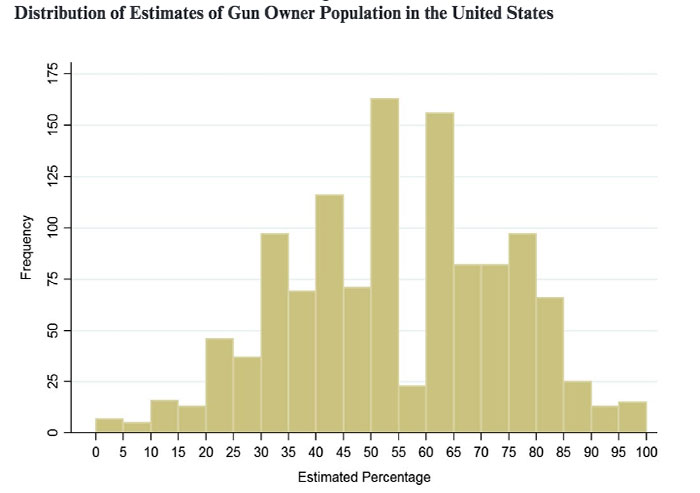
Specifically, the survey asked people to give their “best guess” on what percentage of Americans owned firearms. The actual percentage of U.S. individual gun owners is roughly 25 percent, and about 33-40 percent of U.S. households have at least one gun in the home, the researchers said.
However, the researchers found that more than 75 percent of respondents overestimated the number, and only a small minority, 2.3 percent, underestimated the number of gun owners.
The most common estimate was 50 percent, and nearly one-fifth of respondents estimated the gun owner population was 70 percent or higher.
“Generally speaking, less knowledgeable people tend to overestimate the size of groups, but so, too, do people who belong to the group, have contact with the group or have positive affinity towards the group,” Haider-Markel said. “In short, we inflate the size of groups we belong to or are close to.”
The overestimation of the population among both gun owners and non-gun owners could provide some explanation for the level of support surrounding pro-gun policies or the lack of support for federal gun control measures, even in wake of high-profile mass shootings, such as Newtown, Connecticut; Las Vegas; and Orlando and Parkland, Florida, though the professors said future research would likely examine potential trends after more recent advocacy efforts by gun violence victims.
“We see this as another in a line of politicized issues where facts are contested and factual beliefs might influence policy attitudes on the issue. As such, we wanted to explore basic knowledge about gun owners, perceptions of future gun ownership, and determine whether these perceptions influenced gun attitudes,” Haider-Markel said.
He added that past research in this area is built around the notion of a perceived threat of a group, but rarely is that threat actually assessed.
The researchers have conducted similar research on how people overestimate the gay population in the United States.
“As with the earlier study, people are not very good at estimating the size of groups, and this has implications for their policy preferences,” Haider-Markel said. “Here we can also show that people tend to think that the gun owner population will grow in the future even though all indications are that the gun owner population is getting smaller.”
LAWRENCE – It will take many weapons to fight the epidemic of opioid addiction, but one medication critical to fighting the worst drug crisis in U.S. history remains woefully underprescribed and underutilized, according to research from the University of Kansas Medical Center.
The number of Americans with an opioid addiction has more than doubled in the last 10 years. Meanwhile, drug overdoses have become the leading cause death in the United States for people under 50 years of age and the overall leading cause of death by injury (overdoses are categorized as unintentional injuries by the Centers for Disease Control and Prevention).
Yet there remains a huge gap in the number of prescriptions for buprenorphine, a medication effective in treating opioid addiction, and the skyrocketing number of people who have that addiction, according to research led by Andrew Roberts, Pharm.D., Ph.D., assistant professor in the Department of Preventive Medicine and Public Health at the University of Kansas School of Medicine.
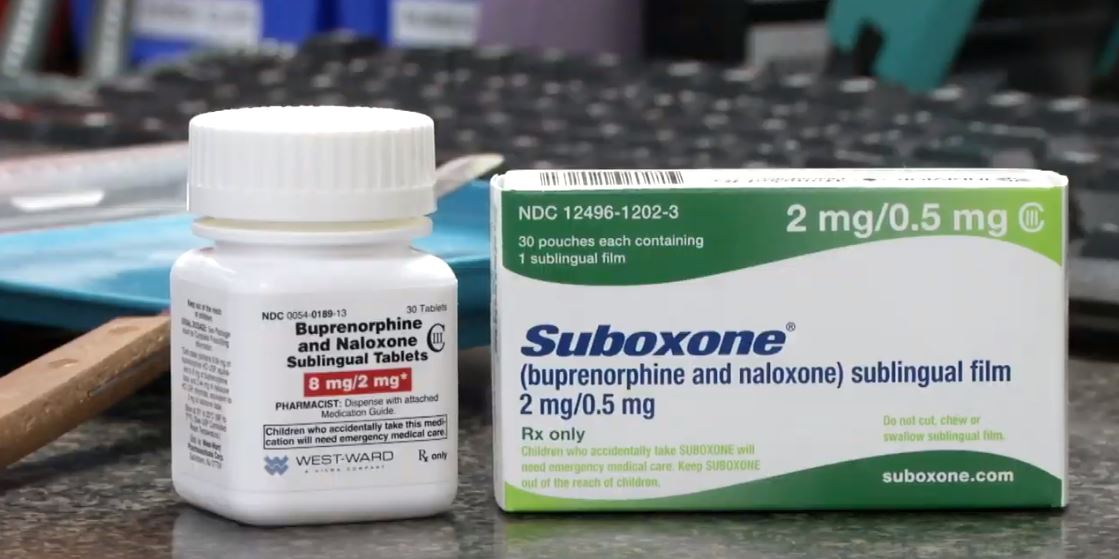
First approved by the Food and Drug Administration in 2002 to treat opioid use disorder, buprenorphine is a partial opioid itself. Also known by its brand name, Suboxone, buprenorphine reduces cravings and relieves withdrawal symptoms but does not produce a high at typical doses. People in recovery from addiction can take buprenorphine to stay physically comfortable while stopping their abuse of riskier prescriptions such as oxycodone or street opioids such as heroin.
Watch the video below of Dr. Roberts and Roopa Sethi, M.D., of the KU addictions clinic discussing buprenorphine barriers and treatment.
Methadone, the better known, older opioid replacement therapy, does the same thing, but is often harder for people to access: in the United States, methadone must be administered to the patient at a clinic certified by the Substance Abuse and Mental Health Services Administration; the methadone clinic system was developed in the 1960s and then carved into law in the Narcotic Addict Treatment Act in 1974. But patients can take buprenorphine at home on a schedule, as they would for any other chronic condition. “It can be prescribed by any physician trained to prescribe it, and you just pick it up at the pharmacy,” said Roberts. “It’s much easier for people to obtain.”
There’s the irony. Of the more than 2 million Americans with opioid addiction, just one in five obtain any treatment. Studies show that the most effective therapy for opioid addiction is medication-assisted treatment: behavioral therapy combined with a medication such as buprenorphine or methadone. In 2016, the same year that more Americans-more than 40,000-died from opioid overdoses than from car accidents, Congress passed the Comprehensive Addiction and Recovery Act to increase treatment access. One provision of the law is an increase the number of people for whom a doctor can prescribe buprenorphine, from 100 to 275 patients per year. Expanding access to the drug has become a major federal priority.
Meanwhile, Roberts and his colleagues were thinking ahead. “Assuming that the provider supply issue could be addressed, we were wondering what other barriers there might be to getting and adhering to treatment.”
They immediately thought of cost, a known treatment barrier with other chronic conditions such as asthma and diabetes. When the price of a medication for those diseases goes up, the less likely people are to take it and the worse their clinical outcomes are.
Roberts also points to the risk of price gouging. The obvious headline-making example is the price of the EpiPen-the life-saving injection device used by millions of Americans to treat lethal allergic reactions-which rose 500 percent over a decade. There’s already some evidence of price gouging happening in the opioid treatment arena. The cost of a twin-pack of injector device to administer naloxone, a drug that can reverse an opioid overdose, has risen to $4,500 in 2018, from $690 in 2014. “We wanted to see if we needed to be worried about the cost of buprenorphine as we try to connect people with treatment,” Roberts said.
Working with researchers from Vanderbilt and Johns Hopkins, Roberts analyzed outpatient prescription claims data from 2003 to 2015, looking at buprenorphine utilization and expenditures for both health plans and insured patients. The database captured 20 million people annually during those years who were in a commercial health insurance plan provided by a large or medium-sized U.S. employer. They wanted to look at privately insured people in particular because these people are more likely to be affected by higher out-of-pocket prescription costs than are Medicare and Medicaid patients.
What they found, Roberts calls a “pleasant surprise”: the median amount paid by private payers (health plans) for a 30-day supply of buprenorphine has remained relatively stable since 2003, and the out-of-pocket median expenditure for privately insured adults has actually steadily decreased over time, from $67 to $32 for a 30-day prescription. Buprenorphine appears to be insulated from the large spending increases that have affected life-saving drugs for other chronic diseases.
But they also saw something worrisome in the data. The number of people taking buprenorphine for treatment increased until 2013, but then the number of people initiating treatment declined from 2013 through 2015. “This is in the face of a massive treatment gap,” said Roberts. “We would have hoped to have seen an exponential increase in the number of people starting treatment-we know they are out there.”
If cost isn’t the barrier to buprenorphine being more widely used, then the question becomes, what is?
One issue, Roberts said, is that although it’s less complicated than methadone, prescribing buprenorphine is more regulated than for other medications. Physicians must take a short training course to get permission to prescribe it. “So there’s that hoop to jump through, and sometimes physicians are leery into wading into that territory [of addiction] clinically. There’s a fear it might invite scrutiny from authorities,” he said. “And then there’s the whole stigma around addiction.”
Brendan Saloner, Ph.D., assistant professor in the Department of Health Policy and Management at the Johns Hopkins Bloomberg School of Public Health and a co-author on the study, also cites stigma as a barrier. “Many patients and doctors still harbor antiquated ideas about how addiction medication works, and there is a pervasive and untrue myth that medication substitutes one form of addiction for another,” he said.
Roberts notes that their data go only through 2015, and the jury is still out on how much of a difference the 2016 regulations, including increasing the number of people doctors can treat with buprenorphine, will make. “But according to our data, the uphill battle to close these treatment gaps is getting providers to participate in this fight,” said Roberts. “And one of the easiest ways to fight it is to get trained and treat patients with this drug.”
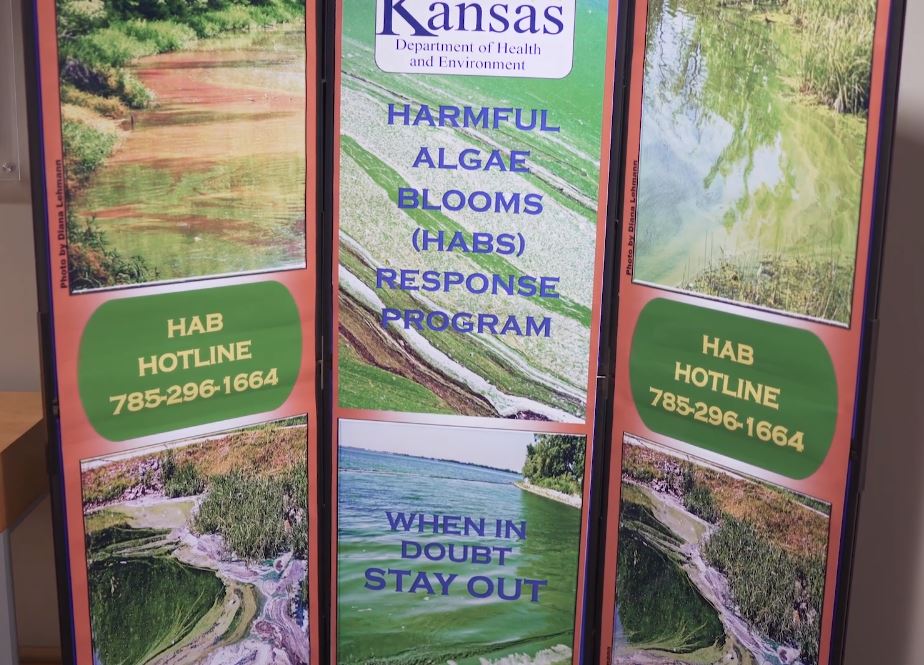
TOPEKA – The Kansas Department of Health and Environment (KDHE) held the 2019 Harmful Algal Bloom Meeting this week at Washburn University in Topeka. The meeting, which included all Kansas agencies which work on harmful algal blooms, discussed health, monitoring and responses due to harmful algal blooms in area water sources.
“At this year’s meeting we have expanded from our recreational stakeholders to include the public water supply operators and other agencies to find the best ways to address issues as they arise,” said Megan Maksimowicz, an environmental specialist at KDHE’s Bureau of Water.
“We want to make sure that we stay on top of all public health and safety issues connected to HABs. We have not had any toxins above the EPA’s health advisory level from HABs in a public water supply system, but we continue to come up with the best ways to prevent this and to monitor these situations.”
Presentation topics included recreation and reservoir research, animal health, testing and monitoring, nutrient reduction and practices, in-lake mitigation strategies, public water supply monitoring, and planning and response, among other discussions. The meeting, hosted by KDHE’s Bureau of Water, has been held annually every winter to engage stakeholders on this challenging issue affecting lakes in Kansas.
PRATT – At its Jan. 17 meeting in Lawrence, the Kansas Wildlife, Parks and Tourism Commission voted on just one item during the Public Hearing session. Commissioners passed a regulation setting the season for hunting on Controlled Shooting Areas to Sept. 1-April 30, extending the season one month, which was approved during last year’s legislative session.
The Commission heard a variety of briefings on proposed regulations during the Workshop Session, including:
Allowing e-bicycles (pedal assist) on trails and in parks
A change to the Public Lands regulations allowing portable blinds to be left out overnight
Allowing the use of calls for squirrel hunting
Changes to the furharvesting regulations, including increasing the season limit on otters to five
The adoption of U.S. Coast Guard navigation rules
A report on the use of unmanned aerial vehicles (drones)
A recommendation to eliminate the $10 duplicate license fee
Antelope season dates: Archery– September 21-29, 2019; Muzzleloader– Sept. 30-Oct. 7, 2019; and Firearm – Oct. 4-7, 2019
Elk season dates: on Fort Riley – Firearm Any-elk, Oct. 1- Dec. 31, 2019; Antlerless-only, Oct. 1-31, 2019, Nov. 1-30, 2019, and Dec. 1-31, 2019; outside of Fort Riley – Muzzleloader, Sep. 1-30, 2019; Archery, Sept. 16-Dec. 31, 2019; and Firearm – August 1-31, 2019, Dec. 4-15, 2019, and Jan. 1-March 15, 2020
Moving the application deadline for resident firearm either-species deer permits and Fort Riley elk permits to the second Friday in June, which coincides with the antelope firearm permit application deadline
Deer season dates: Youth and Hunters with Disabilities – Sept. 7-15, 2019; Muzzleloader – Sept. 16-29, 2019; Archery – Sept. 16-Dec. 31, 2019; Pre-rut Whitetail Antlerless-only – Oct. 12-14, 2019; and Firearm – Dec. 4-15, 2019.
Each of these items will be voted on during the Public Hearing portion of the March 28, 2019 Commission meeting in Topeka, which will be conducted at the Capitol Plaza Hotel. For more information on the Commission, as well as future and past meetings, visit www.ksoutdoors.com.
MANHATTAN — Together, the Kansas Department of Agriculture and the Kansas Department of Commerce were recently awarded a $200,000 State Trade Expansion Program (STEP) Grant award for use in 2019. Since the grant’s inception in 2012, more than 100 Kansas small businesses have participated and achieved $23 million in actual export sales. To further broaden Kansas’ exporter base and to increase the export value and volume, the two departments have joined forces during the 2019 grant year to focus on three main areas: export training, foreign trade shows and trade missions, and market entry support.
The following KDA STEP Grant trade missions are planned for 2019. All dates are tentative.
• Thailand: livestock genetics/equipment and animal health sector, March 28-31, 2019
• Agritech Expo, Zambia: livestock genetics/equipment and animal health sector, April 11-13, 2019
• Foro Mascotas Pet Food International, Mexico: pet food and pet food manufacturing equipment, May 28-30, 2019
• AGRO 2019, Ukraine: agriculture equipment, June 4-7, 2019
Additionally, KDA has planned the following U.S. Livestock Genetics Export trade missions in 2019. The goal of these missions is to provide an opportunity for Kansas’ purebred cattle producers and allied industry to develop relationships with livestock producers to increase market opportunities for U.S. and Kansas beef and dairy genetics.
• La Exposición Rural and ranch visits, Argentina: late July 2019
• Expo Prado and ranch visits, Montevideo, Uruguay: mid-September 2019
Applications for trade missions are due approximately two months prior to tentative travel date. For additional information about the 2019 international travel opportunities, and to apply for any of the missions, please visit www.agriculture.ks.gov/international or contact Suzanne Ryan-Numrich, KDA international trade director, at 785-564-6704 or [email protected].
Total Kansas agriculture exports totaled $3.6 billion in 2017. KDA’s mission is to provide an environment that enhances and encourages economic growth of the agriculture industry domestically and internationally.
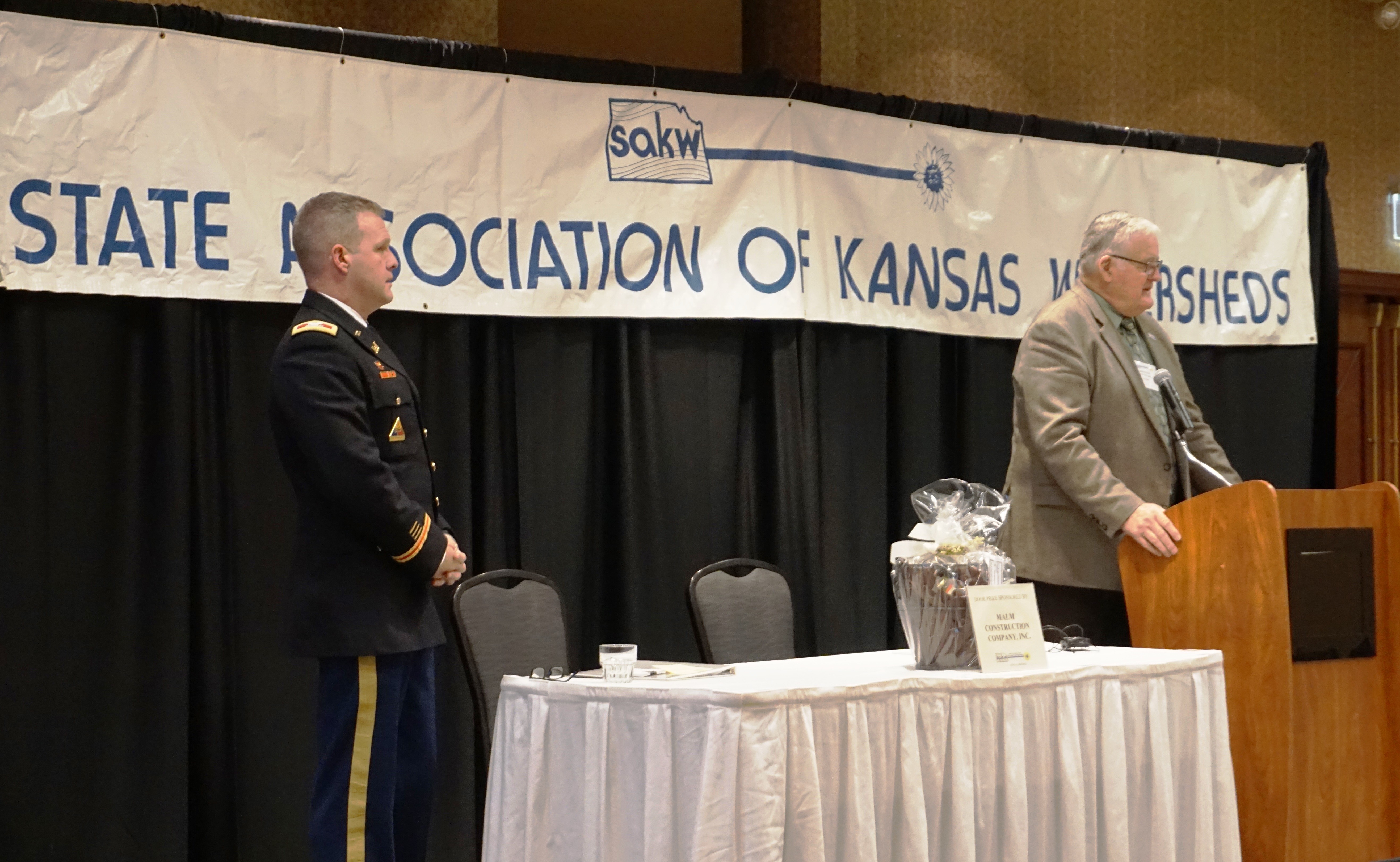
The State Association of Kansas Watersheds held their 68th annual meeting in Topeka Jan. 22, 2019. which brought together the many water district representatives and some of their largest partners in federal, state and local government. Col. Doug Guttormsen, the Kansas City District USACE commander, served as the keynote speaker. Jeremiah Hobbs, vice-president of SAKW, (right) provided the introduction.
USACE
TOPEKA – The State Association of Kansas Watersheds held their 68th annual meeting in Topeka Tuesday which brought together the many water district representatives and some of their largest partners in federal, state and local government.
Col. Doug Guttormsen, the Kansas City District commander of the U.S. Army Corps of Engineers, served as the keynote speaker. He gave an account of the day of the life of his district command experience. He focused on his family life in his off time and on his work making sure we deliver world class projects to the partners we have and emphasized the ones in Kansas.
“Earlier in this fiscal year, we finished a project at McConnell Air Force Base in Wichita, which stands ready to receive the first KC-46 air tankers later this month. Not only did the project come in on time and on budget, other Corps district are coordinating construction at Air Force facilities around the country and the world using elements of the award-winning design and lessons learned from the construction project,” said Guttormsen.
He explained a state-wide sedimentation study which will enhance ongoing projects to determine how to remove silt from our reservoirs. Current projects must decide where to place the dirt and allow for the water supply, flood risk reduction, recreation and other federally mandated functions of the lakes to continue. The life of the reservoirs will be extended by returning some of the original capacity.
The SAKW conference attendees asked several questions about the federal and Corps of Engineers role in regulatory activity and good information was shared.
Earl Lewis, assistant director for the Kansas Water Office, spoke on multiple topics including stream bank erosion mitigation as a key element in reducing sedimentation and extending the usefulness and life of the reservoirs in Kansas.
Rob Reshke, executive director, of the Kansas Department of Agriculture, Division of Conservation, spoke on several topics to include the planned release of an updated Watershed District Handbook by July 2019.
The conference continued through Tuesday and Wednesday.
“We couldn’t hope for better partners than we find here with the State Association of Kansas Watersheds,” said Guttormsen.

 MANHATTAN – The American Legion Boys State of Kansas Leadership Academy is now taking applications for its 2019 session. The event, which will be in its 82nd year, will be held Sunday, June 2, through Friday, June 7, at Kansas State University in Manhattan.