We have a brand new updated website! Click here to check it out!

EPA grants available for eliminating diesel engine fleets

EPA

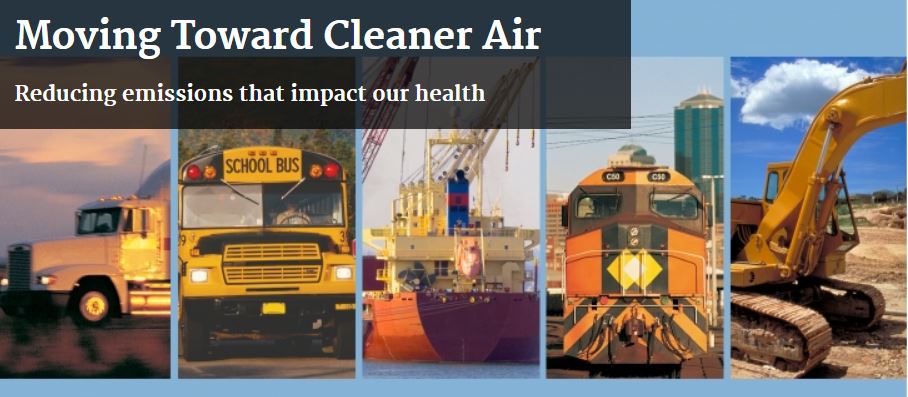
LENEXA – The U.S. Environmental Protection Agency (EPA) announces the availability of $1.5 million grant funding in EPA Region 7 to implement projects aimed at reducing emissions from the region’s existing fleet of older diesel engines.  EPA anticipates awarding approximately $40 million in Diesel Emission Reduction Program (DERA) grant funding nationally to eligible applicants, subject to the availability of funds.

“By financially supporting projects that upgrade aging diesel engines, EPA is helping improve their efficiency and reduce air pollution throughout the nation,” said EPA Acting Administrator Andrew Wheeler. “From our grant programs to our new Cleaner Trucks Initiative, EPA is taking important steps to help modernize heavy-duty trucks and provide cleaner, more efficient methods of transportation that will protect the environment and keep our economy growing.”

Diesel-powered engines move approximately 90 percent of the nation’s freight tonnage, and today nearly all highway freight trucks, locomotives, and commercial marine vessels are powered by diesel engines.

EPA is soliciting applications nationwide for projects that significantly reduce diesel emissions and exposure, especially from fleets operating at goods movements facilities in areas designated as having poor air quality. Priority for funding will also be given to projects that engage and benefit local communities and applicants that demonstrate their ability to promote and continue efforts to reduce emissions after the project has ended.

EPA anticipates releasing a separate Tribal Clean Diesel funding opportunity in late 2019.

In October, during Children’s Health Month, EPA announced the availability of approximately $9 million in rebates to public school bus fleet owners to help replace or upgrade older engines. This is the sixth rebate program to fund cleaner school buses under DERA, that have supported nearly 25,000 cleaner buses across the country for America’s school children.

Background

Since the first year of the DERA program in 2008, EPA has competitively awarded over 530 grants and 390 rebates across the country. Many of these projects funded cleaner diesel engines that operate in economically disadvantaged communities whose residents suffer from higher-than-average instances of asthma, heart and lung disease.

Eligible applicants include regional, state, local or tribal agencies, or port authorities with jurisdiction over transportation or air quality. Nonprofit organizations may apply if they provide pollution reduction or educational services to diesel fleet owners or have, as their principal purpose, the promotion of transportation or air quality. Applicants may apply until Wednesday, March 6, 2019.

Under this competition, EPA anticipates awarding between 40 and 80 assistance agreements. Applicants must request funding from the EPA regional office which covers the geographic project location. The maximum amount of federal funding that may be requested per application varies by Region.

  • Region 1 (Connecticut, Massachusetts, Maine, New Hampshire, Rhode Island, Vermont) will accept proposals requesting up to $1,000,000 in grant funds.
  • Region 2 (New Jersey, New York, Puerto Rico, U.S. Virgin Islands) will accept proposals requesting up to $2,500,000 in grant funds.
  • Region 3 (Delaware, District of Columbia, Maryland, Pennsylvania, Virginia, West Virginia) will accept proposals requesting up to $2,500,000 in grant funds.
  • Region 4 (Alabama, Georgia, Florida, Kentucky, Mississippi, North Carolina, South Carolina, Tennessee) will accept proposals requesting up to $2,000,000 in grant funds.
  • Region 5 (Illinois, Indiana, Michigan, Minnesota, Ohio, Wisconsin) will accept proposals requesting up to $3,000,000 in grant funds.
  • Region 6 (Arkansas, Louisiana, New Mexico, Oklahoma, Texas) will accept proposals requesting up to $2,500,000 in grant funds.
  • Region 7 (Iowa, Kansas, Missouri, Nebraska) will accept proposals requesting up to $1,500,000 in grant funds.  For questions about the regional program, contact Greg Crable, [email protected] or 913-551-7391.
  • Region 8 (Colorado, Montana, North Dakota, South Dakota, Utah, Wyoming) will accept proposals requesting up to $2,400,000 in grant funds.
  • Region 9 (Arizona, California, Hawaii, Nevada, Guam, American Samoa, Northern Mariana Islands) will accept proposals requesting up to $4,000,000 in grant funds.
  • Region 10 (Alaska, Idaho, Oregon, Washington) will accept proposals requesting up to $1,000,000 in grant funds.

For more information and to access the Request for Applications, visit www.epa.gov/cleandiesel/clean-diesel-national-grants.

For more information on the National Clean Diesel campaign, visit www.epa.gov/cleandiesel

Kan. lawmakers get plum committee roles for switching

By JIM MCLEAN
Kansas News Service

TOPEKA – Two Kansas state senators who earlier this week jumped from Republican to Democratic ranks have been rewarded with choice committee assignments.

The assignments given to the former moderate Republicans, Sen. Barbara Bollier of Mission Hills and Sen. Dinah Sykes of Lenxa, make them key players on two of the most contentious issues awaiting the Legislature — school spending and Medicaid expansion.

Bollier is now the top Democrat on the Senate Public Health and Welfare Committee. Before her party switch, she was the panel’s vice-chair. But Republican leaders stripped her of that rank last summer for endorsing a Democratic candidate for Congress.

“This isn’t about me, it’s about Kansans,” Bollier said. “I just want to get to work.”

Sykes is trading up on the Senate Education Committee. She’ll go from being a rank-and-file GOP member to the senior Democrat on the panel. That puts her in the thick of negotiations over how to end years of litigation over school funding.

“The opportunity to serve as the ranking minority on this committee will allow me to better represent my constituents and help shape legislation that moves through conference committees,” Sykes said in an email to the Kansas News Service.

Three-member conference committees work out differences between House and Senate versions of bills. As ranking Democrats on their respective committees, Sykes and Bollier will participate in those negotiations.

Senate Minority Leader Anthony Hensley, a Topeka teacher who had long served as the top Democrat on the education committee, stepped down to make way for Sykes.

“I’m willing to relinquish that position because I know the education issue is very, very important to Johnson County and to Sen. Sykes’ constituents,” Hensley said.

Last session, lawmakers approved a plan to put an additional $522 million into the school funding formula over five years. They believed at the time that would be enough to satisfy the Kansas Supreme Court and end a lengthy court battle with school districts.

But the court ruled that the state needed to spend another $364 million to cover inflation.

When the 2019 session begins on Jan. 14, the debate will focus on whether the state can afford that. Some Republican leaders don’t think so.

“I don’t want to make a commitment the state can’t fulfill,” Senate Majority Leader Jim Denning said at a recent meeting with Johnson County educators, according to the Wichita Eagle.

Still, Hensley said he expects Democratic Gov.-elect Laura Kelly to include the funding increase in her proposed budget.

“I believe the state can afford that,” Hensley said, noting that only about $300 million of the proposed increase would come out of the state’s general operating fund.

Money generated by a statewide property tax levy for schools would cover the rest, he said, citing an analysis done by the Kansas State Board of Education.

Attorneys for the school districts involved in the lawsuit have said the amount specified by the court would satisfy them.

Bollier will be a key player in the push to expand Medicaid to cover an additional 150,000 low-income, elderly and disabled Kansans.

“That is an absolute priority,” she said.

A coalition headed by the Kansas Hospital Association has been lobbying for expansion with little success since 2014. Lawmakers passed an expansion bill in 2017, but they fell a few votes short of overriding Republican and then-Gov. Sam Brownback’s veto.

Many Republican leaders remain opposed to expansion, but it’s a priority for Kelly. And that has expansion advocates cautiously optimistic heading into the session.

“It changes the landscape dramatically because you have a governor who will not only sign a bill, but who will actually be pushing for Medicaid expansion,” said Tom Bell, president and CEO of the hospital association.

There were few other changes in the makeup of Senate committees, other than the announcement that Gene Sullentrop, a conservative Republican from Wichita, will replace Vicki Schmidt as chair of the health committee. Schmidt, a moderate Republican from Topeka, was elected insurance commissioner in November.

Jim McLean is managing director of the Kansas News Service, a collaboration of KCUR, Kansas Public Radio, KMUW and High Plains Public Radio covering health, education and politics. You can reach him on Twitter @jmcleanks.

Ag aircraft manufacturer to locate headquarters in Newton

KDC

NEWTON – Through regional efforts, Harvey County Economic Development and the Greater Wichita Partnership worked with the Kansas Department of Commerce to assist Weatherly Aircraft Company in locating their headquarters and assembly operations to a 26,000 sq. ft. facility at the Newton City-County airport.

Weatherly Aircraft Company is an American agricultural aircraft manufacturer of planes designed for small grain farming. The company plans to add about 109 jobs in the next five years and invest over $1 million in capital investment.

Gary Beck, General Manager for Weatherly said, “As a first move to make Weatherly Aircraft Company’s new home in Kansas, we have selected hangar space at the Newton City-County Airport as an assembly facility for our model 620-B plane.  We appreciate the support we have been provided and will begin production within the first quarter of 2019.”

The city of Newton Commission and the Harvey County Commission voted to approve a five-year lease at a special joint meeting on Dec. 20. Weatherly Aircraft will take possession in February, 2019 and be operational beginning March, 2019.

“Weatherly Aircraft will be a great addition to a growing list of dynamic manufacturers in Newton and Harvey County who are doing business all over the world,” said Bob Myers, Newton City Manager.

Harvey County Economic Development Executive Director, Beth Shelton said, “We are delighted to welcome Weatherly Aircraft to the Newton City-County Airport. This project is a wonderful example of collaboration between our city, county, region, and state working together to facilitate growth and create valuable jobs in Harvey County.”

“This is another terrific development for the city of Newton, for our aviation industry, and for Kansas as a whole,” said Robert North, interim Secretary of the Kansas Department of Commerce. “Weatherly Aircraft Company’s decision to move their manufacturing operations to Kansas is the right move for them. The amount of new employment opportunities coming to Newton is really extraordinary.”

“We were honored to support Weatherly Aircraft Company’s search for new facilities outside of California by demonstrating opportunities available throughout our region,” said Andrew Nave, Executive Vice President of Economic Development for the Greater Wichita Partnership.

“The Newton City-County airport provided an ideal site for this exciting aviation business and the city of Newton, Harvey County Economic Development and the Kansas Department of Commerce worked very collaboratively to make the business case to win this company to our region.”


Bus rear ended in Finney County

Hays Post

A bus was involved in an accident in Finney County on Thursday afternoon.

Kelsey B. Kelley, 32, of Garden City was talking on her cell phone when she pulled forward at a traffic stop on U.S. Highway 50 at milepost 69 and rear ended the bus, according to the Kansas Highway Patrol report.

No one on the bus was injured. The accident happened at 3:40 p.m.. It was unclear in the report who was on the bus at the time of the crash.

Kelley reported possible injuries at the time of the accident, but was not transported to the hospital via ambulance.

The driver of the bus, Maria I Ortiz-Corrales, 31, of Garden City, reported no injuries.

Senate approves Moran-supported bill for veterans’ full housing benefits

OFFICE OF SEN. MORAN

WASHINGTON – The U.S. Senate unanimously approved the Forever GI Bill Housing Payment Fulfillment Act, legislation cosponsored by Senator Jerry Moran (R-Kan.) – member of the Senate Veterans’ Affairs Committee – to make certain the Department of Veterans Affairs (VA) reimburses veterans for missed or underpaid Forever GI Bill housing benefits.

“It is imperative that the VA make every effort to restore confidence with veterans by delivering the care and benefits they have earned,” said Sen. Moran. “I am pleased the U.S. Senate sent a clear message that the VA must earn back GI Bill beneficiaries’ trust, and I’m proud to help lead efforts that will make the VA worthy of the service and sacrifice of our nation’s heroes. The unanimous passage of this legislation moves us one step closer toward that goal.”

This legislation will address the VA’s failure to fully comply with reimbursement rates set by the Forever GI Bill. The improper payments resulted from IT systems that had not been properly updated and lack of internal processes to get the VA the necessary information about payment rates.

The VA should have used the Department of Defense’s 2018 Basic Allowance for Housing rates, which should have been calculated based on the zip code where the student takes the majority of classes, rather than on the zip code in which the school’s main campus is located. Instead, some GI Bill recipients have been receiving housing stipends at the 2017 rate and based on the school’s zip code. In all cases, the 2018 rate is higher than the 2017 rate.

The legislation was introduced by Senators John Boozman (R-Ark.) and Brian Schatz (D-Hawaii), and is cosponsored by Senators Jon Tester (D-Mont.), Richard Blumenthal (D-Conn.), Thom Tillis (R-N.C.), Joe Manchin (D-W.Va.), Michael Bennet (D-Colo.), Mark Warner (D-Va.), Debbie Stabenow (D-Mich.) and Maggie Hassan (D-N.H.).

The Forever GI Bill Housing Payment Fulfillment Act would require the VA to:

  • End improper payments as soon as possible;
  • Establish a team of specialists who will be responsible to report to Congress a detailed plan to correct this egregious error;
  • Provide a report to Congress by July 2020 that identifies how many beneficiaries were impacted and to what extent, aggregated by state; and
  • Certify the department is fully compliant with the law.

New state director for BLM

BLM

WASHINGTON – The Bureau of Land Management today announced the appointment of Tim Spisak, a 34-year career BLM employee, as State Director for New Mexico, Oklahoma, Texas and Kansas.  Spisak, who has been serving as acting New Mexico State Director since October, previously served as the BLM’s Deputy Assistant Director for Energy, Minerals, and Realty Management. 

In making the announcement, BLM Deputy Director for Policy and Programs Brian Steed said, “Tim Spisak is a true professional with decades of experience contributing to the BLM’s multiple-use mission on behalf of the American people.  We’re excited to have Tim leading our agency forward in New Mexico, strengthening and expanding our partnerships with state and community leaders and being a good neighbor.”

As New Mexico State Office Director, Spisak will oversee more than 630 BLM employees in New Mexico, Oklahoma, Texas and Kansas; 13.5 million acres of public lands; and 42 million acres of Federal oil, natural gas, and minerals managed for the use and enjoyment of present and future generations.

During his BLM career, Spisak has worked as a Petroleum Engineer, Supervisory Petroleum Engineer, Program Analysis Officer, and Administrative Officer.  He also served for five years as the Amarillo Field Office Manager overseeing the Federal Helium Program in Amarillo Texas, five years as Fluid Minerals Division Chief in the BLM Washington Office, five years as the Deputy Assistant Director for Energy, Minerals and Realty Management, and three years as Senior Advisor – Conventional Energy. He has served as the Deputy Assistant Director for Energy, Minerals and Realty Management since 2017.

Spisak replaces Aden Seidlitz, who led the New Mexico State Office in an acting capacity for more than a year, tackling challenges related to overseeing the largest oil and gas lease sale in BLM’s history (almost $1 billion), expanding public access to the Sabinoso Wilderness through an acquisition, and working with Tribes and Pueblos on conservation of cultural and natural resources. Seidlitz has returned to his role as Associate State Director.

Spisak has a Bachelor of Science Degree in Petroleum and Natural Gas Engineering from Pennsylvania State University, and a Master of Business Administration Degree from West Texas A&M University.

Moran applauds passage of ‘remarkable’ bipartisan prison, sentencing reform

OFFICE OF SEN. MORAN

WASHINGTON – U.S. Senator Jerry Moran (R-Kan.) – chairman of the Senate Appropriations Subcommittee on Commerce, Justice, Science, and Related Agencies (CJS) – Tuesday applauded the Senate’s passage of the First Step Act, S.3649, of which he is an original cosponsor, to reduce recidivism, promote public safety and improve fairness in the sentencing of federal crimes.

“The First Step Act is a remarkable bipartisan achievement,” said Sen. Moran. “Supported by the president, a supermajority of the United States Senate, and law enforcement and advocacy groups from across the political spectrum, this legislation will allow non-violent offenders to serve time that fits their crime and then, importantly, provide them the opportunity to re-emerge as productive members of society. This legislation is an important first step in promoting a fair and effective criminal justice system, and as chairman of the CJS Appropriations Subcommittee, I will work to make certain law enforcement has the tools it needs to remain tough on crime and provide former prisoners a second chance at life.”

Included in the First Step Act is reauthorization of the Second Chance Act, which includes grant programs for drug rehabilitation, vocational training, mentoring, and other reentry and recidivism reduction initiatives. Sen. Moran’s CJS Appropriations Subcommittee overwhelmingly voted to fund the Second Chance Act’s grant programs at $90 million for FY19.

This comprehensive package aims to reduce crime by helping low-risk inmates prepare to successfully rejoin society through participation in proven recidivism reduction and professional development programs. It recalibrates certain mandatory minimum sentences, grants greater discretion for judges in the sentencing of low-level, nonviolent drug crimes and clarifies congressional intent on sentencing enhancements for certain crimes involving firearms. It also preserves the maximum potential sentences for violent and career criminals. The legislation allows petitions for retroactive application of the Fair Sentencing Act to be considered on an individual basis to reduce sentence disparities between crack and powder cocaine offenses.

Under this legislation, savings generated by the reforms would automatically be reinvested into law enforcement programs to further reduce crime and improve community safety.

Items to note:

Approval grants state authority to continue Medicaid program

KDHE

TOPEKA The Kansas Department of Health and Environment (KDHE) announced Tuesday that the Centers for Medicare and Medicaid Services (CMS) approved the state’s 1115 waiver extension application. The 1115 waiver grants the state of Kansas the authority to operate KanCare, the state’s managed care program.

“I want to thank Administrator Seema Verma and the rest of the Trump administration for approving our 1115 wavier extension,” said Governor Jeff Colyer, M.D. “With the extension, our state can continue to be innovative in the way we address the health care needs of Kansans.”

“I want to congratulate Governor Colyer and his team for their hard work and commitment to serving Kansans,” said CMS Administrator Seema Verma. “The renewal of KanCare will strengthen their program by expanding access to substance use disorder treatment and other supportive services and ensure that this program will continue to deliver value to their state.”

The approved Kansas 1115 waiver extension application included the state requesting authority to implement a supported employment pilot for individuals with disabilities; a waiver of the 15-day monthly maximum on Substance Use Disorder (SUD) Institute for Mental Disease (IMD) utilization for members ages 21-64; and request to extend the Delivery System Reform Incentive Payment (DSRIP) program until an alternative payment model (APM) model will be in place. To gain CMS approval of the 1115 wavier extension the state also had to demonstrate that the federal expenditures were going to be less with the proposed waiver versus operating a program without a waiver.

“It was a collaborative effort and I couldn’t be prouder of the state Medicaid staff that worked on this effort,” said State Medicaid Director Jon Hamdorf. “The CMS team led by Deputy Administrator Mary Mayhew was fantastic and the assistance from our partners at Navigant Healthcare and Optumas, our actuary firm, were instrumental in our success in getting the waiver extension approved.”

“We want to thank CMS for their partnership as we seek to be innovative in finding ways to create better access,” said KDHE Secretary Jeff Andersen. “This approval will make it easier for Kansans to receive the necessary care to stay healthy.”

In the original 1115 waiver extension application, the state also requested authority to implement a community engagement/work requirements program and a new community service coordination program. However, these programs are not going to be implemented in January due to direction given by the legislature through a budgetary proviso. For these programs to be implemented, the state would need to amend the currently approved waiver to negotiate the terms and conditions of those programs.

The approved version of the 1115 waiver extension will be available shortly on the KanCare website at: www.kancare.ks.gov

Kansas teen births declining, yet remain higher than U.S. rate

KDHE

TOPEKA – The Kansas Department of Health and Environment (KDHE) Bureau of Epidemiology and Public Health Informatics published the 2017 Kansas Adolescent and Teenage Pregnancy Report on its website at https://www.kdheks.gov/phi/adol_teen_preg/Adolescent_Teenage_Pregnancy_17.pdf.

The statistical summary indicates that the pregnancy rates among Kansas resident females aged 10-19 dropped by 1.6 percent from 2016 to 2017. Rates among females 10-17 and 15-17 as individual age groups also dropped in 2017. However, pregnancy rates among females aged 18-19 years increased 3.2 percent.

“We are encouraged by the continued decline in the teen pregnancy rates for several Kansas counties and the state overall,” said Rachel Sisson, MS, Director of the KDHE Bureau of Family Health. “KDHE remains committed to working closely with local partners and communities to identify, support and spread strategies and interventions that are making a difference.”

The 2017 Kansas pregnancy rate among females 15-17 years of age (9.5 per 1,000 female age-group population) compares favorably with the Healthy People 2020 (HP 2020) national target of 36.2 pregnancies per 1,000 female age-group population. The state pregnancy rate for females aged 18-19 (48.9 per 1,000 age-group population) also compares favorably with the HP 2020 national target of 105.9 pregnancies per 1,000 female age-group population.

While Kansas had lower teen pregnancy rates than the national targets, the state’s birth rates for females aged 15-19 were lower than the national rates from 1996 to 2006.

Since 2008, teen birth rates in Kansas have remained higher than the U.S rate; however, both Kansas and the U.S. teen birth rates have been declining since then. In 2017, the Kansas rate was unchanged from 2016, while the preliminary U.S. rate for 2017 is not yet available.

KDA to exercise foreign animal disease response

KDA

Manhattan — The Kansas Department of Agriculture will lead an emergency preparedness exercise, named Rampart, Dec. 17–20, 2018, in Manhattan, Kansas, to practice the state’s response plan to a foreign animal disease event.

The four-day functional exercise, which will be based out of KDA headquarters in Manhattan, will enable KDA and its partners in other state agencies, federal and local government, industry, university and 16 other states to practice the state’s foreign animal disease response plan. More than 200 individuals will participate in the Rampart exercise, which will be based on a fictional scenario involving the confirmation of foot-and-mouth disease in the United States.

In addition to KDA, which will operate as the Incident Command Post for the exercise, the Kansas Division of Emergency Management and multiple Kansas counties will activate emergency operations centers as part of the Rampart exercise.

Foot-and-mouth disease was last identified in the United States in 1929. FMD is a highly contagious disease of cattle, sheep, swine, goats, deer and other cloven-hooved animals. It is not a human food safety concern nor a public health threat. It is a primary concern for animal health officials because it could have potentially devastating economic consequences due to disrupted trade and lost investor confidence.

The exercise has been partially funded with a grant provided by the U.S. Department of Homeland Security.

Moran introduces bipartisan bill to make oral cancer meds more affordable

Chronic myelogenous leukemia oral treatment

OFFICE OF SEN. MORAN

WASHINGTON – U.S. Senators Jerry Moran (R-Kan.) and Tina Smith (D-Minn.) Wednesday introduced the Cancer Drug Parity Act to make certain oral cancer drugs are covered in the same way as traditional (IV) chemotherapy to bring down costs for Americans battling cancer. The Cancer Drug Parity Act, which is co-sponsored by Senators Roger Wicker (R-Miss.) and Chris Murphy (D-Conn.), is needed to make certain the way health care covers cancer treatment catches up to the advances in oral cancer medications.

Currently, over 40 states – including Kansas – have passed “oral parity” laws that stop insurers from charging more for prescribed oral cancer medicine than IV chemotherapy. The Cancer Drug Parity Act would build on this work by expanding these protections at the federal level.

“Individuals suffering from cancer deserve the best treatment options available through their insurance,” said Sen. Moran. “As the number of oral cancer drugs increase each year, patients ought to be able to immediately benefit from these medical advancements. This sensible legislation would keep health insurance on pace with the latest cancer treatments, build on laws already implemented in 43 states and expand cancer coverage for oral drugs for 100 million individuals covered through group and individual health plans. I am a strong supporter of medical research to find new treatments, therapies and cures, and I am working to make certain these exciting new treatments can reach cancer patients and ultimately save lives.”

The Cancer Drug Parity Act is supported by more than 30 organizations, including The Leukemia & Lymphoma Society.

“Many patients face obstacles when accessing oral chemotherapy drugs,” said Director of The University of Kansas Cancer Center and President of the Association of American Cancer Institutes Dr. Roy Jensen, which represents 98 academic cancer centers across North America. “At a time when developments in cancer care are advancing rapidly, it is essential for cancer centers like ours to provide patients with access to the best treatment. For some patients, there are no viable alternatives to oral chemotherapy drugs, which often come with high out-of-pocket costs. Oral chemotherapy is a priority for KU Cancer Center and for AACI, and we are delighted that Senators Moran and Smith are introducing this much-needed legislation.”

“Science is dramatically changing the way cancer is treated. Even with these breakthroughs, too many cancer patients can’t access their treatments because insurance rules have not kept pace with innovation,” said President and CEO of The Leukemia & Lymphoma Society Louis J. DeGennaro, Ph.D. “The Cancer Drug Parity Act will eliminate the financial barriers that stand between many cancer patients and the breakthrough treatments that could save their lives. The Leukemia & Lymphoma Society applauds Senator Smith and Senator Moran for their leadership on behalf of cancer patients and stands ready to work with Congress to move this important bill forward.”

The Cancer Drug Parity Act would:
• Prevent insurers from covering oral and self-administered medicines at different cost-sharing rates than IV chemotherapy;
• Not mandate that healthcare plans provide chemotherapy coverage, but rather only apply to plans already covering chemotherapy.

Read a summary of the bill here and full bill text here.

December 15 declared Bill of Rights Day

LPKS

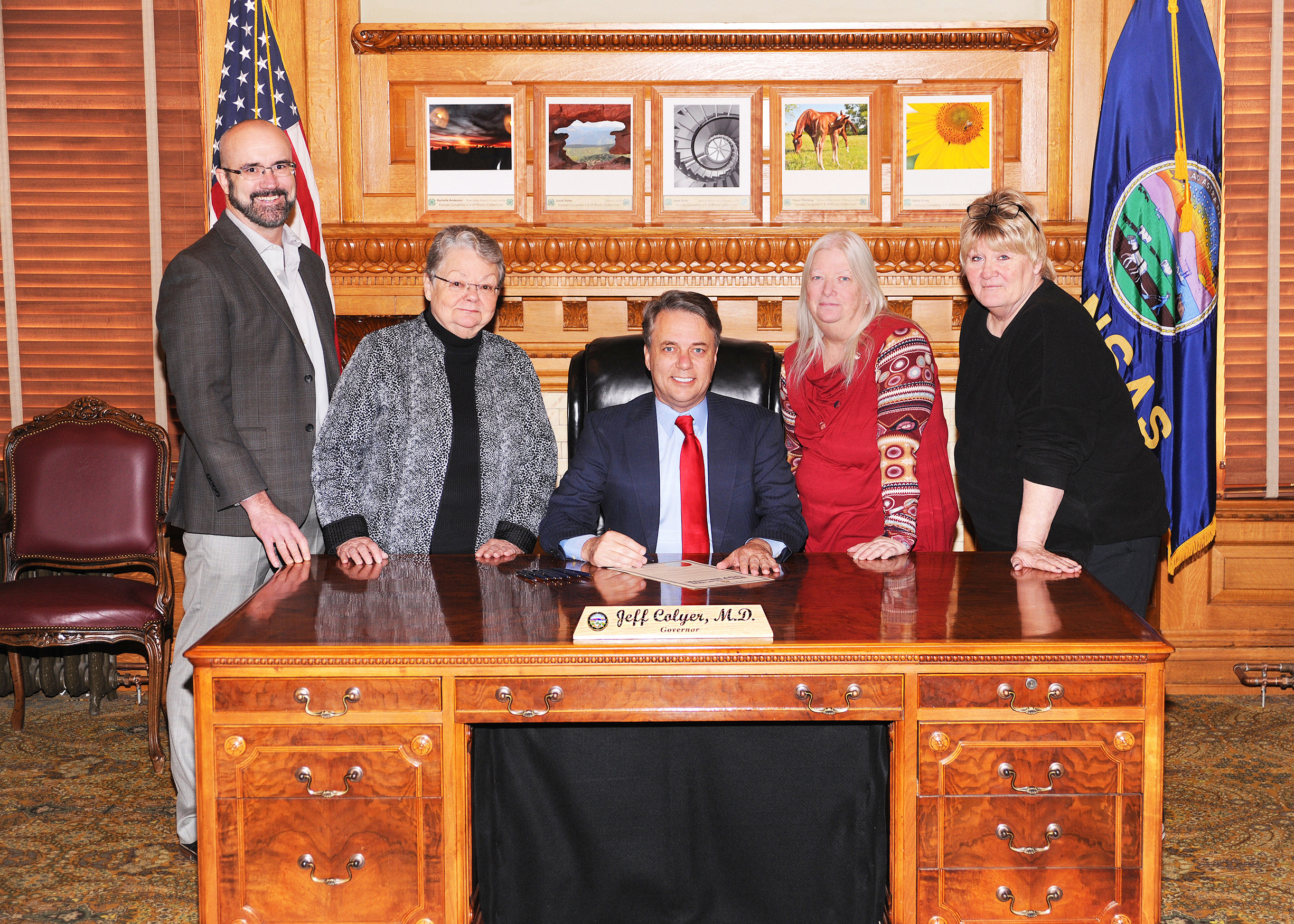
Stacey Davis; Sharon DuBois, LPKS Vice Chair; Gov. Jeff Colyer; Patricia Rowand Szini; and Lois Covey

TOPEKA – On Tuesday, November 20, Kansas Governor Jeff Colyer signed a proclamation declaring December 15 Bill of Rights Day in Kansas. The proclamation asks all Kansans to learn about the first ten amendments to the United States Constitution, which are the foundation of American freedoms. The Libertarian Party of Kansas (LPKS) requested the Governor to make the proclamation.

The Bill of Rights was ratified on December 15, 1791, and protects the rights of U.S. citizens to religious freedom, freedom of speech, freedom of the press, freedom of assembly, freedom from unreasonable search and seizure, among many others.

“There are few documents in the history of the world with as much impact on protecting people from tyranny,” said Kris Logan, Chair of the LPKS. “It’s important that we celebrate not only the ideas contained in the Bill of Rights, but that we remember and honor all those who have suffered and died to keep our freedoms alive.”

The Libertarian Party was founded in 1971, and is the third largest political party in the United States. Fiscally responsible and socially accepting, the LP promotes the ideals of individual liberty and personal responsibility.

The LPKS has had full ballot access in Kansas since 1992.

MORAN: Proposed WOTUS rule would ‘cut red tape for Kan. producers’

OFFICE OF SEN. MORAN

WASHINGTON – U.S. Senator Jerry Moran (R-Kan.) – member of the U.S. Senate Committee on Environment and Public Works – released the following statement after the U.S. Environmental Protection Agency (EPA) and the U.S. Army Corps of Engineers announced a proposal to better define “waters of the United States” (WOTUS) that clarifies federal authority under the Clean Water Act:

“It is critical that we work to protect our wetlands and waterways for future generations. The proposed WOTUS rule aims to promote clean water, while providing clarity to stakeholders on EPA’s jurisdiction under the Clean Water Act. This provides a welcome change from the overreaching Obama-era WOTUS rule by providing a sensible, clear definition that will result in better utilization of resources and cut red tape for Kansas producers. I will work with the administration to make certain its implementation works for farmers, ranchers and other stakeholders.”

Items to note:
• The proposed rule would provide clarity and consistency for farmers, ranchers and other stakeholders across the country, specifically regarding the limits and jurisdiction of the Clean Water Act. More information about the proposed rule can be found here.
• The EPA will take comment on the proposal for 60 days. More information about submitting comments to the agencies regarding the proposed rule can be found here.

Copyright Eagle Radio | FCC Public Files | EEO Public File