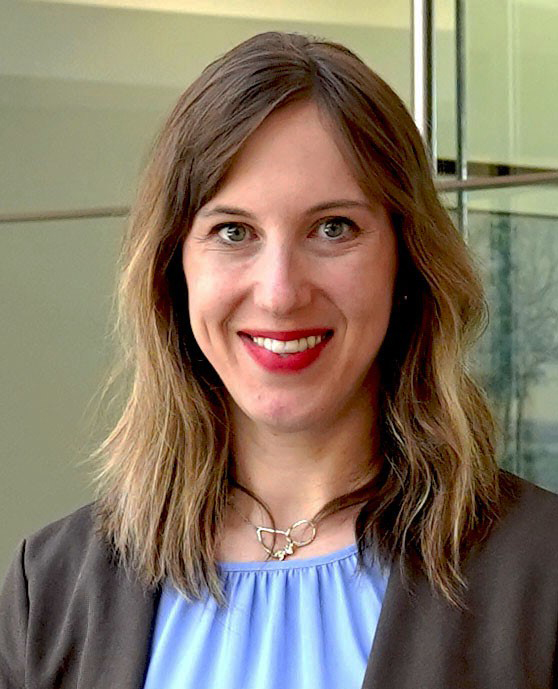
TOPEKA – Kansas Department for Children and Families secretary Laura Howard named Megan Dodge deputy secretary of operations for the agency. Dodge brings years of experience in government management to the position.
“I am excited Megan has decided to share her talent and expertise in public administration with the Department for Children and Families,” Howard said. “We have a lot of moving parts in DCF and I am confident Megan will use her experience and talent to ensure the agency runs smoothly.”
Dodge and her family recently returned to Kansas after living in San Antonio, Texas for several years. She served in various capacities working for the City of San Antonio, most recently as assistant director for the government & public affairs department, where she oversaw government relations, audio visual/video production and creative services. During her tenure, Dodge worked to implement San Antonio’s legislative priorities and led various projects to enhance public participation and transparency in city government, serving a community of 1.5 million residents. While in San Antonio, Megan also worked in the office of management & budget and the city manager’s office.
Prior to her work in San Antonio, Dodge also served Kansas local governments, working in the county manager’s office for Johnson County and in the city manager’s office for Bonner Springs.
“My family and I are thrilled to be back in our home state of Kansas,” Dodge said. “I look forward to supporting the great teams we have at DCF, making sure employees have the resources necessary to do the important work of protecting children and strengthening families.”
In her role as deputy secretary of operations, Dodge will manage the agency’s information technology, fiscal and facilities departments.
Dodge is a proud native Kansan and lifelong Jayhawk. After earning a bachelor’s degree in Spanish and Public Administration at the University of Kansas, she completed KU’s Master of Public Administration Program, which is ranked top in the nation for programs of its kind.
She and her husband are raising two children in Lawrence.
TOPEKA – With the goal of providing vulnerable families access to strong evidence-based programs, Governor Laura Kelly Friday announced new grantees for the state’s family preservation program.
“At the beginning of my administration I canceled previously awarded family preservation grants because of the lack of transparency,” Kelly said. “Today, I am pleased to say that the Department for Children and Families with assistance from the Department of Administration have chosen well qualified partners to assist in our efforts to strengthen families.”
“I am excited that these new grantees include familiar faces and new partners,” Department for Children and Families Secretary Laura Howard said. “DCF looks forward to working together to reduce risk and safety concerns for children and keep Kansas families together.”
Family preservation is a voluntary service provided to families with a child at risk of entering foster care. It includes both short term case management services and intensive in-home services. The program also may serve pregnant women using substances to help the mother find and maintain substance use treatment.
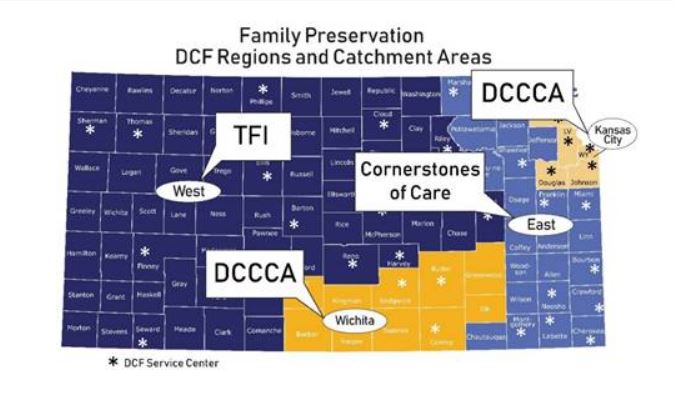
Beginning Jan. 1, three grantees will manage the four DCF regions.
· DCF awarded DCCCA the contracts in the Kansas City and Wichita Regions. DCCCA has 12 years of experience providing family preservation services in Kansas. The agency also has more than 30 years as a prevention services provider and more than 43 years as substance use disorder and addiction provider.
“Given DCCCA’s experience with family services, expertise in substance abuse programming, ability to engage communities and our mission of improving lives, these family preservation grants allow us to combine our strengths,” DCCCA CEO Lori Alvarado said. “Our ultimate goal is to strengthen families and support them to nurture their children, which helps reduce the number of children in care.”
· DCF awarded TFI Family Services the contract for the West region. TFI previously provided family preservation services in Kansas from 2005 to 2009. The agency also has provided recruitment, training, retention and support of foster families across Kansas since 1996.
“TFI Family Services is honored to be selected as the provider for family preservation services in the west region,” TFI CEO Michael Patrick said. “We are excited that our TFI caseworkers and therapists will have the opportunity to serve some of our most at-risk families and ensure they remain safely together as a family.”
· Cornerstones of Care of will manage the contract in the East region. Cornerstones provides intensive in-home services in several Missouri counties including the Kansas City area. The agency also is providing family services for the DCF Kansas City region and functional family therapy for the Kansas Department of Corrections.
“We’re beyond honored and grateful to grow our partnership with the State of Kansas across the DCF East region,” Cornerstones of Care president and CEO Denise Cross said. “We strongly believe in prevention services and will work closely with children, families and community partners through a trauma-informed philosophy. Together, we can keep children safe and families together.”
In order to maintain transparency throughout the process, DCF partnered with the Department of Administration to use a traditional request for proposal process that included:
· DCF grant review teams representing each region and administrative staff
· Technical review for evidence-based practice models, child welfare experience, staffing ratios, accreditation and letters of support.
· Cost proposal review by fiscal staff
In total, DCF received two proposals for the west region, three proposals for the east region, four proposals for the Kansas City region and five proposals for the Wichita region.
The contract term awarded is Jan. 1, 2020 through June 30, 2024.
To report child abuse or neglect or to request services, please call the Kansas Protection Report Center at 1-800-922-5330.
TOPEKA – Every day in America, millions of parents and caregivers take to the road with children in their vehicles. While many children are buckled up in the right car seat for their ages and sizes – nearly half (46 percent) are not, and some aren’t buckled up at all.
Child Passenger Safety Week is September 15-21, 2019, and Safe Kids Kansas, the Kansas Department of Transportation and Kansas Highway Patrol want to ensure children ride as safely as possible—every trip, every time.
“Every 32 seconds in 2017, a child under 13 was involved in a motor vehicle crash,” said Colonel Herman T. Jones, Kansas Highway Patrol. “Using a car seat that fits your child and your vehicle is the best way to keep your children safe.”
According to NHTSA, motor vehicle crashes are a leading killer of children. While fatalities and injuries declined from 2016 to 2017, there is still work to be done to completely eliminate these preventable tragedies. Car seats, booster seats, and seat belts can make all the difference. “In 2017, there were 312 children under the age of 5 saved because they were using restraints,” said Col. Jones. “Car seats matter.”
Too often, parents move their children to the front seat before they should, which increases the risk of injury and death, even if they are buckled up. The safest place for all kids under 13 is in the back seat.
“As parents and caregivers, we have a long list of things we do for our children to show our love. One of the simplest and most important things on the list should be to make sure they are in the right car seat for their age and size,”said Cherie Sage, Safe Kids Kansas. “Get your car seats checked. Make certain they’re installed correctly, and that your kids are in the right seats and are buckled in correctly. Even if you think your child’s car seat is installed correctly, get it checked with a certified Child Passenger Safety Technician, so you can be sure that your child is the safest he or she can be while traveling.”
According to a 2018-19 observational survey, if the driver is belted, about 97% of the observed children are belted too. If the driver is not belted, about 30% of the observed children are belted.
“Drivers play an important role in not only getting to a destination safely, but ensuring all passengers are buckled up,” said Julie Lorenz, Kansas Secretary of Transportation. “Seat belts are for everyone because your life and your passenger’s lives depend on it.”
For optimal safety, it is recommended to keep children rear-facing as long as possible, up to the top height or weight allowed by their particular seats. Once a child outgrows the rear-facing-only “infant” car seat, he/she should travel in a rear-facing “convertible,” or all-in-one car seat. Once your child outgrows the rear-facing size limits, the child is ready to travel in a forward-facing car seat with a harness (always use the tether). After outgrowing the forward-facing car seat with harness, children should be placed in booster seats until they’re the right size to use seat belts safely. And if children are under 13 years old, they should always sit in the back seat.
Remember to register your car seat or booster seat with the seat manufacturer so you can be notified in the event of a recall. Parents and caregivers can find more information on how to choose and use car seats safely at www.ultimatecarseatguide.org.
WICHITA — Large industrial operations — think electrical power plants, oil refineries, ethanol facilities —cough carbon dioxide into the atmosphere by the ton. That, in turn, warms the planet.
Carbon dioxide is all around us. Plants use it for food. Humans exhale it. It’s used in dry ice and to make your soda fizzy.
But it’s produced in serious, problematic quantities when we burn fossil fuels — every time we jump in a car and to generate the majority of the electricity we use.
When we do that, we’re taking carbon that was once stored in the ground and putting it into the atmosphere as carbon dioxide, or CO2.
To prevent some of the catastrophes that would cause, researchers want to stash CO2 emissions back in the ground.
With funding from the U.S. Department of Energy’s CarbonSAFE program, researchers from the Kansas Geological Survey, environmental policy groups, lawyers and oil and gas companies spent the last three years investigating the feasibility of carbon capture and storage in Kansas.
(By Crysta Henthorne/Kansas News Service)Kansas Geological Survey petroleum engineer Eugene Holubnyak has been working on the carbon capture and storage project in Kansas for three years.
“No matter how you slice it,” said Eugene Holubnyak, a petroleum engineer leading the project at the Kansas Geological Survey, “we’re centrally located and I think we have all the necessary components that need to be in place to be a hub for distributing CO2.”
The research first looked at the potential of capturing CO2 emissions from Westar’s Jeffrey Energy Center, a coal-fired power plant located northwest of Topeka. It’s one of the largest emitters of carbon dioxide in the country.
The project would work like this.
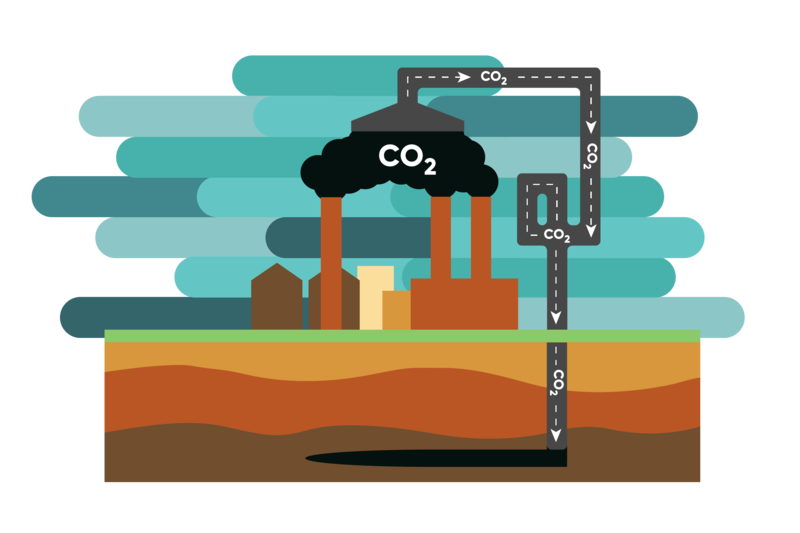
First, capture the CO2 straight from the exhaust stacks of the power plant. Then, compress the gas into a liquid. It would then be put it in a pipeline and sent to southwestern Kansas where it would be pumped deep into the ground.
In some cases, it would be put into what’s known as a saline aquifer — essentially a natural underground storage tank.
In other cases, it would be used for something called enhanced oil recovery. That means injecting CO2 into the ground on one side of a deposit to push hard-to-reach oil and gas toward a well on the other side.
The researchers discovered that, at this point, that plan would be too expensive. Even with recently approved tax incentives aimed at jumpstarting carbon capture projects, it would cost Jeffrey Energy Center far more to capture and compress than it could make selling the CO2.
A possibility that might be more economically tempting would capture CO2 from a network of ethanol plants across the Midwest.
That’s because unlike the byproduct of burning coal, which contains multiple chemicals — pollutants that would have to be separated before you pump anything into the ground — ethanol coughs up relatively untainted carbon dioxide.
“The challenge is that, relative to the size of a power plant, ethanol plants are pretty small,” said Brendan Jordan who worked on the project for the Great Plains Institute, a non-profit that wants to transform the country’s energy systems.
Under that scenario, size would matter. To make the same kind of impact that capturing CO2 from a power plant would have, ethanol plants from all over the Midwest would need to be connected through a regional pipeline.
Jordan said that kind of network would be a start until the cost of capturing power plant CO2 and other industrial sources drops dramatically.
And it might rally a range of people often at odds with each other.
Environmentalists support it because it could help curb climate change. Ethanol plants like it because it opens up a new revenue stream selling CO2 to oil and gas companies. The oil and gas industry is on board because it’s looking for a cheap, consistent source of CO2 to use in enhanced oil recovery.
That kind of broad support makes Jordan optimistic a commercial project could launch in the next five to ten years.
“The problem we have in the Midwest is a mismatch between where a lot of the ethanol plants are and where the appropriate geology is,” Jordan said.
Kansas is right in the middle of that equation. Any major pipeline project would have to run through the state — allowing both producers and consumers of CO2 to easily connect.
“You’ve got the right geology to do saline projects and you’ve got a lot of oil and gas,” Duguid said. “Those fields are at the right depths and have the right properties to do enhanced oil recovery.”
But some environmentalists worry about the unintended consequences of the tax incentives that make any of this profitable enough for companies to try. Particularly since it might just enable more oil drilling.
Hawkins argues carbon capture and storage isn’t a grand solution for eliminating all fossil fuel emissions, but rather one of many tools to reduce their impact.
Even if carbon capture makes it easier to drill for, and burn, oil, Hawkins said it could ultimately offset the fossil fuel use it would make easier.
For now, at least, it’s all still an idea. Researchers and industry professionals are working to make it a reality. But a future with large-scale carbon capture, pipelines and storage projects still largely depends on potential regulatory changes, tax incentives, and the economy as a whole.
So when will the first project get built in Kansas?
“Bold statement: five years,” Holubnyak said. “If not in this time it’s probably never going to happen.”
Brian Grimmett reports on the environment, energy and natural resources for KMUW in Wichita and the Kansas News Service. You can follow him on Twitter @briangrimmett or email him at grimmett (at) kmuw (dot) org. The Kansas News Service is a collaboration of KCUR, Kansas Public Radio, KMUW and High Plains Public Radio focused on the health and well-being of Kansans, their communities and civic life.
There are 14 such sites in the United States., and the KU Cancer Center-Midwest Cancer Alliance site is the only one that focuses on rural communities.
As an NCORP MU community site, KU Cancer Center and Midwest Cancer Alliance will accrue individuals to NCI-approved cancer clinical trials and research studies that encompass cancer prevention, screening, supportive care and symptom management, treatment, quality of life and cancer care delivery.
“This grant is an affirmation and recognition of our scientific leadership and expertise in cancer prevention, survivorship, and cancer-care delivery research,” said Roy Jensen, MD, Director of the KU Cancer Center. “That we are the single site focused on rural communities underscores our vital role in helping our fellow Kansans.”
NCORP is a national network of investigators, cancer care providers, academic institutions and other organizations whose goal is to improve patient outcomes and reduce cancer disparities through clinical trials and research studies. NCORP grants are awarded to top institutions that have demonstrated a strong commitment to the communities they serve.
“As the outreach network of the cancer center, Midwest Cancer Alliance has partnered with hospitals, cancer centers and health care providers across Kansas for more than a decade,” said Hope Krebill, MSW, BSN, RN, executive director of Midwest Cancer Alliance. “This grant enhances our ability to leverage the expertise of our rural cancer providers and KU Cancer Center researchers to expand clinical trials and decrease barriers to participation, with the ultimate goal of eliminating cancer disparities and preventing and treating cancer more effectively,” Krebill said.
“Support from the grant strengthens the institutions’ commitment to advancing clinical trial access and quality of care in rural communities,” said breast oncologist and co-principal investigator Priyanka Sharma, MD. Sharma also noted that patients can now access benefits from several new cancer prevention, survivorship and cancer-care delivery clinical trials.
According to Gary Doolittle, MD, Midwest Cancer Alliance medical director and co-principal investigator for the NCORP grant, bringing clinical trials to a broader patient population may reduce disparities in cancer, given that providing clinical trials to cancer patients is considered a standard of care. Per numerous studies, including a 2017 study conducted by the Centers for Disease Control, people in rural America are more likely to die from cancer than those in the country’s metropolitan counties.
“While improvements in cancer care have been significant over the last several decades, the need to provide dedicated, comprehensive care continues to grow, particularly in rural areas,” Doolittle said. “We need to ensure that people across the landscape of our area have access to the highest quality cancer care, and this grant enables KU Cancer Center and Midwest Cancer Alliance to help do just that.”
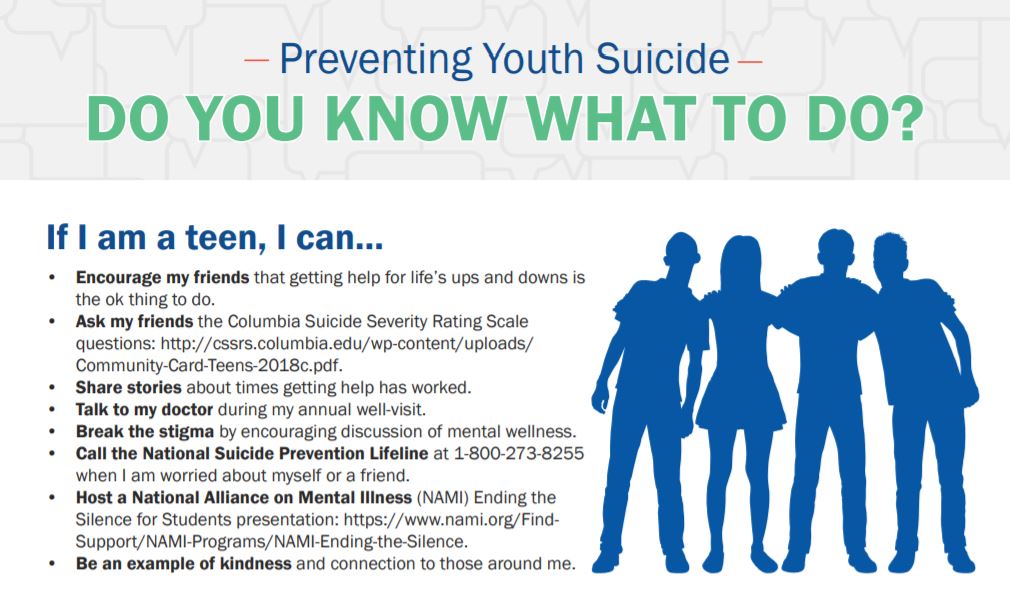
TOPEKA – In support of September as Suicide Prevention Month and National Suicide Prevention Week September 8-14, state agencies, along with the Kansas Attorney General’s Office, are releasing a unified resource that outlines actions that all Kansans can take to protect and empower youth.
“Suicide is the second leading cause of death for Kansans age 15 to 24 and it is the third leading cause of death for youth ages 5 to 14 – this is unacceptable,” said Dr. Lee Norman, Secretary of the Kansas Department of Health and Environment (KDHE). “Every one of us has a role to play, whether you’re a friend, parent, community member or school employee. We need to come together to help our youth.”
The resources, which can be found online, identify actions that everyone can take. The agencies involved in its creation include: KDHE, the Kansas Department for Aging and Disability Services, the Kansas Department for Children and Families, Kansas State Department of Education and the Kansas Attorney General’s Office, in collaboration with the Kansas Suicide Prevention Resource Center.
“As we mark National Suicide Prevention Week, I want to commend the work of all the agencies involved in creating the tip sheets as resources for Kansans and look forward to working closely together as we lead a collaborative effort to strengthen the overall Kansas response to youth suicide,” said Gina Meier-Hummel, Youth Suicide Prevention Coordinator for the Kansas Attorney General’s Office.
If you or someone you know is in need of assistance, please call the National Suicide Prevention Lifeline at 1-800-273-8255.
TOPEKA – Secretary of Commerce David Toland announced Trent Armbrust will join the Kansas Department of Commerce as director of strategy for Bioscience and Technology effective Sept. 23.
This newly created role and Armbrust’s appointment come as Kansas Governor Laura Kelly and Secretary Toland aggressively target the bioscience and technology sectors for growth in the state. Armbrust will develop a strategy to reengage these key sectors, helping them achieve sustained success in Kansas.
“Creating an ecosystem that facilitates the growth of tech companies in Kansas is a priority for Governor Kelly and the Department of Commerce,” Secretary Toland said. “We are thrilled to have Trent join the Commerce team and lead the effort to reengage the state as a partner in growing knowledge jobs in Kansas.”
Armbrust comes to Commerce following seven years in Economic Development for the Manhattan Area Chamber of Commerce. An active member of several economic development, bioscience and community organizations, Armbrust earned his bachelor’s degree in Biology and master’s degree in Plant Physiology from Kansas State University and is a graduate from the Economic Development Institute at the University of Oklahoma.
Speaking of his new role, Armbrust said, “It’s truly exciting to join the Kansas Department of Commerce as Governor Kelly and Secretary Toland build a new vision for Kansas as a preeminent state for business location and success.”
Armbrust will serve as a member of the Commerce leadership team and be responsible for rebuilding relationships with private- and public-sector partners as the state seeks to help advance new technologies, support innovative research, create new jobs and further advance Kansas’ leadership across key bioscience sectors.
TOPEKA – Access to emergency services and community resources is vital to all Kansans. The Lifeline program offers discounts to help eligible low-income families and individuals connect to voice and broadband networks to call for help in an emergency, access health care, find jobs, take classes and connect with family.
As part of National Lifeline Awareness Week, September 9-13, the Kansas Corporation Commission wants to make residents aware of the assistance the program can offer.
Under the federal Lifeline Program, low-income consumers can receive up to $9.25 per month off their monthly bill for phone (residential or wireless), broadband, or bundled phone and broadband service. Some may also be eligible for the state Lifeline program that provides an additional $7.77 monthly discount.
Lifeline serves more than 10 million Americans, nearly 41 thousand in Kansas. Forty-nine companies currently offer Lifeline services in the state. The program has provided discounted phone service for qualifying consumers since 1985. In 2016, the program was expanded to include broadband.
Residents enrolled in any of the following assistance programs are eligible for the Lifeline program: Supplemental Nutrition Assistance Program (SNAP), Medicaid, Supplemental Security Income (SSI), Federal Public Housing Assistance (FHPA), Veterans Pension & Survivors Pension Benefit, Bureau of Indian Affairs General Assistance, Tribally Administered Temporary Assistance for Needy Families, Head Start Tribal Programs (only those meeting its income qualifying standard), and the Food Distribution Program on Tribal Lands. Those at 135% of the federal poverty level also qualify. Participants must provide three consecutive months of statements as documentation of income, or provide a copy of their tax return for the previous year. Recertification is required each year.
SANTA FE, N.M. — The Bureau of Land Management New Mexico raised $9,839,328 in its quarterly oil and gas lease sale held September 5, 2019. Nearly 50 percent of the revenue from the sale will go to the states where the oil and gas activity occurs—in this case New Mexico, Kansas and Oklahoma—while the rest will go to the U.S. Treasury.
For this sale, the BLM offered leases on 15 parcels totaling 3,174.08 acres. The highest bid per acre was $31,001 sold to Cimarex Energy Company for 40 acres in Lea County, New Mexico. The highest bid per parcel was a total of $3,176,397 sold to Platform Energy III, LLC in Lea County, New Mexico, for 396.68 acres.
The BLM awards oil and gas leases for a term of 10 years and as long thereafter as there is production of oil and gas in paying quantities. If the leases result in producing oil or gas wells, revenue from royalties based on production is also shared with the state.
The BLM is a key contributor to the Trump Administration’s America First Energy Plan, which is an all-of-the-above plan that includes oil and gas, coal, strategic minerals, and renewable sources such as wind, geothermal, and solar, all of which can be developed on public lands.
The BLM’s policy is to promote oil and gas development if it meets the guidelines and regulations set forth by the National Environmental Policy Act of 1969 and other subsequent laws and policies passed by the U.S. Congress. The sales are also in keeping with the America First Energy Plan, which includes development of fossil fuels and coal, as well as renewable energy.
The BLM manages more than 245 million acres of public land located primarily in 12 Western states, including Alaska. The BLM also administers 700 million acres of sub-surface mineral estate throughout the nation. Diverse activities authorized on these lands generated $96 billion in sales of goods and services throughout the American economy in fiscal year 2017. These activities supported more than 468,000 jobs.
HUTCHINSON – The Climate + Energy Project is pleased to announce the 2019 Climate + Energy Awards, recognizing individuals and organizations who are leading the way to a clean energy future.
The awards celebrate lifetime achievement, volunteer engagement, and innovative change agents in Kansas. Join us in honoring our award winners on Monday, September 30, at the Lawrence Beer Company for Visions of a Resilient Kansas, our annual fundraiser and awards ceremony.
Mary Fund
Impact Award: A lifetime achievement award recognizing an individual whose work resulted in positive, long-term, broad impacts in climate, energy, and environmental issues across the state.
Mary Fund has dedicated her life to sustainable agriculture and rural communities. A strong presence at the Kansas Rural Center, Topeka, for the last 40 years, Mary has worked bravely and tirelessly to raise issues of environmental concern – from clean energy to clean water, healthy soils to local foods, and so much more. Mary never shies away from bringing up the important, if controversial issues, including most recently highlighting climate change in town halls across the state. Mary is as direct in her opinions as she is curious about what others think, which makes her a valuable partner to all.
Mary has elevated rural issues to legislators while simultaneously addressing challenging issues with rural audiences. Mary’s no-nonsense, common-sense approach has been foundational to conversations about environmental issues for decades.
Kim Bellemere
Mark Richardson Sustainer Award: A volunteer-recognition award for an individual who has regularly engaged with CEP for at least five years.
Kim Bellemere has been a reliable and enthusiastic partner with the Climate + Energy Project for the last eight years, first as a steering committee member for Water + Energy Progress and most recently as a strong WEALTH partner.
In her work as the Director of Outreach at the Grassland Heritage Foundation, Shawnee Mission, Kim speaks passionately about the important role of grasslands and native plants as a climate solution. Kim’s leadership on climate change among conservationists has lit a spark for change and catalyzed partnerships to address climate issues locally. Kim’s nominator explained, “I’ve often felt overwhelmed by the climate change discussion, until I started having conversations with Kim and noticed the work that she was doing with Grassland Heritage Foundation. Small steps lead to big ones, and it’s people like Kim that take the first step so that the rest of us can follow.”
The Merc Co+op
Changemaker Award: Recognition for an organization or individual whose recent (1-3 years) work has significantly advanced climate, energy, and/or environmental issues in Kansas.
The Merc Co+op, Lawrence, has elevated solar power and electric vehicles as clean energy solutions in a high-profile location. Through a full rooftop array, two solar covered carports and a solar covered patio, the community-owned grocery store installed 688 high performance solar panels to provide 29% of their energy each year, when combined with an electric vehicle charging station and a solar covered pergola the panels will produce enough energy to power 22 homes each year.
The Merc’s highly visible location for solar panels and one of the few Electric Vehicle charging stations in Lawrence has strong potential to inspire other businesses to get on board with clean energy. The Merc Co+op is also working to ease the pressures of food deserts in Kansas by opening a grocery store in Wyandotte county. Since 2012, the co-op has reduced electricity consumption by 30% through LED lighting and preventative maintenance, in addition to reducing waste, improving access to local foods, and presenting sustainable options for the northeast Kansas community.
Metro KC Climate Action Coalition
Metro KC Climate Action Coalition
The Metro KC Climate Action Coalition has rapidly elevated the issue of climate change in northeast Kansas.
Initiated by Lindsey Constance and Mike Kelly, the MKCCAC provides a vehicle for local and state elected officials to take action on climate change. The coalition brings together diverse local elected officials to use their power to tackle climate change at the local and state level. MKCCAC has organized several events, including the upcoming Metro KC Climate Action Summit in Kansas City on September 14. They are in the process of developing a local action playbook, a climate emissions inventory, and more. This bipartisan coalition has made impressive progress convening elected officials across the state line, leading with conversations about regional climate change solutions.
TOPEKA – The Kansas Department of Transportation (KDOT) has launched a new program designed to provide state funding for transportation projects while also leveraging local and private funding. The new Cost Share Program will provide funding to local entities for transportation projects that improve safety, support job retention and growth, improve access or mobility, relieve congestion and help areas across the state improve the transportation system.
Up to $50 million will be available in the program for fiscal year 2020. The on-going program, which has at least $11 million available, requires a minimum of 15% non-state cash match. Additional consideration will be given to project applications that commit more than the minimum required match amount. The funding above the base $11 million comes from a one-time, $50 million State General Fund transfer. A minimum 25% match is required for projects to qualify for the one-time funds.
The Cost Share Program is open to all transportation projects including roadway (on and off the state highway system), rail, airport, bicycle/pedestrian and public transit. Funds from the program can only be used for construction.
“Creating the Cost Share Program allows us to leverage both state and local dollars to help address important transportation needs across Kansas,” said Kansas Secretary Julie Lorenz. “We look forward to working with Kansas communities to build projects that improve safety and keep the Kansas economy moving.”
Funding for the program is part of the $216 million in sales tax authorized by the Legislature and Gov. Laura Kelly to remain in the state highway fund in fiscal year 2020. In addition to the Cost Share Program, those funds are being used to increase highway preservation, help complete delayed T-WORKS projects, improve safety and provide new funding opportunities for cities and counties.
Applications will be accepted on an ongoing basis beginning Sept. 3, 2019, and will be reviewed twice annually, in October and March. To be included in the first review period, applications must be submitted by Oct. 11, 2019. Selection criteria will include consideration of projects that meet program objectives, eligibility categories and requirements. Geographic distribution also will be considered during project selection.
Application and a fact sheet on the Cost Share Program can be found at www.KSDot.org or with the links below:
WICHITA—Kansas is a national leader in wind energy, but a new report shows the state lags in the adoption of other so-called green technologies.
Find out how Kansas compares to the rest of the country.
Wind
Kansas and other Plains states produce the majority of the nation’s wind energy. While that’s mostly because the area has the highest average sustained wind speeds, the leading wind states have put in place regulatory policy and tax incentives aimed at attracting wind developers.
In 2018, developers installed 543 megawatts of new wind generation in Kansas, according to a new U.S. Department of Energy study. That’s good enough for sixth in the country.
As far as overall capacity, Kansas ranks fifth.
And since 2009, the amount of wind-generated electricity produced in Kansas has grown sevenfold, the third most of any state during the same time period.
Solar
Like with wind, Kansas is in a great position to turn abundant solar radiation into electricity.
Unlike with wind, it hasn’t.
A report from the environmental advocacy group Environment America ranks Kansas 45th in solar energy growth from 2009 to 2018.
In 2018, only 36 gigawatt hours (GWh) were produced in the state. That’s compared to nearly 40,000 GWh coming from the nation’s top state, California.
Everything Else
Kansas has adopted other new green technologies slower than most of the country, too. Cumulative electric vehicle sales in Kansas through 2018 is only 2,621 vehicles — ranking 33rd among U.S. states.
Major electric utility companies in Kansas haven’t invested in any large-scale battery storage projects, either. That’s not unique — it’s a relatively new technology — but the Environment America report shows adoption in the rest of the country is growing quickly.
But thanks to Kansas’ quick adoption of wind energy and developers’ willingness to build here, the state still ranks high when it comes to the amount of renewable energy it produces in relation to how much energy it consumes.
In 2018, 47% of the electricity the state used came from wind or solar, the second- highest percentage in the country.
Brian Grimmett reports on the environment, energy and natural resources for KMUW in Wichita and the Kansas News Service. You can follow him on Twitter @briangrimmett or email him at grimmett (at) kmuw (dot) org. The Kansas News Service is a collaboration of KCUR, Kansas Public Radio, KMUW and High Plains Public Radio focused on the health and well-being of Kansans, their communities and civic life.
KANSAS CITY – The Kansas City District, U.S. Army Corps of Engineers was authorized a deviation from the operating manual for cumulative releases from reservoirs in the Kansas River Basin.
This decision was made in consultation with the Missouri River Basin Water Management through a thorough impacts analysis that addresses the downstream impacts of increased release targets and upstream impacts of not evacuating all the stored flood waters in the reservoir projects. Retaining flood storage in the Kansas River reservoirs into the next flood year presents unacceptable risk to downstream life and property for all stakeholders below the lower Kansas River reservoirs.
The 2019 flood resulted in flood control storage at the Kansas City District lakes and reservoirs being filled through the spring and summer months to alleviate downstream flooding on the Missouri River. Record setting rainfall hasn’t stopped, as many localities again set rainfall records in the month of August. Missouri River stages remain high, which leads to decreased releases from reservoirs along the Kansas River – most notably Milford, Tuttle Creek, Perry, and Clinton.
Currently, there is more than two million acre-feet of stored flood waters within the Kansas River Basin projects. To evacuate this storage prior to this winter’s freeze, the Kansas City District has received a deviation which allows it to increase the Phase 1 target on the Missouri River at Waverly from 90,000 cubic feet per second to 140,000 cfs. This is necessary, as a 90,000 cfs target is not expected to allow for releases from the lower 50 percent of flood control storage in the Kansas Basin until November or December. We estimate that the 140,000 cfs target at Waverly will facilitate emptying the stored flood waters over a three month period. Continued wet weather may prolong the drawdown.
Throughout the flood event, the Corps has shared vital information regarding the Missouri River system, and that all operations have impacts on one another. Exact dates and amounts of releases from the Kansas basin will depend on releases from Gavins Point, inflows to the Kansas River basin, and tributary inflows. Gavins Point releases are anticipated to remain at 70,000 cfs into October and remain above 60,000 cfs through November.
It’s important that the public remains vigilant, as higher river levels will persist. While the drawdown is occurring, it is anticipated the flow in the Kansas River, outside of local rain events, will remain between 20,000 cfs and 30,000 cfs. This is well below action stage along the Kansas River. 140,000 cfs at the Waverly gage on the Missouri river is approximately two foot above flood stage. Missouri River gages downstream of Waverly will be below flood stage at a flow of 140,000 cfs, but rainfall could result in them going over flood stage.