TOPEKA – Kansas organizations interested in informing the public about financial education are invited to apply for 2018 grants offered by the Office of the Kansas Securities Commissioner (KSC).
John Wine, Kansas Securities Commissioner, has announced the opening of the 2018 Investor Education Grant Cycle through the securities office. Those receiving grants can use awarded funds for purposes related to investor education, financial literacy or securities fraud prevention.
The latest round of applications must be received by the KSC office by August 25, 2018.
“In 2017 we issued more than $40,000 in grants to community and state-wide partners to promote financial education around the state,” said Commissioner Wine, “and we look forward to providing similar support again this year.”
For questions about grants, contact Shannon Santschi, Director of Investor Education, at [email protected] or go to the KSC website, www.ksc.ks.gov/Grants .
TOPEKA—The Kansas Insurance Department Thursday filed a motion for a temporary injunction in Shawnee County District Court to stop the State of Kansas from sweeping more than $16 million from the department’s Service Regulation Fee Fund.
The motion follows the department’s petition filed July 13 asking the district court to declare the sweeps in violation of Kansas law. That action limited the use of certain fee funds for the purposes set forth in the Kansas Statutes concerning the funds, and for no other governmental purpose.
According to the filing, “A Temporary Injunction is in the public interest because consumers will be harmed if (insurance) companies are forced to pass additional assessments on to them in increased premiums.”
The petition and temporary injunction stem from legislation — 2017 Senate Substitute for House Bill 2002 — that authorized the sweep of $8 million in fiscal year (FY) 2018 and $8 million in FY 2019, all from the Service Regulation Fee Fund. The 2018 Kansas Legislature took appropriate action to reverse the FY2019 sweep. However, Governor Jeff Colyer vetoed the reversal of the FY2019 sweep.
The fee fund is a major portion of the department’s operating budget.
In a May 2018 insurance department news release concerning the governor’s budget decision, the action was labeled as a violation of state law.
Both the petition and the injunction pleadings are on the department’s website, www.ksinsurance.org, under “Help with Finding laws, regulations, orders, bulletins.”
TOPEKA –The Centers for Disease Control and Prevention (CDC), the Kansas Department of Health and Environment (KDHE), the Kansas Department of Agriculture (KDA), the Johnson County Department of Health and Environment (JCDHE), public health and regulatory officials in several states, and the U.S. Food and Drug Administration are investigating a multi-state outbreak ofSalmonella Sandiego infections. Spring Pasta Salad purchased at Hy-Vee grocery stores is a likely source of the outbreak.
As of July 17, the CDC reported 21 people infected with the outbreak strain ofSalmonella Sandiego from five states. On July 20, KDHE and JCDHE identified one infected person, an adult resident of Johnson County.
“Any individuals who have this in their refrigerator should return the recalled Spring Pasta Salad to the store for a refund or throw it away,” said KDHE Chief Medical Officer Dr. Greg Lakin. “Even if some of it was eaten and no one got sick, do not eat it. If you stored recalled pasta salad in another container, throw the pasta salad away. Thoroughly wash the container with warm, soapy water before using it again, to remove harmful germs that could contaminate other food,” Lakin said.
The Spring Pasta Salad was sold in Kansas Hy-Vee stores before Hy-Vee removed it from all its locations on July 16. Kansans should check their refrigerators to ensure they do not eat the recalled pasta salad. The Spring Pasta Salad includes shell pasta, carrots, celery, cucumbers, green pepper, onion and mayonnaise. It was sold in one-pound (16 oz.) and three-pound (48 oz.) plastic containers or may have been scooped at the deli counter into clear plastic containers. The recalled pasta salad was sold in all Hy-Vee grocery stores in Illinois, Iowa, Kansas, Minnesota, Missouri, Nebraska, South Dakota and Wisconsin. The expiration dates for the recalled pasta salad range from June 22, 2018 to Aug. 3, 2018.
Contact a health care provider if you think you got sick from eating recalled Hy-Vee Spring Pasta Salad. Most people infected with Salmonella develop diarrhea, fever and stomach cramps 12 to 96 hours after being exposed to the bacteria. The illness usually lasts four to seven days, and most people recover without treatment. In some people, the diarrhea may be so severe that the patient needs to be hospitalized. Salmonella infection may spread from the intestines to the bloodstream and then to other places in the body. Children younger than five years, adults older than 65 years, and people with weakened immune systems are more likely to have a severe illness.
Girl Scouts today reveals 30 new badges now available exclusively for girls ages 5–18 that not only enhance the one-of-a-kind Girl Scout experience, but also address some of society’s most pressing needs, such as cybersecurity, environmental advocacy, mechanical engineering, robotics, computer science, and space exploration. (PRNewsfoto/Girl Scouts of the USA)
GSUSA
NEW YORK— Girl Scouts of the USA (GSUSA) today reveals 30 new badges now available exclusively for girls ages 5–18 that not only enhance the one-of-a-kind Girl Scout experience, but also address some of society’s most pressing needs, such as cybersecurity, environmental advocacy, mechanical engineering, robotics, computer science, and space exploration.
In a safe all-girl space, Girl Scouts develop important soft skills, including confidence and perseverance, as well as hard skills, setting them up for success and preparing them to take action for a better world.
Today’s youth are more vocal than ever about the change they want to see, and Girl Scouts are the most equipped with the skills needed to make a real impact. The results are proven: girls who participate in Girl Scouts are more than twice as likely to exhibit community problem-solving skills than girls who don’t (57 percent versus 28 percent).
The unique Girl Scout environment provides fun, exciting, and essential experiences that carry into girls’ future careers and life success; the KPMG Women’s Leadership Study of more than 3,000 professional and college women shows that early exposure to leadership has a significant impact on a woman’s perceptions of her ability to lead. Additionally, 76 percent of women today wish they had learned more about leadership and had more leadership opportunities while growing up, demonstrating how imperative it is for girls and volunteers to join Girl Scouts.
The new programming for girls in grades 6–12 includes:
Environmental Stewardship badges, GSUSA’s first-ever badge series focused on environmental advocacy. Girls in grades 6–12 prepare for outdoor experiences and take action on environmental issues. Although Girl Scouts have been advocating for the environment since the organization’s founding 106 years ago, these badges are the first to specifically prepare girls to be environmental advocates who address problems, find solutions, and protect the natural world (funded by the Elliott Wildlife Values Project).
Badges that teach girls how to program, design, and showcase robots, completing the suite of Robotics badges GSUSA first introduced for grades K–5 last year.
The College Knowledge badge for Girl Scouts in grades 11 and 12, the first badge completely dedicated to college exploration. By showing girls how to research the admissions process, financial aid, and other factors, the badge fills a specific need that girls asked for—and that many do not have support for outside Girl Scouts.
Two Girl Scout Leadership Journeys: Think Like a Programmer (funded by Raytheon) provides a strong foundation in computational thinking and the framework for Girl Scouts’ first ever national Cyber Challenge, coming in 2019. The Think Like an Engineer Journey exposes girls to design thinking to understand how engineers solve problems. As with all Leadership Journeys, girls complete hands-on activities and use their newly honed skills to take action on a problem in their community. The programming aims to prepare girls to pursue careers in fields such as cybersecurity, computer science, and robotics.
Girls in grades K–5 can now earn badges in:
Environmental Stewardship, through which girls learn how to respect the outdoors and take action to protect the natural world (funded by the Elliott Wildlife Values Project).
Cybersecurity, introducing girls to age-appropriate online safety and privacy principles, information on how the internet works, and how to spot and investigate cybercrime (funded by Palo Alto Networks).
Space Science, enabling girls to channel their inner NASA scientist as they learn about objects in space and how astronomers conduct investigations (funded by NASA’s Science Mission Directorate and led by the SETI Institute).
Mechanical Engineering for Girl Scout Juniors, through which girls in grades 4 and 5 design paddle boats, cranes, and balloon-powered cars, learning about buoyancy, potential and kinetic energy, machines, and jet propulsion. Following last year’s introduction of Mechanical Engineering badges for girls in grades K–3, the addition of these badges for Girl Scout Juniors means that all Girl Scouts in elementary school can now have hands-on engineering experiences.
“Across the country, people are having powerful conversations about the increasingly strong voice of young people who want to change the world and the lack of women in leadership positions in the United States—two topics Girl Scouts is uniquely positioned to address,” said GSUSA CEO Sylvia Acevedo. “Whether they are fighting cybercrime, exploring how engineers solve problems, or advocating for issues affecting their community, Girl Scouts are learning how to proactively address some of the foremost challenges of today while also building skills that will set them up for a lifetime of leadership. I am so proud that our new programming continues to push girls to be forward-thinking and equips them with the skills they need to make the world a better place. We believe in the power of all girls, and we invite them to strengthen their unique abilities by joining Girl Scouts.”
GSUSA works with top organizations in fields that interest today’s girls. Combined with Girl Scouts’ expertise in girl leadership, these organizations and specialists advise and inform on content to provide the most cutting-edge programming available to girls. Content collaborators include Code.org, the Cyber Innovation Center, robotics educator and author Kathy Ceceri, the Leave No Trace Center for Outdoor Ethics, the Museum of Science, Boston, and WGBH’s Design Squad Global. Girl Scouts themselves also rigorously tested some of the new offerings, including the Think Like a Programmer activities and the Space Science and Cybersecurity badges, which were announced last year and are now available for girls around the country to earn.
Prepare your girl to unleash her inner strength. To join or volunteer, visit www.girlscouts.org/join.
TOPEKA – The Kansas Department for Children and Families (DCF) Secretary Gina Meier-Hummel is pleased to announce the relocation of five staff to improve community relations and outreach. The staff, previously located in the DCF Administration Office in Topeka, Kan., are now being strategically placed across the state to create meaningful community relationships, and to focus on targeted foster care recruitment.
Effective July 1, 2018, staff were placed in specific counties that have a high number of youth in foster care. In the next two months, two more staff will start at the agency to assist with foster care recruitment as well. Additionally, the team will be working with community partners, schools, faith-based organizations and others to discuss effective prevention programs to serve the families in each community.
“We are working diligently to strengthen numerous things at our agency—our community outreach being one of them,” said Secretary Gina Meier-Hummel. “Having more staff in the communities will allow us to foster positive, beneficial relationships to best serve the children and families of Kansas.”
Additionally, the Foster Kansas Kids website, an initiative funded by DCF, now features an interactive map that helps connect interested families with Child Placing Agencies (CPA’s) and other foster care organizations in their county. From there, individuals can click on specific agency names to learn more about each organization in their area.
The website also features a live-chat function, a comprehensive calendar of foster care events across the state, foster parent and former youth-in-care blogs and an extensive resources page that features frequently asked questions and a video library.
“I agree wholeheartedly with Secretary Meier-Hummel’s decision to improve community outreach and make foster care recruitment a community effort,” said Governor Jeff Colyer. “Together, we can rally in each of our communities to support and care for some of our most vulnerable citizens.”
If you are interested in becoming a foster parent, please visit www.fosterkskids.org or call 1-844-380-2009. To stay up to date on foster care in Kansas, follow Foster Kansas Kids on Facebook and Twitter.
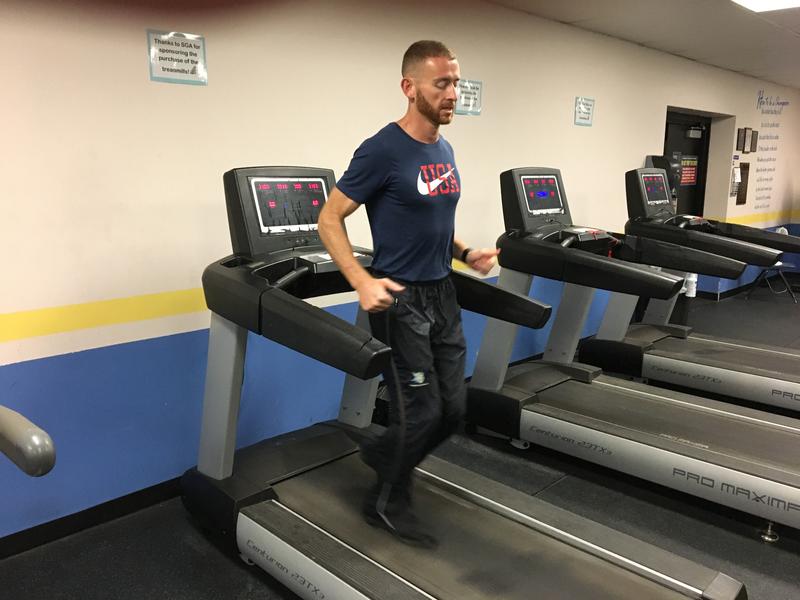
Bethany College track and cross country coach Aaron Yoder spends a lot of time on the treadmill in the Lindsborg, Kansas, school’s cardio room. It doesn’t seem unusual unless you see what he’s doing — running backward.
Yoder has been training for this weekend’s world championships for backward running, or retrorunning, in Bologne, Italy. Yoder is recognized by the Guinness Book of World Records as a record-holder in three retrorunning events: 1 mile (5 minutes, 54.25 seconds), 1000 meters and 4X400m relay. Plus, he’s awaiting ratification for a world record in the 200m, which he did last year on the campus track.
Yoder’s first world record came three years ago with the mile, a distance with deep roots in Kansas; think legendary Olympians Glenn Cunningham, (1932 and ’36), Wes Santee (1952) and Jim Ryun (1964, ’68 and ’72).
A few years earlier, doctors advised him not to run, period. He was a high school champion in the mile, but by his mid 20s, a chronically injured left knee led to arthritis.
Running backward, however, made Yoder feel more comfortable.
“A big difference is the stress you put on your joints,” the 32-year-old said. “When you’re running backward, you don’t have as much pressure on your knee because you’re landing behind yourself.”
Dr. Brian Ware, a podiatrist in Kansas City, says retrorunning puts less stress on joints.
Dr. Brian Ware, a podiatrist in Kansas City and a runner himself, said he understands Yoder’s reluctance to give up running all together.
“With runners it’s a mindset. We do not like to take time off,” said Ware, who also backs up Yoder’s claims that running backward is easier on the joints.
He added that there’s another other benefit to backward running.
“The posture is a little bit better backward running. When you tend to get fatigued in forward running, your back muscles get overused because you lean forward,” Ware said.
Running backward piqued Yoder’s interest during his middle school years in Peabody, Kansas, saying he did it “because I was trying to get in better shape for other sports.”
Retrorunning is popular in Europe, and this is the seventh running of the International Retrorunning championships, which happen every other year.
One of Yoder’s former athletes at Bethany, Noah Smucker, said Yoder’s backward treadmill habit caught his attention at first —because of how much time Yoder spends on it. It was enough to wear out and break one of the training center treadmills, Smucker said.
“I always knew he was a little different,” he said. “When I saw him do that, I definitely knew he was a something different.”
Yoder takes that as a compliment. Though he said he comes from a family that likes to stay active, no one else within the family ran backward.
“My mom would tell of (when) we would go out in the country — she’d have her bike — and she would time me while I did some mile runs,” he said, adding, “They just said, ‘Aaron is just doing what he does.’”
But things have changed. Yoder’s twin brother and his parents are now retro-running and also will compete in this week’s world championships.
Greg Echlin is a freelance sports reporter for KCUR 89.3.
WICHITA – The Kansas Leadership Center (KLC) is currently accepting applications for 2019 Leadership Transformation Grants through Friday, August 31.
We’re looking for partners who aspire to spread a culture of leadership through their organization or community. Is that you or someone you know?
Help us spread the word. Pass this email on to your local city manager, superintendent, pastor or Rotary president. Encourage them to apply for a grant or join us for an informational conference call next week. With your help, we can extend our reach to more civically engaged organizations and individuals across Kansas.
Learn more about the grants. We’re hosting a conference call on Wednesday, July 18 from Noon to 1 p.m.Anyone wanting to know more about the Leadership Transformation Grants is welcome to join us and bring questions. Call-in number: 1-877-567-1262. Passcode: 6113-000#
MANHATTAN — The Kansas Department of Agriculture’s agricultural marketing, advocacy and outreach team is seeking talented Kansans to serve on the Marketing Advisory Board. The mission of the KDA marketing team is to serve all Kansans through innovative programming and deliver solutions designed to create an environment that facilitates growth and expansion in agriculture while increasing pride in and awareness of the state’s largest industry — agriculture.
The Marketing Advisory Board will advise the program team on a variety of topics through the following sub-programs: agricultural business development, international agricultural development/trade, From the Land of Kansas, local foods and affiliated programs, agricultural workforce development and agricultural education.
If you are interested in applying to serve as a Marketing Advisory Board member, please email a resume, statement of interest/cover letter and tax clearance confirmation PDF. For more details about the board and about the application process, go to agriculture.ks.gov/marketing-advisory-board. Submit application materials and address questions to Kerry Wefald, marketing director, at [email protected] or call 785-564-6758.
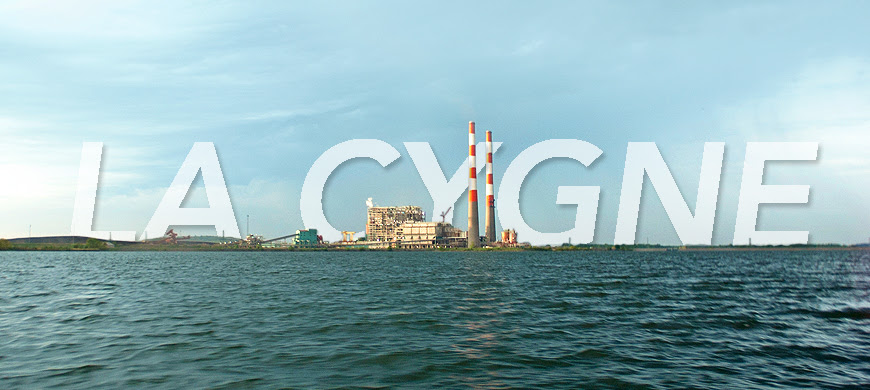
LA CYGNE – Kansas bass fishing is on the national map. La Cygne Reservoir, the 2,600-acre power plant cooling lake in Linn County, is listed as one of the country’s top 100 bass fishing lakes by Bassmaster Magazine. In the publication’s July/August 2018 issue, the nation’s top 100 bass lakes are listed by region, based on the number and size of largemouth or smallmouth bass that are produced and caught. La Cygne is listed as No. 10 in the Central Region.
Criteria used to rank most lakes on the list involved weights brought in by tournament bass anglers. However, while local clubs conduct bass fishing tournaments at the comparatively small La Cygne, it’s not on any major tournament circuit. Bassmaster Magazine editors considered the results of Kansas Department of Wildlife, Parks and Tourism (KDWPT) biologists’ electrofishing efforts last spring, which turned up an eye-popping 17 bass longer than 20 inches per hour of shocking effort. Editors also noted that two largemouth bass weighing more than 10 pounds were caught on the same weekend in March 2017.
La Cygne Reservoir consistently ranks near the top for bass fishing in Kansas. Each spring, biologists use electrofishing to sample the largemouth bass populations of Kansas lakes, gathering data to help make stocking requests and regulation recommendations. The data is also used in the annual fishing forecast, and the 2018 Kansas Fishing Forecast lists La Cygne as No. 1 with a Density Rating of 89.09 bass longer than 12 inches per hour of electroshocking. Of those, 66 were longer than 15 inches and 17 were longer than 20 inches. While some smaller state and community lakes produced fish over 20 inches during sampling efforts, none approached the numbers found at La Cygne.
Because the lake’s water is used to cool the La Cygne Generating Station coal-fired power plant, it rarely freezes and fish enjoy warmer water temperatures year-round. The longer growing season, and the fact that some Florida strain largemouth bass genes still linger, probably account for the lake’s big bass. Florida strain largemouths, which grow bigger than their northern cousins but are temperature sensitive, were stocked in La Cygne in the early 1980s. It was hoped that with the warmer water temperatures, larger fish would be produced. However, subsequent surveys didn’t indicate strong survival of the Florida strain fish, so no follow-up stockings were conducted. But subsequent genetic testing of La Cygne bass shows remnants of their Florida cousins.
To learn more about La Cygne Reservoir, see weekly fishing reports or to download the 2018 Kansas Fishing Forecast, visit www.ksoutdoors.com. If you like to catch big bass, make plans to visit La Cygne.
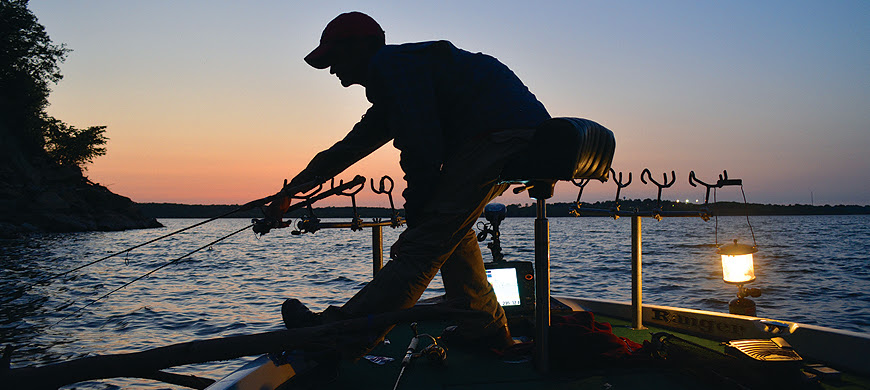
PRATT – You don’t have to quit fishing just because it’s hot. You just have to adjust your schedule to fish at night rather than during the day. Oh yeah – and leave a light on.
July and August are perfect months to catch white bass, crappie and wipers under lights. Young-of-the-year gizzard shad, the primary forage in Kansas reservoirs, are just getting to “bite size” and sport fish are busy filling their bellies.
To catch fish under the lights at night, you first need to anchor your boat in a strategic location just before dark. Your best bets are over a deep brush pile or cube cluster, creek channel ledge or mudflat. Once the sun sets, set out lanterns, floating lights or submersible halogen lights, and wait.
What happens is a natural but amazing phenomenon of the aquatic food chain. The light will attract microscopic zooplankton, which in turn will attract minnows and shad. When the lights have congregated a large school of shad – which will often swim in circles around the light as if disoriented – the predators will show up below. You’ll see the shad under the lights, and if you watch your sonar, you’ll know when the predators show up beneath the shad school. Drop a jig or minnow down and you’re in business.
It may take a trip or two to become accustomed to fishing at night, and there are safety considerations to keep in mind. Once the sun sets, your boat needs to have navigation lights on. Motor boats less than 40 feet long should have a white light at the stern, visible all around, and a light at the bow, showing red on the port side and green on the starboard side. A white light should be visible when the boat is at anchor. Wear your lifejacket and become familiar with the area before it gets dark. Go slow and use a hand-held spotlight to locate shorelines or obstacles while under power. If your sonar has GPS, use the map page with the trackback function on so you’ll have a safe route back to the ramp in the dark.
For some great tips on catching crappie under the lights, check out the July/August 2018 issue of Kansas Wildlife and Parks Magazine (ksoutdoors.com/Services/Publications/Magazine). Expert angler and guide, Joe Bragg, shares his night fishing know-how in a feature article authored by Brent Frazee.
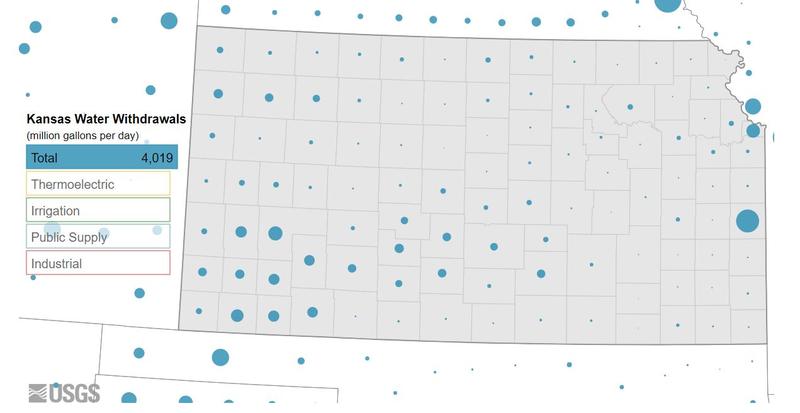
Kansas water use is declining, according to a new report from the U.S. Geological survey.
Kansans decreased their water usage by 25 percent over the past 25 years — which is great. But conservation experts say there’s still a lot more work to be done.
“What we’re doing is great, it’s just not enough of it,” said Kansas Water Office Director Tracy Streeter.
He’s particularly concerned about areas of western Kansas where farmers draw from the diminishing Ogallala aquifer.
“Overall, we’ve got to see more widespread adoption of conservation efforts,” he said.
The top three water consuming counties are Stevens, Finney and Seward — all located in southwestern Kansas.
Linn County, in eastern Kansas, withdraws the most water per day of any county. The culprit is the LaCygne coal-fired power plant, which withdraws 610 million gallons per day. But the plant puts almost all the water it withdraws back into the lake it comes from, consuming just 1 percent of it.
Mandy Stone is a hydrologist at the USGS in Kansas. She said the data is a good tool to show policymakers, and Kansans, where their water comes from and where it goes.
“This water use data is important, ultimately because all of us in the economy depend on water every day,” she said.
Brian Grimmett, based at KMUW in Wichita, is a reporter focusing on the environment and energy for the Kansas News Service, a collaboration of KMUW, Kansas Public Radio, KCUR and High Plains Public Radio covering health, education and politics. Follow him on Twitter @briangrimmett.
Employees from the Cosmosphere space museum in Hutchinson are helping to recreate one of the biggest moments in our nation’s space history: the mission control room used during the first moon landing.
Specifically, the team at SpaceWorks, a division of the Cosmosphere, are updating the famous control room consoles piece by piece.
The SpaceWorks facility west of downtown Hutchinson includes a restoration warehouse and workshops for metal fabrication, machining, woodworking and paint.
“For the most part, we try to be self-sustaining as possible,” says Jack Graber, project manager and Cosmosphere vice president of exhibits and technology. “I would say less than 10 percent of the parts are done outside of our shop.”
SpaceWorks manager Dale Capps is working on metal brackets that he created in the fabrication shop. They will hold the monitor in place on a console. Original replacements are not available. CREDIT LARISSA LAWRIE / KMUW
SpaceWorks manager Dale Capps is smoothing the edges inside a small rectangular metal bracket in the metal fabrication workshop. The part, a faceplate, will hold a monitor in a console that was used during the historic Apollo space missions nearly 50 years ago.
A replacement is not available, so Capps used one of the originals to create a mold to manufacture brackets in-house.
Graber says finding original equipment is the hardest part of doing historically accurate restoration work.
“The actual components that would have been around in the Apollo-era are obviously past their prime so we’ve had to replicate some things that we may not have anticipated just because they are not available anymore,” he says.
Flight controllers celebrate the successful conclusion of the Apollo 11 lunar landing mission on July 24, 1969, at NASA’s Mission Control Center in Houston. CREDIT NASA
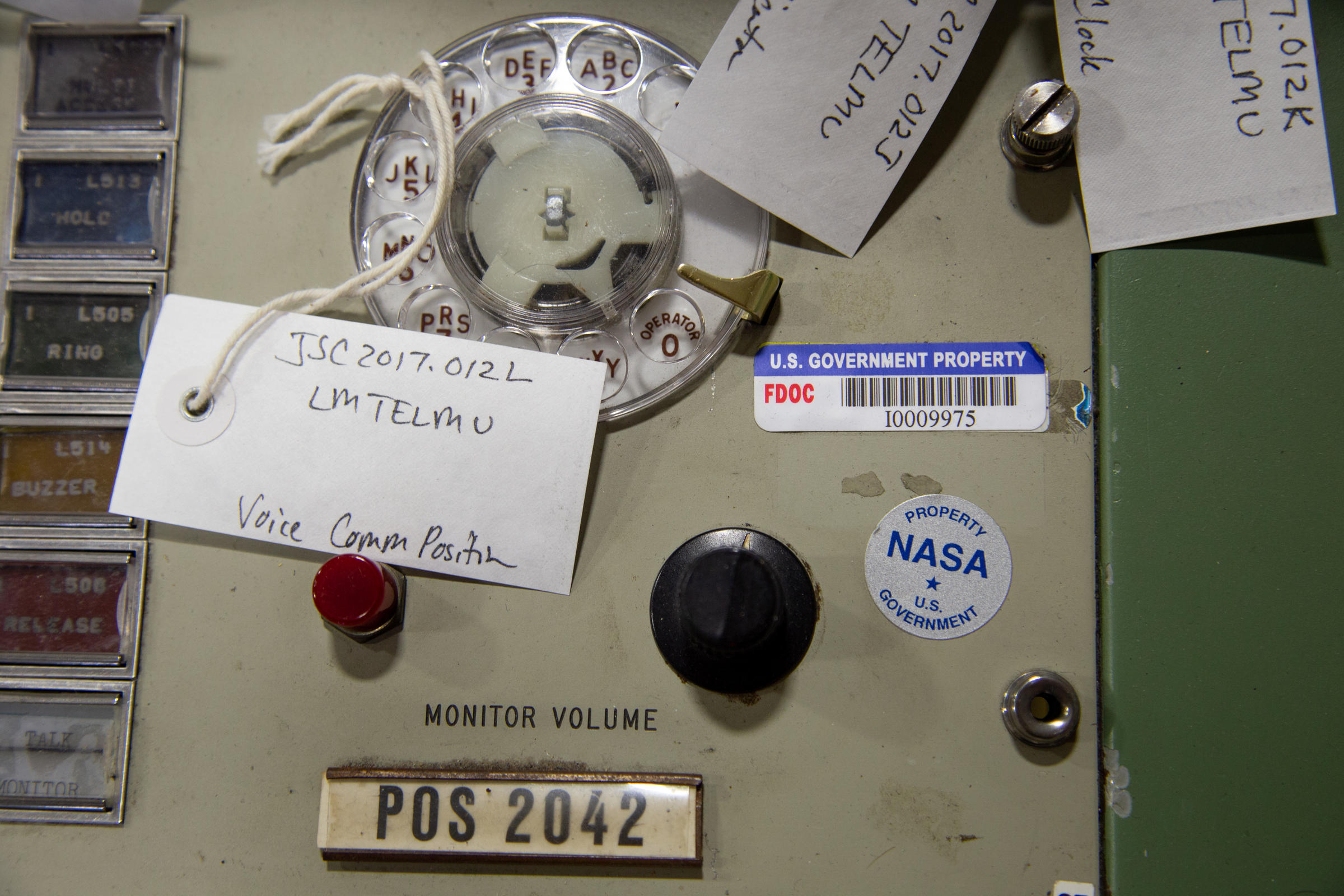
Graber and his team are restoring and preserving nearly two dozen mission control consoles from the Johnson Space Center in Houston. NASA flight controllers used these consoles during missions that put astronauts on the moon and space shuttles into orbit.
The consoles were retired and shut down after the Discovery space shuttle flight in 1992.
“The tours would come into there and they would just see the consoles dead; just turned off. The room was very empty in a sense,” Graber says.
The SpaceWorks team is working to bring the consoles back to life.
“So they will not function or communicate with anything. They will just look like they would have in a snapshot in time with lights, data on the screens, information that way,” Graber says.
Two rows of the green metal consoles are currently in the SpaceWorks restoration facility. The team works on one console at a time. They clean and fix the wiring, identify which parts can stay, and which parts need to be replaced or replicated. The cabinets will be restored to their Apollo-era appearance with working displays and backlit push-button panels.
Work on this first set of consoles will be completed in September, and then they will be returned to Johnson Space Center. CREDIT LARISSA LAWRIE / KMUW
“We have a layout for each console, and we match that layout per console. Then we will research through pictures to try and match buttons as far as what was lit at a certain time,” Graber says.
The craftsmen are also relying on a manual for the configuration for the consoles. The team often uses reverse engineering and a bit of creativity when it comes to recreating these important pieces of space history. Photographs rarely show the mission control consoles head-on.
“You have a lot of pictures of the room from corners. Sometimes we might find a picture of a certain pattern that might have been on one console and try to replicate it on another. So it’s been a lot of research, been a lot of fun and we’re still digging into that part of it,” Graber says.
Technician Don Aich is retrofitting the display mounting for one of the consoles by adding those metal brackets created in-house. He is replacing the old tube monitors with modern flat screen LEDs. He says no one will notice the upgrade because the front looks identical to the original console display.
Technician Don Aich shows how an upgraded monitor plate looks identical to an original. CREDIT LARISSA LAWRIE / KMUW
“Other people think it looks good and they can’t tell the difference. And we’ve had astronauts who couldn’t tell the difference from some of the things we’ve created,” Aich says.
Because the mission operations control room was designated a National Historic Landmark in 1985, every piece of every console is considered an artifact and is documented. Graber says any parts that are not used in a refurbished console will be archived.
“All of the pieces that we take out that are not historically accurate or that are not going to used anymore, we catalogue, we preserve and then we store for future generations to be able to reference,” Graber says.
The console restoration is part of a bigger Johnson Space Center project to return the entire flight control room and visitor viewing room to their Apollo-era configurations. All of the furnishings in those rooms including carpet, wallpaper and chairs are being cleaned or replaced to match their 1969 appearance. That’s why Graber and his team are making sure every component in the consoles is accurate and functioning.
Jack Graber, vice president of exhibits and technology at the Cosmosphere, uses a color-coded tagging system on the consoles to identify historically accurate parts and parts that need to be replaced or replicated. CREDIT LARISSA LAWRIE / KMUW
“So when people come on tours and they walk in there, it looks like it did on that day with coats and jackets and cigarette ashtrays, and books and manuals and that’s why the consoles will be lighted as well,” he says.
The SpaceWorks team will finish renovating these consoles in September. Then they will take them back to Houston, and pick up the remaining consoles.
The restoration project is expected to be completed next summer in time for the 50th anniversary of the first moon landing.
TOPEKA – Five million dollars in tax credits are still available to investors in innovative emerging businesses in Kansas through the Kansas Angel Tax Credit (KAITC) program. The program offers Kansas income tax credits to qualified individuals who provide seed-capital financing for emerging Kansas businesses engaged in development, implementation, and commercialization of innovative technologies, products and services.
The KAITC Program is administered by the Kansas Department of Commerce and designed to bring together accredited angel investors with qualified Kansas companies seeking seed and early-stage investment. The Kansas Angel Investor Tax Credit act was established to facilitate the availability of equity investment in businesses in the early stages of commercial development and to assist in the creation and expansion of Kansas businesses, which are job- and wealth-creating enterprises.
How does it work?
The KAITC program grants tax credits against the Kansas income tax liability of investors investing in these startup ventures. With the primary goal of encouraging individuals to provide seed-capital financing for emerging, Kansas businesses engaged in the development, implementation, and commercialization of innovative technologies, products and services.
Applications for certification will be accepted only for Kansas businesses in the seed and early-stage rounds of financing.
Companies must meet the following criteria to be certified as a Qualified Kansas Business:
The business has a reasonable chance of success and potential to create measurable employment within Kansas.
In the most recent tax year of the business, annual gross revenue was less than $5,000,000.
Businesses that are not Bioscience businesses must have been in operation for less than five years; bioscience businesses must have been in operation for less than 10 years.
The business has an innovative and proprietary technology, product, or service.
The existing owners of the business have made a substantial financial and time commitment to the business.
The securities to be issued and purchased are qualified securities.
The company agrees to adequate reporting of business information to the Kansas Department of Commerce.
The ability of investors in the business to receive tax credits for cash investments in qualified securities of the business is beneficial because funding otherwise available for the business is not available on commercially reasonable terms.
Each applicant must sign a Qualified Company Agreement with the Kansas Department of Commerce.
Who are Angel Investors?
Angel investors are either individuals or groups looking to make an investment in new or existing businesses. The incentive on such investments is that they may yield a higher return than other methods of investing.
Most angel investors are entrepreneurs who have had their own business succeed in part due to such investments.
Only accredited angel investors can qualify for the Kansas Angel Investor Tax Credit by investing in Kansas Department of Commerce certified Kansas businesses.
The tax credit is 50% of the investor’s cash investment into a qualified Kansas Business
The tax credit may be used in its entirety in the taxable year in which the cash investment was made
The Tax Credits are transferable
If the amount of the credit exceeds the investors’ liability in any one taxable year the remaining portion of credit may be carried forward until the total amount of credit is used
Investors can receive tax credits up to $50,000 in tax credits per company they invest in, not to exceed $250,000 in one year
If investing through a permitted entity, all the equity owners of the permitted entity must be accredited investors.
Certification of companies must meet mandates established by Kansas statute to allow accredited Angel Investors to receive the Kansas Angel Investor Tax Credit.
Applications for companies seeking investment are accepted through August 31, 2018. For complete information on the Kansas Angels Initiative, visit https://kansasangels.com.