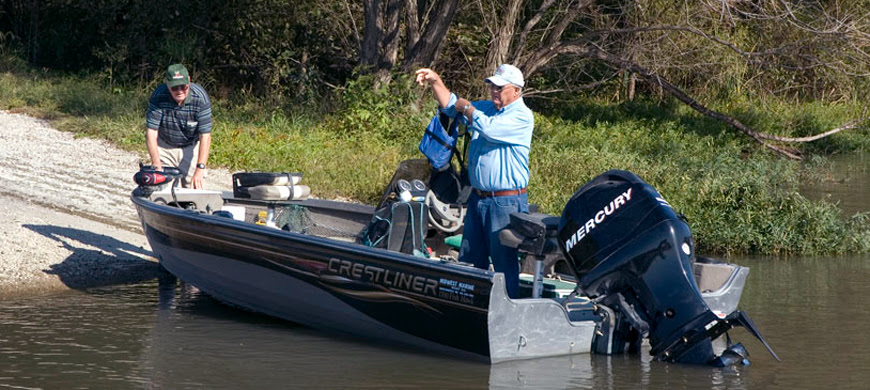
PRATT – Kansas’ license requirement to fish on public waters will be temporarily lifted for two days in June. Anglers can fish for free on June 2 and 3, 2018 thanks to the Kansas Department of Wildlife, Parks and Tourism’s (KDWPT) “Free Fishing Days.”
Each year, KDWPT designates one weekend where everyone can fish without a license; All you need is a pole and a place to go! The Department began the effort as a way to take part in National Fishing and Boating Week – a week dedicated to celebrating, and recognizing the importance of, recreational boating and fishing.
If you’ll be taking part in this year’s free fishing days, here are a couple tips to help you plan your weekend outing:
-Visit www.ksoutdoors.com and click “Fishing,” then “Where to Fish” to find a public fishing spot near you.
-While license requirements are waived for the weekend, anglers must still abide by all other regulations such as length and creel limits, equipment requirements, and more. To find regulation information, grab a copy of the 2018 Kansas Fishing Regulations Summary at a license vendor near you. The summary also lists every state fishing lake, community lake and reservoir, and designates those considered “family friendly,” which means they have easy access to the water, flush restrooms, security patrols and lighting, and no alcohol is allowed.
Go fishing on June 2 and 3; the only thing it will cost you is your free time.
PRATT – Finally! Summer is here and the boating season officially kicks off over the Memorial Day weekend. Kansas reservoirs will be busy with anglers, sailors, skiers, and just plain ole cruisers this weekend and for the next three months. Being on the water is a fun and relaxing way to enjoy the warm weather but boaters must adhere to basic safe boating practices to ensure everyone returns to the boat ramp safe and sound.
The first rule is to wear a life jacket. Kansas law requires all youth 12 and younger to wear U.S. Coast Guard approved life jackets when on a boat. While boaters 13 and older are not required to wear life jackets on the water, a serviceable life jacket must be readily accessible for each person on board. U.S. Coast Guard statistics show that 85 percent of those who drowned in boating accidents last year were not wearing life jackets.
Simply wearing a life jacket can save your life, and today’s life jackets are more comfortable, cooler and lighter than the bulky orange jackets most boaters are familiar with. Innovative options, such as inflatables, allow for mobility and flexibility during boating activities such as fishing, paddling or hunting.
The second rule is to drink moderately, or better yet, avoid alcohol altogether while boating. Alcohol use is the leading contributing factor in fatal boating accidents. It is legal to drink while boating, but it is not legal to operate a boat with a blood alcohol content of .08 percent or greater. And there’s a difference between drinking on land and drinking in a boat. Sun, wind, noise, vibration, and motion – “stressors” common to the boating environment – intensify the side effects of alcohol, drugs, and some medications. Kansas Department of Wildlife, Parks and Tourism (KDWPT) officers will be patrolling waters this weekend looking for unsafe boaters and administering boating under the influence checks.
“There are so many easy steps to ensure boating this weekend – and the rest of the summer – is done in a safe and enjoyable way,” said Chelsea Hofmeier, Boating Education coordinator for KDWPT. “Wear your life jacket, leave the alcohol on shore, be aware of your surroundings, and make sure everyone on board your boat knows the safety procedures.”
The Kansas Boater Safety Education course is offered three ways – a home study packet, online or in a classroom. Go to www.ksoutdoors.com, click on “Boating,” then “Boating Education” to learn more. Not only will the course help you be safer on the water, you might also get a discount on your boat insurance.
Boat safe this Memorial Day weekend and enjoy the wonderful water recreation opportunities our Kansas lakes offer.
WASHINGTON – U.S. Senator Jerry Moran (R-Kan.) – member of the Senate Veterans Affairs Committee and of the Senate Appropriations Subcommittee on Military Construction, Veterans Affairs, and Related Agencies – today applauded Senate passage of S.2372, The John S. McCain III, Daniel K. Akaka, and Samuel R. Johnson VA Maintaining Internal Systems and Strengthening Integrated Outside Networks, or VA MISSION Act, of 2018, by a vote of 92-5.
Following passage, Sen. Moran released the following statement:
“I’m proud the Senate overwhelmingly supported this legislation that empowers our veterans and provides our nation’s heroes with the timely and quality healthcare they deserve. It has been an honor to work alongside my friend and colleague Senator John McCain to reform access to community care in the VA and to provide greater choice for veterans. Named after Senator McCain, the VA MISSION Act includes provisions we have both pursued to establish access and quality standards for veteran eligibility to care in the community and strategic planning to improve the VA’s integrated healthcare system. I look forward to the president signing this bill as we celebrate Memorial Day.”
TOPEKA—The Kansas Supreme Court appointed two new members to the Kansas Sentencing Commission and reappointed two others.
Kansas Court of Appeals Judge Stephen Hill and District Judge Benjamin Sexton will serve two-year terms ending June 30, 2020.
The court reappointed District Judge Lee Fowler and Chris Mechler of the judicial branch’s Office of Judicial Administration to two-year terms, also ending June 30, 2020.
Hill is a former district judge who has served on the Court of Appeals since 2003. Sexton serves in Dickinson County of the 8th Judicial District. Fowler serves in Lyon County of the 5th Judicial District. Mechler is a court services officer specialist to the state’s district courts.
The Legislature established the commission to evaluate sentencing guidelines and advise and recommend changes to the secretary of corrections and legislators.
The chief justice or a designee of the Supreme Court serves on the 17-member commission, and the Supreme Court also appoints two district court judges and a court services officer. Other commission members represent the attorney general, public defenders, defense counselors, district attorneys, the secretary of corrections, the state parole board, community corrections, legislators, and the general public.
Chief Justice Lawton Nuss named Hill as his designee. Hill succeeds Court of Appeals Judge Patrick McAnany.
Sexton succeeds Chief Judge Evelyn Wilson, who serves in Shawnee County of the 3rd Judicial District. Wilson currently chairs the sentencing commission, and Fowler is the vice chair.
PRATT – Whatever your outdoor interests, you’ll find something you enjoy at a Kansas state park this summer. Kansas Department of Wildlife, Parks and Tourism staff have our state parks groomed and ready for visitors, and many special events are scheduled. Your outdoor experience can be exactly what you want it to be: quiet and relaxing, exhilarating, educational or entertaining.
Nearly every Kansas state park offers a combination of full-service RV camping and primitive camping sites, and most also provide cabins for rent. In addition, there are hiking, biking and horse trails, many with interpretive signage and local wildlife to observe. Park staff will also conduct nature programs, and host a variety of events. There will be concerts, races, star parties, and competitive trail rides to name a few.
Not what you’re looking for? Most parks offer convenient access to water with numerous boat ramps and courtesy docks. For anglers, Kansas reservoirs are home to crappie, walleye, white bass, wipers, black bass, and trophy-class channel, blue and flathead catfish. And Kansas is famous for its wind, so our lakes are popular with sail boaters and wind surfers. But there’s room for everyone, and riding behind a motorboat on a tube or water skis is a great way to cool off on a warm summer day. Many park areas also provide easy access to sandy beaches if you’re into swimming or just catching some rays.
If you prefer to “get away from it all” and simply enjoy some of Kansas’ amazing natural offerings, our parks have that, too. Find that out-of-way primitive campsite, pitch a tent, then hit one of the trails. There are more than 500 miles of trails and many will take you through spectacular natural areas away from the commotion of campers and boaters.
Start planning a trip to one of our state parks now. You can find out everything you need to know at www.ksoutdoors.com. View or download state park maps, get contact information for individual park offices, see fees and regulations, and you can even make a reservation. It’s all there and it’s all waiting for you.
TOPEKA – The Kansas Department of Commerce announces Wade Wiebe has been appointed as the agency’s Director of Workforce Innovation. The agency also announces the appointments of Susan NeuPoth Cadoret as Director of Business and Community Development, Kevin Doel as Director of Marketing and Communications, and Sherry Rentfro as Chief Fiscal Officer.
Wade Wiebe
As Director of Workforce Innovation, Mr. Wiebe will oversee strategic direction and implementation of workforce development solutions such as the agency’s Workforce Aligned with Industry Demand (AID) program, an employer-driven training system that matches the skills needed for a company’s workforce with education providers who deliver the training. He previously served with the Department of Commerce as Manager of the Innovation Growth Program before joining the Kansas Department of Transportation as its Director of Administration. He served in that role for the past six years. He earned a B.S. degree in Business from The University of Kansas.
Susan NeuPoth Cadoret
Ms. NeuPoth Cadoret has been serving as Acting Director of the Business & Community Development Division for over a year before being appointed as the permanent Director. She has served with the Department of Commerce for 19 years, including over six years as the Assistance Manager for the Business and Community Development Division. Prior to working for Commerce, NeuPoth Cadoret worked 15 years in economic development at the local level. She earned a B.A. degree in Communications from Fort Hays State University.
Kevin Doel
Mr. Doel joined the Department of Commerce in 2017 as Director of Communications and has also served as Interim Director of Marketing since January 2018. Before joining Kansas Commerce, he served as Communications Manager for the State Fire Marshal. Previously, he served as Director of Marketing for Brewster Place, Topeka’s largest non-profit senior health and living organization, and owned and operated Talon360, a publicity firm for mobile technology companies, for 15 years. He earned his B.S. degree in Management and Ethics from Dallas Christian College.
Sherry Rentfro
Ms. Rentfro joined Commerce in June of 2014 as Fiscal Analyst and has been serving as the Acting Chief Fiscal Officer since February 2018. Prior to Commerce, she worked for over 10 years managing the accounting and finances of a non-profit association that serves the telecommunications industry in Kansas. She earned a BBA in Finance from Washburn University and MBA from Baker University.
About Kansas Department of Commerce
As the state’s lead economic development agency, the Kansas Department of Commerce strives to empower individuals, businesses and communities to achieve prosperity in Kansas. Under the leadership of Interim Secretary of Commerce Robert North, the department comprises a variety of programs and services that create jobs, attract new investment, provide workforce training, encourage community development and promote the state as a wonderful place to live, work and play. For more information on the Kansas Department of Commerce, visit www.KansasCommerce.gov.
By ALAN WELDON Kansans for Life Chairman of the Board
WICHITA – Kansans for Life announces that Mary Wilkinson, KFL Vice President, has succeeded Joe Patton, KFL President, as Interim President of Kansans for Life. The Executive Board is thankful to Joe Patton for his service to KFL.
Wilkinson has been involved in the pro-life movement for 30 years, getting her feet wet during the “Summer of Mercy” in Wichita, and serving as President of Kansans for Life Wichita affiliate. She also serves on the KFL Political Action Committee, both statewide and locally in Wichita.
Patton is one of the founders of Kansans for Life and has served as volunteer president of Kansans for Life for the past year and a half. Patton will continue as a volunteer to organize a coalition to lead the statewide effort to pass a constitutional amendment to ensure the people’s right, through their legislators, to continue to pass pro-life laws in Kansas.
Patton stated, “I have enjoyed working with KFL and am honored to have served the pro-life community as President during this time of transition with the passing of a great pro-life leader, David Gittrich. I will cherish many memories from the past year and a half. The organization will have continued success under the capable direction of its new President, Mary Wilkinson. Mary has my full support and I am confident under her leadership Kansans for Life will be in good hands. I am more passionate today than I have ever been about the pro-life cause. I will continue to be involved in the pro-life movement because we have all been called to secure the foundation of all human rights, the right to life.”
Wilkinson said, “It is my honor and privilege to serve as Interim President of Kansans for Life, an organization that I have worked with for three decades. There is no more important work today than saving the lives of the weak, the helpless, the vulnerable, created in God’s image. KFL stands ready to continue to educate, to elect pro-life leaders, and to pass laws that save lives. I look forward to serving KFL and working together with all pro-life Kansans in this important election year.”
WASHINGTON – U.S. Senator Jerry Moran (R-Kan.) this week joined a bipartisan group of colleagues in introducing the Protecting Rational Incentives in Newsprint Trade Act of 2018 (PRINT Act). This legislation, which has been endorsed by printers and publishers including the Kansas Press Association, representing more than 600,000 American jobs, would suspend import taxes on uncoated groundwood paper while the Department of Commerce examines the health of – and the effects on – the printing and publishing industry.
“A local newspaper is important to every community in Kansas, yet every Kansas newspaper is facing significant challenges to stay in business,” said Sen. Moran. “Increasing tariffs on newsprint means that printing a newspaper becomes more expensive, resulting in less local news, weather and sports reaching mailboxes and front porches in Kansas. I will continue working with my colleagues to encourage the Department of Commerce to consider these consequences before moving forward with implementing these tariffs.”
“Publishers already face economic headwinds due to the migration of advertising from print to digital,” said President & CEO of News Media Alliance David Chavern. “We simply cannot absorb extra costs from import taxes. Newspapers will close or be forced to raise prices for readers and advertisers. We are already seeing some papers cut back on news distribution and cut jobs. These tariffs are killing jobs and high-quality news in local communities. We are grateful that Senator King, Senator Collins and the original co-sponsors of the bill showed leadership and stepped up to protect small publishers in local communities across America.”
The Department of Commerce initiated antidumping and countervailing duty investigations in late 2017 into the Canadian uncoated groundwood paper industry on behalf of a single domestic paper mill – this paper is used by newspapers, book publishers and numerous other commercial printers in the United States. The import taxes are as high as 32 percent on some products, and that cost is passed on to printers, book publishers and newspapers that are already under severe economic stress.
Nearly all of the U.S. paper industry opposes these import taxes, including the large trade association representing the industry, the American Forest and Paper Association, because the Department of Commerce’s action threatens to decimate the paper industry’s customers and injure printers and publishers.
The PRINT Act is also sponsored by Senators Susan Collins (R-Maine), Angus King (I-Maine), Roy Blunt (R-Mo.), Doug Jones (D-Ala.), Deb Fischer (R-Neb.), Claire McCaskill (D-Mo.), Roger Wicker (R-Miss.), Johnny Isakson (R-Ga.) and Shelley Moore Capito (R-W.Va.).
Specifically, the PRINT Act would:
Require a study by the Department of Commerce of the economic wellbeing, health and vitality of the newsprint industry and the local newspaper publishing industry in the United States;
Require a report from the Commerce Secretary to the president and Congress within 90 days that includes both the findings of the study and any recommendations the secretary considers appropriate;
Stay the effect of proceedings of the Department of Commerce and the International Trade Commission in regards to uncoated groundwood paper until the president certifies that he has received the report and that he has concluded that such a determination is in the economic interest of the United States; and
Halt the collection of deposits for uncoated groundwood until the president has made such certifications.
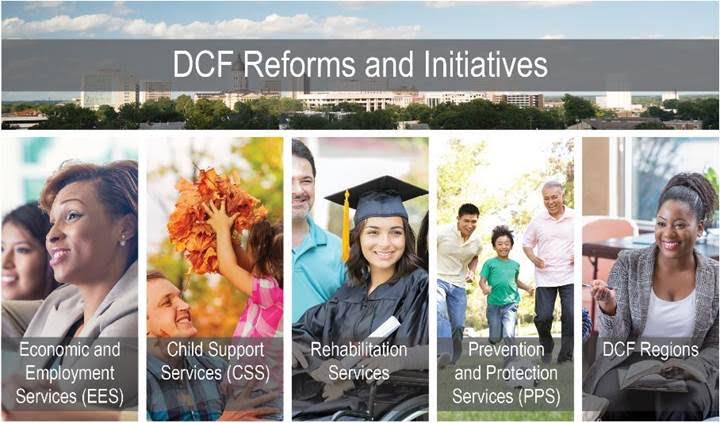
TOPEKA – Kansas Department for Children and Families (DCF) Secretary Gina Meier-Hummel is pleased to announce the roll out of an online, interactive dashboard. The DCF Reforms and Initiatives Dashboard demonstrates reforms and initiatives for each program area and region, as well as agency-wide goals. Additionally, the webpage illustrates progress, allowing the public to track DCF efforts online.
“Our agency exists to serve Kansans, and we want to clearly demonstrate to the public the work being done,” said Secretary Meier-Hummel. “This is just another step we are taking to be more transparent and accountable to the public.”
For the past six months, Secretary Meier-Hummel has been working diligently with each program and DCF Regions to identify the current projects, as well as goals and initiatives to be implemented on the dashboard.
“I am thrilled that Secretary Meier-Hummel has implemented this dashboard. We want to be the most open administration in the history of Kansas,” said Governor Jeff Colyer. “This dashboard increases transparency by creating a one-stop-shop for Kansans to see the work being done by the agency.”
The progress for each initiative will be measured by the length of the project, compared to the action steps that have already taken place to complete the project. Some of the identified initiatives will be ongoing projects, and will be noted as such. The dashboard will be updated the last Friday of every month. Once a project has been completed, new goals or reforms will be identified.
“We have to continuously be looking forward and tracking our progress. This will allow us to continue to make significant movements, and will ultimately improve the way we serve the children and families of Kansas,” said Secretary Meier-Hummel. “I hope that the public will utilize this dashboard to keep us accountable, and stay up-to-date on what is happening at our agency.”
The DCF Reforms and Initiatives Dashboard can be found online here. You can also find it at www.dcf.ks.gov, on the right-hand side, in the Quick Links section as Agency Dashboard.
Gov. Colyer signs the KDADS Health Occupations Credentialing program
OFFICE OF GOV.
TOPEKA – Governor Jeff Colyer, M.D., signed into law Thursday a bill authorizing the Kansas Department for Aging and Disability Services’ (KDADS) Health Occupations Credentialing program to conduct national fingerprint-based background checks on individuals seeking to work in adult care homes or home health agencies or to provide services through one of the state’s seven home- and community-based services Medicaid waivers.
“This bill is a common-sense measure that will help to protect vulnerable Kansans. I was pleased to sign this important legislation because it closes a loophole that could allow caretakers to victimize disabled or elderly Kansans. Expanding our fingerprint-based background checks makes all of those receiving care safer,” Governor Colyer said.
“This will allow us to carry out a more thorough check of individuals who work caring for the vulnerable in our state,” KDADS Secretary Tim Keck said. “Currently, there are approximately 8,000 individuals working in Kansas adult care homes who reside in a state that borders Kansas. The national background fingerprint check will ensure that records of crimes committed in other states are available for review before individuals can be hired, regardless of their state of residence.”
The bill signed by Governor Colyer amends three existing criminal record-check statutes to align all the offenses and timeframes that disqualify or prohibit an individual from working in any of those health care settings and sets a length of time after conviction of a disqualifying crime must pass before the individual is eligible to be employed in those settings. Alignment of the prohibited offenses and timeframes creates parity for all potential workers because all are held to the same standards.
KDADS’ background check portal, KanCheck, has been developed and built through a grant from the federal Centers for Medicare and Medicaid Services (CMS) at no cost to the State of Kansas. The system was designed to be utilized by multiple agencies and programs. The Kansas Department of Health and Environment will be utilizing the KanCheck system to complete their criminal record checks for childcare providers.
In 2017, KDADS completed a total of 63,514 criminal record background checks and issued a total of 976 employment prohibitions, 147 for adult care home/home health agency applicants and 829 for home- and community-based services job applicants.
TOPEKA – The Democratic National Committee announced Tuesday the Kansas Democratic Party (KDP) is a recipient of a grant from the State Party Innovation Fund (SPIF), a first-of-its-kind, competitive grant program that incentivizes early organizing through state parties and supports efforts to engage local communities.
The Kansas Democratic Party will receive a $50,000 grant, which will be used to help train and engage the next generation of Kansas Democrats. The Kansas Democratic Party is focused on preparing young Kansans through leadership development, new campaign skills, and digital organizing tactics. The grant will also help the Kansas Democratic Party continue their work to help candidates implement new volunteer and voter outreach tactics in rural communities and small towns, run stronger campaigns, and compete in every ZIP code across the state.
“The Kansas Democratic Party is putting in the hard work to deliver the leadership their state deserves,” said DNC Chair Tom Perez. “We know that if we empower and organize young people, they will be the difference-makers in 2018 and into the future. The DNC is proud to partner with the Kansas Democratic Party to ensure that the state party has the tools, resources, and first-rate staff they need to expand their ranks, engage and mobilize voters in rural communities across the state and lift Democratic candidates running in offices up and down the ticket, across the country to victory in 2018, 2020, and beyond.”
“Kansas Democrats are committed to standing up for working Kansas families and fighting for a stronger future for our state,” said Kansas Democratic Chair John Gibson. “With this grant, we will be able to continue our work to build our base, recruit strong local candidates, invest in training programs, and expand upon our efforts to build stronger relations with young voters and in rural communities. We’re grateful that the DNC shares our commitment and is helping to execute our plan to recruit the next generation of leadership, elect Democrats up and down the ticket, and mobilize voters in every corner of Kansas.”
In addition to SPIF, through the DNC’s Every ZIP Code Counts program, state parties have consistently been receiving $10,000 a month since October 2017, which is a 33% increase over the base funding levels from 2016 and a 100% increase over 2015, and is based on state-specific strategic plans.
MANHATTAN —A public hearing will be conducted at 10:00 a.m. on Wednesday, May 23, 2018, to consider an increase to fees for food establishments, food processing plants and certificates of free sale. The hearing will be held in room 124 on the first floor of the Kansas Department of Agriculture, 1320 Research Park Dr. in Manhattan, Kansas.
The proposed regulations, K.A.R. 4-6-3, K.A.R. 4-28-5 and K.A.R. 4-28-6, seek to increase application and licensing fees for food establishments and food processing plants and fees for certificates of free sale, and add a new fee category for very low risk food establishments.
The regulations can be found at the KDA website, agriculture.ks.gov/ProposedRegs. Comments can be submitted prior to the hearing at that webpage as well.
All interested persons may attend the hearing and will be given the opportunity to express comments either orally or in writing, or both. Interested parties may appear in person or by counsel. Persons who require special accommodations must make their needs known at least five days prior to the hearing. For more information, including special accommodations or a copy of the regulations, please contact Ronda Hutton, 785-564-6715.
The DuBree family has adopted more than a dozen foster children, and come to see that state officials can only help so much. (Photo illustration by Kansas News Service)
By MADELINE FOX Kansas News Service
Janelle DuBree didn’t need statistics to see that foster kids are traumatized. The evidence was spilled, smashed and smeared all over her kitchen and down the hallway.
Two of the younger girls she took in, on one of their first nights in her Emporia home, raided the kitchen around 2 a.m. Eggs were cracked and trailed everywhere — on the floor, the countertops, the side of the refrigerator. Her carpet was soaked in bright red Hawaiian Punch.
DuBree adopted the girls, now 7 and 9, from a place where food wasn’t always available. So when it was plentiful, they took out and ate everything they could.
Another of DuBree’s daughters, adopted out of Texas in September 2007, was abused in her birth home and subsequent foster homes.
Psychiatrists said that left her often unable to trust anyone. She still frequently runs away from home — especially in the summer, which triggers bad memories.
“That’s a pretty common story,” said Jim Orwig, a therapist who works with foster children and their families in southeast Kansas.
Kids wounded by significant trauma use whatever tools they can — hoarding food, running away, withdrawing emotionally — to impose order and a sense of safety on their lives.
Even in a safe, adoptive home, it can be hard to shed those defensive instincts. The state and its contractors promise parents help — psychiatrists, counseling, case workers coaching families through heart-breaking challenges.
But it simply can’t keep up.
A road map for kids in care
When kids land in foster care, a case planning conference for everyone involved in the child’s life — foster parents, attorneys, case workers, DCF, maybe a therapist or someone from the kid’s school — aims to hash out what they need.
That becomes a road map for the child’s stay in foster care.
The state helps adoptive families, too. They don’t get the money and coaching devoted to foster homes. But since 2013, the Department for Children and Families has insisted contractors make sure adoptive parents get various forms of backup, at least until the child turns 18.
The agency acts as go-between. Adoptive and foster parents call its abuse hotline when they see behavior that, on the surface, doesn’t make sense.
That’s a chance to steer the family to a mental health therapist, or point it toward local adoption support groups. The call might prompt the dispatching of a DCF worker trained to walk a family through crisis — and spare everyone the prospect of moving a child to yet another home.
“I would call asking, ‘How do I handle this? How do I handle that?’” DuBree said.
“DCF literally broke that contract with us”
DuBree and her truck driver husband, Will, have seen plenty of challenges. They adopted 16 children from the Kansas and Texas foster care systems, bringing their total to 19 kids.
One of the DuBrees’ adopted sons helps another style his hair in the family’s dining room. The DuBrees have 19 kids total, including a son of Janelle’s from before their marriage, a daughter the couple had together and Janelle’s nephew, whom they adopted after her brother’s death. (Photo by Madeline Fox, Kansas News Service)
With their adopted daughter working through the trauma of sexual abuse by a foster father, though, phone calls for advice, and even regular therapy and medication, weren’t enough.
When the girl ran away in October 2016, the DuBrees secured a bed for her at a residential psychiatric facility. They figured taking her there would give her the intense help and supervision they couldn’t offer.
DuBree also told DCF her daughter had run away, exactly where she was, and about the services they were planning for her when they got her home. Police picked her daughter up and put her into protective custody.
Within a few days, the DuBrees stood before a judge, expecting to have the girl returned to their home. Janelle DuBree said the family didn’t bring a lawyer to court because she and her husband were expecting it to be a formality. They’d get the girl back, and then bring her to the residential facility.
Instead, DCF took the girl into custody and placed her in a Topeka foster home that wasn’t equipped to provide the kind of mental health care she needed.
Six months passed. On one front, the DuBrees were working to get the adopted daughter out of foster care. On another, they fought to get the care she needed.
The girl’s case plan, that road map of necessary services, included medication, individual therapy and family therapy.
From the month after she was taken into care, that plan included concerns that she wasn’t getting mental health services in the DuBrees’ Emporia home. But their insurance records show regular therapy appointments and medication refills in the year before she was taken into foster care.
In Topeka, she was far away from the therapists she’d seen in Emporia. And when Janelle DuBree checked insurance records during her daughter’s foster care stay, they showed only two therapy appointment charges, an intake session and a missed appointment fee.
The DuBrees began taking her back to Emporia on family visits for the same therapy services she’d gotten before DCF removed her.
Near the end of the girl’s stay in foster care, DuBree noticed that her daughter’s medication hadn’t been refilled for months — meaning she had essentially quit an antipsychotic medication cold turkey without a doctor’s order.
DuBree called the contractor handling the girl’s stay in foster care.
The girl’s prescription was picked up by her social worker in March, just before she was returned to the DuBrees’ Emporia home in April.
Janelle DuBree sits in her living room. She and her husband, Will, have adopted 16 kids out of the foster care systems in Kansas and Texas since they married in 1999, most of them in groups of siblings. (Photo by Madeline Fox, Kansas News Service)
Janelle DuBree said she reads DCF’s policy manual every time it’s updated. She highlighted the section outlining post-adoption finalization services, and its promise of services to “assure the stability of the adoption” as needed for as long as the children stay in that family. That policy wasn’t in place for most of the DuBrees’ adoptions — including their older daughter’s — but DuBree says it outlines what the state welfare agency should provide to parents.
“DCF literally broke that contract with us,” DuBree said.
“It could still happen right now”
Foster parents are supposed to make sure kids are getting the services outlined on their case plan. If they don’t, DCF Secretary Gina Meier-Hummel said, that becomes the contractors’ responsibility.
In a successful case, she said, everyone works together to make sure kids are getting their needs met. For example, if a foster parent can’t take children to their appointments, the social worker might chauffeur.
It’s not very hard for a kid to slip through the cracks.
Yet the system faces more cases than it can keep up with. Between a skyrocketing number of kids in care — more than 7,500 as of March — a shortage of social workers and shuffle between contractors and subcontractors, it’s not very hard for a kid to slip through the cracks.
Could the same thing the DuBrees encountered happen again?
“Yeah, absolutely. It could still happen right now,” Meier-Hummel said. “Are we heading to a place where I think it’ll be less likely to happen? Yeah, I think in the future it will be much less likely.”
The agency has asked for more money to ease some of the strains on the foster care system. Some funds would go toward family preservation — things such as drug counseling, anger management, parenting classes — so kids don’t have to be pulled into foster care in the first place.
Other money would raise salaries for DCF’s social workers. That could make it easier to hire new people and keep experienced hands in the agency.
Meier-Hummel said DCF is also talking with other state agencies and community organizations to strengthen community mental health services, again so kids can be taken care of closer to home.
But the agency head said the system still needs work. A lot. In the meantime, it’s getting more stressed, as the number of kids in care steadily rises.
A family picks up the pieces
Access to services in times of crisis can be essential for treating symptoms. But Orwig, the therapist, said those services have to be more consistent to address the root problems. Foster kids need to be able to form a trusting relationship with someone they know they will see regularly.
“It’s kind of like parenting — a consistent relationship with somebody who really cares about the kids,” he said.
Neat, happy endings don’t come easily. The DuBrees got their troubled, adoptive daughter back a year ago. Since then, she’s been in and out of hospitals and treatment centers.
The girl needed intensive treatment before her stint in foster care, DuBree said. More than six months in foster care without medication or regular counseling only made things worse.
“One of the worst things DCF can do is take that child out of the home,” DuBree said, “take that stability away from that child.”
Madeline Fox is a reporter for the Kansas News Service, a collaboration of KCUR, Kansas Public Radio, KMUW and High Plains Public Radio covering health, education and politics. You can reach her on Twitter @maddycfox.

 KDWPT
KDWPT