We have a brand new updated website! Click here to check it out!

Kansas infant mortality rate holds steady

KDHE 

TOPEKA – The Kansas Department of Health and Environment (KDHE) reports the Kansas Infant Mortality Rate (IMR) held steady in 2016, at 5.9 infant deaths per 1,000 live births, with the lowest number infant deaths (223) ever reported in Kansas. This rate remained unchanged from 5.9 per 1,000 live births (230 infant deaths) in 2015.

The Infant Mortality Rate (IMR) reflects the health and well-being of a nation or state. The U.S. rate is 6.0 infant deaths per 1,000 live births. The Kansas IMR of 5.9 is below the Healthy People 2020 (HP2020) target of 6.0. Healthy People 2020 is a 10-year program from the Office of Disease Prevention and Health Promotion of HHS.

“The Kansas Department of Health and Environment is committed to working with our partners to reduce infant mortality and disparities in infant mortality. Together with community partners, we have continued to maintain the lowest ever recorded infant mortality rate for our State through applied research and community intervention,” said Susan Mosier, MD, MBA, FACS, Secretary of KDHE and State Health Officer.

The White non-Hispanic population IMR (5.2) and the Hispanic IMR (5.1) also met the HP2020 target while the Black non-Hispanic (15.2) rate did not.

For Kansas in 2016, the White non-Hispanic population group had the highest number of infant deaths (139 infant deaths), while the Black non-Hispanic group had the highest rate (15.2 per 1,000 live births). The disparity in rates between White and Black non-Hispanic infant deaths was evident in all periods of death.

In the last century, the Kansas infant mortality rate (IMR) has decreased dramatically, from 73.5 deaths per 1,000 live births in 1912 (2,795 infant deaths) to 5.9 in 2016 (223).

“Even though we have reached our lowest number of infant deaths ever reported, we are not done. We will continue to work with our partners to further decrease infant mortality and disparities in infant mortality,” said Dr. Mosier.

One way KDHE helps at-risk communities is through the Healthy Start Home Visitor Services. Maternal and Child Health Grants are provided to local health departments so they can provide outreach visits to pregnant women and families with newborns. Under public health nurse supervision, visitors provide in-home interventions such as education, support and referrals to other community services.

The Selected Special Statistics, Stillbirths and Infant Deaths, Kansas, 2016 summarizes vital records data on stillbirths and infant deaths. This report is attached and will be posted athttps://www.kdheks.gov/phi/index.htm.

KDOC presents plan to rebuild Lansing prison

Lansing prison

KDOC

TOPEKA – Kansas Secretary of Corrections Joe Norwood today presented a proposal to rebuild Lansing Correctional Facility (LCF) to the Legislative Budget Committee. This presentation is the latest in a series related to the construction project at LCF, as the Kansas Department of Corrections (KDOC) seeks legislative approval of the project.

The current LCF facility includes a medium unit built in the 1980s, as well as the original maximum unit that dates to the 1860s. KDOC is proposing that a modern facility be built where the medium facility is currently located.

During the 2017 Legislative Session, the KDOC presented the project concept to the House Transportation & Public Safety Budget Committee on February 8, the House Corrections and Juvenile Justice Committee on March 6, the House Appropriations Committee on March 14, and to the Joint Committee on State Building Construction on March 16.

A budget proviso set forth the process by which the Department requested bids from vendors and moved forward with seeking approval from the legislature for the preferred bid. This proviso specifically authorizes the Department to seek bids for projects only at the site of the current facility in Lansing. It also specifically mandates that the KDOC operate the facility.

With the passage of the 2017 Omnibus Budget Bill, the legislature granted the Department authorization to pursue bond-financing or lease-purchase agreement.  In addition to the proviso, the Legislative Post Audit Committee also examined the funding mechanisms available, using assumption-based models.

With assistance from the Department of Administration Office of Procurement and Contracts, the KDOC issued the Request for Proposal in accordance with KSA 75-31,102. Two bids were received, both funded by the lease-purchase funding mechanism. KDOC chose to move forward with the lower bid, submitted by CoreCivic.

CoreCivic proposes to design and construct the new LCF facility within 24 months using Kansas companies. The plan encompasses a net savings of $23.6 million over the life of the lease with staff and building efficiency as the primary drivers. The new construction would replace the deteriorating facility that is inefficient to operate and maintain.

A modernized facility at LCF would allow for efficiency and security upgrades. KDOC currently spends 46 percent of its Capital Improvements Budget on the LCF. The current design of LCF requires an inordinate number of staff for a facility of its size—a demand that the Lansing community struggles to meet, as evidenced by the nearly 20% vacancy rate. The improved working conditions offered by a modern facility will be safer for staff and more attractive to prospective employees.

The proposed agreement with CoreCivic is a 20-year lease term. The facility will revert to the ownership of the State after 20 years at no additional cost. The annual lease payment is $14.9 million with 1.94% escalator, payments that can be made with the savings gained from reduced staffing levels.

The current design of LCF calls for 506 uniformed and 176 non-uniformed staff, at a cost of over $37 million per year. The new design would require 287 uniformed and 84 non-uniformed staff, at just over $20 million.

The proposed design would allow LCF to consolidate many services. Three existing compounds that currently provide duplicated services would be consolidated into two compounds. The new facility would combine the kitchens, dining rooms, clinics, and program areas of the current medium and maximum-security sections of LCF, reducing the number of posts to staff those areas.

CoreCivic is responsible for maintenance of LCF, and is tasked with maintaining a replacement schedule on all capital assets (which includes life cycle replacements and emergency repairs and replacements). The leaser would also covers cost overruns, and lease payments do not start until occupancy.

The proposed facility design includes:

  • Two housing units: a 1,920-bed maximum and medium unit and a 512-bed minimum unit
  • 75% of the cells are 2-person units, 25% are 4-person units
  • Medical Services (improved design for aging population) Food Service, Spiritual Life, and Staff Support areas
  • Indoor and outdoor recreation areas, ample site circulation and parking, and improved lighting and security
  • Modern utility systems that provide significant cost and energy savings
  • Capacity for future expansion
  • Local maintenance staff, locksmiths, and professional services
  • Energy saving shell design with top-of-the-line roofing system, and highly insulated walls systems
  • Security systems include triple-biased magnetic door switches, and enhanced video surveillance systems
  • A layout design which controls the movement of the inmate population


Chief justice reappoints retired judge to Kansas Government Ethics Commission

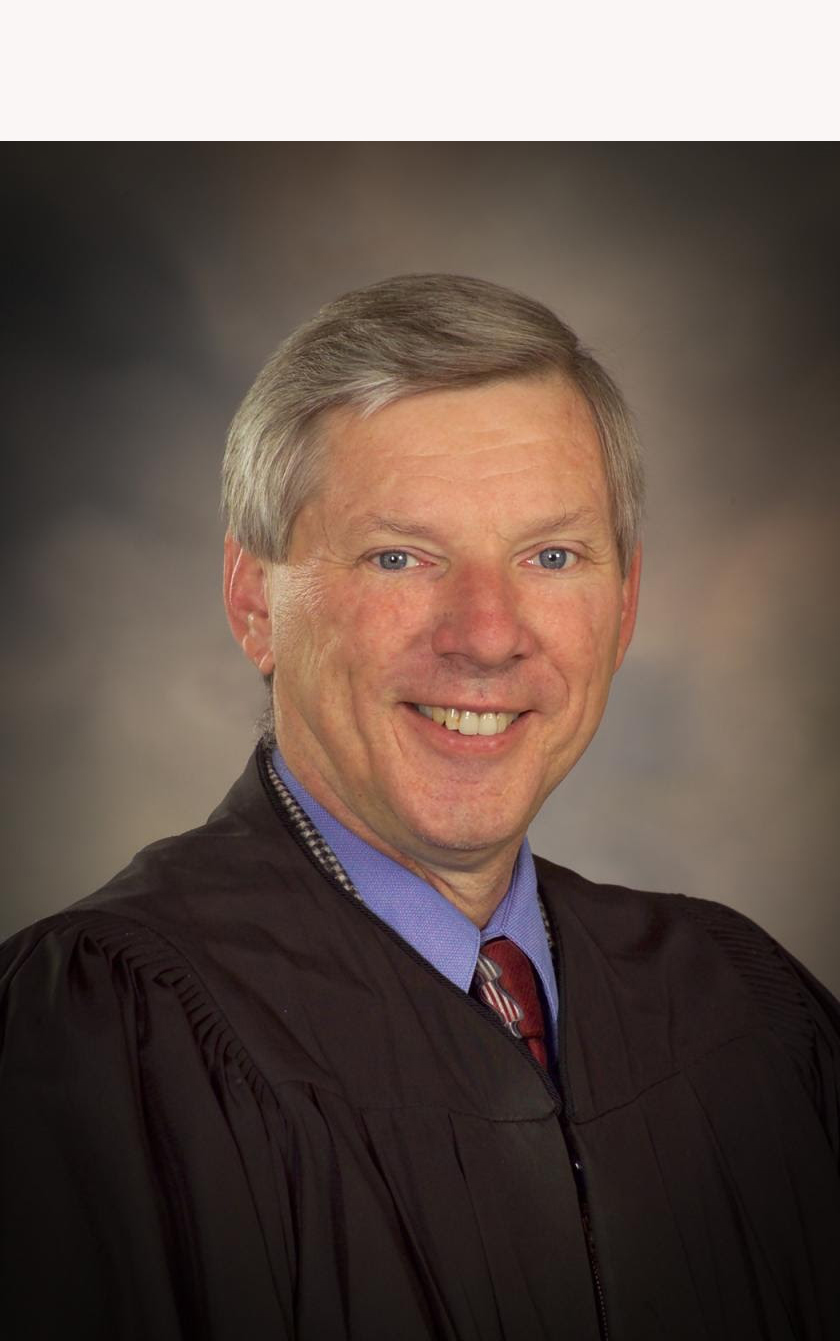
Retired Judge Jerome Hellmer

OJA

TOPEKA — Chief Justice Lawton Nuss has reappointed Jerome P. Hellmer, a retired judge, to the Kansas Government Ethics Commission.

The appointment is for a two-year term that runs through January 2020.

Hellmer has served on the ethics commission since January 2015, when he retired as chief judge of the 28th Judicial District, which is composed of Saline and Ottawa counties. He served as a district court judge from 1996 to 2011 and as chief judge from 2011 to 2015. Before his appointment to the bench, Hellmer practiced law in Salina for 22 years.

The nine-member Kansas Governmental Ethics Commission is charged with administering, interpreting and enforcing the state’s Campaign Finance Act and laws relating to conflict of interests, financial disclosure, and the regulation of lobbying. These laws establish the public’s right to information about the financial affairs of Kansas’ public officials, lobbyists, and candidates for office. In addition, the commission renders advisory opinions and can adopt rules and regulations under a less comprehensive conflict-of-interest law covering local government officials and employees.

The chief justice of the Kansas Supreme Court appoints one of the members of the commission. The governor appoints two members, and the secretary of state, attorney general, Senate president, House speaker, Senate minority leader, and House minority leader each appoint a member.

Kansas is up two spots in health rankings

UHF

MINNETONKA, Minn.  – Each year, the United Health Foundation publishes a comprehensive heath ranking of all fifty states. This is the 28th edition of America’s Health Rankings, making it the longest-running report of its kind.

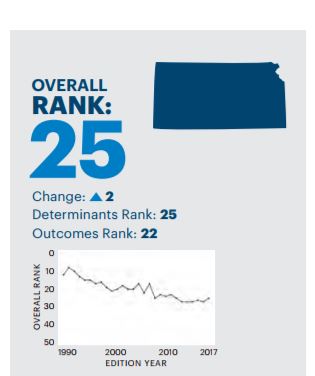
This year, Kansas’ overall ranking is 25, which is up two spots from 2016.

Kansas – 25

Strengths:

  • Low prevalence of frequent physical distress
  • Low prevalence of low birthweight
  • Low drug death rate

Challenges:

  • Lower number of dentists
  • High incidence of pertussis
  • Low per capita public health funding

Highlights:

  •  In the past year, obesity decreased 9% from 34.2% to 31.2% of adults
  •  In the past five years, drug deaths increased 23% from 9.6 to 11.8 deaths per 100,000 population
  •  In the past year, infant mortality decreased 5% from 6.4 to 6.1 deaths per 1,000 live births
  •  In the past four years, cardiovascular deaths increased 5% from 242.4 to 253.5 deaths per 100,000 population
  •  In the past 10 years, air pollution decreased 29% from 10.3 to 7.3 micrograms of fine particles per cubic meter

Ranking:

  • Kansas is 25th this year; it was 27th in 2016
  • The state ranks 31st for senior health and 25th for the health of women and children

For additional reference of where the states stand compared to others in the Midwest, Missouri ranks 40, Nebraska ranks 13 and Iowa ranks 15.

For the America’s Health Rankings annual full annual report, including information on the nation’s overall health, visit: https://americashealthrankings.org/.

Licenses buyers soon to enjoy auto-renew and 365-day licenses

KDWPT

PRATT – Take care of those who take care of you, right? Well, staff at the Kansas Department of Wildlife, Parks and Tourism (KDWPT) are doing their best to ensure hunters, anglers, and other license buyers are taken care of in a big way in 2018 and for many years to come.

For the first time, Kansas licenses buyers will soon have the ability to auto-renew some of their favorite annual licenses and permits. And, many of those will be valid (beginning Jan. 1, 2018) for 365 days from date of purchase.

Previously, Kansas’ outdoor licenses and permits were set to expire Dec. 31 of each calendar year, regardless of purchase date. But that’s about to change. Kansas license buyers will soon be able to enjoy more season for their money, without any additional cost.

Both the auto-renew option and 365-day licenses will be available beginning Dec. 15, 2017. While these new features are implemented, 2018 licenses and permits purchased between Dec. 15 and Dec. 31, 2017 will not be valid until Jan. 1, 2018. Once valid, the item purchased, if eligible, will then be valid for 365 days.

For a complete list of licenses and permits that will be valid for 365 days, visit ksoutdoors.com/License-Permits/365-Day-Licenses

For instructions on how to enroll in auto-renew, visit ksoutdoors.com/License-Permits/Auto-Renew.

“Never Miss A Memory” afield with KDWPT’s new auto-renew and 365-day license options.

Kansas Wildlife And Parks magazine: The perfect gift

KDWPT

PRATT – Struggling to think of a unique and meaningful gift you can give this holiday season that’s within budget? Consider this your gift-buying “aha moment.” Wow family, friends and the outdoor enthusiasts in your life with a gift subscription to Kansas Wildlife And Parks Magazine.

Kansas Wildlife And Parks Magazine ­– Kansas’ premiere outdoor magazine for nearly 75 years – offers readers stunning wildlife photography, inspiring stories of the outdoors, hearty game recipes, helpful tips and tricks, the latest happenings in Kansas outdoor recreation, and more.

For just $12 for one year (six issues), $20 for two years (12 issues), or $29 for three years (18 issues), you can give a gift this holiday season that will last long into the New Year.

Are your friends and family already subscribers? Consider purchasing them a subscription to KANSAS! magazine – a quarterly publication of the Tourism Division of the Kansas Department of Wildlife, Parks and Tourism. Inside KANSAS! magazine, readers will find lists of the best places to eat and drink, dates of upcoming festivals and events not to be missed, and even learn about the people and places that make Kansas so special.

To subscribe to Kansas Wildlife And Parks Magazine, call (620) 672-5911 or visit ksoutdoors.com/Services/Publications/Magazine.

To subscribe to KANSAS! magazine, call (800) 678-6424 or visit www.travelks.com/ks-mag/subscribe/.

Kansas Cancer Partnership launches strategic plan and website

KDHE

TOPEKA – More than 13,000 Kansans are diagnosed with cancer each year, and approximately 5,300 die from the disease. In fact, cancer is one of the leading causes of death in the state. To address cancer-related issues across the state, the Kansas Cancer Partnership (KCP) announces availability of the Kansas Cancer Prevention and Control Plan 2017-2021 and its companion document, Burden of Cancer in Kansas 2017. Both documents are posted on the new KCP website, www.KSCancerPartnership.org.

“KCP is a coalition of dynamic individuals and organizations from across the state,” said Gary Doolittle, MD, University of Kansas Cancer Center.  “KCP members are committed to reducing the burden of cancer in Kansas through evidence-based prevention, screening and survivorship interventions.”

Dr. Doolittle, who serves as KCP Chair, went on to describe the cancer plan as a road map for KCP to address issues across all cancers, while highlighting cancers with the highest incidence and mortality in Kansas. The plan presents methods to prevent cancer from occurring, diagnose cancer in its earliest stage when it is most easily treatable, and improve survivor quality of life during and after treatment. These goals will be accomplished through promotion of activities that increase healthy choices, cancer screening, access to care and health equity.

The burden report describes the current status of cancer incidence and mortality in Kansas, as well as associated risk and protective factors among Kansans. “The purpose of the report is to help guide cancer stakeholders at the state and local levels in their cancer prevention and control activities by identifying gaps and establishing baselines for planning and evaluation. Ryan Lester, Kansas Department of Health and Environment’s Bureau of Health Promotion Director, explained. “Updates to this document will help identify areas where increased efforts are needed.”

The documents may be downloaded in full or in part from the website, which includes more information about KCP membership, regional coalitions and cancer-related resources. A limited quantity of hard copies of both the cancer plan and burden documents are available by request by emailing [email protected] or by calling 785-296-1207.

Women’s Foundation’s Appointments Project™ expands across Kansas with new initiative

WOMEN’S FOUNDATION

WICHITA — The Women’s Foundation, League of Kansas Municipalities, Kansas State University Extension and the Kansas Health Foundation have announced a new partnership focused on expanding the Appointments Project™, an initiative designed to increase the number of women serving on civic boards and commissions.

The League of Kansas Municipalities and its participating member cities, including Wichita, will work with the Women’s Foundation to encourage and promote board and commission vacancies be filled with diverse and underrepresented members of their communities.

“We’re excited to work with the League of Kansas Municipalities and Kansas State University Extension to increase the number of women and women of color who are at the decision-making table of their communities. Many of our city, county, and state boards and commissions do not reflect the communities they serve,” said Women’s Foundation President & CEO Wendy Doyle. “More than a nicety, including women in the process strengthens communities and is a best practice for good governance.”

Started in 2014, the Appointments Project is getting results with over 800 applicants with a total of 82 women appointed to Kansas and Missouri boards and commissions. In Kansas City, where the program was piloted, it has helped increase the percentage of women on city boards and commissions from 33-percent to 42-percent in just three years. Recently, Missouri Governor Eric Greitens acknowledged the importance of the Appointments Project and delivered on his commitment to appoint 30 women to statewide board and commission seats in 25 days in honor of Women’s Foundation’s 25th anniversary.

“The League works everyday to strengthen the cities of Kansas and our partnership with the Women’s Foundation and their Appointments Project not only makes our communities stronger, but it addresses the critical issue of diversity in the civic arena,” said League of Kansas Municipalities Executive Director Erik Sartorius.

Kansas State University Extension will offer civic leadership trainings to appointees and public officials.

“We’re thrilled to be a supporter of this statewide partnership,” said Tara Markley, county extension director for Johnson County K-State Research and Extension. “We understand the need to have leaders who reflect the diversity of our communities. Our trainings will give local leaders the tools to better serve the state of Kansas. ”

Support from the Kansas Health Foundation helped make the expansion possible to promote civic health.

“Diversity and inclusion are two hallmarks of democracy,” said Steve Coen, President and CEO of the Kansas Health Foundation. “Ensuring representation of all genders, races, ethnicities and backgrounds is vital for new ideas, fresh perspectives and respectable governance now and in the future.”

The partnership with League of Kansas Municipalities and Kansas State University Extension is one of several Appointments Project expansion efforts. The Women’s Foundation has existing partnerships with the City of Olathe, Kansas; the City of Topeka, Kansas, the State of Missouri; the State of Kansas; and other jurisdictions to address the lack of women on boards and commissions.

Learn more about the Appointments Project at https://www.womens-foundation.org/a-p/.

The Women’s Foundation promotes equity and opportunity for women of all ages, using research, philanthropy and policy solutions to make meaningful change.  More information about the organization can be found at www.Womens-Foundation.org.


Comparing change in uninsured rates in Kansas and other states

(Click to enlarge)

KHI

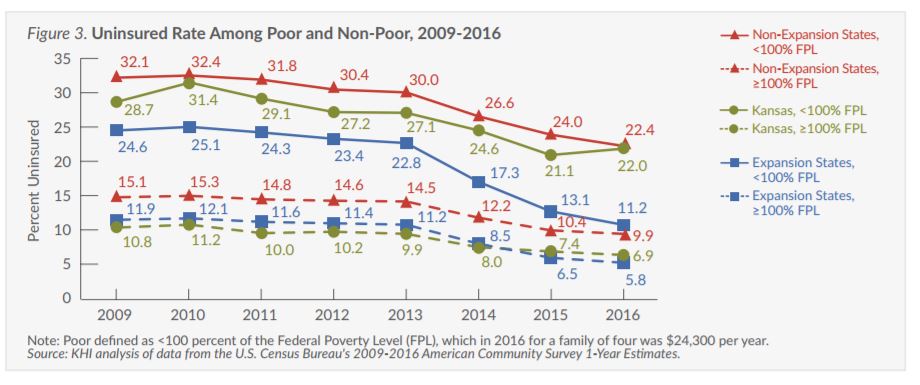
While Medicaid expansion is a major factor, other policy decisions made by states also influence their uninsured rate, especially among the poor and minorities. This fact sheet, entitled Comparing Change in Uninsured Rates in Kansas and Other States, compares the change in insurance coverage in Kansas to that in other non-expansion states, as well as to the change in states that expanded Medicaid.

Thirty states and the District of Columbia have expanded their Medicaid programs since the Affordable Care Act (ACA) allowed them to expand on January 1, 2014. States that have not expanded their Medicaid programs had a higher uninsured rate than expansion states even before the implementation of the ACA. Since then, states that expanded Medicaid have experienced a larger drop in the uninsured rate than non-expansion states. The drop in the uninsured rate in Kansas has been significant, but is smaller than that seen in many other non-expansion states, especially among the poor and minorities.

Tracking changes in the uninsured rate can help policymakers understand how policy decisions—in addition to Medicaid expansion—affect insurance coverage.

The Kansas Health Institute delivers credible information and research enabling policy leaders to make informed health policy decisions that enhance their effectiveness as champions for a healthier Kansas. The Kansas Health Institute is a nonprofit, nonpartisan health policy and research organization based in Topeka, established in 1995 with a multiyear grant from the Kansas Health Foundation.

Senators Moran, McCain introduce legislation to reform VA into 21st Century health care system

OFFICE OF SEN. MORAN

WASHINGTON ­– U.S. Senators John McCain (R-Ariz.), Chairman of the Senate Armed Services Committee, and Jerry Moran (R-Kan.), Chairman of the Senate Appropriations Subcommittee on Military Construction, Veterans Affairs, and Related Agencies, have introduced the Veterans Community Care and Access Act of 2017, legislation that would transform the Department of Veterans Affairs (VA) into a modern, efficient and easy-to-use system that will increase veterans’ access to quality care. This legislation, S. 2184, would better integrate VA services and existing VA community care programs, such as the Veterans Choice Program, into an efficient and high-performing healthcare system.

“In the wake of the scandal in care at VA hospitals in Phoenix and around the country, we vowed to guarantee our veterans timely access to quality treatment,” said Sen. McCain. “The Veterans Choice Program was the first step in delivering on that promise, but much more needs to be done to provide all veterans a choice in when and where they receive care. Our bill would strengthen and improve the core elements of Choice by consolidating and streamlining the VA’s community care program. Moreover, the bill would deliver long overdue, critical reforms to the VA, including commonsense reporting standards that ensure cost-efficient care to our nation’s veterans. It’s time we transform the VA into a 21st century health care system, one that respects the dignity of our men and women in uniform and provides all veterans the quality health care they deserve.”

“Since the creation of the Veterans Choice Program, Congress has repeatedly pushed the VA to make much-needed changes to its healthcare system,” said Sen. Moran. “Far too many Kansas veterans have experienced unnecessary difficulties accessing the care they’ve earned from the VA, and I appreciate that they have shared their stories and empowered us to work on their behalf. Demand has demonstrated that veterans want and need healthcare options in their communities, but there must be reform at the VA to create a system that works for them. I’m proud to be introducing this transformative legislation with Senator McCain, whose advocacy for our veterans is unparalleled. This joint effort to reform the VA will offer veterans an integrated healthcare system within their community that reduces red tape, enhances their quality of life and provides care that is worthy of their service and sacrifice.”

This legislation would ensure that veterans are the primary decision-makers concerning when and where they receive care. In addition, the bill would require the VA to use objective data on healthcare demand to set standards for access and quality, and to identify and bridge gaps in veterans’ care – whether in VA or community facilities. Importantly, the bill would ensure the VA promptly pays community providers, offers access to walk-in clinics, offers telemedicine, increases graduate medical education and residency positions for employees, and improves its collaboration with community providers and other federal agencies.

This legislation is supported by the American Legion, AMVETS and Concerned Veterans for America.

“On behalf of the 2 million members of The American Legion, I write to support your bill titled, Veterans Community Care and Access Act of 2017,” said American Legion National Commander Denise H. Rohan. “The bill, as currently written, would modify the already existing Choice program, providing veterans with the 21st Century medical system they rightfully deserve.” The American Legion’s full letter in support of the legislation is available here.

“AMVETS is pleased to support the Veterans Community Care and Access Act of 2017. Veterans need health care, both inside and outside of the VA system of care,” said AMVETS National Executive Director Joe Chenelly. “This measure addresses funding, implements ongoing patient surveying in conjunction with community care teams, and devises re-evaluation of both VA and private sector care. Both need oversight. All veterans have a right to receive the quality health care they have earned, and we applaud the hard work and insight that has taken place for this type of measure to be created. We urge its swift passage and will assist however we can.”

“Despite tens of billions of dollars in budget increases for the VA over the past three years, there are still far too many veterans waiting long periods of time for critical appointments and still too frequent reports of veterans suffering as the result of substandard care at the VA,” said Concerned Veterans for America Executive Director Dan Caldwell. “The Veterans Community Care and Access Act of 2017 would change that by reforming how the VA delivers health care to our veterans. The legislation would give veterans more options in their healthcare and change how it is delivered. Additionally, the legislation creates a plan to combine multiple outside care programs at the VA that will reduce bureaucracy and streamline reimbursements to community providers… Concerned Veterans for America strongly supports this legislation and we thank you for leading on this important issue.” Concerned Veterans for America’s full letter in support of the legislation is available here.

A description of key highlights of the bill is available here. Read a full section by section description of the legislation here.

Researchers using math to boost wheat straw use for ethanol

TOPEKA, Kan. (AP) — Researchers in Kansas and China are using mathematical modeling to improve the process of converting wheat straw into pellets for the production of ethanol.

Wheat straw, the plant residue left after wheat harvest, is abundant in Kansas. The straw has low commercial value, but one use for it is fuel production.

The Topeka Capital-Journal reported researchers in Kansas and China are using mathematical modeling to improve the process of converting wheat straw into pellets for the production of ethanol.

Pellets can be more easily handled and transported to ethanol processing plants, where ethanol extracted from them can be substituted for fossil fuels.

Mathematical modeling can save both time and resources required for experimental studies.

Kansas keeps secret who benefits from tax breaks

TOPEKA, Kan. (AP) — Kansas gives up hundreds of millions of dollars in revenue to a list of tax credits each year, but finding out which companies and individuals benefit has proven difficult.

The Kansas City Star reports that Kansas is a rare state that forbids disclosure of tax credit recipients, arguing that it’s confidential taxpayer information.

An official from corporate tax break watchdog Good Jobs First says the lack of disclosure provides no way of analyzing whether corporate tax credits actually work.

Tax credits allow recipients to lower their tax liability as a reward for making certain investments or behavior, such as scholarship programs, adoptions or paying employees above-average wages.

The Kansas Department of Revenue reports that the state recorded $530 million in foregone revenue from tax credits in 2015.

Kansas families report requests to sign blank Medicaid forms

TOPEKA, Kan. (AP) — Advocates say family members have been asked to accept plans of care for disabled Kansas residents under the state’s Medicaid program without knowing whether services will be cut.

The Kansas City Star reports that independent case managers in Johnson County say the program has become less collaborative and more secretive for people with disabilities since 2013. That’s when the state turned over its management to three private insurance companies.

The privatized program is known as KanCare and covers more than 400,000 people.

About 20,000 Kansas residents with disabilities rely on KanCare for services such as bathing, dressing and tube feedings to live at home rather than in an institution.

Family members report being asked to sign blank pages in care plans.

The state says it is addressing the concerns.

Copyright Eagle Radio | FCC Public Files | EEO Public File