TOPEKA — Ken Selzer, CPA, Kansas Commissioner of Insurance, is urging Kansans who own annuity products through insurance companies to watch for unauthorized account withdrawals.
The alert comes following fraud reports received by the Office of the Kansas Securities Commissioner and the Kansas Insurance Department’s Anti-Fraud Division. The reports came from four different life insurance companies within the past two months.
“In these cases, identity thieves have called the companies identifying themselves as clients,” Commissioner Selzer said. “The thieves then give accurate client personal information, including name, date of birth, Social Security numbers and account numbers.”
Other national reports say that scammers are also faxing in withdrawal forms to companies to begin the illegal activity, the commissioner said.
The thieves are seeking a cash withdrawal from the annuity following the completion of the required withdrawal form and banking information for transfer of the money.
“Of the four reported attempts in Kansas, only one of the fraudulent withdrawals occurred,” Commissioner Selzer said. “But that one theft cost the insurance company several thousand dollars.”
Commissioner Selzer and John Wine, Kansas Securities Commissioner, caution all annuities policyholders to pay attention to all correspondence about their annuities to be sure account balances, personal information and company information are correct. They also ask Kansans always to protect personal information, especially as it appears on the Internet.
“Unfortunately, identity theft is something we constantly have to guard against,” said Commissioner Selzer. “Always know who you are dealing with when it comes to your private financial and insurance information. “
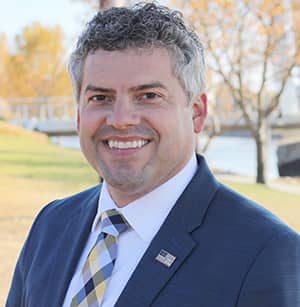
Jim Barnett, M.D., Topeka, is a Republican candidate for governor of Kansas.
TOPEKA – Calling education “the driver of the Kansas economy in the 21st Century” Jim Barnett, candidate for the Republican nomination for governor, today released a detailed plan for accelerating education excellence in Kansas.
“I have organized my education agenda into three basic categories,” Barnett said. “These are what I call the ABCs of education excellence in Kansas.”
“A is for Advancing early childhood development,” Barnett said. “Up to 25% of our children under-perform in the classroom and there are steps we can take at an early age to remedy this. Nothing will help early childhood achievement more or break the cycle of generational dependence on welfare and other programs, like making progress in this area.”
“There are individual school systems in Kansas that have found ways to do this on their own, in part by combining existing programs together in new and better ways, Barnett said. “As governor, I will make improved childhood development a statewide effort, so all school districts in the state can benefit from knowing what works and learning best practices to make progress.”
A key part of better child development is overcoming adverse childhood events or experiences. Things like neglect, abuse or even sustained lack of parental interaction, that occur in the early years of childhood can mark kids for life if not remedied. Making progress here has the added benefit of reducing longer term problems like addiction, mental health and other issues that stem from the adverse early childhood events.
“B means Be out of Court,” Barnett said. “For most of the past 12 years, decisions around education funding have been stuck in court. We need to end this cycle. We cannot make the necessary changes we need in education if we are constantly arguing in front of a judge. We should be working together for the changes and innovations that will help our children get ahead.”
“The court has clearly marked school finance as inequitable and inadequate. But while more money in the system will be needed, there are many areas where more money is not the solution,” Barnett stated.
A key concern is that the Court used what are known as “the Rose Capacities” as part of their decision. These capacities stem from court decisions in Kentucky in 1989. They were never meant to be standards, but are now called that in Kansas. According to Barnett, “the Rose Capacities are not bad, they are just not good enough”.
“As the next governor, I will work to bring people together to develop new educational standards that are pertinent to Kansas and that are measurable. We are using 20th century standards when our children need a 21st century education to succeed” Barnett said.
The longterm impact of spending all of our time in court is dangerous. “Sadly, Kansas children will see that our state does not value teachers and young people will not choose education as a career. That is already happening,” Barnett stated.
“C is for Careers,” Barnett stated. “We need to change our focus from the earning and amassing of credits to learning the life skills to build careers. This recognizes the importance of work force development as one of the engines needed for our economic growth.”
“We are 6 to 10 years behind in developing the work force we need in Kansas today,” Barnett said. “There are jobs going unfilled in Kansas right now because we have not helped our citizens get the skills necessary to do them.”
“The notion that everyone needs a four year college degree to have a productive life is wrong,” Barnett said. “People can obtain a good education in our Community and Technical Colleges. They can get high paying jobs that provide for their families and help grow the Kansas economy. We should be teaching skills like computer coding in elementary school and it should be fun. We should be encouraging life-long technical learning to help Kansans keep up with changes in their occupation and with technology in general.”
“Kansas must commit to making post-secondary education affordable to all Kansans. We cannot become a user pay state where only the wealthy can afford higher education,” Barnett said.
“My ABCs of reform are the building blocks of improving education in Kansas,” said Barnett. “They will make a difference for students in our school system now, and for decades to come.”
This tour will have stops at schools in Topeka, Emporia, Wellington and Winfield, as well as Arkansas City and Coffeyville. While these locations are the first to be visited, Barnett plans to visit a multitude of other districts during the campaign.
From left to right: Ayden Ostrom, Anna Ostrom, Kathy Ostrom, Secretary Phyllis Gilmore, Elijah Ostrom, Jay’La Ostrom, Rilee Ostrom, Lon Ostrom and KCSL East Region Director Gail Cozadd attended the adoption month reception to celebrate the kick-off of November as National Adoption Month.
DCF
TOPEKA – When Lon and Kathy Ostrom got married in 2006, they blended their families, with Lon having two boys and Kathy having three as well. While some might say that five children make for a complete family, the Ostroms felt differently.
After losing her youngest son to an accident in 2001, and unable to have more children, Kathy and Lon decided to open their home and become foster parents. Since 2007, the Ostroms have fostered more than 50 children.
But when the opportunity presented itself to make some of those children a part of their family, the Ostroms, who live in Manhattan, decided it was the right thing to do. Since beginning their foster care journey, the Ostrom family has adopted five children—three boys and two girls.
The Ostrom family was present at the Governor’s Conference in Child Abuse and Neglect Prevention, Adoption Month Reception on Nov. 2, to share their story about adoption and kick-off National Adoption Month with Kansas Department for Children and Families (DCF) and Kansas Children Service League (KCSL) staff. Governor Sam Brownback signed a proclamation on Thursday, Oct. 19, designating November as
Adoption Month.
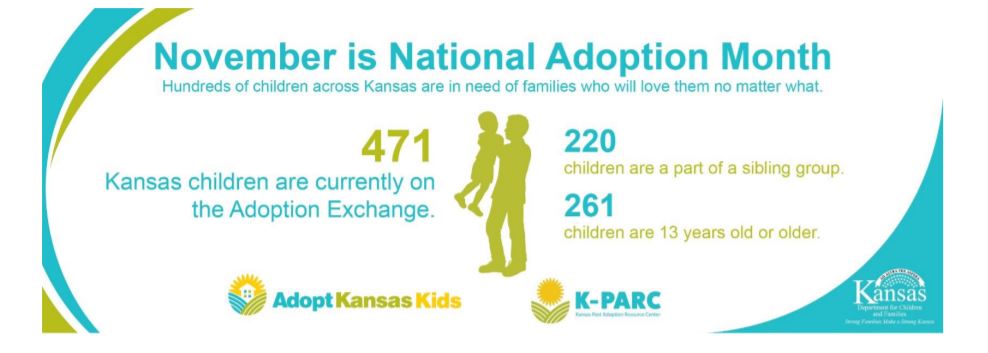
Throughout the month, DCF, and its contractors and community partners are taking part in a series of events to call attention to the need for more adoptive and foster families. Currently, there are approximately 470 children available for adoption in Kansas, an increase of approximately 100 children from last year. In FY 2017, 758 children were adopted from foster care.
This year, DCF is highlighting the many older youth in foster care who are eligible for adoption with the theme “Teens need families, no matter what.” Of the 471 children available for adoption in Kansas, approximately 261 are 13 years or older.
“Often, teens in foster care feel that they are too old to be adopted,” said DCF Secretary Phyllis Gilmore. “But in reality, they need love, acceptance and a place to call home just like the younger youth in care.”
“It is essential that we take this time to recognize the need for adoptions out of foster care because there are so many children that are waiting to find their forever home— especially sibling groups and older youth,” said Lieutenant Governor Jeff Colyer. “Every child deserves a loving place to call home, so while we take November to highlight this need, it is important to remember year-round.”
DCF’s contracted service providers and several courts around the state will celebrate National Adoption Day on Nov. 18, when many adoptions across the state will be finalized. DCF is also encouraging faith organizations to educate their members about adoption on Adoption Sunday, Nov.12.
The Kansas Post Adoption Resource Center (K-PARC), a DCF-funded initiative launched in November 2016, in collaboration with KCSL, to serve parents who have adopted children privately or through the foster care system. K-PARC has several events planned throughout the month of November to celebrate adoption month and provide support to Kansas adoptive families.
Last year, more than 235 parents attend a K-PARC Strong Families Adoptive Parent Retreat, 83 parents and children participated in a Parent Circle/Kids Training Series, and K-PARC delivered more than 1,300 hours of Trust-Based Relational Intervention training to families, volunteers, professionals and kids.
“K-PARC has provided much-needed resources to adoptive families across the state of Kansas,” said KCSL East Region Director Gail Cozadd. “The feedback from families has been extremely positive, and that is a reflection of the support they receive from K-PARC. We hope to continue, grow and expand upon that support system to better provide resources for adoptive children and families.”
To learn more about children who are currently available for adoption, visit www.adoptkskids.org or call 877-457-5430.
PRATT – Seven big game permits will be awarded to Kansas conservation organizations at the January 11, 2018 Kansas Wildlife, Parks and Tourism (KDWPT) Commission meeting. This unique program allows conservation organizations to apply for and sell big game permits to raise funding for conservation.
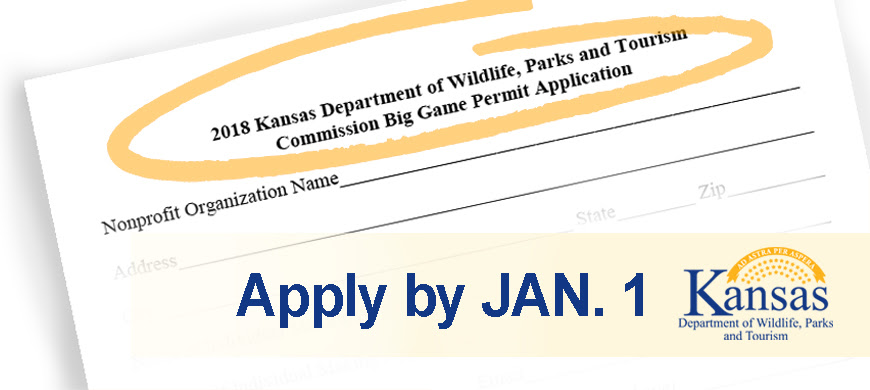
Local chapters of nonprofit organizations based or operating in Kansas that actively promote wildlife conservation and the hunting and fishing heritage are eligible to apply. Applications, which can be downloaded from www.ksoutdoors.com, must be submitted by Jan. 1, 2018.
The Commission Big Game Permit program began in 2006, and since that first year, nearly $500,000 has been raised. One elk, one antelope or up to seven deer permits are issued each year, depending on applicant preference. Winning groups are issued a voucher, which they can sell or auction to the highest bidder. The cost of the permit, and 15 percent of the total price, is subtracted and kept by the group, and the rest is remitted to KDWPT with a proposal for a conservation project. Once the project is approved, the money is returned to the group to complete the project. An exception to this procedure would occur if Kansas Hunters Feeding the Hungry (KHFH) is drawn. In that case, KHFH keeps 85 percent of the funds to help pay for processing donated deer.
In 2017, 142 applications were received and seven deer permits were issued and sold for more than $70,000. Groups are eligible to win permits just once in a three-year period. Hunters who purchase the permits remit a voucher to KDWPT and are issued permits and carcass tags. The deer permits are prized because they are either-species/either-sex and are valid statewide during any season with legal equipment for that season. They do not count against any other big game permits the holder is eligible for.
TOPEKA –The arrival of colder weather means more homes will be turning up the heat with fuel-burning appliances. These appliances include furnaces, ovens, space heaters, generators, indoor grills, and fireplaces that can unknowingly cause dangerous levels of carbon monoxide (CO) to build up in the home.
According to the Centers for Disease Control and Prevention, an average of 430 people die each year from unintentional carbon monoxide poisoning in the United States. In Kansas, from 2010 to 2014, there were annually an average of 148 emergency department visits, 23 hospitalizations, and 13 deaths due to unintentional carbon monoxide poisoning.
“Carbon monoxide is colorless and odorless,” said Cherie Sage, Safe Kids Kansas (SKK). “The symptoms of CO poisoning are similar to those of common winter ailments, like the flu. Without a CO detector in your home, your family can be poisoned without even realizing it’s happening.” Carbon monoxide poisoning can happen suddenly or cause poisoning over a longer amount of time. Carbon Monoxide detectors cost approximately $20 and can be purchased at most hardware and retail stores.
“Carbon monoxide can cause sudden illness or even death,” says Dr. Farah Ahmed, Environmental Health Officer with the Kansas Department of Health and Environment (KDHE). “Having a carbon monoxide detector with a battery backup near where people sleep saves lives.”
Tips to protect your family from CO poisoning:
Prevent CO buildup in the first place – make sure heating appliances are in good working order and used only in well-ventilated areas. Don’t run a car engine or any other gas powered tool in the garage, even with the garage doors open. If you need to warm up your vehicle, move it outside first.
Install detectors in the hallway near the bedrooms in each separate sleeping area and on every level of the home. Keep detectors at least 15 inches from all fuel-burning appliances.
Follow manufacturer’s directions for installation, testing, and using CO detectors. There are many options and styles to choose from including hardwired, combination smoke and CO detectors, and battery operated. When you check your smoke alarm batteries each month, check the batteries on your CO alarms at the same time.
Never use an oven or gas range for heating.
Only use portable generators, gas camp stoves, and charcoal grills outside with proper ventilation. They cannot be used indoors, inside of a garage or enclosed porch.
If more than one person in the home suddenly feels ill for no apparent reason, or if a CO alarm goes off, get everyone outside immediately and call 911 from a pre-arranged meeting place. Pay attention to pets, sometimes they will show signs of illness first. Don’t go back inside until the fire department or gas company says it is safe.
“Having a working CO alarm is just as important as having a smoke alarm,” said Doug Jorgensen, Kansas Fire Marshal. “These devices provide the best protection for early detection.”
The Kansas Office of the State Fire Marshal, through its “Get Alarmed, Kansas,” program, is working with fire departments across the state to deliver and install free smoke alarms, which include CO detection. For more information on “Get Alarmed, Kansas,” visit, www.firemarshal.ks.gov.
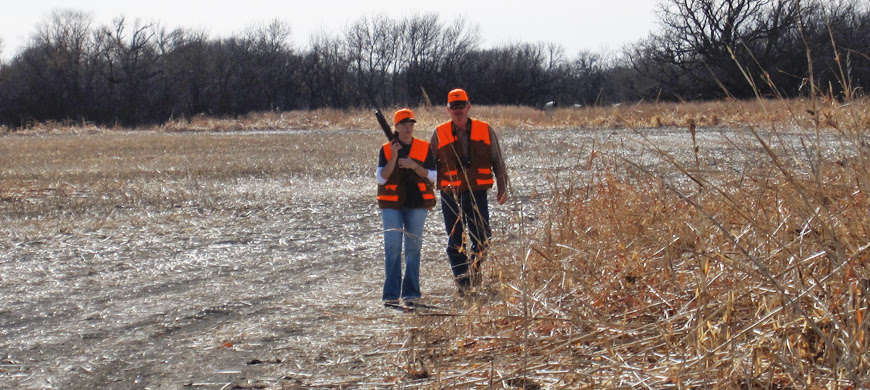
PRATT – If you know a young hunter who’s anxious to learn about bird hunting, there’s no better time to teach them than during the Nov. 4-5, 2017 youth pheasant and quail season. During the weekend prior to the regular pheasant and quail opener, hunters age 16 and younger may hunt as long as they are under the supervision of an adult 18 or older. Daily bag limits during the youth pheasant and quail season are two rooster pheasants per day and four quail per day. Sixteen-year-old resident hunters and all nonresident youth need a hunting license.
The youth season allows the adult mentor to focus on teaching and ensuring safe hunting practices are observed. This may not be the case when youth are included in a big opening-day group. Youth also get first crack at the birds, and public wildlife areas and Walk-in Hunting Access areas are not likely to be crowded.
Take advantage of these special seasons, and give a young hunter memories that will last a lifetime. Passing on our hunting heritage is critical to the future of wildlife conservation.
TOPEKA – For the second year in a row, the Social Security Administration (SSA) is recognizing the Kansas Department for Children and Families’ (DCF) Disability Determination Services (DDS) for its accuracy in disability determinations.
In FY 2017, Kansas was number one in the nation, with an SSA accuracy rating of 99.1 percent, in disability determinations. The program was also number one in the nation in FY 2016. The SSA rates state accuracy by assessing and comparing disability decision errors.
DDS, a program within DCF’s Rehabilitation Services division, makes disability and blindness determinations for the SSA on most Social Security Disability Insurance (SSDI) and Supplemental Security Income (SSI) claims filed or reviewed in Kansas.
DDS employs 34 disability examiners and 24 medical experts to make disability determinations. In the last fiscal year, DDS made decisions on approximately 20,000 cases.
“This recent achievement illustrates the hard work and dedication that our employees have for their job and their clients,” said Rehabilitation Services Director Michael Donnelly.
In addition, DDS was identified by the SSA as the second best in the nation for performance accuracy, which is different than disability determination accuracy, as it is measured by the accuracy of all-encompassing disability decisions, including reconsiderations cases, hearings, continuing disability reviews, etc.
In addition to making disability determinations, DCF also offers vocational rehabilitation services to empower Kansans with disabilities to become successfully employed and self-reliant.
Recently, DCF launched a new program, Pre-Employment Transition Services (Pre-ETS), to further its efforts to help Kansans with disabilities gain meaningful employment. Pre-ETS was first launched in FY 2017, and its services are designed to help youth with disabilities get an early start at job exploration, assist students with disabilities in making the transition from secondary to post-secondary education/training and to empower them to realize their full potential.
To learn more about Pre-ETS and other Rehabilitation Services, visit www.dcf.ks.gov.
TOPEKA, Kan. (AP) — Kansas officials are proposing a new version of the state’s privatized Medicaid program that would require about 12,000 adults to work.
The proposal was unveiled Friday as the state considers changes to a program that serves more than 400,000 residents.
Kansas currently has no work requirement for Medicaid recipients and it would be the first state in the country to do so.
Gov. Sam Brownback’s administration says requiring some people to work will improve their lives. Officials note that of the 12,000 people that would be affected, most already are required to work because they receive welfare assistance.
Advocates for Medicaid recipients say work requirements are illegal and were not allowed before President Donald Trump’s administration.
The proposal must be approved by the federal government.
————–
TOPEKA – Secretaries for the Kansas Department for Health and Environment (KDHE) and the Kansas Department for Aging and Disability Services Friday unveiled details of the new KanCare 2.0 waiver proposal that will be posted for 30 days of public comment.
The proposed new KanCare waiver is available for public review on the KanCare website (www.KanCare.ks.gov). Hard copies will be available for review on request at the agencies, located at 1000 SW Jackson St., Topeka and 503 S Kansas Ave., Topeka.
Lt. Governor Jeff Colyer, who helped craft KanCare 2.0, had this to say:
“Since its launch in 2013, KanCare has become an example of how states can simplify their Medicaid programs while providing higher quality health care to those in need. In the years since the launch we have saved over a billion dollars while increasing services and improving health outcomes.
“In the construction of KanCare 2.0 we listened closely to the voices of stakeholders and citizens in our effort to make KanCare even stronger. KanCare 2.0 builds on the successes we’ve had in the past in order to continue serving our most vulnerable citizens, assisting them with services that benefit their physical health and improve their quality of life.”
KDHE Secretary Dr. Susan Mosier said, “The goal for KanCare 2.0 is to help Kansans achieve healthier, more independent lives by providing services and supports for social determinants of health and social determinants of independence in addition to traditional Medicaid benefits.”
“KanCare 2.0 is designed to improve our ability to provide behavioral health care and treatment to members, and offer disability waiver participants enhanced care coordination and competitive employment opportunities,” KDADS Secretary Tim Keck said.
Programs that address social determinants of health are designed to work across all Medicaid populations and individuals. KanCare members who participate in these programs may benefit from:
• Resources for helping participants meet daily needs (e.g., safe housing and local food markets)
• Access to higher quality education and employment opportunities
• Access to health care and services
• Access to community recreational and leisure-time activities
• Transportation options
The programs above may be used to address social determinants of independence by developing personal plans that are tailored to an individual’s goals for self-reliance. These plans may assist a person with:
• Achieving career goals
• Having a more stable home environment
• Becoming an active, contributing part of their community
• Having more opportunities to develop social and emotional connections with others
What KanCare 2.0 will do:
• Continue to provide and advance comprehensive, integrated, whole-person care through the full spectrum of health, including the social determinants of health and independence.
• Improve care coordination by requiring MCOs to contract with local entities to perform community service activities, while expanding reimbursed services to further support members.
• Invest in supported, competitive employment to help members meet their life goals. KanCare 2.0 offers voluntary work opportunities and supports for KanCare members who wish to and are able to work, with a requirement for able-bodied adults to work (with a broad range of exceptions).
• Integrate social determinants of health and independence by developing detailed care plans to provide whole-person care that addresses not only clinical needs but also supports housing assistance, educational attainment, employment opportunities and building stronger families and communities.
• KanCare 2.0 will continue to incorporate some of the leading healthcare innovations into the program, such as telehealth, to provide a high-quality system for members.
HUTCHINSON – In honor of the Climate + Energy Project’s TEN YEAR ANNIVERSARY celebration, we launched the inaugural Climate + Energy Awards to recognize individuals and organizations who are leading the way to a clean energy future in Kansas.
We were overwhelmed with the number of nominations – there are great things happening in Kansas! After much deliberation, we are pleased to announce the 2017 award winners.
Nancy Jackson
Impact Award – Nancy Jackson, Climate + Energy Project Founder
A lifetime achievement recognizing an individual whose work resulted in positive, long-term, broad impacts in climate, energy, and environmental issues across the state.
Nancy Jackson founded and directed the Climate + Energy Project from 2007-2010. Under her guidance, CEP received the Governor’s Commendation for Achievement in Renewable Energy and Energy Efficiency in 2009. Nancy’s ability to focus on positive solutions became a founding principal of the organization and one that CEP continues today. Nancy created the foundation for CEP to skip the arguments about climate change and get right to work on solutions to actually reduce greenhouse gas emissions – more renewable energy and energy efficiency. By focusing on finding common ground with a wide variety of Kansans, building relationships based on shared values like thrift, faith and energy security, CEP has made huge impacts on the clean energy economy which in turn has reduced emissions. Our work continues to follow the practical principles and common ground approach that Nancy instilled in CEP from the start, and it’s still the most effective way to lead Kansas to a clean energy future.
Sustainer – Mark Richardson, Farmer & Renewable Energy Advocate
A volunteer-recognition award for someone who has regularly engaged with CEP for at least five years.
Mark Richardson is easily the volunteer who has been with us the longest and engaged the most! Mark has been a part of almost every campaign, always showing up with a smile, a positive and steady attitude, and a willingness to work. Mark exemplifies CEP’s common ground approach to elevating renewable energy, working with our neighbors, and finding solutions that work for Kansas. Mark is a long-standing, tireless supporter of our work and our staff, willing to put in the hours as a volunteer, speak up for renewables at the statehouse, and sustain the work as a board member.
Changemaker – Bruce Graham, Wind Energy Instructor, Cloud County Community College
Recognition for an organization or individual whose recent work has significantly advanced climate, energy, and/or environmental issues in Kansas.
Bruce Graham built the Wind Energy Technology Program at Cloud County Community from an idea to a thriving program with 100% job placement. He worked with wind companies to develop textbooks while creating one class after another for CCCC. With over 100 students, six instructors, 26 courses, and four degree offerings (Wind Energy Tech, Substation Maintenance, Turbine Repair, and Small Unmanned Aircraft Systems -SUAS), the program is a thriving success. Bruce’s vision and dedication to wind energy, renewables, and technical education brought about significant changes and opportunities for renewables in Kansas.
The Climate & Energy Project, based in Hutchinson, seeks to dramatically reduce greenhouse gas emissions in America’s Heartland through the ambitious deployment of energy efficiency and renewable energy, in policy and practice.
TOPEKA — Kansas consumers making choices on health insurance for 2018 need to be aware of the shortened open enrollment period and possible changes in network providers, according to Ken Selzer, CPA, Kansas Commissioner of Insurance.
The shorter open enrollment period for the 2018 plan year begins November 1 and ends December 15, 2017. The federal government established the time period, and it applies to plans sold on and off the federal marketplace.
“Those choosing a new health plan for coverage beginning January 1, 2018, also have several other factors to consider,” Commissioner Selzer said. “Making sure your providers—doctors, hospitals and other health care providers—are within the plan’s network is important. Also, be aware that networks can vary within the same company, depending on where you live.”
In Kansas for 2018, companies will be offering policies with the following types of network arrangements: preferred provider organizations (PPO), exclusive provider organizations (EPO) or health maintenance organization (HMO) plans. Definitions of each network are in the issue brief mentioned near the end of this article.
“It is important to understand how the policy you purchase works from a network perspective,” Commissioner Selzer said. “All of these types of plan are not available in all Kansas counties. Talk to your doctors, other providers or your insurance company to make sure medical providers are part of the insurance health plan network. Also, check with hospitals and other providers such as labs, specialty physicians or facilities.”
If you purchase a health insurance policy through the federal marketplace, your cost may be reduced if you are eligible for an advance premium tax credit (APTC). Those credits are available only if you buy insurance on the marketplace. They are not available for off-marketplace individual purchase, or if you purchase insurance through your employer.
Kansas consumers have likely heard about the following recent actions taken at the federal level.
President Trump signed an executive order on October 12, 2017. The order prioritizes three areas: association health plans (AHPS), short-term limited-duration insurance and health reimbursement arrangements (HRAs). The order requires the secretaries of federal agencies to propose regulations. The executive order has not changed the 2018 marketplace at this time.
Cost share reduction (CSR) subsidy payments to insurers selling marketplace coverage will stop almost immediately. CSR subsidy payments are different subsidies than the advance premium tax credits (APTCs). The discontinued payments are payments to insurance companies for the assistance they provide to low income consumers.
“The companies have signed their final issuer agreements for participation in 2018,” said Commissioner Selzer. “Kansas has a stable market and no further rate revisions are anticipated.”
“Getting the health insurance you need means taking personal responsibility to learn about the subject and then apply it to your situation,” Commissioner Selzer said. “If you need assistance, however, look to our Consumer Assistance Division at the insurance department (800-432-2484) for answers to general health insurance questions, or use our online chat feature at www.ksinsurance.org .”
WICHITA — Sedgwick County Clerk and Kansas Republican Party chairman Kelly Arnold is running for Kansas Secretary of State.
“I’m running to provide quality, efficient service to Kansas businesses and taxpayers. My experience as Sedgwick County Clerk along with my role supporting election officials all across the state gives me the right experience to serve as your Secretary of State.” Arnold said.
Kelly was sworn in as Sedgwick County Clerk in January 2009 and re-elected to his third term in 2016. Arnold is a member of the Kansas County Clerks and Election Officials Association, a network representing the clerks and elections officials in Kansas’ 105 counties. He has earned the designation of Certified Master County Clerk from the WSU Hugo Wall School of Public Affairs.
The Kansas Republican Party unanimously elected Arnold to a third term as chairman of the Party in February 2017. Arnold has run unopposed in all three terms’ chairman elections. In party leadership roles and as Chairman, Arnold is proud to have helped lead the party to a 32-0 record in federal and statewide races.
In addition to holding elected office, Arnold serves as Vice Chairman of the Kansas Public Employees Retirement System Board and is a member of the Board of Directors at Hillsboro State Bank. After graduating from McPherson High School, Kelly earned degrees in Business Management and Finance at Tabor College. A fifth-generation Kansan, Kelly makes his home in Wichita where he is a member of Pathway Church.
PRATT – For 37 years, wildlife and wildlife enthusiasts have benefited from the Kansas Department of Wildlife, Parks and Tourism’s (KDWPT) Chickadee Checkoff program through small grants. By making small grants available each year, KDWPT is able utilize the talents and expertise of people outside of the department to complete a wide variety of educational, research-based, and habitat projects, as well as the monitoring of nongame wildlife and critical habitats.
KDWPT is currently accepting proposals for the Chickadee Checkoff Small Grants Program through December 1, 2017.
Interested parties can obtain more information, including eligibility requirements and a list of priority projects for 2018, by downloading the grant guidance document at ksoutdoors.com/Services/Wildlife-Diversity/Chickadee-Checkoff/Chickadee-Checkoff-Small-Grants-Program.
The Kansas Creative Arts Industries Commission has added seven artists to the official Kansas Touring Roster, a directory of Kansas artists which helps match artists with venues.
“The Kansas Touring Roster represents the best in Kansas arts and culture. If you are an artist, becoming a member of the roster helps you to be found by presenting organizations in communities across the state and the region. If you are a presenting organization, the roster provides assurance that featured program offerings meet high standards for both artistic quality and community impact,” said Peter Jasso, Director of the Kansas Creative Arts Industries Commission.
The newly added artists, which range from music and dance performers to authors and visual artists, include:
Angela Pickman – Visual Arts / Lawrence
Angie Pickman is a nationally recognized cut paper artist that combines the art of traditional paper cutting with collage to create intricately detailed works of art and animations. She exhibits at galleries and art fairs nationally, does illustration, animation and design work, conducts public presentations on her art, and teaches various art classes and workshops. Her work has been featured in Midwest Living and Martha Stewart Living magazines, and her animation work was featured in Daughters of the Forest, a PBS documentary, in the summer of 2016.
Annette Hope Billings – Literature / Topeka
Annette Hope Billings is an award-winning author and actress who infuses elements of theater to present her original poetry and prose. Dubbed “Maya of the Midwest” by audiences, she has published two books of poetry with a third due in winter of 2017. Awards to date include Renna Hunter acting award, Topeka ARTSConnect ARTY Award in Literature, and Troy Scroggins Award. She has also been published in numerous journals and several anthologies.
Carswell & Hope – Music / Lawrence
With Irish frontman Nick Carswell, Carswell & Hope mix big vocal harmonies and rich arrangements with inventive songwriting and a fearless mix of pop, rock and experimental. Their debut LP, A Hunger, was hailed as “a breath of fresh air” (iheartlocalmusic.com) and “an audacious debut” (Deli Magazine).
Erin Mae Music – Music / Wichita
Erin Mae is a mountain dulcimer virtuosa who has taken an obscure American folk instrument, and with it has developed a high level of technical proficiency and musical expression. Erin has been playing for over twenty years and in that time has developed a unique and progressive style. She is a member of the nationally-touring groups Scenic Roots and S.E.A.
Maura Garcia – Dance / Lawrence
Dancer/choreographer Maura Garcia collaborates within communities to create stories of identity and place. Originally from North Carolina, Maura is an Indigenous woman (non-enrolled Cherokee/ Mattamuskeet) who brings her own mixed-blood southern story to all of her work. She collaborates to create multi-media, interactive shows and engage via arts projects and experiential workshops involving everyone in the creative process. Maura uses her art to form connections, to uplift Indigenous cultural values and to explore the rhythms of the natural world.
Poke Salad Orchestra – Music / Fairway
The Poke Salad Orchestra is a string trio that is firmly rooted in American traditions of old-time, country and early popular music. An orchestra in the humblest sense, their spontaneous approach to music ranges from down-home to downright harrowing, as they navigate musical twists and turns at sometimes breakneck speed. The group’s three-way rapport, combined with individual command of their instruments, draws listeners in and envelopes them in the sound of strings being coaxed to their limits.
WC String Quartet – Music / Peabody
The WC String Quartet plays everything from Mozart to Jazz to Sufi chants. An innovative group, the members are all fine classical musicians, but are also adept at improvising and enjoy exploring a wide variety of genres of music. They are all seasoned music educators and delight in working with others. The WC String Quartet has been together for ten years and has played at a variety of events. They are all consummate musicians, educators, and are involved in arts organizations and projects across the region, bringing a creative and joyful spirit to their performances.
ABOUT THE KANSAS TOURING ROSTER
The Kansas Creative Arts Industries, a division of The Kansas Department of Commerce, maintains an approved Touring Roster of Kansas-based touring companies and artists. In this program, the artist or artist’s management sets the fee and negotiates the booking. Applicants must have a history of touring and maintain a reasonable fee range.
Roster artists are required to perform outside their community regularly. Touring artists offer single performances or exhibitions as well as complementary services that may include workshops, master classes, lecture-demonstrations, arts education components, residencies, or short performances.
 KID
KID