We have a brand new updated website! Click here to check it out!

Kansas helping Texas farmers, ranchers after Hurricane Harvey

KDA

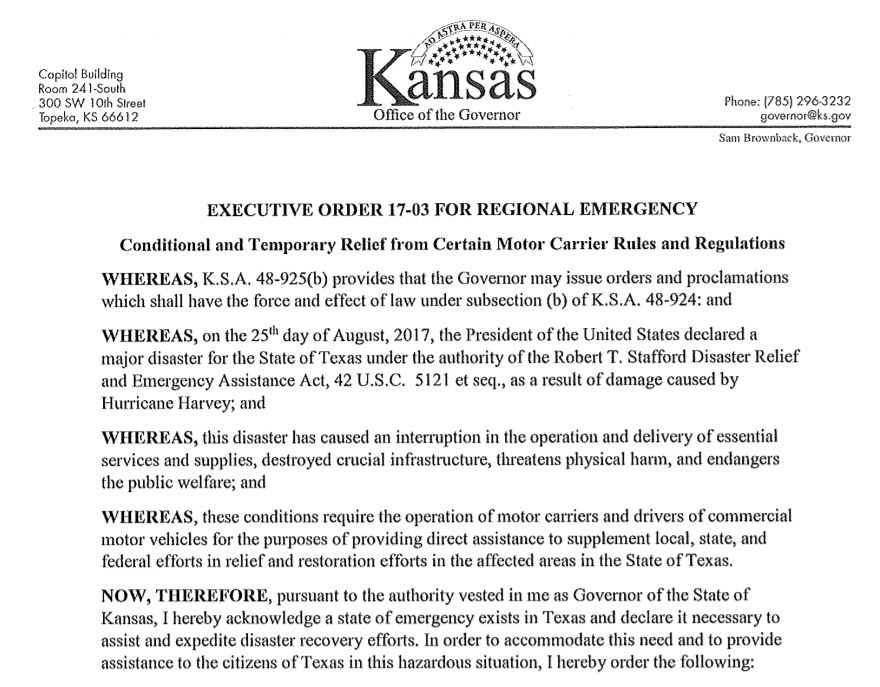
MANHATTAN — The hurricane and subsequent flooding in Texas this week has prompted Kansas to take action to assist and expedite disaster recovery efforts. On Aug. 30, Governor Sam Brownback signed an executive order to lift regulations on motor carriers traveling from and through Kansas en route to aid in recovery from widespread damage left by Hurricane Harvey.

Executive Order 17-03 will only apply to motor carriers and persons operating commercial motor vehicles who are directly participating in relief and restoration efforts in Texas. It will temporarily suspend licensing, certification and permitting rules and regulations; registration and fuel tax permits; and will waive fees for over dimension/overweight permits. In addition, height and weight limits for participating motor carriers have been extended to 12 feet in width and 14 feet, six inches in height.

This action will help Kansans who wish to provide hay and other supplies to help farmers and ranchers in Texas during recovery from Hurricane Harvey, as well as others who are traveling through Kansas in the relief efforts.

The Kansas Department of Agriculture has created a page on the KDA website for Hurricane Harvey Disaster Recovery Resources, which includes the full Executive Order along with contact information for a variety of ways to help with disaster relief.

Go to www.agriculture.ks.gov/hurricanerecovery.

KS woman pleads guilty in defrauding $50K SNAP benefits

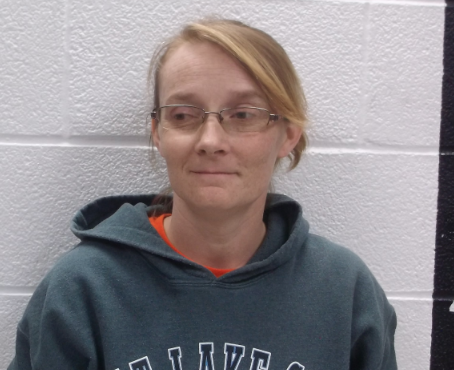
Hessling-Photo Clay Co.

TOPEKA – The Kansas Department for Children and Families’ (DCF) Anti-Fraud Unit works to aggressively investigate, detect, prevent and prosecute welfare recipient fraud in all public assistance programs administered by DCF, including cash assistance, food assistance, child care assistance and utility assistance.

Last week, the unit’s hard work paid off. On Thursday, Aug. 24, Stephanie Hessling of Clay County, pleaded no contest to defrauding the State of more than $50,000 worth of Supplemental Nutrition Assistance Program (SNAP) benefits. SNAP is also known as food assistance.

DCF Special Investigator Laura Lindsey led the investigation on the Hesslinger’s case. As a special investigator, some of her duties include speaking to employers, neighbors, co-workers or anyone else with knowledge of the accused person. She also examines documents, such as bank records and wages. Lindsey says working fraud cases is gratifying, especially when it leads to a conviction.

“There is only so much money available for government-funded programs, such as food and cash assistance,” said Lindsey. “Assuring that these resources are in fact given to Kansans in need, versus those who are misrepresenting their situations for personal gain, is very important to me.”

In State Fiscal Year (SFY) 2017, the Anti-Fraud Unit obtained more than 249 fraud judgments in the SNAP program. These DCF fraud findings resulted in more than $1.4 million in judgments. Additionally, in Federal Fiscal Year (FFY) 2014, Kansas ranked second in the nation in the number of SNAP judgments obtained. Then again in FFY 2015, Kansas ranked third nationwide in the number of SNAP judgments. FFY 2016 and FFY 2017 rankings are not currently available.

“Protecting the integrity of our public assistance programs is a priority for this Administration, and I am proud of the diligent efforts of our Anti-Fraud Unit,” said DCF Secretary Phyllis Gilmore. “I especially want to commend Special Investigator Laura Lindsey for her efforts to end this specific crime in Clay County.”

In July, the Anti-Fraud Unit strengthened its efforts to combat welfare benefits by offering an online submission form to report suspected incidents of fraud. Those who suspect benefits fraud are encouraged to fill out the “Fraud Report Form” online at www.dcf.ks.gov. You can also call 800-432-3913. Those who report fraud may remain anonymous.

CORRECTED: 2:02 p.m. Aug. 30 to clarify that Hessling pleaded no contest.

Brownback issues Exec. Order to aid in Hurricane Harvey relief; KNG on standby

Sam Brownback (R) Kansas Governor

OFFICE OF GOV.

TOPEKA—Governor Sam Brownback on Wednesday issued an executive order that will lift regulations on motor carriers traveling through Kansas en route to aid in recovery from widespread damage left by Hurricane Harvey.

Executive Order 17-03 applies to commercial vehicles directly participating in relief and restoration of areas in Texas recovering from the destruction of the hurricane and resulting floods. Under the order, certain motor carrier fees and regulations will be waived.

“There’s no doubt the people of Houston and the surrounding communities are facing historic devastation,” Governor Brownback said. “Our thoughts and prayers continue to be with Texas. Their neighbors here in Kansas are ready to assist.”

Separately, the Kansas National Guard is on standby to deploy to the areas impacted when called by disaster operations command. Resources such as high-water vehicles, communications teams, and Guardsmen, among others, are available when called upon to relieve troops currently in the area.

Kansas is also the coordinating state for the Emergency Management Assistance Compact (EMAC), in charge of coordinating relief efforts with other states.

“The stories coming out of the hurricane zone prove the power of what happens when neighbors work together,” said Lt. Governor Jeff Colyer. “We will continue working together to help the victims long after the floodwaters recede.”

The executive order is in immediate effect.  Read the full text of the EO 17-03 document.

KNG on standby for deployment to Hurricane Harvey; cash donations best

KDEM

TOPEKA – The Kansas Division of Emergency Management is urging Kansans who wish to help the victims of Hurricane Harvey on the Gulf Coast, to donate money to a reputable volunteer, charitable or faith-based organization rather than sending food, clothing or other goods.

“Too often, well-meaning people send clothing, diapers, and other items to disaster stricken areas, but their donations end up unused or even discarded,” said Angee Morgan, deputy KDEM director. “The reason is that these goods must be sorted, packaged and stored until they can be distributed, which diverts manpower from other tasks and requires a place to warehouse the items. In some areas, there may not be any place available to do this. Also, there is often a surplus of one thing and not enough of another.”

Transporting and distributing the goods also requires manpower that can be better used in other capacities. Food must also be stored until used. If there is no refrigeration available, perishable foods may become unusable before they can be distributed. Even nonperishable goods can be a problem; one can only use so many cans of green beans.

Donating money allows human services agencies to purchase exactly what is needed when it is needed and does not waste resources. It also puts money back into the local economy, helping local businesses recover faster.

KDEM also urges volunteers not to self-deploy. You may be heading to areas that are not safe. If you become injured because you lack proper training and safety equipment, you have only added to the problem. Too much manpower in a given area can be as much of a problem as too little because volunteers must be fed and sheltered, taking away resources from the disaster victims.

It is better to register with a reputable volunteer organization, outlining the skills and/or equipment you have available. If those skills and equipment are needed in a particular area, you will be contacted.

Hurricane Harvey is still an active storm and response measures require skilled, trained personnel. Currently, the Kansas National Guard has a number of Soldiers and Airmen on standby, ready to deploy if they are requested.

The recovery process in these hurricane-stricken states will be long and slow; volunteers are going to be needed for months, if not years. It is better to donate money now and volunteer your time and energy later when the situation is not as dangerous and the needs have been properly assessed.

Kansas native tribes to receive wildlife grant

KDWPT

WASHINGTON – U.S. Deputy Secretary of the Interior David Bernhardt announced $162,127 in funding will go to Kansas Native tribes and more than $720,000 to Kansas state wildlife agencies through the Tribal Wildlife Grant (TWG) program and the State Wildlife Grants (SWG) program. The funds, which are provided by the U.S. Fish and Wildlife Service, give support for a diverse array of species and habitats across the country.

Through the TWG program, the Iowa Tribe of Kansas and Nebraska will receive $162,127 for a fish community assessment in streams with a focus on rare species.

“The work of Kansas Native American tribes and state wildlife agencies is absolutely critical to wildlife conservation in the United States,” said Deputy Secretary Bernhardt. “We’re thrilled to be able to collaborate with them, their local communities, and other partners to ensure important fish, wildlife, habitat and cultural needs are met.”

The $724,487 in funding through the SWG program, which is part of $48 million being distributed nationwide, will support imperiled species and habitats listed in approved state wildlife action plans. All 50 state and U.S. territorial wildlife agencies have these plans, which proactively protect species in greatest conservation need. Projects funded through SWG involve research, monitoring, wildlife surveys, species and habitat management and other activities.

Through the TWG program, more than $4 million funds were given to tribes in 14 states to support fish and wildlife conservation and key partnerships. The awards will benefit 25 projects that encompass a wide range of wildlife and habitats, including species of Native American cultural or traditional importance and species that are not hunted or fished.

SWG funds are administered by the Service’s Wildlife and Sport Fish Restoration (WSFR) program and are allocated to states and territories according to a congressionally-mandated formula based on population and geographic area. Grant funds must be used to address conservation needs, such as research, wildlife surveys, species and habitat management, and monitoring identified within state wildlife action plans. The funds may also be used to update, revise or modify a state’s plan.

TWG funds are provided exclusively to fund wildlife conservation by federally-recognized Native American tribal governments, and are made possible under the Related Agencies Appropriations Act of 2002 through the State and Tribal Wildlife Grants Program. Proposals for the 2018 grant cycle are due Sept. 1, 2017.

For additional information about Native American conservation projects and the Tribal Wildlife Grants application process, visit https://www.fws.gov/nativeamerican/grants.html or http://www.grants.gov/.

Kansas Reading Program to improve proficiency expands to Mississippi

DCF

TOPEKA– Four new Kansas-inspired programs will be launched in the Mississippi Delta this fall. Four schools in the Coahoma County School District—Friars Point, Jonestown, Lyon and Sherard—will begin a partnership with the Kansas Reading Roadmap to further increase early reading proficiency across the district.

The Kansas Reading Roadmap program was commissioned by Governor Sam Brownback in 2013, and is funded by the Kansas Department for Children and Families, through Temporary Assistance for Needy Families funds, to help increase reading proficiency among children. This poverty-prevention measure has been successful in Kansas, and now the Coahoma County District will seek to replicate the success of Kansas schools from the Kansas Reading Roadmap in Mississippi.

The Kansas Reading Roadmap model aligns afterschool and family engagement with school-day instruction and intervention to build upon school efforts to promote early reading proficiency. Coahoma County schools use a school-wide strategy of assessments, instruction and intervention to teach children to read.

“The Reading Roadmap seeks to innovate how schools use out-of-school programs to drive greater achievement in early reading proficiency,” said Andrew Hysell, Director the Reading Roadmap. “Through science-based early reading strategies aligned with school interventions and data, afterschool learning can help schools better achieve third grade reading goals.”

At the heart of the Kansas Reading Roadmap is its partnership with the Kansas State Department of Education’s Technical Assistance Systems Network (TASN). TASN supports Kansas schools to implement the Kansas Multi-Tier System of Supports (MTSS). Kansas MTSS helps schools organize data and instruction to provide individualized instruction and intervention for all children. The Reading Roadmap aligns out-of-school programs with the Kansas MTSS system.

Currently, the Reading Roadmap partners with more than 60 schools and Boys & Girls Clubs in Kansas to expand science-based reading strategies to all students in out-of-school environments, including afterschool, summer and family engagement programming. The mission of the Reading Roadmap is to integrate and align out-of-school programs with data and instruction to enhance school efforts promoting early reading proficiency.

According to an independent, longitudinal evaluation of 30 sites, children attending Reading Roadmap afterschool programs experienced 57 percent greater growth than their peers—as measured by school assessments.

“Kansas Reading Roadmap has been very successful in the State of Kansas, so I am thrilled that Mississippi is adopting similar programs,” said Secretary Phyllis Gilmore. “Early reading proficiency is important because it arms children with the tools they need to have a successful and bright future.”

Third grade reading is a critical point in a child’s life when they transition from learning to read to reading to learn. Early reading proficiency is correlated with school and lifetime success. Research consistently shows that children who are not proficient readers by the fourth grade are four times less likely to graduate on time from high school.

For more information about the Kansas Reading Roadmap, contact Kimberly Muff at 785-243-4860. Learn more about the program at www.readingroadmap.org.

Kansas 2017 Hunting Regulations and Atlas online now

KDWPT

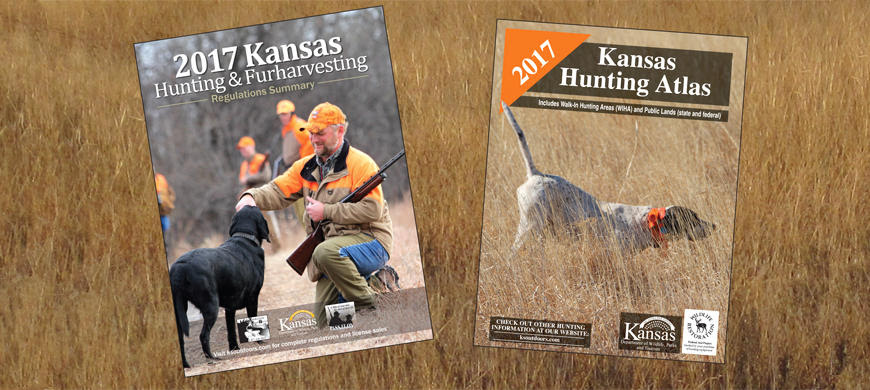
PRATT – Two Kansas Department of Wildlife, Parks and Tourism (KDWPT) publications hunters anxiously await are available now: The 2017 Kansas Hunting and Furharvesting Regulations Summary and the 2017 Kansas Fall Hunting Atlas.

Both publications are available online at www.ksoutdoors.com and both are being shipped to hundreds of license vendors and KDWPT offices around the state this week. Copies can be mailed by calling (620) 672-5911.

The hunting summary includes regulations such as methods of take, season dates, bag and possession limits, as well as a listing of public wildlife areas. One section features color photographs and range maps for popular game species. There is also a list of phone numbers for game wardens by the counties they patrol.

The 2017 Kansas Fall Hunting Atlas includes maps showing all Walk-in Hunting Access (WIHA) areas, as well as state and federal public wildlife areas. WIHA is private land leased by KDWPT and opened to public hunting. More than 1 million acres of WIHA lands are mapped in the atlas, more than tripling the amount of public access open to hunters.

The atlas is available online, and soon Garmin GPS and Google Earth files will be available to download. All WIHA tracts are marked with signs showing the lease dates, which start either Sept. 1 or Nov. 1 and end either Jan. 31 or March 31.

Pick up your copy of the regulations summary and hunting atlas wherever licenses are sold. No hunter should be without them.

Innovative research in Kansas, Nebraska to address state environmental issues

EPA

LENEXA–The U.S. Environmental Protection Agency (EPA) announced research projects addressing priority environmental and human health problems in 14 states through partnerships between EPA’s research office, regional offices, and states.

“EPA encourages the use of innovative scientific approaches to help solve important environmental problems,” said EPA Administrator Scott Pruitt. “By working with our state partners, we can expand and diversify EPA’s work, engage the public, and foster creative solutions to these challenges.”

The research announced is designed to address pressing environmental issues faced by the states. EPA is uniquely equipped to provide scientific expertise to help tackle these problems. The selected projects focus on non-point source nitrogen pollution, volatile organic compound emission detection, harmful algal blooms, roadway air pollution near schools, and other environmental and human health issues across the country. The projects will employ innovative approaches including citizen science, crowdsourcing, a challenge competition, and advanced monitoring technologies.

One of these projects is “Use of Next-Generation Molecular Tools for Harmful Algal Blooms and Microbial Source Tracking to Support Watershed Restoration in Kansas and Nebraska.”

EPA will assist the Nebraska Department of Environmental Quality and Kansas Department of Health and Environment with identifying sources of microbial water pollution and harmful algal bloom assessments using the PhyloChip, an innovative monitoring technology.

Monitoring sources of E. coli and harmful algal blooms is a challenge for environmental managers. In some areas, E. coli has been identified as one of the leading causes of water quality decline. Harmful algal blooms can lead to drinking water contamination and fish or even human poisoning. In Kansas, this project will evaluate the use of new molecular-based technology to identify the cyanobacterial species that produce toxins and factors that promote toxic blooms. In Nebraska, this technology will help identify sources of fecal contamination in rivers and lakes. Combined with ongoing monitoring efforts, the data will provide a comprehensive assessment of the development of harmful algal blooms in Kansas and sources of fecal pollution in Nebraska watersheds.

These assessments will support planning, management and restoration of water resources in Kansas and Nebraska.

Learn more about this project and others at: https://www.epa.gov/innovation/2017-regionalstate-innovation-projects.

Managed fields can be dove hunting hotspots

KDWPT

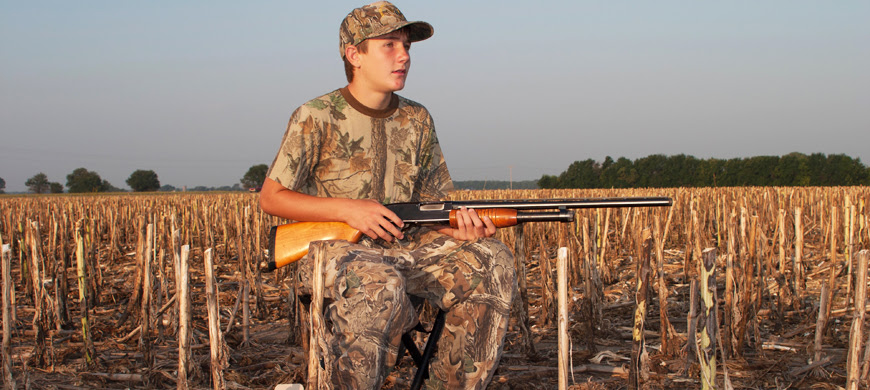
PRATT – Each summer, Kansas Department of Wildlife, Parks and Tourism (KDWPT) Public Lands Division staff begin working fields that will attract doves come September. When the dove season opens on Sept. 1, these specially managed fields can be dove magnets, providing outstanding hunting opportunities. There are dove fields in all regions of the state, but they vary each year due to weather and managers’ time commitments. All 2017 dove fields are listed at www.ksoutdoors.com; simply click on “Hunting,” then “Where To Hunt” then “KDWPT Dove Hunting Fields.”

Wildlife areas with specially-managed fields for dove hunting are categorized by region. Be sure to read through the description of each area. Some fields may be reserved for youth or youth/mentors on the first few days of the season, many require non-toxic shot, and some may limit the number of hunters through special permits. Be sure to note if iSportsman Electronic Daily Hunt Permits are required. With an iSportsman account, hunters can check in and out by phone, smartphone or computer. It’s quick and easy. Visit https://kdwpt.isportsman.net/ to learn more.

Dove fields are often planted with sunflowers or wheat and managed to attract large numbers of doves. Fields may be small and require hunters to be respectful of other hunters, allowing safe distances between parties and taking only safe shots.

Opening day will be here before you know it. It’s time to stock up on shotgun shells and visit the local gun club for some practice. It’s also a good idea to spend a couple of evenings scouting the fields to learn which the doves are using.

Selzer to kick-off gubernatorial campaign Sunday

SUBMITTED

LOUISBURG – On Sunday, August 27th, in Louisburg, Republican Ken Selzer, CPA will officially launch his 2018 campaign for Governor of Kansas.

“I am a CPA and a businessman, who has proven that you can achieve success in managing an important part of state government using the basic principles that every successful business uses by focusing on customer service and being ever more efficient in its operations,” said Selzer in a Friday news release.

“Our staff did such a great job of focusing on the customer and in being more and more responsive that an independent outside organization ranked the Kansas Insurance Department the 2nd highest in the nation. We ranked exceptionally high in customer responsiveness, in transparency, and for our high level of customer service on our website.

“In short, I’ve been in state government long enough to prove we can make it work better, but not long enough to accept more politics as usual,” he said.

Selzer was elected as the Kansas Insurance Commissioner in 2014 and began serving in that position on January 12, 2015.

He graduated with honors with a B.S. in Accounting from Kansas State University and earned a Master’s Degree in Business Administration from the University of Southern California.

Selzer, a fourth generation Kansan, grew up in McPherson and Marion counties in central Kansas. He and his wife, Deb, have been married for 36 years and have two daughters, Mallory and Mackenzie. Mallory and her husband, Colin, are the proud parents of Ken and Deb’s first grandchild.

For more information on Ken Selzer, CPA please visit KansansforSelzer.com.

Seeking dance professionals for New Dance Partners

KDC

TOPEKA–New Dance Partners, a partnership between The Kansas Creative Arts Industries Commission and Johnson County Community College, is accepting applications for 3-5 aspiring dance professionals to participate in the newly launched New Dance Lab.

In its pilot year, The New Dance Lab will expand the programming of New Dance Partners to allow a select group of aspiring dance professionals throughout the state of Kansas the opportunity to participate in one-on-one professional development workshops in one of the following subject areas:

Getting professional jobs: Developing successful resumes; mastering the audition process – including how to develop a DVD to send to Artistic Directors.
Conducted by: Heather Gray, Utah Regional Ballet II

Running a dance company: Finding balance between business and art.
Conducted by: Matthew Neenan, BalletX Philadephia

Forging your own path: Life as a freelance choreographer.
Conducted by: Kameron N. Saunders, COCA St. Louis/freelance choreographer

This lab seeks to provide an opportunity for local dance company advancement and artistic development through meaningful contact with national choreographers. The lab also aims to raise the profile of dance in the region and to highlight local talent. Kansas dancers from all backgrounds and dance disciplines are welcome to apply. A small travel stipend may be available for accepted applicants from outside the Johnson County area.

Applications are due by September 4, and approved dancers will be notified by September 8. Workshops will be scheduled to take place September 11-22.

To submit an application visit https://kansascaic.submittable.com.

New Dance Partners is an initiative launched in 2013 by the Performing Arts Series/Carlsen Center at Johnson County Community College to develop a dance awareness strategy for the region. The program was expanded in 2014 through a grant from the Kansas Creative Arts Industries Commission and returns this year as a partnership between KCAIC and Johnson County Community College.

Through New Dance Partners, a select group of local professional dance companies are paired with reputable choreographers from across the county to create new works. The program provides an opportunity for local dance companies to advance and sustain artistic development while building the local dance audience through a community-based festival in Kansas that celebrates the broad spectrum of dance in the area.

This year’s program will feature:

Kansas City Ballet working with Matthew Neenan, co-founder and Choreographer, BalletX
https://balletx.org/about/artistic-team/#item-180

Owen/Cox Dance Group working with Kameron Saunders, COCA-St. Louis
https://www.cocastl.org/people/kameron-saunders

Wylliams/Henry Contemporary Dance Company working with Jennifer Archibald, founder and Artistic Director of ARCH Dance Company
https://jenniferarchibald.com/about/archibald

Störling Dance Theater working with Heather Gray, Associate Director, Utah Regional Ballet II
https://utahregionalballet.org/heather-gray

New Dance Partners will culminate with performances of the above pieces Sept. 22-23 at Yardley Hall on the Johnson County Community College campus.

For more information about New Dance Partners: https://www.jccc.edu/carlsen-center-presents/events/2017-2018/new-dance-partners.html.

For more on the Kansas Creative Arts Industries Commission go to KansasCommerce.gov/caic.
KSDE announces school districts taking part in Gemini Project

Kansas State Department of Education
TOPEKA — Twenty-one Kansas school districts will take part in the Gemini Project, which is another facet of the Kansans Can School Redesign Project, the Kansas State Department of Education announced Wednesday, Aug. 23, 2017.

In support of Kansas’ vision for education, KSDE launched the Kansans Can School Redesign Project and received applications from 29 districts interested in joining the project. From those applications, seven — each one representing one of the Mercury 7 astronauts — were selected. The names of the seven districts were announced Aug. 8. The remaining schools had the opportunity to participate in the Gemini Project.

The districts who accepted the challenge of becoming a Gemini district, along with the elementary and secondary school they selected, are:
Ashland USD 220, Ashland Elementary and Ashland Junior-Senior High
Basehor-Linwood USD 458, Basehor Elementary and Basehor-Linwood High
Beloit USD 273, Beloit Elementary and Beloit Junior-Senior High
Burrton USD 369, Burrton Elementary and Burrton Middle School/High
Canton-Galva USD 419, Canton-Galva Elementary and Canton-Galva Junior-Senior High
Chaparral USD 361, Harper Elementary and Chaparral Junior-Senior High
Dighton USD 482, Dighton Elementary and Dighton Junior-Senior High
Durham-Hillsboro-Lehigh USD 410, Hillsboro Elementary and Hillsboro Middle
Fowler USD 225, Fowler Elementary and Fowler Junior-Senior High
Geary County USD 475, Westwood Elementary and Junction City High
Kingman USD 331, Kingman Elementary and Kingman Middle
Leavenworth USD 453, David Brewer Elementary and Leavenworth High
Newton USD 373, Slate Creek Elementary/Santa Fe 5-6 Center and Chisolm Middle
North Lyon County USD 251, Americus Elementary and/or Reading Elementary and Northern Heights High
North Ottawa County USD 239, Minneapolis Grade School and Minneapolis Junior-Senior High
Ottawa USD 290, Lincoln Elementary and Ottawa High
Renwick, USD 267, Colwich Elementary and Garden Plain High
Rolla USD 217, Rolla Elementary and Rolla Junior-Senior High
Santa Fe Trail USD 434, Overbrook Attendance Center (kindergarten through third grade) and Santa Fe Trail High
Skyline USD 438, Skyline Elementary and Skyline High
Spring Hill USD 230, Prairie Creek Elementary and Spring Hill High

While the districts participating in the Gemini Project won’t receive onsite coaching from KSDE staff members like the Mercury 7 districts, they will participate in video Professional Learning Community (PLC) sessions together; set a project launch date that occurs no later than the spring of 2020; participate in opportunities to collaborate with other Gemini and Mercury schools; develop and share a project timeline with KSDE staff members; redesign one elementary and one secondary school; and adhere to the redesign fundamental principles.

All districts that applied for the Kansans Can School Redesign Project had to agree
to redesign one elementary and one secondary school around the five outcomes established by the Kansas State Board of Education, the five elements identified as defining a successful high school graduate, and what Kansans said they want schools to provide students. They also had to have approval by their local school board with a public vote, faculty support with a vote of 80 percent, and support from KNEA or other professional organization. The districts had to be willing to launch a new school redesign in the 2018-2019 school year and be willing to serve as a demonstration site for other districts in Kansas to study, learn from and visit.

The following districts and schools, along with the name of the Mercury 7 astronaut they selected, were announced earlier this month:
Coffeyville USD 445: Community Education School and Field Kindley Memorial High (with Roosevelt Middle School staff involved) — John Glenn.
Liberal USD 480: Meadowlark Elementary School and Liberal High School — Alan Shepard.
McPherson USD 418: Eisenhower Elementary School and McPherson Middle School — Wally Schirra.
Olathe USD 233: Westview Elementary School and Santa Fe Trail Middle School — Gordon Cooper.
Stockton USD 271: Stockton Grade School and Stockton High School — Deke Slayton.
Twin Valley USD 240: Tescott Elementary School and Bennington Junior-Senior High School — Gus Grissom.
Wellington USD 353: Kennedy Elementary School and Wellington High School — Scott Carpenter.

Johnson County Gateway named one of nation’s top transportation projects

KDOT

TOPEKA–KDOT’s Johnson County Gateway Phase 2 project has been named one of the Top 12 national finalists in the 2017 America’s Transportation Awards competition.

The $288 million project, the first and largest design-build transportation project completed in Kansas, emerged as a finalist out of a record 92 project nominations from 38 states. The Johnson County Gateway project will now compete for the grand prize and the People’s Choice Award.

The grand prize will be determined by an independent panel of transportation industry experts. The People’s Choice Award will be decided by online popular vote, with votes scaled to state populations. Online voting is now underway and continues through midnight on Thursday, Sept. 21.

Kansans are encouraged to cast a vote for the project by visiting the American Association of State Highway and Transportation Officials (AASHTO) website at https://AmericasTransportationAwards.org. Individuals can vote once a day.

“The Johnson County Gateway is a vital economic corridor, not only for the region but for the state of Kansas,” said Gov. Sam Brownback. “As the improvements achieved through this project encourage new development opportunities and job growth, the economic benefit is expected to exceed $1 billion over the next two decades. I am pleased to see the Gateway recognized as one of the top transportation projects in the nation.”

“We are honored to see this project receive national recognition,” said Transportation Secretary Richard Carlson. “The design-build team worked hard to minimize the impact on travelers, ultimately completing the project six months ahead of schedule. The Gateway improvements address more than 90 percent of the traffic problems in the project area, and we are excited to celebrate its success.”

The Johnson County Gateway included reconstruction and capacity improvements within the I-435, I-35 and K-10 interchange area along with improvements at several major local interchanges. Within the project area, there were 56 new lane miles added as well as 22 new and five rehabilitated bridges, including three new two-lane flyover bridge ramps and widened bridges on I-435 and I-35.

The America’s Transportation Awards competition is celebrating its 10th year and is sponsored by the American Association of State Highway and Transportation Officials, AAA and the U.S. Chamber of Commerce.

Copyright Eagle Radio | FCC Public Files | EEO Public File