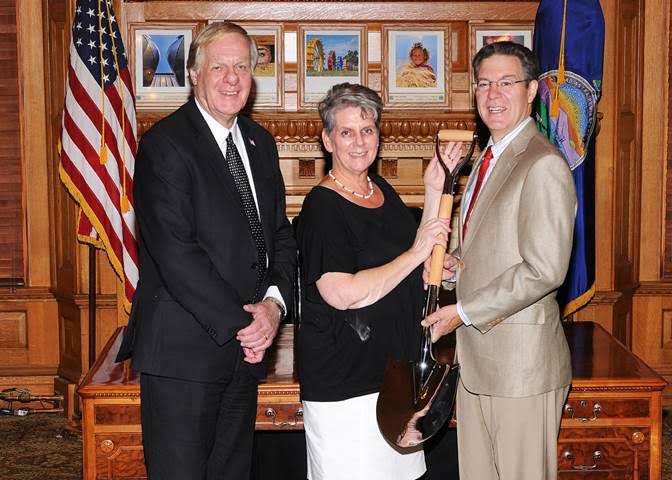
Interim Secretary of Commerce Nick Jordan, Susan Neupoth Cadoret, Acting Director of the Business & Community Development Division of the Kansas Department of Commerce, and Kansas Governor Sam Brownback, with the Silver Shovel Award received from Area Development Magazine in recognition of economic development wins in the State of Kansas.
KDC
TOPEKA–The Kansas Department of Commerce is pleased to announce that the agency has been recognized by Area Development magazine with one of its 2017 Silver Shovel awards. The Silver Shovel award honors state economic development agencies that drive significant job creation through innovative policies, infrastructure improvements, processes, and promotions that attract new employers and investments in new and expanded facilities.
The Silver Shovel awards are presented annually to states that have achieved significant success in terms of job creation and economic impact.
For this year’s award, the Kansas Department of Commerce was recognized for the scope and breadth of its Top 10 Projects which resulted in significant job creation and investment within the state.
Based on the number of high-valued added jobs per capita, amount of investment, number of new facilities, and industry diversity of the 10 submitted projects, Kansas qualified for a Silver Shovel award in the “Fewer than 3 Million Population” category.
Economic development projects submitted to the magazine for consideration included:
Additionally, the Amazon projects in Edgerton and Kansas City were recognized by the magazine as e-commerce “Projects of the Year.”
“The states and communities receiving 2017 Shovel Awards have compiled impressive lists of new and expanded facilities,” says Geraldine Gambale, editor of Area Development. “As with many other states, Kansas’ win of a Silver Shovel was in part due to jobs being created by Amazon.com fulfillment centers. It’s strong aerospace/aircraft and logistics/distribution industries also contributed to the state’s Silver Shovel win.”
A report on the 2017 Shovel Award winners is published in the Q2/2017 issue of Area Development and posted online at www.areadevelopment.com/shovels.
Kansas has been previously honored by the magazine, having received a Gold Shovel award in 2013 and Silver Shovel awards in 2006–2008, 2010–2012, and 2014–2016.
As Congress works to make improvements to our health care system, we should make certain we continue to prioritize medical research and its ability to save lives tomorrow through today’s investments. The National Institutes of Health (NIH) plays a critical role nationwide in directing our medical research community.
I recently visited the NIH headquarters in Bethesda, Md., accompanied by NIH Director Dr. Francis Collins, several directors of NIH Institutes, University of Kansas Chancellor Douglas Girod and members of the KU Alzheimer’s Disease Center, to see firsthand the work being done by some of our nation’s leading physicians and scientists. After touring NIH’s facilities and discussing research progress on neurodegenerative diseases — specifically, Alzheimer’s — it is clear, now more than ever, that sustained funding for the NIH is essential for the next generation of Americans and will help lower health care costs in the future.
As a co-founder of the Senate NIH Caucus and champion of NIH funding, I’ve made it a priority to make certain Congress prioritizes funding to assist our nation’s medical researchers in reaching groundbreaking discoveries, including new treatments and cures for diseases to make our health care system more effective while lowering overall health care costs.
Federal NIH dollars support 3,000 universities, medical schools and research facilities across the country, which are developing cutting-edge treatments that will serve as a catalyst for more affordable care in the future. The importance of NIH funding is real: the medical breakthroughs yielded from NIH research will ensure future generations can live longer, healthier lives knowing that our nation’s doctors, scientists and health care providers have improved treatments and cures for costly diseases.
For example, KU researchers at the Alzheimer’s Disease Center are already contributing through their work on brain imaging, Alzheimer’s prevention, mitochondrial genetics and cellular metabolism. To accelerate this research, KU has joined in partnerships to expedite clinical trials and get to testing and development of potential treatments. These resources and partnerships — combined with the availability of the Hoglund Brain Imaging Center — create research opportunities unique to KU due to its NIH status and research capabilities.
According to a recent NIH report on Alzheimer’s, today there are more than 5 million Americans living with this disease and by 2050 that number could rise to as high as 16 million. Alzheimer’s and other dementia diseases cost $259 billion in 2017; by 2050, that number could explode to $1.1 trillion in total expenses. Furthermore, the report indicates that “in the last five years of life, total health care spending for people with dementia was more than a-quarter-million dollars per person.”
These predictions do not need to become our reality. These astronomical costs can be curbed if these diseases themselves are made treatable and curable.
We must address the costs of health care, not just who pays for health care, to put the United States’ health system on a sustainable financial path forward, including ways to lower costs while treating diseases like Alzheimer’s. If we find new ways to identify diseases early, create new and improved treatments and find cures that improve patients’ lives, it will ultimately lessen the cumulative burden on our health costs.
So many of us care for people who have been affected by serious illnesses. This unfortunate circumstance we share should make it easy to rally behind NIH in hopes of curing these diseases and improving the lives of those we love.
I appreciate the tireless efforts of NIH researchers and the enthusiastic approach they bring to their jobs each and every day. I will continue to work with the National Institutes of Health, NIH-accredited institutions in Kansas and congressional NIH advocates on both sides of the aisle to ensure medical research funding remains a top priority.
LENEXA – The U.S. Environmental Protection Agency (EPA) Region 7’s Air Program has awarded an additional $499,009 to the Air Pollution Control Program at the Kansas Department of Health and Environment (KDHE), in support of implementing the requirements of the Clean Air Act.
KDHE will use these funds to support air quality programs across the state. The Air Pollution Control Program includes National Ambient Air Quality Standards, like ozone, particulate matter and sulfur dioxide mitigation, and implementing and maintaining an ambient air monitoring program.
“Working with our states in partnership is how EPA will fulfill our ‘back to basics’ agenda. Providing this funding directly to the states, where the work on air quality is accomplished, allows us to make great strides forward in keeping the air we breathe clean,” said EPA Administrator Scott Pruitt.
PRATT – September 1 marks the opening of hunting seasons in Kansas, and the date is approaching fast. Once September gets here, the hunting season floodgates open with dove, teal, deer, greater prairie chicken, and snipe seasons opening in quick succession. And while September can’t get here quickly enough for most hunters, there is much to do before it does.
First, go to www.ksoutdoors.com where you can apply for Special Hunts, which offer limited hunter access to areas not normally open to hunting. The application deadline for hunts that occur in September and October is 9 a.m., August 14. The application deadline for hunts in November, December, January and February is 9 a.m., Sept. 25. More than 400 hunts are being offered through a lottery drawing, all of which ensure hunters enjoy high-quality hunting experiences.
While you’re at ksoutdoors.com buy all your licenses and permits. You can also download the 2017 Kansas Hunting and Furharvesting Regulation Summary and 2017 Kansas Fall Hunting Atlas. Printed versions of each will be available by Sept. 1 at all Kansas Department of Wildlife, Parks and Tourism offices and hundreds of licenses vendors statewide. You can also request mailed copies by calling (620) 672-5911.
Once you have our licenses and permits, it’s time for some pre-season preparation and practice. Of course all your gear needs to be collected and examined before the seasons open. And more importantly, get out and practice shooting. Not only will pre-season practice make you more proficient but it will also help ensure that shotguns, bows, and rifles are in safe operating condition.
The best part about preparation is that it’s almost as fun as actually hunting, and it amps up anticipation of coming seasons. They’ll be here before you know it, so get out and get ready now.
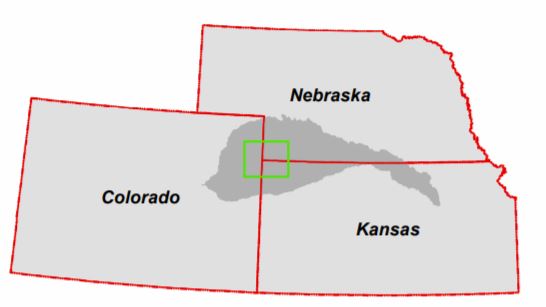
MANHATTAN — The Republican River Compact Administration (RRCA) will hold its 57th annual meeting at 10:30 a.m. MST (11:30 a.m. CST) on Tuesday, Aug. 22, 2017. The meeting will take place at the Burlington Community Center Conference Hall at 340 S. 14th St. in Burlington, Colorado.
The RRCA meeting will be hosted by the Colorado Division of Natural Resources, and will focus on water-related issues and activities, including compact compliance, within the Republican River basin in Kansas, Colorado and Nebraska.
Kansas, Colorado and Nebraska entered into the Republican River Compact in 1943 to provide for the equitable division of the basin’s waters, remove causes of potential controversy, promote interstate cooperation and joint action by the States and the United States in the efficient use of water and the control of destructive floods. The RRCA is composed of three commissioners representing Kansas, Colorado and Nebraska: Kansas Department of Agriculture, Division of Water Resources Chief Engineer David Barfield; Colorado State Engineer Kevin Rein; and Nebraska Department of Natural Resources Director Jeff Fassett.
In addition, RRCA will hold a work session to prepare for the annual meeting at 8:30 a.m. MST (9:30 a.m. CST) Tue., August 22, also in the Conference Hall of the Burlington Community Center. Both the work session and the annual meeting are open to the public.
Individuals who have questions regarding the meeting should contact KDA water management services program manager Chris Beightel at [email protected] or 785-564-6659 for more information.
PRATT – The National Shooting Sports Foundation has announced that August is National Shooting Sports Month, celebrating the passion millions of Americans have for target shooting. Recreational shooting is a safe and fun activity enjoyed by people of all ages, whether in competitive venues or target plinking just for fun. Target shooting is also great preparation for the coming hunting seasons.
To learn more about National Shooting Sports Month, go to www.shootingsportsmonth.org, where you’ll find listings of events and promotions by state, promotion type and location. You can also learn more about how to get involved in National Shooting Sports Month, whether you’re in retail, manufacturing, involved with a shooting range or organization or are a shooter.
To find shooting ranges in Kansas, go to www.ksoutdoors.com and click “Activities” then “Shooting Ranges”. There you’ll find a listing of all shooting ranges, which can be searched by county of location. Under “Archery” in the “Activities” drop-down menu, you’ll find a list of archery target ranges located on public land.
There are five Kansas Department of Wildlife, Parks and Tourism (KDWPT) shooting ranges operated by friends groups within state parks or on wildlife areas: Fancy Creek Range in Tuttle Creek State Park, Hillsdale Range and Training Facility in Hillsdale State Park, Cheney Shooting Range on Cheney Wildlife Area, Hollister Shooting Range on the Hollister Wildlife Area, Shawnee State Fishing Lake Hunter Education Range and a soon to open range at El Dorado State Park. KDWPT ranges offer handgun and rifle lanes, and some offer skeet and trap ranges. There are also archery target ranges on the following KDWPT areas: Byron Walker Wildlife Area, Clinton State Park, Eisenhower State Park, El Dorado State Park, Glen Elder State Park, Hillsdale State Park, Historic Lake Scott State Park, Lovewell State Park, Olathe Prairie Center, Prairie Dog State Park, Pratt Operations Office, Tuttle Creek State Park and Webster State Park.
Recreational shooting is a lifelong activity that not only gets you outdoors with family and friends but it also supports state wildlife agencies, which receive funding derived from excise taxes on firearms and ammunition through the Wildlife and Sport Fish Restoration (WSFR) program. WSFR provides match funds to state wildlife agencies to be used for fish and wildlife programs, as well as public shooting range development.
Make time to visit a shooting range near you this month and if you can, take a youngster or new shooter with you: #letsgoshooting.
TOPEKA–Registration is now open for the 2017 Kansas Energy Conference, which will be held Sept. 26 and 27 in Wichita. The 2017 conference is co-sponsored by the Kansas Department of Commerce and the Clean Energy Business Council.
WHAT: The Kansas Energy Conference will highlight the latest developments in the state’s renewable energy sector, focusing on how technology will accelerate the move to a clean energy economy and the role that Kansas can play to lead this transition. The day-and-half conference will feature three general sessions and several breakout sessions focusing on public sustainability programs, wind, solar, green efficiency programs, renewable energy storage, and oil and gas.
A new optional offering this year is a Pre-Conference Wind Farm Tour, enabling conference attendees to experience wind energy production up-close. For a nominal fee, attendees will participate in an engaging tour of the Kingman Wind Energy Center.
Another bonus with this year’s conference is a post-conference Distributed Generation Workshop, ideal for those who are unable to attend the full conference. This workshop will kick-off the Clean Energy Business Council’s “Around the State” initiative, which will include a total of four community workshops aimed at increasing exposure about market opportunities in renewable energy within Kansas. The workshop is free to conference attendees and available to others for a nominal cost.
WHEN: The conference will be held September 26, 8:30 a.m. – 4:45 p.m., and September 27, 8:00 a.m. – noon. Exhibits will be open from 9:45 a.m. – 6 p.m. on September 26 and 8:00 a.m. – noon on September 27. A reception is planned from 4:45 p.m. – 6:00 p.m. on September 26. The Pre-Conference Wind Farm Tour will be held on Monday, September 25, from Noon – 4:00 p.m., while the Post-Conference Distributed Generation Workshop will be held Wednesday, September 27, from noon – 5:00 p.m.
WHERE: DoubleTree by Hilton Wichita Airport, 2098 S. Airport Road, Wichita, Kansas.
REGISTRATION INFO: A complete itinerary and online registration is available through the Kansas Energy Conference web page at KansasCommerce.gov/EnergyConference. Early bird registration is available for $75 per person through August 23. Regular registration is $100 and is available through September 6.
A block of rooms has been reserved at the DoubleTree by Hilton Wichita Airport for September 12 and 13. For more information about reserving a room, please visit KansasCommerce.gov/EnergyConference, or call (316) 945-5272 and reference the Kansas Energy Conference. The cut-off date to reserve a room is August 29.
WASHINGTON, D.C. – KidsAndCars.org and The Center for Auto Safety filed suit in federal court today to compel the U.S. Department of Transportation (DOT) to implement a law passed by Congress in 2012, and issue a standard requiring a rear seat safety belt warning system.
The law, Moving Ahead for Progress in the 21st Century Act (MAP-21), required DOT to issue a final safety standard no later than October 2015, which would amend the Federal Motor Vehicle Safety Standard (FMVSS) to provide a safety belt reminder system for rear seats. No rule has yet been proposed, let alone issued in final form.
Nearly 1,000 unrestrained rear seat passengers were killed in 2015 alone. Children are particularly at risk. At least 343 children age 15 and under who were not using seat belts were killed in 2015, the last year for which data is available at NHTSA Traffic Safety Facts 2015 (DOT HS 812 384).
The National Highway Traffic Safety Administration (NHTSA) recognizes the value of seat belts, stating on its website that 13,941 lives were saved in 2015 by these safety devices. NHTSA has even created and distributed public service announcements stating that, “Parents need regular and salient reminders to consistently ensure seat belt compliance for themselves and their tween children” at DOT Traffic Safety Marketing website. Yet, when given the statutory directive to require that every new car has a “regular and salient reminder” (for example: an audible warning) about rear seat safety belts for passengers, NHTSA has failed to act.
“To have to bring a lawsuit in federal court to compel NHTSA to simply write a regulation required by law – one that is widely recognized as having significant lifesaving potential – is, to use a word, sad,” said Jason Levine, the new executive director of the Center for Auto Safety. “Instead of fulfilling its job as an expert safety agency on behalf of all consumers, NHTSA has spent five years hitting the snooze button. Hopefully, this action spurs a sense of urgency for something so noncontroversial.”
“The importance of seat belts in saving lives is indisputable. This is one area where the government, auto industry and safety groups completely agree. Everything possible should be done to ensure that all passengers are correctly restrained all the time, on every ride,” said Janette Fennell, KidsAndCars.org founder and president. “As the NHTSA safety campaign states, Never Give Up Until They Buckle Up, we too cannot give up until this law passed by Congress is implemented,” she added.
A recent report from the Insurance Institute for Highway Safety (IIHS) confirmed the need for such a warning system. IIHS found up to 28 percent of adults surveyed admitted not wearing their seat belt in the rear seat all the time and of those, 4 out of 5 say that when they take short trips or travel by taxi or ride-hailing service, they frequently do not wear a seat belt. The same report noted that unrestrained passengers in the rear seat were almost 8 times as likely to sustain a serious injury in a crash as restrained rear seat occupants at IIHS Rear Seat Belt Survey.
The complaint for declaratory and injunctive relief was brought in U.S. District Court for the District of Columbia and is titled Kids and Cars, Inc., and the Center for Auto Safety vs. Chao and NHTSA.
The organizations are being represented in the case by the Washington, D.C. public interest firm, Meyer Glitzenstein & Eubanks.
TOPEKA —Kansas Insurance Department officials said Tuesday that initial rate revision information for the 2018 federal individual health insurance marketplace will be published on Sept. 1 following an announced delay on rate filings last week from the federal government.
The United States Department of Health and Human Services released guidance on Aug. 10 saying that the final rate submission date for all states has been pushed back to Sept. 6. Because of the current uncertainty of the federal guidelines for the marketplace, Ken Selzer, CPA, Kansas Commissioner of Insurance, said he requested the new Kansas publication date to keep the public from being confused.
“With all the uncertainty in Washington, D.C., regarding the cost share reduction reimbursement for insurance companies, we think it is best for the rates not to be published prematurely,” Commissioner Selzer said.
Commissioner Selzer did say that he expected the three companies that indicated their 2018 participation on the Kansas marketplace — Medica, Blue Cross and Blue Shield of Kansas, and Sunflower State Health Plan (a subsidiary of Centene Corp.) — will continue to offer plans for 2018.
Approximately five percent of Kansans purchase individual health insurance plans. In 2017, there were 98,780 Kansans who purchased plans on the federal exchange.
TOPEKA–On Aug. 21, a total solar eclipse will occur as the moon passes directly in front of the sun, darkening the sky. With increased traffic anticipated across the state as people travel to view the eclipse, the Kansas Department of Transportation, Kansas Turnpike Authority, and Kansas Highway Patrol advise travelers to plan ahead and enjoy the eclipse safely.
According to the U.S. Department of Transportation, approximately 200 million people live within driving distance of the eclipse’s path of totality. While only the northeast corner of the state will be in the path of totality for the solar eclipse, the rest of Kansas will still experience part of the astronomical event.
With an increase in traffic and travel time expected, travelers should be patient, avoid distractions, and practice safe driving habits.
“We understand the excitement around the solar eclipse, and we encourage Kansans and our travelers to enjoy this rare opportunity. We do, however, want you to remain safe as you take the opportunity to witness this occurrence,” said Lt. Adam Winters, KHP public information officer.
Travelers across the state are encouraged to follow these tips to drive safely on the day of the eclipse:
Allow plenty of travel time to reach a safe place for viewing, as roads may be congested due to increased traffic.
Do not take photos or wear the eclipse sunglasses when driving.
Do not pull over to the side of the highway to view the solar eclipse. Find a location off the highway and right-of-way to observe and/or take photos.
If you are driving during the eclipse, turn on your headlights and do not rely on your automatic headlights.
Expect the unexpected: watch out for other drivers and pedestrians.
Plan ahead for fuel needs and always remember to keep your gas tank full during long trips.
It is also important to be prepared in case of emergencies and create a travel safety kit. Some items to consider for a travel kit may include:
Non-perishable foods
Water
A first-aid kit and any prescription medications needed
Motor oil
Antifreeze
Fuel
Jumper cables
Brake fluid
Windshield washer fluid
A map
Check the weather and plan accordingly – make sure to dress properly and be fully prepared for potential weather incidents when driving long distances. For information on road conditions, check out www.kandrive.org or call 5-1-1 in Kansas or 1-866-511-KDOT (5368) in the U.
TOPEKA – Governor Sam Brownback today announced that Melika Willoughby will step down from her post as communications director. Willoughby has served on the Governor’s senior staff since November of 2016.
“I am deeply grateful for Melika’s service to the state of Kansas,” said Governor Brownback. “She has been a tireless warrior for conservative principles and an advocate for making Kansas the best state in America to raise a family and grow a business. I trust that she will accomplish great things in the years to come.”
Willoughby joined the Governor’s Office in 2014 as the deputy communications director. She holds a bachelor of arts in Politics from Hillsdale College. Willoughby is a graduate of the Eisenhower Women’s Leadership Series and was named a 2016 Publius Fellow through the Claremont Institute: Recovering the American Idea.
“Governor Brownback’s commitment to expanding the freedoms of our citizens, empowering struggling Kansans through the dignity of work, and defending vulnerable unborn lives is peerless,” said Willoughby. “It’s been a distinct honor to serve on his staff in defense of these principles that make Kansas great.”
Willoughby will join Forge Leadership Network as Vice President of Communications and Strategic Development.
Willoughby will leave the Governor’s Office on August 18. Rachel Whitten will fill the role of spokesperson through the remainder of Governor Brownback’s time in office. Whitten will retain her role as Director of Public Relations at the Kansas Department of Revenue during this time, and will remain at KDOR after her service in the Governor’s Office. Media inquiries should continue being sent to [email protected].
WICHITA–The Kansas Leadership Center (KLC) is offering up to 1,200 spots for up to 35 organizations. Each grant is valued at up to $50,000 worth of leadership training and support in 2018 and covers 100 percent tuition for any of the three core leadership trainings in 2018.
You Lead Now – a 2.5-day introduction to KLC’s leadership framework centered on your own challenge to help you lead more effectively.
Lead for Change – a 2-part, 7-day extensive leadership training designed to help you create lasting culture change within your organization or community, while providing you 1:1 support from a KLC coach.
Equip to Lead – a 2-day training designed to help you teach, facilitate and incorporate leadership ideas into any context.
The Kansas Leadership Center (KLC) is a non-profit organization committed to fostering leadership for stronger, healthier and more prosperous Kansas communities. We are generously funded and supported by a core operating grant from the Kansas Health Foundation. This allows us to provide first-class leadership training opportunities to organizations and civic entities interested in having more people skilled in exercising leadership.
Since 2007, KLC has trained more than 7,500 from all over the world. Although our roots in our home state are deep, our reach spreads beyond state borders. People visit us from as far away as Australia, India, Saudi Arabia and Ireland along with countless states across America.
Since launching the Leadership Transformation Grant, KLC has awarded grants to around 100 Kansas organizations.
LENEXA – The U.S. Environmental Protection Agency (EPA) Region 7 has awarded approximately $2.9 million to the Kansas Department of Health and Environment (KDHE) to address nonpoint source pollution.
EPA will support implementation of activities intended to eliminate or prevent Kansas water quality problems due to the discharge of pollutants from nonpoint sources. While the program provides statewide coverage, funding will focus on activities that address priority watersheds with water quality problems.
“Water quality is important. Our drinking water supplies, recreation, fisheries, and wildlife depend on clean water. Nonpoint source pollution is the leading cause of water quality problems. These funds will help ensure that the states and EPA, working in partnership, make clean water a priority,” stated EPA Administrator Scott Pruitt.
This $2.9 million in funding is a portion of an approximately $8 million grant, which is being funded over three years. This award provides partial funding; full funding may be provided at a later date.
Nonpoint source (NPS) pollution generally results from land runoff, precipitation, atmospheric deposition, drainage, seepage, or hydrologic modification. NPS pollution, unlike pollution from industrial and sewage treatment plants, comes from many diffuse sources. NPS pollution is caused by water moving over and through the ground. As the runoff moves, it picks up and carries away natural and human-made pollutants, finally depositing them into lakes, rivers, wetlands, coastal waters, and groundwater. NPS pollution can range from excess fertilizers, herbicides, and insecticides to salt, oil, animal and pet waste, and grease in agricultural, residential, and urban areas.